Author Archives: vinaire

I am originally from India. I am settled in United States since 1969. I love mathematics, philosophy and clarity in thinking.

The Electromagnetic Spectrum

The electromagnetic (EM) spectrum is part of the spectrum of substance. (see The Spectrum of Substance). The EM spectrum is made up of the following layers of electromagnetic radiation:

  1. Gamma radiation
  2. X-ray radiation
  3. Ultraviolet radiation
  4. Visible radiation
  5. Infrared radiation
  6. Terahertz radiation
  7. Microwave radiation
  8. Radio waves

Each layer is a continuum of substance. It consists of a range of frequencies. All layers may be arranged on a continuous scale of frequencies. The frequency of EM radiation has certain stability. Any effort to change the frequency activates a restoring force similar to the inertia of matter. Thus, EM radiation appears to maintain its frequency throughout the spectrum.

EM radiation resists its frequency from being changed. This is a form of inertia.

The gamma rays are seen to be emitted by the nucleus, and X-rays from inner electrons. This EM spectrum may be seen to be emitted from the electronic region of the atom. Thus the configuration of the atom exists in equilibrium with the EM spectrum.

The EM spectrum exists in equilibrium with the atom.

Maxwell’s electromagnetic cycles may best be compared to Newton’s corpuscles. Each cycle is infinitely divisible like a corpuscle because unit of time is infinitely divisible. The higher is the “frequency” of light, the denser is the concentration of cycles (corpuscles) that make up the radiation. Therefore, the frequency indicates the density of the radiation. According to The Universal Frame of Reference, the speed of light shall decrease with increase in frequency, but this occurs in infinitely small gradients in the electromagnetic spectrum.

EM radiation forms a continuum in space whose density increases (speed decreases) on a very small gradient as frequency increases.

Common to EM spectrum is the concept of photon. The photon is an energy particle (see Particle, Continuum and Atom). This means that photon is the amount of radiation required in its interaction with the electronic region. This amount is proportional to the frequency (density) of radiation.

A photon is an energy particle of radiation, meaning it is the amount of radiation required in its interaction with the electronic region

Per the relationships, E = hf, and E = mc2, each cycle has energy equal to the Planck’s constant (h), and density equal to the constant (h/c2). As we move up the spectrum, the frequency increases and both wavelength and period shrink together. The radiation (field) becomes increasingly denser and more focused. This is perceived as quantization (condensation of energy into mass) at higher frequencies.

EM radiation becomes denser and more penetrating as frequency increases.

The constants described above ensure the continuity of different regions of the field that are at different frequencies. Therefore, these regions are bounded by smooth gradients of frequency. These gradients manifest as tension (charge) or force. These forces then become part of the field. We recognize these forces as gravitational, electromagnetic, nuclear, etc. These forces differ in their nature depending on the sharpness of the gradient as well as on their relative position in the spectrum.

The gravitational, electromagnetic, and nuclear forces exists in the continuum (field) because of frequency or density gradients.

As forces become stronger with frequency, inertia also increases to balance them. If forces are represented by frequency gradient (increased oscillations relative to itself) then inertia is represented by quantization (increased condensation). Basic inertia appears as permeability and permittivity. It balances the conversion between electric (kinetic and linear) and magnetic (potential and rotational) aspects of a cycle. This shows up in the constant rate of propagation of the electromagnetic disturbance within the field.

The forces within the field are balanced by quantization (inertia).

With increasing frequency gradient the increased quantization seems to develop into a dense structure of mass. This structure appears to be made up of high frequency of infinitesimal cycles. The quantization into mass starts out like “eddies in flow”. This shows the primary characteristic of mass to be rotational. We may identify these “eddies” as the multitudes of quantum particles.

Quantum particles arise out of the condensation of EM radiation.

The rotational nature of mass tends to pin it down and reduce its linear motion. This also increases inertia (density). As the density of quantum particles increases their intrinsic motion decreases (see The Universal Frame of Reference).

Rotation is the characteristics that accompanies increasing condensation into mass, and inertia.

The application of external force invokes inertia, and inertia seems to add to the density of the substance, thus decreasing its intrinsic linear motion. This may describe the conservation of force of Faraday. This appears to contradict Newton’s laws of motion, which describe force in terms of acceleration of an object. This contradiction is resolved when we notice that the “acceleration” in terms of distance cannot be observed when there is no other object around. A continually “accelerated” object simply feels as if it has mass added to it.

External force converts into internal mass or density.

This brings up the difference in the perception of absolute motion from relative motion. This topic is taken up in the next chapter.

.
The Wave-Particle Duality

According to Wikipedia:

Wave–particle duality is the concept in quantum mechanics that every particle or quantum entity may be described as either a particle or a wave. It expresses the inability of the classical concepts “particle” or “wave” to fully describe the behavior of quantum-scale objects.

A quantum entity is an “energy particle”. This means it is simply the energy involved in an interaction at the atomic level. Examples are photon and electron. Quantum physics then assumes that photon and electron are indivisible particles (see Feynman on Quantum Behavior).

Light cannot be a wave because it is not a disturbance in stationary medium, such as, aether. Nor can it be a particle because it cannot be distinguished in space by a center of mass. As described earlier,

Light is a continuum in space that has a certain density represented by its “frequency”.

.

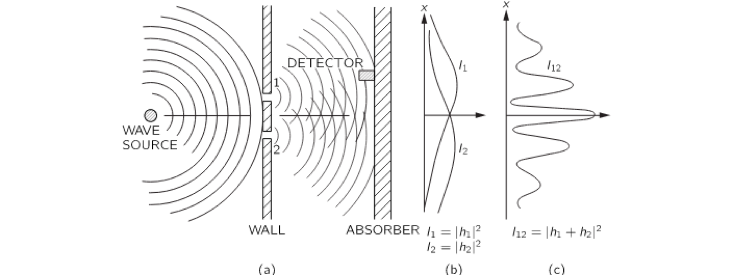
Double-slit Experiment

According to Wikipedia:

In modern physics, the double-slit experiment is a demonstration that light and matter can display characteristics of both classically defined waves and particles…

In a double-slit experiment with water waves an interference pattern is observed.

A similar pattern is observed when this experiment is repeated with light instead of water waves. The feature, which is common to both of these instances, is the infinite divisibility of the “flow” arriving at the two slits. In case of the water wave, the disturbance on the surface of water is infinitely divisible being continuous. In the case of light, light itself is an infinitely divisible continuum.

The infinite divisibility of the flow arriving at the double-slit produces the interference phenomenon.

Newton’s corpuscular theory of light considered corpuscles to be infinitely divisible. Therefore, it should never have been dropped in favor of a wave-theory of light that postulated unobserved aether.

.

Assumption in Physics

Physics assumes that light and electron flow arriving at the double-slits are made up of indivisible particles that go through one slit or the other (see Feynman on Quantum Behavior). Quantum mechanics justifies it through the idea of probability but there are no indivisible particles in the first place. Photons and electrons are “energy particles” arising from interactions. They are not indivisible “lumps” in space. The idea of particles is generated as light or electron interacts with the detector in definite amounts to generate clicks.

The wave-particle confusion exists in physics because “energy particles” are thought of as indivisible particles in space.

This is explained in Particle, Continuum and Atom.

.

Quantum Mechanics

Quantum mechanics came about because of the discreteness of energy interactions at the subatomic level.

A material particle also implies discreteness of energy interactions, but, in addition, it implies discreteness of mass in space because of center of mass property. This similarity of energy and mass discreteness does not carry forward from material to subatomic area.

A quantum particle does not imply indivisibility in space.

.

System of Co-ordinates

We always observe the trajectory of a moving body from a viewpoint. Einstein identifies that viewpoint with a material body, such as, a platform or a train. In other words, we can observe the trajectory of a moving body either from the platform or from the train.

This identification of viewpoint with a material body gives us a co-ordinate system. Space is then defined as an extension of this reference body. It expands and contracts just like the reference body. The reference coordinate system is as rigid as the reference body. In other words, it endures in time at the same rate as the reference body. Therefore, the space and time are unique to the reference co-ordinate system.

.

The Principle of Relativity

Einstein states his principle of relativity (in the restricted sense) as follows:

“If, relative to K, K’ is a uniformly moving co-ordinate system devoid of rotation, then natural phenomena run their course with respect to K’ according to exactly the same general laws as with respect to K.”

The theory of special relativity (SR) looks at the uniform motion of K’ with respect to K. The magnitude of this uniform motion may vary.  Since there is no external force causing different uniform motions, these motions must be a characteristic of the co-ordinate system. According to The Logic of Motion these uniform motions are an expression of inertia (mass concentration) associated with the co-ordinate system.

This logic generalizes the classical laws, incorporated in the co-ordinate system, to also include the phenomena of optics and electrodynamics.

This logic, however, was not considered by Einstein. In its place Einstein proposed the principle of relativity. See The Principle of Relativity (In the Restricted Sense).

.

Co-ordinate System at Rest

According to The Logic of Motion, a co-ordinate system of infinite inertia may be regarded as being absolutely at rest. We may call it K0 and choose it as our body of reference. All motion relative to K0 will then be absolute.

Einstein argues that since earth is in motion, it is obviously not K0. Therefore, its motion should play a part in the general laws of nature. But the motion of earth has revealed no physical non-equivalence of different directions. Einstein, therefore, concludes that there is no co-ordinate system that can be absolutely at rest.

The weakness of this argument is that the relative motion of earth is being confused with its absolute motion. The high mass concentration of earth shows its absolute motion is close to zero. It is 4 times denser than the sun. Denser than earth would be a neutron star or a black hole. Their absolute motion shall be still closer to zero.

Einstein’s conclusion that there is no co-ordinate system at absolute rest may be in error.

The higher is the mass concentration, the closer is the co-ordinate system to being at rest.

.

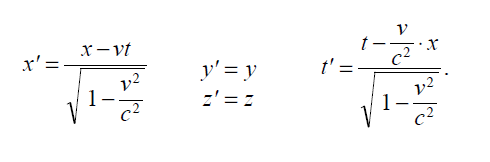
Lorentz Transformations

Lorentz transformation looks at the characteristics of space and time from the viewpoint of the invariant speed of light. The invariance of the speed of light means that it is absolute. It does not depend on anything external to light. It is an intrinsic property.

.

Light as Substance

If light has intrinsic properties, then light may be considered a substance. Newton thought so because he looked at light as made up of corpuscles. Unlike an atom a corpuscle is infinitely divisible. See Corpuscular theory of light – Wikipedia. An “electromagnetic cycle” may be considered a corpuscle. It is infinitely divisible because time can be considered to be infinitely divisible.

The higher is the frequency of light, the greater is the concentration of “electromagnetic cycles”, or corpuscles. These corpuscles cannot be treated as point particles because they do not have center of mass like material particles do. They have to treated as a fluid-like continuum. Therefore, higher concentration of corpuscles would mean, higher density of the fluid-like continuum of light.

We may conclude that light is a continuum with certain density. Its density is represented by a “frequency”. This density indicates that light has mass, but this mass is not structured as it is in matter. This mass displays wave characteristics as it flows at the speed of light.

.

Space and Time

Space may be considered to be a characteristic of substance. Descartes thought that space is defined by the extents of substance. This is obvious for matter. But the space, which is empty of matter, may actually be defined by the extents of light. Here light refers to the whole electromagnetic spectrum.

Similarly, time may be defined by the duration of substance. Matter seems to have almost infinite duration because it endures forever at any location in space. But the duration of light seems to be very small, because it whizzes past any location in space at great speed. The duration of a substance and its absolute speed appear to be inverse of each other. See The Logic of Motion.

.

Speed in Lorentz Equation

The above considerations present motion in absolute terms. They are very likely to provide interesting interpretation to Lorentz transformations and also to Einstein’s theory of special relativity.

The relative motion that we measure as the speed of heavenly bodies and the speed of objects on earth, is not the same thing as the absolute motion that we measure as inverse of density. Therefore, we cannot compare a relative speed to the absolute motion of light because they do not have the same basis. They are like apples and oranges. The “v/c” ratio in Lorentz transform have no consistent basis mathematically.  

The implications of this shall be taken up in the next chapter.

.

The Structure of Mind

Looking at the long history of the universe we observe that there is a continual evolution in terms of increasing order. Underlying this evolution is a power. This same power underlies the mind.

The purpose of the mind, therefore, is to evolve the organism and the environment toward greater order. The primary function of the mind is to coordinate the activities of the body and the environment so they evolve. When there are anomalies, the mind resolves them so there is greater order in terms of consistency, harmony and continuity.

.

The Mental Matrix

Mind is not the same thing as brain. The brain is part of the body’s hardware; mind is the body’s software. To understand the structure of the mind we need to first understand how it operates.

The mind operates by drawing on experience. This experience is derived from the perceptions received continually by the mind. In a normal functioning mind, the perceptions are received through the senses of touch, sight, hearing, taste and smell. These perceptions break down into fine data elements, which are then arranged in a matrix type structure.

A matrix is made up of nodes where each node is in some relationship with every other node. In the mental matrix the nodes are made up of data elements that are related to each other by the properties perceived. For example, in an animal mind, these data elements may be related by the properties of how safe and edible the things perceived are.

The human mind is more complex than the animal mind. The perceptions from the environment get refined rapidly as patterns of data elements. For example, the property “red” may be expressed as part of the color scale. This makes the matrix of the human mind extremely refined and complex. Errors creep in only when perceptions do not get refined and assimilated into this mental matrix.

The mind is a matrix made up of elements derived from the perception of the environment.

.

Earlier Models

The present work proposes this “matrix” model for the mind. Looking at earlier models, we find Freud’s model of conscious and unconscious mind proposed in 1890s, and Hubbard’s model of analytical and reactive mind proposed later in 1950s.

In the matrix model, the greater is the refinement of the data elements and the relationships among them, the higher is the consciousness. Thus human consciousness is much higher than the consciousness in animals. When perceptions from the environment are not refined into patterns of data elements they are just lodged into the mental matrix as “unassimilated nodes”. The person is not conscious of such unassimilated experiences. This describes the concept of “unconscious mind” proposed by Freud.

The “unconscious mind” of Freud is made up of “unassimilated nodes” in the mental matrix.

In the matrix model, thinking occurs as the data elements associate with each other such that continuity, harmony and consistency are maintained at all times throughout the mental matrix. This forms the faculty of the mind to imagine and make projections in an analytical manner. In a refined and well-assimilated matrix the thinking is rational, or analytical. However, as more “unassimilated nodes” are activated in the mental matrix the thinking becomes irrational and reactive. This describes the concept of “reactive mind” proposed by Hubbard.

The “reactive mind” of Hubbard is also made up of “unassimilated nodes” in the mental matrix.

.

Memory

The models of Freud and Hubbard imply that perceptions are stored “as-is” in the mind. However, the “matrix” model describes the storage of perceptions as patterns of data elements well-assimilated within the mental matrix. Since same data elements may be utilized many times in different patterns, the “matrix” model provides a more efficient way of storing perceptions in the mind. A “memory” is a pattern of data elements that is activated by attention. Memory is clear and precise when its pattern is made up of refined and well-assimilated elements. It would be difficult to recall a memory if it contains “unassimilated nodes”.

A “memory” is a pattern of data elements that is activated by attention.

.

Summary

The matrix arrangement ensures that the data elements can be combined in infinity of unique ways to represent all possible experience. These combinations could be the formation of past memories upon recall. Or, they can be the formation of new visualizations needed to sort out anomalies created by “unassimilated nodes”.

The matrix arrangement provides a very efficient organization and storage of experience to support the activities of the mind.

.