Author Archives: vinaire

I am originally from India. I am settled in United States since 1969. I love mathematics, philosophy and clarity in thinking.

Mass, Energy and Time

Substance has the characteristic of mass that is directly related to its substantiality. In fact, the substantiality may be expressed in terms of the density of mass. The mass density may be plotted on a continuous scale meaning that it is continuous in value. It is not an integer multiple of some ultimate amount that is indivisible.

Mass is the measure of substantiality of substance.

The intrinsic motion of substance is expressed as its energy. The agitation of gas molecules is an example of intrinsic motion. Another example is the Brownian motion. The intrinsic motion appears naturally between two substances of different mass densities. An example is the extremely rapid motion of electrons around the nucleus of an atom. Another example is the speed of light relative to earth. These motions are intrinsic. There are no external force generating such motion. 

Energy is the measure of intrinsic motion of substance.

.

Substantiality and Motion

Matter is highly substantial, and it endures at any location for a long time. Its intrinsic motion, therefore, is very small. Light, on the other hand has little substantiality, and it barely endures at any location. Its intrinsic motion, therefore, is very high. This sums up to the following observation.
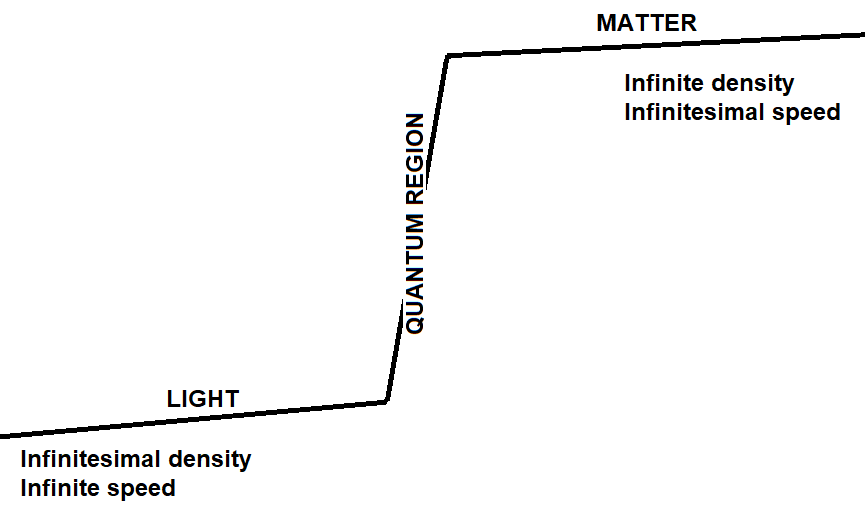
The higher is the substantiality (mass density) of substance, the lower is its intrinsic motion (energy).

In other words, higher is its intrinsic motion, lower is the substantiality of substance. This means that near infinite speed of light must be accompanied by infinitesimal substantiality. Therefore, light must have insignificant but finite mass density.

Einstein’s assertion that light has no mass may be interpreted as follows:

  1. The mass density of light is insignificant and negligible compared to the mass density of matter, or
  2. Light does not have the property of “center of mass”. 

.

Mass and energy

Per the discussion above, intrinsic motion is inverse of mass density. In other words, energy is inversely related to mass density. This seems to contradict Einstein’s famous equation, E = mc2, which seems to relate energy directly to mass.

This contradiction, however, resolves when we look at this equation in terms of unit conversion. Using this equation, we can express mass in energy units, and energy in mass units. It shows that infinitesimal amount of mass density is equivalent to a significant amount of energy because of the large multiplier c2.

Therefore, when mass expands into energy, the amount of that energy is significantly large, and when energy condenses into mass, the amount of that mass is insignificantly small.

.

Time

The discussion above also provides us with a new understanding of time as the “duration of substance.” The higher is the mass density of substance, the longer is the time for which it endures at any location, and the lower is its intrinsic motion. Therefore,

Time is directly proportional to mass density, and inversely proportional to intrinsic motion.

Time has the intrinsic nature of duration that depends on how dense substance is at any location. The fourth dimension at any location, therefore, is mass density.

Each location has three dimensions of space and a fourth dimension of mass density (duration).

Locations of infinite mass density shall have infinite duration and they shall act as points of absolute rest. Thus, points of infinite density shall act as reference points for surrounding motion. That is why we find black holes at the center of galaxies.

.

Particle, Continuum and Atom (old)

Particle and continuum are the subcategories of substance (see Matter, Void and Space). Their extents are defined by space. Both are absent in the void. Current physics has no proper definitions for them.

.

Material Particle & Continuum

The idea of particle is a “distinct entity”. Material objects exist as discrete entities in space. A material object  may be broken down into smaller parts, each of which exist as distinct entities. These are particles of matter. The smallest particle of matter is an atom. 

A classical atom is considered to be made up of substance that is distributed uniformly throughout the atom. The configuration of an atom is rigid. The substance of the atom is identified as mass. A rigid arrangement of atoms then constitutes a solid material body. This rigidity produces a “center of mass” such that forces acting on the body may be reduced to a single resultant force acting on that center. Moments due to the forces may also be reduced to a single resultant torque at that center. This center is called the “center of mass”. It allows a rigid material body to be treated as a “point particle”. 

A material particle is distinguished from another material particle in space because of its center of mass. Billiard balls striking each other on a table are material particles. The dust particle floating in a beam of sunlight across the room are also such material particles. Each have a center of mass.

A MATERIAL PARTICLE in space is defined by its center of mass.

If there is no center of mass, then a material particle cannot be distinguished from its surrounding. There exists simply a continuum of substance. Light filling the space is such continuum of substance.

A CONTINUUM of substance has mass density but no center of mass.

An atom of matter may be considered indivisible because it loses its characteristics when divided further. But light is infinitely divisible because it never loses its characteristics when divided.

.

The Energy Particle

The “energy particle” is defined by an interaction. It refers to the amount of the substance involved in an interaction. It is not the amount existing in space by itself. A quantum of light is the amount of light involved in an interaction within the detector.  A quantum of light is different for different interactions. This is similar to a chemical agent reacting in different amounts in different chemical reactions. 

An ENERGY PARTICLE is the amount of substance participating in an interaction.

A light quantum is created out of a continuum of light. Such energy particle is always discrete because the interactions can be counted. This is what happens in the photoelectric phenomenon. Discrete interactions do not necessarily imply that light is discrete and indivisible in space. Light is a continuum and infinitely divisible in space though its interactions are discrete and “indivisible”.

A quantum is an energy particle. It has a specific value determined from how it interacts, but that value is part of a continuum.

A QUANTUM is a discrete amount drawn from a continuum by an interaction at the atomic level.

.

The Atom 

The atom is a material particle. It has a center of mass. It also has an intrinsic motion as observed indirectly in Brownian motion. The kinetic theory of gases is built on the intrinsic motion of atoms and molecules.

The atom itself consists a nucleus at the center surrounded by an electronic region. The nucleus is only 0.01% of the atom. The rest 99.99% of the atom is the electronic region. The nucleus is extremely dense and almost stationary compared to the electronic region that is 1840 times less dense and moving extremely rapidly. The whole atom is like a flat whirlpool much like a galaxy. It is incorrect to think of atom as being spherical because of the motion inside it. Even the nucleus itself, when magnified, may appear like a flat whirlpool.

The electronic region does not contain center of mass. It is, therefore, a fast-moving continuum in space. There are no orbits of electron particles. There are simply different interactions at different distances from the nucleus. The electronic region seems to decrease in density and increase in motion as it spreads out from the nucleus.

Similarly, the nuclear region appears to increase in density toward the center of the atomic whirlpool. The different nuclear particles are just different interactions within the nucleus.

There is, obviously, a large density gradient between the electronic and nuclear regions. It is possible that this large gradient of density appears as “charge”. More on this later.

The ATOM is a flat whirlpool of a fast-moving continuum of electrons that is thinning in density and increasing in speed as it spreads out from the nucleus.

.

The Belief in Physics

Newton’s corpuscular theory of light considered corpuscles of light to be infinitely divisible. In other words, Newton looked at light as a continuum from which any amount could be drawn for energy interaction.

But there seems to be an assumption in physics that energy particles cannot form a continuum in space, that they must have discrete and indivisible existence. This belief goes back to atomism, which considers atoms to be indivisible.

.

Matter, Void and Space (old)

NOTE (06/04/24): Today I shall replace the term “gravity” used in this essay by the term “thought.” I shall also replace the expression “density or mass” by the term “consistency.”

In this essay, we define some common concepts from the viewpoint of physics. The most common concept is MATTER.  Matter is something that can be sensed. The opposite of matter is VOID that cannot be sensed. Matter and void, thus, form a duality.

MATTER – VOID

But there is SPACE that is neither matter nor void. Space is not void because we can sense it. Space is not matter because it still exists as a perfect vacuum when all matter is removed. Space, thus, forms a region between matter and void.

MATTER – SPACE – VOID

In other words, space consists of things that can be sensed but which are not matter. We identify such things as light and gravity. The objective observation is:

Matter is that which is substantial enough to be sensed.

Space is absence of matter, but it still consists of light and gravity that can be sensed.

Void is the absence of anything that can be sensed.

.

Substance

We use the word SUBSTANCE as a broad category for things that are physically substantial enough to be sensed. Matter, light and gravity fall under this category of substance. Traditionally, matter has been viewed as a substance, but not light and gravity. This has been a source of much confusion.

Newton did view light as substance but it was seriously questioned by the wave theory. Faraday did view force (hence gravity) as substance, but it was overruled by Maxwell. Today we are not sure if light and gravity are particles or wave.

What sets matter apart from light and gravity is its property of center of mass. Newton’s mechanics is based on this property. Light and gravity are also substance but they do not have centers of mass. The objective definitions are:

SUBSTANCE is anything that is substantial enough to be sensed.

MATTER is a substance that has the property of center of mass.

LIGHT and GRAVITY are substances that do not have the property of center of mass.

VOID is that which cannot be sensed.

.

Force and Density

A substance is substantial because it can be sensed. That sense of substantiality may be described by the concept of force. And the degree of substantiality may be described by the concept of density or mass. The objective definitions are:

FORCE is the sense of substantiality of substance.

DENSITY or MASS is the degree of substantiality of substance.

.

Space

Space consists of matter, light and gravity. In other words, space consists of substance. Descartes had argued that space is “the sense of extension”. This was explained by Einstein in “Relativity and the Problem of Space” as follows:

Descartes argued somewhat on these lines: space is identical with extension, but extension is connected with bodies; thus there is no space without bodies and hence no empty space. 

Matter has space which it occupies. Similarly, light and gravity also have spaces that they occupy. Space is sensed only because of the substance that occupies it. When there is no substance, there is no space. Beyond space is the void that cannot be sensed. The objective definition is:

SPACE is the property of extension of substance (matter, light and gravity). 

.

Current Physics

The above definitions differ from those used in current physics as follows.

(1) Current physics confines itself to matter, light (electromagnetic radiation) and gravity but it does not categorize them as substance. Therefore, there is no general category in current physics for things that can be physically sensed.

(2) Current physics considers elementary quantum particles to be the ultimate constituents of matter, light and gravity, but it does not look at them as substance either. Therefore, physics goes deep into abstraction where boundaries are blurred between things that can be sensed and those that are merely imagined.

(3) Current physics does not differentiate between space and void because it does not look at space as the extension of things that can be sensed. It treats space as an abstract continuum that can curve and bend like rigid matter. 

(4) In short, current physics reduces matter to the idea of discrete particles, and void to the idea of a malleable continuum. The duality of matter and void is no longer as distinct as it once used to be. 

This brings up the lack of clear definition in current physics for the words particle and continuum. This is taken up in the next chapter.

.

Mind & Objectivity

When the mind operates from the viewpoint of emptiness, it sees things as they are. This is the objective reality. We perceive objective reality directly through our physical perceptions of sight, hearing, touch, taste and smell. The mind then assimilates these perceptions ensuring consistency, harmony and continuity. The enduring aspects of this assimilation, based on generations of experience, become wisdom or common sense.

The degree of mental assimilation depends on consistency, harmony and continuity.

.

Objectivity

The objectivity depends on seeing things as they are. The word objective is derived from object that has the sense of “something perceived”. Objective reality is not only made tangible through the physical perceptions, but also made logically consistent by the mental perception. The objective reality is that which has been tested and verified and cannot be argued with. It is the same for all people when all known inconsistencies have been resolved.

The subjectivity is different for different people and it may be argued with. The word subjective is derived from subject that has the sense of “open to inspection”. Subjective reality depends on individual viewpoint. It is characterized by inconsistencies among viewpoints that still need to be resolved. As inconsistencies are resolved the subjective reality becomes increasingly objective.

There is, however, a misconception that all perceptions processed through the mind are subjective. The fact is that perceptions are assimilated to different degrees in the mind. Completely assimilated perceptions are objective. As the degree of assimilation reduces, so does the objectivity. The conclusion then become increasingly subjective.

Objectivity depends on the assimilation of perceptions in the mind. To the degree perceptions are not assimilated there is subjectivity.

.

Mind & Emptiness

The mind deals with phenomena. A phenomenon is anything that you become aware of.  A phenomenon can be physical, mental, spiritual, real or imaginary. To assess the nature of a phenomenon completely you must view it from a point beyond phenomena.

.

Emptiness

That viewpoint which is beyond all phenomena is the viewpoint of emptiness. The Heart Sutra in Buddhism defines EMPTINESS as no Birth no Death, no Being no Non-being, no Defilement no Purity, no Increasing no Decreasing.  

The viewpoint of emptiness is just that. It is totally fresh. It is completely clean. There are no preconceived notions, no fixed ideas, and no bias. In short, the concept of emptiness is not viewed through any filters. It is simply what it is.

From a scientific viewpoint, emptiness is like the zero of a scale on which all phenomena may be plotted. Emptiness itself is not a phenomenon, just like zero is not a value. Thus, emptiness provides a reference point from which it is possible to give an objective meaning to any phenomena.

The purpose of a reference point is to align everything that follows. In the absence of a reference point things devolve into confusion. It is common to assume an arbitrary reference point just to avoid the immediate confusion, even when it can’t resolve everything.

GOD is such a reference point. It is there to resolve the confusion of physical reality. But it cannot resolve the reality of itself. To understand the reality of GOD a more basic reference point is needed.

Emptiness is that basic reference point. It has the property of being inherently understood because it denotes the absence of all phenomena. No other reference point is required to understand emptiness.

The basis of mind is emptiness. To see things as they are, the mind must view them from the reference point of emptiness.

.