Tag Archives: 0000ff

Eddington 1927: Significance and Values

????????

Reference: The Nature of the Physical World

This paper presents Chapter XV (section 5) from the book THE NATURE OF THE PHYSICAL WORLD by A. S. EDDINGTON. The contents of this book are based on the lectures that Eddington delivered at the University of Edinburgh in January to March 1927.

The paragraphs of original material are accompanied by brief comments in color, based on the present understanding.  Feedback on these comments is appreciated.

The heading below links to the original materials.

.

Significance and Values

When we think of the sparkling waves as moved with laughter we are evidently attributing a significance to the scene which was not there. The physical elements of the water—the scurrying electric charges—were guiltless of any intention to convey the impression that they were happy. But so also were they guiltless of any intention to convey the impression of substance, of colour, or of geometrical form of the waves. If they can be held to have had any intention at all it was to satisfy certain differential equations—and that was because they are the creatures of the mathematician who has a partiality for differential equations. The physical no less than the mystical significance of the scene is not there; it is here—in the mind.

The physical attributes are much more set compared to the poetical or mystical attributes.

What we make of the world must be largely dependent on the sense-organs that we happen to possess. How the world must have changed since man came to rely on his eyes rather than his nose ! You are alone on the mountains wrapt in a great silence ; but equip yourself with an extra artificial sense-organ and, lo! the aether is hideous with the blare of the Savoy bands. Or—

The isle is full of noises,

Sounds, and sweet airs, that give delight, and hurt not.

Sometimes a thousand twangling instruments

Will hum about mine ears ; and sometimes voices.

So far as broader characteristics are concerned we see in Nature what we look for or are equipped to look for. Of course, I do not mean that we can arrange the details of the scene; but by the light and shade of our values we can bring out things that shall have the broad characteristics we esteem. In this sense the value placed on permanence creates the world of apparent substance; in this sense, perhaps, the God within creates the God in Nature. But no complete view can be obtained so long as we separate our consciousness from the world of which it is a part. We can only speak speculatively of that which I have called the “background of the pointer readings”; but it would at least seem plausible that if the values which give the light and shade of the world are absolute they must belong to the background, unrecognised in physics because they are not in the pointer readings but recognised by consciousness which has its roots in the background. I have no wish to put that forward as a theory; it is only to emphasise that, limited as we are to a knowledge of the physical world and its points of contact with the background in isolated consciousness, we do not quite attain that thought of the unity of the whole which is essential to a complete theory. Presumably human nature has been specialised to a considerable extent by the operation of natural selection; and it might well be debated whether its valuation of permanence and other traits now apparently fundamental are essential properties of consciousness or have been evolved through interplay with the external world. In that case the values given by mind to the external world have originally come to it from the external world-stuff. Such a tossing to and fro of values is, I think, not foreign to our view that the world-stuff behind the pointer readings is of nature continuous with the mind.

The mind does not generate entirely what is out there, but it may modify their view through filters. The mind generates filters also from what is out there.

In viewing the world in a practical way values for normal human consciousness may be taken as standard. But the evident possibility of arbitrariness in this valuation sets us hankering after a standard that could be considered final and absolute. We have two alternatives. Either there are no absolute values, so that the sanctions of the inward monitor in our consciousness are the final court of appeal beyond which it is idle to inquire. Or there are absolute values; then we can only trust optimistically that our values are some pale reflection of those of the Absolute Valuer, or that we have insight into the mind of the Absolute from whence come those strivings and sanctions whose authority we usually forbear to question.

“No absolute values” is the standard of “absolute emptiness”.

I have naturally tried to make the outlook reached in these lectures as coherent as possible, but I should not be greatly concerned if under the shafts of criticism it becomes very ragged. Coherency goes with finality; and the anxious question is whether our arguments have begun right rather than whether they have had the good fortune to end right. The leading points which have seemed to me to deserve philosophic consideration may be summarised as follows:

(1) The symbolic nature of the entities of physics is generally recognised; and the scheme of physics is now formulated in such a way as to make it almost self-evident that it is a partial aspect of something wider.

(2) Strict causality is abandoned in the material world. Our ideas of the controlling laws are in process of reconstruction and it is not possible to predict what kind of form they will ultimately take; but all the indications are that strict causality has dropped out permanently. This relieves the former necessity of supposing that mind is subject to deterministic law or alternatively that it can suspend deterministic law in the material world.

Strict causality applies only to the special case of material-substance. Additional consideration of quantization is needed to apply causality to field-substance. Boundary conditions of “continuum” apply to thought-substance, which provides form to material and field substance.

 (3) Recognising that the physical world is entirely abstract and without “actuality” apart from its linkage to consciousness, we restore consciousness to the fundamental position instead of representing it as an inessential complication occasionally found in the midst of inorganic nature at a late stage of evolutionary history.

The material and field substance are concrete form of thought-substance. The thought-substance goes from concrete to abstract.

 (4) The sanction for correlating a “real” physical world to certain feelings of which we are conscious does not seem to differ in any essential respect from the sanction for correlating a spiritual domain to another side of our personality.

The abstract to concrete forms of thought-substance should all be consistent. In other words, the feelings should be consistent with the situation which evokes them.

It is not suggested that there is anything new in this philosophy. In particular the essence of the first point has been urged by many writers, and has no doubt won individual assent from many scientists before the recent revolutions of physical theory. But it places a somewhat different complexion on the matter when this is not merely a philosophic doctrine to which intellectual assent might be given, but has become part of the scientific attitude of the day, illustrated in detail in the current scheme of physics.

.

Eddington 1927: Causation

karma

Reference: The Nature of the Physical World

This paper presents Chapter XIV (section 1) from the book THE NATURE OF THE PHYSICAL WORLD by A. S. EDDINGTON. The contents of this book are based on the lectures that Eddington delivered at the University of Edinburgh in January to March 1927.

The paragraphs of original material are accompanied by brief comments in color, based on the present understanding.  Feedback on these comments is appreciated.

The heading below links to the original materials.

.

Causation

In the old conflict between freewill and predestination it has seemed hitherto that physics comes down heavily on the side of predestination. Without making extravagant claims for the scope of natural law, its moral sympathy has been with the view that whatever the future may bring forth is already foretold in the configurations of the past—

Yea, the first Morning of Creation wrote
What the Last Dawn of Reckoning shall read.

Free will exists in formulating the postulates at the beginning of a theory, but as the theory develops, the free will is constrained by the logic of consistency, harmony and continuity.

I am not so rash as to invade Scotland with a solution of a problem which has rent her from the synod to the cottage. Like most other people, I suppose, I think it incredible that the wider scheme of Nature which includes life and consciousness can be completely predetermined; yet I have not been able to form a satisfactory conception of any kind of law or causal sequence which shall be other than deterministic. It seems contrary to our feeling of the dignity of the mind to suppose that it merely registers a dictated sequence of thoughts and emotions; but it seems equally contrary to its dignity to put it at the mercy of impulses with no causal antecedents. I shall not deal with this dilemma. Here I have to set forth the position of physical science on this matter so far as it comes into her territory. It does come into her territory, because that which we call human will cannot be entirely dissociated from the consequent motions of the muscles and disturbance of the material world. On the scientific side a new situation has arisen. It is a consequence of the advent of the quantum theory that physics is no longer pledged to a scheme of deterministic law. Determinism has dropped out altogether in the latest formulations of theoretical physics and it is at least open to doubt whether it will ever be brought back.

Free will is constrained by the laws it creates to bring order. The first such law is the LAW OF CONTINUUM, which demands consistency, harmony and continuity of all reality. We have yet to determine the laws for the new quantum theory.

The foregoing paragraph is from the manuscript of the original lecture delivered in Edinburgh. The attitude of physics at that time was one of indifference to determinism. If there existed a scheme of strictly causal law at the base of phenomena the search for it was not at present practical politics, and meanwhile another ideal was being pursued. The fact that a causal basis had been lost sight of in the new theories was fairly well known; many regretted it, and held that its restoration was imperative.*

* A few days after the course of lectures was completed, Einstein wrote in his message on the Newton Centenary, “It is only in the quantum theory that Newton’s differential method becomes inadequate, and indeed strict causality fails us. But the last word has not yet been said. May the spirit of Newton’s method give us the power to restore unison between physical reality and the profoundest characteristic of Newton’s teaching—strict causality.” (Nature, 1927, March 26, p. 467.)

We have yet to determine proper laws of quantization for the new quantum theory.

In rewriting this chapter a year later I have had to mingle with this attitude of indifference an attitude more definitely hostile to determinism which has arisen from the acceptance of the Principle of Indeterminacy (p. 220). There has been no time for more than a hurried examination of the far-reaching consequences of this principle; and I should have been reluctant to include “stop-press” ideas were it not that they appear to clinch the conception towards which the earlier developments were leading. The future is a combination of the causal influences of the past together with unpredictable elements

—unpredictable not merely because it is impracticable to obtain the data of prediction, but because no data connected causally with our experience exist. It will be necessary to defend so remarkable a change of opinion at some length. Meanwhile we may note that science thereby withdraws its moral opposition to freewill. Those who maintain a deterministic theory of mental activity must do so as the outcome of their study of the mind itself and not with the idea that they are thereby making it more conformable with our experimental knowledge of the laws of inorganic nature.

Science by its very nature is deterministic. The principle of Indeterminacy exists because we lack the law of quantization.

.

Eddington 1927: Theory of the Atom

atom3

Reference: The Nature of the Physical World

This paper presents Chapter IX (section 4) from the book THE NATURE OF THE PHYSICAL WORLD by A. S. EDDINGTON. The contents of this book are based on the lectures that Eddington delivered at the University of Edinburgh in January to March 1927.

The paragraphs of original material are accompanied by brief comments in color, based on the present understanding.  Feedback on these comments is appreciated.

The heading below links to the original materials.

.

Theory of the Atom

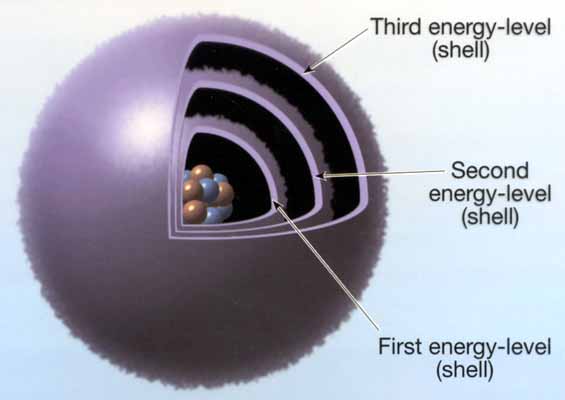
We return now to further experimental knowledge of quanta. The mysterious quantity h crops up inside the atom as well as outside it. Let us take the simplest of all atoms, namely, the hydrogen atom. This consists of a proton and an electron, that is to say a unit charge of positive electricity and a unit charge of negative electricity. The proton carries nearly all the mass of the atom and remains rock-like at the centre, whilst the nimble electron moves round in a circular or elliptic orbit under the inverse square-law of attraction between them. The system is thus very like a sun and a planet. But whereas in the solar system the planet’s orbit may be of any size and any eccentricity, the electron’s orbit is restricted to a definite series of sizes and shapes. There is nothing in the classical theory of electromagnetism to impose such a restriction; but the restriction exists, and the law imposing it has been discovered. It arises because the atom is arranging to make something in its interior equal to h. The intermediate orbits are excluded because they would involve fractions of h, and h cannot be divided.

The significance of the mysterious quantity ‘h’ (Planck’s constant) is that it is energy per cycle at the center of the atom. Here the frequency is near infinite, and the energy per cycle is the lowest. Actually, ‘h’ is the limiting value as frequency goes to infinity.

An atom is a whirlpool of field-substance, much like a galaxy. The rotating field-substance is increasing in substantiality as it approaches the center. At the center it condenses into a nucleus. The nucleus anchors the atom.

The rotating field-substance within the atom is diffused at the periphery but it increases in frequency and quantization as it approaches the center. Increasingly discrete field-particles appear closer to the nucleus. In case of the simplest hydrogen atom, the whirlpool-like field-substance is identified as an “electron”, and the condensed nucleus at the center is identified as a “proton”. The field-substance and field-particles have charge instead of mass. The property of mass belongs to the whole atom.

This field-substance has many quantization levels. Each quantization level has a unique energy per cycle. It acquires the lowest value ‘h’ at the center. The value ‘h’ appears to be constant and indivisible only because it is a limiting value for infinite frequency.

But there is one relaxation. When wave-energy is sent out from or taken into the atom, the amount and period must correspond exactly to h. But as regards its internal arrangements the atom has no objection to 2h, 3h, 4h, etc.; it only insists that fractions shall be excluded. That is why there are many alternative orbits for the electron corresponding to different integral multipliers of h. We call these multipliers quantum numbers, and speak of 1 -quantum orbits, 2-quantum orbits, etc. I will not enter here into the exact definition of what it is that has to be an exact multiple of h; but it is something which, viewed in the four-dimensional world, is at once seen to be action though this may not be so apparent when we view it in the ordinary way in three-dimensional sections. Also several features of the atom are regulated independently by this rule, and accordingly there are several quantum numbers—one for each feature; but to avoid technical complication I shall refer only to the quantum numbers belonging to one leading feature.

Within an atom the highest quantization level exist at the center where the frequency is the highest and energy per cycle is the lowest. As one moves towards the periphery of the atom, the quantization decreases and the energy per cycle increases.

At lower quantization levels, the space and time units are larger because of lesser substantiality. The energy per cycle at these levels is identified as the wave-energy sent from or taken into the atom. The values of energy per cycle appear to be unique and as strict multiples of ‘h’.

Bohr’s atom seems to identify different quantum-orbits filled with electrons. Instead there seems to be different quantization levels manifested as unique field-particles for that level. These field-particles are not completely discrete.

According to this picture of the atom, which is due to Niels Bohr, the only possible change of state is the transfer of an electron from one quantum orbit to another. Such a jump must occur whenever light is absorbed or emitted. Suppose then that an electron which has been travelling in one of the higher orbits jumps down into an orbit of less energy. The atom will then have a certain amount of surplus energy that must be got rid of. The lump of energy is fixed, and it remains to settle the period of vibration that it shall have when it changes into aether-waves. It seems incredible that the atom should get hold of the aether and shake it in any other period than one of those in which it is itself vibrating. Yet it is the experimental fact that, when the atom by radiating sets the aether in vibration, the periods of its electronic circulation are ignored and the period of the aether-waves is settled not by any picturable mechanism but by the seemingly artificial h-rule. It would seem that the atom carelessly throws overboard a lump of energy which, as it glides into the aether, moulds itself into a quantum of action by taking on the period required to make the product of energy and period equal to h. If this unmechanical process of emission seems contrary to our preconceptions, the exactly converse process of absorption is even more so. Here the atom has to look out for a lump of energy of the exact amount required to raise an electron to the higher orbit. It can only extract such a lump from aether-waves of particular period—not a period which has resonance with the structure of the atom, but the period which makes the energy into an exact quantum.

There are no electrons jumping from one quantum orbit to another. Instead there are field-particles being added or subtracted at different quantization levels due to interactions. Each field-particle constitutes a cycle, which is absorbed or emitted as light.

There is no aether. There is only field-substance quantized as field-particle, and which may de-quantize back to field-substance (light).

As the adjustment between the energy of the orbit jump and the period of the light carrying away that energy so as to give the constant quantity h is perhaps the most striking evidence of the dominance of the quantum, it will be worthwhile to explain how the energy of an orbit jump in an atom can be measured. It is possible to impart to a single electron a known amount of energy by making it travel along an electric field with a measured drop of potential. If this projectile hits an atom it may cause one of the electrons circulating in the atom to jump to an upper orbit, but, of course, only if its energy is sufficient to supply that required for the jump; if the electron has too little energy it can do nothing and must pass on with its energy intact. Let us fire a stream of electrons all endowed with the same known energy into the midst of a group of atoms. If the energy is below that corresponding to an orbit jump, the stream will pass through without interference other than ordinary scattering. Now gradually increase the energy of the electrons; quite suddenly we find that the electrons are leaving a great deal of their energy behind. That means that the critical energy has been reached and orbit jumps are being excited. Thus we have a means of measuring the critical energy which is just that of the jump—the difference of energy of the two states of the atom. This method of measurement has the advantage that it does not involve any knowledge of the constant h, so that there is no fear of a vicious circle when we use the measured energies to test the h rule.* Incidentally this experiment provides another argument against the collection-box theory. Small contributions of energy are not thankfully received, and electrons which offer anything less than the full contribution for a jump are not allowed to make any payment at all.

* Since the h rule is now well established the energies of different states of the atoms are usually calculated by its aid; to use these to test the rule would be a vicious circle.

There are no electrons in the atom jumping orbits. There are only the field-particles condensing and de-condensing at certain energies of quantization levels.

.

Inertia, Geometry & Quantization

Geometry of space

Reference: Disturbance Theory

.

The Space Reference frame (SRF) highlights the dimension of inertia. Newton defines inertia as follows,

“The vis insita, or innate force of matter, is a power of resisting by which every body, as much as in it lies, endeavours to preserve its present state, whether it be of rest or of moving uniformly forward in a straight line.”

The status quo of a body is defined here in terms of rest or uniform motion in a straight line. But a “straight line” only means near zero curvature, which is approached as the radius approaches an infinitely large value.

.

Geometry & Inertia

Straight line relates to geometry of space.  Space is a property of substance. It expresses the extension of substance.  The fundamental substance is an electromagnetic cycle.  Per The Problem of Field,

“Something called “charge” triggers the electromagnetic cycle. This cycle is an oscillation between electrical flow and magnetic rotation. The electrical flow winds up as magnetic rotation. The magnetic rotation then unwinds back as electrical flow.”

The electric flow has the kinetic aspect of forward motion, which provides a sense of extension, or SPACE. The magnetic rotation has the potential aspect of holding motion in place, which provides a sense of duration, or TIME. Thus,

“The electromagnetic cycle consists of an oscillation between the “flow” of space and “rotation” of time. The relationship between space and time would depend on the frequency of oscillation. We perceive the ratio of space to time of an electromagnetic cycle as ‘c’ the speed of light.”

As frequency goes to zero, space would seem to stretch out with its curvature approaching zero. The reverse seems to occur as frequency increases. In other words, the curvature of space seems to increase with frequency. Since frequency contributes to the substantial-ness, or inertia, of the electromagnetic substance, it seems that

The curvature of space increases with increase in inertia.

.

Inertia & Quantization

In the electromagnetic spectrum, space represents the extensions of the electromagnetic substance. The curvature of this space approaches zero towards the bottom of the electromagnetic spectrum. But as we move up the electromagnetic spectrum it starts to become very conspicuous towards the top. This is the basis of quantization.

The greater is the inertia of substance, the more quantized it appears.

This, in a way, was the subject of Einstein’s very first paper in 1905 on light quanta [see Einstein’s Paper on Light Quanta (1905)].

This phenomenon of quantization has been debated as the duality of wave and particle properties of electromagnetic substance. Even though the quantization appears to be particle-like, there is always an underlying continuity. Even a material particle of very high inertia has some degree of continuity with the space around it.

Underlying quantization there is always continuity of substance from higher to lower inertia.

.

Empty Space & Substance

“Empty space” is empty of matter only. When there is no matter, there is electromagnetic substance, which is not easily visible. But if the electromagnetic substance is not there, there won’t be empty space either. We may say that the electromagnetic substance is visible as empty space.

This may shed some light on the concepts of “dark energy” and “dark matter”. Any presence of dark energy and matter shall be accompanied by invisible curvatures in space. The curvatures shall change as the inertia of the electromagnetic substance changes.

Higher levels of inertia means more condensed regions. Therefore, regions of higher inertia shall appear inside the regions of lower inertia, just as higher elevations on a surface appear within lower elevations. Thus,

Contour maps of different inertial levels may be created within the “empty space”.

.

Further Research

Heavenly bodies are like regions of very high inertia that exist within with the regions of very low inertia of space. Very high gradients of inertia shall exist at the interface of matter with space, where continuity must exist.

Further research in this area may lead to a better understanding of gravity beyond the mathematical symbols that are often very confusing.

.

The Dynamics (old)

zen

Previous: A Basic Model of Universe
Next: The Self
Reference: The Quest for Certainty

We may start from the concept that there is always something to know; that there is no absolute knowledge. This ultimate concept may be looked upon as “Supreme Being” or Brahma. A version of it is considered to be the Eighth Dynamic by Hubbard of Scientology.

The “static” is the orientation point from which to view this vast universe. This reference point is theoretical but very essential. All properties of the universe must converge back to this point for orientation. Hubbard has a version of it as the Seventh Dynamic.

The universe is not only material but also spiritual. The material aspects are MEST (matter, energy, space and time), and the spiritual aspects are ICAD (identity, consciousness, awareness and desire). The material and spiritual aspects of the universe cannot be separated. Hubbard has a version of it as the Sixth Dynamic.

This universe evolves from the disturbance of the fabric of Space-awareness by the presence of Time-Desire. As a result, first there is Energy-consciousness, which then condenses into Matter-identity. Then there is progressive evolution of Matter-identity into minerals, plant life, and animal life. This evolution has now culminated in sentient humans. Hubbard refers to a version of the above as Fifth Dynamic.

When we focus on the highest form of evolution of this universe, we have Mankind as Fourth Dynamic. We can then look at the division of Mankind into Groups as the Third Dynamic. We may highlight the organization of the procreation activity among humans as the Second Dynamic. Finally, we may regard the individual person and his individuality as the First Dynamic.

Here we have a philosophy of evolution that is logically anchored in the Eighth Dynamic. The proper sequence of Dynamics occurs from Eighth to First. However, Hubbard reverses this sequence by making individuality as the center piece of his philosophy of Scientology. Thus, Hubbard’s philosophy of Scientology is backwards.

When we consider the Eighth Dynamic as the anchor, we notice that there is no limit to knowledge. Evolution has been bringing order to the surrounding disorder by trial and error. Now that evolution has culminated in sentient humans, it is obvious that the  trial and error mode is being replaced by a sentient approach for future evolution.

Science has done a great job in the investigation of the physical aspects of this universe. It has come up with many physical laws. However, science has lagged behind in the investigation of the metaphysical aspects of this universe. We must now come up with metaphysical laws that are as precise as the physical laws in order to evolve further.

Man as the most evolved organism must discover, understand and follow the basic laws of the universe to evolve further.

.