Reference: Beginning Physics II
Chapter 4: ELECTRIC POTENTIAL AND CAPACITANCE
.
KEY WORD LIST
Conservative Force, Electric Potential Energy, Electric Potential, Equipotential Surface, Electron-Volt, Capacitance, Capacitor, Parallel Capacitors, Series Capacitors, Energy Of Capacitors, Dielectric, Polarize, Dipoles, Dielectric Constant, Permittivity
.
GLOSSARY
For details on the following concepts, please consult Chapter 4.
CONSERVATIVE FORCE (Newton)
Forces, in general, are able to do work, and the work that they do can be transformed into kinetic energy. For forces that are “conservative” the work done can be expressed in terms of a change in potential energy associated with those forces. In other words, the total work done in moving a particle between two points is independent of the path taken. Equivalently, if a particle travels in a closed loop, the total work done by a conservative force is zero.
ELECTRIC POTENTIAL ENERGY (Joules)
The electric force is conservative, and work can be written in the form of a change in potential energy. The potential energy of two charges q and Q separated by a distance r is then given by:

The zero of potential energy has been chosen when r → ∞. If the charges are of the same sign, then the potential energy increases as the charges approach each other. This follows because an external force must do positive work in forcing the charges closer together against their mutual repulsion. If left to themselves, these charges would seek regions of lower potential energy.
ELECTRIC POTENTIAL (Volt = Joules/coulomb)
We could associate a specific potential energy with each point in space in a manner similar to associating an electric field to each point in space. We can view this as a situation in which the stationary charges provide each point in space with a scalar value, called the potential, V, such that the potential energy of the system will equal qV if the moving charge is at that point in space.
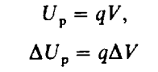
The unit for potential is joules per coulomb, which is the same as volt (V). The quantity ∆V is the “potential difference” between two points in the static electric field. It corresponds to the work needed per unit of charge to move a test charge between the two points. The potential is related to the potential energy in the same manner that the electric field is related to the electric force.
Voltage = Energy / charge
The relationship of electric potential to electric field is as follows:

Potential always decreases as we move along the direction in which the field points.
EQUIPOTENTIAL SURFACE
At every point there is an electric field pointing in some direction. If we move to a different point along that direction, then the potential will change. However, if we move to a different point perpendicular to that direction, the potential will not change. If we move from point to point, always in a direction perpendicular to the electric field at that point, we will sweep out a surface with all points on that surface at the same potential. This surface is called the “equipotential surface”.
A knowledge of how V varies in a region around a point allows us to obtain the magnitude and the direction of the electric field at that point.
E = -∆V/∆d
The minus sign means that E points from high to low potential.
ELECTRON-VOLT
The potential energy of any charge is given by qV, and the change in potential energy that is used in most energy related problems is ∆Up = q ∆V. A positive charge gains energy as it moves to a region of higher potential. A negative charge, such as an electron, will lose energy as it moves to a higher potential. When an electron moves through a difference of potential of one volt it gains or loses e(1) = 1.6 x 10⁻¹⁹ J of energy. This amount of energy is called an electron-volt, or eV. This is a very convenient unit of energy to use whenever one discusses the motion of an electron.
CAPACITANCE
Let us consider the case of two isolated conductors with charge +Q on one and -Q on the other, and a potential difference V between them. Depending on the shape of the conductors and their positions relative to each other, the charges on the conducting surfaces will distribute themselves with some definite (but not necessarily uniform) charge distribution. It is not hard to see that the potential difference V is proportional to the charge Q, as long as the geometry stays the same. We can therefore write Q = CV, and the constant C is called the capacitance of the system. This constant C = Q/V depends on the geometry of the conductors, their size, shape and position, but it does not depend on the charge on the plates. The unit for capacitance is the farad (F).
CAPACITOR
If we build a unit containing two conductors with relatively large surfaces close to each other (but not touching) we call this object a capacitor whose capacitance is C. The name derives from the fact that C represents the capacity of the two conductors to store charge on their surfaces per unit potential difference (per volt) between them. A large capacitance means that the capacitor holds a lot of charge per volt. The most common capacitor geometry is that of two close parallel, conducting plates.
The capacity of a parallel plate capacitor can be written as C = ε0A/d. Thus, doubling the area, or halving the distance between the plates, doubles C as well.
A capacitor has the property that there is no current flow through it, so that, in the steady state it acts like an open circuit. However, the capacitor can become charged as a result of current flowing towards its positive plate, and discharged as a result of charge flowing away from its positive plate. Therefore, current can flow in a DC circuit containing a capacitor, during the time that the capacitor is charging or discharging.
PARALLEL CAPACITORS
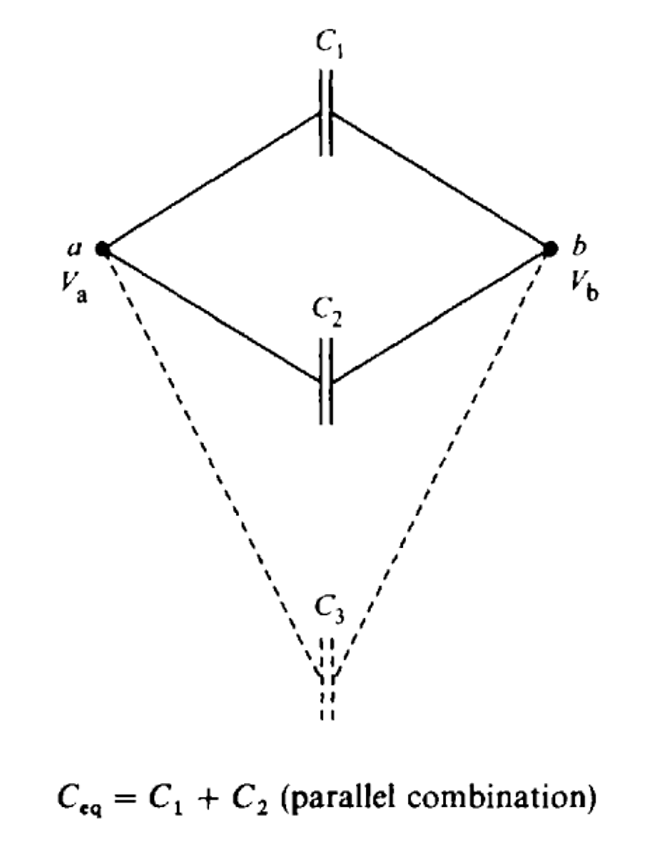
When capacitors are connected in parallel as follows, each branch has the same potential difference or voltage. For two parallel capacitors,
SERIES CAPACITORS
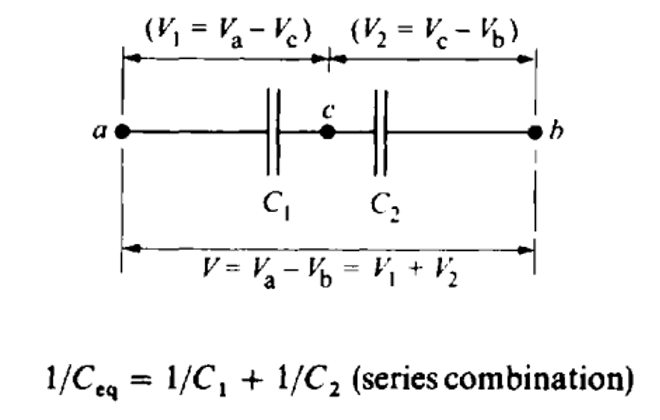
When capacitors are connected in series as follows, the potentials V1 and V2 across the capacitors need not be the same. Indeed, the total voltage between a and b is V = V1 + V2. If we examine the figure more closely, we note that each capacitor will have the same charge. For two series capacitors,
ENERGY OF CAPACITORS
If a capacitor is charged to a difference of potential V, then the energy stored in a capacitor can be written as

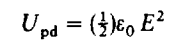
The energy that is stored in a capacitor can be viewed as the energy stored in these electric fields. The entry density within the capacitor may be expressed as,
DIELECTRICS
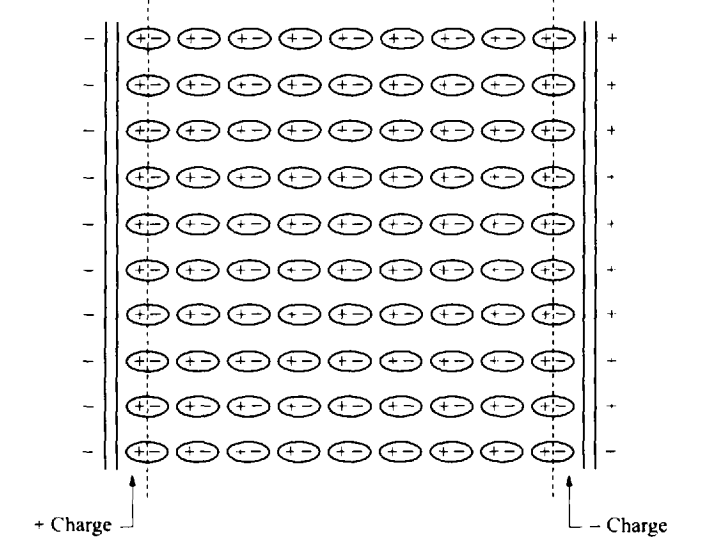
A dielectric is a medium or substance that transmits electric force without conduction. Normal insulating materials are dielectrics. They consist of atoms and molecules that are composed of positively charged nuclei and negatively charged electrons that are tightly bound together with no loose outer electrons that are free to roam. In the presence of an electric field the positive and negative charges in the atoms and molecules are pulled in opposite directions. As a result, the atoms and molecules will become somewhat “polarized” with the positive and negative charges becoming slightly separated from their equilibrium positions. We will then have tiny “dipoles” throughout the material. [See the beginning sketch above.]
POLARIZE
See DIELECTRICS.
DIPOLES
See DIELECTRICS.
DIELECTRIC CONSTANT
If the polarization is proportional to the field, then the new total field will be proportional to the field that would be produced in the absence of the dielectric material. We can then write that E = E0/κ, where E is the total field in the presence of the dielectric, E0 is the field that would be present without the dielectric and κ is the “dielectric constant” of the material. These dielectric constants vary from material to material.
PERMITTIVITY
Permittivity (ε) is a measure of the electric polarizability of a dielectric. A material with high permittivity polarizes more in response to an applied electric field than a material with low permittivity, thereby storing more energy in the material. In electrostatics, the permittivity plays an important role in determining the capacitance of a capacitor. ε0 is called the permittivity of free space. ε = κε0 is called the “permittivity” of the material.
.
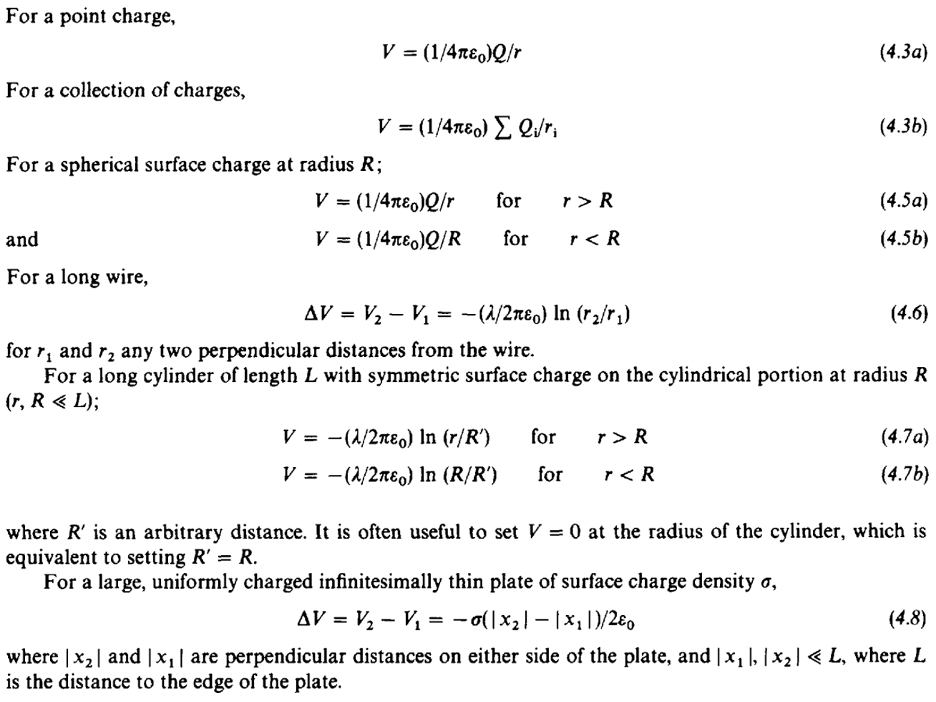
Mathematical Results
.