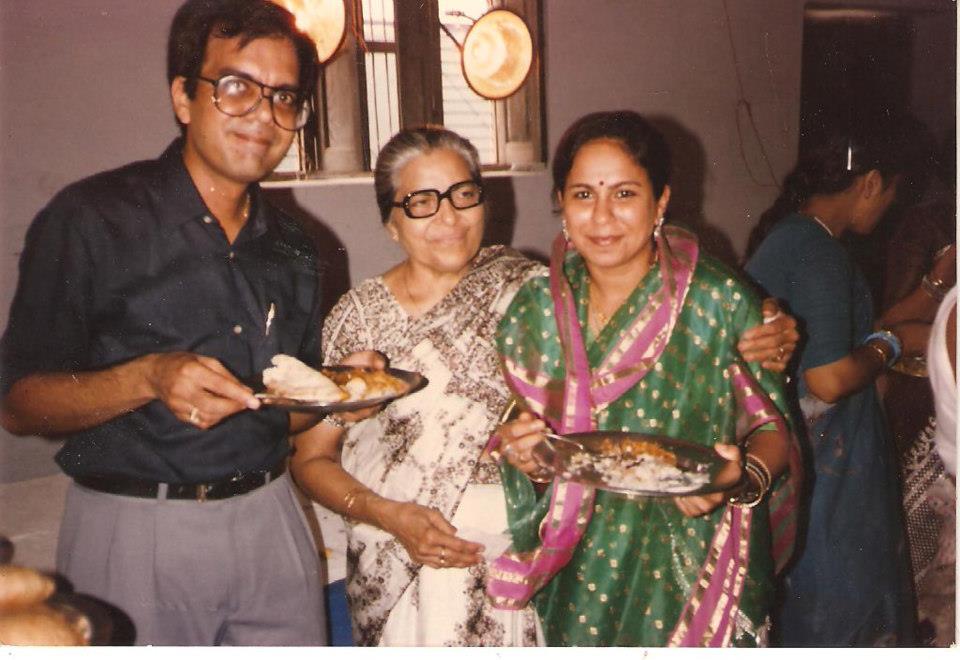
1984 (India) – The newly wedded couple with the ecstatic mother.
.

1994 (India) – Children visiting India and meeting the old family dog Pasha
.
.
.
 Vinaire's Blog
1984 (India) – The newly wedded couple with the ecstatic mother.
.
1994 (India) – Children visiting India and meeting the old family dog Pasha
.
.
.

Scientology Axiom 11 states:
“AS-IS-NESS is the condition of immediate creation without persistence, and is the condition of existence which exists at the moment of creation and the moment of destruction, and is different from other considerations in that it does not contain survival.”
Scientology Axiom 19 states:
“Bringing the static to view as–is any condition devaluates that condition.”
.
It is my understanding that at the moment of AS-IS-NESS there is complete awareness of what one is postulating or viewing. There is nothing hidden. One has a choice to make it persist or not persist. This is how Scientology auditing works. Scientology processes, when applied in a session, guide a person where to look.
This principle is borrowed from Buddhism, which exhorts one to:
“Observe things as they really are, not just as they seem to be.”
In Buddhism, the above principle of mindfulness is to be applied at all times and not, as in Scientology, only when a person is in session.
.
In Scientology, a person is made to look deeply into one’s mind through repetition of process “commands.” Under such introversion a person is likely to be vulnerable. Any little error in directing a person’s attention can have adverse consequences. Some of these consequences may be subtle and may last beyond the session, resulting in conditioning. Though there are actions built into Scientology to minimize such errors, the liability exists for such processes to cause harm, especially through misuse.
But Buddha simply asks one to be mindful of what is there.
“Observe without expecting anything, or attempting to get an answer.”
One does not have to go around searching into one’s memory. One simply lets the mind unwind itself naturally starting from whatever is grabbing one’s attention. This way one can look deeply into one’s psyche without any liability. There is a simple and natural way one goes about practicing mindfulness.
Scientology auditing can be made simpler and more effective by following the Buddhist principle of mindfulness, instead of mechanically repeating an auditing command.
.
An E-meter is used in Scientology to direct a person’s attention in a session. The E-meter is connected to the person. The reactions on the E-meter guide the person where to look. This is fine but it creates a dependence on the E-meter. The E-meter, or the interpretation of its needle reactions, is not error free.
A conflict often occurs when the E-meter reaction indicates something ought to be there, but the person sees nothing. The person, depending on the E-meter, then digs into the mind, and the liability of conditioning comes into play. It then takes ‘CORRECTION LISTS’ to dig the person back out. This is not rare. This happens routinely in Scientology auditing sessions.
Blind digging into the mind, is a liability, which can be prevented with the use of mindfulness.
Such errors may be avoided by simply looking at what is there and not blindly digging into the mind. If nothing is there then one may simply accept that nothing is there. It is my opinion that training on mindfulness may make Scientology processes run much faster and with better results. This may, however, render the E-meter obsolete. In my opinion, E-meter is a marketing ploy. Auditing goes more smoothly and effectively with trained mindfulness.
.
In Scientology, a person is encouraged to talk in session about his intimate details as one looks at one’s experience. Everything the person says is recorded. The records are kept in multiple, thick folders. Such information is used by auditors and case supervisors to determine the processes to be run in auditing sessions. The liability exists for this information to be misused.
Collection of intimate personal details is a liability, which can be eliminated with the use of mindfulness.
Gains in auditing come from the person observing and becoming aware, and not from talking about one’s experiences. But a lot of intimate personal details are gathered in Scientology by getting the person to talk about himself so some ‘expert’ can resolve his case through ‘case programming’.
No such information need be gathered when mindfulness is practiced. A battery of processes may be applied one after another. The mind then unstacks itself naturally whenever the processing question is applicable. The battery of processes may be repeated as long as natural unstacking is taking place. That is the extent of ‘case programming’ needed. It is taken care of by the mind itself. Thus, with the application of mindfulness, one’s privacy need not be compromised while the case is getting resolved.
.
The setup of a Scientology session is quite elaborate. The E-meter is an essential part of it. Thus, guidance in Scientology cannot be provided over long distances using phone, or Skype on Internet. This is an enormous limiting factor in this Information age of today.
With mindfulness it becomes possible to provide Scientology auditing over long distances.
No such limitation exists when the practice of mindfulness replaces the use of E-meter. One can routinely conduct Scientology auditing sessions using phone, or Skype on Internet, with great effectiveness.
.
Thus, it appears that considerable liability attached to Scientology auditing may be eliminated with the use of mindfulness. Also eliminated will be the expense associated with training of auditors on complex auditing actions. The auditor’s function would simply consist of providing auditing commands and to ensure that mindfulness is being practiced by both auditor and the preclear. No Case Supervisor would be necessary. This would make it possible to deliver auditing in much greater volume while also increasing the effectiveness of Scientology applications.
With mindfulness it becomes possible to provide Scientology auditing inexpensively in much greater volume.
Scientology claims itself to be an extension of Buddhism. Let mindfulness also be incorporated into Scientology from Buddhism. There is a great potential in Scientology to spread as a grass roots movement, like Buddhism did 2600 years ago, with great benefit to everybody.
.
With the recent release of the movie THE MASTER, Scientology has become a subject of broad interest. There is plenty that can be read about this subject in books and on Internet. I have done a close study of this subject over a period that started in 1969 (see My Introduction to America). I even spent a few years aboard Hubbard’s yacht Apollo in the seventies (see Memories at Sea (1972-75)). Here is my summary assessment of Scientology.
.

These concepts are mystical and seem to be over the top. They are part of the ancient to most modern beliefs. Here are some wild conjectures emerging as a result of discussions on this blog:
(1) Soul is a set of mental energies and forces released after the physical death of a body. This is discussed further in The Self and the Soul.
(2) The body is made up of macromolecules that have a physical structure, as well as programming capabilities in the configuration of that structure.
(3) The various programming patterns allows the macromolecules to function as molecular computers and regulate the physical and mental functions of the body.
(4) The physical structure may represent “physical energies and forces,” whereas, this programming may represent the “mental energies and forces,” that make up the “I.” This is discussed further in The Structure of “I”.
(5) The soul of a person comprises of these mental energies and forces (programming patterns), which when functioning in a live body, may be considered to be alive.
(6) After death the physical body is reduced to a number of physical organs that gradually disintegrate into physical elements. A single physical entity is no longer there.
(7) Similarly, after death, the soul of a person is reduced to a number of programming patterns that remain. A single spiritual entity is no longer there.
(8) The soul to be alive, needs to be manifesting itself through a live body. After death, neither the soul nor the body are alive.
(9) Any identity that existed as “I” is extinguished at death.
(10) After death, the soul seems to get “stored” in space as numerous individual programming patterns .
(11) These programming patterns are “retrieved” back from space just before birth. They are retrieved in a combination that is compatible with the physical structure of the new body.
(12) A new identity comes into being only after the physical and mental aspects have recombined in a new body.
(13) Past life memories and child prodigies may be explained in terms of the mental patterns obtained from previous souls. The new “soul” may be looked upon as a recombination of previous souls.
(14) Apparently, there is no “life” in the “between-lives” area. There are only numerous programming patterns stored in space.
(15) How these programming patterns come to be stored in space requires another wild conjecture. Space is not nothing. Space is something.
(16) The ripples in the “fabric of space” are the electromagnetic waves that contribute to the formation of matter, while the fabric itself seem to contributes to the characteristics that regulate the behavior of matter.
(17) The stored patterns in the fabric of space influence not only humans but also the plant, animal and marine life.
(18) Certain aspect of these patterns may even be responsible for the Periodic Table of elements.
(19) These patterns probably are the blueprint of the universe, which exists as space.
(20) The postulated dark energy and matter could very well be the programming patterns from dead souls stored in space.
.
I admit this is as wild as it can be. Note that this conjecture is not entirely materialistic. We still don’t know how all this comes to be this way. There is a spiritual dimension to it all.
.

Reference: Religion
Swami Vivekananda
At the world’s Parliament of Religions, Chicago
26th September, 1893
The religion of the Hindus is divided into two parts: the ceremonial and the spiritual. The spiritual portion is specially studied by the monks.
The great glory of the Master lay in his wonderful sympathy for everybody, especially for the ignorant and the poor. Some of his disciples were Brahmins. When Buddha was teaching, Sanskrit was no more the spoken language in India. It was then only in the books of the learned. Some of Buddha’s Brahmins disciples wanted to translate his teachings into Sanskrit, but he distinctly told them, “I am for the poor, for the people; let me speak in the tongue of the people.” And so to this day the great bulk of his teachings are in the vernacular of that day in India.
Whatever may be the position of philosophy, whatever may be the position of metaphysics, so long as there is such a thing as death in the world, so long as there is such a thing as weakness in the human heart, so long as there is a cry going out of the heart of man in his very weakness, there shall be a faith in God.
On the philosophic side the disciples of the Great Master dashed themselves against the eternal rocks of the Vedas and could not crush them, and on the other side they took away from the nation that eternal God to which every one, man or woman, clings so fondly. And the result was that Buddhism had to die a natural death in India. At the present day there is not one who calls oneself a Buddhist in India, the land of its birth.
Hinduism cannot live without Buddhism, nor Buddhism without Hinduism. Then realise what the separation has shown to us, that the Buddhists cannot stand without the brain and philosophy of the Brahmins, nor the Brahmin without the heart of the Buddhist. This separation between the Buddhists and the Brahmins is the cause of the downfall of India. That is why India is populated by three hundred millions of beggars, and that is why India has been the slave of conquerors for the last thousand years. Let us then join the wonderful intellect of the Brahmins with the heart, the noble soul, the wonderful humanising power of the Great Master.
.
