A New Model of Atom (old)


dl10c

Reference:

Propagation of Light

Disturbance Levels of Space

.

An atom is the smallest unit of matter that defines the chemical elements. Atoms are very small. The modern atom is visualized as a small nucleus surrounded by an electronic region.

All the mass of the atom is concentrated in the nucleus, which is made up of still smaller particles called nucleons. The surrounding electron cloud is made up of particles called electrons. Atoms attach to each other by sharing electrons in their outer shells.

In solids, the atoms and molecules are packed much more tightly. They form a rigid structure. Even then the electrons in outer shells of atoms in materials called metals can flow as electric current.
atom2

Many properties within the atomic structures, when expressed as ratios, appear impressively as ordered sets of integers. This has led to the assumption that the atomic structure consists of smaller particles. This assumption is reinforced by the appearance of particles in atomic and nuclear reactions. However, these same sets of integers can be explained in terms of resonances among electromagnetic waves, without assuming the presence of subatomic particles within atoms.

So, there are subatomic particles that are generated during atomic and nuclear reactions. There are also properties of atoms that can be expressed in terms of orderly integer ratios. But this does not necessarily justify that atoms are made of subatomic particles.

It is very likely that an atom is a homogeneous entity with no discrete particles existing inside it. There need not be electrons circling around a nucleus that is made up of protons and neutrons. The interactions at the surface of atom may suffice to generate electrons. Similarly, other interactions with the atom may suffice to generate protons and neutrons.

If we do not assume subatomic particles to reside within an atom, we can express the atomic structure in terms of rapidly condensing wave-frequency of electromagnetic disturbance.

Inertia may be described as the natural tendency of any motion to maintain itself when no external force is acting on it. Because of this inertia an internal resistance is generated when a change in motion is attempted by force. A wave-frequency can be said to have inertia because it tends to maintain itself.

The higher is the frequency of electromagnetic disturbance, the more it tends to maintain itself. We may say that electromagnetic disturbance of higher frequency has higher inertia.

The electromagnetic disturbance has a large spectrum that extends from extremely low frequencies of radio waves to extremely high frequencies of gamma rays. This range of frequencies may be described as disturbance levels (exponent of 2) from 1 to 67 and higher (see the reference above).

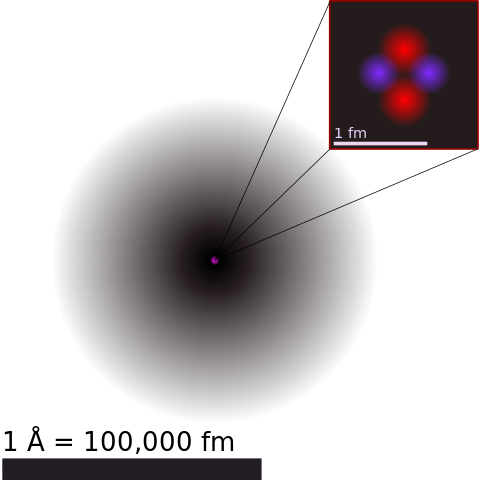
The atom may be modeled as a “sink” for wave-frequency inertia. This means that the atom provides a location where wave-frequency inertia may condense and terminate as mass (See the graphics at the beginning of this article).

In other words, the disturbance levels increase rapidly as the electromagnetic disturbance enters the electronic region of the atom and moves towards its center. These disturbance levels are the same that appear at the upper end of the electromagnetic spectrum.

There is a threshold frequency at which the disturbance becomes rotational and forms an electronic region. There seems to be another threshold frequency within the electronic region at which disturbance collapses from wave-frequency into particle-mass form of inertia. The particle-mass formation appears as the nucleus at the center of the atom.

In this model of atom, the electronic region is like a rotating “whirlpool” within the ubiquitous electromagnetic field in space. The electronic region consists of rapidly increasing disturbance levels toward the center. The extremely high disturbance level at the center collapses into mass forming the nucleus of the atom.

The Bohr’s model of atom has helped provide insight into the Periodic Table; but, it soon becomes very complex when describing the atomic structure beyond the simplest hydrogen atom. The “Disturbance” model of atom outlined in this article is intended to provide a deeper insight into the structure of the atom with simpler math.

In the Disturbance model of the atom, there are “oscillators” in the electronic region of the atom instead of electrons. These “oscillators” achieve characteristic resonances when irradiated with energy. These resonances then emit characteristic radiation and electrons.

In a blackbody, the atomic configurations consist of “oscillators” over the whole range of frequency spectrum. When a blackbody is heated, it emits radiation at all frequencies. Radiation at high frequencies is limited because it requires increasing energy to activate high frequency oscillators.

Energy required to activate an oscillator is proportional to its frequency, E = hf. The proportionality factor is the Planck’s constant h.

The Planck’s constant ‘h’ may be defined as the energy involved in each cycle of oscillation.

In the photoelectric effect, the metal surface emits electrons. Electrons are rotating electromagnetic fields spun off from the electronic region of the atomic configuration. The metallic surface seems to act as a lens to concentrate the wave front of the falling radiation at oscillators within the surface.

The photon seems to be created right at the metallic surface and may not exist in space. Thus, light may just be a wave phenomenon. Its only discrete element may be a frequency cycle containing the energy ‘h’.

Electrons and atoms are stable configurations of extremely high disturbances in space. A free electron may be looked upon as an “atom without a nucleus”.

.

Disturbance Levels of Space

dl10c

Reference: Propagation of Light

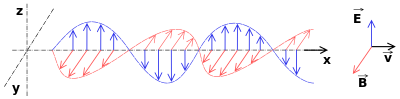
When space is disturbed electric and magnetic fields are generated. These fields oscillate as a transverse wave. The disturbance travels in a straight line at the speed of light.

Disturbance is manifested in space as oscillating electric and magnetic fields.

In each oscillation the disturbance advances by a distance called wavelength. The oscillations occur at a certain frequency. The speed of propagation is then determined by the product of frequency and wavelength. Oscillations are the result of a rotating vector. The propagation of disturbance may be compared to the advance of a rotating screw.

The disturbance propagates like a rotating vector threading into the space.

The space does not provide any resistance. The disturbance contains its own inertia through the interaction between electric and magnetic fields. This inertia resists any change to frequency and wavelength, and keeps the disturbance going.

The disturbance consists of its own inertia that sustains it.

The disturbance has a large range of frequencies and wavelengths. This range is represented by the electromagnetic spectrum consisting of radio waves, microwaves, infra-red light, visible light, ultra-violet light, X-rays and Gamma rays. This spectrum presents increasing frequency and shortening wavelengths, while the speed of propagation remains practically the same.

The disturbance forms a spectrum of increasing frequency and shortening wavelengths.

Since the spectrum extends over a very large range of frequencies, it may be managed more conveniently as Disturbance Levels on a logarithmic scale of base 2 (similar to octaves).

Disturbance Level                 Frequency

                0                                  20 or 1

                1                                  21 or 2

                2                                  22 or 4

                3                                  23 or 8

                …                                 …

                n                                 2n

The disturbance levels of some of the electromagnetic frequencies are as follows

     EM Frequency                 Disturbance Level

Visible light ………………….. ~ 49  

Gamma Rays ………………… ~ 65

Electron ………………………. 66.7

Proton ………………………… 77.6

Neutron ……………………….. 77.6

Inertia seems to increase with increasing disturbance levels. The disturbance levels may provide a measure of inertia.

Ln 2

x represents frequency; y represents Disturbance Levels

These disturbance levels may be plotted as above. It can be seen from this graph that negative disturbance levels may be postulated to exist with the halving of frequency. The frequency never reaches zero, except theoretically. We may postulate a level of zero frequency to describe undisturbed space. This space forms the background of all disturbance. The undisturbed space has zero inertia.

The background of all phenomena is undisturbed space of zero frequency and no inertia.

The disturbance levels express inertia. When disturbance level crosses a threshold, the inertia transitions from “wave-disturbance” to “particle-mass.” Inside the atom, this transition occurs at the boundary of the nucleus.

The concept of “Disturbance Level” shall be used in subsequent discussions.

.

Propagation of Light

Light appears to be like a screw that threads through space.

This is a very rough analogy but here are some interesting points.

  1. A rotational motion is relative to its own axis of rotation. It may be felt merely as force, where the lines of forces may originate from one end of the axis and terminate at the other end. This is like a magnetic force field.

  2. Light consists of magnetic and electrical force fields. Change in one field generates the other field.

  3. The magnetic and electrical fields oscillate in phase but normal to each other. It is as if space splits into these two fields.

    EM

  4. Each “oscillation” is like a vector rotation that advances the disturbance of light along its axis by a wavelength.

  5. The propagation of light takes place as the inertia of its vector rotation simply persists in an inertia-less space.

  6. As the speed of vector rotation increases, wavelength decreases. The increase in vector rotation is similar to the increase in frequency.

  7. With faster vector rotation and shorter wavelength, the “threads” of this corkscrew motion come closer to each other.

  8. Inertia increases with faster vector rotation. It is expected that this increase in inertia may slow down the forward propagation to some degree.

    Note 2/23/15: This may be the threshold disturbance level at which light starts to slow down and start to converge as by a lens. This disturbance level shall occur at the surface of an atom, and also at the surface of an electron.
  9. As the closeness of threads crosses a certain threshold, they may start to congeal into a motion that resembles more like a fast rotating disk. Thus come about the mass type characteristics of inertia.

    Note 2/23/15: This may be the threshold disturbance level at which transition from disturbance to mass takes place. This disturbance level shall occur at the surface of the nucleus of an atom. This disturbance level may only be approached in an electron but not reached.
  10. Hence there is a transition from wave to a particle type motion, which is accompanied by a rapid decrease in forward propagation.

The above are simply some conjectures. Much work needs to be done mathematically and experimentally to support or reject them.

This article provides a crude unidirectional picture. In reality the phenomenon is 3-dimensional. The idea of “disk rotation” may need to be expanded into a more complicated “centered rotation.”

The atom may act as a “sink” for inertia. The electromagnetic radiation approaches the “sink” and its spread-out “threads” start to get compressed, until they transition into mass type centered inertia when approaching the center of the atom.

It is very likely that an atom is made up of electromagnetic patterns of different densities  with no separate electrons, protons and neutrons inside. The atom simply happens to spit out such particles when disturbed at different levels of “depth.”

.

Discrete and Continuous

VLT image of the cometary globule CG4

A rational number, whether real, imaginary or complex is a discrete entity. A discrete entity has a boundary of value. A set of discrete entities is a collection of such values with boundaries.

A scale, dimension, or field is a continuous entity that is stretched out. A continuous entity has continuously varying values. There is no boundary that defines an exact value.

The moment you refer to a “number” you have placed a boundary around a value by identifying it.

A continuous scale, dimension, or field may be filled with a lot of precisely defined numbers, but these numbers remain separate from the scale.

When you say, “There is a continuous field of numbers,” all you are saying is that there is a continuous field that may be filled with numbers. That continuous field is still there when it is not filled with numbers. The numbers DO NOT MAKE the field.

There are no precisely identifiable irrational numbers. When one is looking at an irrational number one is looking at a piece of scale, dimension, or field.

A continuous function like SINE is by itself. It is not made up of numbers, though infinity of numbers may fit into any segment of it.

The bottom line is,

“INFINITY OF DISCRETE ENTITIES DO NOT TOGETHER MAKE A SINGLE CONTINUOUS ENTITY.

Space may be filled with points; but space is not the same thing as a set of points.

.

A Conceptual Model of Inertia, Mass & Location

Solar-system-orbits-ESO1

Both Classical and Quantum Mechanics seem to be based on a mathematical model that views physical space as a set of locations or points. This brings about the inconsistency that a continuous space is being defined by discrete points.

This is the first part of paper that looks at the above inconsistency. It starts by taking a conceptual approach to the subject of inertia.


Inertia

Here are some definitions from Newton’s Principia for the Common Reader:

Definition 1: The quantity of matter is the measure of the same, arising from its density and bulk conjointly.

Newton refers to the quantity of matter as body or mass. It is proportional to weight.

Definition 2: The quantity of motion is the measure of the same, arising from the velocity and quantity of matter conjointly.

Quantity of motion is momentum (mass x velocity) in our present terminology.

Definition 3: The vis insita, or innate state of matter, is a power of resisting, by which every body, as much as in it lies, continues in its present state, whether it be of rest, or of moving uniformly forwards in a right line.

Newton says, “This force is always proportional to the body whose force it is and differs nothing from the inactivity of the mass, but in our manner of conceiving it. A body, from the inert nature of matter, is not without difficulty put out of its state of rest or motion. Upon which account, this vis insita may, by a most significant name, be called inertia (vis inertiae) or force of inactivity. But a body only exerts this force when another force, impressed upon it, endeavors to change its condition; and the exercise of this force may be considered as both resistance and impulse, it is resistance so far as the body, for maintaining its present state, opposes the force impressed; it is impulse so far as the body, by not easily giving way to the impressed force of another, endeavors to change the state of that other. Resistance is usually ascribed to bodies at rest and impulse to those in motion; but motion and rest, as commonly conceived are only relatively distinguished; nor are those bodies always truly at rest, which commonly are taken to be so.”

Definition 4: An impressed force is an action exerted upon a body, in order to change its state, either of rest, or of uniform motion in a right line.

Newton says, “This force consists in the action only, and remains no longer in the body when the action is over. For a body maintains every new state it acquires, by its inertia only. But impressed forces are of different origins, as from percussion, from pressure, from centripetal force.”

Law 1: Every body continues in its state of rest, or of uniform motion in a right line, unless it is compelled to change that state by forces impressed upon it.

Conceptually, inertia is the inherent tendency of a state of motion to maintain its status quo.

Law 2: The change of motion is proportional to the motive force impressed; and is made in the direction of the right line in which that force is impressed.

This is stated as, “Force = mass x acceleration.” Force is proportional to acceleration, and the proportionality factor is the mass (quantity of matter). Mass is equivalent to the force that is required to produce unit acceleration.

Law 3: To every action there is always opposed an equal reaction: or, the mutual actions of two bodies upon each other are always equal, and directed to contrary parts.

The internal resistance encountered due to inertia equals the force applied. Thus, inertia may be accounted for in terms of mass.

The above discussion may be summarized in the following concepts.

  • Inertia is the inherent tendency of a state of motion to maintain its status quo.
  • Inertia comes into play when a force is impressed from outside, and acceleration is generated.
  • Inertia is the property of quantity of matter, or mass.
  • Mass depends on the density and volume of the body.
  • Inertia increases or decreases as mass increases or decreases.
  • Mass may be measured in terms of force required to produce unit acceleration.


Center of Mass

Here are some corollaries from Newton’s Principia for the Common Reader:

Corollary 4:  The common center of gravity of two or more bodies does not alter its state of motion or rest by the actions of the bodies among themselves; and therefore the common center of gravity of all bodies acting upon each other (excluding external actions and impediments) is either at rest, or moves uniformly in a right line.

Newton says, “It is manifest that the common center of all never suffers any change in the state of its motion or rest from the actions of any two bodies between themselves… And therefore the same law takes place in a system consisting of many bodies as in one single body, with regard to their preserving in their state of motion or rest. For the progressive motion, whether of one single body, or of a whole system of bodies, is always to be estimated from the motion of the center of gravity.”

Proposition 24, Cor. 7: And hence appears a method both of comparing bodies one with another, as to the quantity of matter in each; and of comparing the weights of the same body in different places, to know the variation of its gravity. And by experiments made with the greatest accuracy, I have always found the quantity of matter in bodies to be proportional to their weight.

This conclusion is in support of Newton’s Law 2.

From Maxwell’s paper on Matter and motion cited in Newton’s Principia for the Common Reader:

  1. Center of mass of two particles: C is a point such that if the masses of A and B were concentrated at C, their mass-vector from any origin O would be the same as when A and B are in their actual positions. The point C is called the Center of Mass of A and B.

  2. Center of Mass of a system: The center of mass is therefore a definite point in the diagram of the configuration of the system. By assigning to the different points in the diagrams of displacement, velocity, total acceleration, and rate of acceleration, the masses of the bodies to which they correspond, we may find in each of these diagrams a point that corresponds to the center of mass, and indicates the displacement, velocity, total acceleration, or rate of acceleration of the center of mass.

The above discussion may be summarized in the following concepts.

  • A body responds to motion as if its weight is concentrated at a point.
  • Mass is proportional to weight.
  • A body responds to motion as if its mass is concentrated at a point.


Physical Location

Classical mechanics treats physical objects as if all their mass is concentrated at a center. A dimensionless point is used to represent this location. The whole object is not dimensionless, but its center of mass comes closest to pinpointing its physical location, under the laws of classical mechanics.

This location appears in reference to the object itself. It depends on the mass of the object and how that mass is distributed within that object. Thus, the universe also has a location with respect to itself. This location is invariable if the total mass remains constant.

As the mass of an object increases it is harder to move. We may say that its physical location is becoming more centered. From this point of view, the most centered objects in this universe are Black Holes.

As the mass of an object decreases, its physical location becomes less centered even when it is looked upon as “in motion”. The location may still be approximated by a geometrical point, but it is increasingly unstable. It may be altered easily with respect to more stable locations. When there is no mass then there is no physical location that can be defined as a point in space. A massless photon shall have no physical point location  even when it is looked upon as moving.

.

The above discussion may be summarized in the following concepts.

  • A physical point location in space depends on the distribution of mass around it.

  • If there is no mass in a section of space then there is no physical point location within that context.

  • Such physical point locations are discrete and they seem to be distributed in space according to the law of gravity of classical mechanics.

  • A mathematical point is different. It is discrete and it may be assumed anywhere in a continuous space even when there is no mass.

  • A physical location may be represented by a mathematical point. But a mathematical point in space does not necessarily represent a physical location.

  • The physical location of a massless photon may not be represented by a point or points as conceived in mathematics.

  • This paper essentially points out the difference between a physical location and a mathematical point.

.