The Systems View of Life

Transcript of the talk

.

A talk given at Schumacher College (UK), Dartington on May 7th 2014 by Fritjof Capra, the author of the book The Tao of Physics.

The great challenge of our time is to build and nurture sustainable communities, designed in such a manner that their ways of life, physical structures, and technologies do not interfere with nature’s inherent ability to sustain life. To do so, requires a new ecological understanding of life, as well as a new kind of “systemic” thinking.

In this lecture, Fritjof Capra describes that such a new understanding of life in terms of complexity, networks, and patterns of organization, has recently emerged at the forefront of science. He will emphasize, in particular, the new conception of the nature of mind and consciousness, which is one of the most radical philosophical implications of the systemic understanding of life; and the urgency of this new understanding for dealing with our global ecological crisis and protecting the continuation and flourishing of life on Earth.

.

Inertia, Space and Location

 GabrielHorn


A state of motion is defined by INERTIA. The main confusion seems to be between physical and mental aspects of MOTION. So, there is physical inertia as well as mental inertia.

PHYSICAL INERTIA = FREQUENCY & MASS

MENTAL INERTIA = FIXEDNESS & EGO

Physical inertia is made up of the FREQUENCY of electromagnetic waves, and the MASS of material particles. On the spectrum of physical inertia, frequency appears in the lower half, and mass appears on the upper half.

Mental inertia is made up of the FIXEDNESS of attention, and the EGO of individuality. On the spectrum of mental inertia, fixedness appears in the lower half, and ego appears on the upper half.

Based on the concept of inertia we may define SPACE and LOCATION as follows.

PHYSICAL SPACE = A STATE DEVOID OF PHYSICAL INERTIA

MENTAL SPACE = A STATE DEVOID OF MENTAL INERTIA

Space may be defined as the lower end on the spectrum of inertia. Thus, physical space would be an electromagnetic wave of zero frequency and infinite wavelength.

Mental space would be a state of attention that is totally free.

PHYSICAL LOCATION = THE CENTER OF MASS

MENTAL LOCATION = THE CENTER OF EGO

A location may be defined as the upper end on the spectrum of inertia. Thus, physical location would be an infinite mass that is centered at a point. We visualize geometrical point to be dimensionless but discrete. On this concept of point we base the whole subject of geometry. But geometry is only as useful as it is consistent with physical observations.

Mental location would be an immense ego that is centered at a “point”. The “point” is visualized as the spiritual “I”. On this concept of “I” we base the whole subject of spirituality, where God is the ultimate “I”. But spirituality is only as useful as it is consistent with what is experienced.

The concept of SPIRIT is derived from the mental aspect of motion, just like the concept of MATTER is derived from the physical aspect of motion. Both spiritual and material aspects are present at every point on the spectrum of motion or inertia.

When we talk about SPIRIT, we are talking about mental aspects and not the physical aspect. So, SPIRIT has to do with mental space and time, whereas, MATTER has to do with physical space and time. We cannot talk about SPIRIT in terms of physical space and time as it has been done in many religions.

.

Calculus and Quantum Mechanics

hqdefault
Reference: Mathematics of Space and Location

The usefulness of calculus is limited to Classical Mechanics.  Classical mechanics deals with mass that is “centered” and with waves that are “spread out.” In both cases, physical locations may be assumed to be uniform in their characteristics and to be distributed uniformly as points in space.

This assumption no longer holds in the subatomic region, which is the concern of quantum mechanics. In this region, the inertia (state of motion) starts to transition from “mass of particles” to “frequency of waves.” With this transition the nature of locations starts to change from “centered” to being “spread out.”

Thus the locations in the atomic region cannot be considered to be uniform, and they cannot be treated by the infinitesimals of calculus with any certainty.

Calculus cannot be applied with any certainty to the problems of Quantum Mechanics in the subatomic region.

.

The Big Bang

Universe_expansion2

From Wikipedia:

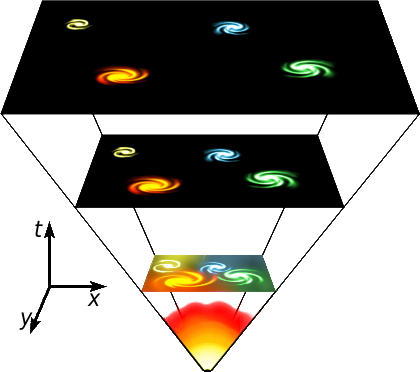
“The Big Bang theory is the prevailing cosmological model for the birth of the universe. It states that at some moment all of space was contained in a single point from which the Universe has been expanding ever since. Modern measurements place this moment at approximately 13.8 billion years ago, which is thus considered the age of the universe. After the initial expansion, the Universe cooled sufficiently to allow the formation of subatomic particles, and later simple atoms. Giant clouds of these primordial elements later coalesced through gravity to form stars and galaxies. The Big Bang theory does not provide any explanation for the initial conditions of the Universe; rather, it describes and explains the general evolution of the Universe going forward from that point on.”

.

Big Bang is the best theory put forth  at present but it does not seem to be the last word.

Did the universe start at the beginning of time, t = 0? Assuming that time could be zero, amounts to thinking of time in absolute terms. The Theory of relativity challenges that notion. From relativistic point of view there is no absolute zero of time.

The universe could be an alternation between expansion and contraction phases.

The universe is essentially motion. The state of motion is called inertia. There is a scale of inertia. As we move toward the high end of the scale, inertia appears as the mass of particles. Inertia increases as mass increases. An example of mass approaching infinity shall be the black hole.

As we move toward the low end of the scale, inertia appears as the frequency of electromagnetic radiation. Inertia decreases as frequency decreases. An example of frequency approaching zero shall be the motion of infinite wavelength. This may be identified as pure space.

At the point of maximum contraction, the universe may appear as having infinite inertia. This condition may appear as a mass particle with a point location. This would be a physical particle that is completely immovable. On the other hand, at the point of maximum expansion, the universe may appear as having zero inertia. This condition may appear as the infinite spread of pure space.

The universe could be oscillating between a point mass of infinite inertia and pure space of infinitesimal inertia.

Therefore “Big Bang” shall occur at the point when the universe transitions from the contracting phase into the expanding phase.

The universe has to be referenced from itself because there is nothing beside the universe. This is where physics transitions into metaphysics.

The conditions of “infinite spread” and “point location” may only be referenced from each other.

.

Solving Real-Life Problems

images

Reference: Scientific method from Wikipedia
Reference: The 12 Aspects of Mindfulness

Here is a step-by-step method for using thought experiments to solve real life problems.

(1) Use your experience

  • Consider the problem.
  • Look for previous explanations.
  • Try to eliminate all inconsistencies using the 12 aspects of mindfulness.
  1. Observe without getting influenced by your expectations and desire for answers.
  2. Observe things as they are, without assuming anything.
  3. If something is missing do not imagine something else in its place.
  4. If something does not make sense then do not explain it away.
  5. Use physical senses as well as mental sense to observe.
  6. Let the mind un-stack itself.
  7. Experience fully what is there.
  8. Do not suppress anything.
  9. Associate data freely.
  10. Do not get hung up on name and form.
  11. Contemplate thoughtfully.
  12. Let it all be effortless.

(2) Form a conjecture

  • State a simple hypothesis or conjecture no matter how unconventional it may appear.

(3) Deduce a prediction from that explanation

  • Predict consequences that may follow from that explanation.

(4) Test (Experiment)

  • Check for the opposite of each consequence to disprove the conjecture.

(5) Verify

  • Note that this can never absolutely verify (prove the truth of) the conjecture. It can only falsify the conjecture.
  • If the conjecture cannot be disproven then continue with step (1) until the complexity of the problem is adequately addressed.
  • If the conjecture is disproven then go back to step (2).

.