PHOENIX LECTURES: Chapter 6

Project: Hubbard 1954: The Phoenix Lectures

This paper presents Chapter 6 from the book THE PHOENIX LECTURES by L. RON HUBBARD. The contents are from the original publication of this book by The Church of Scientology (1954).

The paragraphs of the original material (in black) are accompanied by brief comments (in color) based on the understanding from Buddhism.  Feedback on these comments is always appreciated.

.

IS-NESS

We start out at the beginning or anywhere along the road with this as the highest truth. We are dealing with a static which can consider. That it can consider and then perceive what it considers, makes it a space-energy-mass-time production unit.

From Buddhist viewpoint, the phenomena (universe) simply exists. It may be modeled through the idea of considerations.  A consideration may be considered, most properly, from EMPTINESS, which acts as the reference point of “zero” for phenomena.
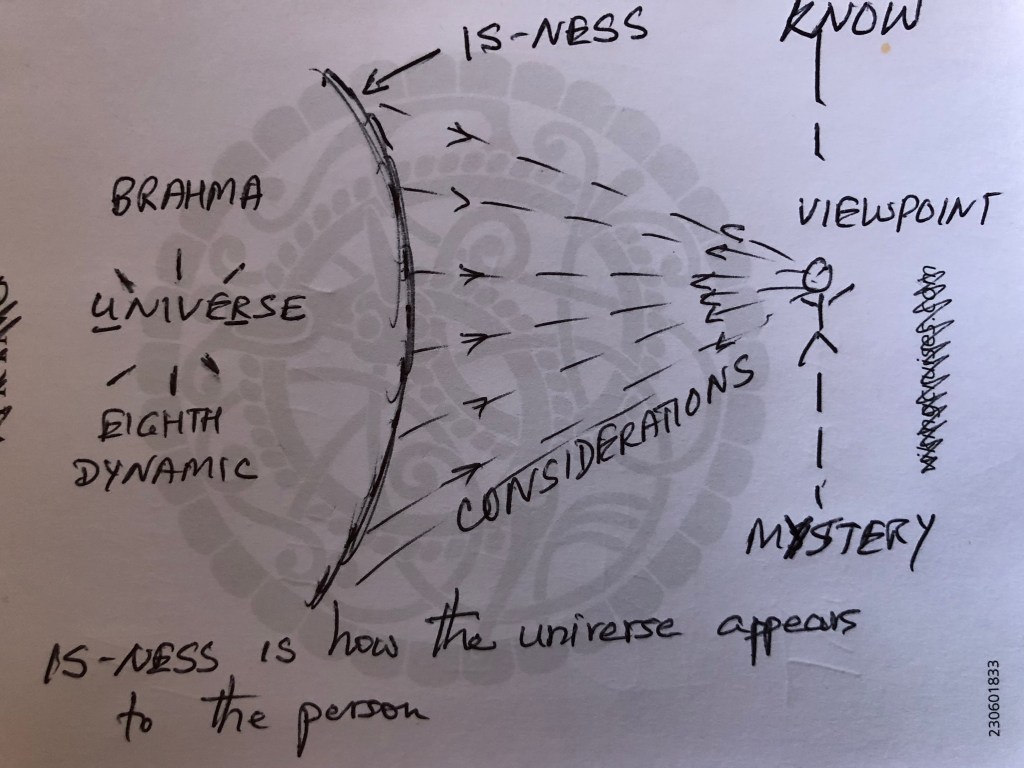
Now don’t ever get hung up on whether or not the actuality that is made is an actuality. This is the wrong way to approach this problem. It’s the way people have been approaching this problem for so long that the problem has remained wholly abstruse. That you can perceive something and that you can perceive that somebody else also perceives something qualifies only one of these conditions of existence, and that’s Is-ness. And that is reality: Is-ness.

Is-ness is the reality (apparent universe) as it is perceived by a person from his viewpoint.

Now, that you simply say something is there, and then perceive that it is there, means simply that you have put something there and perceived that it is there. That’s what it means. It’s no less an Is-ness. That nobody is there to agree with you at the time you do this does not reduce the fact that you have created an Is-ness. It is an Is-ness. It exists. It exists, not “just for you”. It just exists, you see. Now if you were to desire that that persisted, you would then have to go through a certain mechanical step, you would have to make sure that you did not perfectly duplicate it. That is: create it again in the same time in the same space with the same mass and the same energy — because it would no longer be there.

But what have you done really when you’ve done that? You’ve just taken a thorough look. And what you create will vanish if you simply look at it, unless you pull this trick: unless you pull the trick that it is alterable, and that you have altered it. Now if you say that you have altered it, and now that you have forgotten the exact instant it was made and the character of it, it of course then can persist. Because you can look at it all you please — with your first look, you might say — and it won’t vanish. Don’t look at it however with your second look because it will be gone.

When you are simply perceiving something, that is your reality, or is-ness. When you put something out there and perceive that it is there, then that is your imagination. But it is no less an is-ness. It exists because you are aware of it. If you forget that you put it out there, then it will persist for you like any other reality.

For instance — if we looked at the front of a room and saw an object, we would simply have to look at it and conceive ourselves to have made its exact duplicate, or counterpart, which is to say conceived ourselves to have made it. No more, no less than that. And of course, it will get rather thin. To some who are having a rough time with conditions of existence it will first get brighter and brighter and brighter, and then get thinner and thinner and thinner, and it’ll disappear for one. This is a curious thing but is immediately subjected to and you can subject it to a very exacting proof.

As you perceive a situation carefully, you start to get more details first. Therefore, it shall appear to get brighter. But then those details may add up to the realization that the situation is the result of some misinterpretation of yours. At that point the whole situation will disappear, being replaced by a clear understanding. This shall now be a new Is-ness.

Let’s look at this very carefully — at what reality is. Reality is a postulated reality. Reality does not have to persist to be a reality. The condition of reality is simply Is- ness. That is the total condition of reality.

Reality is simply what is perceived from a viewpoint in reaction to the phenomena there. It is what the viewpoint is considering to be there. This is the total condition of is-ness.

Now we get a more complex reality when we enter into the formula of communication because this takes somebody else. We have to say we are somebody else now viewing this and that we don’t know when it was made or where it was made, to get a persistence of the object for that somebody else.

But let us say we just more or less accidentally go into communication with somebody else, and we have an argument, a chitter-chatter back and forth, about what this thing is. If that other person perfectly duplicates exactly what we have created, it will, again, disappear. It doesn’t matter really who created it, he only has to assume that he created it for it to disappear for him. In other words, he has to duplicate it in its same space, same energy, same mass at the same instant it was created, and it will disappear for him. So, you and he had better alter this thing which you made so that you can both perceive it. And then we get what is known as an agreed upon reality, and that is an Is-ness with agreement.

Now actually the word reality itself is commonly accepted to mean that which we perceive. This then is the real definition for reality, the one which is commonly used, and that would be: an agreed upon Is-ness. That would be a reality.

When two people are communicating, each has his own reality about what is there. When either sees it for what it is, the misperceptions will disappear for him, no matter who created them, and the reality may converge. But when neither sees it for what it is, and both agree on the same misperceptions. Then we get agreed-upon reality.

A NOT-IS-NESS is a protest. The common practice of existence of course is to try to vanish Is-ness by using it to destroy itself — taking a mockup such as a building or something of the sort and trying to destroy it by blowing it down with dynamite. This is very practical application, this material. It isn’t esoteric, it doesn’t apply only to the Engram Bank (Engram: A mental image picture of an experience containing pain, unconsciousness, and a real or fancied threat to survival; it is a recording in the reactive mind of something which actually happened to an individual in the past and which contained pain and unconsciousness, both of which are recorded in the mental image picture called an engram. “Engram bank” is a colloquial name for the reactive mind. It is that portion of a person’s mind which works on a stimulus-response basis) — this is just existence.

Is-ness can be translated quite generally as existence. We get a Not-Is-ness being enforced upon an Is-ness by the quality of the Is-ness itself, or, by a new postulate with which the individual is saying it’s not there.

This new postulate, in which you simply say “It’s not there” does not pattern itself with the mechanics of the creation of the Is-ness, the exact time of creation, the exact space, the exact continuance, same mass, same space, same time. And as a consequence, saying, “All right it’s not there”, it will probably dim down for you. But you have to do something else. You have to put a black screen up or push it away, or chew it up, or do anything to it here rather than giving it a perfect duplicate.

So, it’s a Not-is-ness when we say something doesn’t exist which we know full well does exist.

Now you have to know something does exist before you can try to postulate it out of existence and thus create a Not-is-ness.

The definition of Not-is-ness would be simply: trying to put out of existence by postulate or force something which one knows priorly, exists. One is trying to talk against his own agreements and postulates with his new postulates or is trying to spray down something with the force of other Is-nesses in order to cause a cessation of the Is-ness he objects to.

And this is the use of mass to handle mass, of force to handle force, and is definitely and positively wrong if you ever want to destroy anything.

When we destroy things by blowing them up, we are practicing NOT-IS-NESS. It’s a Not-is-ness when we say something doesn’t exist which we know full well does exist. It is a protest.

The world consists of different viewpoints with their own unique is-nesses. This generates differences and disagreements. A viewpoint may be unable to practice as-is-ness after too much alter-is-ness has taken place. So, it enforces Not-is-ness. Thus, two viewpoints may try to push their version of “reality” on each other by force.

That is the way to destroy yourself, which is why nations engage in it. Force versus Force. We see a very badly misunderstood rendition of this in early Christian times with the introduction of the idea that if you were hit you should tum the other cheek. The truth of matter is that if it were rendered in this wise it would have made much more sense: when you encounter force don’t apply more and new force to conquer the force which has been exerted because if you do you will then be left with a chaos of force, and pretty soon you won’t be able to trace anything through this chaos of force. So turn the other cheek is actually very workable if it’s simply translated to mean force must not be used to combat force. The way to properly handle such a situation is just to duplicate it perfectly.

Now, let’s go into this business of a perfect duplicate. A perfect duplicate, again, is creating the thing once more in the same time, in the same space with the same energy and the same mass. A perfect duplicate is not made by mocking the thing up alongside of itself. That is a copy, or more technically a facsimile, a made facsimile. Copy and facsimile, by the way, are synonymous, but a facsimile we conceive to be a picture which was unknowingly or automatically made of the physical universe, and a copy would be something that a thetan on his own volition simply made of an object in the physical universe with full knowingness. In other words, he copies it and knows he is copying it. A facsimile can be made without one’s knowledge by mental machinery or the body or something of that character.

Force versus force is the way to destroy yourself. That is why Jesus preached “turning the other cheek.” It meant that when you encounter force don’t apply more and new force. Simply block the force if you can and nullify it with as-is-ness. As-is-ness is making a perfect duplicate. It is perceiving something for what it is. It is different from making a copy of something. It is not a facsimile or belief. It is operating with an intimate understanding.

What we are talking about here is a perfect duplicate, mechanically, but it is more important to recognize it in the terms of our four categories of existence. It’s AS-IS-NESS. If we can recognize the total As-is-ness of anything, it will vanish. Sometimes, if it had many component parts, we would have to recognize the total As-is-ness as including the As-is-ness of each component part of it. And in that lies the secret of destroying actual matter. And actual matter can be destroyed by a thetan if he is willing to include into the As-is-ness which he is now postulating toward any objects which exist — toward any Is-ness — the As-is-ness of each component part.

If we recognize the total as-is-ness of the components of matter, all fixation on matter will vanish. But matter itself, as Hubbard postulates, may not be destroyed.

NOTE: The considerations of matter as THE substance is a fixation of Hubbard because “substance” (as matter) consists of whole scale of electromagnetic frequencies. Similarly, the consideration of thetan as THE beingness is also a fixation of Hubbard because the nomenclature of “thetan” substitutes for a whole scale of beingness (viewpoints).

A thetan created a mockup, and this mockup was agreed upon very widely, and another process, Alter-is-ness was addressed to it and it became more and more solid and more and more solid — and then one day somebody cut it in half and dragged part of it up the hill to make somebody’s doorstep.

That’s already, you see, out of location. Same place is part of a duplication, and it’s already been removed from the place where it was mocked up and moved up to the top of the hill and now it’s making somebody’s doorstep. Those people themselves wouldn’t quite remember where the doorstep came from if asked suddenly, but after a while those houses up there — by the way, just mockups like everything else — are torn down, and somebody picks up this doorstep and chews it up for road ballast, throws it out in the road to be used as road.

And the road they make with it just runs just fine, and it runs alongside of some wharves, and one day the road is no longer being used. They now have a big long steel pier coming out there, and somebody uses a steam shovel to pick up a load of rocks and gravel, dumps them into the hold of a ship which is going to South Africa, and they unload this ballast in South Africa, and the natives use it to gravel the garden, and at length there’s a volcanic explosion it’s buried under twelve feet of lava, and time marches on, and this thing is getting more and more remote from its agreed upon time, its agreed upon original position — and the moment it was postulated, as related to the time span of the people who were agreeing upon it.

You see they’ve agreed upon a time span, so this thing is aging and they’ve agreed upon this space too and it’s getting moved around in this space, and here atom by atom as the eons move along, this object which was part of an original mockup is now distributed all over the planet.

It would all be fairly hard to trace unless as a thetan you suddenly took a good look at it and sort of asked it — or just located it easily. And the law of conservation of energy blows up right here.

Hubbard’s example given here is rather a concrete representation of the principles being considered. The practical application of these principles, however, is in the field of human aberration.

Some kind of is-ness (mockup) and viewpoint (thetan) is always there. As the viewpoint increasingly practices alter-is-ness with his considerations, he loses track of them sooner or later, and becomes increasingly fixated on the considerations he now has. But it is possible that he can take a good look and suddenly recognize the not-is-ness and come back to present time.

Hubbard thinks incorrectly that the law of conservation of energy blows up. He does not realize that law of conservation takes into account both energy and matter. Alter-is-ness causes condensation of energy into matter. As-is-ness causes the dispersal of matter back into energy.

In view of the fact that the time itself is a postulate, it’s very easy to reassume the first time of anything. Just as you ask a person in Dianetic auditing to “go back to the moment when”, he could reassume the time, and if we had just added “the place where” and then said “Okay, now duplicate it with its own energy”, why it would have blown up.

This is not a process we would use today particularly but is one you should know about.

To create an As-is-ness one would have to create the As-is-ness of the object itself and all of its parts, and only at that moment would he escape the law of conservation of energy. Conservation of energy depends upon the chaos of all parts of all things being mixed up with all the parts of all the things. In other words, we couldn’t have any conservation of energy unless we were all completely uncertain as to where this atom or that atom originated. And if we were totally uncertain as to the original creation spot in the space of the atom, molecule, proton, whatever — if we were to remain totally ignorant, we of course could not destroy it, because force will not destroy it. Force will not destroy anything made of force.

Time is tied to the duration of energy and matter. Therefore, one can always trace back to the moment, when anything was persisting in a certain way and as-is it in that state. Any as-is-ness of that thing will bring it back to its previous unaltered state. One can repeat this procedure of as-is-ness back to the very origin of the universe. But since the law of conservation is there, we can’t assume an ultimate beginning of the universe.

In view of the fact that you would have to make as many postulates, practically as many As-is-nesses, as there are atoms in the object, why it looks awfully complex unless you could span your attention that wide and that fast, at which point you would be capable of doing an As-is-ness of it and your operational level would be such that the conservation of energy (itself a consideration) is exceeded.

Now we’ve taken care of As-is-ness by the mechanics of a perfect duplicate. The As- is-ness would be the condition created again in the same time, in the same space, with the same energy and the same mass, the same motion and the same time continuum.

In science, we have as-ised all objects to their atoms, and all atoms to a set of quantum particles. Further as-isness of the particles only leads us down the spectrum of electromagnetic energy. We don’t know if this spectrum lead down to NOTHING in violation of the law of conservation. Hubbard assumes that it does. But it seems that As-is-ness occurs in gradients, and there is no absolute As-is-ness.

This last, the same time continuum, is only incidentally important. It only comes up as important when you’re crossing between universes, and particles do not cross between universes. A particle is only as good as it’s riding on its own time continuum. Destroy the time continuum, and of course no activities can take place from that moment forward.

Let’s say that Group A has made a set of postulates which gives them certain energy and mass, and over here is Group B, and they get together and mutually agree to accept each other’s masses. This would never get to the point where the mass created by Group A and the mass created by Group B would interchange. Somebody has to be around always who was part and parcel of the creation of the mass looked at, at least by agreement — and then we would get a time continuum, we would get a continuous consciousness. It’s this they are talking about when they talk about Cosmic Consciousness, which is a very fancy word for saying, “Well, we’ve all been here for a long time”.

A time continuum is a gradient of the duration of energy/matter. In other words, it is a gradient of is-ness on the Know-to-Mystery scale. We simply have one universe by definition, and a gradient of reality within that universe. Cosmic consciousness is a continuum of consciousness.

Now let’s take this As-is-ness and let’s discover that a thing will disappear if a mockup will disappear, and that too can be subjected to proof very easily.

If a mockup can be vanished simply by creating it in the same time and the same space with the same energy and the same mass, in other words by just repeating the postulate, if it would disappear the moment you applied As-is-ness, then people would begin to avoid As-is-ness in order to have an Is-ness, and that is done by Alter-is-ness.

We have to change the character of something, we have to lie about it for it to exist, and so we get any universe being a universe of lies.

When a viewpoint does not want to change it would alter the is-ness of the other viewpoint in a way to maintain itself.  Thus, the is-ness is made up of the last alter-is.

When this universe of lies compels you to tell its truths you can get very confused.

Going back in history, we find people on every hand telling us, “Well, maybe there was such a person as Christ, and maybe there wasn’t, and maybe he said this and maybe he didn’t and maybe the material came from here or came from there”, and boy are they giving him survival! Survival itself is dependent upon Alter-is-ness.

They are not giving survival to Christ. They are giving survival to some altered version of Christ.

In order to get an As-is-ness to persist it is absolutely necessary that its moment of creation be masked. Its moment, space, mass and energy, if duplicated, would cause that to cease to exist. The recognition of As-is-ness will bring about a none-ness — a disappearance. In other words, a return to the basic postulate. You’d have to make the postulate all over again, and then, to get it to exist any further, why you would then have to go forward and change it in such a way that people would not actually be able to recognize its source at all. You have to thoroughly obscure the source to get a persistence. Be sure you see that. You’d have to say it came from somewhere and someone other than the actual source. People have done this with such things as Dianetics.

We make postulates from which to generate theories. If a theory is good, it brings clarity to the is-ness by dissipating misconceptions. This validates the postulate of the theory.

One rave on the subject claimed it was really invented in the late part of the eighteenth century by a fellow by the name of Hicklehogger or Persilhozer or something of the sort. This is a fact. Here we had something which could be unmocked very easily because it was set up to be unmocked, to get at the As-is-ness of things, and in view of the fact that it was set up to unmock, then it becomes very, very easy to simply say that its As-is-ness was such and such and so and so, and it would have practically disappeared if you’d continued to assert that its As-is-ness was what its As-is-ness actually was. In order to get a persistence of it of any kind, we would have had to have done something very strange and peculiar, we would have had to alter it. We would have had to enter the practice of Alter-is-ness. And if we try to alter something bad — then, too, we’ll make that persist.

In this example, somebody is altering the source of Dianetics by giving out a lie. To unmock that lie, we simply say, “This person is altering the source of Dianetics by giving out this lie.” This is As-is-ness of the lie.

Knowing that life is basically a consideration of a Static which is not located in time- space, which has no mass, energy or wavelength, and knowing also that As-is-ness is a condition which will unmock or disappear, that you have to practice Alter-is-ness in order to get an Is-ness, and that after an Is-ness has occurred the mechanism of handling it is to postulate a Not-is-ness, or use force to bring about a Not-is-ness, and that any further Alter-is-ness practiced on it will only continue to create an Is-ness of this new condition, and that every new Is-ness is going to be met by the postulated or force-handled Not-is-ness, and that every Not-is-ness is going to be followed by an Alter-is-ness which is going to result in a persistence of what we now have, we begin to see after a while that there is no way out of this giddy little maze of mirrors except this recognition that we have a static that can consider, and that the pattern by which we arrived at what we call reality, solidity, is contained in these four conditions.

The cycle of existence is, then, for a static to consider an Is-ness as an As-is-ness. It just says: There is. And then to alter the As-is-ness even to his own recognition and obscure his knowingness as to that As-is-ness to procure an Is-ness. Then, having procured an Is-ness, he usually can be counted upon sooner or later to practice a Not-is-ness, and not liking the result since the Is-ness he was contesting doesn’t disappear, it simply hangs up, and he gets unhappy about it. He now would practice a new Alter-is-ness, which would get a confirmation of the Not-is-ness he now has, which would then persist.

And we find that life can enter itself upon a very, very dizzy cycle and these inversions then follow: the new Is-ness is treated with an Alter-is-ness, is followed by a Not-is-ness, and is followed again by a new condition, which is persisting — a new Is-ness. And so we get this back-and-forth and see-sawing around.

Now all this depends upon a basic postulate that we agree that things proceed in a fairly orderly fashion or uniform rate of spacing or at speed or at tolerance or something of the sort.

Time has to be entered in there, and we must have had a postulate right in there ahead of all of these Is-nesses that would determine when, and in the absence of that one you’d get no time continuum, so there’d never be any such thing as a persistence. So time fits right in there.

Hubbard is basically describing here the descent of a viewpoint on the scale of reality (is-ness) from a condition of As-is-ness toward a condition of Not-is-ness through repeated Alter-is-ness. At the top we simply have the Universal Viewpoint, which is synonymous with the Universal Is-ness. Hubbard describes it as the “static”. All these conditions depend on continuity, harmony and consistency with each other. Time represents the duration of is-ness. It increases with Alter-is-ness toward Not-is-ness.

Now do you see this progress of these various conditions? I think that the problem of existence now narrows down just to this: an examination of Is-nesses. But the agreements as to time itself are conditional upon what was created in the time stream, and we get a basic postulate in there resistant to all effects as being time itself.

Well, these are the four conditions of Is-nesses and the various definitions which accompany them and will explain any manifestation of life, human behavior, matter, energy, space or time.

There seems to be a condensation of energy/matter from thought energy to physical energy to matter. This condensation produces time. The condition of is-ness is what really matters.

.

FINAL COMMENTS

From Buddhist viewpoint, the phenomena (universe) simply exists. It may be modeled through the idea of considerations (see below).  A consideration may be considered, most properly, from EMPTINESS, which acts as the reference point of “zero” for phenomena.

Is-ness is the reality (apparent universe) as perceived by a person. Is-ness is what the person is considering to be there from his viewpoint. The person’s viewpoint travels up and down the Know-to-Mystery scale, which may be sketched as follows.
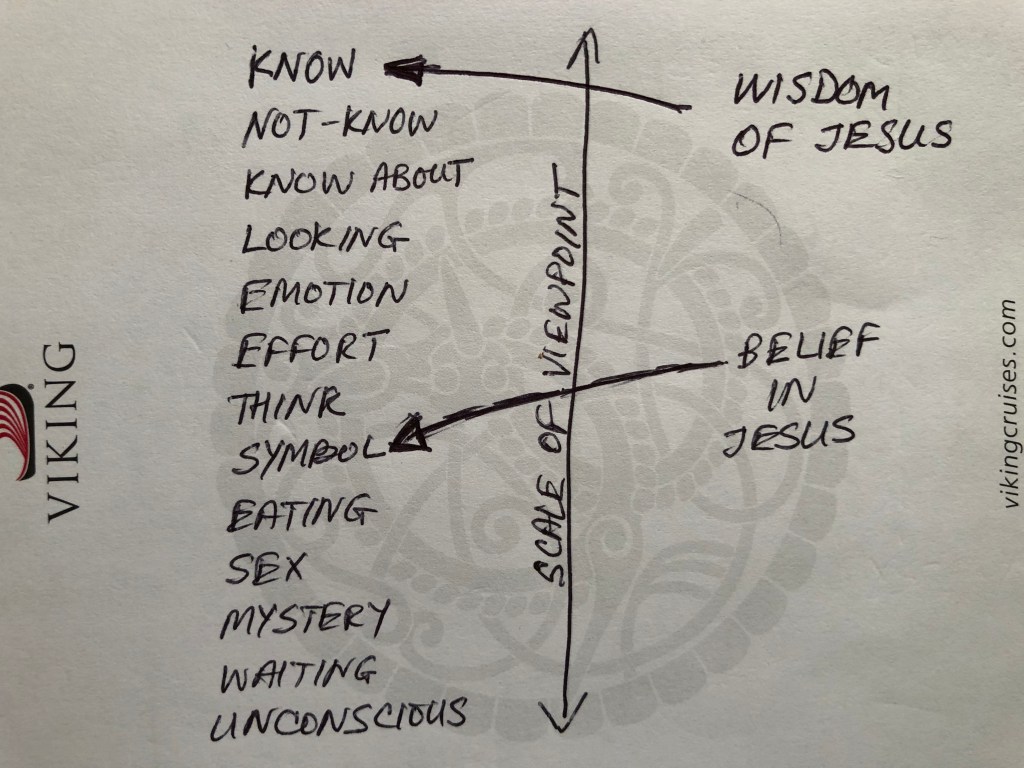
As the person as-ises his considerations, his viewpoint moves up toward KNOW. As he alter-ises his considerations, his viewpoint moves downwards toward MYSTERY. Too much alter-is-ness leads to not-is-ness (unreality) and unconsciousness.

When two people are communicating, each has his own reality about what is there. As their viewpoints move up the scale toward KNOW their reality converges. As their viewpoints move down the scale, their reality diverges even when they may agree on the same misperceptions. As viewpoints diverge, they increasingly apply force on each other. To move back up the scale, a person should simply hold back the incoming force without applying new or more force, and then practice as-is-ness to nullify that force.

At the top of this scale the observer (VIEWPOINT) and the observed (UNIVERSE) merge into one. This results in a Universal Viewpoint observing itself. Hubbard defines it as STATIC. This is Buddhist NIRVANA.

.

BIBLE: MATTHEW (Chapter 2)

Reference: Religion

[NOTE: I present here my interpretation and understanding of some of the religious texts.  I apologize ahead of time if my presentation does not quite agree with the traditional interpretation. I welcome any discussion and consequent correction.]

.

BIBLE: MATTHEW (Chapter 2)

Verses 1 to 12 narrate the renown of Jesus right from his birth as the king of Jews. This summoned wise men from the East (by means of a new star) to worship him. It also alarmed King Herod of Judea.

Verses 13 to 18 narrate that Joseph, the father of Jesus, realized that Jesus was in danger. So, he, with his family, moved to Egypt. When King Herod heard of this escape, he ordered all boys in Bethlehem and its vicinity, who were two years old and under, to be killed.

Verses 19 to 21 narrate that when Joseph found out that King Herod had died, he returned to the district of Galilee, and settled in a town called Nazareth.         

A close up of a map

Description automatically generated
Judea and the district of Galilee

This account emphasizes magical events, stark portrayal of evil, and fulfilling of earlier prophecies. Believers may take this story to be factual, which in their mind, adds to the mystique and, therefore, divinity of Jesus. Here we are seeing a viewpoint that is operating in mystery. It has a tendency to equate mystery with divinity.

From Wikipedia:

“Most modern biographers of Herod, and probably a majority of biblical scholars, dismiss Matthew’s story as an invention. Contemporary non-biblical sources, including Herod’s friend and personal historian, Nicolas of Damascus, provide no corroboration for Matthew’s account of the massacre, and it is not mentioned in the Gospel of Luke. Classical historian Michael Grant states “[t]he tale is not history but myth or folk-lore”, while Peter Richardson notes that the story’s absence from the Gospel of Luke and the accounts of Josephus “work[s] against the account’s accuracy”. Richardson suggests that the event in Matthew’s gospel was inspired by Herod’s murder of his own sons.”

As an overview, the wisdom taught by Jesus is wonderful and it speaks for itself. The question arises, “Why must such mystique be attached to Jesus?”

In my opinion, it may have been difficult for the Church to convey the wisdom of Jesus to illiterate people. So, mystique was added to attract attention. This seems to be the case with all religions in general.

.

PHOENIX LECTURES: Chapter 5

Project: Hubbard 1954: The Phoenix Lectures

This paper presents Chapter 5 from the book THE PHOENIX LECTURES by L. RON HUBBARD. The contents are from the original publication of this book by The Church of Scientology (1954).

The paragraphs of the original material (in black) are accompanied by brief comments (in color) based on the understanding from Buddhism.  Feedback on these comments is always appreciated.

.

CONSIDERATION AND IS-NESS

Now here is the most fundamental fundamental that there can be fundamental below the level of consideration. I haven’t written very much about considerations. There really isn’t very much to say about the subject of consideration. If anyone is confused on the subject it is because consideration is consideration and all things are a consideration of the consideration so that if you consider something which is considerable, why — you have considered it.

A consideration is simply what you have considered.

Phenomena such as space and energy, time, matter and so forth are produced on the basis of consideration.

Matter, energy, space and time are the broadest and most fundamental considerations that you are using to define the universe.

Consideration of A is senior to A. Consideration of R is senior to R and consideration of any and all parts of C are of course senior to any and all parts of C.

When you’re dealing with A, R and C (Affinity, Reality and Communication) you have entered into a very early level of anatomy as far as the business of life is concerned, but you are not into the first and immediate level of anatomy as far as mechanics are concerned.

A, R and C (Affinity, Reality and Communication) are also fundamental considerations that you are using to define the business of life.

There is a level lying between considerations and A, R and C and this is Is-ness. It’s the consideration of Is-ness. Things are because you consider that they are and therefore something that is, is considered is. If you don’t consider that it is, it of course can be considered to be something else. But if you recognize that it is a consideration you only have to recognize that it is. And if you recognize that something is, then you have recognized merely that it is a consideration. As soon as you have recognized that something is, IS, you have reduced it to a consideration, and that’s that. One has affinity because he considers he has affinity. One has reality because he considers he has reality. One has agreement because he considers he has agreement. One has disagreement because he considers he has disagreement. One has a Dynamic (A Dynamic: any one of the eight subdivisions of the Dynamic Principle of Existence — SURVIVE — which are: The urge to survive as, or to the survival of, (1) Self, (2) Sex and family, (3) One’s group, (4) Mankind, (5) Any life forms, (6) MEST: Matter, Energy, Space, Time — the physical universe, (7) Theta, spirit; the Thetan, a spiritual being, thought, etc., (8) Supreme Being — the “Infinity Dynamic”) — one has a Dynamic because one considers he has a Dynamic.

IS-NESS is how we see the universe. It is made up of our considerations. The is-ness of the universe is directly related to our viewpoint. When we look at things really up closely, we find ourselves staring at our own considerations. Matter, energy, space, time, affinity, reality, communication and dynamics are considerations extended from a viewpoint to form the IS-NESS of the universe.

Any of the eight parts of the Dynamic Principle of Existence, any part of the Cycle of Action, of Create-Survive-Destroy, of Affinity-Reality- Communication (The ARC Triangle), the Chart of Attitudes top and bottom — (Chart of Attitudes: a chart on which in 1951 L. Ron Hubbard plotted with the numerical values of the Emotional Tone Scale the gradient of attitudes which fall between the highest and lowest states of consideration about life. Example : top — CAUSE; bottom — FULL EFFECT.) the entire scale of emotions (The Emotional Tone Scale), the Know-to-Mystery Scale (Know-to-Mystery Scale: the scale of Affinity from Knowingness down through Lookingness, Emotingness, Effortingness, Thinkingness, Symbolizingness, Eatingness, Sexingness, and so through to not-Knowingness — Mystery. The Know-to-Sex scale was the earlier version of this scale) — all these are preceded by a consideration. In other words they are postulated into existence. But right with consideration we have the most native and intimate mechanic which precedes all other mechanics and that mechanic is Is-ness. We have to consider that we can consider before we can consider an Is-ness. One considers that one considers and therefore what one considers is, IS!! Anything that is, is considered as being. What is, is, as it is considered to be.

We have a scale of Dynamics from Dynamic Eight narrowing down to Dynamic One. And a scale of Affinity from Knowingness narrowing down to Mystery. The viewpoint of a person lies on these scales. The considerations of this viewpoint create the corresponding IS-NESS of the universe for that person.

Now the moment you recognize, then, the Is-ness of anything, it will disappear. To have something, to have anything over a long period of time particularly, you have to beware of recognizing what it is. Because if you look at it with a recognition of what it is, simply its Is-ness, this simple recognition will of course vanish it. So you have to be careful, if you want something, not to recognize what it is. Now one of the best ways to have something for a long time is to put something in your pocket and then forget that it is there and you’ll have something in your pocket. You’ll have something in your pocket even though you’ve forgotten it’s there. And that’s the safest method of possession, to forget that you have it, because if you remember that you have it you won’t have it.

Now this would all be hopeless if there weren’t another factor way above consideration, and that is Knowingness. You know anything you want to know and you know anything that has gone on.

Hubbard says, that if you recognize the is-ness of anything, it will disappear. This requires the slight modification as follows. As you recognize something for what it is, any misinterpretation disappears, and the is-ness improves. The viewpoint rises up on the scale. hen all misinterpretations disappear, you attain the knowingness of the universal viewpoint.

Now let’s take the person who is using facsimiles (Facsimile: A mental image picture) in order tell him what has happened. He looks at the facsimile, the facsimile has certain pictures and symbols in it, so then he knows what took place. Well, he had to know what took place in order for a facsimile of that incident to be created. Now, he did know what took place, so he could create a facsimile of the incident, and he does this on an unknowingness level. And above this level he can then look at the picture and know what took place. But he had to know what took place before he made the picture.

Now if the picture was gone utterly and completely he would still know what took place, unless he had the consideration that he has to have a picture in order to prove to himself what took place.

The “facsimile” is the filter that the person is looking through. It determines the persons considerations. The “facsimile” is, therefore, embedded in the viewpoint. It fixes the position of the viewpoint on the Know-to-Mystery scale. When the “facsimile” is gone, the fixation of the viewpoint disappears. It knows what took place, but his viewpoint is not controlled by it.

Anybody would know anything that was going on if he didn’t have to prove it. Proof, conviction, is itself a very early level of aberration. As soon as you have to start proving things and convincing people of things, why then you have to get into agreement with them and in order to do this — you have to Alter-is. You have to have something persist long enough for them to see it, so that they can then understand what it is. So in order for them to really understand what it is you can’t possibly put up something that they understand what is, because if they saw completely what it was it would disappear, so you would not have been able to have proven it.

You can’t prove something to a person who has a fixed viewpoint. He will just see what he wants to see and ignore what he doesn’t want to see. If that person really wants to see, then he must first be willing to look from other viewpoints. If he is not willing to look more closely at his own or other viewpoints, he would never be able to see or learn anything new.

I hope you follow this very closely! Because actually what I am talking about here makes sense easily if strung together and looked at in a rational way. But if you try to Alter-is it, if you try to change it around, then you’ll be able to remember it perfectly, but if you merely accept exactly what I am saying at each and every point, you know this already, so it won’t exist. Now this is a very bad thing, I realize, so the best thing for me to do would be to color, if I really wanted this material to be remembered, to color the material so that it appeared to be something else than what it was. I could do that, for instance, by talking about your egg libidol, and your re-conscious. I could quote authorities who didn’t exist. That’s always best, you know. That’s really a curve, you see. Nobody could ever see those, so they can’t ever disappear. And I could quote these authorities which didn’t exist but which you couldn’t disprove and we could go on about the counter-reflex of the seratopol palsy and the og libidol, the bog libidol, the sog libidol and the mog libidol and how we would categorize these things as explanatory to the behavior of a feeshee preservation on the part of young alligators, and this nonsense of course would then be utterly comprehensible because it could be so remembered in every detail particularly if it were altered from what I was really talking about — in trying to talk to you about turbo-electric systems, for example, with that amount of data injected into it.

We could go that far afield and you would find that you would start hanging up on these non sequitur facts. You have experienced this sort of thing.

When you alter the datum from what it is, it generates confusion; but when you explain it for what it is, it becomes understanding. The confusion always persists but the understanding simply assimilates into the background of knowledge. One way of generating confusion is forcing somebody to accept a datum by quoting authorities instead of explaining what it is.

As a person becomes unable to recognize the Is-ness of things he can’t get jokes any more. Every datum that comes in must have a significance. It never occurs to him that it doesn’t have a significance, and he is sure there must be a deeper significance so that something will remain. This accounts for the badly jammed facsimile bank (Facsimile bank: mental image pictures; the contents of the reactive mind; colloquially, “bank”) of an individual, particularly when that facsimile bank of the individual is badly jammed.

He will add significance to everything and he will certainly achieve a preservation of data. He, in adding all that significance to things, is Alter-is-ing. So he gets: preservation of facsimile bank.

As a person becomes unable to recognize the As-is-ness of things he can’t get jokes anymore. Everything becomes significant to him and he can neither assimilate nor reject something outright. Added significance is Alter-is-ness. This accounts for too many things jammed in the head.

Now let’s look at the various categories of Is-ness. We find that each one has a gradient scale and first there is As-is-ness. This is the first level that we encounter and is actually the disappearance level.

As we are content with and can accept things as they are, they won’t exist. That is absolute.

Why? The simple recognition of their existence would blow them into a consideration. A wall. What wall? When we really know what a wall is, there isn’t going to be a wall. That’s As-is-ness, and we can see that mechanically. We have a lower, mechanical strata on that which is a perfect duplicate. If we make a perfect duplicate of a wall — boom — no wall. All right, that may be just for the thetan but it’s certainly no wall. Anyway, I at least will lead you down the track to believing that you are not about to destroy the physical universe.

I wouldn’t want you to shy off from the processes which come from this data just because they knocked out the physical universe.

When we recognize the As-is-ness of something we can easily reject the alter-is-ness. The simple recognition of the Alter-is-ness blows it as unnecessary significance. Thus, any misinterpretations immediately disappear. This is the level of AS-IS-NESS.

The physical universe is knocked out as an unnecessary significance when one realizes that the division of universe into physical and spiritual (thought) was arbitrarily introduced by the Greeks. There is only one universe that has physical and spiritual aspects well integrated.

The next stage down the line from As-is-ness is Alter-is-ness, the effort to preserve something by altering its characteristics. We make it as a simple consideration and then we alter the method by which we made it. In other words “Let’s dodge on it.” Having mocked it up we will now dodge and say Joe mocked it up. Well this is just as far from truth as is necessary, to get something to exist, but you have altered an As-is-ness slightly in order to keep it from being perfectly duplicated in its own time, its own space, with its own energy and mass, thus ceasing to exist.

So we enter into the field of Alter-is-ness as a method of preservation. And one seeks, when he makes an object or a space, to get it to exist simply by saying somebody else did it, or it is a different kind of space, or its method of construction was different. The consideration is altered just enough so that one will get a continuation of it.

We say “God made it”, or anything that would throw somebody off this track. Well, supposing God did make it, that would be all right. It would then cease persisting if you looked at it recognizing that God made it.

When a significance is added to Is-ness in such a way that it cannot be disproved, we have ALTER-IS-NESS. This makes the added significance persist. For example, having committed an error the person blames it on others. That is enough of an Alter-is-ness for that error not to be resolved completely. The error, or added significance, will then persist in some form.

People get in to Alter-is-ness — simply by the experience of having had too many things disappear.

So we see a person who has lost many things then trying to change everything. He’s trying to shift the As-is-ness of everything. He’s trying to shift from As-is-ness to Alter-is-ness and he’s got to change the significances and structure and background and everything around him so that then these things will continue to exist, and that is his first impulse.

For example, we build a brick house and then cover it up with shingles, and then insist that it is built out of lumber. You would get into enough of an argument with people trying to buy the house who could observably see that it was not totally a lumber house for them to get upset and worried about it, and that house is likely to persist in one’s ownership for some time, if he just did that sort of thing. So we see Alter-is-ness then, totally mechanically, as a method of getting things to continue their existence, and that’s an important fact.

Although the nomenclature here is simply chosen at random it’s a pretty good nomenclature because it says exactly what it means.

The control case, the person obsessively controlling things, and himself, is an Alter-ist. He’s got to change, change. Well he’s lost too much. Now he’s got to change everything but he’s not satisfied with anything. If he were walking down the street in a limber and loose fashion he would think he had to walk in a tight fashion, etc. He’s become anxious about things disappearing so he of course has to alter everything he sees in order to keep these things from disappearing.

When a person has lost many things, his first impulse is to change the significances of everything around him so that a version of those things will continue to exist.

Now let’s get to the next category — Not-is-ness. Here is someone who has altered things up to the point where they are beginning to persist. In fact he’s upset about their continuous persistence. He doesn’t think this is a good thing, to have a black box staring him in the face all the time, or to have the walls of the room appear to be 180 feet tall although they’re only nine feet tall. It’s not a good thing, that Alter-is-ness, he has concluded. He has changed too many things and lost track. He isn’t quite secure about what the things were in the first place, he’s shifted them so often. He’s like the small boy who’s told so many lies that he can no longer remember what lies he has told and so he’s stuck with the lies — and so becomes a human being. Now the next step along that line, Not-is-ness, is manifested as and is in itself the mechanism we know as unreality.

NOT-IS-NESS is the mechanism we know as unreality. It occurs when a person has changed too many things and lost track. He isn’t quite secure about what the things were in the first place. He is, therefore, stuck with a sense of unreality.

There is a category of just plain Is-ness. This of course is not a bad thing. This, in its highest level, is what we call reality. But we could spell this with bigger and bigger caps. We could keep spelling “IS” there with bigger caps and bigger caps and finally give it an exclamation point — which would represent a psycho. There is a dragon in the middle of the room, and he knows this. There are many other things which he doesn’t know, but he knows this. If you ask him to mockup an anchor point to define a space, he makes a pyramid out of solid iron. And when he is asked to move one of his own mock-ups, a knowingly created object or space, he knows he doesn’t have that much strength. The world is too real.

Once in a while when somebody’s just about to kill you or cut your throat or eat you up or arrest you or do something of this sort you get an enormous flash of Is-ness, a recognition of the situation. Boy, this is it is real — GULP! A moment after that you’re likely to get or postulate an immediate reaction of Not-is-ness. “It’s not real”. A fellow will flare up and daze from Is-ness to Not-is-ness very swiftly in a sudden emergency.

The Is-ness (how things appear) of a person varies on a scale from the level of As-is-ness (reality) to the level of Not-is-ness (unreality) depending on how much Alter-is-ness he has practiced.

Now Alter-is-ness, Not-is-ness and Is-ness would be then the categories which can be aberrated but remember these are not basically aberration. They become aberration only when they go entirely beyond the ability of the person to re-recognize As-is-ness. When a person has lost his ability entirely to recognize As-is-ness, he’s gone. He’s stuck with and has only Alter-is-ness, Not-is-ness and Is-ness — all three, or one or two of the three — some such combination — with no As-is-ness left. Therefore, he gets everything persisting around him. He gets everything less and less changeable, and he goes into a dwindling spiral, because he has lost his quality of As-is-ness. That is all he has lost.

Have him touch a few walls. You just have him go around and touch walls for a little while and all of a sudden, he’ll say, “It’s a wall!” And right then he feels much better.

As-is-ness (seeing things as they are) is the cure for aberration. The basic nature of aberration is fixation. The more fixated a person is the more aberrated he is. As his ability to as-is develops he is able to look through his fixations and starts to handle his aberrations. As the person gets more in communication with the things around him, he starts to come out of any feeling of unreality.

He knows he’s in communication. Well, he has a case of Not-is-ness — “There are no walls” — or Is-ness — “There are walls all through the room and all through my mind and I have barriers everywhere, everywhere, everywhere”, or “There are no barriers anywhere, anywhere, anywhere”. Just variations of Not-is-ness and Is-ness. And you’ve now shown him that there were walls, and these were agreed upon walls and of course that’s way up scale because you have demonstrated to him something closer to an As-is-ness. Now each one of these is a gradient scale and you know that you can recognize poorly enough the actual As-is-ness of something. You just draw back just a tiny bit from the As-is-ness of something, in other words indulge in just a little bit of Alter-is-ness or just a little bit of Not-is-ness or just a little bit of Is-ness — making it a little bit more — and it’ll persist with great satisfactoriness. Of course, if you walk up to it and simply hit it with As-is-ness it’s not there anymore.

Follow this very carefully, because it’s quite important, and the technology which we’re using is elementary, and you discover that many philosophies could be adjudicated out of these four categories. And believe me, any philosophy there is has been adjudicated from these four categories. This is the make-route of all philosophy as well as all existence and you’re standing right there at the tiniest co-point between mechanics and considerations that we have so far attained.

Hubbard repeatedly says that whatever is there disappears with As-is-ness. But what really disappears are the misperceptions due to earlier Alter-is-ness. What remains finally is a KNOWINGNESS.

You could then develop many philosophies out of this and the first and most dangerous of them would simply be this one: “Well, I just have to accept everything as it is and therefore what we’re really supposed to produce out of this is an apathy, because if I had to accept everything as is there would be nothing left but apathy because if I can’t… or… something or other…, but I’ll go into apathy. Yeah, I know what the auditor wants, he wants me to be apathetic about the whole thing.” This is too easy a philosophy. This is the philosophy of Zeno. You can’t do anything about it so you might as well accept it and everybody go into apathy and cut his throat anyhow.

The philosophy extended by Zeno was, “You can’t do anything about it so you might as well accept it.” One may do that for the time being and bide his time until he knows enough to do something about the situation. But if this philosophy gets one into apathy then, probably, the person is closer to the Not-is-ness end of the reality scale.

We have an enormous number of things which we could say, list or categorize in terms of the philosophy of this and this is only one of those which will hit your preclear. You see he has to be able to accept his own restlessness before he can be restless. He has to accept his own dislike of things before he can dislike things. He has to accept something before he can have it, because he has to get back some As-is-ness before he can have any As-is-ness. He has to get back some As-is-ness before he can become fluid in his practice of As-is-ness, Alter-is ness, Not-is-ness and Is-ness.

The business of life requires that he be quite able in all four categories, not just As-is- ness.

You’re not particularly specializing in this. But when it comes to this universe you will discover that as you return your preclear to As-is-ness things disappear. That may be regrettable, it may be interesting, it may be this and that but those things too, just like opinions of art are merely considerations.

A person is aberrated because he has accepted that aberration. He has to start questioning that aberration before he can get rid of it.

Now the first step that we would adventure upon in this would be a step which would be immediately addressed to such a thing as exteriorization. Recovering the thetan’s ability to be, outside the body. You would merely in auditing find what part of the body was acceptable to the preclear. What part of the body was he able to accept as is. And we would go on asking this question and asking this question and asking this question.

We could vary it by asking what part of the body would he be at liberty to alter as to its position or shape.

Or what part of the body would be acceptable to him on an absent basis. What part of the body would be acceptable to him on a much more present basis — for instance, just a hand walking around all by itself.

Indicated processes. Actually, this processing is so good that you can almost take any part of it and just work with that. An indicated process on As-is-ness is simply done with that command, “What part of your body is acceptable to you?” or, “What part of the environment would be acceptable to you?” And you merely have him improve his considerations, and if he hangs up too long you could say, “Can you accept your dislike of …” and of course it just involutes. He could just watch it. It just sort of goes away. It’s terrible! The first thing he can recognize is the fact that he disliked the environment. All right. Well can he accept his dislike of the environment. The second he does this he has recognized the As-is-ness of his dislike; at which moment it will blow. You can get him to recognize the existence of anything as such and it’ll disappear. Just getting him to accept parts of the body on this simple auditing command, “What part of the body could you accept? Give me another part of the body you could accept” — there are tremendous comm lags on this. You could say, “How would it have to be altered for you to accept it?” or “What would it be fine to have absent about this body?” Then we can turn around and say, “What’s the acceptance level of your body about a thetan?” (Acceptance level: the degree of a person’s actual willingness to accept people or things, monitored and determined by his consideration of the state or condition that those people or things must be in for him to be able to do so.) He doesn’t do this by mock-ups, you understand. That’s the trick. Get him to concentrate on the actual body. Does it accept the thetan this way or that way or how? “What distance could your face tolerate to a thetan?”

The first aberration that needs to be handled is fixation on the body. In Scientology, this is called “exteriorizing the person”. Hubbard recommends the following commands. One may meditate on these commands under the discipline of mindfulness.

“What part of your body is acceptable to you?”
“What part of the body could you accept?”
“Give me another part of the body you could accept”
“What part of the environment would be acceptable to you?”

If it is difficult to meditate, you may then ask yourself,
“Can you accept your dislike of …”
“How would it have to be altered for you to accept it?”
“What would be fine to have it absent about this body?”
“How much is your body willing to accept you?”
“What distance to you could your face tolerate?”

All these questions simply get you to look at your body and the environment more closely and increase the communication.

What distance could your face tolerate to a thetan?” We already have this on exteriorization processing, but without this one fact stressed, which in this case makes the difference between a workable technique and a non-workable technique. What distance is acceptable? What distance would be comfortable from your face to the thetan? Where would your face accept a thetan? And the first thing you know you have spotted the preclear (the face seems to have spotted him) then he spots himself. But the whole thing would run out without any such complexity of command at all. You would merely ask him, “What is acceptable to you in the environment?” Look around, and simply go over it one item after another item and his considerations will improve, which is the modus operandi behind 8C Opening Procedure. Do this long enough on a preclear and he would find the entire environment, even working in it, certainly very, very acceptable to him. We could just continue to run this as “What part of the environment is acceptable to you?” and he would begin to check them off and he would eventually get down to his body and having gotten down to that and taken care of the space around the body — we’d take it by parts of the body — what parts of the body are acceptable to you, and just on and on and on — and he’d be out there standing in back of his head. Now that’s the easiest method of exteriorization I know and the method which I commonly use when I am balked by a preclear. It’s an easy and certain process. It’s a rather short process, really. You just ask him to pick up the As-is-ness of his environment and body and if he really recognizes it believe me, he will be outside. Once in a while he says, “Well, I really dislike” this and that. Run “Can you accept your dislike of it?” This’ll involute it, which is the only additional command I have ever used. So, we have As-is-ness, Alter-is-ness, Not-is-ness and Is-ness. All cases fall into these categories.

The bottom line is that you communicate through close inspection.

.

FINAL COMMENTS

A consideration is simply what one has considered. The ISNESS (appearance of the universe) is directly related to our viewpoint (see the diagram above). The basic consideration that we extend out from our viewpoint are of matter, energy, space, time, affinity, reality, communication and the dynamics. When we look at things really up closely, we find ourselves staring at our own considerations. The viewpoint lies on a scale of reality, from KNOW to MYSTERY.

As you start recognizing something for what it is (AS-IS-NESS), your misinterpretations (ALTER-IS-NESS) start to disappear, and your viewpoint rises up on the scale toward KNOW. When all misinterpretations disappear, you attain the knowingness of the universal viewpoint.

The IS-NESS of a person varies on a scale from the level of AS-IS-NESS (reality) to the level of NOT-IS-NESS (unreality) depending on how much ALTER-IS-NESS he has practiced. NOT-IS-NESS is the sense of unreality, which occurs when a person has changed too many things and lost track.

AS-IS-NESS (seeing things as they are) is the cure for aberration (fixation). As a person’s ability to as-is develops he is able to look through his fixations and starts to handle his aberrations.

.

BIBLE: MATTHEW (Chapter 1)

Reference: Religion

[NOTE: I present here my interpretation and understanding of some of the religious texts.  I apologize ahead of time if my presentation does not quite agree with the traditional interpretation. I welcome any discussion and consequent correction.]

.

BIBLE: MATTHEW (Chapter 1)

Verses 1 to 17 of this chapter trace the genealogy of Jesus from Abraham.

Abraham is the common patriarch of Christianity, Islam and Judaism. In Judaism, importance of Abraham comes from a narrative in which God revealed himself to Abraham and made a covenant with him. In Christianity, Abraham is the prototype of all believers, Jewish or Gentile. In Islam Abraham is seen as a link in the chain of prophets that begins with Adam and culminates in Muhammad.

From wisdom point of view, the importance of Abraham comes for his spiritual insights from God. As remarked in BIBLE: GENESIS (Part 1):

1. Heaven and earth are an extension of God because creator and creation cannot be separated from each other.

2. God is not a human like beingness. It is rather a deep abstract principle describing order precipitating from chaos.

Therefore, we shall simply say that the importance of Abraham comes from certain spiritual insights. There is nothing more mysterious about it.

Verse 18 talks about mother of Jesus, Mary, being pregnant through Holy Spirit. The word HOLY comes from the idea of being whole. The word SPIRIT originally referred to breathing or to life. Therefore, “Holy Spirit” refers to the very essence of life. The process of becoming pregnant and producing a baby is the very essence of life. It is looked upon as a miracle even today. This is indeed sacred. The Church gives it a special significance with regards to the birth of Jesus and makes it a matter of faith peculiar to Christianity.

Verse 20 talks about angel of the Lord appearing to Joseph. This is essentially Joseph having a realization about the ethical thing to do, but the Church again adds mystery to it.

We see in this chapter mystery and belief being entered into a human narrative to give it a special significance. The believers in this mystery may argue, but there is no more significance to it from the point of view of wisdom. Wisdom is what we need to apply in our daily lives to advance spiritually.

.

PHOENIX LECTURES: Chapter 4

Project: Hubbard 1954: The Phoenix Lectures

This paper presents Chapter 4 from the book THE PHOENIX LECTURES by L. RON HUBBARD. The contents are from the original publication of this book by The Church of Scientology (1954).

The paragraphs of the original material (in black) are accompanied by brief comments (in color) based on the understanding from Buddhism.  Feedback on these comments is always appreciated.

.

CONSIDERATION, MECHANICS AND THE THEORY BEHIND INSTRUCTION

Here we go into some items quite rapidly which we find are of considerable importance to us in Scientology. It is demonstrable material, or doctrine. This is the basic theory which underlies instruction and indoctrination. 

Considerations take rank over the mechanics of space, energy and time. Considerations are senior to these things. 

These mechanics are the products of agreed-upon considerations which life mutually holds. The reason we have space, energy, time, objects is that life has agreed upon certain things, and this agreement has resulted in a solidification. And so our agreed-upon material is then quite observable. 

We have awareness and we are aware of things. We use considerations to define THAT, which we are aware of. We refer to the entirety of THAT as the universe. Hubbard is separating considerations from the mechanics of space, energy and time; but space, energy and time themselves are broader and more fundamental considerations. These fundamental considerations may be held individually, however, education brings us into agreement over them.

Mechanics have taken such precedence in Man that they have become more important than the considerations. “Doesn’t matter what you think,” is the theme. The mechanics of space, energy, objects, time, rooms, houses, earth, electricity, Ivory Soap — these things have a greater value than Man’s considerations. In other words, Man has become inverted. Having agreed upon these things so long — that they are so solid — he is now below the level of making agreements upon them, so his considerations do not apparently pack as much power as his immediate environment. This is what over-powers a man’s ability to act freely in the framework of mechanics although he invented them. His considerations are now of less impressiveness than the mechanics with which he is operating. The agreement is more solid than his new consideration. And so as he makes a new consideration he runs into the mechanics of existence — his agreements with people, space, energy, objects and time. 

All these considerations together make up a whole (consistent, harmonious and continuous) universe. To work with this universe we need to be aware of it as it is. The reason our postulates and considerations do not have power, is not because, as Hubbard says, “mechanics have taken precedence over considerations”. It is because any kind of fixation, reinforced by agreement, makes us unaware of what is really there.

A primary goal of processing in Scientology is to bring an individual into such thorough communication with the physical universe that he can regain the power and the ability of his own postulates. We discover an individual in an inverted state — that is to say, his considerations have now less value than the wall in front of him. And in processing, for example, in Opening Procedure 8C, we put him into sufficient communication with the wall that’s there in front of him — that he can then see that there is a wall in front of him. And at that exact point he has graduated upstairs, you might say, to a cognition of what his postulates have created. He can go on from there and can graduate up to where his considerations again have precedence over mechanics. 

In Scientology a primary goal of processing is to bring an individual into such thorough communication with the physical universe that he can regain the power and the ability of his own postulates. In Mindfulness the primary goal is to broaden the viewpoint by removing fixations so he can see things as they are. This can be done by bringing the individual into thorough communication with the difficulty.

The mechanics are so much in his road, they are such observable barriers, that he has become unacquainted with them. 

It is not the mechanics (energy, space and time) that, as Hubbard says, are in the road; but it is the fixation of the viewpoint, as it narrows, which becomes a barrier.

Now it would seem as if it shouldn’t be necessary to do this at all. All one would really have to do would be to get an individual simply to change his mind — all of a sudden to have an individual who could change his mind — but that is just not the way it is. It just doesn’t work out that way. The principle here is: get an individual into thorough communication with something, and then, when he has lost his fear of it, is no longer flinching, to demonstrate to him that he can change his mind about it. 

Both in Scientology and Mindfulness, the practice is pretty much the same, which is, to get an individual into thorough communication with something so that he is no longer afraid of it and can really see what is there. Only then he can change his mind about it.

But unless you get him over his blindness, his unreality about something he’s already agreed to, he is working against himself — he’s fighting his own agreements. He has agreed that there is a wall there so there’s a wall there — and now he’s fighting that agreement, and he’s saying there is no wall there. He is fighting his own postulates, so his own postulates are therefore very weak. Because the wall is there — that’s his own postulate. And now without undoing that postulate, he’s trying to change his mind about it and say “There is no wall there, there is no wall there”. And there is a wall there, all right. 

There are walls in this universe, but if a person is operating on a fixed belief that there are no walls, then he would be running into difficulties, simply because he is not seeing things as they are.

So this is the state in which we find Man. He has agreed that there is a physical universe, and then having agreed upon it he’s sorry about it and now he wants to change his mind about it but to change his mind about it would make him wrong. An individual who has already said that there is something there, if he now says, without changing the first postulate, that there is now nothing there — of course he has got to make himself wrong before he can be right, and if you’re wrong, your postulates don’t stick. That’s what Man is up against. 

Hubbard is assuming that the universe is the result of a person’s considerations. But the universe is something that includes the person as well. We are simply using our considerations to describe that universe. It is not just the “physical universe”. To ascertain what is really there, we need to examine our own considerations for anomalies and straighten them out.

Scientology is the science of knowing how to know answers. That’s extended a little bit. We have defined it as the science of knowing how to know, but we’d better say what we’re trying to know. We’ll just add that it’s the science of knowing how to know answers. 

In mindfulness, we are resolving anomalies in our in own considerations to understand what the reality is.

A Scientologist is expected to be able to resolve problems in a great many specialized fields, of which auditing is the first field he addresses. If you know the principles such as, for instance, the principle of A-R-C (Principle of A-R-C: The “A-R-C” triangle is Affinity, Reality and Communication. The basic principle here is that as one raises or lowers any of the three, the others are raised or lowered, and that the key entrance point to these is Communication) — when you know this as the modus operandi and the mechanism of agreement (which has been agreed on itself) you can do many things. You can take an organization, an industry, a store, a troop of Boy Scouts, or whatever, and you will certainly know “how to straighten out this mess”. 

You are using communication when you are examining something closely. You resolve problems by examining the considerations in an area. For an individual, it is the individual’s consideration. For a group it is the group’s consideration expressed as agreements or policies.

We know the anatomy of confusions: an unpredictability, followed by a confusion, which then goes into a mystery. There is a mystery because someone didn’t predict something and this made them wrong. The only reason a person thinks things are mysterious is that the amount of unpredictability became too great. So he closed it all off and said: “It’s a mystery!” and, “I now don’t know anything about that”. 

The anatomy of confusions is: an unpredictability, followed by a confusion, which then goes into a mystery.

If an individual knew that, and ARC — a few of the principles and applications of Scientology — he would see that in the case of this troop of Boy Scouts or this business or this disaster area, or anything else that he might be dealing with, it would be necessary to bring the individuals in it to follow a certain pattern in order to regain a communication, and having regained communication, why, he knows that other matters would remedy themselves. He would not have to be an expert in turbines to straighten out a factory which made turbines. All he’d probably have to do would be to get management in touch with the foreman and the foreman in touch with the workman and the workman in touch with the management, and the plant would make turbines. He would be a specialist in knowing how to know answers but this does not mean that he would have to accumulate an enormous amount of specialized information. What he would do would be to get the people who had the specialized information and put them into communication and the job would get done. 

To straighten out the mess in a group, the “considerations” in the group must first be examined for anomalies. Any anomalies found must be resolved and the results issued as policies. Then the members of the group are put in thorough communication with those policies so they can predict group’s actions. One does not have to be an expert in turbines to straighten out a factory which made turbines.

The world is every day more violently impressed with mechanics. The little wheel that goes spin, spin, spin is far, far more important than the little boy who is going spin, spin, spin. The care of the body and the transport of the body, the conducting of electricity — these are far more important than any activity of Life itself. The world is terribly impressed with space and energy and machines and objects which, any of them seem to be more important than a mind — the mind which makes them. And this is curious, but it brings a person down, as he gets more and more impressed with mechanics, to lower and lower levels of being mechanical. So, if you could conceive it, the individual, the thetan, a life-energy-production unit, has actually dropped out of sight to such a degree that people don’t even know they are one any more. Now that is attributable to a dependency on mechanics and the validation of mechanics. It isn’t that you should just withdraw from mechanics and leave them all alone and let’s all go off and quit. No, an individual has to be put back into communication with them, mostly because he’s afraid of them, and after he’s done this he says, “Now, lookee here, I don’t have to depend on these things. That’s nonsense!” 

And the next thing you know he has regained some of his own power and ability. 

The problem today is the dependence on mechanics. In other words, we are terribly fixated on the fundamental considerations of energy, space and time without understanding them. The solution is to get back in communication with these fundamental considerations until we are not afraid of them. And the next thing we know we have regained some of our power and ability.

Now, when it comes to atomic fission, there is produced in this society an enormous mystery. It couldn’t help but do so. It’s unpredictable. The first bomb, for example, was dropped without any warning and this was certainly an unpredictability. Nobody even knew one was being made. That’s nice and unpredictable, isn’t it? So that the world is living in an expectancy of an unpredicted atomic attack. Well, that looks interesting, too, doesn’t it? No more unpredictability. Now let’s take up subject of confusion a bit further. 

What do you suppose is the picture of all of these electrons and protons and morons exploding in all directions on a random pattern — would you possibly look upon that as a confusion of particles? What would be your chance, by the way, of tracing each of these particles individually, all through the entire mass? Well, your chance of doing that, if you’re in very good shape, is very good. But Johnny Q. Public knows that he can’t trace one card while it’s being dealt across the table (that’s what card sharks thrive on) and much less billions, and billions to the billion power, electrons and morons exploding all over space. And that is a confusion to him. So here you certainly have an unpredictability and then a confusion. 

What follows is mystery. And so we have everybody being very secret about all the formulas of fission. They’re only available in all of the library text books that are in all of the libraries in all the world. They’re very secret. They are so secret, that the notebooks of anyone who has taken a course in nuclear physics abound with the basic formulas, the material of atomic fission. It isn’t something suddenly discovered. They just decided to do it. It took billions of dollars to do it and it took a long time for somebody to put up that much money. But they’re being very secret about formulas that have been public property — some of them — for fifty years. And all of the material that the U.S. had on the manufacture of the atomic bomb has already been transported over to Russia by spies, who were since executed for it. So who are we keeping it secret from? Well; maybe we’re not keeping it secret from anybody. Maybe it’s just a mystery because it is unpredictable and confusing and therefore we’d better lower all our communication lines — and before you know it, government is going to be almost totally out of communication with its own people, just on this basis. You get more and more cut communication lines. There’s a big mystery building up. Well, how would you solve this? The way one might solve it would be to simply point out the fact to the government and to people that atomic disaster was not going to ruin the entire world and that if you accepted the disaster and predicted what was going to happen, then you could resolve the situation. Next, one would ask that the study of the manufacture of atomic fission be made a third or fourth grade subject, and get the children indoctrinated into this great mystery immediately — so it wouldn’t scare the kids. Actually all they’re doing is scaring the kids these days — which is not an honorable activity for big, grown men. 

Hubbard says, “The world is living in an expectancy of an unpredicted atomic attack.” This has produced confusion and mystery in the world (1954). The knowledge of atomic fission and manufacturing of atomic bombs has not been a secret for a while, but this whole subject is being made into a mystery. The confusion about atomic explosion may be resolved by understanding the mathematics of atomic fission. The rest of the mystery may be resolved by explaining the scope of atomic disaster so that  the situation becomes predictable.

Now the role of Scientology is, to impede any disintegration which is going on the realm of knowingness. Just to impede it. But if a disintegration does occurr, why, people who know Scientology ought to just be ready to pick up the pieces. You could have a society so organized and with such enlightenment and so functioning that it didn’t disintegrate people so quickly. 

You could have one where freedom itself could be achieved. 

But if you, all of a sudden, were looking at the complete smearing of a state or a country or a nation, you still, knowing the principles of communication — and just what a trained Scientologist knows — could play a very large role in picking up the pieces resulting from any disintegration. 

The disintegration you would be dealing with would be one not of mechanics but would be a disintegration of knowingness. 

The important thing is to know the principles of communication, because you apply these principles to examine situations and to impede the disintegration in the realm of knowingness or wisdom.

Now as far as any politics would become a concern of Scientology, I would say off-hand that it would probably hew to a democratic line — not Democratic Party — but democratic principles — because of our datum of self-determinism, but that does not make Scientology necessarily possessed of a political opinion. A body of knowledge cannot have an opinion on something. It simply extends what is found to be true, wherever it is found to be true — into greater truths. That’s all. And if something is true, that’s all right. And if something is false — well, one simply recognizes that it is false. So far as political opinion is concerned, Scientology as such, could not have, and does not have one. It knows that certain types of government could be very disintegrative to a people. It knows, for instance that facism, military control of areas, and so forth, would result in a knockdown of communication lines, which would be very, very unhealthy for that particular area. 

But this is in the field of Scientology, not in the field of politics. And one should remember well that Scientology has no political opinions or allegiances. If one political practice works better than another one, according to Scientology, that’s fine, but what’s working is Scientology — not the political practice. Don’t ever get detoured on this one, because if you do — you get lost. 

In politics, the idea of self-determinism leads to democratic principles (not Democratic party). Such principles simply extend what is found to be true, wherever it is found to be true. Scientology and mindfulness do not have any political opinion. But they know that a government that knocks down communication lines is disintegrative to a people. Political practice works better when the principles of Scientology are being applied.

Now the next one that comes up is — does Scientology have any religious conviction? Well, again we have the fact that a body of data does not have an opinion. I’ve known a lot of witch doctors who make more sense than a lot of priests. And I know a lot of priests who make more sense than a lot of preachers. I’ve seen the historical records and found that the Roman Empire didn’t kill many Christians. As a matter of fact in one year of that confusion Christians killed more Christians in the city of Alexandria than the Roman Empire executed during all its existence. One hundred thousand Christians were killed in one year by Christians in Alexandria. Well that’s because of a conviction — force without wisdom. There must have been some kind of a conviction running counter to some kind of a conviction, and — as far as having an opinion on this sort of thing is concerned, you can look at it on the basis of: this demonstrates that there must have been real bad ARC around there someplace! But beyond that it might be slightly amusing to you as a datum but it actually means nothing in relation to the body of data. 

So a Scientologist’s or anyone’s social, religious and political convictions would be those that he held to be true and that he had been oriented to. Trained to be democratic in his viewpoint, and trained to be a protestant, why then he’s certainly democratic in his viewpoint, and a protestant, unless he sees fit to alter his convictions to some degree because a greater wisdom seems to have penetrated those very convictions. What would he do in that case? He’d probably simply modify for the better his convictions. 

Scientology does not have any religious convictions either because a body of data does not have an opinion. Religious convictions can be very destructive when they use force without wisdom. Scientology only helps improve one’s social, religious and political convictions through communication and greater knowingness.

But one of the oldest things that was ever given into the training of wise men that I know of was simply this — the basic faith in which the individual has been trained and the basic political allegiance of the individual must not be tampered with by the Order training him. And it was the Order itself which laid that down. That’s an old, old one. They were training very wise men and that was the first thing that they made sure not to do. They did not tamper with these things. If the individual cared to alter these things himself nobody was going to tell him to or tell him not to. Nobody was even vaguely persuading him. It might be in the course of his study that he found certain things that men did laughable, or confusing, or he found certain things that men did remediable — but nobody was standing there trying to lead him into a higher religious or political conviction. And that is the case with Scientology. 

If you were to teach a tribal population on the banks of the Yap-Yap River Scientology, and they believed in the Great God Boogoo-Boogoo you would just be wasting your time to start in by training them on the basis that the great God Boogoo-Boogoo was nine feet tall not twelve feet tall. That’s about all you’d probably accomplish, too. You’d probably convince them he was not quite so tall, or something of that sort. A Scientologist has no business fooling around with a savage tribesman’s political or religious convictions or a very, very cultured, super-cultivated Oriental Potentate’s religious or political convictions. His customs are definitely his. You would produce at best new convictions, but that’s force, and that’s not the way to free a thetan! 

There are very, very many ways to live. All of them can be derived from the same source and the same sources. Just because they can be so derived doesn’t mean they’re not different, one from another. So Scientology does not tamper with an individual’s religious or political convictions. The total empire of a Scientologist and of Scientology and its organizations is an empire of wisdom. 

Scientology does not tamper with the basic faith and political allegiance in which the individual has been trained. If the individual cares to alter these things himself nobody is going to tell him to or tell him not to. The total empire of Scientology and a Scientologist is an empire of wisdom.

Now on the basis of mechanics, an auditor is expected to follow the Auditor’s Code of 1954. That is a very solid compilation of things an auditor can do wrong and it says don’t do them. Each one of those things has considerable importance. There is the one which tells you to run an auditing command until the Comm Lag is flat (“Comm Lag is flat”: Comm Lag is Communication Lag: the time it takes for a preclear to give an answer to the exact auditing question or to carry out the exact auditing command. “Flat Comm Lag” is the point at which the auditing question or command is no longer producing change of communication lag). And then there is the one which tells you to run a process until the process is flat. (“Process is flat”: A process is continued as long as it produces change and no longer, at which time the process is “flat”). 

These are the two most important parts of that Code. Very, very much the two most important parts of the Code. You should know that Code. It was put together to keep us from making mistakes. It depends for its authority only upon this — that when it is disobeyed in processing an auditor has a lot more work to do. That’s its total authority. It enforces itself. 

In mindfulness meditation, the equivalent of Auditor’s Code is the discipline of mindfulness, such as, observing the natural reaction without interfering with the mind. Auditor code is useful when you are interacting with others.

Not so the Code of a Scientologist. The Code of a Scientologist is put together on this basis: an aberrated society has in it a few who would try to keep the organization and organizations of Scientology from doing their job — by cutting their affinity lines. And the first part of the Code of a Scientologist, To hear or speak no word of disparagement to the press, public or preclears concerning any of my fellow Scientologists, our professional organization or those whose names are closely connected to this science, is simply an arbitrary slid in front of that one. When we don’t allow our affinity lines to be cut, auditor to auditor, auditors to organizations, and organizations to auditors, we certainly thrive much better and we survive much better and we are certainly a lot happier. And as we go down the line, on the various parts of this Code, this again is simply knowledge which if we had started following from the very beginning, we would have had far less difficulty than we sometimes have had. 

And the last paragraph of the Code of a Scientologist says don’t engage in unseemly disputes on the subject of Scientology with the uninformed. That is no effort to keep the material of Scientology closed up. That’s not what it’s about. We keep the lines open and flowing. But when somebody comes along — perhaps he’s a major in Phrenology at the university of something or other — and starts protesting, “Well, I don’t believe,” and “Is your conviction…?” — why don’t you just start talking about the weather. That is, please, an invitation not to go into a fight on the subject of demonstrating to somebody who doesn’t have any awareness to talk to anyhow — all about Scientology. We have always gotten ahead faster when we haven’t sat down and entered into verbal fisticuffs with everybody who disagreed with us on the subject of Dianetics and Scientology. He hasn’t any information on it, and now you’re going to sit there and give him a complete Professional Auditor course? Well, do you have any idea of how much work and organization it requires to bring somebody up along through the level of HCA? (HCA: Hubbard Certified Auditor) A lot of work is expended to bring someone that far. Nowadays, with codified training, it can be done easier, but you’re not going to do that in a drawing room. And this part of the Code says in effect: please recognize this and don’t make the party awful for eight other people while you and a psychology student argue. 

A reporter comes in — he “wants to know all about it,” although he’s going to write something different entirely or more likely — his story is already written before he comes to “find out all about it”. He comes from a profession which works this way. You’ll do best telling him all about the weather. You should never depend on anybody’s industry with regard to a society at large or carrying the word in the society. Never depend on anyone’s industry but your own. Other people, organizations and so forth are going to help you all they can. But don’t depend on that help. Depend on yourself. 

The Code of a Scientologist is intended to protect the organization from the aberrations in the society around it. But it does not help eliminate aberrations that have entered Scientology organizations. An important part of this code is Don’t get into dispute with a person who does not have enough awareness on a subject. Finally, never depend on anyone’s industry but your own with regard to a society at large or carrying the word in the society. Depend on yourself.

.

FINAL COMMENTS

Here Hubbard is separating considerations from the mechanics of space, energy and time; but space, energy and time themselves are broader and more fundamental considerations. Together, these considerations make up a whole (consistent, harmonious and continuous) universe.

It is not the mechanics (energy, space and time) that, as Hubbard says, are in the road; but it is the fixation of a narrow viewpoint, which is the barrier. The primary goal of spiritual advancement is to broaden the viewpoint by removing fixations so he can see things as they are. We do this by bringing the individual into thorough communication with the difficulty.

The problem today is the dependence on mechanics. In other words, we are terribly fixated on the fundamental considerations of energy, space and time without understanding them. The solution is to get back in communication with these fundamental considerations until we are not afraid of them. And the next thing we know we have regained some of our power and ability. The important thing is to know the principles of communication.

Scientology does not have any convictions of its own. It simply helps improve one’s social, religious and political convictions through communication and greater knowingness.

.