Matter & Void

The first thing we observe about the concepts of matter and void is that there is assumed to be a sharp discontinuity at the interface between them. Since objectivity follows the law of continuity, we expect matter not to stop abruptly, but to thin out gradually, until there is complete absence of matter (void). We, therefore, need to examine the interface between matter and void more closely.

.

Matter

We use a more general term “substance” for matter because, matter is substantial to us to the degree it impacts our senses. Basically, matter is a phenomenon that we sense through our five physical senses. Then we use the mental sense to combine the input from those physical senses to arrive at deeper understanding. This has led us to the discovery of the atomic nature of matter.

From solids to gases, matter has a lessening impact. That means matter thins out as it changes from a solid state to a gaseous state. This has the effect of matter reducing in density. The atomic theory explains it in terms of atoms moving farther apart. Therefore, in order to study the transition from matter to void, we need to take a closer look at atoms.

.

Atoms

In ancient times atoms were visualized to be matter particles that were very small, solid, indivisible and permanent. Newton (1642–1727) theorized that such particles have mass, motion and inertia, and they interact with each other through force. Therefore, a particle, such as, atom could be represented by a mathematical point called center of mass.

The modern atomic theory was born at the beginning of 19th century, and its first application was in the subject of Chemistry. Dalton (1766–1844) theorized that atoms of the same element are alike, but atoms of different elements are different; atoms of different elements combine in certain definite ratios. The idea of atoms being hard, solid and impenetrable particles, continued to be held.

However, some scientists disagreed. Boscovich (1711–1787) theorized that atoms cannot be hard, rigid, massive spheres because they cannot change their velocity instantaneously upon collision, as it violated the law of continuity. He visualized atoms as point particles enveloped by force.

Faraday (1791–1867) found that when he tried to explain electrical conduction using atoms as solid particles separated by space, it led to contradictions. The Boscovich model explained not only electrical conduction, but also “action at a distance” without using the postulate of aether. He saw atoms as “centers of force” from which “tubes of force” extended connecting one atom to another. Force was very concentrated at these centers, but it spread out and filled all space between the atoms. Faraday’s view of nature of matter is expressed in detail in this letter: “A speculation touching Electric Conduction and the Nature of Matter”. We shall further explore this view below.

According to current atomic models, every atom is composed of a hard, point-like nucleus surrounded by clouds of electrons, which are 1800 times lighter. More than 99.94% of an atom’s mass is concentrated in the nucleus that occupies only 0.01% of the atomic volume.

.

Electronic Substance

Physics treats electrons as particles. In truth, electrons do not have centers of mass, so they cannot be differentiated from one another as real particles. No boundary separates one electron from another, or from the void. It is just a particle-less, fluid-like continuum that fills the atom. The consideration of electrons as “particles” comes from a mathematical treatment of discrete sub-atomic reactions.

Even physics considers electrons to have a wave-like nature. It talks about “electron clouds” within the atom that fill over 99% of the atomic volume. This writer finds it more appropriate to consider the electron region to be filled with particle-less, fluid-like continuum made up of layers of different consistencies. To be more real, we shall use the term “electronic substance” in place of electrons.

From Faraday’s point of view, the electronic substance is pure force, and the nucleus of the atom is the “center of force”. The apparent solidity of the nucleus comes from the extreme concentration of the electronic substance at the center of the atom. This makes the nucleus appear 1800 times more dense than the region around it. But there is continuity from the nucleus to the surrounding electronic substance. There is no gap.

The above description does not contradict any experimental data. In this model, the “particles” described by the standard model of particle physics are viewed as “energy particles”. These energy particles are energies of sub-atomic reactions. They are not actual particles in space.

.

Beyond the Atom

Atoms are centers from which matter spreads out into space around them. It loses its consistency very fast and appears as fluid-like electronic substance. This electronic substance, like Faraday’s force, extends out and connects to other atoms. Physics does not define hard boundary for atoms. Mathematically, the electron is a wave function that may extend out to any distance.

So, the space beyond the atom is not empty. Besides electronic substance, it is filled with cosmic microwave background, light and other forms of radiation. This radiation is a fast moving, extremely thin, fluid-like substance that has wave-like properties; and it is not a wave in some postulated substance called aether. Faraday anticipated this way before other scientists in his ideas expressed in this letter: “Thoughts on Ray Vibrations.”

Physics ascribes electromagnetic properties to this radiation and considers it to be made up of discrete particle-like quanta. The idea of quantum is based on the discovery that the energy of radiation is proportional to its frequency, as opposed to the energy of a wave that is proportional to the square of its amplitude. This confirms that radiation is a substance and that it is not a disturbance in an aethereal medium. A quantum is an “energy particle” similar to the electron and other particles, i.e., it is the energy of discrete interactions observed, as of light with metals in photoelectric phenomenon. In reality, radiation is a continuum in space.

According to Faraday’s proposal, radiation is also “force”. It is part of the same line of force that starts at an atom somewhere and spreads out into space to finally terminate at some other atom somewhere. In other words, the electronic substance ends up as radiation as it loses its consistency further by spreading out in space.

.

Conclusion

We arrive at the following conclusions:

  • Matter appears hard, solid and permanent because of the concentration of its substance.
  • Matter thins out at first as electronic substance and then further as radiation.
  • Any discrete appearance of matter as material and energy particles is due to discrete interactions among itself and with our senses.
  • Where this thinning out of matter ends and void begins may only be speculated.

We may, thus, highlight the following:

(1) In reality, matter is a continuum of substance in space.

(2) This substance has variable consistency from matter to void.

.
Tertium Organum

Reference: Tertium Organum (1949)
Reference: Tertium Organum (1920)

The following is a commentary on the chapters of the book Tertium Organum by P D Ouspensky:

Tertium Organum, Introduction
Chapter 1: Knowledge
Chapter 2: Existence
Chapter 3: Space
Chapter 4: Time
Chapter 5: Change
Chapter 6: Reality
Chapter 7: Dimensions
Chapter 8: Consciousness
Chapter 9: Assimilation
Chapter 10: Motion

Chapter 11: Science
Chapter 12: Phenomena
Chapter 13: Life
Chapter 14: Sensation
Chapter 15: Love
Chapter 16: Man
Chapter 17: Oneness
Chapter 18: Intellect and Emotion
Chapter 19: New Knowledge
Chapter 20: Logic of Infinity
Chapter 21: Higher Logic
Chapter 22: Mysticism
Chapter 23: Cosmic Consciousness

.

The Bhagavad Gita

Reference: Religion

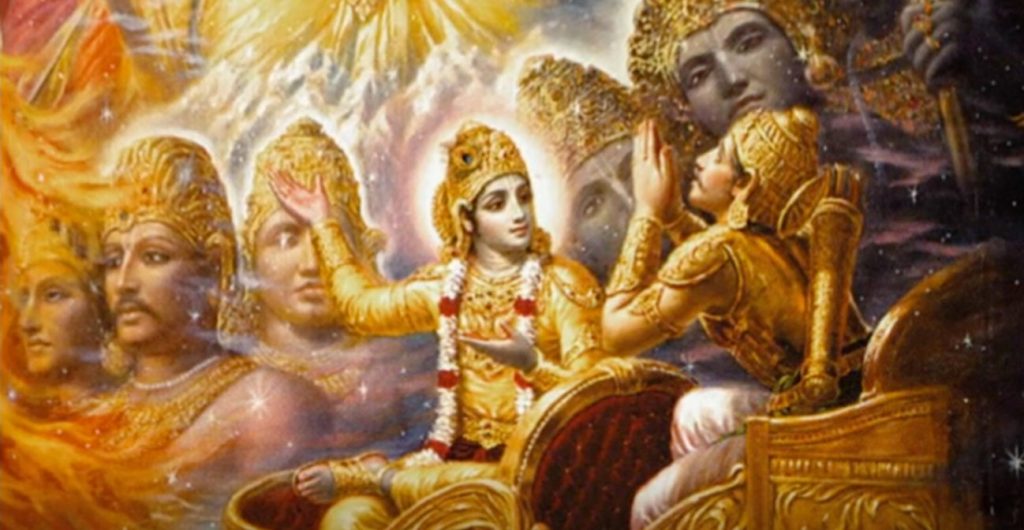
The Bhagavad Gita, often referred to as the Gita, is a 700-verse Hindu scripture that is part of the epic Mahabharata. The Gita is set in a narrative framework of a dialogue between Pandava prince Arjuna and his guide and charioteer Krishna.

A quick reference to translations of a verse of Gita from different sources may be obtained at

GITA SUPERSITE

.

0. THE BHAGAVAD GITA: Introduction

1. THE BHAGAVAD GITA: Chapter 1

2. THE BHAGAVAD GITA: Chapter 2

3. THE BHAGAVAD GITA: Chapter 3

4. THE BHAGAVAD GITA: Chapter 4

5. THE BHAGAVAD GITA: Chapter 5

6. THE BHAGAVAD GITA: Chapter 6

7. THE BHAGAVAD GITA: Chapter 7

8. THE BHAGAVAD GITA: Chapter 8

20. Sanskrit Dictionary 1

21. Sanskrit Dictionary 2

22. Glossary of Spiritual Terms

23. Glossary for Bhagavad Gita

.

Glossary of Spiritual Terms

The purpose of this Glossary is to express ancient Vedic knowledge using modern scientific language. The “translation” may not be exactly right at first, but, hopefully, it shall improve as better input is received.

.

AGNI
The Vedas start with homage to Agni. Agni implies energy in all its forms. It is animated by an innate impulse. Energy is the basic substance of the universe. Everything physical, spiritual, real, imaginary, postulated or considered, is made of energy.

BECOMING ONE
To “become one” is to know something so intimately that there is no distance left. For example, when you are expert in riding a bicycle, you have become one with that bicycle. You push pedals and apply brakes without putting attention on them. But you are fully aware of those actions, and you can change them whenever you want. To “become one with God” is to know the universal laws so well that you operate according to them without having attention on them. When one says, “the seer and scenery has become one,” it implies knowingness. See KNOWINGNESS.

BEING
A being is an energy form animated by an innate impulse.

BHAGAVĀN
Bhagavān literally means “fortunate”, “blessed”, and hence “illustrious”, “divine”, “venerable”, “holy”, etc. Please see Etymology and meaning.
“He who understands the creation and dissolution, the appearance and disappearance of beings, the wisdom and ignorance, should be called Bhagavān.” — Vishnu Purana, VI.5.78

BRAHMA
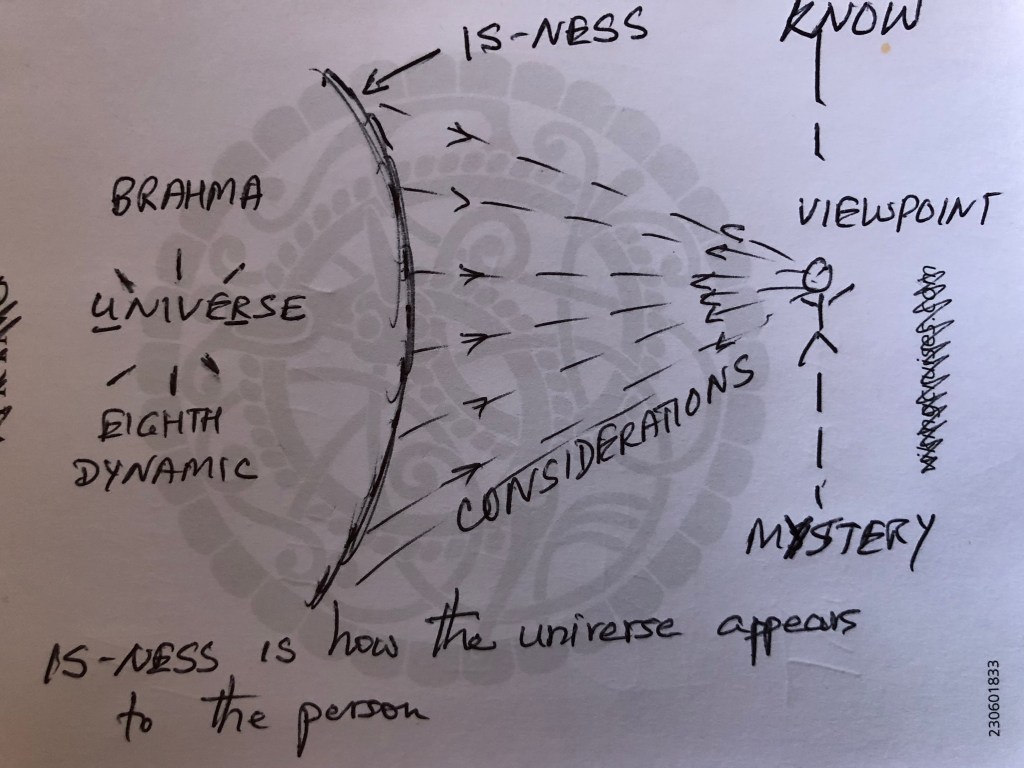
Brahma is the innate impulse manifested as energy in the form of the whole universe.

In modern language one would say that the highest metaphysical reality is the innate impulse, which is the characteristic of all energy. This impulse, on a universal scale, is understood as Brahma (the universal viewpoint). But, on the scale of an entity, it is understood as Atman (the individual viewpoint). There is quite a distance from Atman (or Paramatman) to Brahma in terms of broadness of the viewpoint.

CONSCIOUSNESS
Consciousness is the level of awareness of the mind. The greater is the refinement of the data elements (and the relationships among them) from perception, the higher is the consciousness. Human consciousness is much higher than the consciousness in animals, because the data elements are much more refined with greater number of relationships among them. See MIND.

DHARMA
Dharma means, literally, “the Law of Being.”  It refers to the natural purpose of something. For example, the “Dharma” of the sun is to shine and give warmth.

ISHVARA (ईश्वर)
The composite word, Ishvara literally means “owner of best, beautiful”, “ruler of choices, blessings, boons”, or “chief of suitor, lover”. As a concept, Ishvara in ancient and medieval Sanskrit texts, variously means God, Supreme Being, Supreme Soul, lord, king or ruler, rich or wealthy man, god of love, deity Vishnu… [in Vedas,] the contextual meaning, however as the ancient Indian grammarian Pāṇini explains, is neither god nor supreme being. Please see Etymology.

IS-NESS
It is how the universe appears to a person

IMMORTALITY
State of freedom from all samskaras (karmic impressions)

KALPA
One day of Brahma equal to 1000 Yugas, equal to 4320 million years. See Hindu units of time.

KNOWINGNESS
Knowingness is to know something so intimately that it has become part of you. For example, an expert has knowingness in his area of expertise. He knows his area so well that he can skillfully carry out the actions in that area without thinking. We associate absolute knowingness with God, but that is an ideal one holds. In reality, there is no absolute knowingness.

MAYA
Maya consists of filters generated by karmic impressions that cloud one’s vision.

MIND
The mind is the organ of mental sense. In a normal functioning mind, the perceptions are received through the senses of touch, sight, hearing, taste and smell. These perceptions break down into fine data elements, which are then arranged in a matrix type structure. Experience is stored as patterns of relationships among these data elements. The duplication of data elements is minimized. New perception is assimilated by arranging them in existing patterns with the correct time stamp and removing duplicate data elements. The existing patterns are modified and extended as necessary. Also see ASSIMILATION.

MINDFULNESS
A presence, which is free of assumptions, bias and fixed ideas

REALITY
Reality and unreality are the opposite ends of the scale of Is-ness, where is-ness is the sense of reality of the person. His is-ness on this scale improves as his viewpoint broadens.

SACRIFICE
Sacrifice is surrendering one’s self-interests and devotedly working for the sake of the welfare of the world.

SAMĀDHI (समाधि)
Samādhi means concentration of the thoughts, profound or abstract meditation, intense contemplation of any particular object (so as to identify the contemplator with the object meditated upon); this is the eighth and last stage of yoga; with Buddhists samādhi is the fourth and last stage of dhyāna or intense abstract meditation. The deep sleep like state of samadhi is the period of assimilation in which you completely reset your system. But you don’t live in that state. Samadhi leads you toward the universal viewpoint. Being “established in God” would means being established in the universal viewpoint.

SAMSKARAS
Karmic impressions brought about by one’s actions and their consequences

SAT-CHIT-ANAND
The bliss of pure thought energy

SURRENDER (in yoga)
Surrendering is “not avoiding, not denying, not resisting, and not suppressing.” It is experiencing fully what is there. You free yourself from an unwanted condition only by becoming fully aware of it. Suppressing is not the same thing as surrendering. If a person is suppressing bad habits to become good, he has not surrendered yet. After you have surrendered, only your basic nature is left. The basic nature operates according to the universal laws

THOUGHT ENERGY
Thought energy is the fundamental energy on which the spectrum of radiative energy and matter rest. The thought energy resides in the mind, which then transitions into physical energy of the body.

TRAUMA
The traumas are like “tumors” in the data matrix of the mind. They are made up of painful perceptions that did not get assimilated. They have only a few connection with the data matrix. They get reactivated when perception comes through these few connections. These “traumas” have their own unhealthy patterns that are backed up by the force of mental pain. The continual reactivation of traumatic experiences then gradually infects and conditions the healthy parts of the mental matrix by forcefully imposing unhealthy patterns. These unhealthy patterns contain all the emotional baggage, phobias, fixed ideas, prejudices, biases, etc., that you encounter. The traumas are not easy to access because they are not assimilated into the mental matrix. Repairing infected circuits in the mental matrix may allow, ultimately, to uncover these traumas and blow them; at which point many deep rooted problems also resolve. See ASSIMILATION, MIND.

UNREALITY
Unreality manifests itself in the form of inconsistencies, disharmonies and discontinuities. You resolve these things and the unreality disappears. It does not continue. Only the reality continues.

VIDHATA
Vidhata means “inherent principles of existence.” Duality is a natural consequence of these principles. Any imbalance straightens out by itself.

YAJNA
Yajna means selfless action done for the welfare of the world. For example, Jnana yajna is performed to spread jnana for larger benefit of community. The ritual of yajna is a symbol for such action. See SACRIFICE.

.

Inertial & Gravitational Mass

THE WORLD OF ATOM by Boorse

Chapter 36: Einstein’s Legacy – Albert Einstein (1879 – 1955)

“He also published an analysis indicating the equivalence of gravitational and inertial mass is not a mere accident of nature, but the basis of a profound physical principle that leads to a new theory of gravity.”

NOTE: Inertial mass is a mass parameter giving the inertial resistance to acceleration of the body when responding to all types of force. Gravitational mass is determined by the strength of the gravitational force experienced by the body when in the gravitational field g.

Comment:

To me, inertial mass balances the intrinsic motion. Light has very large but finite velocity because it has an “inertial mass” restraining infinite motion. As inertial mass increases the intrinsic velocity decreases. A body of infinite inertial mass may be postulated to be at absolute rest. Different inertial masses mean different intrinsic velocities. Thus, relative velocities may be understood in terms of differentials of inertial mass.

From this point of view, when a body is accelerating in a gravitational field, it means that the inertial mass of the body is somehow reduced by that gravitational field. Since this reduction is extremely small, the “gravitational mass” appears to be the same as the “inertial mass”.

.