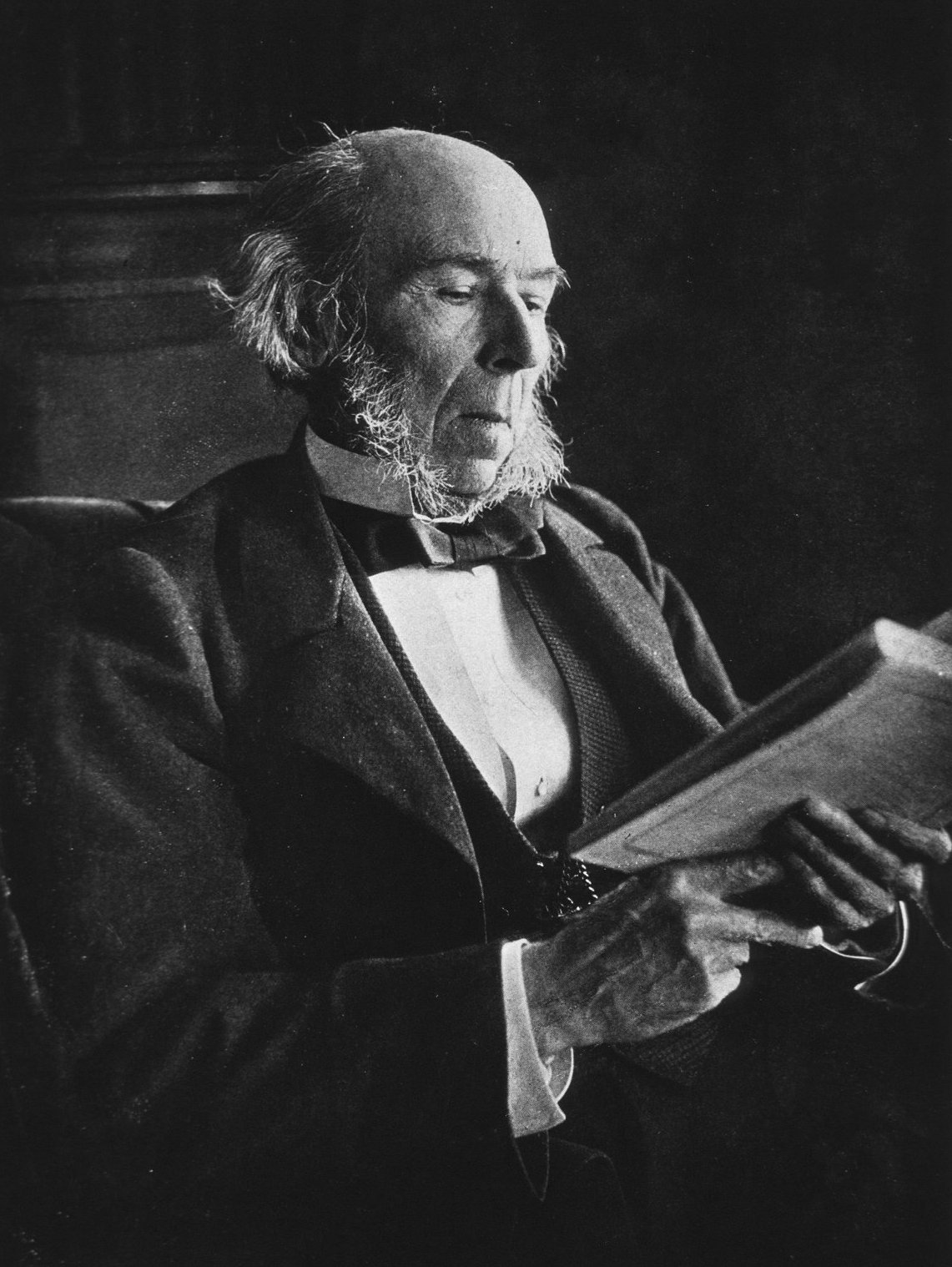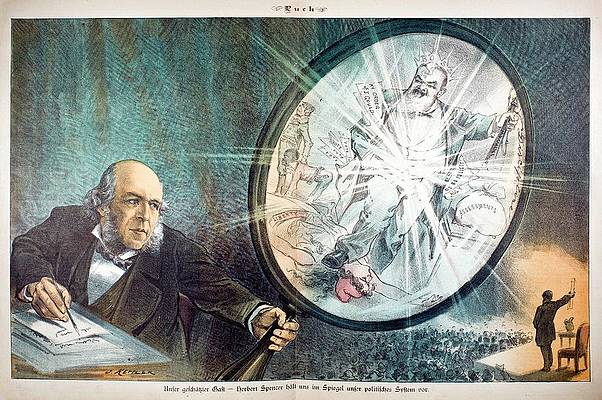
HERBERT SPENCER: Evolution

Reference: The Story of Philosophy

This paper presents Chapter VIII Section 3.2 from the book THE STORY OF PHILOSOPHY by WILL DURANT. The  contents are from the 1933 reprint of this book by TIME INCORPORATED by arrangement with Simon and Schuster, Inc.

The paragraphs of the original material (in black) are accompanied by brief comments (in color) based on the present understanding.

.

III. First Principles

2. Evolution

Having indicated the unknowable, philosophy surrenders it, and turns its face to what can be known. Metaphysics is a mirage: as Michelet put it, it is “the art of befuddling one’s self methodically.” The proper field and function of philosophy lies in the summation and unification of the results of science. “Knowledge of the lowest kind is un-unified knowledge; science is partially-unified knowledge; philosophy is completely-unified knowledge.” Such complete unification requires a broad and universal principle that will include all experience, and will describe the essential features of all knowledge. Is there a principle of this kind?

The function of philosophy is to completely unify all knowledge. Such complete unification requires a broad and universal principle that will include all experience, and will describe the essential features of all knowledge.

We may perhaps approach such a principle by trying to unify the highest generalizations of physics. These are the indestructibility of matter, the conservation of energy, the continuity of motion, the persistence of relations among forces .(i. e., the inviolability of natural law), the transformability and equivalence of forces (even of mental and physical forces), and the rhythm of motion. This last generalization, not usually recognized, needs only to be pointed out. All nature is rhythmical, from the pulsations of heat to the vibrations of violin strings; from the undulations of light, heat and sound to the tides of the sea; from the periodicities of sex to the periodicities of planets and comets and stars; from the alternation of night and day to the succession of the seasons, and perhaps to the rhythms of climatic change; from the oscillations of molecules to the rise and fall of nations and the birth and death of stars.

It is cyclical universe that contains cycles within cycles of birth and death, start and stop, appearance and disappearance.

All these “laws of the knowable” are reducible (by an analysis which must not here be followed in detail) to the final law of the persistence of force. But there is something static and inert about this principle; it does not so much as ‘hint at the secret of life. What is the dynamic principle of reality? What is the formula of the growth and decay of all things? It must be a formula of evolution and dissolution, for “an entire history of anything must include its appearance out of the imperceptible and its disappearance into the imperceptible.”

The dynamic principle of reality must relate to the growth and decay of all things. It must be a formula of evolution and dissolution.

So Spencer offers us his famous formula of evolution, which made the intellect of Europe gasp for breath, and required ten volumes and forty years for its explanation. “Evolution is an integration of matter and a concomitant dissipation of motion; during which the matter passes from an indefinite, incoherent homogeneity to a definite, coherent heterogeneity; and during which the retained motion undergoes a parallel transformation.” What does this mean?

Spencer’s formula of evolution: “Evolution is an integration of matter and a concomitant dissipation of motion; during which the matter passes from an indefinite, incoherent homogeneity to a definite, coherent heterogeneity; and during which the retained motion undergoes a parallel transformation.”

The growth of planets out of nebulae; the formation of oceans and mountains on the earth; the metabolism of elements by plants, and of animal tissues by men; the development of the heart in the embryo, and the fusion of bones after birth; the unification of sensations and memories into knowledge and thought, and of knowledge into science and philosophy; the development of families into clans and gentes and cities and states and alliances and the “federation of the world”: here is the integration of matter,—the aggregation of separate items into masses and groups and wholes. Such integration of course involves a lessening of motion in the parts, as the growing power of the state lessens the freedom of the individual; but at the same time it gives to the parts an inter-dependence, a protective tissue of relationships, which constitute “coherence” and promote corporate survival. The process brings, too, a greater definiteness of forms and functions: the nebula is shapeless, nebulous; and yet out of it come the elliptical regularity of the planets, the sharp lines of mountain-chains, the specific form and character of organisms and organs, the division of labor and specialization of function in physiological and political structures, etc. And the parts of this integrating whole become not merely definite but diverse, heterogeneous in nature and operation. The primeval nebula is homogeneous—i. e., it consists of parts that are alike; but soon it is differentiated into gases and liquids and solids; the earth becomes here green with grass, there white with mountain-tops, or blue with the multitudinous sea; evolving life begets, out of a relatively homogeneous protoplasm, the varied organs of nutrition, reproduction, locomotion, and perception; a simple language fills whole continents with its, multiplying dialects; a single science breeds a hundred, and the folk-lore of a nation flowers into a thousand forms of literary art; individuality grows, character stands out uniquely, and every race and people develops its peculiar genius. Integration and heterogeneity, aggregation of parts into ever larger wholes and differentiation of parts into ever more varied forms: these are the foci of the orbit of evolution. Whatever passes from diffusion to integration and unity, and from a homogeneous simplicity to a differentiated complexity (cf. America, 1600-1900), is in the flow of evolution; whatever is returning from integration to diffusion, and from complexity to simplicity (cf. Europe 200-600 A. D.), is caught in the ebb of dissolution.

Whatever passes from diffusion to integration and unity, and from a homogeneous simplicity to a differentiated complexity, is in the flow of evolution; whatever is returning from integration to diffusion, and from complexity to simplicity, is caught in the ebb of dissolution.

Not content with this synthetic formula, Spencer endeavors to show how it follows by inevitable necessity from the natural operation of mechanical forces. There is, first, a certain “Instability of the Homogeneous”: i. e., similar parts cannot long remain similar because they are unevenly subjected to external forces; outer parts, e. g., are sooner attacked, like coast-line towns in war; and the variety of occupations moulds similar men into the varied embodiments of a hundred professions and trades. There is, again, a “Multiplication of Effects”: one cause may produce a vast variety of results, and help to differentiate the world; a word amiss, like Marie Antoinette’s, or an altered telegram at Ems, or a wind at Salamis, may play an endless role in history. And there is the law of “Segregation”: the parts of a relatively homogeneous whole, being driven separate into different areas, are shaped by diverse environments into dissimilar products,—as the English become Americans; or Canadians, or Australians, according to the genius of the place. In these many ways the forces of nature build the variety of this evolving world.

Similar parts cannot long remain similar because they are unevenly subjected to external forces. The variety of occupations moulds similar men into the varied embodiments of a hundred professions and trades. In these many ways the forces of nature build the variety of this evolving world.

But finally, and inescapably, comes “Equilibration.” Every motion, being motion under resistance, must sooner or later come to an end; every rhythmic oscillation (unless externally reinforced) suffers some loss of rate and amplitude. The planets ride through a lesser orbit, or will ride, than once they rode; the sun will shine less warmly and brightly as the centuries pass away; the friction of the tides will retard the rotation of the earth. This globe, that throbs and murmurs with a million motions, and luxuriates into a million forms of riotously breeding life, will some day move more leisurely in its orbit and its parts; the blood will run cooler and more slowly in our desiccated veins; we shall not hurry any more; like dying races, we shall think of heaven in terms of rest and not of life; we shall dream of Nirvana. Gradually, and then rapidly, equilibration will become dissolution, the unhappy epilogue of evolution. Societies will disintegrate, masses will migrate, cities will fade into the dark hinterland of peasant life; no government will be strong enough to hold the loosened parts together; social order will cease to be even remembered. And in the individual too, integration will give way to disruption; and that coordination which is life will pass into that diffuse disorder which is death. The earth will be a chaotic theatre of decay, a gloomy drama of energy in irreversible degradation; and it will itself be resolved into the dust and nebula from which it came. The cycle of evolution and dissolution will be complete. The cycle will begin again, and endless times again; but always this will be the denouement. Memento mori is written upon the face of life; and every birth is a prelude to decay and death. 

But finally, and inescapably, comes “Equilibration.” Every motion, being motion under resistance, must sooner or later come to an end. Memento mori is written upon the face of life; and every birth is a prelude to decay and death. 

First Principles is a magnificent drama, telling with almost classic calm the story of the rise and fall, the evolution and dissolution, of planets and life and man; but it is a tragic drama, for which the fittest epilogue is Hamlet’s word—“The rest is silence.” Is there any wonder that men and women nurtured on faith and hope rebelled against this summary of existence? We know that we must die; but as it is a matter that will take care of itself, we prefer to think of life. There was in Spencer an almost Schopenhauerian sense of the futility of human effort. At the end of his triumphant career he expressed his feeling that life was not worth living. He had the philosopher’s disease of seeing so far ahead that all the little pleasant shapes and colors of existence passed under his nose unseen. 

At the end of his triumphant career Spencer expressed his feeling that life was not worth living. He had the philosopher’s disease of seeing so far ahead that all the little pleasant shapes and colors of existence passed under his nose unseen. 

He knew that people would not relish a philosophy whose last word was not God and heaven, but equilibration and dissolution; and in concluding this First Part he defended with unusual eloquence and fervor his right to speak the dark truths that he saw. 

Whoever hesitates to utter that which he thinks the highest truth, lest it should be too much in advance of the time, may reassure himself by looking at his acts from an impersonal point of view. Let him remember that opinion is the agency through which character adapts external arrangements to itself, and that his opinion rightly forms part of this agency—is a unit of force constituting, with other such units, the general. power which works out social changes; and he will perceive that he may properly give utterance to his innermost conviction; leaving it to produce what effect it may. It is not for nothing that he has in him these sympathies with some principles and repugnance to others. He, with all his capacities, and aspirations, and beliefs, is not an accident but a product of the time. While he is a descendant of the past he is a parent of the future; and his thoughts are as children born to him, which he may not carelessly let die. Like every other man he may properly consider himself as one of the myriad agencies through whom works the Unknown Cause; and when the Unknown Cause produces in him a certain belief, he is thereby authorized to profess and act out that belief. … Not as adventitious therefore will the wise man regard the faith that is in him. The highest truth he sees he will fearlessly utter; knowing that, let what may come of it, he is thus playing his right part in the world—knowing that if he can effect the change he aims at—well; if not—well also; though not so well.

Spencer knew that people would not relish a philosophy whose last word was not God and heaven, but equilibration and dissolution; and in concluding this First Part he defended with unusual eloquence and fervor his right to speak the dark truths that he saw. 

.

HERBERT SPENCER: The Unknowable

Reference: The Story of Philosophy

This paper presents Chapter VIII Section 3.1 from the book THE STORY OF PHILOSOPHY by WILL DURANT. The  contents are from the 1933 reprint of this book by TIME INCORPORATED by arrangement with Simon and Schuster, Inc.

The paragraphs of the original material (in black) are accompanied by brief comments (in color) based on the present understanding.

.

III. First Principles

1. The Unknowable 

“We too often forget,” says Spencer at the outset; “that not only is there ‘a soul of goodness in things evil,’ but generally also a soul of truth in things erroneous.” He proposes, therefore, to examine religious ideas, with a view to finding that core of truth which under the changing form of many faiths, has given to religion its persistent power over the human soul. 

Spencer proposes to examine religious ideas, with a view to finding that core of truth which under the changing form of many faiths, has given to religion its persistent power over the human soul. 

What he finds at once is that every theory of the origin of the universe drives us into inconceivabilities. The atheist tries to think of a self-existent world, uncaused and without beginning; but we cannot conceive of anything beginningless or uncaused. The theist merely puts back the difficulty by a step; and to the theologian who says, “God” made the, world,” the child’s unanswerable query comes, “Who made God?” All ultimate religious ideas are logically inconceivable. 

We cannot conceive of anything beginningless or uncaused, nor can we answer the question “Who made God?” All ultimate religious ideas are logically inconceivable. 

All ultimate scientific ideas are equally beyond rational conception. What is matter? We reduce it to atoms, and then find ourselves forced to divide the atom as we had divided the molecule; we are driven into the dilemma that matter is infinitely divisible,—which is inconceivable; or that there is a limit to its divisibility,—which also is inconceivable. So with the divisibility of space and time; both of these are ultimately irrational ideas. Motion is wrapped in a triple obscurity, since it involves matter changing, in time, its position in space. When we analyze matter resolutely we find nothing at last but force—a force impressed upon our organs of sense, or a force resisting our organs of action; and who, shall tell us what force is? Turn from physics to psychology, and we come upon mind and consciousness: and here are greater puzzles than before. “Ultimate scientific ideas,” then, “are all representations of realities that cannot be comprehended. … In all directions the scientist’s investigations bring him face to face with an insoluble enigma; and he ever more clearly perceives it to be an insoluble enigma. He learns at once the greatness and the littleness of the human intellect—its power in dealing with all that comes within the range of experience, its impotence in dealing with all that transcends experience. He, more than any other, truly knows that in its ultimate nature nothing can be known.” The only honest philosophy, to use Huxley’s word, is agnosticism.

All ultimate scientific ideas are equally beyond rational conception. Matter reduces to motion; and motion reduces to force. Who shall tell us what force is? The human intellect knows that in its ultimate nature nothing can be known.

The common cause of these obscurities is the relativity of all knowledge. “Thinking being relating, no thought can express more than relations. … Intellect being, framed simply by and for converse with phenomena, involves us in nonsense when we try to use it for anything beyond phenomena.”* And yet the relative and phenomenal imply by their names and natures something beyond them, something ultimate and absolute. “On watching our thoughts we see how impossible it is to get rid of the consciousness of an Actuality lying behind Appearances, and how from this impossibility results our indestructible belief in that Actuality.”  But what that Actuality is we cannot know.

*This unconsciously follows Kant, and succinctly anticipates Bergson.

The common cause of these obscurities is the relativity of all knowledge. And yet the relative and phenomenal imply something ultimate and absolute beyond them. But what that Actuality is we cannot know.

From this point of view the reconciliation of science and religions is no longer very difficult. “Truth generally lies in the coordination of antagonistic opinions.” Let science admit that its “laws” apply only to phenomena and the relative; let religion admit that its theology is a rationalizing myth for a belief that defies conception. Let religion cease to picture the Absolute as a magnified man; much worse, as a cruel and blood-thirsty and treacherous monster, afflicted with “a love of adulation such as would be despised in a human being.” Let science cease to deny deity, or to take materialism for granted. Mind and matter are, equally, relative phenomena, the double effect of an ultimate cause whose nature must remain unknown. The recognition of this Inscrutable Power is the core of truth in every religion, and the beginning of all philosophy.

Scientific “laws” apply only to phenomena and the relative. Religious theology is simply a rationalizing myth for a belief that defies conception. But there is an Inscrutable Power whose nature must remain unknown.

.

FINAL COMMENTS

.

Herbert Spencer:

  1. What core of truth, under the changing form of many faiths, has given to religion its persistent power over the human soul. 
  2. Every theory of the origin of the universe drives us into inconceivabilities.
  3. We cannot conceive of anything beginning-less or uncaused.
  4. All ultimate religious ideas are logically inconceivable. 
  5. All ultimate scientific ideas are equally beyond rational conception.
  6. Matter comes from atoms, which come from electromagnetic radiation, which comes from force, which comes from ???
  7. Man truly knows that in its ultimate nature nothing can be known.
  8. The common cause of these obscurities is the relativity of all knowledge.
  9. There is something beyond but we cannot know it.
  10. The laws in science apply only to phenomena and the relative.
  11. Theology in religion is a rationalizing myth for a belief that defies conception.
  12. There is an inscrutable Power.

.

HERBERT SPENCER: The Development of Spencer

Reference: The Story of Philosophy

This paper presents Chapter VIII Section 2 from the book THE STORY OF PHILOSOPHY by WILL DURANT. The  contents are from the 1933 reprint of this book by TIME INCORPORATED by arrangement with Simon and Schuster, Inc.

The paragraphs of the original material (in black) are accompanied by brief comments (in color) based on the present understanding.

.

II. The Development of Spencer

He was born at Derby in 1820. In both lines his ancestors were Non-conformists or Dissenters. His father’s mother had been a devoted follower of John Wesley; his father’s brother, Thomas, though an Anglican clergyman, led a Wesleyan movement within the Church, never attended a concert or a play, and took an active part in movements for political reform. This drive to heresy became stronger in the father, and culminated in the almost obstinate individualism of Herbert Spencer himself. The father never used the supernatural to explain anything; he was described by one acquaintance (though Herbert considered this an exaggeration) as “without faith or religion whatever, so far as one could see.” He was inclined to science, and wrote an Inventional Geometry. In politics he was an individualist like his son and “would never take off his hat to anyone, no matter of what rank.” “If he did not understand some question my mother put, he would remain silent; not asking what the question was, and letting it go unanswered. He continued this course all through his life, notwithstanding its futility; there resulted no improvement.” One is reminded (except for the silence) of Herbert Spencer’s resistance, in his later years, to the extension of State functions.

In both lines Spencer’s ancestors were Non-conformists or Dissenters. This drive to heresy became stronger in the father, and culminated in the almost obstinate individualism of Herbert Spencer himself.

The father, as well as an uncle and the paternal grandfather, were teachers of private schools; and yet the son, who was to be the most famous English philosopher of his century, remained till forty an uneducated man. Herbert was lazy, and the father was indulgent. At last, when he was thirteen, Herbert was sent to Hinton to study under his uncle, who had a reputation for severity. But Herbert promptly ran away from the uncle, and trudged all the way back to the paternal home at Derby—48 miles the first day, 47 the next, and 20 the third, all on a little bread and beer. Nevertheless he returned to Hinton after a few weeks, and stayed for three years. It was the only systematic schooling that he ever received. He could not say, later, just what it was he learned there; no history, no natural science, no general literature. He says, with characteristic pride: “That neither in boyhood nor youth did I receive a single lesson in English, and that I have remained entirely without formal knowledge of syntax down to the present hour, are facts which should be known; since their implications are at variance with assumptions universally accepted.” At the age of forty he tried to read the Iliad, but “after reading some six books I felt what a task it would be to go on—felt that I would rather give a large sum than read to the end.” Collier, one of his secretaries, tells us that Spencer never finished any book of science. Even in his favorite fields he received no systematic instruction. He burnt his fingers and achieved a few explosions in chemistry; he browsed entomologically among the bugs about school and home; and he learned something about strata and fossils in his later work as a civil engineer; for the rest he picked his science casually as he went along. Until he was thirty he had no thought at all of philosophy. Then he read Lewes, and tried to pass on to Kant; but finding, at the outset, that Kant considered space and time to be forms of sense-perception rather than objective things, he decided that Kant was a dunce, and threw the book away. His secretary tells us that Spencer composed his first book, Social Statics, “having read no other ethical treatise than an old and now forgotten book by Jonathan Dymond.” He wrote his Psychology after reading only Hume, Mansel and Reid; his Biology after reading only Carpenter’s Comparative Physiology (and not the Origin of Species) ; his Sociology without reading Comte or Tylor; his Ethics without reading Kant or Mill or any other moralist than Sedgwick. What a contrast to the intensive and relentless education of John Stuart Mill! 

Spencer had little formal education. He never finished any book of science. Even in his favorite fields he received no systematic instruction. He picked his science casually as he went along.

Where, then, did he find those myriad facts with which he propped up his thousand arguments? He “picked them up,” for the most part, by direct observation rather than by reading. “His curiosity was ever awake, and he was continually directing the attention of his companion to some notable phenomenon … until then seen by his eyes alone.”. At the Athenaeum Club he pumped Huxley and his other friends almost dry of their expert knowledge; and he ran through the periodicals at the Club as he had run through those that passed through his father’s hands for the Philosophical Society at Derby, “lynx-eyed for every fact that was grist to his mill.” Having determined what he wanted to do, and having found the central idea, evolution, about which all his work would turn, his brain became a magnet for relevant material, and the unprecedented orderliness of his thought classified the material almost automatically as it came. No wonder the proletaire and the business man heard him gladly; here was just such a mind as their own—a stranger to book learning, innocent of “culture” and yet endowed with the natural, matter-of-fact knowledge of the man who learns as he works and lives. 

Having determined what he wanted to do, and having found the central idea, evolution, his brain became a magnet for relevant material, and the unprecedented orderliness of his thought classified the material almost automatically as it came.

For he was working for his living: and his profession intensified the practical tendency of his thought. He was surveyor, supervisor and designer of railway lines and bridges, and in general an engineer. He dripped inventions at every turn; they all failed, but he looked back upon them, in his Autobiography, with the fondness of a father for a wayward son; he sprinkled his reminiscent pages with patent salt-cellars, jugs, candle-extinguishers, invalid-chairs, and the like. As most of us do in youth, he invented new diets too; for a time he was vegetarian; but he abandoned it when he saw a fellow-vegetarian develop anemia, and himself losing strength; “I found that I had to rewrite what I had written during the time I was a vegetarian, because it was so wanting in vigor.” He was ready in those days to give everything a trial; he even thought of migrating to New Zealand, forgetting that a young country has no use for philosophers. It was characteristic of him that he made parallel lists of reasons for and against the move, giving each reason a numerical value. The sums being 110 points for remaining in England and 301 for going, he remained. 

Spencer worked for his living as a surveyor, supervisor and designer of railway lines and bridges, and in general as an engineer. He was ready in those days to give everything a trial.

His character had the defects of its virtues. He paid for his resolute realism and practical sense by missing the spirit and zest of poetry and art. The only poetical touch in his twenty volumes was due to a printer who made Spencer speak of “the daily versification of scientific predictions.” He had a fine persistence whose other side was an opinionated obstinacy; he could sweep the entire universe for proofs of his hypotheses, but he could not see with any insight another’s point of view; he had the egotism that bears up the non-conformer, and he could not carry his greatness without some conceit. He had the limitations of the pioneer: a dogmatic narrowness accompanying a courageous candor and an intense originality; sternly resisting all flattery, rejecting proffered governmental honors, and pursuing his painful work for forty years in chronic ill-health and modest seclusion; and yet marked, by some phrenologist who gained access to him—“Self-esteem very large.” The son and grandson of teachers, he wielded the ferule in his books, and struck a high didactic tone. “I am never puzzled,” he tells us. His solitary bachelor life left him lacking in the warmly human qualities, though he could be indignantly humane. He had an affair with that great Englishman, George Eliot, but she had too much intellect to please him. He lacked humor, and had no subtlety or nuances in his style. When he lost at his favorite game of billiards, he denounced his opponent for devoting so much time to such a game as to have become an expert in it. In his Autobiography he writes reviews of his own early books, to show how it should have been done.”

Spencer paid for his resolute realism and practical sense by missing the spirit and zest of poetry and art. He had a fine persistence whose other side was an opinionated obstinacy. He lacked humor, and had no subtlety or nuances in his style. 

Apparently the magnitude of his task compelled him to look upon life with more seriousness than it deserves. “I was at the Fete of St. Cloud on Sunday,” he writes from Paris; “and was much amused by the juvenility of the adults. The French never entirely cease to be boys; I saw gray-haired people riding on whirligigs such as we have at our own fairs.” He was so busy analyzing and describing life that he had no time to live it. After seeing Niagara Falls he jotted down in his diary: “Much what I had expected.” He describes the most ordinary incidents with the most magnificent pedantry—as when he tells us of the only time he ever swore.* He suffered no crises, felt no romance (if his memoirs record him well); he had some intimacies, but he writes of them almost mathematically; he plots the curves of his tepid friendships without any uplifting touch of passion. A friend said of himself that he could not write well when dictating to a young woman stenographer; Spencer said that it did not bother him at all. His secretary says, “The passionless thin lips told of a total lack of sensuality, and the light eyes betrayed a lack of emotional depth.” Hence the monotonous levelness of his style: he never soars, and needs no exclamation-points; in a romantic century he stands like a sculptured lesson in dignity and reserve.

*Tyndall once said of him what a much better fellow he would be if he had a good swear now and again. 

Spencer was so busy analyzing and describing life that he had no time to live it. He suffered no crises, felt no romance. In a romantic century he stands like a sculptured lesson in dignity and reserve.


He had an exceptionally logical mind; he marshalled his à prioris and his à posterioris with the precision of a chess player. He is the clearest expositor of complex subjects that modern history can show; he wrote of difficult problems in terms so lucid that for a generation all the world was interested in philosophy. “It has been remarked,” he says, “that I have an unusual faculty of exposition—set forth my data and reasonings and conclusions with a clearness and coherence not common.” He loved spacious generalizations, and made his works interesting rather with his hypotheses than with his proofs. Huxley said that Spencer’s idea of a tragedy was a theory killed by a fact; and there were so many theories in Spencer’s mind that he was bound to have a tragedy every day or two. Huxley, struck by the feeble and undecided gait of Buckle, said of him to Spencer: “Ah, I see the kind of man; he is top-heavy.” “Buckle,” Spencer adds, “had taken in a much larger quantity of matter than he could organize.” With Spencer it was the other way: he organized much more than he had taken in. He was all for coordination· and synthesis; he depreciated Carlyle for lacking a similar turn. The fondness for order became in him an enslaving passion; a brilliant generalization over-mastered him. But the world was calling for a mind like his; one who could transform the wilderness of facts with sunlit clarity into civilized meaning; and the service which Spencer performed for his generation entitled him to the failings that made him human. If he has been pictured here rather frankly, it is because we love a great man better when we know his faults, and suspiciously dislike him when he shines in unmitigated perfection. 

Spencer had an exceptionally logical mind. He is the clearest expositor of complex subjects that modern history can show. He could transform the wilderness of facts with sunlit clarity into civilized meaning.

“Up to this date,” wrote Spencer at forty, “my life might fitly have been characterized as miscellaneous.” Seldom has a philosopher’s career shown such desultory vacillation. “About this time” (age twenty-three) “my attention turned to the construction of watches.” But gradually he found his field, and tilled it with honest husbandry. As early as 1842 he wrote, for the Non-conformist (note the medium be chose), some letters on “The Proper Sphere of Government,” which contained his later laissez-faire philosophy in ovo [in the egg]. Six years later he dropped engineering to edit The Economist. At the age of thirty, when he spoke disparagingly of Jonathan Dymond’s Essays on the Principles of Morality, and his father challenged him to do as well with such a subject, he took the dare, and wrote his Social Statics. It had only a small sale, but it won him access to the magazines. In 1852 his essay on “The Theory of Population” (one of the many instances of Malthus’ influence on the thought of the nineteenth century) suggested that the struggle for existence leads to a survival of the fittest, and coined those historic phrases. In the same year his essay on “The Development Hypothesis” met the trite objection—that the origin of new species by progressive modification of older ones had never been seen—by pointing out that the same argument told much more strongly against the theory of the “special creation” of new species by God; and it went on to show that the development of new species was no more marvelous or incredible than the development of a man from ovum and sperm, or of a plant from a seed. In 1855 his second book, The Principles of Psychology, undertook to trace the evolution of mind. Then, in 1857, came an essay on “Progress, Its Law and Cause,” which took up Von Baer’s idea of the growth of all living forms from homogeneous beginnings to heterogeneous developments, and lifted it into a general principle of history and progress. In short Spencer had grown with the spirit of his age, and was ready now to become the philosopher of universal evolution. 

Spencer had grown with the spirit of his age, and was ready now to become the philosopher of universal evolution. 

When, in 1858, he was revising his essays for collective publication, he was struck by the unity and sequence of the ideas he had expressed; and the notion came to him, like a burst of sunlight through opened doors, that the theory of evolution might be applied in every science as well as in biology; that it could explain not only species and genera but planets and strata, social and political history, moral and esthetic conceptions. He was fired with the thought of a series of works in which he would show the evolution of matter and mind from nebula to man, and from savage to Shakespeare. But he almost despaired when he thought of his nearly forty years. How could one man, so old, and an invalid, traverse all the sphere of human knowledge before his death? Only three years back he had had a complete break-down; for eighteen months he had been incapacitated, broken in mind and courage, wandering aimlessly and hopelessly from place to place. The consciousness of his latent powers made his weakness a bitter thing to him. He knew that he would never be quite healthy again, and that he could not bear mental work for more than an hour at a time. Never was a man so handicapped for the work he chose, and never did a man choose, so late in life, so great a work. 

In 1858, a notion came to Spencer, like a burst of sunlight through opened doors, that the theory of evolution might be applied in every science as well as in biology; that it could explain not only species and genera but planets and strata, social and political history, moral and esthetic conceptions.

He was poor. He had not given much thought to getting a living. “I don’t mean to get on,” he said; “I don’t think getting on is worth the bother.” He had resigned the editorship of The Economist on receiving $2,500 as bequest from an uncle; but his idleness had consumed this gift. It occurred to him now that he might seek advance subscriptions for his intended volumes, and so live from hand to mouth, and pay his way as he went. He prepared an outline, and submitted it to Huxley, Lewes, and other friends; they secured him an imposing list of initial subscribers whose names might adorn his prospectus: Kingsley, Lyell, Hooker, Tyndall, Buckle, Froude, Bain, Herschel and others. Published in 1860, this prospectus brought 440 subscriptions from Europe; and 200 from America; the total promising a modest $1,500 a year. Spencer was satisfied, and set to work with a will. 

Spencer was poor. He had not given much thought to getting a living. It occurred to him now that he might seek advance subscriptions for his intended volumes, and so live from hand to mouth, and pay his way as he went.

But after the publication of First Principles, in 1862, many subscribers withdrew their names because of the famous “Part One,” which, attempting to reconcile science and religion, offended bishops and pundits alike. The way of the peacemaker is hard. First Principles and The Origin of Species became the center of a great Battle of the Books, in which Huxley served as generalissimo for the forces of Darwinism and agnosticism. For a time the evolutionists were severely ostracized by respectable people; they were denounced as immoral monsters, and it was thought good form to insult them publicly. Spencer’s subscribers fell away with every installment, and many defaulted on payments due for installments received. Spencer went on as long as he could, paying out of his pocket the deficit which every issue involved. At last his funds and his courage were exhausted, and he issued to the remaining subscribers an announcement that he could no longer continue his work. 

When Spencer attempted to reconcile science and religion, it offended bishops and pundits alike. His subscribers fell away with every installment. Spencer went on as long as he could. At last his funds and his courage were exhausted.

Then came one of the encouraging incidents of history. Spencer’s greatest rival, who had held the field of English philosophy before the publication of First Principles, and now saw himself superseded by the philosopher of evolution, wrote to him as follows on February 4, 1866: 

Dear Sir:
On arriving here last week, I found the December livraison of your Biology, and I need hardly say how much I regretted the announcement in the paper annexed to it. … I propose that you should write the next of your treatises, and that I should guarantee the publisher against loss. … I beg that you will not consider this proposal in the light of a personal favor, though even if it were I should still hope to be permitted to offer it. But it is nothing of the kind—it is a simple proposal of cooperation for an important public purpose, for which you give your labor and have given your health. I am, Dear Sir, 

Very truly yours,
J. S. Mill

Spencer courteously refused; but Mill went out among his friends and persuaded several of them to subscribe for 250 copies each. Spencer again objected, and could not be moved. Then suddenly came a letter from Prof. Youmans, saying that Spencer’s American admirers had bought, in his name, $7000 of public securities, of which the interest or dividends were to go to him. This time he yielded. The spirit of the gift renewed his inspiration; he resumed his task; and for forty years he kept his shoulder to the wheel, until all the Synthetic Philosophy had arrived safely into print. This, triumph of mind and will over illness and a thousand obstacles is one of the sunny spots in the book of man. 

Spencer was then offered financial help, while he gave his labor and health. The spirit of the gift renewed his inspiration; he resumed his task; and for forty years he kept his shoulder to the wheel, until all the Synthetic Philosophy had arrived safely into print.

.

The Definition of PTSness

Reference: Subject: Scientology Fundamentals

We shall look at the definitions of POTENTIAL TROUBLE SOURCE (PTS) and SUPPRESSIVE PERSON (SP) carefully from the Technical Dictionary. Apparently, an SP is the cause of suppression, and a PTS is the effect of suppression. We shall start by looking at the definition of SUPPRESS.

.

SUPPRESS, to squash, to sit on, to make smaller, to refuse to let reach, to make uncertain about his reaching, to render or lessen in any way possible by any means possible, to the harm of the individual and for the fancied protection of a suppressor. 

According to this definition we are looking at any activity that does not allow a person to be himself or herself. Instead, such an activity tries to destroy the beingness of the person. 

POTENTIAL TROUBLE SOURCE, 1. a person or preclear who “rollercoasters,” i.e., gets better, then worse. This occurs only when his connection to a suppressive person or group is unhandled and he must, in order to make his gains from Scn permanent, receive processing intended to handle such.

In order for the results from Scientology processing to last, any threat to a person’s beingness must be handled as a priority.

POTENTIAL TROUBLE SOURCE, 2. somebody who is connected with an SP who is invalidating him, his beingness, his processing, his life.

To handle the threat to one’s beingness, one must first identify the source of such threat. Such source is always a living entity. In Scientology, that source is called the SP (suppressive person).

POTENTIAL TROUBLE SOURCE, 3. means the case is going to go up and fall down. He’s a trouble source because he’s going to get upset. He’s a trouble source because he’s going to make trouble. And he’s trouble for the auditor and he’s trouble for us and he’s trouble for himself. 

A person whose beingness is under threat is not going to retain any benefits from auditing until that threat is handled. Until then he is gong to be trouble to Scientology organization that is auditing him.

POTENTIAL TROUBLE SOURCE, 4. it means someone connected to a person or group opposed to Scn. It is a technical thing. It results in illness and roller-coaster and is the cause of illness and roller-coaster. 

From Scientology perspective, the SP is opposed to the person getting better, and by extension, the SP is also opposed to Scientology activity that is trying to stabilize the person.

PTS, 1. means potential trouble source which itself means a person connected to a suppressive person. All sick persons are PTS. All pcs who roller-coaster (regularly lose gains) are PTS. Suppressive persons are themselves PTS to themselves.  

A PTS person is identifiable by his inability to hold on to his gains in auditing, because his beingness is constantly being invalidated by an SP.

PTS, 2. is the manifestation of a postulate—counter-postulate. 

The PTS person wants to be himself, but the SP is not allowing that.

PTS, 3. environmental menace that keeps something continuously keyed in. This can be a constant recurring somatic, a continual, recurring pressure or a mass. The menace in the environment is not imaginary in such extreme cases. 

To the PTS person the threat to his beingness appears as a diffused environmental menace because he is unable to identify the source of it. 

PTS TYPE A, a person intimately connected with persons (such as marital or familial ties) of known antagonism to mental or spiritual treatment or Scn. 

The source of threat that a PTS feels could be right there, but the PTS is blind to it. He may not be able to associate the threat to its source because he is in some relationship with it, and he can’t let go.

PTS TYPE ONE, the SP on the case is right in present time, actively suppressing the person. Type one is normally handled by an ethics officer in the course of a hearing.

When the SP on the case is right in present time, the handling is to get the PTS to recognize this fact.

PTS TYPE TWO, type two is harder to handle than type one, for the apparent suppressive person in present time is only a restimulator for the actual suppressive. The pc who isn’t sure, won’t disconnect, or still roller-coasters, or who doesn’t brighten up, can’t name any SP at all is a type two. 

But what appears to be an SP in present time, may only be a reminder of the real SP. So, it may require a search and discovery of the real SP.

PTS TYPE THREE, the type three PTS is mostly in institutions or would be. On this case the type two’s apparent SP is spread all over the world and is often more than all the people there are—for the person sometimes has ghosts about him or demons and they are just more apparent SPs but imaginary as beings as well. 

The PTS person may start seeing SPs everywhere. Such a person is so terrified that he or she is unable to function in life and may have to be institutionalized. 

SUPPRESSIVE PERSON, 1. he’s solving a present time problem which hasn’t in actual fact existed for the last many trillenia in most cases, and yet he is taking the actions in present time which solve that problem. The guy’s totally stuck in present time, that is the whole anatomy of psychosis. 

The SP is threatening the beingness of others around him in an effort to solve some imaginary problem. He is psychotic in this sense. He is stuck in some engram.

SUPPRESSIVE PERSON, 2. a person who rewards only down statistics and never rewards an up statistic. He goofs up or vilifies any effort to help anybody and particularly knifes with violence anything calculated to make human beings more powerful or intelligent. A suppressive automatically and immediately will curve any betterment activity into something evil or bad.

The SP is not logical in his thinking. He harbors great fear against anybody getting better than him.

SUPPRESSIVE PERSON, 3. a person who doesn’t get case gain because of continuing overts.

An SP does not get better because he is continually engaged in committing harmful acts.

SUPPRESSIVE PERSON, 4. the person is in a mad, howling situation of some yesteryear and is “handling it” by committing overt acts today. I say condition of yesteryear but this case thinks it’s today. 

An SP is living with an engram completely controlling his mind.

SUPPRESSIVE PERSON, 5 . an SP is a no-confront case because, not being in his own valence he has no viewpoint from which to erase anything. That is all an SP is.

An SP is simply acting out some valence in his engram.

SUPPRESSIVE PERSON, 6. those who are destructively antisocial. 

In an SP, the thinking is completely mechanical, so no social activity flows from it.

SUPPRESSIVE PERSON, 7. a person with certain behavior characteristics and who suppresses other people in his vicinity and those other people when he suppresses them become PTS or potential trouble sources.  

An SP is threatening the beingness of others around him as part of acting out some past engram. Those whose beingness is threatened cannot hold on to their gains in auditing and become troublesome to those who are trying to help them.

SUPPRESSIVE PERSON, 8. is one that actively seeks to suppress or damage Scn or a Scientologist by suppressive acts.

An SP then starts to threaten those who are trying to help, such as, Scientology and Scientologists.

SUPPRESSIVE PERSON, 9. a person who has had a counter – postulate to the pc you are handling.

An SP is at the other end of the troublesome preclear you are trying to handle.

.

Anomalies

DEFINITION: An anomaly is any violation of the integrity of reality, such as, discontinuity (missing data), inconsistency (contradictory data), or disharmony (arbitrary data). An anomaly flags the presence of a hidden impression on the mind in the form of an assumption. When the assumption is discovered, one becomes aware of the underlying impression. This awareness produces a realization that resolves the anomaly.

The Scientology Organizations have declared many people on their lines, and on their staff, as SPs because they were difficult to manage. The number of such instances is so large that it points to a weakness in the application of Scientology itself. This requires a clear statement of PTSness.

.

Resolution

With subject clearing, the state of PTSness appears to be as follows:

PTSness occurs when a person feels threatened about his or her beingness. This may also extend to a person who is feeling threatened about an aberrated beingness.The latter would be the condition of SPness. So, the conditions of PTSness and SPness are closely tied together and should be carefully assessed for proper handling.

Subject Clearing shall be immensely useful in handling this condition in either of its form of PTSness or SPness.

.

The Definition of EXTERIORIZATION

Reference: Subject: Scientology Fundamentals

Scientology provides the following definitions associated with EXTERIORIZATION.

.

Scientology Technical Dictionary

“IDENTIFICATION, 1. the inability to evaluate differences in time, location, form, composition, or importance.”
“IDENTIFICATION, 2. identification is a monotone assignment of importance.”
“IDENTIFICATION, 3. the lowest level of reasoning is complete inability to differentiate, which is to say, identification.” 
“IDENTIFICATION, 4. Duplicating in one space continually, is in itself identification.”

Scientology identifies Static with theta and theta with thetan. It lacks a clear differentiation among these three concepts. Subject Clearing differentiates these three concepts as Unknowable, Self (ability to postulate), and Being (the postulate of individuality), respectively.

“INTERIORIZATION, 1. interiorization means going into it too fixedly, and becoming part of it too fixedly. It doesn’t mean just going into your head.”
“INTERIORIZATION, 2. if the havingness of the preclear is low, he is apt to close in tight to the body because this gives him more havingness and if the preclear fears that the body is going to go out of control he will also move in closer to the body. Thus we get interiorization as no more complicated than fear of loss of control and drops in havingness.”

Interiorization means that the attention of the person has become narrowly fixated on the body because the body provides him with an obvious sense of individuality that gets attention from others.

“EXTERIOR, the fellow would just move out, away from the body and be aware of himself as independent of a body but still able to control and handle the body.”

A person feels exterior to the body when he is able to visualize it in totality. Similarly, when he can observe his thoughts he feels exterior to them. But to the degree he cannot observe himself as a being he feels interiorized.

“EXTERIORIZATION, 1. the state of the thetan, the individual himself, being outside his body. When this is done, the person achieves a certainty that he is himself and not his body.”
“EXTERIORIZATION, 2. the phenomenon of being in a position in space dependent on only one’s consideration, able to view from that space, bodies and the room, as it is.” 
“EXTERIORIZATION, 3 . the act of moving out of the body with or without full perception.” 

Exteriorization is a state where a person is feeling exterior to his body. He may or may not be able to visualize his body, but his attention is no longer fixated on his body as if the body alone determines his beingness. He realizes that he is much more than the body and that his individuality is also determined by his viewpoint.

There are dreamlike “out of body” experiences, which accompany the shocking realization that one is more than one’s body. But that does not mean that one can literally be separate from one’s body. Scientology makes the error of interpreting such a feeling in a literal sense.

.

Subject Clearing

A person feels exterior to anything when he is able to visualize it in totality. This may happen when a person has a vivid “out of body” experience. The person suddenly realizes that he is more than just a body. Until then he had been identifying himself with his body because his body has gotten the most attention from others, and his sense of individuality has built up on this attention.

The vividness of “out of body” experience springs from complete assimilation of related sensations in the mental matrix. This applies to sensation from the sense organs that assimilate routinely in mental matrix to create present time perceptions. It also applies to a facsimile coming forward on the genetic line and assimilating in the mental matrix for the first time appearing as a vivid “past life” memory. You can also create a vivid visualization of being out in space if all the related sensations happens to assimilate completely in the mental matrix.

A person can thus visualize being completely separate from the body. But this does not mean that he is literally without a body. He may even visualize being completely separate from this universe, but that doesn’t mean he is no longer connected with the universe. The ultimate exteriorization occurs when the person realizes that his sense of individuality is just his postulate. But that doesn’t take away his individuality.

Scientology looks at the “out of body” experiences and makes the error of interpreting it literally to mean that the “thetan” can separate himself from the body and survive body death.

.