Patanjali Yoga Sutras Chapter 1

Reference: Patanjali Yoga Sutras

Chapter 1: Samadhi Pada (On concentration)
Verses 1:1- 1:51

Reference: THE SANSKRIT CHANNEL
Reference: The Sun of Sanskrit Knowledge

Sutras (1-4) – What is Yoga, and Why?
.
Sutras (5-11) – Five Compulsive States
.
Sutras (12-16) – Means of Control
.
Sutras (17-22) – Subtle States of Meditation
.
Sutras (23-29) – Definition of God
.
Sutras (30-39) – Calming the Mind
.
Sutras (40-50) – Deeper States of Meditation
.
Sutra (51) – Going Beyond

.

Summary of Samadhi Pada

When a person starts on Yoga, he has his life experiences made of compulsive, cyclical actions. Yoga is essentially the stopping of such actions. When one accomplishes that he reduces to a witness to all that is happening. Otherwise, he remains subject to compulsive, cyclical actions. 

Such actions can be pleasant also. They result in automatic judgment, misjudgment, imagination, sleep and remembrance. The judgement may be formed from how things are perceived and inferred, or they may simply be acquired. Misjudgment is skewed or illusory perspective of what is there. Imagination is assuming to fill in an incomplete picture. Sleep is cyclical lack of consciousness. And remembrance is formed out of old retained experiences.

Such compulsions are handled through any continuous, long-term practice that brings about a controlled state, and through detachment, which means disentangling oneself from all fixations. This leads to experiencing the true self that takes one beyond even the deep-seated inherent drives.

As you look at how life functions around you, and contemplate over it deeply, there is pure state of bliss in that contemplation that is enjoyed by the sense of ‘I’. When this leads to a deep meditative state it is called the samprajnAta-samAdhi. But when, with continuous practice, one gives rest to even this refined mental activity and only the latent tendencies remain, one enters the asamprajnAta-samAdhi. Those who are not fixated on their body, and who are simply immersed in their natural self, the asamprajnAta-samAdhi is brought about as a natural consequence of simply being. In others, this state is brought through continuous practice of focus, vigour, remembrance, equanimity and pure perception.

The attainment of asamprajnAta-samAdhi may be accelerated by intense resolve, or by immersing oneself in Ishwara. Ishwara is the sense of ideal self untouched by afflictions, actions, results and intentions. From this sense of Ishwara sprouts all knowledge. It is described by the primordial sound A-U-M. It has to be chanted repeatedly, and constantly contemplated upon. From the sense of Ishwara arises the knowledge of individual consciousness and dissolution of obstacles.

The obstacles that scatter the mind are: illness, procrastination, doubt, negligence, laziness, fixation, hallucination, lack of faith in oneself and unsteadiness. The scattering of mind leads to suffering, depression, lack of control over one’s limbs, and labored breathing. The only way to overcome these obstacles is focusing the mind on a single principle.

The mind gets clear and pleasant through the feelings of friendliness, compassion, joy and neutrality towards the dualities, such as, pleasantness and unpleasantness, virtue and vice; or, through controlled inhalation and exhalation of breath. It can also be accomplished simply by being one’s own intrinsic nature.  Still one can attain that pleasant state of chitta by maintaining a bright disposition, which is free of sorrow; or by keeping the mind devoid of entanglement with the objects of the senses. The vivid recollection of what happened in the dream and how it was caused can also make the chitta pleasant. But this can be tricky. The most freeing of all actions, however, is meditating upon any object of one’s choice. 

A person, who has gained complete control over one’s compulsive, cyclical actions, gains the ability to grasp all things from the tiniest to the most enormous. His mind has become clear like a crystal, and he has become one with the receiver, the act of receiving, and the object received. The sound, its essence and the knowledge of it has become one for him. This is the state of Savitarka samAdhi. When even the imprints of memory clear up, and it feels like one’s own form is absent, such as state where only the essence shines through, is the state of Nirvitarka samAdhi. It is by these two samAdhis that the subtle concepts of ‘thoughtfulness’ and ‘thoughtlessness’ are described.

These subtle states only remain as long as there is the perception of a form (linga), and cease to exist beyond that. They are called Sabija samAdhi. Through skill and competence in Nirvitarka samAdhi, one enters the realm of true spirituality. In that realm, one’s perception opens up to the truths of existence, and that is when you realize things. The knowledge of this reality is unique and all-encompassing. It is different from that which is normally perceived through one’s senses and logic, The impressions born out of this perception, prevents other inherent compulsive tendencies of all kinds. Thus, beyond five physical sense perceptions, and the sixth mental perception of intellect, there is the seventh cosmic perception. 

When even this seventh perception is brought under one’s conscious control, such a state is called Nirbija SamAdhi. At this level, one’s mental matrix is totally assimilated and has become one with the Universal matrix.

.

Sutras (1-4) – What is Yoga, and Why?

अथ योगानुशासनम्॥१॥
Atha yogānuśāsanam ||1||

And now, the self-discipline of Yoga. (1)

Now that you have experienced all sort of things; and, have arrived at the present point in life, we shall start with the discipline of Yoga.

.

योगश्चित्तवृत्तिनिरोधः॥२॥
Yogaścittavṛttinirodhaḥ ||2||

Yoga is the control over the compulsive cyclical actions of one of the aspects of the mind, called chitta. (2)

Yoga is essentially the stopping of the compulsive, cyclical actions. Many such actions are a reaction to the environment due to the unassimilated impressions from past experiences.

.

तदा द्रष्टुः स्वरूपेऽवस्थानम्॥३॥
Tadā draṣṭuḥ svarūpe’vasthānam ||3||

It is then, that one is established in the true sense of the seer, called self. (3)

Somewhere in the background there is a sense of being a witness to all the events that are happening. With the practice of yoga one gets established in that.

.

वृत्तिसारूप्यमितरत्र॥४॥
Vṛttisārūpyamitaratra ||4||

Otherwise, one is verily identified with the cyclical actions of the mind. (4)

When these compulsive, cyclical actions are there, the sense of witness gets caught up in them, much like being caught up in the emotions of a movie or a play that one is watching.

.

Sutras (5-11) – Five Compulsive States

वृत्तयः पञ्चतय्यः क्लिष्टा अक्लिष्टाः॥५॥
Vṛttayaḥ pañcatayyaḥ kliṣṭā akliṣṭāḥ ||5||

These cyclical actions are of five kinds, some complex and some simple. (5)

These cyclical actions need not be so complicated that lead only to suffering; they can also be simple and pleasant yet compulsive. Such compulsions are of five kinds.

.

प्रमाणविपर्ययविकल्पनिद्रास्मृतयः॥६॥
Pramāṇaviparyayavikalpanidrāsmṛtayaḥ ||6||

These five are: pramANa=judgment, viparyaya=misjudgment, vikalpa=imagination, nidrA=sleep, and smRti=remembrance. (6)

The first kind of compulsive, cyclical action is the judgment, which the mind is doing all the time automatically. The second kind is mistaking one thing for another. The third kind is filling gaps in data with imagination or assumptions. The fourth kind is the state of unconsciousness, as in sleep. The fifth kind are the impressions from previous experiences that may take over one’s consciousness.

.

प्रत्यक्षानुमानागमाः प्रमाणानि॥७॥
Pratyakṣānumānāgamāḥ pramāṇāni ||7||

pramANa=judgment, is through pratyakSha=direct experience, anumAna=inference, and Agama=acquisition. (7)

Judgement depends on data experienced directly, or inferred from various observations, or acquired from elsewhere, such as, from the scriptures, guru, or elders.

.

विपर्ययो मिथ्याज्ञानमतद्रूपप्रतिष्ठम्॥८॥
Viparyayo mithyājñānamatadrūpapratiṣṭham ||8||

viparyaya=misjudgment, is illusory and false knowledge, which is rooted in the misidentification of truth. (8)

In viparyaya, one does not discern something exactly for what it is; but rather has a skewed perspective of it. For example, mistaking a rope for a snake. 

.

शब्दज्ञानानुपाती वस्तुशून्यो विकल्पः॥९॥
Śabdajñānānupātī vastuśūnyo vikalpaḥ ||9||

vikalpa=imagination, is a result of knowing something at the surface, without a complete picture. (9)

When there are blanks in the data, one may fill it up with assumptions or imagination. For example, some people fill up up the gap about the origin of this universe with the idea of a humanlike God. This is vikalpa.

.

अभावप्रत्ययालम्बना वृत्तिर्निद्रा॥१०॥
Abhāvapratyayālambanā vṛttirnidrā ||10||

nidrA=sleep, is a cyclical activity of rest which is supported by the state of non-being. (10)

In each of the previous cyclical activities, the consciousness is not under control and it gets altered one way or another. However, in the cyclical activity of sleep, the consciousness actually shuts down completely, and a state of unconsciousness ensues. 

.

अनुभूतविषयासम्प्रमोषः स्मृतिः॥११॥
Anubhūtaviṣayāsampramoṣaḥ smṛtiḥ ||11||

smRti=remembrance, is retaining old experiences without letting them pass. (11)

The cyclical aspect of memory is the unassimilated impressions from previous experiences that take over one’s consciousness. A person then, unconsciously, acts out such impressions.

.

Sutras (12-16) – Means of Control

अभ्यासवैराग्याभ्यां तन्निरोधः॥१२॥
Abhyāsavairāgyābhyāṁ tannirodhaḥ ||12||

These are controlled through abhyAsa=practice and vairAgya=dis-identification (12)

In next four sutras, Patanjali talks about means to stop these compulsive, cyclical actions. These means are: abhyAsa and vairAgya. Here we have dual means that are mutually complementary to each other. You do one thing, the other naturally comes along. When you are established in abhyAsa, vairAgya develops; and being in a constant state of vairAgya itself is abhyAsa. 

.

तत्र स्थितौ यत्नोऽभ्यासः॥१३॥
Tatra sthitau yatno’bhyāsaḥ ||13||

abhyAsa=practice is an attempt to continuously be in such a state of control. (13)

abhyAsa is continuously putting in an effort to stay in a controlled state wherein no compulsive, cyclical actions exist. It is not some specified practice but any kind of effort that brings about such a controlled state. In abhyasa, the effort becomes a part of your nature; and firmly rooted in you.

.

स तु दीर्घकालनैरन्तर्यसत्कारासेवितो दृढभूमिः॥१४॥
Sa tu dīrghakālanairantaryasatkārāsevito dṛḍhabhūmiḥ ||14||

It is strengthened by prolonged, uninterrupted and well-performed application of action. (14)

The nature of abhyAsa is that you get established in it firmly when you perform it efficiently for a long time, without breaks or interruptions.

.

दृष्टानुश्रविकविषयवितृष्णस्य वशीकारसञ्ज्ञा वैराग्यम्॥१५॥
Dṛṣṭānuśravikaviṣayavitṛṣṇasya vaśīkārasañjñā vairāgyam ||15||

vairAgya=dis-identification is control over the thirst for objects of senses, which have either been perceived or just been heard about. (15)

vairAgya (not being entangled) is defined as keeping under control the craving not only for things you have already experienced, but also for the things you have only heard about. The state of vairAgya is more than just being disinterested. It is being disentangled. You can be interested, and even involved, in anything you want to, but you are not stuck in it.

.

तत्परं पुरुषख्यातेर्गुणवैतृष्ण्यम्॥१६॥
Tatparaṁ puruṣakhyāterguṇavaitṛṣṇyam ||16||

It is a state of the beyond, born out of the true knowledge of the self, when one is beyond the thirst of even the guNas=qualities themselves. (16)

That vairAgya is going beyond even the primeval urges built in us and getting established in that which drives us from within. PuruSha is that which drives us from within. guNas are the inherent qualities within us. See The Static Viewpoint.

.

Sutras (17-22) – Subtle States of Meditation

वितर्कविचारानन्दास्मितारूपानुगमात्सम्प्रज्ञातः॥१७॥
Vitarkavicārānandāsmitārūpānugamātsamprajñātaḥ ||17||

samprajnAta-samAdhi=’Equanimous-Mind which still discerns’, is a state which is a consequence of vitarka=spiritual reasoning, vichAra=deep thought, Ananda=pure bliss, and asmitA=being in the sense of ‘I’. (17)

Patanjali now talks about deeper and deeper states of meditativeness. One does not have to go through them in that particular order, but Patanjali covers them all. The first of those meditative states is samprajnAta-samAdhi. It is a consequence of spiritual reasoning that you do as you look at how life functions around you, and then contemplate over it deeply. There is pure state of bliss in that contemplation that is enjoyed by the sense of ‘I’. This is a good application of Jnana (knowledge) that leads to deep meditative state. Therefore, it is called samprajnAta-samAdhi. 

 .

विरामप्रत्ययाभ्यासपूर्वः संस्कारशेषोऽन्यः॥१८॥
Virāmapratyayābhyāsapūrvaḥ saṁskāraśeṣo’nyaḥ ||18||

The other state, asamprajnAta-samAdhi=’Equanimous-Mind beyond discernment’ is a consequence of the continuous practice of giving rest to the mental activity, where only one’s samskAras=’latent-tendencies’ remain. (18)

The state which is beyond that (samprajnAta-samAdhi) is the consequence of continuous practice where all thought processes are no longer compulsive and only one’s deepest tendencies are operative on their own. 

.

भवप्रत्ययो विदेहप्रकृतिलयानाम्॥१९॥
Bhavapratyayo videhaprakṛtilayānām ||19||

For those who are videha=’without a body’ and prakRtilaya=’immersed in one’s own nature’, this state is caused by just bhava=’simply being’. (19)

Those who are without a body (not fixated on their body), and those who are totally immersed in their own self, the asamprajnAta-samAdhi is brought about as a natural consequence of simply being.

.

श्रद्धावीर्यस्मृतिसमाधिप्रज्ञापूर्वक इतरेषाम्॥२०॥
Śraddhāvīryasmṛtisamādhiprajñāpūrvaka itareṣām ||20||

And for all others, this state is caused as a consequence of shraddhA=’steadfast focus’, vIrya=’high energy’, smRti=’constant remembrance’, samAdhi=’equanimity’, and prajnA=’pure perception’. (20)

Others, who have a body and who are not immersed in their own nature, attain this state (beyond samprajnAta-samAdhi), through steadfast focus, high energy, constant remembrance, equanimity and pure perception.

.

तीव्रसंवेगानामासन्नः॥२१॥
Tīvrasaṁvegānāmāsannaḥ ||21||

It is easily attainable to those who approach it with a keen resolve. (21)

But those who are filled with intense resolve, can attain this state relatively easily.

.

मृदुमध्याधिमात्रत्वात्ततोऽपि विशेषः॥२२॥
Mṛdumadhyādhimātratvāttato’pi viśeṣaḥ ||22||

This resolve is of three kinds again, mRdu=’mild’, madhya=’medium’, and adhimAtra=’intense’. (22)

Even here the resolve may be categorized as mild, medium and intense; though Patanjali wants people to be intense in their resolve.

.

Sutras (23-29) – Definition of God

ईश्वरप्रणिधानाद्वा॥२३॥
Īśvarapraṇidhānādvā ||23||

It can also be attained through praNidhAna=’abiding in’ Ishwara. (23)

Patanjali is quite scientific in his rendition. This is the only sutra where he mentions bhakti (devotion) as an alternative—you can meditate and just immerse yourself in Ishwara. He then goes on to give a technical description to what Ishwara is. Also see Can God be Defined?

.

क्लेशकर्मविपाकाशयैरपरामृष्टः पुरुषविशेष ईश्वरः॥२४॥
Kleśakarmavipākāśayairaparāmṛṣṭaḥ puruṣaviśeṣa īśvaraḥ ||24||

Ishwara is that distinguished sense of self beyond and untouched by the realms of klesha=’afflictions’, karma=’actions’, vipAka=’results’ and Ashaya=’intentions’. (24)

Ishwara is not somewhere up there; it is actually an exalted sense of self within, which is beyond and not sullied by afflictions, actions and their results, not even by the intent of performing actions. This definition may be applied to your perception of Rama, Krishna and other Gods. 

.

तत्र निरतिशयं सर्वज्ञवीजम्॥२५॥
Tatra niratiśayaṁ sarvajñavījam ||25||

In that Ishwara, is contained the seed of all knowledge. (25)

That exalted sense of self (Ishwara) is within you; and there itself is the seed of all knowledge. Whatever there is to know as knowledge about life; whenever you want to understand something about a field of knowledge, you just calm yourself to that state of meditativeness and that meaning dawns upon you.

.

पूर्वेषामपि गुरुः कालेनानवच्छेदात्॥२६॥
Pūrveṣāmapi guruḥ kālenānavacchedāt ||26||

That Ishwara is the guru=’illuminator’ of all who came before, due to the unending nature of time. (26)

Because of the cyclical and unending nature of time, that Ishwara, which dwells within, illuminated all those hundreds and thousands of great masters who came before. All this knowledge has originated from within us only.

.

तस्य वाचकः प्रणवः॥२७॥
Tasya vācakaḥ praṇavaḥ ||27||

The descriptor of Ishwara is praNava=’the first sound’. (27)

The definition of praNava is that it is a name given to Ishwara (the exalted sense of self and the source of all knowledge within). praNava is the primordial sound whose components are A, U, and M. 

.

तज्जपस्तदर्थभावनम्॥२८॥
Tajjapastadarthabhāvanam ||28||

It is that to be chanted repeatedly, and it’s essence which is to be contemplated upon. (28)

That praNava is a descriptor of Ishwara (the exalted sense of self within and the source of all knowledge), that has to be constantly contemplated, meditated. And chanted, upon. That is the practice.

.

ततः प्रत्यक्चेतनाधिगमोऽप्यन्तरायाभावश्च॥२९॥
Tataḥ pratyakcetanādhigamo’pyantarāyābhāvaśca ||29||

From that arises the knowledge of individual consciousness, and the absence of antarAya=’obstacles’. (29)

By constant meditation and contemplation over the essence of praNava (primordial sound) the knowledge of individual consciousness arises and any obstacles are dissolved.

.

Sutras (30-39) – Calming the Mind

व्याधिस्त्यानसंशयप्रमादालस्याविरतिभ्रान्तिदर्शनालब्धभूमिकत्वानवस्थितत्वानि चित्तविक्षेपास्तेऽन्तरायाः॥३०॥
Vyādhistyānasaṁśayapramādālasyāviratibhrāntidarśanālabdhabhūmikatvānavasthitatvāni cittavikṣepāste’ntarāyāḥ ||30||

antarAya=’obstacles’ are those which scatter the mind. They are vyAdhi=’illness’, styAna=’procrastination’, samshya=’doubt’, pramAda=’negligence’, Alasya=’laziness’, avirati=’failure to not-cling’, bhrAnti-darshana=’hallucination’, alabdha-bhUmikatva=’inability to gain grounding’, and anavasthitava=’unsteadiness’. (30)

This group of sutras lists the obstacles that scatter the chitta; but get dissolved by japa of praNava.

.

दुःखदौर्मनस्याङ्गमेजयत्वश्वासप्रश्वासा विक्षेपसहभुवः॥३१॥
Duḥkhadaurmanasyāṅgamejayatvaśvāsapraśvāsā vikṣepasahabhuvaḥ ||31||

When the mind is scattered, it leads to duHkha=’suffering’, daurmanasya=’depression’, angamejayatva=’losing control over the limbs’, and shvAsaprashvAsA=’labored breathing’. (31)

This sutra talks about the symptoms that occur when the chitta is scattered. 

.

तत्प्रतिषेधार्थमेकतत्त्वाभ्यासः॥३२॥
Tatpratiṣedhārthamekatattvābhyāsaḥ ||32||

The only way to overcome these, is through focused practice on attaining to one-truth. (32)

This sutra talks about how to overcome these symptoms.  This can be done by concentrating the mind on a single tattva (axiom or principle). 

.

मैत्रीकरुणामुदितोपेक्षाणां सुखदुःखपुण्यापुण्यविषयाणां भावनातश्चित्तप्रसादनम्॥३३॥
Maitrīkaruṇāmuditopekṣāṇāṁ sukhaduḥkhapuṇyāpuṇyaviṣayāṇāṁ bhāvanātaścittaprasādanam ||33||

The mind gets clear and pleasant through the feelings of maitrI=’friendliness’, karuNA=’compassion’, muditA=’joy’, and upekShA=’neutrality’ towards the objects of sukha=’pleasantness’, duHkha=’unpleasantness’, puNya=’virtue’ and apuNya=’vice’. (33)

This sutra talks about the pleasant states of chitta, and how they come about. It is achieved by staying friendly, compassionate, joyful and neutral toward the dualities in life.

.

प्रच्छर्दनविधारणाभ्यां वा प्राणस्य॥३४॥
Pracchardanavidhāraṇābhyāṁ vā prāṇasya ||34||

Or through the controlled inhalation and exhalation of one’s prAna=’life airs’. (34)

An alternative method of achieving the same results is through pranAyama, which is a science in itself.

.

विषयवती वा प्रवृत्तिरुत्पन्ना मनसः स्थितिनिबन्धिनी॥३५॥
Viṣayavatī vā pravṛttirutpannā manasaḥ sthitinibandhinī ||35||

Or the states of the mind are also steadied by sensations caused by one’s own intrinsic nature. (35)

The same can be accomplished through in one’s intrinsic nature (simply by being oneself); even when the mind is involved in all these dualities.

.

विशोका वा ज्योतिष्मती॥३६॥
Viśokā vā jyotiṣmatī ||36||

Or by a bright state of mind, free of sorrow. (36)

Still one can attain that pleasant state of chitta by maintaining a bright disposition, which is free of sorrow.

.

वीतरागविषयं वा चित्तम्॥३७॥
Vītarāgaviṣayaṁ vā cittam ||37||

Or by keeping the mind devoid of entanglement with the objects of the senses. (37)

Another way is to keep the mind free of entanglements with the objects of the senses. 

.

स्वप्ननिद्राज्ञानालम्बनं वा॥३८॥
Svapnanidrājñānālambanaṁ vā ||38||

Or by seeking support in the knowledge of dream and sleep-states. (38)

The vivid recollection of what happened in the dream and how it was caused can also make the chitta pleasant. But this can be tricky.

.

यथाभिमतध्यानाद्वा॥३९॥
Yathābhimatadhyānādvā ||39||

Or through meditation upon any object of one’s choice. (39)

This is the most freeing of all the sutras. Pick something, anything that interests you and meditate upon that.

.

Sutras (40-50) – Deeper States of Meditation

परमाणुपरममहत्त्वान्तोऽस्य वशीकारः॥४०॥
Paramāṇuparamamahattvānto’sya vaśīkāraḥ ||40||

Even the tiniest and the most enormous, are within the grasp of such a person. (40)

Patanjali now talks about the states one may achieve once the chitta has been pacified and one has gained complete control over one’s compulsive, cyclical action. Such a person gains the ability to grasp all things from the tiniest to the most enormous.

.

क्षीणवृत्तेरभिजातस्येव मणेर्ग्रहीतृग्रहणग्राह्येषु तत्स्थतदञ्जनता समापत्तिः॥४१॥
Kṣīṇavṛtterabhijātasyeva maṇergrahītṛgrahaṇagrāhyeṣu tatsthatadañjanatā samāpattiḥ ||41||

The one whose compulsive cyclical activities are subdued, and the mind is clearing up like a crystal, attains to the capability of being established as one with all the activities of being the grahItR=’the consumer’, grahaNa=’the act of consumption’, and grAhya=’the consumed’. (41)

Such a person also gains the state of samApatti (coming together to the original form) where the receiver, the act of receiving and what is received become one. 

.

शब्दार्थज्ञानविकल्पैः सङ्कीर्णा सवितर्का समापत्तिः॥४२॥
Śabdārthajñānavikalpaiḥ saṅkīrṇā savitarkā samāpattiḥ ||42||

There comes the capability of savitarka-samAdhi, which unites the three factors of shabda=’the sound’, artha=’its essence’ and jnAna=’the knowledge of it’. (42)

There comes about savitarka-samAdhi in which the three factors of shabda, artha and jnAna are united. These factors are actually three different manifestations of the same thing.

.

स्मृतिपरिशुद्धौ स्वरूपशून्येवार्थमात्रनिर्भासा निर्वितर्का॥४३॥
Smṛtipariśuddhau svarūpaśūnyevārthamātranirbhāsā nirvitarkā ||43||

When even the imprints of memory clear up, and it feels like one’s own form is absent, such a state where only artha=’the essence’ shines through is called as nirvitarka-samAdhi. (43)

One step deeper is the nirvitarka-samAdhi in which the sound and any specific knowledge dissolve and only the essence remains. There is no longer any identify with any form, which was the consequence of memory. Memory clears up and so does the form. These deeper states are experiential states. The only way to know them is to be in them. 

.

एतयैव सविचारा निर्विचारा च सूक्ष्मविषया व्याख्याता॥४४॥
Etayaiva savicārā nirvicārā ca sūkṣmaviṣayā vyākhyātā ||44||

It is by these two samAdhis that the subtle concepts of savichAra=’thoughtfulness’ and nirvichAra=’thoughtlessness’ are described. (44)

These two states—savitarka and nirvitarka—are the subtle states of being. These subtle states were talked about in Patanjali’s time. They are also referred to as savichArA and nirvichArA samAdhi in this sutra. These two states are much subtler compared to the samprajnAta and asamprajnAta samAdhis. 

.

सूक्ष्मविषयत्वं चालिङ्गपर्यवसानम्॥४५॥
Sūkṣmaviṣayatvaṁ cāliṅgaparyavasānam ||45||

These subtle states only remain as long as there is the perception of a form, and cease to exist beyond that. (45)

The literal meaning of linga (लिङ्ग) is ‘form’. It is because the essence of this form still remains in nirvitarka samAdhi (though its sound and knowledge are dissolved) we call it a subtle state.

.

ता एव सवीजः समाधिः॥४६॥
Tā eva savījaḥ samādhiḥ ||46||

It is these states, which are called as sabIja-samAdhi=’states of causal equanimity’. (46)

In these subtle states, the cause (seed) of the compulsive, cyclical actions is still alive; therefore, they are categorized as sabIja-samAdhi.

.

निर्विचारवैशारद्येऽध्यात्मप्रसादः॥४७॥
Nirvicāravaiśāradye’dhyātmaprasādaḥ ||47||

Through skill and competence in nirvichArA=’thoughtless states of meditation’, one enters the realm of adhyAtma=’spirituality’. (47)

By continuously staying in the state of nirvitarka or nirvichArA samAdhi, you become skilled and competent in it, and you enter the realm of adhyAtma (spirituality). Before that point ‘spirituality’ is rather unreal.  ‘adhyAtma’, which means “own, belonging to self, Supreme Spirit“ is the best word to describe the realm of spirituality. 

.

ऋतम्भरा तत्र प्रज्ञा॥४८॥
Ṛtambharā tatra prajñā ||48||

In that realm, one’s perception is filled with Rta=’the true reality of existence’. (48)

Once you enter the realm of spirituality, there the state of perception is filled with the truth of cosmos. The universe has two aspects—satyam  (सत्यम् relative) is the reality as we experience it in the physical world; and rtam (ऋतम् absolute, cosmic) is the cosmic truth, which is unchanging. One’s perception opens up to the truths of the cosmos, and that is when you realize things. 

.

श्रुतानुमानप्रज्ञाभ्यामन्यविषया विशेषार्थत्वात्॥४९॥
Śrutānumānaprajñābhyāmanyaviṣayā viśeṣārthatvāt ||49||

The knowledge of this reality is unique, and different from that which is normally perceived through one’s senses and logic, due to its nature of being all-encompassing. (49)

The reality of the physical world (satyam सत्यम् ) can be known by contemplating over it, but when you perceive truth which is not known, that is the true reality of existence (rtam ऋतम्). The knowledge through rtam is enormously empowering, so that you do not have to rely on books or inferred knowledge anymore. You just perceive the truth there is, for what it is

.

तज्जः संस्कारोऽन्यसंस्कारप्रतिबन्धी॥५०॥
Tajjaḥ saṁskāro’nyasaṁskārapratibandhī ||50||

The impressions born out of this perception, prevents other inherent compulsive tendencies of all kinds. (50)

The impressions that are born from the realization through rtam take precedence over impressions born from all other sense perceptions. One then becomes truly cultured. Thus, there are five physical sense perceptions, the sixth is the logical, or intellectual perception, and now seventh is the rtam (cosmic) perception. 

.

Sutra (51) – Going Beyond

तस्यापि निरोधे सर्वनिरोधान्निर्वीजः समाधिः॥५१॥
Tasyāpi nirodhe sarvanirodhānnirvījaḥ samādhiḥ ||51||

When even this perception and everything else is stopped under one’s control, such a state is called nirbIja-samAdhi=’a state of causeless equanimity’. (51)

When even this deepest impression through rtam is also brought under control (meaning it is no longer automatic), one enters the state of nirbIja-samAdhi. Here even the seed (in the form ritambhara prajna) is dissolved. Ritambhara means “bearing the truth in itself”. It refers to the cosmic harmony, or to the mental matrix in which all impressions are assimilated. Now there is complete absence of any compulsive, cyclical actions.

.
HERBERT SPENCER: Ethics: The Evolution of Morals

Reference: The Story of Philosophy

This paper presents Chapter VIII Section 7 from the book THE STORY OF PHILOSOPHY by WILL DURANT. The  contents are from the 1933 reprint of this book by TIME INCORPORATED by arrangement with Simon and Schuster, Inc.

The paragraphs of the original material (in black) are accompanied by brief comments (in color) based on the present understanding.

.

VII. Ethics: The Evolution of Morals

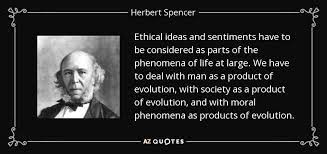
So important does this problem of industrial reconstruction seem to Spencer that he devotes to it again the largest section. of The Principles of Ethics (1893)—“this last part of my task … to which I regard all the preceding parts as subsidiary.” As a man with all the moral severity of the mid-Victorian, Spencer was especially sensitive to the problem of finding a new and natural ethic to replace the moral code which had been associated with the traditional faith. “The supposed supernatural sanctions of right conduct do not, if rejected, leave a blank. There exist natural sanctions no less pre-emptory, and covering a much wider field.” 

There exist natural sanctions no less pre-emptory, and covering a much wider field.

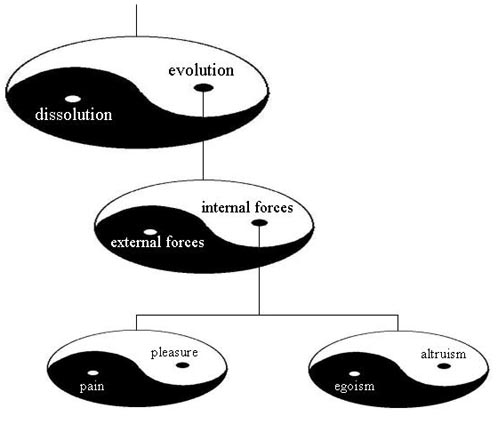
The new morality must be built upon biology. “Acceptance of the doctrine of organic evolution determines certain ethical conceptions.” Huxley, in his Romanes lectures at Oxford in 1893, argued that biology could not be taken as an ethical guide; that “nature red in tooth and claw” (as Tennyson was phrasing it) exalted brutality and cunning rather than justice and love; but Spencer felt that a moral code which could not meet the tests of natural selection and the struggle for existence, was from the beginning doomed to lip-service and futility. Conduct, like anything else, should he called good or bad as it is well adapted, or mal-adapted, to the ends of life; “the highest conduct is that, which conduces to the greatest length, breadth, and completeness of life.” Or, in terms of the evolution formula, conduct is moral according as it makes the individual or the group more integrated and coherent in the midst of a heterogeneity of ends. Morality; like art, is the achievement of unity in diversity; the highest type of man is he who effectively unites in himself the widest variety, complexity, and completeness of life. 

Spencer felt that a moral code which could not meet the tests of natural selection and the struggle for existence, was from the beginning doomed to lip-service and futility. Conduct, like anything else, should he called good or bad as it is well adapted, or mal-adapted, to the ends of life.

This is a rather vague definition, as it must be; for nothing varies so much, from place to place and from time to time, as the specific necessities of adaptation, and therefore the specific content of the idea of good. It is true that certain forms of behavior have been stamped as good—as adapted, in the large, to the fullest life—by the sense of pleasure which natural selection has attached to these preservative, and expansive actions. The complexity of modern life has multiplied exceptions, but normally, pleasure indicates biologically useful, and pain indicates biologically dangerous, activities. Nevertheless, within the broad bounds of this principle, we find the most diverse, and apparently the most hostile, conceptions of the good. There is hardly any item of our Western moral code which is not somewhere held to be immoral; not only polygamy, but suicide, murder of one’s own countrymen, even of one’s parents, finds in one people or another a lofty moral approbation. 

The wives of the Fijian chiefs consider it a sacred duty to suffer strangulation on the death of their husbands. A woman who had been rescued by Williams ‘escaped during the night, and, swimming across the river, and presenting herself to her own people, insisted on the completion of the sacrifice which she had in a moment of weakness reluctantly consented to forego’; and Wilkes tells of another who loaded her rescuer ‘with abuse,’ and ever afterwards manifested the most deadly hatred towards him.” “Livingstone says of the Makololo women, on the shores of the Zambesi, that they were quite shocked to hear that in England a man had only one wife: to have only one was not ‘respectable.’ So, too, in Equatorial Africa, according to Reade, ‘If a man marries, and his wife thinks that he can afford another spouse, she pesters him to marry again; and calls him a “stingy fellow” if he declines to do so.’  

The complexity of modern life has multiplied exceptions, but normally, pleasure indicates biologically useful, and pain indicates biologically dangerous, activities. Nevertheless, within the broad bounds of this principle, we find the most diverse, and apparently the most hostile, conceptions of the good.

Such facts, of course, conflict with the belief that there is an inborn moral sense which tells each man what is right and what is wrong. But the association of pleasure and pain, on the average, with good or evil conduct, indicates a measure of truth in the idea; and it may very well be that certain moral conceptions, acquired by the race, become hereditary with the individual. Here Spencer uses his favorite formula to reconcile the intuitionist and the utilitarian, and falls back once more upon the inheritance of acquired characters. 

The association of pleasure and pain, on the average, with good or evil conduct, indicates a measure of truth in the idea that there is an inborn moral sense which tells each man what is right and what is wrong.

Surely, however, the innate moral sense, if it exists, is in difficulties today; for never were ethical notions more confused. It is notorious that the principles which we apply in our actual living are largely opposite to those which we preach in our churches and our books. The professed ethic of Europe and America is a pacifistic Christianity; the actual ethic is the militaristic code of the marauding Teutons from whom the ruling strata, almost everywhere in Europe, are derived. The practice of dueling, in Catholic France and Protestant Germany, is a tenacious relic of the original Teutonic code. Our moralists are kept busy apologizing for these contradictions, just as the moralists of a later monogamic Greece and India were hard put to it to explain the conduct of gods who had been fashioned in a semi-promiscuous age.

However, the innate moral sense, if it exists, is in difficulties today; for never were ethical notions more confused. It is notorious that the principles which we apply in our actual living are largely opposite to those which we preach in our churches and our books.

Whether a nation develops its citizens on the lines of Christian morality or the Teutonic code depends on whether industry or war is its dominant concern. A militant society exalts certain virtues and condones what other peoples might call crimes; aggression and robbery and treachery are not so unequivocally denounced among peoples accustomed to them by war, as among peoples who have learned the value of honesty and non-aggression through industry and peace. Generosity and humanity flourish better where war is infrequent and long periods of productive tranquillity inculcate the advantages of mutual aid. The patriotic member of a militant society will look upon bravery and strength as the highest virtues of a man; upon obedience as the highest virtue of the citizen; and upon silent submission to multiple motherhood as the highest virtue of a woman. The Kaiser thought of God as the leader of the German army, and followed up his approbation of dueling by attending divine service. The North American. Indians “regarded the use of the bow and arrow, the war-club and spear, as the noblest employments of man. … They looked upon agricultural and mechanical labor as degrading. … Only during recent times—only now that national welfare is becoming more and more dependent on superior powers of production,” and these “on the higher mental faculties, are other occupations than militant ones rising into respectability.”

Whether a nation develops its citizens on the lines of Christian morality or the Teutonic code depends on whether industry or war is its dominant concern.

Now war is merely wholesale cannibalism; and there is no reason why it should not be classed with cannibalism and unequivocally denounced. “The sentiment and the idea of justice can grow only as fast as the external antagonisms of societies decrease, and the internal harmonious cooperations of their members increase.” How can this harmony be promoted? As we have, seen, it comes more readily through freedom than through regulation. The formula of justice should be: “Every man is free to do that which he wills, provided he infringes not the equal freedom of any other man.” This is a formula hostile to war, which exalts authority, regimentation and obedience; it is a formula favorable to peaceful industry, for it provides a maximum of stimulus with an absolute equality of opportunity; it is conformable to Christian morals, for it holds every person sacred, and frees him from aggression; and it has the sanction of that ultimate judge—natural selection—because it opens up the resources of the earth on equal terms to, all, and permits each individual to prosper according to his ability and his work. 

The sentiment and the idea of justice can grow only as fast as the external antagonisms of societies decrease, and the internal harmonious cooperations of their members increase. Harmony comes more readily through freedom than through regulation. The formula of justice should be: “Every man is free to do that which he wills, provided he infringes not the equal freedom of any other man.”

This may seem, at first, to be a ruthless principle; and many will oppose to it, as capable of national extension, the family principle of giving to each not according to his ability, and product, but according to his need. But a society governed on such principles would soon be eliminated. 

During immaturity benefits received must be inversely proportionate to capacities possessed. Within the family-group most must be given where least is deserved, if desert is measured by worth. Contrariwise, after maturity is reached benefit must vary directly as worth: worth being measured by fitness to the conditions of existence. The ill-fitted must suffer the, evils of unfitness, and the well-fitted profit by their fitness. These are the two laws which a species must conform to if it is to be preserved. … If, among the young, benefit were proportioned to efficiency, the, species would disappear forthwith; and if, among adults, benefit were proportioned to inefficiency, the species would disappear by decay in a few generations. …The only justification for the analogy between parent and child, and government and people, is the childishness of the people who. entertain the analogy.

If, among the young, benefit were proportioned to efficiency, the, species would disappear forthwith; and if, among adults, benefit were proportioned to inefficiency, the species would disappear by decay in a few generations.

Liberty contends with Evolution for priority in Spencer’s affections; and Liberty wins. He thinks that as war decreases, the control of the individual by the state loses most of its excuse; and in a condition of permanent peace the state would be reduced within Jeffersonian bounds, acting only to prevent breaches of equal freedom. Such justice should be administered without cost, so that wrong-doers might know: that the poverty of their victims would not shield them from punishment; and all the expenses of the state should be met by direct taxation, lest the invisibility of taxation should divert public attention from governmental extravagance; But “beyond maintaining justice, the state cannot do anything else without transgressing justice”; for it would then be protecting inferior individuals from that natural apportionment of reward and capacity, penalty and incapacity, on which the survival and improvement of the group depend. 

Spencer thinks that as war decreases, the control of the individual by the state loses most of its excuse; and in a condition of permanent peace the state would be reduced within Jeffersonian bounds, acting only to prevent breaches of equal freedom.

The principle of justice would require common ownership of land, if we could separate the land from its improvements. In his first book, Spencer had advocated nationalization of the soil, to equalize economic opportunity; but he withdrew his contention later (much to the disgust of Henry George, who called him “the perplexed philosopher”), on the ground that land is carefully husbanded only by the family that owns it, and that can rely on transmitting to its own descendants the effects of the labor put into it. As for private property, it derives immediately from the law of justice, for each man should be equally free to retain the products of his thrift. The justice of bequests is not so obvious; but the “right to bequeath is included in the right of ownership, since otherwise the ownership is not complete.” Trade should be as free among nations as among individuals; the law of justice should be no merely tribal code, but an inviolable maxim of international relations. 

The principle of justice would require common ownership of land, if we could separate the land from its improvements. Each man should be equally free to retain the products of his thrift. Trade should be as free among nations as among individuals; the law of justice should be no merely tribal code, but an inviolable maxim of international relations. 

These are, in outline, the real “rights of man”—the right to life, liberty, and the pursuit of happiness on equal terms with all. Besides these economic rights, political rights are unimportant unrealities. Changes in the form of government amount to nothing where economic life is not free; and a laissez-faire monarchy is much better than a socialistic democracy. 

Voting being simply a method of creating an appliance for the preservation of rights, the question is whether universality of votes conduces to creation of the best appliance for the preservation of rights. We have seen that it does not effectually secure this end. … Experience makes obvious that which should have been obvious without experience, that with a universal distribution of votes the larger class will inevitably profit at the expense of the smaller class. … Evidently the constitution of the state appropriate to that industrial type of society in which equity is fully realized, must be one in which there is not a representation of individuals but a representation of interests. … It may be that the industrial type, perhaps by the development of cooperative organizations, which theoretically, though not at present practically, obliterate the distinction between employer and employed, may produce social arrangements under which antagonistic class-interests will either not exist, or will be so far mitigated as not seriously to complicate matters. … But with such humanity as now exists, and must for a long time exist, the possession of what are called equal rights will not insure the maintenance of equal rights properly so-called.

These are, in outline, the real “rights of man”—the right to life, liberty, and the pursuit of happiness on equal terms with all. Changes in the form of government amount to nothing where economic life is not free.

Since political rights are a delusion, and only economic rights avail, women are misled when they spend so much time seeking the franchise. Spencer fears that the maternal instinct for helping the helpless may lead women to favor a paternalistic state. There is some confusion in his mind on this point; he argues that political rights are of no importance, and then that it is very important that women should not have them; he denounces war, and then contends that women should not vote because they do not risk their lives in battle—a shameful argument for any man to use who has been born of a woman’s suffering. He is afraid of women because they may be too altruistic; and yet the culminating conception of his book is that industry and peace will develop altruism to the point where it will balance egoism and so evolve the spontaneous order of a philosophic anarchism. 

Spencer is afraid of women because they may be too altruistic; and yet the culminating conception of his book is that industry and peace will develop altruism to the point where it will balance egoism.

The conflict of egoism and altruism (this word, and something of this line of thought, Spencer takes, more or less unconsciously, from Comte) results from the conflict of the individual with his family, his group, and his race. Presumably egoism will remain dominant; but perhaps that is desirable. If everybody thought more of the interests of others than of his own we should have a chaos of curtsies and retreats; and probably “the pursuit of individual happiness within the limits prescribed by social conditions is the first requisite to the attainment of the greatest general happiness.” What we may expect, however, is a great enlargement of the sphere of sympathy, a great development of the impulses to altruism. Even now the sacrifices entailed by parentage are gladly made; “the wish for children among the childless, and the occasional adoption of children, show how needful for the attainment of certain egoistic satisfactions are these altruistic activities.” The intensity of patriotism is another instance of the passionate preference of larger interests to one’s immediate concerns. Every generation of social living deepens the impulses to mutual aid. “Unceasing social discipline will so mould human nature that eventually, sympathetic pleasures will be spontaneously pursued to the fullest extent advantageous to all.” The sense of duty which is the echo of generations of compulsion to social behavior, will then disappear; altruistic actions, having become instinctive through their natural selection for social utility, will, like every instinctive operation, be performed without compulsion, and with joy. The natural evolution of human society brings us ever nearer to the perfect state.

Presumably egoism will remain dominant; but perhaps that is desirable. We may expect a great enlargement of the sphere of sympathy, a great development of the impulses to altruism. The natural evolution of human society brings us ever nearer to the perfect state.

.

HERBERT SPENCER: Sociology: The Evolution of Society

Reference: The Story of Philosophy

This paper presents Chapter VIII Section 6 from the book THE STORY OF PHILOSOPHY by WILL DURANT. The  contents are from the 1933 reprint of this book by TIME INCORPORATED by arrangement with Simon and Schuster, Inc.

The paragraphs of the original material (in black) are accompanied by brief comments (in color) based on the present understanding.

.

VI. Sociology: The Evolution of Society

With sociology the verdict is quite different. These stout volumes, whose publication ranged over twenty years, are Spencer’s masterpiece: they cover his favorite field, and show him at his best in suggestive generalization and political philosophy. From his first book, Social Statics, to the last fascicle of The Principles of Sociology, over a stretch of almost half a century, his interest is predominantly in the problems of economics and government; he begins and ends, like Plato, with discourses on moral and political justice. No man, not even Comte (founder of the science and maker of the word), has done so much for sociology. 

The volumes on Sociology cover Spencer’s favorite field, and show him at his best in suggestive generalization and political philosophy. 

In a popular introductory volume, The Study of Sociology (1873), Spencer argues eloquently for the recognition and development of the new science. If determinism is correct in psychology, there must be regularities of cause and effect in social phenomena; and a thorough student of man and society will not be content with a merely chronological history, like Livy’s, nor with a biographical history like Carlyle’s; he will look in human history for those general lines of development, those causal sequences, those illuminating correlations, which transform the wilderness of facts into the chart of science. What biography is to anthropology, history is to sociology. Of course there are a thousand obstacles that the study of society must yet overcome before it can deserve the name of science.* The young study is harassed by a multitude of prejudices—personal, educational, theological, economic, political, national, religious; and by the ready omniscience of the uninformed. “There is a story of a Frenchman who, having been three weeks here, proposed to write a book on England; who, after three months, found that he was not quite ready; and who, after three years, concluded that he knew nothing about it.” Such a man was ripe to begin the study of sociology. Men prepare themselves with life-long study before becoming authorities in physics or chemistry or biology ; but in the field of social and political affairs every grocer’s boy is an expert, knows the solution, and demands to be heard. 

*If Spencer’s critics had read this passage they would not have accused him of over-rating sociology.

If determinism is correct in psychology, there must be regularities of cause and effect in social phenomena; and a thorough student of society will look in human history for those causal sequences, which transform the wilderness of facts into the chart of science.

Spencer’s own preparation, in this case, was a model of intellectual conscience. He employed three secretaries to gather data for him, and to classify the data in parallel columns giving the domestic, ecclesiastical, professional, political, and industrial institutions of every significant people. At his own expense he published these collections in eight large; volumes, so that other students might verify or modify his conclusions; and the publication being unfinished at his death. he left part of his little savings to complete the undertaking. After seven years of such preparation, the first volume of the Sociology appeared in 1876; not until 1896 was the last one ready. When everything else of Spencer’s has become a task for the antiquarian, these three volumes will still be rich in reward for every student of society. 

Spencer employed three secretaries to gather data for him, and to classify the data in parallel columns giving the domestic, ecclesiastical, professional, political, and industrial institutions of every significant people.

Nevertheless, the initial conception of the work is typical of Spencer’s habit of rushing into generalizations. Society, he believes, is an organism, having organs of nutrition, circulation, coordination and reproduction,* very much as in the case of individuals. It is true that in the individual; consciousness is localized, while in society each of the parts retains its own, consciousness and its own will; but the centralization of government and authority tend to reduce the scope of this distinction. “A social organism is like an individual organism in these essential traits: that it grows; that while growing it becomes more complex; that while becoming more complex, its parts acquire increasing mutual dependence; that its life is immense in length compared with the lives of its component units; … that in both cases there is increasing integration accompanied by increasing heterogeneity.”  Thus the development of society liberally carries out the formula of evolution: the growing size of the political unit, from family to state and league, the growing size of the economic unit, from petty domestic industry to monopolies and cartels, the growing size of the population unit, from villages to towns, and cities—surely these show a process of integration; while the division of labor, the multiplication of professions and trades, and the growing’ economic interdependence of city with country, and of nation with nation, amply illustrate the development of coherence and differentiation. 

*Budding with colonization, and sexual reproduction with the inter-marriage of races.

Spencer believed that society is an organism, having organs of nutrition, circulation, coordination and reproduction, very much as in the case of individuals. 

The same principle of the integration of the heterogeneous applies to every field of social phenomena, from religion and government to science and art. Religion is at first the worship of a multitude of gods and spirits, more or less alike in every nation; and the development of religion comes through the notion of a central and omnipotent deity subordinating the others, and coordinating them into their hierarchy of special roles. The first gods were probably suggested by dreams and ghosts. The word spirit was, and is, applied equally to ghosts and gods. The primitive mind believed that in death, or sleep, or trance, the ghost or spirit left the body; even in a sneeze the forces of expiration might expel the spirit, so that a protective “God bless you!”—or its equivalent—became attached to this dangerous adventure. Echoes and reflections were sounds and sights of one’s ghost or double; the Basuto refuses to walk by a stream, lest a crocodile should seize his shadow and consume it. God was, at first, only “a permanently existing ghost.” Persons who had been powerful during their earthly lives were believed to keep their power in their ghostly appearance. Among the Tannese the word for god means, literally, a dead man. “Jehovah” meant “the strong one,'” “the warrior”: he had been a local potentate, perhaps, who was worshiped after his death as the “god of hosts.” Such dangerous ghosts had to be propitiated: funeral rites grew into worship, and all the modes of currying favor with the earthly chief were applied to the ceremonial of prayer and the appeasement of the gods. Ecclesiastical revenues originated in gifts to the gods, just as state revenues began as presents to the chief. Obeisances to kings became prostration and prayer at the altar of the god. The derivation of the god from the dead king shows clearly in the case of the Romans, who deified rulers before their death. In such ancestor-worship all religion seems to have its origin. The power of this custom may be illustrated by the story of the chief who refused baptism because he was not satisfied with the answer to his query as to whether he would meet his unbaptized ancestors in heaven. (Something of this belief entered into the bravery of the Japanese in the war of 1905; death was made easier for them by the thought that their ancestors were looking down upon them from the skies.) 

The same principle of the integration of the heterogeneous applies to every field of social phenomena, from religion and government to science and art. The first gods were probably suggested by dreams and ghosts. The word spirit was, and is, applied equally to ghosts and gods. 

Religion is probably the central feature in the life of primitive men; existence is so precarious and humble among them that the soul lives rather in the hope of things to come than in the reality of things seen. In some measure, supernatural religion is a concomitant of militarist societies; as war gives way to industry, thought turns from death to life, and life runs out of the grooves of reverent authority into the open road of initiative and freedom. Indeed, the most far-reaching change that has taken place in all the history of western society is the gradual replacement of a military by an industrial regime. Students of the state habitually classify societies according as their governments are monarchical, aristocratic, or democratic; but these are superficial distinctions; the great dividing line is that which separates militant from industrial societies, nations that live by war from those that live by work. 

The most far-reaching change that has taken place in all the history of western society is the gradual replacement of a military by an industrial regime, nations that live by war from those that live by work. 

The military state is always centralized in government, and almost always monarchical; the cooperation it inculcates is regimental and compulsory; it encourages authoritarian religion, worshiping a warrior god; it develops rigid class distinctions and class codes; it props up the natural domestic absolutism of the male. Because the death rate in warlike societies is high, they tend to polygamy and a low status of women. Most states have been militant because war strengthens the central power and makes for the subordination of all interests to those of the state. Hence “history is little more than the Newgate calendar of nations,” a record of robbery, treachery, murder and national suicide. Cannibalism is the shame of primitive societies; but some modern societies are sociophagous, and enslave and consume whole peoples. Until war is outlawed and overcome, civilization is a precarious interlude, between catastrophes; “the possibility of a high social … state fundamentally depends on the cessation of war.”

Until war is outlawed and overcome, civilization is a precarious interlude, between catastrophes.

The hope of such a consummation lies not so much in the spiritual conversion of the hearts of men (for men are what the environment makes them), as in the development of industrial societies. Industry makes for democracy and peace: as life ceases to be dominated by war, a thousand centers of economic development arise, and power is beneficently spread over a large portion of the members of the group. Since production can prosper only where initiative is free, an industrial society breaks down those traditions of authority, hierarchy, and caste, which flourish in military states, and under which military states flourish. The occupation of the soldier ceases to be held in high repute; and patriotism becomes a love of one’s country rather than a hatred of every other. Peace at home becomes the first need of prosperity, and as capital becomes international, and a thousand investments cross every frontier, international peace becomes a necessity as well. As foreign war diminishes, domestic brutality decreases; monogamy replaces polygamy because the life-tenure of men becomes almost equal to that of women; the status of women rises, and the “emancipation of women” becomes a matter of course. Superstitious religions give way to liberal creeds whose focus of effort is the amelioration and ennoblement of human life and character on this earth. The mechanisms of industry teach men the mechanisms of the universe, and the notion of invariable sequences in cause and effect; exact investigation of natural causes replaces the easy resort to supernatural explanations. History begins to study the people at work rather than the kings at war; it ceases to be a record of personalities and becomes the history of great inventions and new ideas. The power of government is lessened, and the power of productive groups within the state increases; there is a passage “from status to contract,” from equality in subordination to freedom in initiative, from compulsory cooperation to cooperation in liberty. The contrast between the militant and the industrial types of society is indicated by “inversion of the belief that individuals exist for the benefit of the State into the belief that the State exists for the benefit of the individuals.

The hope of such a consummation lies not so much in the spiritual conversion of the hearts of men (for men are what the environment makes them), as in the development of industrial societies. Industry makes for democracy and peace.

While protesting vigorously against the growth of an imperialistic militarism in England, Spencer chose his country as a type of approach to the industrial society, and pointed to France and Germany as instances of the militant state. 

From time to time newspapers remind us of the competition between Germany and France in their military developments. The body politic, in either case, expends most of its energies in growths of teeth and claws—every increase on the one side prompting an increase on the other. … Recently the French Minister for Foreign Affairs, referring to Tunis, Tongking, the Congo, and Madagascar, enlarged on the need there had been for competing in political burglaries with other nations; and held that, by taking forcible possession of territories owned by inferior peoples, ‘France has regained a certain portion of the glory which so many noble enterprises during previous centuries has insured her.’ … Hence we see why, in France, as in Germany, a scheme of social re-organization under which each citizen, while maintained by the community, is to labor for the community, has obtained so wide an adhesion as to create a formidable political body—why among the French, St. Simon, Fourier, Proudhon, Cabet, Louis Blanc, Pierre Leroux, now by word and now by deed, have sought to bring about some form of communistic working and living. … Verification by contrast meets us on observing that in England, where the extent of ownership by others has been less than in France and Germany, alike under its military form and under its civil form, there has been less progress in sentiment and idea towards that form of ownership by others which socialism implies.

While protesting vigorously against the growth of an imperialistic militarism in England, Spencer chose his country as a type of approach to the industrial society, and pointed to France and Germany as instances of the militant state. 

As this passage indicates, Spencer believes that socialism is a derivative of the militant, and feudal type of state, and has no natural affiliation with industry. Like militarism, socialism Involves the development of centralization, the extension of governmental power, the decay of initiative, and the subordination of the individual. “Well may Prince Bismarck display leanings towards State Socialism.” “It is the law of all organization that as it becomes complete it becomes rigid.” Socialism would be in industry what a rigid instinctive equipment is in animals; it would produce a community of human ants and bees, and would issue in a slavery far more monotonous and hopeless than the present condition of affairs. 

Under the compulsory arbitration which socialism would necessitate, … the regulators, pursuing their personal interests, … would not be met by the combined resistance of all workers; and their power, unchecked as now by refusals to work save on prescribed terms, “Would grow and ramify and consolidate until it became irresistible. … When from regulation of the workers by the bureaucracy we turn to the bureaucracy itself, and ask how it is to be regulated, there is no satisfactory answer. … Under such conditions there must arise a new aristocracy, for the support of which the masses would toil; and which, being consolidated, would wield a power far beyond that of any past aristocracy.*

*There is danger of this in Russia to-day.

Spencer believes that socialism is a derivative of the militant, and feudal type of state, and has no natural affiliation with industry. Like militarism, socialism Involves the development of centralization, the extension of governmental power, the decay of initiative, and the subordination of the individual. 

Economic relationships are so different from political relationships, and so much more complex, that, no government could regulate them all without such an enslaving bureaucracy. State interference always neglects some, factor of the intricate industrial situation, and has failed whenever tried; note the wage-fixing laws of medieval England, and the price-fixing laws of Revolutionary France. Economic relations must be left to the automatic self-adjustment (imperfect though it may be) of supply and demand. What society most wants it will pay for most heavily; and if certain men, or certain functions, receive great rewards it is because they have taken, or have involved, exceptional risks or pains. Men as now constituted will not tolerate a compulsory equality. Until an automatically-changed environment automatically changes human character, legislation enacting artificial changes will be as futile as astrology. 

Economic relationships are so different from political relationships, and so much more complex, that, no government could regulate them all without such an enslaving bureaucracy. Economic relations must be left to the automatic self-adjustment of supply and demand.

Spencer was almost made sick by the thought of a world ruled by the wage-earning class. He was not enamored of trade-union leaders so far as he could know them through the refractory medium of the London Times. He pointed out that strikes are useless unless most strikes fail; for if all workers should, at various times, strike and win, prices would presumably rise in accord with the raised wages, and the situation would be as before. ”We shall presently see the injustices  once inflicted by the employing classes paralleled by the injustices inflicted by the employed classes.”

Spencer was almost made sick by the thought of a world ruled by the wage-earning class. He pointed out that if all workers should, at various times, strike and win, prices would presumably rise in accord with the raised wages, and the situation would be as before.

Nevertheless his conclusions were not blindly conservative. He realized the chaos and brutality of the social system that surrounded him, and he looked about with evident eagerness to find a substitute. In the end he gave his sympathies to the cooperative movement; he saw in this the culmination of that passage from status to contract in which Sir Henry Maine had found the essence of economic history. “The regulation of labor becomes less coercive as society assumes a higher type. Here we reach a form in which the coerciveness has diminished to the smallest degree consistent with combined action. Each member is his own master in respect of the work he does; and is subject only to such rules, established by majority of the members, as are needful for maintaining order. The transition from the compulsory cooperation of militancy to the voluntary cooperation of industrialism is completed.” He doubts if human beings are yet honest and competent enough to make so democratic a system of industry efficient; but he is all for trying. He foresees a time when industry will no longer be directed by absolute masters, and men will no longer sacrifice their lives in the production of rubbish. “As the contrast between the militant and the industrial types is indicated by inversion of the belief that individuals exist for the benefit of the state into the belief that the state exists for the benefit of individuals; so the contrast between the industrial type and the type likely to be evolved from it is indicated by inversion of the belief that life is for work into the belief that work is for life.”

Spencer doubts if human beings are yet honest and competent enough to make so democratic a system of industry efficient; but he is all for trying. He foresees a time when industry will no longer be directed by absolute masters, and men will no longer sacrifice their lives in the production of rubbish.

.

HERBERT SPENCER: Psychology: The Evolution of Mind

Reference: The Story of Philosophy

This paper presents Chapter VIII Section 5 from the book THE STORY OF PHILOSOPHY by WILL DURANT. The  contents are from the 1933 reprint of this book by TIME INCORPORATED by arrangement with Simon and Schuster, Inc.

The paragraphs of the original material (in black) are accompanied by brief comments (in color) based on the present understanding.

.

V. Psychology: The Evolution of Mind

The two volumes on The Principles of Psychology (1873) are the weakest links in Spencer’s chain. There had been an earlier volume on the subject (1855), a youthfully vigorous defense of materialism and determinism; but age and thought revised this into a milder form, and padded it out with hundreds of pages of painstaking but unilluminating analysis. Here, even more than elsewhere, Spencer is rich in theories and poor in proofs. He has a theory of the origin of nerves out of intercellular connective tissue; and a theory of the genesis of instinct by the compounding of reflexes and the transmission of acquired characters; and a theory of the origin of mental categories out of the experience of the race; and a theory of “transfigured realism”;* and a hundred other theories that have all the obfuscating power of metaphysics rather than the clarifying virtue of a matter-of-fact psychology. In these volumes we leave realistic England and go “back to Kant.” 

*Spencer means by this that although the objects of experience may very well be transfigured by perception, and be quite other than they seem, they have an existence which does not all depend upon perceiving them.

Spencer is rich in theories and poor in proofs. The theories have all the obfuscating power of metaphysics rather than the clarifying virtue of a matter-of-fact psychology.

What strikes us at once is that for the first time in the history of psychology, we get here a resolutely evolutionist point of view, an attempt at genetic explanations, an effort to trace the bewildering complexities of thought down to the simplest of nervous operations, and finally to the motions of matter. It is true that this effort fails; but who has ever succeeded in such an attempt? Spencer sets out with a magnificent program for the unveiling of the processes whereby consciousness has been evolved; in the end he is compelled to posit consciousness everywhere, in order to evolve it. He insists that there has been one continuous evolution from nebula to mind, and at last confesses that matter is known only through mind. Perhaps the most significant paragraphs in these volumes are those in which the materialist philosophy is abandoned: 

Can the oscillation of a molecule be represented in consciousness side by side with a nervous shock, and the two be recognized as one? No effort enables us to assimilate them. That a unit of feeling has nothing in common with a unit of motion, becomes more than ever manifest when we bring the two into juxtaposition. And the immediate verdict of consciousness thus given, might be analytically justified; … for it might be shown that the conception of an oscillating molecule is built out of many units of feeling.” (I. e., our knowledge of matter is built up out of units of mind—sensations and memories and ideas). “… Were we compelled to choose between the alternatives of translating mental phenomena into physical phenomena, or of translating physical phenomena into mental phenomena, the latter alternative would seem the more acceptable of the two.

Spencer sets out with a magnificent program for the unveiling of the processes whereby consciousness has been evolved; in the end he is compelled to posit consciousness everywhere, in order to evolve it.

Nevertheless there is of course an evolution of mind; a development of modes of response from simple to compound to complex, from reflex to tropism to instinct, through memory and imagination to intellect and reason. To the reader who can pass alive through these 1400 pages of physiological and psychological analysis there will come an overwhelming sense of the continuity of life and the continuity of mind; he will see, as on a retarded cinematograph, the formation of nerves, the. development of adaptive reflexes and instincts, and the production of consciousness and thought through the clash of conflicting impulses. “Intelligence has neither distinct grades nor is it constituted by faculties that are truly independent, but its highest manifestations are the effects of a complication that has arisen by insensible steps out of the simplest elements.” There is no hiatus between instinct and reason; each is an adjustment of inner relations to outer relations, and the only difference is one of degree, in so far as the relations responded to by instinct are comparatively stereotyped and simple, while those met by reason are comparatively novel and complex. A rational action is simply an instinctive response: which has survived in a struggle with other instinctive responses; aroused by a situation; “deliberation” is merely the internecine strife of rival impulses. At bottom, reason and instinct, mind and life, are one. 

Nevertheless there is of course an evolution of mind; a development of modes of response from simple to compound to complex, from reflex to tropism to instinct, through memory and imagination to intellect and reason.

Will is an abstract term which we give to the sum of our active impulses, and a volition is the natural flow of an unimpeded idea into action. An idea is the first stage of an action, an action is the last stage of an idea. Similarly, an emotion is the first stage of an instinctive action, and the expression of the emotion is a useful prelude to the completed response; the baring of the teeth in anger. gives a substantial hint of that tearing of the enemy to pieces which used to be the natural termination of such a beginning. “Forms of thought” like the perception of space and time, or the notions of quantity and cause, which Kant supposed innate, are merely instinctive ways of thinking; and as instincts are habits acquired by the race but native to the individual, so these categories are mental habits slowly acquired in the course of evolution, and now part of our intellectual heritage. All these age-long puzzles of psychology can be explained by “the inheritance of continually-accumulating modifications.”—It is of course just this all-pervading assumption that makes so much of these laborious volumes questionable, and perhaps vain.

It is of course just this all-pervading assumption that makes so much of these laborious volumes questionable, and perhaps vain.

.

HERBERT SPENCER: Biology: The Evolution of Life

Reference: The Story of Philosophy

This paper presents Chapter VIII Section 4 from the book THE STORY OF PHILOSOPHY by WILL DURANT. The  contents are from the 1933 reprint of this book by TIME INCORPORATED by arrangement with Simon and Schuster, Inc.

The paragraphs of the original material (in black) are accompanied by brief comments (in color) based on the present understanding.

.

IV. Biology: The Evolution of Life 

The second and third volumes of the Synthetic Philosophy appeared in 1872 under the title of Principles of Biology. They revealed the natural limitations of a philosopher invading a specialist’s field; but they atoned for errors of detail by illuminating generalizations that gave a new unity and intelligibility to vast areas of biological fact. 

Spencer provided illuminating generalizations to vast areas of biological fact. 

Spencer begins with a famous definition: “Life is the continuous adjustment of internal relations to external relations.” The completeness of life depends on the completeness of this correspondence; and life is perfect when the correspondence is perfect. The correspondence is not a merely passive adaptation; what distinguishes life is the adjustment of internal relations in anticipation of a change in external relations, as when an animal crouches to avoid a blow, or a man makes a fire to warm his food. The defect of the definition lies not merely in its tendency to neglect the remolding activity of the organism upon the environment, but in its failure to explain what is that subtle power whereby an organism is enabled to make these prophetic adjustments that characterize vitality. In a chapter added to later editions, Spencer was forced to discuss “The Dynamic Element in Life,” and to admit that his definition had not really revealed the nature of life. “We are obliged to confess that Life in its essence cannot be conceived in physico-chemical terms.” He did not realize how damaging such an admission was to the unity and completeness of his system. 

Spencer begins with a famous definition: “Life is the continuous adjustment of internal relations to external relations.” But his definition had not really revealed the nature of life.

As Spencer sees in the life of the individual an adjustment of internal to external relations, so he sees in the life of the species a remarkable adjustment of reproductive fertility to the conditions of its habitat. Reproduction arises originally as a re-adaptation of the nutritive surface to the nourished mass; the growth of an amoeba, for example, involves an increase of mass much more rapid than the increase in the surface through which the mass must get its nourishment, Division, budding, spore-formation, and sexual reproduction have this in common, that the ratio of mass to surface is reduced, and the nutritive balance is restored. Hence the growth of the individual organism beyond a certain point is dangerous; and normally growth gives way, after a time, to reproduction. 

Spencer sees in the life of the species a remarkable adjustment of reproductive fertility to the conditions of its habitat. The ratio of mass to surface is prone to adjustment to establish the nutritive balance.

On the average, growth varies inversely with the rate of energy-expenditure; and the rate of reproduction varies inversely with the degree of growth. “It is well known to breeders that if a filly is allowed to bear a foal, she is thereby prevented from reaching her proper size. … As a converse fact, castrated animals, as capons and notably cats, often become larger than their unmutilated associates.” The rate of reproduction tends to fall as the development and capability of the individual progress. “When, from lowness of organization, the ability to contend with external dangers is small, there must be great fertility to compensate for the consequent mortality; otherwise the race must die out. When, on the contrary, high endowments give much capacity for self-preservation, a correspondingly low degree of fertility is requisite,” lest the rate of multiplication should outrun the supply of food. In general, then, there is an opposition of individuation and genesis, or individual development and fertility. The rule holds for groups and species more regularly than for individuals: the more highly developed the species or the group, the lower will its birth-rate be. But it holds for individuals too, on the average. For example, intellectual development seems hostile to fertility. “Where exceptional fertility exists, there is sluggishness of mind, and where there has been, during education, excessive expenditure in mental action, there frequently follows a complete or partial infertility. Hence the particular kind of further evolution which Man is hereafter to undergo is one which, more than any other, may be expected to cause a decline in his power of reproduction.” Philosophers are notorious for shirking parentage. In woman, on the other hand, the arrival of motherhood normally brings a diminution of intellectual activity; and perhaps her shorter adolescence is due to her earlier sacrifice to reproduction.

The more highly developed the species or the group, the lower will its birth-rate be. On the average, the rate of reproduction varies inversely with the degree of growth.

Despite this approximate adaptation of birth-rate to the needs of group survival, the adaptation is never complete, and Malthus was right in his general principle that population tends to outrun the means of subsistence. “From the beginning this pressure of population has been the proximate cause of progress. It produced the original diffusion of the race. It compelled men to abandon predatory habits and take to agriculture. It led to the clearing of the earth’s surface. It forced men into the social state, … and developed the social sentiments. It has stimulated to progressive improvements in production, and to increased skill and intelligence.” It is the chief cause of that struggle for existence through which the fittest are enabled to survive, and through which the level of the race is raised. 

Malthus was also right in his general principle that population tends to outrun the means of subsistence. It is the chief cause of that struggle for existence through which the fittest are enabled to survive, and through which the level of the race is raised. 

Whether the arrival of the fittest is due chiefly to spontaneous favorable variations, or to the partial inheritance of characters or capacities repeatedly acquired by successive generations, is a question on which Spencer took no dogmatic stand; he accepted Darwin’s theory gladly, but felt that there were facts which it could not explain, and which compelled a modified acceptance of Lamarckian views. He defended Lamarck with fine vigor in his controversy with Weismann, and pointed out certain defects in the Darwinian theory. In those days Spencer stood almost alone on the side of Lamarck; it is of some interest to note that today the neo-Lamarckians include descendants of Darwin, while the greatest contemporary English biologist gives it as the view of present-day students of genetics that Darwin’s particular theory (not, of course the general theory) of evolution must be abandoned.

Spencer accepted Darwin’s theory gladly, but felt that there were facts which it could not explain, and which compelled a modified acceptance of Lamarckian views.

.