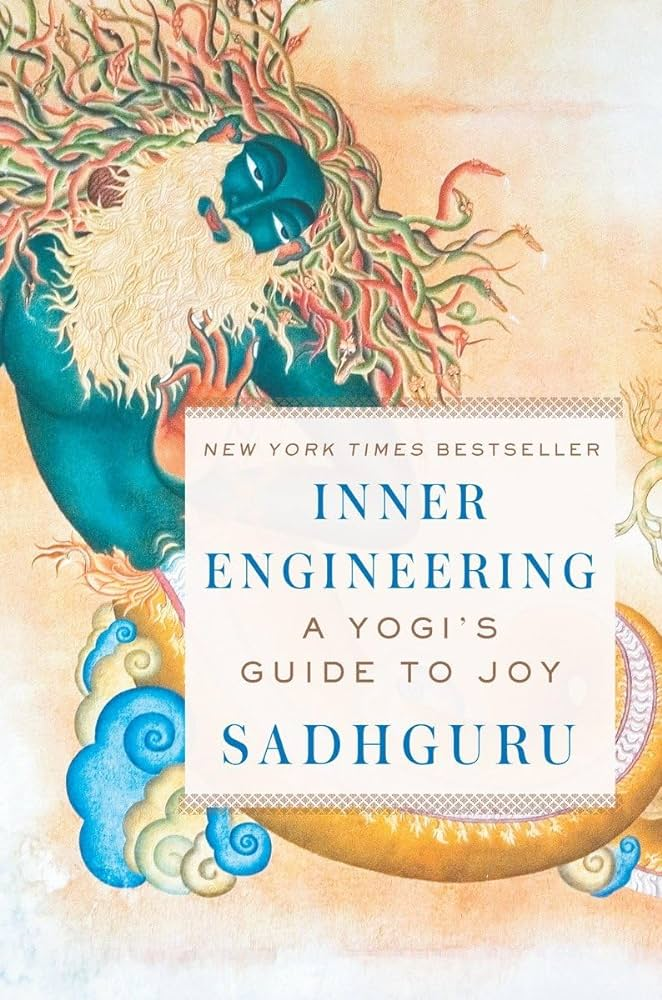
Inner Engineering – A Yogi’s Guide to Joy, a New York Times Bestseller, is a guide to self-empowerment that relies on the teaching and principles of classical yoga to help readers create an enduring foundation for inner stability and peace. For the first time, Sadhguru presents readers with a path to achieving absolute well-being through the classical science of yoga in a practical, accessible book. It is a means to create inner situations exactly the way you want them, turning you into the architect of your own joy.
In this transformative book, Sadhguru tells the story of his own awakening, from a boy with an affinity for the natural world, to a young daredevil who crossed the Indian continent on his motorcycle. He relates the moment of his enlightenment on a mountaintop in southern India, from which he emerged radically changed. Today, as the founder of Isha, he lights the path for millions. The wisdom distilled in this accessible, profound, and engaging book offers readers the opportunity to achieve nothing less than a life of joy.
Contents
Cover
Title Page
Copyright
Epigraph
“One man’s “magic” is another man’s engineering.” —ROBERT A. HEINLEIN
This paper presents Chapter XI Section 2.2 from the book THE STORY OF PHILOSOPHY by WILL DURANT. The contents are from the 1933 reprint of this book by TIME INCORPORATED by arrangement with Simon and Schuster, Inc.
The paragraphs of the original material (in black) are accompanied by brief comments (in color) based on the present understanding.
.
II. WILLIAM JAMES
2. Pragmatism
The direction of his thought is always to things; and if he begins with psychology it is not as a metaphysician who loves to lose himself in ethereal obscurities, but as a realist to whom thought, however distinct it may be from matter, is essentially a mirror of external and physical reality. And, it is a better mirror than some have believed; it perceives and reflects not merely separate things, as Hume supposed, but their relations too; it sees everything in a context; and the context is as immediately given in perception as the shape and touch and odor of the thing. Hence the meaninglessness of Kant’s “problem of knowledge” (how do we put sense and order into our sensations?)—the sense and the order, in outline at least, are already there. The old atomistic psychology of the English school, which conceived thought as a series of separate ideas mechanically associated, is a misleading copy of physics and chemistry; thought is not a series, it is a stream, a continuity of perception and feeling, in which ideas are passing nodules like corpuscles in the blood. We have mental “states” (though this is again a misleadingly static term) that correspond to prepositions, verbs, adverbs and conjunctions, as well as “states” that reflect the nouns and pronouns of our speech; we have feelings of for and to and against and because and behind and after as well as of matter and men. It is these “transitive” elements in the flow of thought that constitute the thread of our mental life, and give us some measure of the continuity of things.
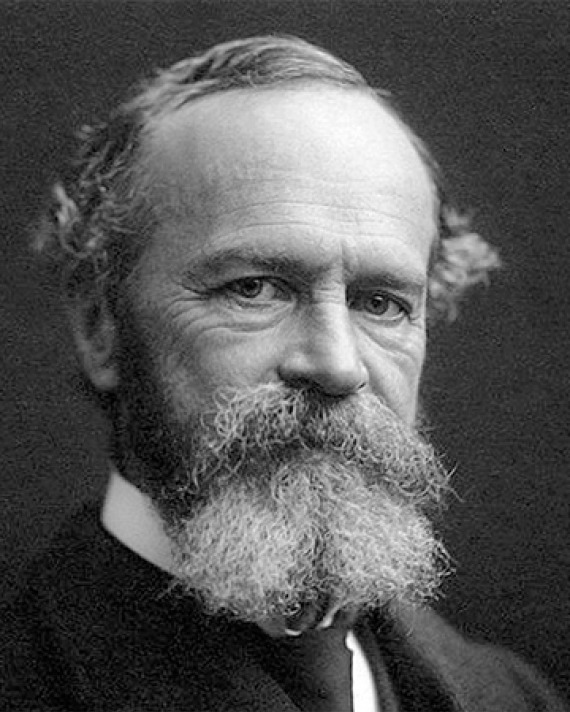
William James is a realist to whom thought, however distinct it may be from matter, is essentially a mirror of external and physical reality. It perceives and reflects not merely separate things but their relations too. It sees everything in a context; and the context is as immediately given in perception as the shape and touch and odor of the thing.
Consciousness is not an entity, not a thing, but a flux and system of relations; it is a point at which the sequence and relationship of thoughts coincide illuminatingly with the sequence of events and the relationship of things. In such moments it is reality itself, and no mere “phenomenon,” that flashes into thought; for beyond phenomena and “appearances” there is nothing. Nor is there any need of going beyond the experience-process to a soul; the soul is merely the sum of our mental life, as the “Noumenon” is simply the total of all phenomena, and the “Absolute” the web of the relationships of the world.
Consciousness is a flux and system of relations; it is reality itself that flashes into thought. The soul is merely the sum of our mental life. The “Noumenon” is simply the total of all phenomena. The “Absolute” is the web of the relationships of the world.
It is this same passion for the immediate and actual and real that led James to pragmatism. Brought up in the school of French clarity, he abominated the obscurities and pedantic terminology of German metaphysics; and when Harris and others began to import a moribund Hegelianism into America, James reacted like a quarantine officer who has detected an immigrant infection. He was convinced that both the terms and the problems of German metaphysics were unreal; and he cast about him for some test of meaning which would show, to every candid mind, the emptiness of these abstractions.
Brought up in the school of French clarity, James abominated the obscurities and pedantic terminology of German metaphysics.
He found the weapon which he sought when, in 1878, he came upon an essay by Charles Peirce, in the Popular Science Monthly. on “How to Make Our Ideas Clear.” To find the meaning of an idea, said Peirce, we must examine the consequences to which it leads in action; otherwise dispute about it may be without end, and will surely be without fruit. This was a lead which James was glad to follow; he tried the problems and ideas of the old metaphysics by this test, and they fell to pieces at its touch like chemical compounds suddenly shot through with a current of electricity. And such problems as had meaning took on a clearness and a reality as if, in Plato’s famous figure, they had passed out of the shadows of a cave into the brilliance of a sun-lit noon.
To find the meaning of an idea, we must examine the consequences to which it leads in action; otherwise dispute about it may be without end, and will surely be without fruit.
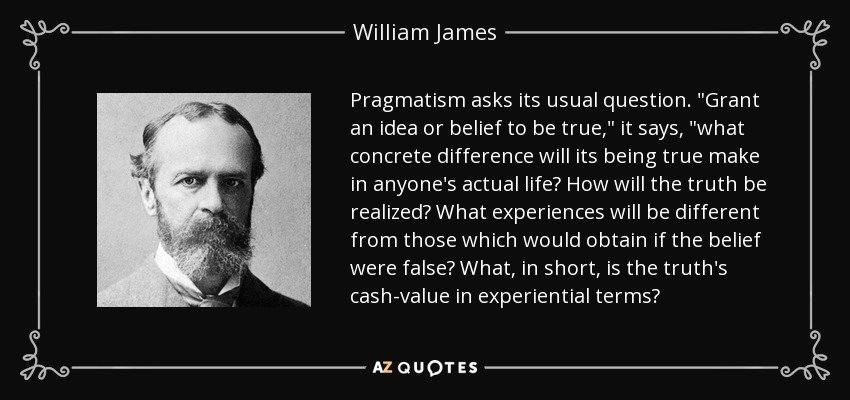
This simple and old-fashioned test led James on to a new definition of truth. Truth had been conceived as an objective relation, as once good and beauty had been; now what if truth, like these, were also relative to human judgment and human needs? “Natural laws” had been taken as “objective” truths, eternal and unchangeable; Spinoza had made them the very substance of his philosophy; and yet what were these truths but formulations of experience, convenient and successful in practice; not copies of an object, but correct calculations of specific consequences? Truth is the “cash-value” of an idea.
The true … is only the expedient in the way of our thinking, just as “the right” is only the expedient in the way of our behaving. Expedient is almost any fashion; and expedient in the long run and on the whole, of course; for what meets expediently all the experiences in sight won’t necessarily meet all further experiences equally satisfactorily. … Truth is one species of good, and not, as is usually supposed, a category distinct from good, and coordinate with it. The true is the name of whatever proves itself to be good in the way of belief.
Truths are but formulations of experience, convenient and successful in practice; not copies of an object, but correct calculations of specific consequences. Truth is the “cash-value” of an idea.
Truth is a process, and “happens to an idea”; verity is verification. Instead of asking whence an idea is derived, or what are its premises, pragmatism examines its results; it “shifts the emphasis and looks forward”; it is “the attitude of looking away from first things, principles, ‘categories,’ supposed necessities, and of looking towards last things, fruits, consequences, facts.” Scholasticism asked, What is the thing,—and lost itself in “quiddities”; Darwinism asked, What is its origin?—and lost itself in nebulas; pragmatism asks, What are its consequences?—and turns the face of thought to action and the future.
Truth is a process, and “happens to an idea”; verity is verification. Instead of asking whence an idea is derived, or what are its premises, pragmatism examines its results.
This paper presents Chapter XI Section 2.1 from the book THE STORY OF PHILOSOPHY by WILL DURANT. The contents are from the 1933 reprint of this book by TIME INCORPORATED by arrangement with Simon and Schuster, Inc.
The paragraphs of the original material (in black) are accompanied by brief comments (in color) based on the present understanding.
.
II. WILLIAM JAMES
1. Personal
The reader will not need to be reminded that the philosophy which we have just summarized is a European philosophy in everything but the place of its composition. It has the nuances and polish and mellow resignation characteristic of an old culture; one could tell from any paragraph in the Life of Reason that this is no native American voice.
Santayana’s philosophy, though composed in America, is more European.
In William James the voice and the speech and the very turn of phrase are American. He pounced eagerly upon such characteristic expressions as “cash-value,” and “results,” and “profits,” in order to bring his thought within the ken of the “man in the street”; he spoke not with the aristocratic reserve of a Santayana or a Henry James, but in a racy vernacular and with a force and directness, which made his philosophy of “‘pragmatism” and “reserve energy” the mental correlate of the “practical” and “strenuous” Roosevelt. And at the same time he phrased for the common man that “tender-minded” trust in the essentials of the old theology which lives side by side, in the American soul, with the realistic spirit of commerce and finance, and with the tough persistent courage that turned a wilderness into the promised land.
In William James the voice and the speech and the very turn of phrase are American. He spoke in a racy vernacular and with a force and directness with the realistic spirit of commerce and finance.
William James was born in New York City in 1842. His father was a Swedenborgian mystic, whose mysticism did no damage to his wit and humor; and the son was not lacking in any of the three. After some seasons in American private schools, William was sent with his brother Henry (one year his junior) to private schools in France. There they fell in with the work of Charcot and other psychopathologists, and took, both of them, a turn to psychology; one of them, to repeat an old phrase, proceeded to write fiction like psychology, while the other wrote psychology like fiction. Henry spent most of his life abroad, and finally became a British citizen. Through his more continuous contact with European culture he acquired a maturity of thought which his brother missed; but William, returning to live in America, felt the stimulation of a nation young in heart and rich in opportunity and hope, and caught so well the spirit of his age and place that he was lifted on the wings of the Zeitgeist to a lonely pinnacle of popularity such as no other American philosopher had ever known.
William James was raised in the mysticism of the Swedenborgian church, and later fell in with the work of Charcot and other psychopathologists. He felt the stimulation of a nation young in heart and rich in opportunity and hope, and caught the spirit of his age and place.
He took his M. D. at Harvard in 1870, and taught there from 1872 to his death in 1910, at first anatomy and physiology, and then psychology, and at last philosophy. His greatest achievement was almost his first—The Principles of Psychology (1890); a fascinating mixture of anatomy, philosophy and analysis; for in James psychology still drips from the foetal membranes of its mother, metaphysics. Yet the book remains the most instructive, and easily the most absorbing, summary of its subject; something of the subtlety which Henry put into his clauses helped William James to the keenest introspection which psychology had witnessed since the uncanny clarity of David Hume.
His greatest achievement was almost his first—The Principles of Psychology (1890); a fascinating mixture of anatomy, philosophy and analysis; for in James psychology still drips from the foetal membranes of its mother, metaphysics.
This passion for illuminating analysis was bound to lead James from psychology to philosophy, and at last back to metaphysics itself; he argued (against his own positivist inclinations) that metaphysics is merely an effort to think things out clearly; and he defined philosophy, in his simple and pellucid manner, as “only thinking about things in the most comprehensive possible way.” So, after 1900, his publications were almost all in the field of philosophy. He began with The Will to Believe (1897); then, after a masterpiece of psychological interpretation—Varieties of Religious Experience (1902)—he passed on to his famous books on Pragmatism (1907); A Pluralistic Universe (1909), and The Meaning of Truth (1909). A year after his death came Some Problems of Philosophy (1911); and later, an important volume of Essays in Radical Empiricism (1912). We must begin our study with this last book, because it was in these essays that James formulated most clearly the bases of his philosophy. *
* The reader who has leisure for but one book of James’s should go directly to Pragmatism, which he will find a fountain of clarity as compared with most philosophy. If he has more time, he will derive abundant profit from the brilliant pages of the (unabbreviated) Psychology. Henry James has written two volumes of autobiography, in which there is much delightful gossip about William. Flournoy has a good volume of exposition, and Schinz’s Anti-Pragmatism is a vigorous criticism.
James argued that metaphysics is merely an effort to think things out clearly; and he defined philosophy as “only thinking about things in the most comprehensive possible way.”
In this chapter Sage Patanjali talks about the methods of attaining yoga. These methods result in the the erosion of obstacles and attainment of samadhi.
The obstacles are ignorance, wrong identification of the self, attraction, aversion, and fixation. Ignorance is the source of all others obstacles. Ignorance is thinking impermanent to be permanent, impure to be pure, unpleasant to be pleasant, and something that is not self to be self. The root of these obstacles is the heap of karmas (actions), which causes suffering in the current birth and in others.
One should work upon resolving the obstacles even before they happen. You can do so by uniting the SEER with the SEEN. The SEER sees because it is being and has the power of sight. The SEEN manifests, acts and continues. It has substance that can be experienced and released. It is specific or generic that can be defined or undefined. The SEEN exists so that it can be seen. That’s its entire purpose.
The realization of true self requires the realization that both creator and creation are one. The apparent identification of body, mind and self exists because of ignorance. As this ignorance is removed through continuous awareness of what is not self (net, neti), one attains to the true sense of unity (kaivalyam). This is the higher self.
This method called Yoga has eight components: yama (self-discipline), niyama (strict-regimen), Asana (posture), prANAyAma (breath control), pratyAhAra (sensory withdrawal), dhAraNa (concentration), dhyAna (meditation), and samAdhi (equanimity).
Yama consists of non-violence, truthfulness, non-stealing, focus on divine, and non-covetousness. Such observance are universally applicable; and they are not modified by one’s country, birth, time, place and circumstances. The illogical thoughts, and practices, such as violence, come from greed and delusion.
Niyama consists of cleanliness, contentment, penance, and abiding in the Divine. By being established in cleanliness, one rises beyond the attachment for one’s own body parts, and over the sexual desire for the other’s. If one is troubled by the thoughts of straying away from yama and niyama, one should remind oneself of the outcome of the alternative choice.
Asana (posture) should be such that it provides a firm foundation for meditation and is pleasant to maintain.
In pranayama, one exercises the separation of the flow of inhalations and exhalations. With this practice the mind becomes eligible to hold concentration.
With pratyahara, the senses are no longer compulsively engaged in reacting to the objects in the environment. So, then they become capable of grasping what lies beyond.
NOTE: The remaining three components of Yoga are described in Chapter 3 of Patanjali Yoga Sutra.
tapaH=’penance’, svAdhyAyA=’study of the self’, IshwarapraNidhAna=’Abiding in the Divine’, constitute the process of kriyAyogaH=’Yoga of Internal Action’. (1)
In this chapter Sage Patanjali talks about the methods of attaining yoga. There are three such methods that fall under the category of Kriya Yoga. The first method is penance, where you build up the heat, or energy, in your body. The second method involves the mind to study the self. And the third method is immersing oneself in Ishwara.
avidyA=’Ignorance’, asmitA=’Wrong identification of the Self’, rAga=’Affection’, dveSha=’Aversion’, and abhinivesha=’Clinging’ are kleshas=’Obstacles’. (3)
There are five kleshas mentioned in this sutra. These are ignorance, wrong identification of the self, affection, aversion, and fixation. All these are obstacles to sAdhana and samAdhi.
avidyA=’Ignorance’ is the source of all the others, which are of the levels of prasupta=’Dormant’, tanu=’Feeble’, vichChinna=’Intermittent’ and udAra=’Profuse’. (4)
All these obstacles stem from the same source, which is avidyA. If avidyA is absent, all other obstacles will also not be there. These obstacles can be in four forms: dormant, feebly active, intermittently active, or fully active.
avidyA=’Ignorance’ is thinking anitya=’Impermanent’ to be nitya=’Permanent’; ashuchi=’Impure’ to be shuchi=’Pure’; duHkha=’Unpleasantness’ to be sukha=’Pleasantness’; and anAtma=’Not the Self’ to be Atma=’Self’. (5)
This sutra defines avidyA itself. avidyA (ignorance) is mistaken perception. Everything that is physical in this world is impermanent. Thinking of them as permanent is ignorance. Similarly, thinking of things that are unclean as clean; mistaking the state of misery to be a desired state; and looking at that which is not the self as the knowledge of the self—all this wrong knowledge is avidyA. On a cosmic scale, avidya is called maya.
asmitA=’Wrong identification of the Self’ is the apparent unity between drk=’Seer’ and darshana-shakti=’The power of sight’. (6)
From avidyA springs asmitA, which is the wrong identification of the Self. This is problematic for those who are in pursuit of Yoga. One is confusing the power to experience that lies within as oneself. The true self is much more basic or fundamental than just the power to experience. We see that there is an experience present; and as we think of the cause of that experience, and try to identify the true sense of self, we might get stuck and limited at the level of just identifying the ability to experience as ME. That ignorance where we get stuck at one level and do not go beyond to identify the true sense of self is asmitA.
.
सुखानुशयी रागः॥७॥ Sukhānuśayī rāgaḥ ||7||
rAga=’Affection’ is an outcome of sukha=’Pleasantness’. (7)
rAga is passion or affection. It might be pleasant but still it is an obstacle. If an experience is pleasant, it leads to a craving for it. Such craving is the obstacle of rAga.
.
दुःखानुशयी द्वेषः॥८॥ Duḥkhānuśayī dveṣaḥ ||8||
dveSha=’Aversion’ is an outcome of duHkha=’Unpleasantness’. (8)
If something is unpleasant, aversion builds up towards it. This also becomes an obstacle to sadhanA. Thus, clinging to pleasantness and unpleasantness—both of them are obstacles.
abhinivesha=’Clinging’ flows out of svarsa=’Interest in one’s own Self’, and is established even among viduShas=’The knowledgable ones’. (9)
The final obstacle is abhinivesha, which means ‘clinging’ or ‘being invested in’ or ‘strongly attached’ to something. It is an obstacle even for those who are knowledgable and know better. It flows out of one’s own self-interest and the basic instincts for survival. It is best understood by looking at one’s own self-interests. It is different for different people.
.
ते प्रतिप्रसवहेयाः सूक्ष्माः॥१०॥ Te pratiprasavaheyāḥ sūkṣmāḥ ||10||
These above mentioned kleshas are sUkShma=‘Subtle’, and need to be reduced by attending to the roots of their origin. (10)
These are very subtle internal states and difficult to withdraw from. They have to be handled once and for all, such that they do not recur.
The root of these kleshas is the heap of karmas=‘Actions’ which causes suffering in the current birth and in others. (12)
Patanjali now looks at the origin of these kleshas. The consequences of karma (actions) that one has engaged in the past, consciously or unconsciously, must be suffered eventually. This suffering occurs in the present life and in future lives too. So, the root cause of these kleshas is this heap of karmas.
.
सति मूले तद्विपाको जात्यायुर्भोगाः॥१३॥ Sati mūle tadvipāko jātyāyurbhogāḥ ||13||
As long as this root exists, it results in the fruits of jAti=“Birth’, AyuH=‘Life Span’, and bhogAH=‘Experiences’. (13)
karmAshaya (heap of karmas) exists in the form of impressions in the mind that are yet to be fully assimilated. Until they are fully assimilated these impressions cause the cycle of birth, life span and experiences to continue again and again.
.
ते ह्लादपरितापफलाः पुण्यापुण्यहेतुत्वात्॥१४॥ Te hlādaparitāpaphalāḥ puṇyāpuṇyahetutvāt ||14||
They in-turn result in the fruits of AhlAda=‘Delight’, and paritApa=‘Dejection’ due to the causes of puNya=‘Virtue’ and apuNya=‘Vice’ respectively. (14)
The heap of karmas result in both pleasantness and unpleasantness because of the virtues and vices associated with them. Such variations alternate as in waves and keep the life going.
Those who are driven by the intellect, perceive everything as unpleasant since everything has an intrinsic nature of change, which leads to afflictions and misery, and due to the conflicting nature of the actions born out of the three guNas. (15)
One who can discern the nature of these cyclical actions, sees duHkha (suffering) in everything. They can see that they are eternally stuck in a loop, and anything pleasant is just fleeting and momentary as it changes. That heap of karmas, which are at the root of all afflictions, are born of conflicting guNas within us and become impressions that continually impress upon us generating suffering.
.
Sutras (16-28) – Removing Obstacles
हेयं दुःखमनागतम्॥१६॥ Heyaṁ duḥkhamanāgatam ||16||
Unpleasantness which has not yet come about, needs to be avoided. (16)
Patanjali now talks about how to remove these kleshas (obstacles). He says—don’t wait for sorrow to come; avoid it. In other words, work upon avoiding sorrow even before it approaches you. For example, don’t wait for thirst to dig a well; dig a well before you feel thirsty.
Uniting the draShTA=‘The one who sees’, and the dRShyam=‘That which is seen’ is the cause which helps one avoid it. (17)
Usually there is this distinction between ‘me’ and the ‘other’, and the ‘other’ is always the issue. When you eliminate that distinction between ‘me’ and ‘not me’, you are fully prepared to handle any sorrow even before it approaches.
dRShyam=‘That which is seen’ has the tendencies of prakAsha=‘Manifestation’, kriyA=‘Action’, and stithi=‘Continuation’; is of the nature of bhUta=‘Elements’, and indriya=’Senses’; and serves the purpose of bhoga=‘Experience’ and apavarga=‘Release’. (18)
Patanjali now describes the nature of our experience and its various attributes. What we experience has the tendencies of manifestation, activity, and the stability of that activity. It consists of the five elements, and the senses. It serves the purpose of taking in (experience), and releasing outwards (liberation).
guNas=‘Qualities’ of the dRShyam can take up all possible states of being visheSha=’Specific’ or avisheSha=‘Generic’, and linga-mAtra=‘Defined’ or alinga=‘Undefined’. (19)
These attributes and qualities of that which is experienced, can take on many states. For example, they can be very specific or generic; or they can have a concrete form or be abstract.
draShTA=‘The one who sees’ is nothing but the power of sight, who even being pure, sees only through the perspective of pratyaya=‘The State of Being’. (20)
Patanjali now talks about the nature of that which experiences. The witness within is unblemished and free from all that is experienced; but, still, it is identified with the power of experience that it is using.
.
तदर्थ एव दृश्यस्यात्मा॥२१॥ Tadartha eva dṛśyasyātmā ||21||
It is for this purpose that dRShyam=‘That which is seen’ exists. (21)
And because draShTA is using that power of experience, the nature of dRShyam exists for that purpose. In other words the Atma (nature) of dRShyam exists because draShTA is perceiving it.
.
कृतार्थं प्रति नष्टमप्यनष्टं तदन्यसाधारणत्वात्॥२२॥ Kṛtārthaṁ prati naṣṭamapyanaṣṭaṁ tadanyasādhāraṇatvāt ||22||
Even when its purpose is served, once the draShTA=‘Seer’ becomes one with dRShyam=‘That which is seen’, it does not cease to exist due to its general relevance to all other beings. (22)
The purpose of dRShyam existing is served when it unites with draShTA, and so it does not exist any more as something separate. But it is not gone completely because of its generic relevance in creation at large.
The cause for realizing the true self, and the potential of both the creation and the creator, is this apparent unity between the body, mind and self.(23)
The self is identifying itself with the body and the mind because it wants to realize the true form of what animates us from within and what brings about this creation.
.
तस्य हेतुरविद्या॥२४॥ Tasya heturavidyā ||24||
And the cause for this apparent unity is avidyA=‘Ignorance’. (24)
In the absence of this ignorance, the apparent unity is also gone, and one attains to the state of kaivalyam. (25)
When that avidyA is not there, the identification of self with mind and body ceases, and one attains to the state of kaivalyam (just one, there is no other). Everything is just self; there is no sense of other than self.
The method to destroy ignorance is through aviplava=‘uninterrupted knowledge’ of vivekakhyAti=‘Distinction between what is self, and what is not’. (26)
The method to reduce avidyA is making the distinction between what is self and what is not, but this ‘knowing’ should not be intermittent. So, when that sense of distinction is continuously present, that destroys ignorance.
The seven-step process in which this vivekakhyAti comes about, is called as prajnA=‘True Knowledge’. (27)
prajnA is awareness or true perception. The path of prajnA consists of seven different stages, by which one removes that apparent unity (identification) with one’s own faculties and physiology; and finally arrives at the sense of uninterrupted distinction between what is self, and what is not.
Through the practice of the components of Yoga, the impurities are destroyed, resulting in the dawning of the light of True Knowledge. (28)
The impurity of the mind (identification) is destroyed by the practice of yoga. This gives rise to spiritual illumination, which results in deeper awareness of reality. This is the higher self.
The eight components of Yoga are yama=’Self-Discipline’, niyama=’Strict-Regimen’, Asana=‘Posture’, prANAyAma=‘Breath Control’, pratyAhAra=’Sensory Withdrawal’, dhAraNa=‘Concentration’, dhyAna=‘Meditation’, and samAdhi=‘Equanimity’. (29)
The raja yoga of Patanjali is divided into eight limbs. Yama, niyama, asana, pranayama and pratyahara form the external means of yoga. Dharana, dhyana, and samadhi form the internal means. The external and internal means are interdependent. Every stage of raja yoga makes way for the next higher stage.
AhinsA=‘Non-Violence’, satya=‘Truthfulness’, asteya=’Non-Stealing’, brahmcharya=‘Being on the Path of the Divine’, aparigraha=’Non-Covetousness’, are the practices of yama=’Self-Discipline’. (30)
Both yama and niyama mean discipline, but yama is more internal, and niyama is something that you do outwardly. Yama (self-discipline) is non-violence, truthfulness, non-stealing, focus on divine, and non-covetousness.
These practices hold true everywhere, and are not disturbed by jAti=‘One’s Birth’, desha=‘One’s place’, kAla=‘The Times One lives in’ and samaya=‘One’s Circumstances’. (31)
Yamas are great observances that are universally applicable. They are not modified by one’s country, birth, time, place and circumstances.
shaucha=‘Cleanliness’, santoSha=‘Contentment’, tapaH=‘Penance’, svAdhyAya=’Study of the Self’, and IshvarapraNidhAna=‘Abiding in the Divine’ are the practices of niyama=’Strict-Regimen’. (32)
Niyama’s are regimens according to which one conducts oneself. These are cleanliness, contentment, penance to raise energy level, and abiding in the Divine.
If one is troubled by vitarka=‘Illogical thoughts’ of straying away from yama and niyama, one should remind oneself of the outcome of the alternative choice. (33)
Vitarka is dreaming up justifications to not follow yama and niyama. When one is troubled by such justifications, one should simply remind oneself of the alternatives.
These illogical thoughts, and practices such as violence, either directly done, made to be done, or encouraged, due to the feelings of lobha=‘Greed’ and moha=‘Delusion’, performed either mildly, moderately or intensely, result in unbounded duHkha=‘Unpleasantness’ and ajnAna=‘Ignorance’. Thus, one should remind oneself of the outcome of the alternative choices. (34)
These illogical thoughts are about actions that go against yama and niyama. These actions may have been done directly, or through others, or simply approved. Such actions occur because of greed, rage and delusion. They may be performed to a mild, moderate or intense effect. Such actions inevitably lead to sorrow and stupidity in immense measure. This is how you remind yourself of the alternative.
By being established in AhimsA=’Non-Violence’, enmity is given up in the presence of such a person. (35)
Patanjali now looks at the benefits of yama and niyama. In the presence of one who is established in non-violence, the feeling of enmity naturally goes away because there are no harmful intentions whatsoever.
By being established in brahmcharya=‘Being on the Path of the Divine’, one begets vIrya=‘Vigour’. (38)
vIrya literally means the vital (genetic) fluids of the body for both men and women. When one’s path is firmly established in the source of creation, one gains that vitality and vigor. By not wasting the life force within, one builds up energy and radiance.
By being established in aparigraha=’Non-Covetousness’, one understands how one’s process of birth and death has been and will be. (39)
When one has renounced all possession except those objects that are essential for living, one gains the knowledge of how birth happened and all the previous births.
By being established in shaucha=‘Cleanliness’, one rises beyond the attachment for one’s own body parts, and over the sexual desire for the other’s. (40)
From this sutra begins the discussion of the niyamas. The benefit of being clean is that one overcomes the aversion for one’s own body and covetousness for the bodies of others.
.
सत्त्वशुद्धिसौमनस्यैकाग्र्येन्द्रियजयात्मदर्शनयोग्यत्वानि च॥४१॥ Sattvaśuddhisaumanasyaikāgryendriyajayātmadarśanayogyatvāni ca ||41||
One also attains to sattva=‘Vitality’, shuddhi=“Purity’, saumnasya=‘Pleasantness of the mind’, aikArgya=‘Intent Focus’, indriyajaya=Victory over the Senses’, and youyatva=‘Eligibility’ for Atmadarshana=‘Perception of the True Self’. (41)
There are further benefits of being clean, such as, vitality, purity, cheerfulness, close attention, control over senses. One also becomes capable to perceive one’s true self. Thus, yama and niyama are the foundations on which you build the practice of other limbs of Yoga.
By being established in tapaH=‘Penance’, one’s impurities are washed away, and one gains attainments corresponding to the Physical Body and the Senses. (43)
Through Tapas one attains mastery over one’s body and the senses, and removes the impurities within.
By being established in svAdhyAya=’Study of the Self’, one attains the practical utility of one’s deity of worship. (44)
Through the study of the self and knowing self clearly, one gains the ability to activate one’s own deity of worship. It is understood that such deities of worship are our own creation, and we can make them work for our well-being.
By being established in IshvarapraNidhAna=‘Abiding in the Divine’, one attains to samAdhi=‘Equanimity’. (45)
By abiding in Ishwara, we attain the state of samAdhi.
.
Sutras (46-48) – Asana
स्थिरसुखमासनम्॥४६॥ Sthirasukhamāsanam ||46||
Asanam=‘Posture’ is that which is sthiram= ‘Firm’ and Sukham=‘Pleasant’. (46)
Patanjali now talks about Asana. Asana (posture) should be such that it provides a firm foundation for meditation and is pleasant to maintain. It has nothing to do with twisting the body in complex ways.
In that state, the separation of the flow of Inhalations and Exhalations is called as prANAyAma. (49)
Patanjali now talks about prANAyAma. In that state of boundless ease and freedom from duality, working on separating the inhalations and the exhalations, and noticing their flow and movement, is prANAyAma.
It becomes long and subtle, with a practice of holding the breath inside and outside, being conscious of the three factors of desha=‘Place of Holding’, kAla=‘Time of Holding’ and Sankhya=’Number of Repetitions’. (50)
The breath becomes long and subtle as one notices it inside and outside, while holding in consciousness the sense of its location, duration and the count.
When the mind is withdrawn from the objects of the senses, the sense-organs also follow suit, and withdraw into themselves. This is known as pratyAhAra. (54)
Patanjali now talks about pratyAhAra. pratyAhAra is a state of sense-organs. When mind is not fixated on the object of the senses, and has withdrawn into itself; then, the sense organs, too, stop reacting to those objects and withdraw into themselves. This is pratyAhAra.
And then, the senses are pervaded by the supreme nature of the beyond. (55)
Sense-organs are faculties that help us engage with the world around us. With pratyAhAra, they are no longer compulsively engaged in reacting to the objects in the environment. So, then they become capable of grasping what lies beyond.
This paper presents Chapter XI Section 1.6 from the book THE STORY OF PHILOSOPHY by WILL DURANT. The contents are from the 1933 reprint of this book by TIME INCORPORATED by arrangement with Simon and Schuster, Inc.
The paragraphs of the original material (in black) are accompanied by brief comments (in color) based on the present understanding.
.
I. GEORGE SANTAYANA
6. Comment
There is in all these pages something of the melancholy of a man separated from all that he loves and was accustomed to a man deracine (uprooted), a Spanish aristocrat exiled to middle-class America. A secret sadness sometimes breaks forth: “That life is worth living,” he says, “is the most necessary of assumptions, and, were it not assumed, the most impossible of conclusions.” In the first volume of “The Life of Reason” he talks of the plot and meaning of human life and history as the subject of philosophy; in the last volume he wonders is there a meaning, or a plot? He has unconsciously described his own tragedy: “There is tragedy in perfection, because the universe in which perfection arises is itself imperfect.” Like Shelley, Santayana has never felt at home on this middling planet; his keen esthetic sense seems to have brought to him more suffering from the ugliness of things than delight in the scattered loveliness of the world. He becomes at times bitter and sarcastic; he has never caught the hearty cleansing laughter of paganism, nor the genial and forgiving humanity of Renan or Anatole France. He stands aloof and superior, and therefore alone. “What is the part of wisdom?” he asks; and answers—“To dream with one eye open; to be detached from the world without being hostile to it; to welcome fugitive beauties and pity fugitive sufferings, without forgetting for a moment how fugitive they are.”
Santayana has never caught the hearty cleansing laughter of paganism, nor the genial and forgiving humanity of Renan or Anatole France. He stands aloof and superior, and therefore alone.
But perhaps this constant memento mori (remember that you must die) is a knell to joy; to live, one must remember life more than death; one must embrace the immediate and actual thing as well as the distant and perfect hope. “The goal of speculative thinking is none other than to live as much as may be in the eternal, and to absorb and be absorbed in the truth.” But this is to take philosophy more seriously than even philosophy deserves to be taken; and a philosophy which withdraws one from life is as much awry as any celestial superstition in which the eye, rapt in some vision of another world, loses the meat and wine of this one. “Wisdom comes by disillusionment,” says Santayana; but again that is only the beginning of wisdom, as doubt is the beginning of philosophy; it is not also the end and fulfillment. The end is happiness, and philosophy is only; a means; if we take it as an end we become like the Hindu mystic whose life-purpose is to concentrate upon his navel.
To live, one must remember life more than death; one must embrace the immediate and actual thing as well as the distant and perfect hope. A philosophy which withdraws one from life is as much awry as any celestial superstition in which the eye, rapt in some vision of another world, loses the meat and wine of this one.
Perhaps Santayana’s conception of the universe as merely a material mechanism has something to do with this sombre withdrawal into himself; having taken life out of the world, he seeks for it in his own bosom. He protests that it is not so; and though we may not believe him, his too-much protesting disarms us with its beauty:
A theory is not an unemotional thing. If music can be full of passion, merely by giving form to a single sense, how much more beauty or terror may not a vision be pregnant with which brings order and method into everything that we know. … If you are in the habit of believing in special providences, or of expecting to continue your romantic adventures in a second life, materialism will dash your hopes most unpleasantly, and you may think for a year or two that you have nothing left to live for. But a thorough materialist, one born to the faith and not half plunged into it by an unexpected christening in cold water, will be like the superb Democritus, a laughing philosopher. His delight in a mechanism that can fall into so many marvellous and beautiful shapes, and can generate so many exciting passions, should be of the same intellectual quality as that which the visitor feels in a museum of natural history, where he views the myriad butterflies in their cases, the flamingoes and shell-fish, the mammoths and gorillas. Doubtless there were pangs in that incalculable life; but they were soon over; and how splendid meantime was the pageant, how infinitely interesting the universal interplay, and how foolish and inevitable those absolute little passions.
Perhaps Santayana’s conception of the universe as merely a material mechanism has something to do with this sombre withdrawal into himself; having taken life out of the world, he seeks for it in his own bosom.
But perhaps the butterflies, if they could speak, would remind us that a museum (like a materialist philosophy) is only a show-case of lifeless things; that the reality of the world eludes these tragic preservations, and resides again in the pangs of passion, in the ever-changing and never-ending flow of life. “Santayana,” says an observant friend,
had a natural preference for solitude. … I remember leaning over the railing of an ocean liner anchored at Southampton and watching passengers from the English tender crowd up the gang-plank to the steamer; one only stood apart at the edge of the tender, with calm and amused detachment observed the haste and struggle of his fellow-passengers, and not till the deck had been cleared, followed himself. ‘Who could it be but Santayana?’ a voice said beside me; and we all felt the satisfaction of finding a character true to himself.
Perhaps the reality of the world eludes these tragic preservations, and resides again in the pangs of passion, in the ever-changing and never-ending flow of life.
After all, we must say just that, too, of his philosophy: it is a veracious and fearless self-expression; here a mature and subtle, though too sombre, soul has written itself down quietly, in statuesque and classic prose. And though we may not like its minor key, its undertone of sweet regret for a vanished world, we see in it the finished expression of this dying and nascent age, in which men cannot be altogether wise and free, because they have abandoned their old ideas and have not yet found the new ones that shall lure them nearer to perfection.
Santayana’s philosophy is a veracious and fearless self-expression; here a mature and subtle, though too sombre, soul has written itself down quietly, in statuesque and classic prose.