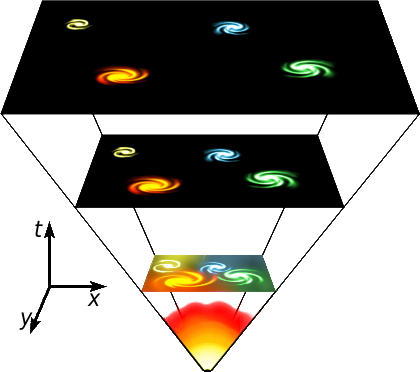
Objective and Subjective

Reference: Course on Subject Clearing

When Kant came along he introduced the idea of “object-in-itself” that is beyond experience. This influenced the definitions of the following words:

Objective
Origin: “something thrown down or presented (to the mind).” Objective is something that belongs to the object of thought. It is something clearly graspable visibly and intellectually and, therefore, considered factual. It is not subject to personal feelings, interpretations, or prejudice. Example: an objective opinion.

After Kant the definition of “Objective” was corrupted by some to mean “an absolute form of object that is beyond intellectual grasp.”

Subjective
Origin: “to throw or place beneath.” Subjective is something that belongs to the thinking subject rather than to the object of thought. It pertains to the characteristic of an individual. It is subject to personal feelings, interpretations, prejudice or speculation. Example: a subjective speculation.

After Kant the definition of “Subjective” was corrupted by some to mean “all things grasped by the mind.”

.

Kant was basically talking about the “Unknowable”.

Unknowable
That, which is before the beginning of the universe. It cannot be known because it is not manifested. It is different from “unknown,” which is something manifested but not known.

.

The Unknowable cannot be differentiated any further because it is unknowable. It cannot be defined as “absolute form of an object” because that would simply be speculation, and that speculation would exist in the mind.

So, the later (post-Kant) interpretations of Objective and Subjective are inherently inconsistent.

.

Summary

“Unknowable” and “Knowable” is the first level of categorization. Then under Knowable, we have objective and subjective as the second level of categorization. Unknowable, being unknowable, cannot be equated with anything. So you cannot equate objective with unknowable. When you make the error of equating objective with unknowable, then you also make the error of equating subjective with everything knowable, making this second level categorization useless.

.

The Universe & Looking (old)

Reference: Course on Subject Clearing

This Key Word List and Glossary considers looking at the universe. The essence of looking is assimilation of what is perceived.

.

Key Word List

Looking, Inconsistency, Arbitrary, Attention, Unassimilated impression, Unstacking, Free Association, Directed Process, Memory, Time stamp,  Experiencing

.

Glossary

Looking
Looking means to observe and recognize things for what they are. Looking does not involve thinking. Accurate perception requires the elimination of inconsistencies through unstacking of unassimilated impressions.

Inconsistency
An inconsistency is something that is not consistent with its surroundings. It is arbitrary to some degree. Yet it is accepted because it seems to explain some confusion. Examples of this would be unreal beliefs that people carry around, and strange rituals that they engage in.

Arbitrary
An arbitrary consists of the assumption or projection made during the assimilation of perceptual elements to maintain continuity, consistency and harmony in the mental matrix. The arbitrariness exists because not all data is known. It generates anomalies when various data is associated. These anomalies show up as doubts and perplexities, which are then resolved by getting more precise data.

Attention
Attention, when left to itself, generally goes to those areas where the processing of sensory input is slowed or blocked by inconsistencies.

Unassimilated impression
Unassimilated impressions consists of sensations, perceptions and knowing that have not been assimilated. At the root of unassimilated sensations are traumas that are too chaotic to be assimilated. Until they are assimilated, the subsequent perceptions and knowing also remain unassimilated to some degree. 

Unstacking
Unassimilated impressions stack up in the mind waiting to be assimilated. They unstack only by themselves when not interfered with, under deep concentration and free association.

Free Association
In free association one looks at the mind without interfering with it. Attention may flip from place to place; but as one keeps looking non-judgmentally without resistance, a pattern may emerge. As one keeps looking, the pattern may reveal some inconsistency. Such free association is non-verbal.

Directed Process
A directed process simply provides some assistance to a person in looking, with the proviso that the process does not imply that there must be something to be found in that direction. The directed process constrains free association to that direction.

Memory
Origin: “remembering”. When recalled, perceptual elements come together per their time stamps to generate the memory. Memory operates in the background to support computations. Memory does not consist of readymade recordings stored in the mind. 

Time stamp
Time stamp is the sense of successive occurrence coded in the perceptual elements.

Experiencing
Experiencing is a deeper form of looking. It is looking at the feelings, emotions, sensations and efforts arising in the mind and felt in the body. These are flows that outpour or discharge when not resisted.

.

The Universe & Beingness

Reference: Course on Subject Clearing

This Key Word List and Glossary considers the universe and its beingness. The essence of beingness is awareness.

.

Key Word List

Beingness, Reality,  Matter, Energy, Space, Time, Thought, Self, Viewpoint, Identity, Individuality, Ego, “I”

.

Glossary

Beingness
A manifestation means that it has a beingness. Every bit of existence is being, and it is aware of other bits of existence as part of the same universe. In humans, the beingness is very complex and sophisticated. A human being is a bundle of abilities.

Reality
The reality of beingness is expressed as matter, energy, space, time and thought.

Matter
Matter is the solidity of the beingness. That means what is being is staying fixed. 

Energy
Energy is the changeability of the beingness. That means what is being is changing continually.

Space
Space is the scope and dimensions of the beingness. That means what is being has extents and properties.

Time
Time denotes the persistence of the beingness and the successive changes it undergoes. That means what is being is existing and evolving. 

Thought
Thought is the consideration of beingness. It is made of associations in the mental matrix.

Self
Self is the thought considering its own nature. In humans, self is the center of the mental matrix.

Viewpoint
The viewpoint is the frame of reference, which the self uses to view things. 

Identity
Origin: “same, always being itself.” When self ascertains what it is, it acquires an identity. Identity is condition that identifies something. In humans, identity is the character as to who a person is, and the qualities, beliefs, etc., that distinguish that person. 

Individuality
The individuality of a person is part of his identity as it distinguishes him from others of his kind. Individuality is determined by the uniqueness of the mental matrix.

Ego
Ego is an identity with an introverted and fixed viewpoint.

“I”
“I” is the “center of awareness” of the mental matrix. This concept is similar to the concept of “center of mass” of a solid object in Physics.

.

The Universe & Beginning

Reference: Course on Subject Clearing

This Key Word List and Glossary considers the universe and its beginning. We may only speculate on this subject based on the reasoning provided below.

.

Key Word List

Manifest, Begin, Unknowable, Change, Cause & Effect, End, Cycle, Evolution

.

Glossary

Manifest
Origin: “detected in the act, evident, visible”. Manifest means readily perceived by the eye or the understanding. We become aware of the universe upon its manifestation.

Begin
The universe began with a manifestation. In other words, the universe began with awareness.

Unknowable
That, which is before the beginning of the universe. It cannot be known because it is not manifested. It is different from “unknown,” which is something manifested but not known. 

Change
Starting from the beginning there are successive changes.

Cause & Effect
When there is a previous manifestation that changes into a subsequent manifestation, we have the ideas of cause and effect. The idea of CAUSE applies to the “previous manifestation”, which is “unknowable” for the universe itself. Otherwise, cause and effect apply to everything within the universe. 

End
Within the universe a manifestation ends when it changes to another manifestation. 

Cycle
A cycle is something that repeats. Begin-Change-End is the most basic cycle. A cycle can be viewed only from a viewpoint independent of that cycle. Thus, we can see cycles within the universe of which we are not a part. Since we are not independent of the universe; we may only speculate on the cycle of the universe. We cannot say if the universe has a beginning or an end. For us, the universe begins with awareness, and ends in non-awareness. 

Evolution
Origin: “to unroll, open, unfold”. To evolve is to develop gradually. The cycles in this universe lead to evolution from simple to more complex and sophisticated. There is evolution from inanimate objects to self-animated organism. The self-animated organism evolve from the vegetable and the animal kingdoms to humans. The peak of this evolution is the human kind. The deep awareness appears only at the level of humans in the form of knowingness.

The Universe & Mind (old)

Reference: Course on Subject Clearing

This Key Word List and Glossary introduces the universe and its relationship to the mind. The universe provides all possible relationships. The mind generates associations in a mental matrix to conceive the universe.

Note: The Key Word List and the Glossary have been updated since the issuance of the video above.

.

Key Word List

Universe, Existence, Sense, Sensation, Perceptual Element,  Perception, Knowingness, Awareness, Mental matrix

.

Glossary

Universe
Origin: “entire, all, literally, turned into one.” The universe refers to all matter, all energy, all space, all time, and all thought. In other words, the universe includes everything physical, metaphysical, real, imaginary, postulated or speculated. Nothing is excluded from the universe. It is the whole existence treated as ONE. 

Existence
Any thing that can be sensed and perceived has existence. It is part of the universe.

Sense
Origin: “to feel”. At the most basic level, to sense is to have a contact and subsequent reaction. A contact occurs because there is some relationship. All the laws of nature come about because the elements of the universe are able to sense each other. As life evolves the activity of “sensing” becomes more complex. In humans, “sensing” involves the faculties of sight, hearing, smell, taste, and touch. 

Sensation
Sensations are basically reactions based on relationship and contact. In humans, the sensations are outcome of interactions between the faculties of sight, hearing, smell, taste, and touch, and the environment. Sensations may be thought of as made of perceptual elements.

Perceptual Element
A perceptual element is an association generated from the relationships in the universe. In humans the perceptual elements are much finer than in the animals. Therefore, the character of awareness in humans is also very different compared to animals.

Assimilation
Origin: “made similar”. Assimilation establishes all possible associations among the perceptual elements. Duplicate perceptual elements are merged together. 

Perception
Origin: “a taking in”. Perceptions come about as the perceptual elements from incoming sensations continually get assimilated with each other. Thus, sensations get increasingly defined through complex and sophisticated associations and become perceptions.

Knowingness
Origin: “to know how, be able to” To know is to perceive or understand as fact or truth; to apprehend clearly and with certainty. Knowingness comes about as perception get assimilated and evolve into deep understanding. Here we have extremely sophisticated associations of the elements of the universe.

Awareness
Awareness arises on a gradient from associations among the perceptual elements of the universe as sensations, perceptions and knowingness.

Mental matrix
Origin of matrix: “womb”. The mind is essentially a multi-dimensional, complex matrix of perceptual elements accumulated over its existence. The mental matrix provides a copy of the universe based on one’s exposure to it. The more sophisticated are the perceptual elements within the mental matrix, the clearer is the awareness of the universe.

Mind
See Mental matrix.