Category Archives: Subject Clearing

Word Meanings

Reference: The Book of Subject Clearing

Words and symbols form our basic understanding. When there is confusion in the study materials, the first thing to do is to isolate the area of confusion. Then locate the paragraph which is confusing. Then locate the sentence in that paragraph which doesn’t make sense. Then find the first word in that sentence that seem to generate confusion, and clear up its meaning. Here you have to be careful because the confusion may arise from a simple word, such as, “on”, “of”, or “in” because they can be used in different meanings.

In short, clear up the meaning of words in the area of confusion. It may be just one word or many. But the moment you find a misunderstood word, the confusion lessens and your mood brightens. Keep repeating the above procedure. You will be surprised how fast the confusion clears up.

.

New and Familiar Words

Many a time we run into new words, but we guess their meaning from the context and carry on. Later when we start to have trouble, we may not connect it to this new word that we didn’t look up.

Many words appear familiar to us because we have come across them many times. But we always guessed their meanings and never looked them up. So, it is always safe to look up the meaning of a word when there is the slightest doubt. This will help you avoid a lot of headache later.

.

Broad Concept

Before you look up the definitions, make sure you know the broad concept of the word. You may find the broad concept listed under ‘history’, ‘origin’, or ‘etymology’ in a dictionary. The following broad concepts for some words are taken from “Dictionary of Word Origins” by John Ayto.

The word STUDY comes from a Latin word meaning “eagerness, intense application”.

The word MATHEMATICS comes from a Greek word meaning “something learned”.

The word ARITHMETIC comes from Greek, ARITHMOS number + TECHNE skill, which means “number skill”.

.

Many Definitions

A word, especially a simple one, usually has more than one definition. You may check all the definitions in a good dictionary, and find the one that makes most sense in the given context. If there are more than one definition that seem to fit, then you must understand the difference between them and choose the right definition.

To choose the right definition, visualize each definition. You may sketch the concept as a diagram on paper, or demonstrate it dynamically with bits and pieces of things. You may even use clay to model the concept. In case of animals, trees, flowers, etc., you may consult images on search engines on Internet like Google images. For abstract concepts, such as, “love,” make real examples from your experience to understand the differences, It is always helpful to use the word in a few sentences to get further clarity on a definition. 

.

Words in Definitions

If a word in the definition itself is not quite clear, then look it up in a dictionary as described above. This may sometime get you in a chain of words. List the words as you look them up, and cross them out as they are cleared up. It is okay to look up the same word many times because each time you look it up you may pick up a new dimension to its meaning.

.

The Right Definition

The right definition is the one that lessens the confusion. As there may be more than one word that needs clearing up, keep repeating this procedure until the confusion in the study materials is gone.

When all the words in the area of confusion are understood, but some confusion still remains, then look for anomalies. See Resolving Anomalies.

.

The Discipline of Discussion

Reference: Course on Subject Clearing

When you are studying a subject and listening to others, you are inflowing information from other people’s observations. When you are discussing with other people you are outflowing your independent observations and opinions about that subject. This balances your inflow with your outflow. Such a balance is important.

Discussion may be a good way to resolve the doubts and perplexities you have.

.

Discussion

The purpose of a discussion is to learn by exchanging viewpoints. One uses experience and experimentation to obtain data and then brings it to the table to be discussed.

The participants in a discussion focus on the subject and not on each other. A discussion is not a debate where one is in a contest to win argument against others. There is no need for sophistry. In a discussion there are no opponents. All participants are on the same side. On the other side may just be ignorance. In a discussion each participant’s viewpoint is bound to change and evolve as he/she learns from the data pooled together by all.

Thus, a discussion is a cooperative effort. There is no reason to censor any data in a discussion. The data simply needs to be examined in detail.

.

Rules of Discussion

(1) DO NOT DEFEND A VIEWPOINT, INSTEAD LOOK FOR SOME ANOMALY GENERATED BY IT.

For example, a person may believe that God is a being who has created this world. He may reject those who think differently. This viewpoint generates an inconsistency. A being has a form, but all forms are created only when the world gets created. So either God must have been created along with the world, or God is not a being. The person may not be aware of this inconsistency caused by his belief, and he may be willing to engage in a mindful discussion.

But when a person refuses to engage in a discussion despite inconsistency, and continues to defend his belief, then he may be using that belief to hide some confusion. He may be afraid that if his belief is shaken, some confusion will overwhelm him. But as he gets exposed to mindfulness, he may be willing to examine his confusions. Mindful discussion could then help resolve that confusion. Everybody wins.

.

(2) FOCUS ON THE DATA BEING PRESENTED AND NOT ON THE PERSON PRESENTING IT.

Many people feel so invested in their beliefs that they feel attacked when they are unable to uphold their viewpoint in a discussion. They start commenting on the perceived characteristics of another participant holding a different viewpoint. They may even become accusative, emotional and combative.

Any focus on participants rather than on the subject of discussion causes much distraction. It must be avoided.

.

(3) IN A DISAGREEMENT NEVER CALL THE OTHER PERSON WRONG, INSTEAD PROVIDE FURTHER CLARIFICATION REGARDING YOUR VIEWPOINT.

In any disagreement effort should be made to clarify one’s viewpoint as much as possible. Not doing so, and simply saying that the other person is wrong, does not resolve anything. It only produces distraction.

.

(4) FURTHERMORE, IN A DISAGREEMENT, ASK FOR CLARIFICATION AND, WHEN IT IS PROVIDED, CONSIDER IT WITH MINDFULNESS.

A person can be so convinced about being right that he would not even ask the other person for further clarification. He would not even listen if the other person offers any clarification. He simply would not engage in a discussion. This kind of behavior also produces much distraction.

.

(5) DO NOT COMPLAIN THAT THE OTHER PERSON IS NOT ANSWERING YOUR QUESTION, INSTEAD DISCUSS WHAT YOU ARE EXPECTING.

When a person is committed to certain expectations, he may not even see an answer when it is given to him. An indication of that is his continual complaint that he is not getting an answer. The solution is for the person to honestly look at the expectations he has committed himself to and compare it to answers he is getting. If he then finds an anomaly, he should bring it to the table for discussion. But as long as that person is justifying his expectations in his mind, no discussion is possible.

.

(6) ALWAYS FOCUS ON ANOMALIES AND ISOLATE THEM AS BEST AS YOU CAN. NEVER BE DISCOURAGED IF OTHERS ARE TAKING TIME TO RECOGNIZE IT.

An anomaly is a discontinuity (missing information), an inconsistency (contradicting information),  or disharmony (arbitrariness of altered importance). It is something that does not make sense. Mindfulness discussion is very successful because it focuses on anomalies only. When an anomaly is difficult to resolve simply look around for more data on that area of discontinuity, inconsistency, or disharmony, and consider it carefully.

.

Summary

A disagreement doesn’t mean that what is being disagreed with is untrue. To show untruthfulness of something one needs to point out the anomaly. Then that anomaly needs to be resolved to find the actual substance, which makes the observations free of anomalies. That substance shall qualify as the truth.

.

Studying a Subject (old-3)

Please see Course on Subject Clearing

When studying a subject your focus must be on spotting the anomalies and resolving them. The anomaly could arise because of a misunderstanding of the materials, or it could be present in the materials themselves. 

To avoid any misunderstanding, make sure that you do not go past a  a word that you do not fully understand the meaning of. Most of the time any difficulty can always be traced to a word that was misunderstood. Make full use of the dictionaries, glossaries, and any notes available. But, even after understanding the materials something does not make sense then you start investigating the key concepts for anomalies.

.

KEEP NOTES

Note your thoughts and comments after a paragraph, or a reasonable section of study material. This is easy to do If you can copy your study materials to a word processor. For example, see: THE BHAGAVAD GITA: Chapter 2.

.

WORD MEANINGS

If you find your mind going blank as you read a section, then find the first sentence which doesn’t make sense. Then find the first word in that sentence that seem to generate confusion. Here you have to be careful because the confusion may arise from a simple word, such as, “on”, “of”, or “in”. 

A word, especially a simple one, usually has more than one definition. Quickly check all the definitions of the word in question, and find the definition that makes most sense. Repeat this procedure until the whole section is understood. 

.

COMMENTS

If the difficulty still persists, then look for an anomaly in that section. There could be missing information (discontinuity), which is usually the case. But there can also be a contradiction, or some arbitrary opinion that does not belong there. It may require further study of the subject before this anomaly can be resolved. So, make this anomaly a part of your comment at the end of that section.

The purpose of your notes and comments is to make any review of the material easier. Briefly note your understanding of the section, and write your comments, as if you are having a discussion with the author. Write it so that it is helpful when you review that section later.

.

KEY WORDS LIST

The key words contain the key concepts dealt within the subject. They make up the vocabulary of that subject. You may note in your comment the key word being discussed in that section and the key thought related to that key word for later reference.

After you complete a chapter, review your notes and comments. List the key words in a separate document. With each key word, note down its definition and related key thoughts. Continue as above with your study of the subject section by section and chapter by chapter. Add new key words to your list as you come across them. 

.

ANOMALIES IN CONCEPTS

It may be convenient to build up the Key Word List on an Excel worksheet, where you can easily rearrange their sequence to reflect the development of concepts in that subject. It is easy to see such a sequence in a subject, such as, mathematics: counting, numbers, digits, place values, addition, subtraction, multiplication, division, factors, fractions, etc. The main sequence may branch out requiring many Excel worksheets.

An examination of such sequences may reveal holes in the subject, which may explain some of the anomalies you have been running into; you may run into contradictions in how a concept is defined at different places (such as, the concept of God); and you may find arbitrary ideas inserted into the subject that do not contribute to its understanding.

Resolve such anomalies, one at a time, through careful examination and contemplation. You may have to study books on that subject by other authors to get more information. The contradictions may spur you look more deeply for hidden assumptions. You may have to cull out the irrelevant information and ideas. As your resolve the anomalies your understanding will start to increase as well as simplify.

.

GLOSSARY

There will come a point when you are ready to start putting together your own glossary on the subject. This glossary shall contain your knowledge of the subject that is free of discontinuities, inconsistencies and disharmonies. It shall consist of key words arranged in alphabetical order. The key words shall be well defined, related key words shall be listed, and reference links to details elsewhere shall be provided. For example, see Glossary of SELF.

As you expand your knowledge by reading more books on the subject, your glossary of the subject shall also expand. This will be a work in progress. 

.

FUNDAMENTALS

The priority should always be to clarify the fundamentals of the subject because the anomalies in the fundamentals affect the rest of the subject. Any anomaly at the fundamental level must be handled as a priority. 

As an example, in the subject of Physics, a unified theory is the main priority, which could make the fundamentals of Newtonian Physics, the Theory of Relativity, and the Quantum Mechanics consistent. This means that anomalies exist in our understanding at the fundamental level of physics

There are likely to be many contributors to a subject who may use different words for the same concept. This is the case with religions from different cultures. Group such words together to discover anomalies among concepts. Study of such anomalies may lead to the discovery of arbitrary beliefs that were advanced in the absence of accurate observations, or you may find erroneous notions that are taken for granted. This may reveal gaps in the subject itself. Develop your own understanding by resolving anomalies among the fundamentals of a subject.

.

KNOWLEDGE

As you work through the the steps above for more subjects, you will have many realizations. You will discover many gaps in knowledge that are hidden under fixed beliefs and dubious explanations. This would be true especially for those subjects where anomalies abound.

As the gaps are revealed, real progress becomes possible. Make your knowledge as complete as possible through direct experience and experimentation.

.

KNOWINGNESS

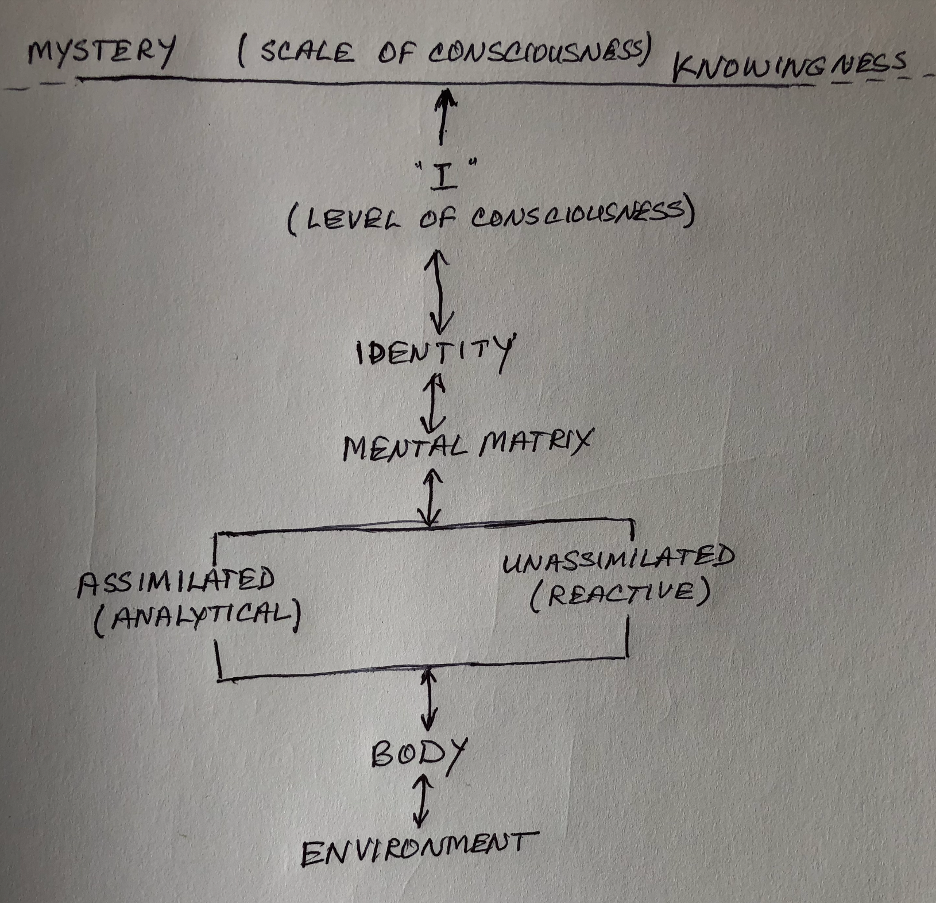
The journey of consciousness is from mystery to knowingness. Please see Meditation from Mystery to Knowing. The ultimate achievement may be expressed as The Static Viewpoint.

.

Introduction to Subject Clearing (old-2)

Please see The Book of Subject Clearing

Subject Clearing is the natural system that helps evolve consciousness. The focus of Subject Clearing is on resolving anomalies so one has a very clear view of what is there. 

.

ANOMALY

We all have studied mathematics. We should have a clear view of the fundamentals of this subject. We should clearly understand the difference between a digit and a number. If we don’t, then we have an anomaly. Let’s check out the following:

If you now have a better understanding of a digit and a number, then you just resolved an anomaly. Some of you may not even have been aware of this anomaly. The fact is: if you have a doubt, a perplexity, or a nagging feeling that there is something missing, then you are definitely confronted with an anomaly.

An ANOMALY is any violation of the integrity of reality, such as, discontinuity (missing data), inconsistency (contradictory data), or disharmony (arbitrary data). An anomaly flags the presence of an impression on the mind, which is hidden under an assumption. When one spots the assumption, and becomes aware of the underlying impression, the anomaly resolves with a realization.

Here is another example: A doubt or perplexity about who one is. This is a discontinuity that disturbs the sense of oneness with nature. It is a very fundamental anomaly. It is the mystery of human self.

There is a lot of material out there that tries to deal with this anomaly. There are religions, and books on spirituality, yoga, psychology, etc. They all try to answer this question. But as long as a confusion exists in your mind, the anomaly is not resolved for you. Take a look at Subject: Human Condition, especially at the words: self, identity, consciousness, “I” and mental matrix. See if you get a better understanding.

.

RESOLUTION

The resolution of an anomaly occurs when you spot your postulate, or the assumption, which is keeping the anomaly in place. Once you recognize the assumption, and become aware of the underlying impression, the anomaly disappears for you.

The mind naturally generates projections when gaps exist in understanding. They stay as assumptions until they are replaced by reality or narrowed into better assumptions. 

Many assumptions in astronomy got clarified with progress in mathematics and after the invention of the telescope. Similarly, assumed causes of illnesses were corrected after the invention of microscope. 

.

RULE

Dr. Winter states in his introduction to DIANETICS, “We should feel free to examine the basic assumptions of any body of knowledge we wish, without fear of committing lese majeste. If any system of thought is going to wither in the light of investigation, it does not deserve the title of Authority.”

The rule in Subject Clearing is:

No past idea or learning in the area of doubt and perplexity is sacrosanct—meaning so “sacred” that you cannot question it.

.

Subject: Human Condition

Reference: Course on Subject Clearing

This special glossary is being developed for the subject of HUMAN CONDITION. It is made up of a Key Word List, and a Glossary.

.

KEY WORD LIST

This Key Word List provides a logical arrangement of the key words by their concepts. You may look up the keys words of the glossary in this sequence. Not all the words of the glossary are listed here.

  1. HUMAN (Self, Identity, Consciousness)
  2. CONDITION (Aberration, Psychosomatic Illness, Dianetics, Subject Clearing)
  3. SELF (“I”, Ego, Egotism, Beingness)
  4. IDENTITY (body, mind, Individuality, Life cycle)
  5. CONSCIOUSNESS (Spirit, Soul, Thetan, Ātman, Immortality)
  6. EVOLUTION (Survival, Static Viewpoint, Paramātman, God)
  7. MIND (Senses, Mental Matrix, Assimilation, Perception, Memory, Thought)
  8. MENTAL MATRIX (Analytical Mind, Reactive Mind, Trauma, Facsimile)
  9. FACSIMILE (Anomaly, Arbitrary)

Conclusion: The human condition results from unresolved anomalies. The anomalies are there because of missing knowledge. As knowledge becomes available in the area of doubt and perplexity, one should make every effort to resolve those doubts.

NOTE: This key word sequence and glossary definitions can definitely be improved. In fact, I shall request you to improve upon them.

.

GLOSSARY

Please refer to

  1. KHTK Glossary
  2. Technical Dictionary

Additional data shall be added as necessary.

.