This paper presents Chapter
I, section 8 from the book THE EVOLUTION
OF PHYSICS by A. EINSTEIN and L. INFELD. The contents are from the original
publication of this book by Simon and Schuster, New York (1942).
The paragraphs of the original
material (in black) are accompanied by brief comments (in color) based on the present
understanding. Feedback on these comments is appreciated.
The heading below is linked to
the original materials.
Less
than a hundred years ago the new clue which led to the concept of heat as a
form of energy was guessed by Mayer and confirmed experimentally by Joule. It
is a strange coincidence that nearly all the fundamental work concerned with
the nature of heat was done by non-professional physicists who regarded physics
merely as their great hobby. There was the versatile Scotsman Black, the German
physician Mayer, and the great American adventurer Count Rumford, who
afterwards lived in Europe and, among other activities, became Minister of War
for Bavaria. There was also the English brewer Joule who, in his spare time,
performed some most important experiments concerning the conservation of
energy.
Joule
verified by experiment the guess that heat is a form of energy, and determined
the rate of exchange. It is worth our while to see just what his results were.
Joule verified by experiment the guess that heat is a form of
energy, and determined the rate of exchange.
The
kinetic and potential energy of a system together constitute its mechanical energy. In the case of the
switchback we made a guess that some of the mechanical energy was converted
into heat. If this is right, there must be here and in all other similar physical
processes a definite rate of exchange
between the two. This is rigorously a quantitative question, but the fact that
a given quantity of mechanical energy can be changed into a definite amount of
heat is highly important. We should like to know what number expresses the rate
of exchange, i.e., how much heat we obtain from a given amount of mechanical energy.
The kinetic and potential energy of a system together constitute
its mechanical energy.
The
determination of this number was the object of Joule’s researches. The
mechanism of one of his experiments is very much like that of a weight clock.
The winding of such a clock consists of elevating two weights, thereby adding
potential energy to the system. If the clock is not further interfered with, it
may be regarded as a closed system. Gradually the weights fall and the clock
runs down. At the end of a certain time the weights will have reached their
lowest position and the clock will have stopped. What has happened to the
energy? The potential energy of the weights has changed into kinetic energy of
the mechanism, and has then gradually been dissipated as heat.
A
clever alteration in this sort of mechanism enabled Joule to measure the heat
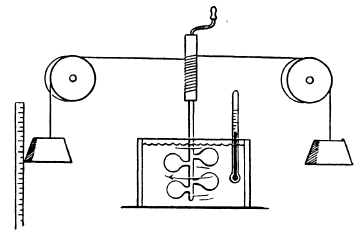
lost and thus the rate of exchange. In his apparatus two weights caused a paddle
wheel to turn while immersed in water. The potential energy of the weights was
changed into kinetic energy of the movable parts, and thence into heat which raised
the temperature of the water. Joule measured this change of temperature and,
making use of the known specific heat of water, calculated the amount of heat
absorbed. He summarized the results of many trials as follows:
1st. That the quantity of heat produced by the friction of bodies, whether solid or liquid, is always proportional to the quantity of force [by force Joule means energy] expended.
And
2nd. That the quantity of heat capable of increasing the temperature of a pound of water (weighed in vacuo and taken at between 55° and 60°) by 1° Fahr. requires for its evolution the expenditure of a mechanical force [energy] represented by the fall of 772 Ib. through the space of one foot.
In
other words, the potential energy of 772 pounds elevated one foot above the
ground is equivalent to the quantity of heat necessary to raise the temperature
of one pound of water from 55° F. to 56°
F. Later experimenters were capable of somewhat greater accuracy, but the
mechanical equivalent of heat is essentially what Joule found in his pioneer
work.
Joule determined that a given quantity of mechanical energy was changed into a definite amount of heat.
Once
this important work was done, further progress was rapid. It was soon
recognized that these kinds of energy, mechanical and heat, are only two of its
many forms. Everything which can be converted into either of them is also a
form of energy. The radiation given off by the sun is energy, for part of it is
transformed into heat on the earth. An electric current possesses energy, for
it heats a wire or turns the wheels of a motor. Coal represents chemical
energy, liberated as heat when the coal burns. In every event in nature one form
of energy is being converted into another, always at some well-defined rate of
exchange. In a closed system, one isolated from external influences, the energy
is conserved and thus behaves like a substance. The sum of all possible forms
of energy in such a system is constant, although the amount of any one kind may
be changing. If we regard the whole universe as a closed system, we can proudly
announce with the physicists of the nineteenth century that the energy of the
universe is invariant, that no part of it can ever be created or destroyed.
It was determined further that in every event in nature one form
of energy is being converted into another, always at some well-defined rate of
exchange.
Our
two concepts of substance are, then, matter
and energy. Both obey conservation
laws: An isolated system cannot change either in mass or in total energy. Matter
has weight but energy is weightless. We have therefore two different concepts
and two conservation laws. Are these ideas still to be taken seriously? Or has this
apparently well-founded picture been changed in the light of newer
developments? It has! Further changes in the two concepts are connected with
the theory of relativity. We shall return to this point later.
Our two concepts of substance are, then, matter and energy. Both
obey conservation laws: An isolated system cannot change either in mass or in
total energy.
.
Final Comment
Energy is looked upon as “weightless substance.” It is considered substance because it is conserved in the same way as mass. It is a dynamic form of substance. Energy comes in many different forms. There are well-defined rates of exchange between different forms of energy.
Energy tracks changes and interactions. When change is occurring at some place in a closed system, a compensating change is always occurring elsewhere in that system. When there are no changes occurring, there is conservation in terms of momentum.
This paper presents Chapter
I, section 7 from the book THE EVOLUTION
OF PHYSICS by A. EINSTEIN and L. INFELD. The contents are from the original
publication of this book by Simon and Schuster, New York (1942).
The paragraphs of the original
material (in black) are accompanied by brief comments (in color) based on the present
understanding. Feedback on these comments is appreciated.
The heading below is linked to
the original materials.
Let
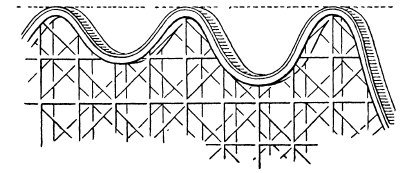
us trace the motion of that popular thrill-giver, the switchback. A small car
is lifted or driven to the highest point of the track. When set free it starts
rolling down under the force of gravity, and then goes up and down along a
fantastically curved line, giving the occupants a thrill by the sudden changes
in velocity. Every switchback has its highest point, that from which it starts.
Never again, throughout the whole course of the motion, will it reach the same
height. A complete description of the motion would be very complicated. On the
one hand is the mechanical side of the problem, the changes of velocity and
position in time. On the other there is friction and therefore the creation of
heat, on the rail and in the wheels. The only significant reason for dividing
the physical process into these two aspects is to make possible the use of the
concepts previously discussed. The division leads to an idealized experiment,
for a physical process in which only the mechanical aspect appears can be only
imagined but never realized.
In a roller-coaster, heat due to friction accompanies mechanical
effects.
For
the idealized experiment we may imagine that someone has learned to eliminate
entirely the friction which always accompanies motion. He decides to apply his
discovery to the construction of a switchback, and must find out for himself
how to build one. The car is to run up and down, with its starting-point, say,
at one hundred feet above ground level. He soon discovers by trial and error
that he must follow a very simple rule: he may build his track in whatever path
he pleases so long as no point is higher than the starting-point. If the car is
to proceed freely to the end of the course, its height may attain a hundred
feet as many times as he likes, but never exceed it. The initial height can
never be reached by a car on an actual track because of friction, but our
hypothetical engineer need not consider that.
To continue moving, the car in a roller-coaster can never exceed
the initial height.
Let
us follow the motion of the idealized car on the idealized switchback as it
begins to roll downward from the starting-point. As it moves its distance from the
ground diminishes, but its speed increases. This sentence at first sight may
remind us of one from a language lesson: “I have no pencil, but you have
six oranges.” It is not so stupid, however. There is no connection between
my having no pencil and your having six oranges, but there is a very real
correlation between the distance of the car from the ground and its speed. We
can calculate the speed of the car at any moment if we know how high it happens
to be above the ground, but we omit this point here because of its quantitative
character which can best be expressed by mathematical formulae.
There is a definite relationship between distance of the car
from the ground and its speed.
At
its highest point the car has zero velocity and is one hundred feet from the
ground. At the lowest possible point it is no distance from the ground, and has
its greatest velocity. These facts may be expressed in other terms. At its
highest point the car has potential energy
but no kinetic energy or energy of
motion. At its lowest point it has the greatest kinetic energy and no potential
energy whatever. At all intermediate positions, where there is some velocity
and some elevation, it has both kinetic and potential energy. The potential energy
increases with the elevation, while the kinetic energy becomes greater as the
velocity increases. The principles of mechanics suffice to explain the motion. Two
expressions for energy occur in the mathematical description, each of which
changes, although the sum does not vary. It is thus possible to introduce
mathematically and rigorously the concepts of potential energy, depending on
position, and kinetic energy, depending on velocity. The introduction of the
two names is, of course, arbitrary and justified only by convenience. The sum
of the two quantities remains unchanged, and is called a constant of the
motion. The total energy, kinetic plus potential, can be compared, for example,
with money kept intact as to amount but changed continually from, one currency
to another, say from dollars to pounds and back again, according to a well-defined
rate of exchange.
Two mathematical concepts are introduced here: the concepts of
potential energy, depending on position, and kinetic energy, depending on
velocity. They convert back and forth into each other.
In
the real switchback, where friction prevents the car from again reaching as
high a point as that from which it started, there is still a continuous change
between kinetic and potential energy. Here, however, the sum does not remain
constant, but grows smaller. Now one important and courageous step more is
needed to relate the mechanical and heat aspects of motion. The wealth of
consequences and generalizations from this step will be seen later.
The motion, however, encounters friction, which prevents all of
kinetic energy from converting back to potential energy. This friction produces
heat. This means that some kinetic energy converts into heat.
Something
more than kinetic and potential energies is now involved, namely, the heat
created by friction. Does this heat correspond to the diminution in mechanical energy,
that is kinetic and potential energy? A new guess is imminent. If heat may be
regarded as a form of energy, perhaps the sum of all three heat, kinetic and
potential energies remains constant. Not heat alone, but heat and other forms
of energy taken together are, like a substance, indestructible. It is as if a
man must pay himself a commission in francs for changing dollars to pounds, the
commission money also being saved so that the sum of dollars, pounds, and francs
is a fixed amount according to some definite exchange rate.
The
progress of science has destroyed the older concept of heat as a substance. We
try to create a new substance, energy, with heat as one of its forms.
Energy is effect produced by substance. In fact, it is an extension of substance.We try to create a new substance, energy, with heat as one of its forms.
.
Final Comment
Potential energy is like tension created by gravity. This tension of potential energy releases itself into motion of kinetic energy, part of which converts into heat of friction. It appears that the total of tension, motion and heat is conserved as “weightless substance.” This total may be equivalent to some infinitesimal amount of mass.
This total amount of weightless substance seems to be the result of conversion of infinitesimal mass when the natural balance of inertia-uniform motion is disturbed.
This paper presents Chapter
I, section 6 from the book THE EVOLUTION
OF PHYSICS by A. EINSTEIN and L. INFELD. The contents are from the original
publication of this book by Simon and Schuster, New York (1942).
The paragraphs of the original
material (in black) are accompanied by brief comments (in color) based on the present
understanding. Feedback on these comments is appreciated.
The heading below is linked to
the original materials.
Here
we begin to follow a new clue, one originating in the realm of heat phenomena.
It is impossible, however, to divide science into separate and unrelated
sections. Indeed, we shall soon find that the new concepts introduced here are
interwoven with those already familiar, and with those we shall still meet. A
line of thought developed in one branch of science can very often be applied to
the description of events apparently quite different in character. In this
process the original concepts are often modified so as to advance the
understanding both of those phenomena from which they sprang and of those to
which they are newly applied.
We now have a new clue originating in the realm of heat phenomena.
The
most fundamental concepts in the description of heat phenomena are temperature and heat. It took an unbelievably long time in the history of science
for these two to be distinguished, but once this distinction was made rapid
progress resulted. Although these concepts are now familiar to everyone, we
shall examine them closely, emphasizing the differences between them.
The breakthrough was the understanding of the difference between
temperature and heat.
Our
sense of touch tells us quite definitely that one body is hot and another cold.
But this is a purely qualitative criterion, not sufficient for a quantitative
description and sometimes even ambiguous. This is shown by a well-known
experiment: we have three vessels containing, respectively, cold, warm and hot
water. If we dip one hand into the cold water and the other into the hot, we
receive a message from the first that it is cold and from the second that it is
hot. If we then dip both hands into the same warm water, we receive two
contradictory messages, one from each hand. For the same reason an Eskimo and a
native of some equatorial country meeting in New York on a spring day would
hold different opinions as to whether the climate was hot or cold. We settle
all such questions by the use of a thermometer, an instrument designed in a
primitive form by Galileo. Here again that familiar name! The use of a
thermometer is based on some obvious physical assumptions. We shall recall them
by quoting a few lines from lectures given about a hundred and fifty years ago
by Black, who contributed a great deal toward clearing up the difficulties
connected with the two concepts, heat and temperature:
By the use of this instrument we have learned, that if we take 1000, or more, different kinds of matter, such as metals, stones, salts, woods, feathers, wool, water and a variety of other fluids, although they be all at first of different heats, let them be placed together in the same room without a fire, and into which the sun does not shine, the heat will be communicated from the hotter of these bodies to the colder, during some hours perhaps, or the course of a day at the end of which time, if we apply a thermometer to them all in succession, it will point precisely to the same degree.
The
italicized word heats should,
according to present day nomenclature, be replaced by the word temperatures.
The sense of touch informs us only of relative degree of hotness
and coldness, and not the absolute degree. For the latter we need a
thermometer.
A
physician taking the thermometer from a sick man’s mouth might reason like
this: “The thermometer indicates its own temperature by the length of its
column of mercury. We assume that the length of the mercury column increases in
proportion to the increase in temperature. But the thermometer was for a few minutes
in contact with my patient, so that both patient and thermometer have the same
temperature. I conclude, therefore, that my patient’s temperature is that registered
on the thermometer.” The doctor probably acts mechanically, but he applies
physical principles without thinking about it.
Bodies in contact attain the same temperature.
But
does the thermometer contain the same amount of heat as the body of the man? Of
course not. To assume that two bodies contain equal quantities of heat just
because their temperatures are equal would, as Black remarked, be
taking a very hasty view of the subject. It is confounding the quantity of heat in different bodies with its general strength or intensity, though it is plain that these are two different things, and should always be distinguished, when we are thinking of the distribution of heat.
An
understanding of this distinction can be gained by considering a very simple
experiment. A pound of water placed over a gas flame takes some time to change
from room temperature to the boiling point. A much longer time is required for
heating twelve pounds, say, of water in the same vessel by means of the same
flame. We interpret this fact as indicating that now more of
“something” is needed and we call this “something” heat.
Temperature is more like intensity of heat, which is different
from quantity of heat.
A
further important concept, specific heat,
is gained by the following experiment: let one vessel contain a pound of water
and another a pound of mercury, both to be heated in the same way. The mercury
gets hot much more quickly than the water, showing that less “heat”
is needed to raise the temperature by one degree. In general, different amounts
of “heat” are required to change by one degree, say from 40 to 41
degrees Fahrenheit, the temperatures of different substances such as, water,
mercury, iron, copper, wood etc., all of the same mass. We say that each
substance has its individual heat capacity,
or, specific heat.
The same amount of different substances, to reach the same temperature, requires different amount of heat. Thus, different substances have different specific heats.
Once
having gained the concept of heat, we can investigate its nature more closely.
We have two bodies, one hot, the other cold, or more precisely, one of a higher
temperature than the other. We bring them into contact and free them from all
other external influences. Eventually they will, we know, reach the same
temperature. But how does this take place? What happens between the instant
they are brought into contact and the achievement of equal temperatures? The
picture of heat “flowing” from one body to another suggests itself,
like water flowing from a higher level to a lower. This picture, though
primitive, seems to fit many of the facts, so that the analogy runs:
Water—Heat Higher level—Higher temperature Lower level—Lower temperature
The
flow proceeds until both levels, that is, both temperatures, are equal. This
naive view can be made more useful by quantitative considerations. If definite
masses of water and alcohol, each at a definite temperature, are mixed
together, a knowledge of the specific heats will lead to a prediction of the
final temperature of the mixture. Conversely, an observation of the final
temperature, together with a little algebra, would enable us to find the ratio
of the two specific heats.
Heat flows from hotter to cooler body on contact, just like water
flows from higher to lower level upon being connected.
We
recognize in the concept of heat which appears here a similarity to other
physical concepts. Heat is, according to our view, a substance, such as mass in
mechanics. Its quantity may change or not, like money put aside in a safe or
spent. The amount of money in a safe will remain unchanged so long as the safe
remains locked, and so will the amounts of mass and heat in an isolated body.
The ideal thermos flask is analogous to such a safe. Furthermore, just as the
mass of an isolated system is unchanged even if a chemical transformation takes
place, so heat is conserved even though it flows from one body to another. Even
if heat is not used for raising the temperature of a body but for melting ice,
say, or changing water into steam, we can still think of it as a substance and
regain it entirely by freezing the water or liquefying the steam. The old names,
latent heat of melting or vaporization, show that these concepts are drawn from
the picture of heat as a substance. Latent heat is temporarily hidden, like money
put away in a safe, but available for use if one knows the lock combination.
But
heat is certainly not a substance in the same sense as mass. Mass can be
detected by means of scales, but what of heat? Does a piece of iron weigh more
when red-hot than when ice-cold? Experiment shows that it does not. If heat is
a substance at all, it is a weightless one. The “heat-substance” was
usually called caloric and is our
first acquaintance among a whole family of weightless substances. Later we
shall have occasion to follow the history of the family, its rise and fall. It
is sufficient now to note the birth of this particular member.
Thus, heat may be treated analogous to a substance that is
conserved, but it is not a substance like mass.
The
purpose of any physical theory is to explain as wide a range of phenomena as
possible. It is justified in so far as it does make events understandable. We
have seen that the substance theory explains many of the heat phenomena. It
will soon become apparent, however, that this again is a false clue, that heat
cannot be regarded as a substance, even weightless. This is clear if we think about
some simple experiments which marked the beginning of civilization.
We
think of a substance as something which can be neither created nor destroyed.
Yet primitive man created by friction sufficient heat to ignite wood. Examples of
heating by friction are, as a matter of fact, much too numerous and familiar to
need recounting. In all these cases some quantity of heat is created, a fact
difficult to account for by the substance theory. It is true that a supporter
of this theory could invent arguments to account for it. His reasoning would
run something like this: “The substance theory can explain the apparent
creation of heat. Take the simplest example of two pieces of wood rubbed one
against the other. Now rubbing is something which influences the wood and
changes its properties. It is very likely that the properties are so modified
that an unchanged quantity of heat comes to produce a higher temperature than before.
After all, the only thing we notice is the rise in temperature. It is possible
that the friction changes the specific heat of the wood and not the total
amount of heat.”
Heat is not truly a substance because it can be created.
At
this stage of the discussion it would be useless to argue with a supporter of
the substance theory, for this is a matter which can be settled only by
experiment. Imagine two identical pieces of wood and suppose equal changes of
temperature are induced by different methods; in one case by friction and in
the other by contact with a radiator, for example. If the two pieces have the
same specific heat at the new temperature, the whole substance theory must
break down. There are very simple methods for determining specific heats, and
the fate of the theory depends on the result of just such measurements. Tests
which are capable of pronouncing a verdict of life or death on a theory occur
frequently in the history of physics, and are called crucial experiments. The crucial value of an experiment is revealed
only by the way the question is formulated, and only one theory of the
phenomena can be put on trial by it. The determination of the specific heats of
two bodies of the same kind, at equal temperatures attained by friction and
heat flow respectively, is a typical example of a crucial experiment. This
experiment was performed about a hundred and fifty years ago by Rumford, and
dealt a death blow to the substance theory of heat.
An
extract from Rumford’s own account tells the story:
It frequently happens, that in the ordinary affairs and occupations of life, opportunities present themselves of contemplating some of the most curious operations of Nature; and very interesting philosophical experiments might often be made, almost without trouble or expense, by means of machinery contrived for the mere mechanical purposes of the arts and manufactures.
I have frequently had occasion to make this observation; and am persuaded, that a habit of keeping the eyes open to every thing that is going on in the ordinary course of the business of life has oftener led, as it were by accident, or in the playful excursions of the imagination, put into action by contemplating the most common appearances, to useful doubts, and sensible schemes for investigation and improvement, than all the more intense meditations of philosophers, in the hours expressly set apart for study…
Being engaged, lately, in superintending the boring of cannon, in the workshops of the military arsenal at Munich, I was struck with the very considerable degree of Heat which a brass gun acquires, in a short time, in being bored; and with the still more intense Heat (much greater than that of boiling water, as I found by experiment) of the metallic chips separated from it by the borer…
From whence comes the Heat actually produced in the mechanical operation above mentioned?
Is it furnished by the metallic chips which are separated by the borer from the solid mass of metal?
If this were the case, then, according to the modern doctrines of latent Heat, and of caloric, the capacity ought not only to be changed, but the change undergone by them should be sufficiently great to account for all the Heat produced.
But no such change had taken place; for I found, upon taking equal quantities, by weight, of these chips, and of thin slips of the same block of metal separated by means of a fine saw and putting them, at the same temperature (that of boiling water), into equal quantities of cold water (that is to say, at the temperature of 59° F.) the portion of water into which the chips were put was not, to all appearance, heated either less or more than the other portion, in which the slips of metal were put.
Finally
we reach his conclusion:
And, in reasoning on this subject, we must not forget to consider that most remarkable circumstance, that the source of the Heat generated by friction, in these Experiments, appeared evidently to be inexhaustible.
It is hardly necessary to add, that anything which any insulated body, or system of bodies, can continue to furnish without limitation, cannot possibly be a material substance; and it appears to me to be extremely difficult, if not quite impossible, to form any distinct idea of anything, capable of being excited and communicated, in the manner the Heat was excited and communicated in these Experiments, except it be MOTION.
Thus
we see the breakdown of the old theory, or to be more exact, we see that the
substance theory is limited to problems of heat flow. Again, as Rumford has
intimated, we must seek a new clue. To do this, let us leave for the moment the
problem of heat and return to mechanics.
According to Rumford, heat was created by motion.
.
Final Comment
Temperature is more like intensity of heat, which is different from quantity of heat. To reach the same temperature, the same amount of different substances requires different amount of heat. Thus, different substances have different specific heats.
Bodies in contact attain the same temperature. Heat flows from hotter to cooler body on contact, just like water flows from higher to lower level upon being connected. Thus, heat may be treated analogous to a substance that is conserved, but it is not a substance like mass. Einstein refers to it as weightless substance.
Heat seems to be a weightless substance that is converted from other weightless substances. For example, heat can be created from friction and motion between two masses. All such weightless substance together are conserved. Maybe infinitesimal amount of mass gets converted into heat during friction.
This paper presents Chapter
I, section 5 from the book THE EVOLUTION
OF PHYSICS by A. EINSTEIN and L. INFELD. The contents are from the original
publication of this book by Simon and Schuster, New York (1942).
The paragraphs of the original
material (in black) are accompanied by brief comments (in color) based on the present
understanding. Feedback on these comments is appreciated.
The heading below is linked to
the original materials.
When
first studying mechanics one has the impression that everything in this branch
of science is simple, fundamental and settled for all time. One would hardly suspect
the existence of an important clue which no one noticed for three hundred
years. The neglected clue is connected with one of the fundamental concepts of
mechanics—that of mass.
In mechanics, the concept of mass has not been explored fully.
Again
we return to the simple idealized experiment of the cart on a perfectly smooth
road. If the cart is initially at rest and then given a push, it afterwards moves
uniformly with a certain velocity. Suppose that the action of the force can be
repeated as many times as desired, the mechanism of pushing acting in the same
way and exerting the same force on the same cart. However many times the
experiment is repeated, the final velocity is always the same. But what happens
if the experiment is changed, if previously the cart was empty and now it is
loaded? The loaded cart will have a smaller final velocity than the empty one.
The conclusion is: if the same force acts on two different bodies, both
initially at rest, the resulting velocities will not be the same. We say that
the velocity depends on the mass of the body, being smaller if the mass is greater.
As mass increases, the same push results in lesser velocity.
We
know, therefore, at least in theory, how to determine the mass of a body or,
more exactly, how many times greater one mass is than another. We have identical
forces acting on two resting masses. Finding that the velocity of the first
mass is three times greater than that of the second, we conclude that the first
mass is three times smaller than the second. This is certainly not a very
practical way of determining the ratio of two masses. We can, nevertheless,
well imagine having done it in this, or in some similar way, based upon the application
of the law of inertia.
By pushing and measuring velocities we may determine the mass.
This is called inertial mass.
How
do we really determine mass in practice? Not, of course, in the way just
described. Everyone knows the correct answer. We do it by weighing on a scale.
By weighing on a scale also we may determine the mass. This is called gravitational mass.
Let
us discuss in more detail the two different ways of determining mass.
The
first experiment had nothing whatever to do with gravity, the attraction of the
earth. The cart moves along a perfectly smooth and horizontal plane after the
push. Gravitational force, which causes the cart to stay on the plane, does not
change, and plays no role in the determination of the mass. It is quite
different with weighing. We could never use a scale if the earth did not
attract bodies, if gravity did not exist. The difference between the two
determinations of mass is that the first has nothing to do with the force of
gravity while the second is based essentially on its existence.
The force of gravity is essential to gravitational mass, but it has nothing to do with inertial mass.
We
ask: if we determine the ratio of two masses in both ways described above, do
we obtain the same result? The answer given by experiment is quite clear. The
results are exactly the same! This conclusion could not have been foreseen, and
is based on observation, not reason. Let us, for the sake of simplicity, call
the mass determined in the first way the inertial
mass and that determined in the second way the gravitational mass. In our world it happens that they are equal,
but we can well imagine that this should not have been the case at all. Another
question arises immediately: is this identity of the two kinds of mass purely
accidental, or does it have a deeper significance? The answer, from the point
of view of classical physics, is: the identity of the two masses is accidental
and no deeper significance should be attached to it. The answer of modern
physics is just the opposite: the identity of the two masses is fundamental and
forms a new and essential clue leading to a more profound understanding. This
was, in fact, one of the most important clues from which the so-called general
theory of relativity was developed.
It so happens that the two masses are exactly the same. This is not accidental. The fundamental reason underlying this equality led to the general theory of relativity.
A
mystery story seems inferior if it explains strange events as accidents. It is
certainly more satisfying to have the story follow a rational pattern. In
exactly the same way a theory which offers an explanation for the identity of
gravitational and inertial mass is superior to one which interprets their
identity as accidental, provided, of course, that the two theories are equally consistent
with observed facts.
Rational explanation is superior to mystery.
Since
this identity of inertial and gravitational mass was fundamental for the
formulation of the theory of relativity, we are justified in examining it a
little more closely here. What experiments prove convincingly that the two
masses are the same? The answer lies in Galileo’s old experiment in which he
dropped different masses from a tower. He noticed that the time required for
the fall was always the same, that the motion of a falling body does not depend
on the mass. To link this simple but highly important experimental result with the
identity of the two masses needs some rather intricate reasoning.
Different masses take the same time to fall from the same height. Therefore the motion of a falling body is independent of its mass. The motion means acceleration in this case and not velocity.
A
body at rest gives way before the action of an external force, moving and
attaining a certain velocity. It yields more or less easily, according to its
inertial mass, resisting the motion more strongly if the mass is large than if
it is small. We may say, without pretending to be rigorous: the readiness with
which a body responds to the call of an external force depends on its inertial mass.
If it were true that the earth attracts all bodies with the same force, that of
greatest inertial mass would move more slowly in falling than any other. But this
is not the case: all bodies fall in the same way. This means that the force by
which the earth attracts different masses must be different. Now the earth
attracts a stone with the force of gravity and knows nothing about its inertial
mass. The “calling” force of the earth depends on the gravitational
mass. The “answering” motion of the stone depends on the inertial mass.
Since the “answering ” motion is always the same all bodies dropped
from the same height fall in the same way it must be deduced that gravitational
mass and inertial mass are equal.
The inertial mass is determined by a short push and change in uniform velocity at the end of the push; but in case of the determination of gravitational mass, the gravity is acting continuously all the time.
More
pedantically a physicist formulates the same conclusion: the acceleration of a
falling body increases in proportion to its gravitational mass and decreases in
proportion to its inertial mass. Since all falling bodies have the same
constant acceleration, the two masses must be equal.
In
our great mystery story there are no problems wholly solved and settled for all
time. After three hundred years we had to return to the initial problem of motion,
to revise the procedure of investigation, to find clues which had been
overlooked, thereby reaching a different picture of the surrounding universe.
It was this two different ways of looking at mass that provided
a new clue.
.
Final Comment
By pushing and measuring velocities we may determine the mass. This is called inertial mass. By weighing on a scale also we may determine the mass. This is called gravitational mass. It was this two different ways of looking at mass that provided a new clue that led to the general theory of relativity.
Both inertia and gravity are continuous forces. The inertial and gravitational masses appear to be the same. The general theory of relativity assumes that the two masses are exactly the same. This may be verified by observing in free space if objects of two different masses continue to float at the same distance or drift apart over time.
This paper presents Chapter
I, section 4 from the book THE EVOLUTION
OF PHYSICS by A. EINSTEIN and L. INFELD. The contents are from the original
publication of this book by Simon and Schuster, New York (1942).
The paragraphs of the original
material (in black) are accompanied by brief comments (in color) based on the present
understanding. Feedback on these comments is appreciated.
The heading below is linked to
the original materials.
So
long as we deal only with motion along a straight line, we are far from understanding
the motions observed in nature. We must consider motions along curved paths,
and our next step is to determine the laws governing such motions. This is no
easy task. In the case of rectilinear motion our concepts of velocity, change
of velocity, and force proved most useful. But we do not immediately see how we
can apply them to motion along a curved path. It is indeed possible to imagine
that the old concepts are unsuited to the description of general motion, and
that new ones must be created. Should we try to follow our old path, or seek a
new one?
We must consider motions along curved paths because that is the
reality.
The
generalization of a concept is a process very often used in science. A method
of generalization is not uniquely determined, for there are usually numerous ways
of carrying it out. One requirement, however, must be rigorously satisfied: any
generalized concept must reduce to the original one when the original
conditions are fulfilled.
Laws governing motion along curved paths must reduce to laws
governing motion along a straight line when the path is straight.
We
can best explain this by the example with which we are now dealing. We can try
to generalize the old concepts of velocity, change of velocity, and force for the
case of motion along a curved path. Technically, when speaking of curves, we
include straight lines. The straight line is a special and trivial example of a
curve. If, therefore, velocity, change in velocity, and force are introduced
for motion along a curved line, then they are automatically introduced for
motion along a straight line. But this result must not contradict those results
previously obtained. If the curve becomes a straight line, all the generalized
concepts must reduce to the familiar ones describing rectilinear motion. But
this restriction is not sufficient to determine the generalization uniquely. It
leaves open many possibilities. The history of science shows that the simplest generalizations
sometimes prove successful and sometimes not. We must first make a guess. In
our case it is a simple matter to guess the right method of generalization. The
new concepts prove very successful and help us to understand the motion of a
thrown stone as well as that of the planets.
There are many generalizations possible. Start with a simple
generalization. There is a good chance of success.
And
now just what do the words velocity, change in velocity, and force mean in the
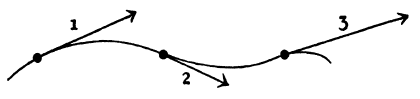
general case of motion along a curved line? Let us begin with velocity. Along
the curve a very small body is moving from left to right. Such a small body is
often called a particle. The dot on the curve in our drawing shows the position
of the particle at some instant of time. What is the velocity corresponding to
this time and position? Again Galileo’s clue hints at a way of introducing the
velocity. We must, once more, use our imagination and think about an idealized
experiment. The particle moves along the curve, from left to right, under the
influence of external forces. Imagine that at a given time, and at the point
indicated by the dot, all these forces suddenly cease to act. Then, the motion
must, according to the law of inertia, be uniform. In practice we can, of
course, never completely free a body from all external influences. We can only
surmise “what would happen if. . . ?” and judge the pertinence of our
guess by the conclusions which can be drawn from it and by their agreement with
experiment.
The
vector in the next drawing indicates the guessed direction of the uniform
motion if all external forces were to vanish. It is the direction of the
so-called tangent. Looking at a moving particle through a microscope one sees a
very small part of the curve, which appears as a small segment. The tangent is
its prolongation. Thus the vector drawn represents the velocity at a given
instant. The velocity vector lies on the tangent. Its length represents the
magnitude of the velocity, or the speed as indicated, for instance, by the
speedometer of a car.
First we guess the direction of motion as the tangent at that point.
Our
idealized experiment about destroying the motion in order to find the velocity
vector must not be taken too seriously. It only helps us to understand what we
should call the velocity vector and enables us to determine it for a given
instant at a given point.
In
the next drawing, the velocity vectors for three different positions of a
particle moving along a curve are shown. In this case not only the direction
but the magnitude of the velocity, as indicated by the length of the vector,
varies during the motion.
Direction varies along a curved path, but the speed may vary
too, and we indicate that by the length of the vector.
Does
this new concept of velocity satisfy the requirement formulated for all
generalizations? That is: does it reduce to the familiar concept if the curve
becomes a straight line? Obviously it does. The tangent to a straight line is
the line itself. The velocity vector lies in the line of the motion, just as in
the case of the moving cart or the rolling spheres.
The
next step is the introduction of the change in velocity of a particle moving
along a curve. This also may be done in various ways, from which we choose the
simplest and most convenient. The last drawing showed several velocity vectors
representing the motion at various points along the path. The first two of
these may be drawn again so that they have a common starting-point, as we have
seen is possible with vectors. The dotted vector we call the change in
velocity. Its starting-point is the end of the first vector and its endpoint
the end of the second vector. This definition of the change in velocity may, at
first sight, seem artificial and meaningless. It becomes much clearer in the
special case in which vectors (1) and (2) have the same direction. This, of
course, means going over to the case of straight-line motion. If both vectors
have the same initial point, the dotted vector again connects their endpoints.
The drawing is now identical with that on p. 18, and the previous concept is
regained as a special case of the new one. We may remark that we had to
separate the two lines in our drawing, since otherwise they would coincide and
be indistinguishable.
Next we determine the change in velocity, by connecting the
heads of the vectors by a dotted line.
We
now have to take the last step in our process of generalization. It is the most
important of all the guesses we have had to make so far. The connection between
force and change in velocity has to be established so that we can formulate the
clue which will enable us to understand the general problem of motion.
The
clue to an explanation of motion along a straight line was simple: external
force is responsible for change in velocity; the force vector has the same
direction as the change. And now what is to be regarded as the clue to
curvilinear motion? Exactly the same! The only difference is that change of
velocity has now a broader meaning than before. A glance at the dotted vectors
of the last two drawings shows this point clearly. If the velocity is known for
all points along the curve, the direction of the force at any point can be
deduced at once. One must draw the velocity vectors for two instants separated
by a very short time interval and therefore corresponding to positions very
near each other. The vector from the end-point of the first to that of the
second indicates the direction of the acting force. But it is essential that
the two velocity vectors should be separated only by a “very short”
time interval. The rigorous analysis of such words as “very near”,
“very short” is far from simple. Indeed it was this analysis which
led Newton and Leibnitz to the discovery of differential calculus.
Next we determine the force responsible for the change in velocity at a point.
It
is a tedious and elaborate path which leads to the generalization of Galileo’s
clue. We cannot show here how abundant and fruitful the consequences of this
generalization have proved. Its application leads to simple and convincing
explanations of many facts previously incoherent and misunderstood.
From
the extremely rich variety of motions we shall take only the simplest and apply
to their explanation the law just formulated.
A
bullet shot from a gun, a stone thrown at an angle, a stream of water emerging
from a hose, all describe familiar paths of the same type the parabola. Imagine
a speedometer attached to a stone, for example, so that its velocity vector may
be drawn for any instant. The result may well be that represented in the above
drawing. The direction of the force acting on the stone is just that of the
change in velocity, and we have seen how it may be determined. The result,
shown in the next drawing, indicates that the force is vertical, and directed
downward. It is exactly the same as when a stone is allowed to fall from the
top of a tower. The paths are quite different, as also are the velocities, but
the change in velocity has the same direction, that is, toward the centre of
the earth.
The direction of the force acting on the particle is just that of the change in velocity. This generalization provides clear explanation of many observed motions.
A
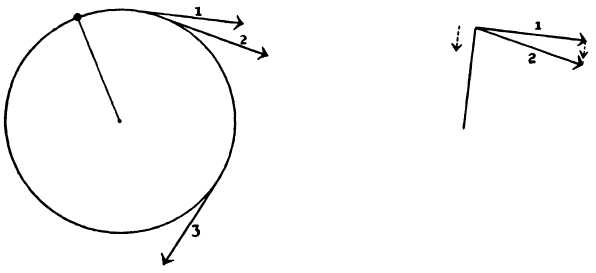
stone attached to the end of a string and swung around in a horizontal plane
moves in a circular path.
All
the vectors in the diagram representing this motion have the same length if the
speed is uniform. Nevertheless, the velocity is not uniform, for the path is
not a straight line. Only in uniform, rectilinear motion are there no forces
involved. Here, however, there are, and the velocity changes not in magnitude
but in direction. According to the law of motion there must be some force
responsible for this change, a force in this case between the stone and the
hand holding the string. A further question arises immediately: in what
direction does the force act? Again a vector diagram shows the answer. The
velocity vectors for two very near points are drawn, and the change of velocity
found. This last vector is seen to be directed along the string toward the centre
of the circle, and is always perpendicular to the velocity vector, or tangent.
In other words, the hand exerts a force on the stone by means of the string.
A stone attached to the end of a string and swung around in a horizontal plane moves in a circular path.The vector diagram shows that the direction of the force exerted is towards the center.
Very
similar is the more important example of the revolution of the moon around the
earth. This may be represented approximately as uniform circular motion. The
force is directed toward the earth for the same reason that it was directed
toward the hand in our former example. There is no string connecting the earth
and the moon, but we can imagine a line between the centres of the two bodies;
the force lies along this line and is directed toward the centre of the earth,
just as the force on a stone thrown in the air or dropped from a tower.
When a body is revolving around another the force lies along the
line joining their centers.
All that we have said concerning motion can be summed up in a single sentence. Force and change of velocity are vectors having the same direction.This is the initial clue to the problem of motion, but it certainly does not suffice for a thorough explanation of all motions observed. The transition from Aristotle’s line of thought to that of Galileo formed a most important corner-stone in the foundation of science. Once this break was made, the line of further development was clear. Our interest here lies in the first stages of development, in following initial clues, in showing how new physical concepts are born in the painful struggle with old ideas. We are concerned only with pioneer work in science, which consists of finding new and unexpected paths of development; with the adventures in scientific thought which create an ever-changing picture of the universe. The initial and fundamental steps are always of a revolutionary character. Scientific imagination finds old concepts too confining, and replaces them by new ones. The continued development along any line already initiated is more in the nature of evolution, until the next turning point is reached when a still newer field must be conquered. In order to understand, however, what reasons and what difficulties force a change in important concepts, we must know not only the initial clues, but also the conclusions which can be drawn.
Force and change of velocity are vectors having the same direction. This is the initial clue to the problem of motion.
One
of the most important characteristics of modern physics is that the conclusions
drawn from initial clues are not only qualitative but also quantitative. Let us
again consider a stone dropped from a tower. We have seen that its velocity
increases as it falls, but we should like to know much more. Just how great is
this change? And what is the position and the velocity of the stone at any time
after it begins to fall? We wish to be able to predict events and to determine
by experiment whether observation confirms these predictions and thus the
initial assumptions.
In modern physics the conclusions that are drawn from initial
clues are not only qualitative but also quantitative, so they can be verified
experimentally.
To draw quantitative conclusions we must use the language of mathematics. Most of the fundamental ideas of science are essentially simple, and may, as a rule, be expressed in a language comprehensible to everyone. To follow up these ideas demands the knowledge of a highly refined technique of investigation. Mathematics as a tool of reasoning is necessary if we wish to draw conclusions which may be compared with experiment. So long as we are concerned only with fundamental physical ideas we may avoid the language of mathematics. Since in these pages we do this consistently, we must occasionally restrict ourselves to quoting, without proof, some of the results necessary for an understanding of important clues arising in the further development. The price which must be paid for abandoning the language of mathematics is a loss in precision, and the necessity of sometimes quoting results without showing how they were reached.
So long as we are concerned only with fundamental physical ideas we may avoid the language of mathematics. But mathematics as a tool of reasoning is necessary if we wish to draw conclusions which may be compared with experiment.
A
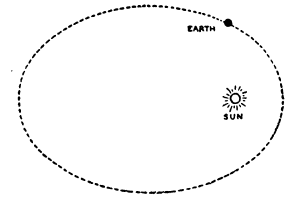
very important example of motion is that of the earth around the sun. It is
known that the path is a closed curve, called the ellipse. The construction of
a vector diagram of the change in velocity shows that the force on the earth is
directed toward the sun. But this, after all, is scant information. We should
like to be able to predict the position of the earth and the other planets for
any arbitrary instant of time, we should like to predict the date and duration
of the next solar eclipse and many other astronomical events. It is possible to
do these things, but not on the basis of our initial clue alone, for it is now
necessary to know not only the direction of the force but also its absolute
value its magnitude. It was Newton who made the inspired guess on this point.
According to his law of gravitation the force of attraction between two bodies
depends in a simple way on their distance from each other. It becomes smaller
when the distance increases. To be specific it becomes 2×2=4 times smaller if the
distance is doubled, 3×3 = 9 times smaller if the distance is made three times
as great.
Moon around the Earth and Earth around the Sun are examples of
motions from which a lot can be learned. Newton made an inspired guess to
compute the force necessary for such motion.
Thus
we see that in the case of gravitational force we have succeeded in expressing,
in a simple way, the dependence of the force on the distance between the moving
bodies. We proceed similarly in all other cases where forces of different kinds
for instance, electric, magnetic, and the like are acting. We try to use a
simple expression for the force. Such an expression is justified only when the
conclusions drawn from it are confirmed by experiment.
But
this knowledge of the gravitational force alone is not sufficient for a
description of the motion of the planets. We have seen that vectors
representing force and change in velocity for any short interval of time have
the same direction, but we must follow Newton one step farther and assume a
simple relation between their lengths. Given all other conditions the same,
that is, the same moving body and changes considered over equal time intervals,
then, according to Newton, the change of velocity is proportional to the force.
Newton went one step farther and found that the change of
velocity is proportional to the force.
Thus
just two complementary guesses are needed for quantitative conclusions
concerning the motion of the planets. One is of a general character, stating
the connection between force and change in velocity. The other is special, and
states the exact dependence of the particular kind of force involved on the
distance between the bodies. The first is Newton’s general law of motion, the
second his law of gravitation. Together they determine the motion. This can be
made clear by the following somewhat clumsy-sounding reasoning. Suppose that at
a given time the position and velocity of a planet can be determined, and that
the force is known. Then, according to Newton’s laws, we know the change in
velocity during a short time interval. Knowing the initial velocity and its
change, we can find the velocity and position of the planet at the end of the
time interval. By a continued repetition of this process the whole path of the
motion may be traced without further recourse to observational data. This is,
in principle, the way mechanics predicts the course of a body in motion, but
the method used here is hardly practical. In practice such a step-by-step
procedure would be extremely tedious as well as inaccurate. Fortunately, it is
quite unnecessary; mathematics furnishes a short cut, and makes possible
precise description of the motion in much less ink than we use for a single
sentence. The conclusions reached in this way can be proved or disproved by
observation.
Newton’s discoveries and mathematics allows us to easily
determine the path of the planets.
The
same kind of external force is recognized in the motion of a stone falling
through the air and in the revolution of the moon in its orbit, namely, that of
the earth’s attraction for material bodies. Newton recognized that the motions
of falling stones, of the moon, and of planets are only very special
manifestations of a universal gravitational force acting between any two
bodies. In simple cases the motion may be described and predicted by the aid of
mathematics. In remote and extremely complicated cases, involving the action of
many bodies on each other, a mathematical description is not so simple, but the
fundamental principles are the same.
The principle of universal gravitation, discovered by Newton is
simple but the mathematical description of cases where many bodies are involved
is not so simple.
We
find the conclusions, at which we arrived by following our initial clues,
realized in the motion of a thrown stone, in the motion of the moon, the earth,
and the planets.
It
is really our whole system of guesses which is to be either proved or disproved
by experiment. No one of the assumptions can be isolated for separate testing.
In the case of the planets moving around the sun it is found that the system of
mechanics works splendidly. Nevertheless we can well imagine that another
system, based on different assumptions, might work just as well.
There may be another system based on different assumptions that
may work even better to describe the phenomenon of motion due to gravity.
Physical
concepts are free creations of the human mind, and are not, however it may
seem, uniquely determined by the external world. In our endeavour to understand
reality we are somewhat like a man trying to understand the mechanism of a
closed watch. He sees the face and the moving hands, even hears its ticking,
but he has no way of opening the case. If he is ingenious he may form some picture
of a mechanism which could be responsible for all the things he observes, but
he may never be quite sure his picture is the only one which could explain his
observations. He will never be able to compare his picture with the real
mechanism and he cannot even imagine the possibility or the meaning of such a
comparison. But he certainly believes that, as his knowledge increases, his
picture of reality will become simpler and simpler and will explain a wider and
wider range of his sensuous impressions. He may also believe in the existence
of the ideal limit of knowledge and that it is approached by the human mind. He
may call this ideal limit the objective truth.
Our picture of reality will grow and become simpler as knowledge
increases. We shall then be able to explain wider range of our observations and
experiences.
.
Final Comment
Force and change of velocity are vectors having the same direction. This is the initial clue to the problem of motion. Newton went one step farther and found that the change of velocity is proportional to the force. Newton’s discoveries and mathematics allows us to easily determine the path of the planets. But the mathematical description of cases where many bodies are involved is not so simple.
There may be another system based on different assumptions that may work even better to describe the phenomenon of motion due to gravity. Our picture of reality will grow and become simpler as knowledge increases. We shall then be able to explain wider range of our observations and experiences.