Category Archives: Science

Substance and Mass

Reference: The Physics Book

Traditionally, matter is generalized as substance. We use the word SUBSTANCE as a broad category for things that are physically substantial enough to be sensed. This makes force the key characteristic of substance. 

SUBSTANCE is anything that is substantial enough to be sensed.

Matter may be categorized as a special kind of substance that contains mass (inertial force). The laws of mechanics apply to all material particles because they have a center of mass.

MATTER is a substance that has the property of a center of mass.

Today we know that light may not have mass but it has momentum (impact). This qualifies light as a substance. We feel gravity through every cell of our body; so it would be a substance too. 

LIGHT and GRAVITY are substances that do not have a center of mass.

This provides us with a more accurate definition of VOID.

VOID is that which cannot be sensed.

The Structure of Atom

Hydrogen is the lightest material substance. The hydrogen atom consists of a proton and an electron. The tiny proton forms the nucleus at the center of the atom. The old atomic model assumed the electron and proton to be “particles” separated by a void. The negatively charged electron revolves around the positively charged proton as it is attracted towards it. But this configuration cannot be stable because an accelerating charged particle loses energy. The loss of energy will make the revolving electron immediately spiral into the proton.

The Quantum mechanics model of the atom is quite different, but it is described mathematically only. Realistically, 99.99% of the volume of the hydrogen atom is the electron. The tiny proton occupies only 0.01% of the volume at the center of the atom. It is like a tiny marble immersed in a large pond. There is no void separating the electron from the proton. They are very much in contact with each other. 

The proton consists of 1836/1837 of the total mass of the atom. The mass of the surrounding electron is 1/1836 times the mass of the embedded proton. If the proton consists of “solid mass,” we may consider the electron to consist of “liquid mass.” Furthermore, the atom is embedded in a much larger but much less concentrated force field of light and gravity. We may consider that force field to consist of “gaseous mass.”

Here we have used the terms “solid, liquid, and gaseous,” in the context of mass, only to make the point that the concept of mass need not be confined to matter only. It is a concept inherent to all substance.

Consistent with Faraday’s hypothesis of “force field” the concept of mass may be applied to matter, light and gravity equally. The mass becomes much dilated in case of light and gravity. This allows us to explain better the idea of momentum associated with light.

.

Matter, Void & the Force Field

Reference: The Physics Book

The classical physics starts with the concepts of matter and void. These two concepts are connected in the sense that void is conceived as the absence of matter. 

Essentially, matter exists and moves within the void. 

Matter is conceived as the substance of the universe. It is concentrated in astronomical bodies. Such material bodies consist of material objects that can be broken down into smaller and smaller material particles. 

The smallest particle of matter is an atom this is considered to be infinitesimally small and spherical in shape. 

The laws of Newtonian mechanics apply to material bodies, objects and particles because they have a center of mass. Without a center of mass there is no material particle.

A material particle down to the atom is defined by a center of mass.

A material object consists of atoms. There is void among these atoms. As this void expands, the form of matter changes from solid to liquid to gaseous. 

All forms of matter—solid, liquid or gaseous—consist of atoms and a void among them.

There seems to exist a sharp boundary between matter and void at macroscopic level. Is that still the case at atomic level?

.

The Force Field

We observe that the astronomical bodies influence each other from great distances. Newton (1642 – 1726) determined that this influence depended upon the mass of the material bodies and the distance between them. It was described as the force of gravity, and identified as the property of matter. This force could barely be detected between two material objects. But it was postulated to exist between two material particles down to the atoms. 

It was postulated that matter extends itself as the force of gravity throughout the void.

Roger Boscovich (1711 – 1787) developed a concept of “impenetrability” as a property of hard bodies which explained their behavior in terms of force rather than matter. He found that the continuity of force is a necessary assumption for determinism. He, therefore, saw atoms as centers of force.

Michael Faraday (1791 – 1867) found that the concept of atoms as centers of force resolved the anomaly of electrical conduction in matter. He notes in his paper, Electrical Conduction & Nature of Matter, January 25, 1844:

“If we must assume at all, as indeed in a branch of knowledge like the present we can hardly help it, then the safest course appears to be to assume as little as possible, and in that respect the atoms of Boscovich appear to me to have a great advantage over the more usual notion. His atoms, if I understand aright, are mere centres of forces or powers, not particles of matter, in which the powers themselves reside.”

Faraday, thus, rejected the notion of “particles of matter surrounded by a system of powers.” He identified a “force field” as the basic substance that was concentrated in the atoms, and which filled the void among atoms.

Faraday defines matter to be essentially a “concentrated force field.”

Faraday further resolved the anomaly of light requiring an impossible ethereal medium by the concept of lines of force extending out from atoms. Essentially, matter, as a force field could thin out as lines of force to fill the void among material objects and bodies. This idea he presented in his paper, Thoughts on Ray Vibrations, April 15, 1846. 

Matter conceived as a force field that could thin out may explain the nature of light, and, possibly, the nature of gravity.

Faraday was convinced that the “conservation of force,” as in force field, could more than replace the principle of conservation of matter. He emphasized this with great intensity in his paper, On the Conservation of Force, February 27, 1857.

The force field may be able to substitute both matter and void as the sole substance of the universe.

Thus, we may look at matter, electricity, light, and heat as different concentrations of force field. Within an atom itself, the force field may exist on a gradient with maximum concentration at the center and least concentration at the periphery.

This hypothesis makes the void a very thinned out force field, and puts matter in continuum with that field while existing and moving within it.

The sharp boundary between matter and void, when looked closely, may be found to consist of a gradient of force.

.

Physics I: Chapter 16

Reference: Beginning Physics I

CHAPTER 16: THERMODYNAMICS II: GAS LAWS, THE ATOMIC VIEW, AND STATISTICAL MECHANICS

.

KEY WORD LIST

Molecular Mass, Mole, Avogadro’s Number, Boltzmann Constant, Universal Gas Constant, Ideal Gas Law, Average Kinetic Energy, Mean Square Velocity, Internal Energy, Heat Capacity, Molar Heat Capacity, Equipartition of Energy, Statistical Mechanics, Law of Dulong and Petit

.

GLOSSARY

For details on the following concepts, please consult CHAPTER 16.

MOLECULAR MASS
A mass of any substance whose numerical value in grams is the same as its atomic or molecular mass is called a gram atomic or molecular mass of that substance.

MOLE
One gram atomic or molecular mass of any substance is called a mole of that substance.

AVOGADRO’S NUMBER (NA)
The number of atoms or molecules in a mole of any substance is this a universal constant called Avogadro’s Number.

BOLTZMANN CONSTANT (k)
This is a universal constant:           

k = 1.38 x 10⁻²³ J/(particle. K)

UNIVERSAL GAS CONSTANT (R)

R = NAk = 8.31 J / (mol . K)

IDEAL GAS LAW
For any confined diluted gas:        

PV = nRT

The result from the laws of statistical mechanics is

AVERAGE KINETIC ENERGY
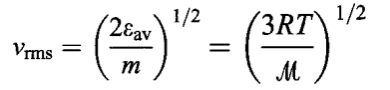
The average translational kinetic energy per molecule in a sample of ideal gas is

This gives a fundamental meaning to the concept of temperature.

MEAN SQUARE VELOCITY
The mean square velocity (v2)av is the average value of the square of the magnitude of velocity of the gas molecules.

At a given temperature the lighter molecules have greater velocities since the average kinetic energy is the same for all gases at a given temperature.

INTERNAL ENERGY (U)
In our infinitesimal “billiard ball” model of a monoatomic gas, the only energy is translational kinetic energy. Therefore, the internal energy is:

If we add some heat to our system, we must have,

HEAT CAPACITY (C)
Heat capacity is the total amount of heat needed to produce a degree rise in temperature. For a constant volume process,

MOLAR HEAT CAPACITY (cv)
The heat capacity per mole for an ideal gas at constant volume:

The heat capacity per mole for an ideal gas at constant pressure:

EQUIPARTITION OF ENERGY
These results, in which each degree of freedom that involves energy (with certain restrictions) contribute the same value (1/2 kT) to the average energy, are called the law of equipartition of energy.

STATISTICAL MECHANICS
Thermodynamics and statistical mechanics thus allowed for the indirect study of the physics of the realm of atoms and molecules, which lead to the realization that Newtonian mechanics does not apply in this realm. This in turn led to the formulation of the new “quantum” mechanics in the early twentieth century.

LAW OF DULONG AND PETIT
A study of the actual values of the molar heat capacities of crystalline solids at constant volume shows that at high temperatures they all have essentially the same molar heat capacity 3R (six degrees of freedom). But all real crystal solids have molar heat capacities that decrease to zero as the Kelvin temperature decreases to zero. This is because the assumption of Newtonian mechanics do not hold.

.

Physics I: Chapter 15

Reference: Beginning Physics I

CHAPTER 15: THERMODYNAMICS I: TEMPERATURE & HEAT

.

KEY WORD LIST

Macroscopic Systems, Thermodynamics, Quasistatic Systems, Thermodynamic Variables, Mechanical Equilibrium, Chemical Equilibrium, Thermal Equilibrium, Thermodynamic Equilibrium, Temperature, Zeroth Law of Thermodynamics, Thermometric Property, Celsius Scale, Ice Point, Steam Point, Fahrenheit Scale, Thermometer, Constant Volume Gas Thermometer, Kelvin Temperature Scale, Rankine Temperature Scale, Triple Point, Coefficient of Linear Expansion, Caloric, Thermal Energy, Heat, Internal Energy, Calorie, British Thermal Unit, Specific Heat, Heat Capacity, Calorimetry, Heat of Fusion, Heat of Vaporization, Heat of Sublimation, P-T Diagram, Evaporation

.

GLOSSARY

For details on the following concepts, please consult CHAPTER 15.

MACROSCOPIC SYSTEMS
These are large systems that are characterized by their having myriad atoms and/or molecules. They depend on the myriad random motions and interactions of the component atoms and molecules, rather than their lockstep behavior.

THERMODYNAMICS
Thermodynamics deals with macroscopic systems. More specifically, it deals with the relations between heat and other forms of energy (such as mechanical, electrical, or chemical energy), and, by extension, of the relationships between all forms of energy.

QUASISTATIC SYSTEMS
Quasistatic systems mean that they are in mechanical, chemical, and thermal equilibrium, or that their properties vary so slowly that they can be described at any instant as if in equilibrium.

THERMODYNAMIC VARIABLES
Thermodynamic variables (or macroscopic variables) are physical properties, such as, volume and internal energy, which describe the system as a whole. Most other thermodynamic variables, such as, pressure and temperature can be defined only if the system is quasistatic.

MECHANICAL EQUILIBRIUM
This is understood to mean not only that the system as a whole does not accelerate, but that within the system the different parts are in mechanical equilibrium with each other —no churning of fluids and no pressure imbalances.

CHEMICAL EQUILIBRIUM
A system in mechanical equilibrium may still undergo change through a chemical reaction. The system is in chemical equilibrium when there is no change in chemical composition taking place.

THERMAL EQUILIBRIUM
A system in mechanical and chemical equilibrium may still undergo change in temperature. Two objects in thermal equilibrium with each other are also said to be at the same temperature.

THERMODYNAMIC EQUILIBRIUM
A system that is in mechanical, chemical and thermal equilibrium with its surroundings, as well as internally is said to be in thermodynamic equilibrium. Thermodynamic equilibrium means that there is no change on the macroscopic level.

TEMPERATURE
Temperature is a numerical value that we assign to each thermal equilibrium state of a system as determined by some agreed-upon procedure.

ZEROTH LAW OF THERMODYNAMICS
If two systems A and B are each found to be in thermal equilibrium with a third system C, then when the two systems A and B are brought into contact with each other, they are themselves found to be in thermal equilibrium.

THERMOMETRIC PROPERTY
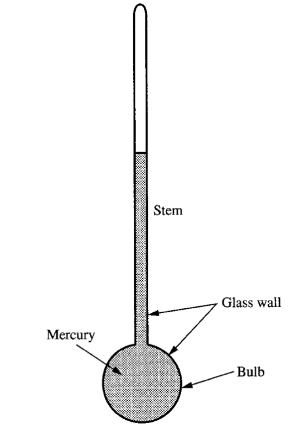
A thermometric property is a property that varies with the thermal equilibrium states in a well-defined and reproducible way. For example, mercury in a sealed hollow bulb attached to a long, thin hollow glass stem. When mercury expands or contracts with change in the thermal equilibrium state, small changes in its volume are observable from its height in the thin stem.

CELSIUS SCALE
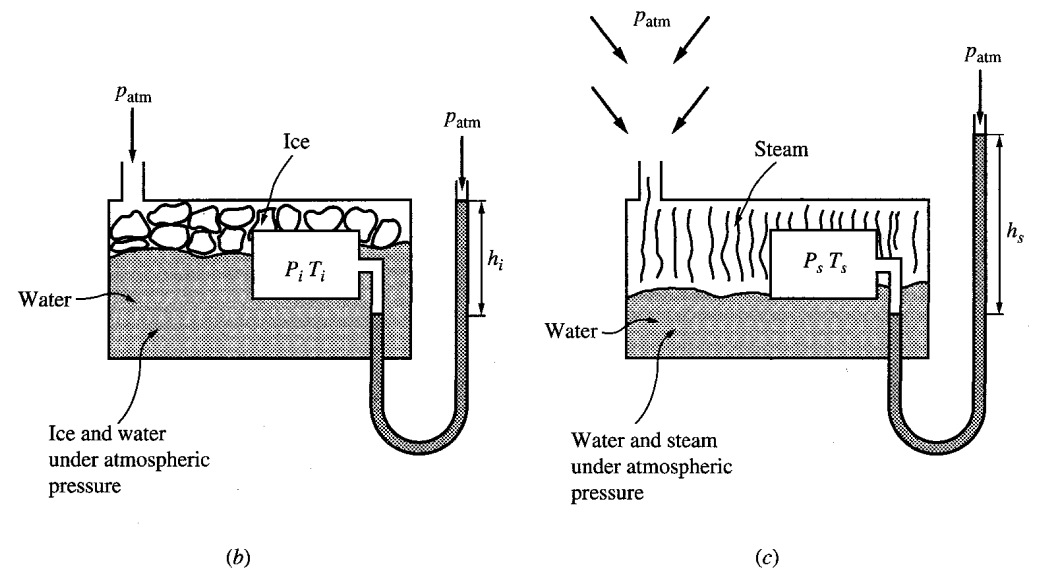
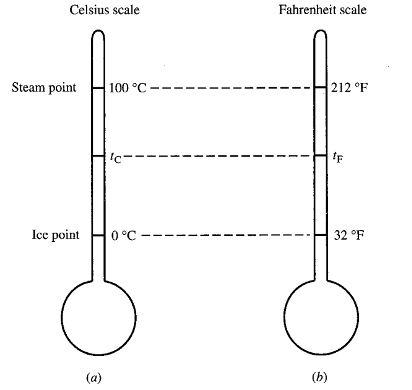
This is the most widely used temperature scale that assigns the number tC = 0°C for the ice point, and tC =100°C for steam point at atmospheric pressure. The distance between these two points is divided into 100 equal marked intervals labeled in 1°C steps.

ICE POINT
The point at which ice and water are in thermal equilibrium at atmospheric pressure.

STEAM POINT
The point at which steam, and water are in thermal equilibrium at atmospheric pressure.

FAHRENHEIT SCALE
On this scale the ice point and steam point are defined as tF = 32°F and tF = 212°F respectively, and the distance between these two points is divided into 180 equal marked intervals labeled in 1°F steps.

THERMOMETER
A thermometer is a temperature-calibrated mercury system, which can be used to measure the temperature of any other object. However, the temperature scale shall be dependent on the material being used to define it.

CONSTANT VOLUME GAS THERMOMETER
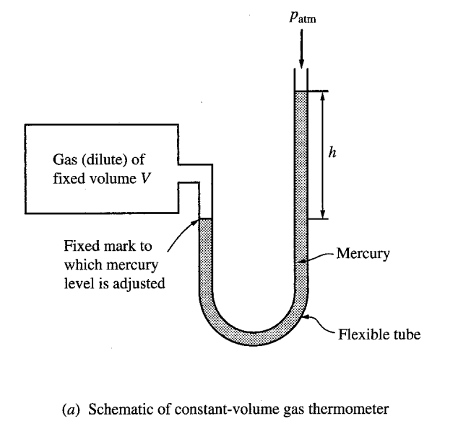
This thermometer consists of a gas confined to a fixed volume, with an open-tube manometer used to measure the pressure of the gas inside. Constant volume gas thermometer is often considered the “standard” against which other thermometers are calibrated.

KELVIN TEMPERATURE SCALE
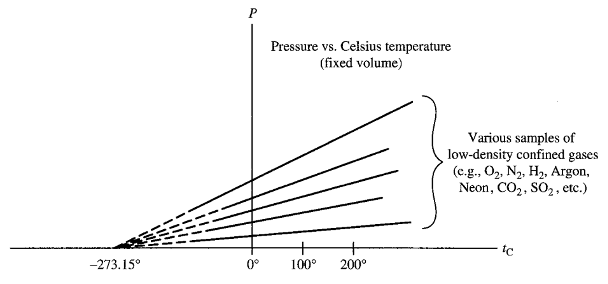
The graphs of pressure vs. temperature of all very low-density gases at fixed volumes are straight lines. When extrapolated these straight lines intersect the temperature axis at the same point: -273.15°C. On the basis of this result, one defines the Kelvin (or absolute) temperature scale. It is same as the Celsius Scale with its zero shifted to “-273.15°C”.

T = tC + 273.15

RANKINE TEMPERATURE SCALE
This is the Kelvin scale using the Fahrenheit degree rather than the Celsius degrees.

TR = tF + 459.67

TRIPLE POINT
The triple point is the temperature, tC = 0.01°C, at which all three phases of water—solid, liquid, and vapor—coexist.

COEFFICIENT OF LINEAR EXPANSION
If we have a rod of length L at a given absolute temperature and we increase the temperature by a small amount ∆T, we find that the length of the rod increases b an amount ∆L that is proportional to the original length L and to the temperature increase ∆T:

L = a LT

The proportionality constant a is called the coefficient of linear expansion; it depends on the material of which the rod is made.

CALORIC
Early scientists believed that some invisible and weightless substance, which they called caloric, flows from a hotter to cooler object until both objects reach thermal equilibrium.

THERMAL ENERGY
It became clear through the efforts of Joule and others that it is not caloric but thermal energy that is transferred between two macroscopic systems in contact.

HEAT
Heat is the thermal energy transfer from one system to another. Heat is actually the statistical “summing up” of the mechanical work done by the random interactions of the individual atoms and molecules of the two systems.

INTERNAL ENERGY
Related to heat is the internal energy that resides in a system due to the random motion and jiggling of the myriad atoms and molecules making up that system.

CALORIE (CAL)
A calorie is defined as the “amount of heat” (thermal energy in transit) necessary (at atmospheric) to raise the temperature of 1 gram of water 1°C. 1 cal = 4.184 J

BRITISH THERMAL UNIT (BTU)
A Btu is the amount of heat necessary to raise 1 lb of water 1°F. The conversion is 1 Btu = 252 cal.

SPECIFIC HEAT (c)
The specific heat is the characteristic amount of heat that flows into a unit mass of a given substance and raises its temperature by 1°. For solids and liquids, heat is transferred under constant atmospheric pressure.

HEAT CAPACITY (C)
Heat capacity is the total amount of heat needed to produce a degree rise in temperature.

CALORIMETRY
Calorimetry is the experimental measurements of specific heats and other heat constants.

HEAT OF FUSION (Lf)
Heat of fusion is the amount of heat added to melt each unit mass of substance at the melting point (under normal atmospheric pressure).

HEAT OF VAPORIZATION (Lv)
Heat of vaporization is the amount of heat added to vaporize each unit mass of substance at the boiling point (under normal atmospheric pressure).

HEAT OF SUBLIMATION (Ls)
Heat of sublimation is the amount of heat added to sublimate each unit mass of substance at the sublimation point (under normal atmospheric pressure).

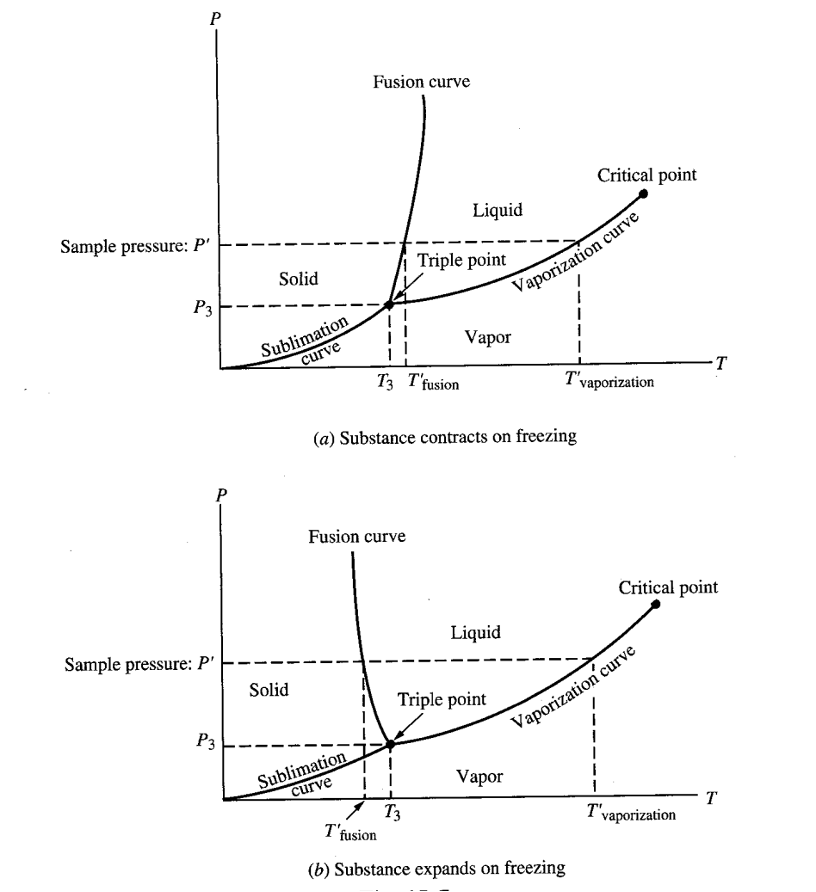
P-T DIAGRAM
The P-T diagram keeps track of phase changes. For a pure substance the diagram will resemble the following.

EVAPORATION
Evaporation takes place at the surface of the liquid in contact with a gas at a given pressure. At temperatures well below the boiling point, molecules from the liquid that are particularly energetic can break free and rise above the liquid to form a vapor. The evaporating molecules take away the thermal energy with them—on average the amount of energy per unit mass is the same order of magnitude as the heat of vaporization for boiling. Thus the evaporation process removes heat from the liquid, cooling it and anything in contact with it.

.

Physics I: Chapter 14

Reference: Beginning Physics I

CHAPTER 14: FLUIDS IN MOTION (HYDRODYNAMICS)

.

KEY WORD LIST

Viscosity, Viscous Forces, Non-Viscous Fluids, Turbulent Flow, Steady-State Flow, Laminar Flow, Flow Line, Streamline, Flow Tube (Stream Tube), Incompressible Fluid, Ideal Fluid, Equation of Continuity, Bernoulli’s Equation, Torricelli’s Theorem, Venturi Tubes, Stagnation Point, Aerodynamics, Coefficient Of Viscosity, Poiseuille’s Law, Stoke’s Law, Reynold’s Number

.

GLOSSARY

For details on the following concepts, please consult CHAPTER 14.

VISCOSITY
In general, there are shear forces between layers of fluids that move past each other and between the moving fluids and boundary surfaces. This property of fluids is called viscosity.

VISCOUS FORCES
The shear forces of viscosity are frictional in nature. They are called viscous forces.

NON-VISCOUS FLUIDS
For some fluids the viscous forces can be quite small, especially when they are moving slowly. In such vases one can ignore viscosity. Such a fluid is known as a non-viscous fluid.

TURBULENT FLOW
Much fluid motion is quite complex, with the flow pattern at any given point changing over time. Such motion is called turbulent flow. Turbulent flow is characterized by swirling and eddies and constantly changing patterns of motion.

STEADY-STATE FLOW
In many cases, however, the flow pattern at any point stays the same from moment to moment. Such motion is called steady-state or just steady flow. It is also called laminar flow.

LAMINAR FLOW
See STEADY-STATE FLOW.

FLOW LINE
The flow line of a particle of water moving in a stream is the path it takes. In steady flow, any particle that is located on the flow line of a previous particle will repeat the motion of that particle.

STREAMLINE
The streamline of a flow is the flow pattern of the entire fluid at a given instant, retaining knowledge of the velocities of all the particles at that instant. In steady flow, the streamlines remain constant in time. For steady-state flow, two streamlines can never cross each other.

FLOW TUBE (STREAM TUBE)
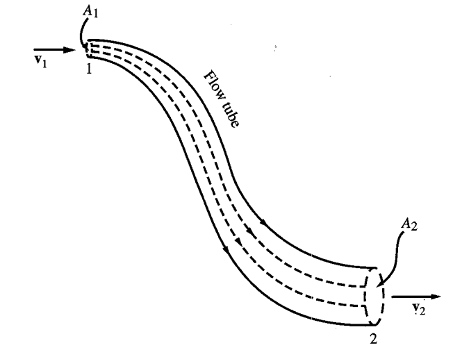
A flow tube is made up of the streamlines that pass through the perimeter of a small cross-sectional area in steady state. The flowing fluid can never cross the boundary of the tube.

INCOMPRESSIBLE FLUID
For an incompressible fluidthe changes in the densities from location to location are so small that we can ignore them.

IDEAL FLUID
An incompressible fluid that has no viscosity is called an ideal fluid.

EQUATION OF CONTINUITY
The mass of fluid that flows into one end of the flow tube in a given time interval must be the same as the mass that flows out the other end in the same time interval.

BERNOULLI’S EQUATION

TORRICELLI’S THEOREM
If you have a container filled with fluid with small hole at the bottom of the container, the fluid leaves through the hole with velocity same as it would experience if dropped from the same height to the hole level.

VENTURI TUBES

(a) The pressure in the pipe is determined by observing the height of water in the tube.
(b) The tube acts like a open-tube manometer and measures the gage pressure of the flowing liquid.z
(c) The height difference of the mercury (corrected for the different heights of fluid above the mercury on the two sides) directly measures P2 P1. This also yields velocity per P2 P1 = ½ dv12.

STAGNATION POINT
The stagnation point is a small region or point right in front of the tube at 2 in figure (c) above, where the fluid is at rest since it must go around one or the other side of the tube.

AERODYNAMICS
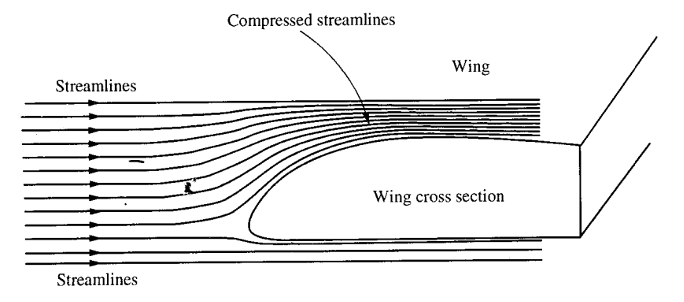
An airplane in motion is supported by the pressure difference between the top and undersides of the wing. Compression of the streamlines above the wing means that the flow tube above the wing has a smaller cross-sectional area and, therefore, greater velocity of the air. This greater velocity implies lower pressure.

COEFFICIENT OF VISCOSITY
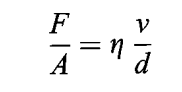
For fluid in steady flow between parallel plates, the stress is proportional to the velocity gradient, where the coefficient of viscosity  is the proportionality constant,

POISEUILLE’S LAW
The volume flow rate depends on the fourth power of the radius of the pipe, as well as on the change in pressure per unit length along the pipe.

STOKE’S LAW
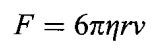
When an object moves through a viscous fluid in such a way that the fluid is in steady flow past it, the viscous forces on the object are, to a good approximation, proportional to the relative velocity and the coefficient of viscosity. The expression for the force will vary with the shape of the object. For sphere,

REYNOLD’S NUMBER

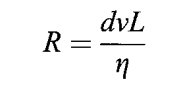
The Reynold’s number is a dimensionless quantity that depends on four factors: the density d of the flowing fluid, the coefficient of viscosity , the average relative velocity of the fluid v, and the characteristic linear dimension L of the solid boundary. For flow through a pipe, L is the diameter of the pipe. For an object moving through a fluid, L can be taken as some average linear dimension of the object facing into the fluid flow. In all cases the expression for the Reynold’s number is

When R exceeds a certain value for the geometry at hand, the flow turns from steady to turbulent. A good rule of thumb for fluids flowing through a pipe is that when R exceeds 2000, the flow becomes turbulent. Similarly for a sphere moving through a fluid, the critical value of R is about 10.

.