Category Archives: Mathematics

Free Math Tutoring

MC 007
This is a picture taken at the Math Club that I ran for 15 years

I have been tutoring math for the last fifty years on and off. I have written my own math materials. All of that and other reference material, which I like, is available on this blog. See Course in Mathematics.

I have decided to tutor mathematics for free as I am now approaching retirement. At the moment I am consulting  part time as an engineer, I shall be tutoring at the locations I visit frequently. These locations are the local Library, the local Starbucks, and the local Barnes & Nobles.

The reasoning behind free math tutoring is the same as the reasoning that underlies the research I have been doing into KHTK (mindfulness).

I feel secure to the degree the environment around me is capable of mindfulness.The knowledge of math and science definitely contributes to mindfulness.

Today, I shall be conducting my first free math tutoring session under this program. How many students I am able to tutor shall depend on the time available to me. In the future, I may extend this offer on Skype.

Normally, I shall be tutoring a student once a week for three free sessions. After three sessions I may continue with the same student, or move to another student. This offer is based on first come first served.

This is an ambitious experiment.  This may include tutoring some students to become math tutors. I am excitedly looking forward to its results.

MC 001

The Math Club… a busy place!

.

Old Algebra Book

bk05ray1866

Reference: Remedial Math

For application by the student

These sections are taken from PRIMARY ELEMENTS OF ALGEBRA by Joseph Ray, first published in 1866.

A00 Contents

A01 Definitions

A02 Addition

A03 Subtraction

A04 Multiplication

A05 Division

A06 Factoring

A07 Fractions

A08 Equations 1

A09 Equations 2

A10 Equations 3

A11 Equations 4

A12 Powers

A13 Radicals

A14 Quadratic Eqn

A15 Progressions

A16 Ratio

.

The Field Axioms

field

  1. If x and y are real numbers, then… x+y is a unique real number. [CLOSURE PROPERTY OF ADDITION]

  2. If x and y are real numbers, then… xy is a unique real number. [CLOSURE PROPERTY OF MULTIPLICATION]

  3. If x and y are real numbers, then… x+y = y+x. [COMMUTATIVE PROPERTY OF ADDITION]

  4. If x and y are real numbers, then… xy = yx. [COMMUTATIVE PROPERTY OF MULTIPLICATION]

  5. If x, y and z are real numbers, then… (x+y)+z = x+(y+z). [ASSOCIATIVE PROPERTY OF ADDITION]

  6. If x, y and z are real numbers, then… (xy)z = x(yz). [ASSOCIATIVE PROPERTY OF MULTIPLICATION]

  7. Multiplication distributes over addition. If x, y and z are real numbers, then… x(y+z) = xy + xz. [DISTRIBUTIVE PROPERTY]

  8. The IDENTITY ELEMENT FOR ADDITION is 0, i.e., for any real number x, … x+0 = x. [ADDITION PROPERTY OF 0]

  9. The IDENTITY ELEMENT FOR MULTIPLICATION is 1, i.e., for any real number x, … x.1 or 1x = x. [MULTIPLICATION PROPERTY OF 1]

  10. A unique ADDITIVE INVERSE exists for every real number, i.e., for every x the additive inverse is -x such that… x + (-x) = 0.

  11. A unique MULTIPLICATIVE INVERSE exists for every real number, i.e., for every non-zero x the multiplicative inverse is 1/x such that… x . (1/x) = 1.

.

Equations & Transposition

math4

.

Equations

(1) An equation has two sides that are equal.

For example,               3 + 4  =  7

The left hand side (LHS) of the equation is 3 + 4. The right hand side (RHS) of the equation is  7

Let A, B, and C stand for numbers, where A + B equals C. Then we write the equation as,

A + B   =   C

.

(2) When the same quantity is added to, or subtracted from, the two sides, the equation is maintained.

For example,          (3 + 4) + 8  =  (7) + 8

Let N be a number added to both sides of the earlier equation, then

  (A + B) + N  =   (C) + N

Similarly,                  (A + B) – N   =   (C) – N

.

(3) When the two sides of an equation are multiplied or divided by the same quantity, the equation is maintained.

For example,           (3 + 4) x 8  =  (7) x 8

Let both sides of the earlier equation be multiplied by the number N, then

  (A + B) x N   =   (C) x N

Similarly,                  (A + B) ÷ N   =   (C) ÷ N

The above is taught in American schools. But the same thing can be done mentally as explained in the next section.

.

Rules of Transposition

The word TRANSPOSITION means “to position across.”

(4) When the equation is made up of two equal expressions, and a term is moved from one side to the other side, its sign changes to the opposite. That is, + becomes –, and – becomes +.

EXAMPLE:

If    A + B   =   C
then     A  =  C – B
and      B  =  C – A

EXAMPLE:

If     A – B   =   C
then     A  =  C + B
and      A – C  =  B        or       B = A – C

.

(5) When the equation is made up of two equal terms, and a factor is moved from one side to the other side, then multipication becomes division, and division becomes multiplication.

EXAMPLE:

If     A x B   =   C
then      A  =  C / B
and       B  =  C / A

EXAMPLE:

If    A / B   =   C
then      A  =  C x B
and       A / C  =  B        or       B = A / C

.

Application of Transposition

When working with word problems, we first translate the word problem into an equation, using a letter to represent the unknowm.

We then bring the unknown to one side of the equation, and all the knowns to the other side of the equation using the rules of transposition.

.

EXAMPLE: 3 more than 5 times a number is 13. What is that number?

Suppose the unknown number is N. The problem translates to the equation,

       5N + 3   =   13

We first transpose the term 3 to the right. Addition becomes subtraction.

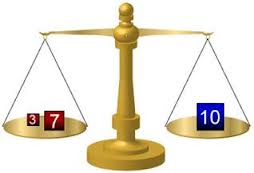
       5N   =   13 – 3   =   10

Then we transpose the factor 5 to the right. Multiplication becomes division.

       N   =   10 / 5   =   2

The answer is N = 2. We verify the answer by substituting it in the equation.

       5 (2) + 3   =   13

The answer N = 2 is correct.

.

EXAMPLE: If   5A – 6 = 14,   what is the value of A ?

We get,               5A   =   14 + 6   =   20               (Transpose 6)
Therefore,           A   =   20 / 5   =   4                    (Transpose 5)

Verify by substituting 4 for A in the original relation.

We get,               5 (4) – 6   =   14                    (Verified correct)

.

EXAMPLE: Determine the value of A if   7A / 3 + 4 = 18.

We get,              7A / 3   =   18 – 4   =   14          (Transpose 4)
Therefore,          7A   =   14 x 3   =   42               (Transpose 3)
Therefore,          A   =   42 / 7   =   6                    (Transpose 7)

Verify by substituting 6 for A in the original relation.

We get,               (7)(6) / 3 + 4   =   18            (Verified correct)

EXAMPLE: Determine the value of X if   4X – 2 = X + 7.

By transposition, you can bring all X‘s to the left and all number to the right in one step as follows.

We get,               4X – X = 7 + 2
or,                             3X  =  9
or,                               X  =  3

Such transposition can easily be done mentally. The alternate method of repeatedly adding, subtracting, multiplying or dividing equal quantities from both sides takes longer.

.

Concepts in Arithmetic (old 2)

negative

ARITHMETIC = Arithmos (number) + Techne (Skill) = Number skill

.

(1)  In counting, the previous number is one less.

1 less than 3       =     2

1 less than 2       =     1

1 less than 1       =     0 (zero, nothing)

.

(2)  Zero provides the reference point for all counting numbers.

1      =     0 + 1

5      =     0 + 5

9      =     0 + 9

If N is any number then,

N      =     0 + N

For measuring heights on earth, zero is the sea level.

.

(3)  Then numbers may be counted both forward and backward from zero.

Numbers counted forward from 0 are positive numbers:  +N   =   0 + N

Numbers counted backward from 0 are negative numbers:  –N   =   0 – N

The numbers go on forever in both forward and backward directions.

This we call the set of INTEGERS (untouched, hence, undivided)

.

(4)  The set of integers may be visualized as a number line.

Integer0

.

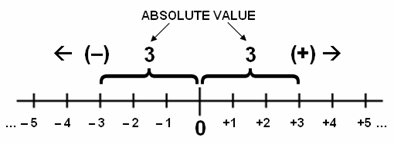
(5)    An integer is made up of a sign and an absolute value.

Integer2

Absolute value of +3   =    |+3|    =    3

Absolute value of –3   =    |–3|    =    3

.

(6)  POSITIVE affirms the existing characteristic.

Positive of a positive integer is that positive integer:    + (+1)   =   +1

Positive of a negative integer is the negative integer:  + (–1)   =   –1

.

(7)  NEGATIVE indicates the opposite characteristic.

Negative of a positive integer is the negative integer:   – (+1)   =   –1

Negative of a negative integer is the positive integer:   – (–1)   =   +1

.

(8)  A Rational number can be expressed as a ratio of two counting numbers.

Therefore, there is a definite unit on which a rational number is based.

This unit is the common factor of the two counting numbers.

.

(9) An Irrational number cannot be expressed as a ratio of two counting numbers.

Therefore, there is no unit, however small, on which an irrational number may be based.

Please see Going Beyond Counting.

Thus, the basic nature of number being discrete comes under question.

.

(10)  The following are considered as Real numbers:

Natural, whole, positive, negative, rational and irrational numbers.

Real numbers may be represented on a Number Line with a common reference point of zero.

The reference point of zero may be selected arbitrarily on the number line.

.

(11)  The square of an integer of either sign is always a positive integer.

A positive integer has two square roots: one positive and the other negative.

A negative integer has no square root in the real number system.

.

(12)  The square root of –1 is denoted as i (an imaginary unit)

Thus,      i2   =   −1

Therefore, the square root of 4 is written as 2i.

.

(13)  The Imaginary numbers may be represented on a different number line.

The imaginary and real numbers lines are independent of each other.

.

(14)  A complex number a + bi is made up of real and imaginary components.

The real component is a, and the imaginary component is bi

Here a and b are real numbers, and i is the imaginary unit satisfying i2 = −1

.

(16)  The Complex numbers may be represented on a complex plane.

A complex plane is determined by a real number line as the horizontal axis,

and an imaginary number line as the vertical axis.

The reference point of zero is shared by both number lines.

.