Author Archives: vinaire

I am originally from India. I am settled in United States since 1969. I love mathematics, philosophy and clarity in thinking.

Physics II: Chapter 8

ReferenceBeginning Physics II

Chapter 8: MAGNETIC PROPERTIES OF MATTER

.

KEY WORD LIST

Magnetization, Orbital Motion, Spin, Diamagnetic Material, Paramagnetic Material, Ferromagnetism, Magnetic Poles, Magnetization Vector, Magnetic Intensity Vector, Magnetic Susceptibility, Superconductor

.

GLOSSARY

For details on the following concepts, please consult Chapter 8.

MAGNETIZATION
A magnetic field can change the properties of the material in which it is created, and result in having the material produce its own field, which has to be added to the original field. This modification of the properties of a material is called “magnetization” of the material.

ORBITAL MOTION
In order for a magnetic field to have any effect, a material must consist of moving charged particles. All materials consist of a collection of atoms and molecules. The orbital motion may be thought of as electrons circulating about a nucleus within an atom.

SPIN
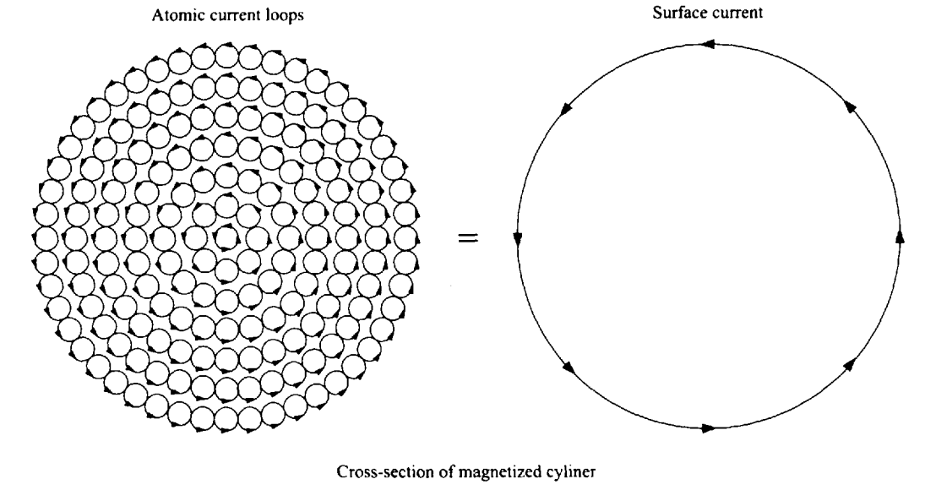
In addition to orbiting the nucleus, the electrons spin on their axes and, as a consequence, have an additional “spin” angular momentum and “spin” electric current loops. In either case, orbital or spin, magnetic fields can be set up by the atomic current loops, and an external magnetic field can exert forces on the electrons, and thereby modify their motion.

DIAMAGNETIC MATERIAL
An external magnetic field generally induces      currents and associated magnetic moments in the atoms of a material. These magnetic moments, in turn, produce their own magnetic fields, which, by Lenz’s law, are in a direction opposite to the original field. The materials in which this is the dominant effect are called diamagnetic materials, in the same manner as materials that produce electric fields opposed to the original electric field are dielectric materials. In general, such induced magnetic fields in an atom are very small and the external field is reduced by a tiny amount as a consequence of diamagnetism. While diamagnetism is present in all atoms, it dominates only in those atoms in which the orbital and spin angular moments average out to zero.

PARAMAGNETIC MATERIAL
In paramagnetic materials there is a net orbital and/or spin angular momentum and a net effective current loop for the atom. Such an “effective” current loop gives the atom a definite overall magnetic dipole moment. An external magnetic field exerts a torque on such a magnetic moment and the torque tries to line up the moment parallel to the magnetic field. The lined-up moments will then produce their own magnetic field in the same direction as the original field, thus increasing the magnetic field. Paramagnetic materials are more common than diamagnetic materials, especially since they dominate in materials where both effects are present.

FERROMAGNETISM
Certain materials, notably iron, nickel and cobalt, exhibit ferromagnetism at room temperature. This means that the magnetic interactions between the magnetic moments of neighboring atoms is strong enough, even at room temperature, to align the moments in the same direction. If an external field is applied to the ferromagnetic material it has the effect of causing the domains of aligned moments to rotate and point in the same direction, the direction of the magnetic field. Once they have been aligned, they tend to remain aligned even if the external field that originally caused them to align is removed. The material has now become a permanent magnet.

MAGNETIC POLES
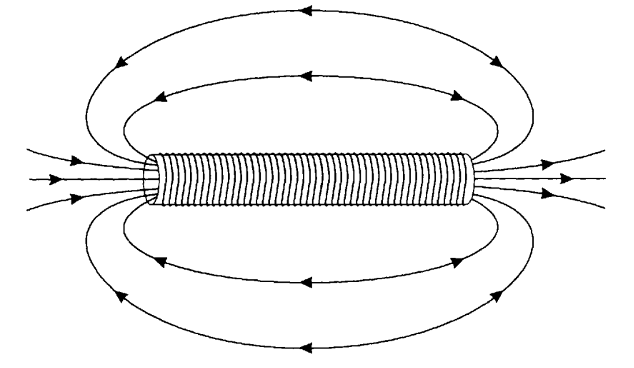
The field produced by a solenoid is nearly the same in shape as the electric field produced by oppositely charged particles located at the ends of the bar. We therefore often talk of the bar as being composed of two opposite magnetic poles (the substitute for electric charges), one called a north pole and the other called a south pole.

The north pole is the apparent source of magnetic field lines (as is a positive charge for electric field lines), and the south pole is a sink for the lines. In actuality the lines do not terminate at the poles, but continue in straight lines within the material, forming closed loops. The designation of north or south pole arises from the fact that the bar tends to line up in the magnetic field of the earth with the north pole facing in the northerly direction. As in the case of electric charges, opposite poles attract, and similar poles repel each other.

MAGNETIZATION VECTOR
The magnetization vector, M, is the total magnetic moment per unit volume. Thus, a material in a magnetic field can become magnetized, with a magnetization M = ΣM/V). The magnetic field, BM produced by the magnetic dipoles in the material is related to the magnetization as follows.

MAGNETIC INTENSITY VECTOR (H)
It is the part of the magnetic field in a material that arises from an external current and is not intrinsic to the material itself. The definition of H is:

H = B/μ0 − M

where B is the actual magnetic field within a material considered as a concentration of magnetic field lines per unit cross-sectional area; μ0 is the magnetic permeability; and M is the magnetization vector. The magnetic field H might be thought of as the magnetic field produced by the flow of current in wires and the magnetic field B as the total magnetic field including also the contribution M made by the magnetic properties of the materials in the field. When a current flows in a wire wrapped on a soft-iron cylinder, the magnetizing field H is quite weak, but the actual average magnetic field (B) within the iron may be thousands of times stronger because B is greatly enhanced by the alignment of the iron’s myriad tiny natural atomic magnets in the direction of the field.

MAGNETIC SUSCEPTIBILITY
In general, except for material that becomes a permanent magnet, the magnetization is proportional to the magnetic field, and therefore to the magnetic intensity as well. We can therefore write that,
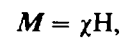
Where χ is called the magnetic susceptibility of the material. Then

where μ is the permeability of the material, κm, is the relative permeability of the material, and μ = μ0κm, with κm = 1 + χ. This means that for these materials, we can calculate B if we know H, merely by multiplying H by μ.

SUPERCONDUCTOR
Some materials, at sufficiently low temperatures lose all their resistivity. These materials are called superconductors. They also set up surface currents in a magnetic field, which themselves produce an exactly opposite field, and thereby cancel any field which tries to be established in its interior. Thus, a superconductor can be considered to be a perfect diamagnet.

.
KHTK Factor # 7

Reference: The Factors

KHTK Factor # 7: When gaps are viewed among dimension points, new dimensions are postulated to fill them. Thus there is reasoning.

The dimension point is a point of knowingness in the vast background of the Unknowable. It is created out of postulates. It has substance.

But the earlier postulates as dimension points provide a rough sketch only.  The principle of oneness makes the sketchiness visible. One immediately sees tremendous gaps. New postulates are then made in an attempt to fill these gaps. This cycle keeps repeating. And so the earlier sketch starts to take a more of a recognizable appearance. 

This is the process of creation of the “being” we know as the Universe. First there is the substance in the form of postulates. Next that substance starts to spread out and starts to show gaps. As these gaps starts to get filled, the first appearance that we have is that of continuous space.

So, the primary anomaly is discontinuity (missing knowingness). It is very difficult to spot this anomaly because it is not there to be spotted.

This is the beginning of reason; and the first challenge of reasoning is to spot what is missing.

So the universe starts to form. But we are not quite there yet.

.

Scientology

Compare the above to the following factor in Scientology.

Scientology Factor # 7. And from the viewpoint to the dimension points there are connection and interchange. Thus new dimension points are made. Thus there is communication.

Communication already exists with the ability to view the dimension points. This communication now develops into reasoning to discover more.

.

Logic

Reasoning requires the ability to perceive what is missing. This is impossible to do without a universal criterion, such as, the principle of oneness. Reasoning is qualified by the viewpoint.

.

Physics II: Chapter 7

ReferenceBeginning Physics II

Chapter 7: MAGNETISM-SOURCE OF THE FIELD

.

KEY WORD LIST

Magnetic Field (Source), Field Produced By Currents, Solenoid, Magnetic Field Lines, Composite Fields, Ampere’s Law, Coaxial Cable

.

GLOSSARY

For details on the following concepts, please consult Chapter 7.

MAGNETIC FIELD (SOURCE)
One basic origin of a magnetic field is a moving charge or an equivalent current in a wire. It exerts a force on another moving charge. Another basic source for a magnetic field is an electric field that varies with time.

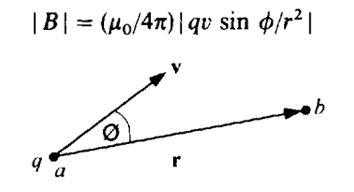
The following is the formula for the magnitude of the field produced by a moving charge q, moving with velocity v, at a point located at a displacement r from the charge.

This is known as the Law of Biot and Savart. The field is zero if φ is zero. The largest magnetic field is produced when φ is 90°. The magnitude of B decreases as 1/r2 with the distance from point a. The field increases with both q and v.

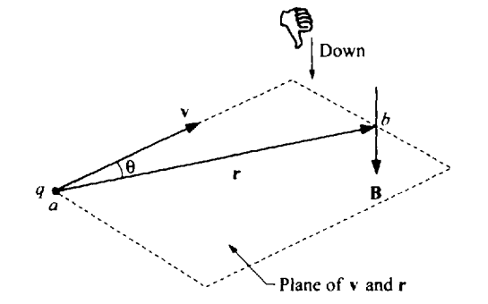
The direction of the field is perpendicular to the plane containing both v and r, and according to the right-hand rule.

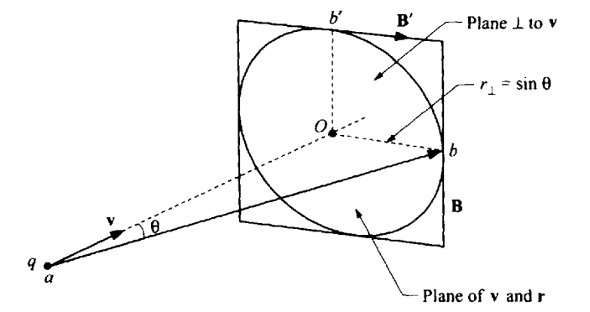
If one traces the magnetic field lines, they form concentric circles around the direction of v.

Two charges of the same sign moving parallel to each other in the same direction shall experience magnetic attraction.

FIELD PRODUCED BY CURRENTS
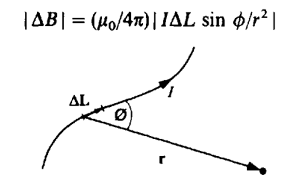
Current flowing in a wire is equivalent to moving charge: qv = I∆L. The magnitude of the magnetic field produced by a current I flowing in a wire of length ∆L at a point located at a distance r from the element is,

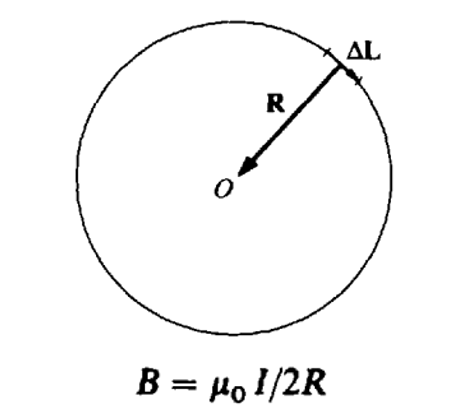
Field at the Center of a Current Carrying Ring

A current I, flowing in the clockwise direction. Then the field at the center of the ring, with direction into the paper is,

For N turns of the coil the field is multiplied by N.

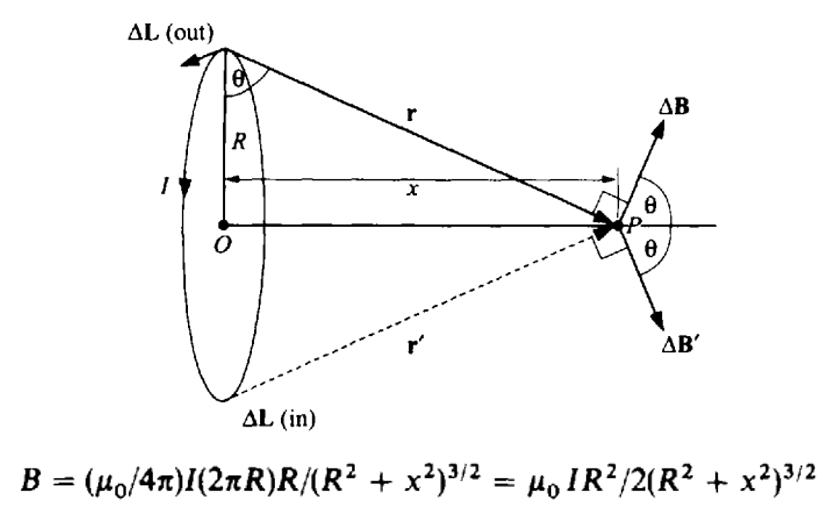
Field Along the Axis of a Ring

The field at the center of the ring, with direction at P to the right is,

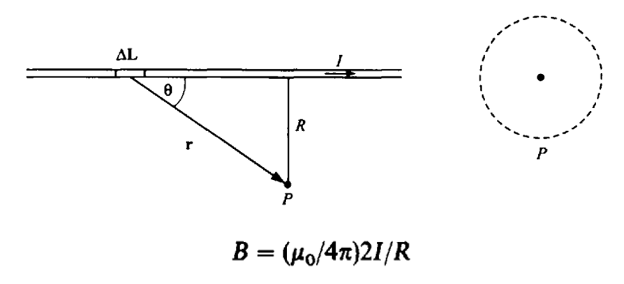
Field of a Long Straight Wire

I is the current in the wire and R is the perpendicular distance of the point P from the wire. The direction of the field is into the paper at P.

SOLENOID
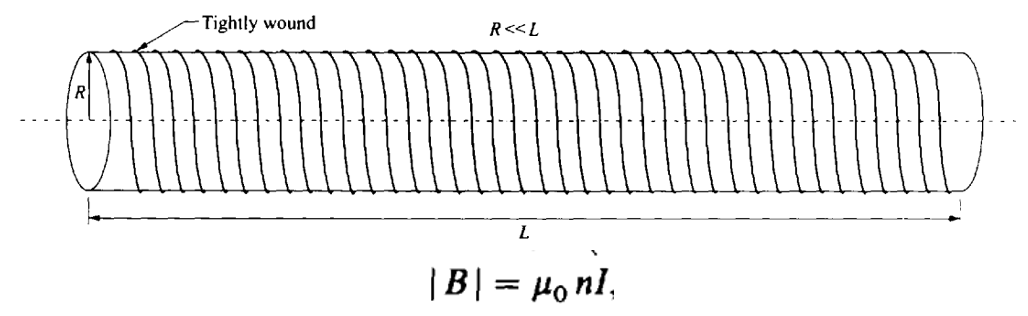
A solenoid
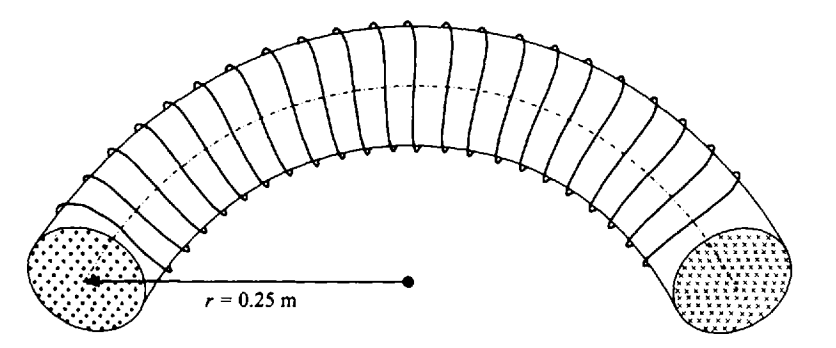
is a wire is continuously wound around a long pipe with adjacent windings close to each other. The field within a long solenoid is the same at any point within the solenoid and is zero (or very small) outside the solenoid.

where n is the number of turns per meter. The direction of the field is parallel to the axis with the direction given by the same right-hand rule used for the ring. The result is the reason that solenoids are so very useful for producing magnetic fields. The field produced is uniform, with the same magnitude and direction everywhere within the solenoid. Furthermore, this uniform field does not depend on the radius of the solenoid, only on the number of windings per unit length. One can, for instance, wind several layers of turns, one on top of the other, to increase n, and each layer will contribute the same field, independent of the radius (as long as the solenoid is truly long).

If the solenoid is not infinitely long, but the length is much greater than the radius, then the above result is still nearly true as long as one is not too near to the end of the windings. The field lines inside the solenoid are straight lines, parallel to the axis, until one approaches the ends. Outside the solenoid, the field is no longer zero, and the field lines are as shown above. This happens to be the same field line configuration as for a permanent bar magnet.

MAGNETIC FIELD LINES
The magnetic field lines form closed loops, unlike electric field lines that begin or end at a point charge. The fact that magnetic field lines don’t converge to or diverge from a point is a fundamental property of the magnetic field and can be stated as a general law: “Magnetic field lines never converge to a point or diverge from a point”.

COMPOSITE FIELDS
If several wires each produce magnetic fields, then the actual magnetic field at any point is the vector sum of the fields produced by each wire.

AMPERE’S LAW
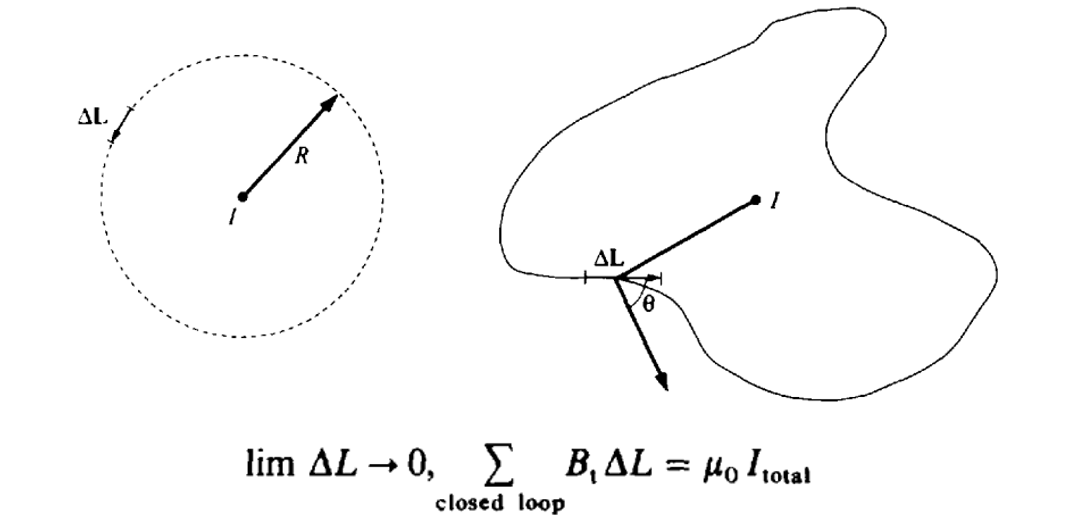
There is a powerful general law relating the magnetic field and the current, which often gives insight into the behavior of the magnetic field, and, in certain circumstances, allows for the compete determination of the field without lengthy calculation. This relationship is given by Ampere’s law.

The line integral of B cos θ ∆L around a closed path equals the total current flowing through the area enclosed by that path. This very important result is Ampere’s law.

COAXIAL CABLE
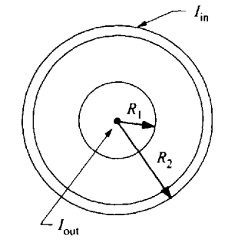
A coaxial cable consists of an inner solid conductor of radius R1, carrying current I out of the paper, and an outer, concentric hollow cylinder, of radius R2, carrying the same current I into the paper, the current being distributed uniformly around the cylinder.

Since the two currents are equal and flow in opposite directions, the field outside the cable is zero.

.

KHTK Factor # 6

Reference: The KHTK Factors

KHTK Factor # 6: The beingness has attention that can roam around, broadened, or focused narrowly.

The beingness, when manifested as a being, is aware and actively manipulating that awareness through postulating. This is also called directing its attention.

The beingness can place its attention on different things physical or mental. Therefore, the attention can roam around and pick things selectively to become aware of.

This attention may be broadened to become aware of a large sphere. The attention may then be focused on parts of that sphere to absorb greater details.

.

Scientology

Compare the above to the following factor in Scientology.

Scientology Factor # 6. The action of a dimension point is reaching and withdrawing.

The whole idea here is that a being can view selectively, or allow itself to be viewed selectively.

.

Logic

The fundamental characteristic of the mind is attention, which it can use to view things broadly or selectively. When attention cannot be controlled, no reasoning is possible.

.

KHTK Factor # 5

Reference: The KHTK Factors

KHTK Factor # 5: The being manifests as space.

Space has to do with distances, extents and dimensions. When there are points to view, or dimension points, there are dimensions and extents. This is space.

There is no empty space, because there must be something with extents and dimensions in order to have space. This something is the substance of postulates. It is also the substance of beings.

Therefore, space represents the primary substance of beings. As beings condense, the space also condenses into energy and matter.

.

Scientology

Compare the above to the following factor in Scientology.

Scientology Factor # 5. Thus there is space created, for the definition of space is: viewpoint of dimension. And the purpose of a dimension point is space and a point of view.

Anything that you view has viewpoint involved. The characteristic of space is “dimension.” Distance is not the only dimensions. There are also the dimensions of color, taste, smell, etc. 

.

Logic

Broadly, space describes all the properties of substance that constitutes the being. These properties can be plotted on dimensional scales.

.