Author Archives: vinaire

I am originally from India. I am settled in United States since 1969. I love mathematics, philosophy and clarity in thinking.

Scientology and the Ultimate Reality

Field2

To understand the essence and scope of a subject one must start with an examination of its basic postulates. To understand how ultimate reality is viewed in Scientology one must examine the following postulates.

  1. Scientology Axiom #1: Life is basically a static. DEFINITION: a life static has no mass, no motion, no wavelength, no location in space or in time. It has the ability to postulate and to perceive.

  2. Scientology Factor #1: Before the beginning was a Cause and the entire purpose of the Cause was the creation of effect.

  3. Scientology Pre-Logics #1: Self-determinism is the common denominator of all life impulses.

Axiom #1 claims that a Life Static has no mass, no motion, no wavelength, no location in space or in time, yet it has the ability to postulate and to perceive. It is Aristotle’s unmoved mover, Factor #1 simply posits the same concept as uncaused cause. Here it is an abstract capability from which all creation pours forth. In religion, we are familiar with this concept as God. Pre-logics #1 puts this capability to be the essence of all human and other beings.

Scientology essentially makes people believe that the characteristics associated with God are within the reach of every individual, and that one can actually achieve the state of Godhood through the processing available in Scientology.

The ultimate reality in Scientology is the attaining of beingness, which hitherto was exclusively associated with God.

Thus, a Scientologist believes that he is creating this universe continually in agreement with everyone else; and to enforce his will he must get everyone to agree with him. He entertains the ideal scene of a being who is cause over “matter, energy, space, time and all life.” In other words, his ideal scene is to act like God.

It is very hard to visualize a universe where everyone is acting like God. Such a universe is going to be highly unstable. To get the universe going, all the Gods must agree with each other. And when that happens then there remains no individual will. It becomes a collective like the Borg species of Star Trek.

The other alternative is for each “God” to postulate and perceive one’s own universe in which one can do whatever one wants. Such a “God” becomes out of touch with the physical universe. The physical universe simply does not exist for such a “God.”

At this moment the effort of the Church of Scientology is to survive as a collective in a physical universe that is unknowingly being created by unenlightened WOGS. The “solution” therefore is to assimilate all WOGS into the collective of Scientology by enlightening them the Scientology way. If this effort fails then the alternative would be for Scientology to get absorbed completely in a self-created universe and become totally dissociated with the “physical universe.” These are the ultimate realities in Scientology caused by the desire to identify oneself with a Godlike beingness that can have its way in spite of matter, energy, space, time and other life.

The source of this reality may be traced back to the theistic view prevalent in Abrahamic religions that God is a being, and that one is created in the image of God. When we take this view literally then the pursuit in Scientology starts to make sense.

In Scientology we see the theistic view being taken literally, and being pursued relentlessly.

Let’s look at the alternate view, where God is not viewed as a “being.” This is the atheistic view of the Eastern religions. In this view, God is seen as a power that underlies all manifestations. God is understood to be like a field similar to an electric or a magnetic field, but much more basic. It is from the condensation of such a field that self emerges. This is the field into which self ultimately dissolves.

In this view of God, there is no individuality that creates anything. Things just come together due to underlying laws. Here the ultimate reality is neti-neti (not this, not that), meaning that there is always something beyond to be understood. All phenomena are relative. Nothing can be pinned down in an absolute sense like the last digit of pi. There is no absolute God like that of the theists.

We can postulate anything but the postulate must be consistent with the existing reality to be real. The reality of the universe cannot be ignored. The thrust should always be to understand the reality, which is the universe. That is the thrust of science.

Spiritual and physical are two different aspects of this universe. These aspects do not exist independent of each other. “God” and the “physical universe” exist together. The physical universe may be looked upon as a form of God; and God may be looked upon as the essence of the physical universe. Scientology veers off this philosophy when it postulates “The origin of MEST lies with theta itself, and that MEST, as we know the physical universe, is a product of theta.” This postulate is not real.

Cause and effect do not exist outside this universe. Cause is as much a part of this universe as the effect. There is no uncaused Cause or unmoved mover. Cause and effect are always associated and should be viewed as a single phenomenon.

My view of God fundamentals is as follows:

Underlying all reality there seems to be a primordial field, which when disturbed by a primordial energy, gives rise to awareness. The undisturbed primordial field is the theoretical ground state for this universe. The primordial energy is what generates disturbance in this field. The disturbance arises as awareness that gradually condenses as self. The outer form of this disturbance is electromagnetism that gradually condenses as matter. Life has the characteristics of both awareness (spirituality) and electromagnetism (physicality).

Can the ultimate reality be ever defined? I believe that the pleasure of defining the ultimate reality more accurately will always be there.

.

MarkNR

Shelley & Me Favorite

Here is Mark in a picture that was taken a few years ago with his daughter. Mark is a scientific thinker. He has been an excellent contributor to Vinaire’s Blog. The recent KHTK Postulates for Physics contain elements of his thinking.

.

KHTK Postulates for Physics – Part 1 (old)

c1

Please see Course on Subject Clearing

The starting postulates for Physics are the same as those for Metaphysics as stated in the reference above.

The theoretical ground state for this universe is inertia-less primordial field, which, when disturbed, gives rise to the electromagnetic phenomenon with inertia. Motion is not infinite because motion is defined by inertia. The universe is kept together only because there is inertia. We can walk only because there is friction. This earth can exist only because there is inertia.

These postulate are as workable as they produces observations consistent with reality. There are no absolute certainties. One can always come up with better postulates.

That is how science makes progress. Einstein declared the speed of light to be a universal constant. This is a certainty for now, but there may possibly be a wider context in which the speed of light is a special case.

.

KHTK Postulate P1: At the physical level the disturbance in the inertia-less primordial field takes the form of undulating electric and magnetic fields of finite frequency, wavelength and period.

The familiar electromagnetic wave is understood to be transverse in nature. It is like the ripples formed on the surface of a pond when a stone is dropped. The particles of water move up and down in a direction perpendicular to the direction of the ripple.

On the other hand, the sound wave formed in air when we speak is longitudinal in nature. It is a pressure wave in which the particles of air move back and forth along the same direction in which the wave propagates.

The transverse wave seems to form at the interface of two different media, such as, between water and air while the longitudinal disturbance seems to form within a single media, such as, within air, or within water. The electromagnetic disturbance, being transverse in nature, seems to require an interface between two different media. We recognize this interface to be formed by electric and magnetic fields.

.

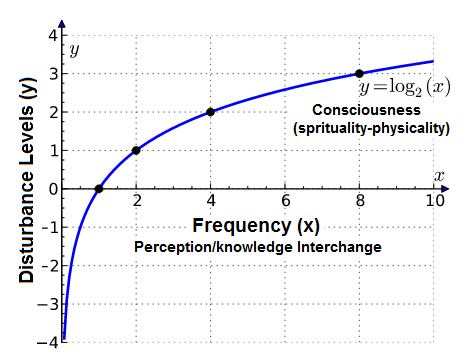
KHTK Postulate P2: Increasing electromagnetic disturbance may be defined in terms of levels of doubling frequency.

These disturbance levels are defined in KHTK Postulate M-5 as DL0, DL1, DL2, etc. The frequency of disturbance level “n” (DLn) is defined as “2n

The disturbance level for visible light may be approximated as DL49 (frequency 249). The disturbance level of radio waves may be approximated as DL27 (frequency 227). And the disturbance level of gamma rays may be approximated at DL65 (frequency 265).

.

KHTK Postulate P3: The basic electromagnetic disturbance determines the characteristics of space, time, and inertia.

The disturbance, as motion, is made up of different states. The idea of different states provides the characteristic called space. The idea of the progression of such states provides the characteristic called time. The idea of structure due to these states provides the characteristic called inertia.

The ideas of space, time and inertia are inherent to disturbance (motion). This may seem counter-intuitive because we observe objects moving in space and time. But the solid objects are at a much higher disturbance levels than the background.

.

KHTK Postulate P4: With increasing disturbance levels, the inertia of disturbance increases.

As frequency of the disturbance increases it provides greater rigidity to its structure, and therefore, the inertia also increases. This inertia is expressed as resistance. A measure of this inertia is provided by permittivity and permeability “of space”.

  • Permittivity is the measure of the resistance that is encountered when forming an electric field in a medium. The permittivity of classical vacuum, or free space, is about 8.85 × 10⁻¹² Farads/meter.
  • Permeability is the measure of the ability of a material to support the formation of a magnetic field within itself. The permeability of classical vacuum, or free space, is about 1.26 ×10⁻⁶ Henries per meter.

.

KHTK Postulate P5: With increasing disturbance levels, space and time condense.

Increasing disturbance levels are accompanied by a shortening of wavelength and period. While increasing frequency indicates greater inertia, the shortening of wavelength and period indicate condensing space and time.

.

Next: 

KHTK Postulates for Physics – Part 2

.


The Disturbance Hypothesis of Light

Yoda

My “disturbance hypothesis of light” is far from complete but it is being egged on with help from some very intelligent friends. The following comment from Mark has helped me flesh out some of the ideas in more coherent form.

Comment from MarkNR

My response:

Yes, there are transverse and longitudinal waves. When you flip a rope, the wave that travels over it is transverse. When you play with a slinky, the wave that travels through it is longitudinal.

The ripples on the surface of water in a pool are of transverse nature. But the sound waves that travel through water or air are of longitudinal nature. The electromagnetic waves are thought to be transverse.

You are right in that a transverse wave seems to be a “surface” phenomenon, whereas, longitudinal wave seems to be a “volume” phenomenon. I never looked at it that way before. But it makes sense.

If electromagnetic waves are transverse in nature then are they traveling at the interface of two very different media? Well, we have electrical and magnetic fields associated with this phenomenon. So, an electromagnetic wave may somehow travel in a medium that easily separates into an electric and a magnetic field.

I have been thinking that the electromagnetic waves are to some degree discrete in nature even at very low frequencies. Let’s call such a discrete wave packet of some arbitrarily number of wavelengths a photon.  In that case, a photon will be very long and snakelike at low frequencies, but it will get shorter and more compact as the wavelengths become shorter at higher frequencies.

At the level of electrons, the frequency within the “photon” is high enough to display mass properties due to its compactness. The electron appears like a particle. But it is still spread over some distance to display appreciable wavelike properties.

At the level of proton, however, the frequency within the “photon” is extremely high to make it appear more like a particle than a wave. Its “spread” is very small. At the level of neutron, I believe that the “photon” becomes still more compact such that the charge property gets converted to mass property completely.

This seems to indicate that there is some relationship between the charge and mass. I am trying to define that relationship in terms of “disturbance levels”. A neutron is a really compact “disturbance”. A proton is less so. And an electron displays still lesser compactness of disturbance. What is being disturbed is a primeval field, which appears as “electromagnetic” upon disturbance.

What you are talking about is the corpuscular theory of light that Newton favored. However, Maxwell’s research supported the wave theory of light. I believe that the truth is somewhere in between. I am trying to express my understanding in terms of “disturbance levels” of a primeval field. Such disturbances appear to be increasingly discrete as they gradually become more compact with increasing frequency.

I am simply postulating a primeval field whose inherent nature is yet to be discovered, but the disturbance of which is “electromagnetic” in nature. A disturbance may be looked in terms of having a frequency even when there is nothing vibrating but only a repeating pattern of disturbance.

The notion of “particle” seems to come from the notion of “spread of disturbance” as it becomes compact. The disturbance levels simply lay out a gradient of this “spread”, which becomes increasingly compact. The more compact this disturbance is the better defined its position is in space as a particle.

Your “puffs of smoke” analogy is very apt. It is a concrete rendition of the abstract patterns of “disturbances in vacuum”. Thank you.

.

Real Numbers

Numbers

Natural numbers are counting numbers. Counting refers to things. Counting starts from 1 and goes “one more” forever.

Whole numbers include the additional idea of “nothing” as the absolute reference point. This reference point exists at the beginning of the number line as zero (0). One may then count forever starting from 0. Thus, whole numbers include natural numbers.

Whole number           =        0 + natural number     (in absolute sense)

Integers include the idea of a relative reference point. This reference point may exist anywhere on the number line. This reference point is also called “zero”, and one counts from this point forever in either direction. Counting to the right is positive. Counting to the left is negative. Thus, integers include whole numbers.

Positive number        =        0 + natural number     (in relative sense)

Negative number      =        0 – natural number     (in relative sense)

Rational numbers fill the gaps between integers on the number line, such as, between 0 and 1, between 1 and 2, etc. These numbers are represented as a ratio of two integers, such as, “1/2”, “2/3”, “7/4”, etc. Rational numbers include all integers. Rational numbers may be represented by decimal numbers that either are recurring or terminate.

Rational number       =        ratio of two integers

Irrational numbers also fill the gaps between integers, but they cannot be represented as ratio of two integers. Example of irrational number is the “circumference to diameter ratio” of a circle. This is known as “π (pi)”. Other examples are square roots of prime numbers, such as, √2, √3, etc. Irrational numbers may be approximated by decimal numbers of any length.

All the above numbers together make up the set of Real Numbers. The squares of real numbers are always positive and never negative. The square roots of negative numbers are represented by Imaginary numbers.

.