
Here are some pictures on Facebook from our recent trip to New Zealand.
 Vinaire's Blog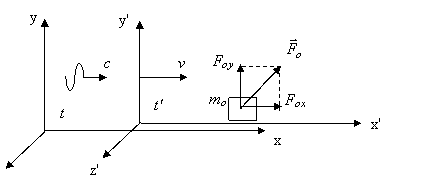
Wikipedia describes the Inertial Frame of Reference as follows:
In physics, an inertial frame of reference… is a frame of reference that describes time and space homogeneously, isotropically, and in a time-independent manner.
All inertial frames are in a state of constant, rectilinear motion with respect to one another; an accelerometer moving with any of them would detect zero acceleration. Measurements in one inertial frame can be converted to measurements in another by a simple transformation (the Galilean transformation in Newtonian physics and the Lorentz transformation in special relativity). In general relativity, in any region small enough for the curvature of spacetime to be negligible, one can find a set of inertial frames that approximately describe that region.
Underlying this frame of reference is the concept of Inertia.
Inertia is the resistance of any physical object to any change in its state of motion (including a change in direction). In other words, it is the tendency of objects to keep moving in a straight line at constant linear velocity. The principle of inertia is one of the fundamental principles of classical physics that are used to describe the motion of objects and how they are affected by applied forces. Inertia comes from the Latin word, iners, meaning idle, sluggish. Inertia is one of the primary manifestations of mass, which is a quantitative property of physical systems…
In common usage the term “inertia” may refer to an object’s “amount of resistance to change in velocity” (which is quantified by its mass), or sometimes to its momentum, depending on the context. The term “inertia” is more properly understood as shorthand for “the principle of inertia” as described by Newton in his First Law of Motion: that an object not subject to any net external force moves at a constant velocity. Thus, an object will continue moving at its current velocity until some force causes its speed or direction to change.
On the surface of the Earth inertia is often masked by the effects of friction and air resistance, both of which tend to decrease the speed of moving objects (commonly to the point of rest), and gravity. This misled classical theorists such as Aristotle, who believed that objects would move only as long as force was applied to them.
Newton called inertia “innate force of matter,” and “power of resisting.” Einstein’s concept of inertia remained unchanged from Newton’s original meaning. But Einstein redefined gravity in terms of a new concept of “curvature” of space-time, instead of the more traditional system of forces understood by Newton.
.
Inertia plays a key role in the KHTK model of Cosmology, as described below:
We seem to see motion occurring in space and time. However, that space and time obtains its characteristics from the ‘disturbance level’ of motion.
The frequency of Disturbance Level 1 (DL1) may be defined arbitrarily as ‘1’. The subsequent Disturbance Levels are then defined by doubling of this frequency (2, 4, 8, 16, 32 and so on). The Disturbance Level ‘n’ shall have a frequency of 2n-1.
The electromagnetic waves may be defined on this Disturbance Scale per their frequency. The radio waves shall appear around DL28 (Disturbance level of 28), the visible light around DL50, and the gamma rays around DL66.
The motions at DL28, DL50 and DL66 shall be different from each other in their fundamental characteristics. Einstein postulated ‘c’ (speed of visible light) as the fundamental characteristic of motion that is universally constant.
However, this model predicts the radio waves to have a speed greater than ‘c’, and the gamma rays to have a speed lower than ‘c’.
Momentum provides an index of inertia. Inertia expresses itself in terms of discreteness. Photons may not have mass but they have momentum and inertia. At much higher disturbance levels inertia seems to manifest itself as mass.
Let’s suppose the disturbance level of a solid object is around DL100. Its fundamental characteristics of motion shall be very different from that of visible light at DL50. Because these two inertial frames of reference are so different, we cannot reasonably compare the speed of light with the speed of solid matter.
.

We assume an electron to be like a Ping-Pong ball. We then apply the Heisenberg’s principle of uncertainty to its location around the nucleus of an atom. This is Quantum reality.
Why can’t we assume an electron be like a piece of wave that extends in space like a snake. Then we can do away with the Heisenberg’s principle of uncertainty. That would fit more with the classical reality.
Einstein was opposed to Quantum reality. He would have preferred this snake analogy for an electron. The following ia a quote from the excellent book EINSTEIN – HIS LIFE AND UNIVERSE by Walter Isaacson, Chapter 20, Quantum Entanglement.
Einstein’s fundamental dispute with the Bohr-Heisenberg crowd over quantum mechanics was not merely about whether God rolled dice or left cats half dead. Nor was it just about causality, locality, or even completeness. It was about reality. Does it exist? More specifically, is it meaningful to speak about a physical reality that exists independently of whatever observations we can make? “At the heart of the problem,” Einstein said of quantum mechanics, “is not so much the question of causality but the question of realism.”
Bohr and his adherents scoffed at the idea that it made sense to talk about what might be beneath the veil of what we can observe. All we can know are the results of our experiments and observations, not some ultimate reality that lies beyond our perceptions.
.
But Einstein seems to be protesting against what he himself contributed to with his idea of photon and his Theory of Relativity.
It seems that quanta of light (photons) shall be packets made up of finite number of wavelengths. In that case, a photon will also be shaped more like a snake than a Ping-Pong ball. If the number of wavelengths per photon is constant then low-energy ELF photons shall be like very long snakes, and high-energy gamma photons shall be like very short snakes. We may then call very long snakes as waves, and very short snakes as particles.
Furthermore, Einstein denied any need of a medium for light. He denied the Newtonian absoluteness of space and time but replaced it by the absoluteness of the speed of light, thus upsetting the reality of classical physics. But Einstein seemed to backtrack from his mathematical reality later in life.
The above quote continues as follows.
Einstein had displayed some elements of this attitude in 1905, back when he was reading Hume and Mach while rejecting such unobservable concepts as absolute space and time. “At that time my mode of thinking was much nearer positivism than it was later on,” he recalled. “My departure from positivism came only when I worked out the general theory of relativity.”
From then on, Einstein increasingly adhered to the belief that there is an objective classical reality. And though there are some consistencies between his early and late thinking, he admitted freely that, at least in his own mind, his realism represented a move away from his earlier Machian empiricism. “This credo,” he said, “does not correspond with the point of view I held in younger years.” As the historian Gerald Holton notes, “For a scientist to change his philosophical beliefs so fundamentally is rare.”
Einstein’s concept of realism had three main components:
1. His belief that a reality exists independent of our ability to observe it. As he put it in his autobiographical notes: “Physics is an attempt conceptually to grasp reality as it is thought independently of its being observed. In this sense one speaks of ‘physical reality.’ ”
2. His belief in separability and locality. In other words, objects are located at certain points in spacetime, and this separability is part of what defines them. “If one abandons the assumption that what exists in different parts of space has its own independent, real existence, then I simply cannot see what it is that physics is supposed to describe,” he declared to Max Born.
3. His belief in strict causality, which implies certainty and classical determinism. The idea that probabilities play a role in reality was as disconcerting to him as the idea that our observations might play a role in collapsing those probabilities. “Some physicists, among them myself, cannot believe,” he said, “that we must accept the view that events in nature are analogous to a game of chance.”
.
What happened in 1905 was that mathematical reality replaced physical reality starting with the Theory of Relativity. This has continued with Quantum Mechanics even to this date. The article The Philosophy of Cosmology attempts to reverse this trend and reestablish the realism of physical reality.
.

.
.
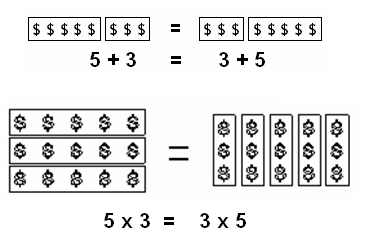
The Commutative Property applies to addition as follows:
Note that 0 (zero) is the neutral element for addition. The operation of plus appears for 5 when 0 is placed in front of it. It does not change the meaning. The commutative property is applied by rearranging the number with its operation. We note that plus for addition is also omitted when 0 is omitted.
.
The Commutative Property applies to subtraction as follows:
Note that 0 (zero) is the neutral element for subtraction as well, because addition and subtraction are opposite of each other. The commutative property is applied by rearranging the number with its operation. Therefore, 3 is moved with its minus operation. When 0 is removed, the ‘minus’ becomes a ‘negative’ sign.
.
The Commutative Property applies to multiplication as follows:
Note that 1 (one) is the neutral element for multiplication. The operation of multiplication appears for 6 when 1 is placed in front of it. It does not change the meaning. The commutative property is applied by rearranging the number with its operation. We note that multiplication sign is also omitted when 1 is omitted.
.
The Commutative Property applies to division as follows:
Note that 1 (one) is the neutral element for division as well, because multiplication and division are opposite of each other. The commutative property is applied by rearranging the number with its operation. Therefore, 2 is moved with its division operation. 1 divided by 2 becomes the fraction half.
.
