Author Archives: vinaire

I am originally from India. I am settled in United States since 1969. I love mathematics, philosophy and clarity in thinking.

Mindful Meditation

Looking


The whole idea of Mindful Meditations is to apply mindfulness to selected areas of the mind. This is done after immediate unwanted conditions are handled per Mindfulness Therapy.

In “mindful meditation” one applies the discipline of mindfulness as follows.

1.    Observe without getting influenced by your expectations and desire for answers.

2.    Observe things as they are, without assuming anything.

3.    If something is missing do not imagine something else in its place.

4.    If something does not make sense then do not explain it away.

5.    Use physical senses as well as mental sense to observe.

6.    Let the mind un-stack itself.

7.    Experience fully what is there.

8.    Do not suppress anything.

9.    Associate data freely.

10.  Do not get hung up on name and form.

11.  Contemplate thoughtfully.

12.  Let it all be effortless.

.

In “mindful meditation” one looks at whatever appears in the mind in response to the meditation directive. See Memory Recall.

A good example of mindful meditation directive is provided in Rightness.

LOOKING is not thinking. In looking, one simply recognizes what is there. There is no effort to associate data or visualize the answer.

LOOKING includes the recognition of the fact that there might not be any response at all.

LOOKING includes becoming aware of all perceptions and not just visual.

LOOKING is not suppressing anything. In looking, one is being totally honest with oneself.

LOOKING at feelings, emotions and sensations simply means that you fully experience them without resisting.

LOOKING is totally non-judgmental. Any judgment belongs to the activity of thinking.

Basically, one is looking at things in the physical environment or in the mind. One is noticing them for what they are, without calling them by name, judging them, or trying to figure them out.

The purpose of looking is to get accurate input, which may then be used for closer examination.

It is the suppression of perceptions, memories, knowledge, thoughts, visualizations, etc., that causes all difficulties in life. This suppression may be addressed effectively by letting the mind un-stack itself through patient looking.

When one is looking for resolution in an area, the first action is to get rid of all suppression by letting the mind un-stack itself naturally, and not dig into the mind. With all relevant data there, the resolution is swift and effortless.

LOOKING by its nature is totally effortless. If there is any effort it comes from thinking on top of suppressed data.

Mindful meditation may quickly un-stack available responses to several meditation directives in a short time. This is OK. Such directive may become alive again at a later time and used again in meditation.

There are hundreds of meditation directives that may be obtained from Scientology. Choose those that immediately seem to produce some response. Then explore them as long as there un-stacking occurring in the mind.

The idea is to keep un-stacking the mind. If it provides a sudden relief at some point then that is just an added bonus.

.
Journey Of Man; A Genetic Odyssey!


.
Have you seen the amazing National Geographic documentary, The Journey of Man? The researcher is Dr. Spencer Wells.
.

A Model of Mind

self

Reference: A Model of Self

The Universe begins as it emerges from non-awareness into awareness. It may appear at first as a vast field of awareness having the form of light. The physical universe evolves within this universal field of awareness. The perception of the physical universe agrees from person to person. This is like personal minds sharing this field of awareness, or universal mind.

The personal minds seem to exist within a vast field of awareness, or universal mind.

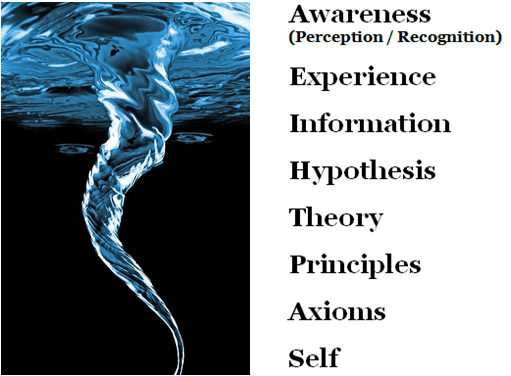
The personal mind seems to be produced by the condensation of awareness at locations within this vast field. This condensation is postulated to comprise of various stages as shown in the whirlpool model above.

The mind begins with awareness. Awareness consists of perception and recognition. According to Wikipedia, the process of perception involves the following steps:

  1. Body’s sensory organs are incited by means of light, sound or another physical process.
  2. These sensory organs transform the input energy into neural activity.
  3. These neural signals are transmitted to the brain.
  4. The brain organizes and interprets the signals.
  5. This creates awareness or understanding of the environment.

But the various elements of this process are themselves perceived in a way. Therefore, it is not quite definitive how we perceive and recognize things

We perceive only what awareness tells us through the mind.

.

As soon as perceptions are recognized, they become experience. Over time experience condenses as information. Experience and information seems to be stored in a very efficiently organized matrix constructed out of definitions and logics. It seems to have the form of an electromagnetic field supported by macromolecules and neurons in the body.

A matrix constructed out of definitions and logics seems to form the core of the mind.

From information the mind generates hypotheses. Certain hypotheses get confirmed as theories and can be relied upon for prediction. Hypotheses and theories help associate data in the mind.

Hypotheses and theories seem to aid the computation that occurs within the mind.

This leads to the generation of wider principles, which provide directions to thinking. Principles are followed by axioms, which are taken for granted to be true when one thinks.

Principles and axioms seem to provide the basis on which the mind operates.

Finally, there is self that represents the uniqueness of the mind. This is the final form of condensed awareness at a location in the field of awareness of the universal mind.

The uniqueness of the mind appears as Self.

.

The objectivity of awareness is determined by the basic field of awareness of the universal mind. Thus, the uncompressed awareness at the point of perception is the most objective in nature. When this perception is condensed as experience and information from some unique perspective of the mind it becomes subjective.

The awareness consistent with the universal field of awareness is the most objective in nature.

The awareness becomes more subjective as it is condensed through various stages of the mind in its unique way. The end product of that condensation is self, which is regarded as a unique individuality.

The most subjective form of awareness is the unique individuality of the self.

The reality is made of the objective awareness at the level of the universal mind. The subjective awareness of self then appears to be as real as it is consistent and coherent with the universal mind.

.

The minds are thus constructed out of condensations of awareness at various locations within the universal mind. The uniqueness of condensation is the self that is recognized by its individuality.

Mind relates the condensation from simple universal awareness to the complex self.

The simple and vast universal mind has the form of light. The unique and complex self has the form of the human body. Spirit and matter occur together as essence and form at every point of condensation.

Matter provides form to spirit, and spirit provides essence to matter.

.

As a summary of this model.

(1) Mind is a multi-dimensional matrix of definitions and logic.

(2) Self is the most condensed expression of the mind.

Also please refer to A Model of Self.

.

A Model of Self

Amsterdam 2008

BRAHMA (Vedas) – A postulated ground state that is beyond definition  or awareness.

GOD (Christianity) – A postulated Supreme Self to explain the appearance of existence

STATIC (Scientology) – A postulated Unmoved Mover that stands separate from the Universe.

GROUND STATE – The ground state has no awareness and no definition. The definition comes with awareness.

AWARENESS – Awareness is postulated to be the disturbance of ground state. It provides a definition. Awareness, as a disturbance, oscillates between perceiving and recognizing.

CONSCIOUSNESS – This is the awareness of the formed definition and properties. The physical form of consciousness is light. It has a frequency, wave-length and period. Consciousness is the divine principle that is fundamental to all existence.

SELF – Self is the definition or properties that arise. As frequency of consciousness increases, more and more definition comes about. The structures known as mind and ego are aspects of self at high frequencies. See A Model of Mind.

.

This seems to be a broad model of self.

  1. A self is a node in a very large matrix of selves in which communication flows.
  2. Each self is a compressed matrix of “definitions” (defined datums) among which logic flows.
  3. A communication particle arrives at the self and activates the flow of logic inside it.
  4. The logic flows through the complex matrix of definitions inside the self.
  5. These definitions are cross-indexed in a fantastically efficient way.
  6. This cross-indexing generates the framework of logic.
  7. The flow of logic consists of the sequences in which these relationships are activated.
  8. A score is kept in terms of the summation of the vectors of activated relationships.
  9. The final resultant vector is shaped into a communication particle.
  10. This communication particle is spitted out by the self.

We can probably make an animation out of the above model. This is a reality-centric model. There are an incredibly large numbers of variables here. How and in what sequence they could be activated provides an incredibly large number of choices for logic to flow. Here may lie the secret of “I”, “will” and “intention.”

This model may develop further.

Guide in KHTK

Affinity

In KHTK, a guide is one who helps another apply KHTK exercises. He may be a partner or a friend who is also interested in doing KHTK exercises. The two may do the exercises together encouraging and guiding each other.

All that is required of a guide is

  • Apply mindfulness at all times
  • Be familiar with KHTK exercises
  • Have compassion for all

The first thing that a guide helps another with is the application of mindfulness. He encourages the other person to think for himself, or herself, and practice mindfulness exercises per The 12 Aspects of Mindfulness

.

The guide recommends the correct KHTK exercise for the other person to work on, giving his reason. He provides factual information with no inconsistencies.

The person needn’t give to the guide any personal details of what he looked at during the exercise. The guide does not analyze a person’s data and give advice.

If the guide is told something he makes sure that he understands it. He responds only in terms of sorting out difficulties with the application of the 12 aspects of mindfulness.

The guide encourages the person to come up with creative ways to look at the area of interest more closely.

If the person’s attention is fixed or dispersed, the guide helps restore it to optimum with proper KHTK exercises.

Almost all exercises in KHTK may be applied by oneself. The guide simply encourages and aids as needed.

The guide does not challenge what the other person is doing. He simply helps the person understand the exercise.

The guide also aids in the development of the subject of KHTK based on his, or her, actual experience.

The guide offers his services as possible for him, and without fee. The compensation, if any, for the services may only be determined by the person helped.