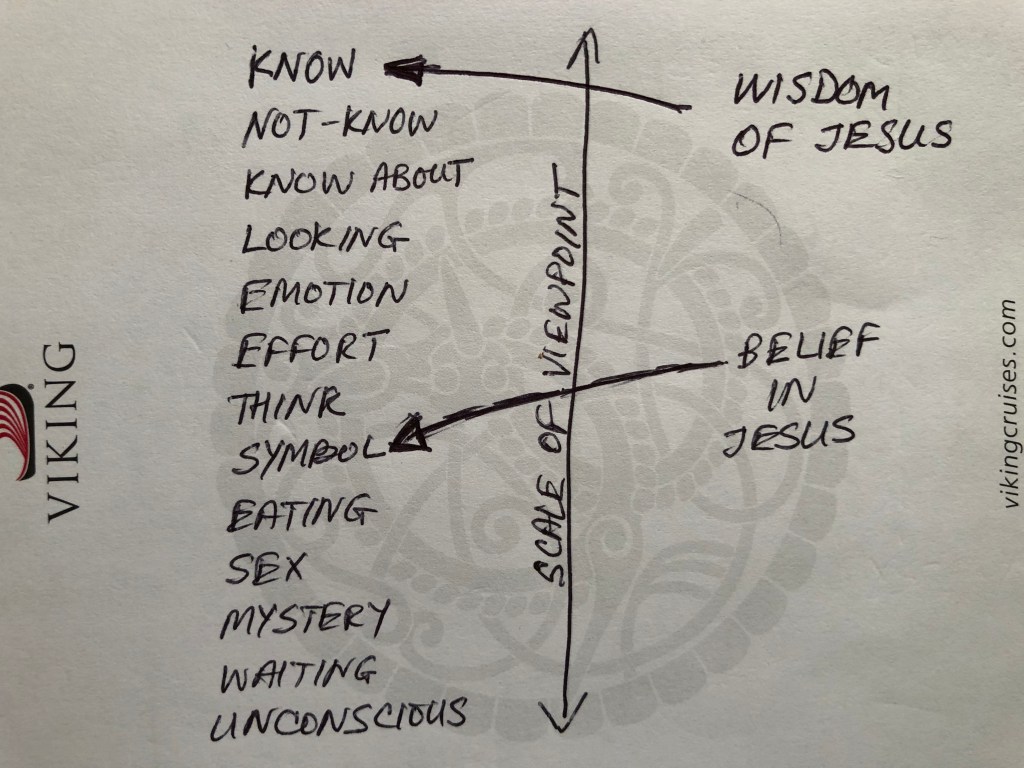
Author Archives: vinaire

I am originally from India. I am settled in United States since 1969. I love mathematics, philosophy and clarity in thinking.

PHOENIX LECTURES: Chapter 7

Project: Hubbard 1954: The Phoenix Lectures

This paper presents Chapter 7 from the book THE PHOENIX LECTURES by L. RON HUBBARD. The contents are from the original publication of this book by The Church of Scientology (1954).

The paragraphs of the original material (in black) are accompanied by brief comments (in color) based on the understanding from Buddhism.  Feedback on these comments is always appreciated.

.

THE FOUR CONDITIONS OF EXISTENCE (Part 1)

All we need to know about existence is that it is. Whatever complexity it has, it still is. It isn’t ever was, which is a most interesting thing about this particular nomenclature. There isn’t any will-be-ness and there is no was-ness. There is simply Is-ness. Speak about existence, and people spontaneously add to it will-be-ness and was-ness. So existence is not the word we want. We want the word Is-ness. We want just the word we’re using. We want that which is.

The Dhyana makes the error of “beginningless and endless time” but that’s not really an error. Probably it is an error as far as the translation of the symbols is concerned. We don’t know that the symbols that were used by Gautama to describe this manifestation add up into English as beginningless and endless time. We’ve already crossed one language jump and so we know that much less of what he was actually saying. But it was an interesting thing that you could represent this by a continuous line which joined itself. Any kind of a complexity of circle, in other words, would represent the fact that we had a beginningless and endless somethingness.

Now, that is too complicated an explanation. In view of the fact that time depends upon a postulate you could say, yes, it is beginningless and endless. You could say as well that it is linear. You could say, as well, that it is continuous. You could say as well that it is Eastern Standard, or Sidereal — it doesn’t matter now how you qualify it, having once made the postulate, you can then go on making further postulates. Nobody is going to limit anybody in making postulates.

The existence is simply IS-NESS. It is never “was-ness” or “will-be-ness”. Time represents the enduring of energy. Therefore, “beginningless and endless time” actually means “beginningless and endless energy.” It means that the universe can neither be as-ised nor not-ised to nothing. This is also expressed the law of conservation of energy. The basic postulate here is energy and not time as Hubbard assumes. Please note that matter is simply a condensed form of energy.

But there happens to be, strangely enough, a true flying back of time. Time is a postulate. It doesn’t even have to be agreed on. You could have a time span all by yourself. You could shut your eyes and say, “and now I’ve sat here for a million years”. “In the next two seconds”, you could say, “I’m going to sit here for a million years”.

There’s nothing unheard of about this — that’s real time. Don’t be too baffled if you dream for five seconds about a five-hour time span. You’ve just re-postulated some time, that’s all.

Unless you continue to postulate time, you haven’t got any. And that’s the first and foremost thing you can know about time. That fellow who depends on a clock up there to move time for him, is going to get in trouble sooner or later. He’s going to get, “stuck on the track”, and “out of pace with his fellow man”, because he’s depending upon their agreement on time to give him time. The only way he can have time is to continue to postulate time.

A dream does not have to be consistent with reality. But a postulate that describes reality must be consistent with reality. IS-NESS is made up of all shades of duration of energy. Therefore, when we span attention over the whole IS-NESS, there is no past or future. You have time as the duration of energy, but you may not have the energy you want. You have to postulate energy to have time.

One of the roughest things that you will discover with anybody who is having trouble with his case is to have him put something on the future time track. He’ll look at that and say, “OH NO!” You say to someone, “Let’s make an appointment. Let’s make it at 2.05 this afternoon”. Oh no. That’s upsetting. That’s why when you talk to somebody on the street, you don’t tell him to come around to “see you later at your office”. You’ve undoubtedly picked up somebody who has attention on the subject of postulating time. The thing for you to do is take him right over to your office right now, if you possibly can. Don’t put something on the future time track for him any more than you can help, because the person here who is really in difficulty, who has all the usual human difficulties, psychosomatic ills and so forth, has stopped postulating time. And the moment he stops postulating time, he doesn’t have any.

Now, how much time has the fellow got and how much time is he rushing and how much time is he sitting still with — all these questions are very interesting except that it all depends on just this one fact: your individual is or is not postulating time for himself.

Looking over a very busy career I can see definitely the speed factor of composition as derived from strictly one postulate. I used to write about 100,000 words a month by writing three hours a day three days a week. Now, that’s a lot of words, but it never occurred to me that it was a lot of words. If you simply postulate that there’s that much action and it can fit into that much time, you have postulated the time. There’s nobody sitting there agreeing with you or disagreeing with you. Actually, you’re just walking free. Well, one might as well postulate eight million words in one hour per month. This was just saying how much physical universe time could be allocated to the time span which I was using in which to compose. You get that as a difference.

Let’s take somebody doing a job of work — you will find something very, very peculiar. You find somebody who is working like mad, he’s just working, working, working, he’s just got to get it all done got to get it all done — and the end of the day comes, and he’s got nothing done. It’s all in a confusion. He was awfully busy all day, but nothing happened.

And the next day he goes out and he’s so busy, he’s just got to do this, and he’s got to do that, and eventually you find him just sitting still, presenting a very funny and silly picture. He’s sitting still, not even moving, not even talking, not even writing, accomplishing absolutely nothing, and now he is telling you how awfully busy he is and how he hasn’t got any time and he’ll eventually collapse down to the point where he has no time of any kind whatsoever to employ on anything, and that’s why he’s sitting there. But that is perfectly reasonable to him. That’s perfectly reasonable.

He’ll get so that he can’t start anything. He has no time in which to start it, much less to finish it. So he starts in originally by saying, Well, I haven’t got time to finish it, then, I haven’t got time to do it well, then, I haven’t got time to do it, then, I haven’t even got time to start it. Then finally, I can’t think about doing it.

Putting something on the future time track is postulating certain energy and condensing it into reality. A writer is doing this when he is writing a long novel in a short span of mechanical (physical) time. When a person looks very busy and nothing is getting done, he is just running around in confusion. He is in figure-figure about how to postulate energy and put it in reality.

And that’s what happens to a person’s doingness. It’s his ability to postulate the amount of time, and the only confusion that you get into about this is the fact that we have an agreed upon time span.

But you might recognize that the time for an entire nation and an entire earth could thereby go awry.

How much can you do in an hour? What’s an hour? An hour is the length of time it takes for the sun to move fifteen degrees in the sky. Now the sun isn’t doing anything. What’s this co-ordination?

When a country can still postulate time or a world can still postulate time, then an hour would be a tremendous amount of doingness. They would have a festival at sunrise and a couple of games, and then along about noon, why, have a feast, and that leaves them all afternoon, that leaves them all afternoon completely empty and that would be a good time to go boating, and then they would have time to practice up for the dance they were giving that night. And then they would finish up about midnight and say, my, what an idle day! This is the amount of time they could postulate in terms of doingness. Do we have time to do it, or don’t we? That is the question.

It all boils down to postulating energy and condensing it into reality (within a mechanical time span) that produces the real sense of time. A person who is operating mechanically on fixed beliefs is not postulating fresh thoughts and putting them into action. He is not making any spiritual progress. He is stuck in time. This can happen to a whole group, or a whole nation.

Now in view of the fact that time itself is merely a postulate this is very simple to understand. If it’s a postulate — does it have an anatomy as such? Well, yes — it’s a complexity of postulates, the way you look at it in this particular universe at this time, but not really very complex. Time depends on change. In order to have time, you have to alter things, because Is-ness has a condition following it called Alter-is-ness — which has to take place for something to persist. This is the way the postulates have gone together which make up this universe — not the theoretical way in which they could go together to make up a universe.

Get these as different things. You could go about this just all out in an entirely different fashion and postulate time and still have time, but it would not necessarily be the postulates which were made, and are made, and are in this universe right here and now. It wouldn’t necessarily be the same set of postulates, if we suddenly just dreamed it up.

Mechanical clock time depends on mechanical changes. In order to have a real sense of time of making progress you have to change things by postulating energy and condensing them into reality. When we are as-is-ing we are postulating energy. When we are alter-is-ing and not-is-ing we are letting conditioning take over.

So, we have to subject the postulates of time to a little subjective proof and get ourselves a test on it. And we find that we can make things persist by changing them. If we keep on changing something and change it and change it and change it and change it we’re getting persistence. But actually, what we’re doing is postulating the time for it to persist in.

And when an individual has stopped postulating time, he has stopped perceiving. Perception and the postulate of time are identical phenomena. Perception and postulation are the same thing here.

You should recognize, in auditing, very clearly, that time is a postulate. When you are working with a preclear who is having difficulty perceiving, you know that there is something wrong with the time postulate. Therefore, there is something wrong with change.

Underlying mechanical change, we have conditioning. Things simply persist in a fixed manner. Real changes occur when one is continually postulating energy. Things then persist as they are postulated. But any postulation of fresh energy must be consistent with earlier postulations of energy.

Alter-is-ness is that part of the time postulate which we can most evenly and closely observe. And we find that changing things brings time into being. It causes a persistence and the mechanism of Alter-is-ness gives us a perception of time.

In alter-is-ness the changes are rather mechanical. They are like the changes in the position of the hand of a clock, or the changes in the position of Earth around the Sun. They are like the continuation of a lie. Therefore, the mechanical time is continuation of the duration of energy that is otherwise fixed.

We find that somebody who is in a state where he believes he is about to perish will then try to change everything in his vicinity, right up to the point where he knows certainly that he is perishing, at which moment he will simply succumb, bang, and he will cease to exist or persist as that particular individuality and he as himself without that individuality will proceed on and pick up another body.

We get the tremendous amount of change or accomplishment which has to take place immediately before death. Here we have people all around the place who aren’t doing anything. Their affairs are in horrible condition.

If we were to carry a little black bag and a stethoscope (that’s the Badge of Office — a little black bag and a stethoscope. One doesn’t quite know what they do with the stethoscope but it’s interesting. It won’t detect even whether a person is dead or not. A stethoscope is actually a reactive dramatization of the Serpent of Caduceus) and we walk up to somebody and say, “My dear fellow I must inform you,” having tapped the stethoscope against his chest so he knows he’s being hit by a snake, “I must inform you that we have just learned through this diagnosis that you only have three months to live.” The odd thing about this is that you would see a busy man promptly. He’ll really get busy. He’ll sit down in a slump for a moment or two. That’s just the impact. And then he’ll say, Let’s see. Time. Time. Oh. Alter-is-ness, Alter-is-ness, Alter-is-ness, Alter-is-ness, Alter-is-ness, change, change, got to get my will straight, got to get this straight, got to get that straight, got to get Mary moved out of that house into the other house I’m having built. Gotta have this and that, and the months go by and the years go by and he’s still alive.

Well, he’d say the doctor was wrong. No, the doctor wasn’t wrong, as of the conditions of that moment, the experience of the doctor demonstrated to him that people who had this illness (who had not been told that they had only three months to live) died in three months. What he’s left out of it is the factor on people who have been told they only have three months to live. You tell somebody that he has only three months to live and he will throw into gear the only mechanism available to him to cause persistence in this universe. And that is Alter-is-ness. And he would change, change, change. He right away has to change his condition. That is the first thing he thinks of. One might think that it is just natural that he would do that. No. We’re talking on a higher echelon of philosophy. You tell him he’s only got three months to live, this is an unacceptable fact to him you say, therefore he’s got to change his condition. No — worse than that. Worse than that. If he has no time persistence, he has to change his condition. The one thing he can do from which he can gain persistence is Alter-is-ness.

When a person believes he is about to perish he will try to change everything in his vicinity to get the feeling of persistence. There is a tremendous amount of accomplishment at this point. When he perishes, he simply ceases to exist as that individuality. His atoms, molecules and energy particles may continue.

If he would simply change the furniture around in his office because he can do that successfully, he’d live a little longer. It’s unsuccessful changes which fixate a person and cause a Not-is-ness to occur. Now unsuccessful and successful are themselves postulates. “I am this individual and this individual is supposed to persist” versus “I am this individual and this individual is not supposed to persist”. You could make up your postulate that way just as well as the other way.

But the accepted chain of considerations which go to make up, for example, art criticism, appreciation, win-lose and so on — we just have a set of considerations. These changes are successful as long as the individual is doing it, and the changes are unsuccessful as long as somebody or something else is doing it. And that’s very much part of the win-lose factor and also of the time factor. That’s self-determinism. One merely has made the postulate that as long as one does it one is successful. As long as one is able to accomplish the postulate this makes up wins. I am now going to pick up my right finger. I pick up my right finger. I won. That is, I made the postulate good.

What has happened to the preclear is that he has made the postulate and then something has contraried [opposed] the postulate to such a degree that he is fixed. He is fixed and cannot change.

Changes that a person makes are successful in making him persist when he is postulating energy to make time. But when changes are simply being made mechanically without energy being postulated, then such changes are unsuccessful in making the individual persist.

It just works out that way in this universe — not necessarily the most optimum set-up that could be made. When you made a postulate and then didn’t accomplish the goal postulated in that postulate (remember you were postulating time to postulate a goal) when you were unable to reach that particular attainment, then, of course, you hadn’t changed anything.

Time is made by changing the position of something in space and so we get all of the neutrons and the morons vibrating at a vast rate of speed, but a uniform rate of speed, changing their positions in space. Well then, we can look around at several of these particles such as the sun, earth and other things, see that they’re changing their relationships to each other in space at a uniform rate, and having perceived this, why then of course, we are looking at a change in time.

There is no such commodity as time, it isn’t anything that could be poured from one bucket to the other but then this does not take place until a postulate is made concerning it. And in this universe the postulate had to do with change of location in space. And when it occurred, then time occurred.

There is mechanical change that leads to mechanical time, and then there is the change that a person decides to make and accomplishes it. This gives the person time that is postulated into existence. Time is duration or persistence of energy.

You could change — the location of something in space simply by lying about it. And you’d get a persistence. You’d come off of the As-is-ness. The moment you change something’s location in space you come away from As-is-ness and it doesn’t unmock and so you get persistence.

The moment you come off As-is-ness, what you are saying is something different than what is. This is a change (lie), and that change shall now persist. Thus, there is time postulated.

Now an individual is as well off as he can change things in location in space. Looking at the Pre-Logics, which precede the Logics and Axioms of Dianetics, we find that they have to do with an energy, and they tell you that a thetan is an energy-space production unit, that a thetan can change objects in location in space, and right next to that we have the fact that a thetan can create objects to change in space of his own creation. In other words, he can do all of these things and we get, in this universe (and this is pretty common in universes) those postulates as the conditional postulates upon the universe. Then one makes another postulate, that something can persist, and this postulate is represented as time, so when we locate something in space, we are actually working with the time postulate. Persistence.

Change in space means change in the extents of energy, for space represents the extents of energy. Hubbard postulates “thetan” as the cause of change, but all we know is that there is a change beyond conditioning. It is the universe changing on its own. This is the spiritual characteristic as opposed to the conditioned (mechanical) characteristic.

Hubbard separates spiritual and mechanical characteristics, which is typical of western philosophy. But per Eastern philosophy, spiritual/mechanical characteristics are integrated in the universe. It is the universe that is changing itself. That change is persisting as evolution.

If you observe that somebody has failed often, then what do you mean by failed? He has decided to move something in space and then hasn’t. In this universe, that’s the total anatomy of failure. Of course, he could simply postulate that he’d fail and that’s another anatomy of failure. He’s always free to do that. You can yourself do that. Not to remedy anything as an auditing procedure or anything of the sort — just simply say to yourself that you failed, for any cause, reason or anything else, just, “I failed and therefore I have to feel a certain way” and then feel that way.

A person represents that part of the universe that is trying to evolve. He may or may not succeed in making a change beyond the conditioned change.

You could do that, or you could simply postulate, I’ve won, I’ve not won something, just postulate that you’ve won, and the conditions of winning are feeling good, which is part of the woof and warp of postulates, “And therefore I feel good” — giving you a reason to feel good. Why don’t you just postulate that you feel good?

You cannot just make an arbitrary change. Any change you make must continue the evolution that has taken place; it must be in harmony with what exists; and it must not generate an inconsistency. That is the law of evolution.

It doesn’t matter whether you are a winner, doing this. There is no sensible concatenation here, we are only talking about an agreed upon concatenation. This universe, and the postulates which formed it, is not necessarily the best universe that could be made. It just happens to be the universe we’re sitting in and it happens to be the universe in which our postulates are being made and unmade and it just happens that it went together on these four conditions of As-is-ness, Alter-is-ness, Is-ness and Not-is-ness, and these four conditions woven together make this universe act as it does and behave as it does and give you ideas of what a win is and what a lose is and it’s all on a postulate basis.

You may postulate anything, but it may not necessarily be consistent with the environment around you. To make it consistent you’ll have to change the environment too, otherwise, you are simply conditioning your mind. It is like self-hypnotism.

But the most curious manifestation in all of this is the manifestation of time, and we have this matter of time occupying a considerable part of the field of aberration. And that is because time is the one postulate when an individual begins to depend on other determinisms more than any other.

Time represents what is persisting. And what is persisting is either an actual evolution of knowledge or a conditioned (deluded) mind. In other words, you are either going up the Know-to-Mystery scale, or you are going down.

We see the sun moving and we take our cue from the sun as to how much time we have. We see clocks moving and we take our cue from them as to how much time we have. And that tells us how much persistence we have. So, we’re being told by these objects whether we can live or not. And that’s just the most curious of things in this universe, that one would take his cue as to whether or not he was going to persist, from whether or not the sun moved a certain direction and distance. It’s idiotic. So, the sun did a figure eight. If I’m not dependent upon sunlight I am certainly not going to cease to live just because of the sun. And a thetan is not dependent upon sunlight. Quite the contrary, a thetan is dependent for his well-being on manufacturing his own jolly old energy. He’s not dependent on the sun manufacturing his energy for him. That’s just an intricate hook-together. And that again depends on postulates.

To reflect sanity, any postulate you make must be continuous, harmonious and consistent with the universe that exists.

The postulate of time could be simply cleanly made, in some universe, saying “Well, there will now be a continuance for one and all”, and that would be that. But that wasn’t the way it was made in this universe. It was made on the basis that when As-is-ness is postulated, in order to get a persistence, we have to practice Alter-is-ness. We have to change the location of something to get a persistence.

Hubbard is trying to separate the abstract notion of persistence from whatever is persisting. The abstract notion of persistence is TIME. What is persisting is ENERGY.  You cannot have TIME without first postulating ENERGY. It is like trying to separate the abstract notion of GOD from the UNIVERSE that is being abstracted. You cannot have GOD without first postulating the UNIVERSE.

People get inverted on this in this universe, so that they take an Is-ness and they change it in location, and it starts disappearing. Suppose you have a person move a postulate around with a mass of energy. He starts moving it around — and the energy mass starts disappearing. But what started disappearing was the energy mass, wasn’t it? It was not the postulate, particularly. He just got used to that postulate and he finally took it over as his own postulate. And a person could finally say, well if I move something around, it will disappear. He has made a counter-postulate.

He is perfectly at liberty to make a counter postulate, but this is not the postulate on which this universe is made. This universe is rigged so that that postulate will avail not, to an individual. That’s part of the considerations that make it up. If you’ve got something and then you say it doesn’t exist — you’re stuck with it. That’s this universe.

Hubbard is basically talking about conditioned thinking versus creative thinking, which refers to different views of time. Conditioned thinking is operating on mechanical alter-is that is fixated attention. Creative thinking operates on “seeing things as they are” basis of As-is-ness. Here the attention is free.

Alter-is-ness produces a persistence, but then we get two types of persistence. We get persistence as Is-ness and we get a persistence as Not-is-ness. The fellow is persisting, but he doesn’t want to be there. Well, he’s persisting because he doesn’t want to be there. This, too, is a change, although he’s fixed in a locale. And secondly there is the fellow who is persisting because he wants to be there and he’s persisting because of change. They’re both Alter-is- nesses. An individual’s desire to change continues his persistence in the spot he’s in, if he continues his persistence in the spot he’s in, if he cannot move. But he had to postulate that he couldn’t move before this could happen. And so, we get the dwindling spiral of the MEST universe.

Hubbard is sounding abstruse here because he does not see that As-is-ness also brings about a change, but that change is opposite in direction to the change brought about by Alter-is-ness. Hubbard is looking at As-is-ness as complete disappearance, rather than disappearance (of misinterpretations) on a gradient.

We sometimes see the manifestation of accumulating energy on a preclear. Every time a preclear has said, Now I am going to move, and hasn’t moved, or has said, Now I am moving and I am going to continue moving, and he is stopped (walking down the street, walks into a lamp post) — any time this has occurred, he has lost, which is to say, he has got a counter-postulate. So, he adds up loss as stationary.

Failure occurs when one is unable to postulate energy and condense it into reality.

This universe, you see, brands everything which isn’t moving as innocent. And things that are moving are guilty, always. So, he’s lost. Well how do you lose, then? By getting fixed in a location. That’s how you lose. An individual who is unable to move objects out of a certain location eventually gets to a position where, when he is trying to move these objects out of this location, he recognizes a failure and so he goes into apathy. He says, “I don’t have enough energy to do this”.

Then the person goes into apathy and stops postulating.

What nonsense! If he doesn’t have energy enough to move energy, why doesn’t he just postulate it someplace else? But that’s another thing. He could say it is as it is and it would disappear and then he could postulate its existence somewhere else, and then change that around so it couldn’t be disappeared again, and he’d be all set. What’s he doing picking things up?

Hubbard is ignoring the fact that postulation of energy needs to be condensed into realty, otherwise, it reduces to a mere mental game.

A drill — simply in moving things and putting them back in the same place again — will resolve this consistent continuous failure and so you get a process such as Opening Procedure by Duplication and its tremendous effectiveness. If it is done with a little bit heavier objects than is ordinary then an individual recognizes very thoroughly that he can pick up and put back into place the same object and win, not fail. You’ve changed the basic postulate by which he is working in this universe, which is saying that if he can’t move, and that he has failed.

When a person decides to do something but is stopped from doing it, he is stuck with an incomplete cycle of action. The person gets fixated on that cycle and goes into apathy. Opening Procedure by Duplication teaches a person that one can come out of fixation by moving things and putting them back in the same place again. In other words, he can disengage, regroup and try again.

However, that may be, we have these various conditions and the immediate point here is that time depends, in this universe, on Alter-is-ness. At least the desire to change. Anybody who is desiring to change is persisting in time, and people who do not want to change do not persist in time. The whole universe is rigged around these postulates.

Time simple equates with persistence. The change, which is made, persists. That change can be negative (alter-is-ness), or it can be positive (as-is-ness).

.

FINAL COMMENTS

In this chapter Hubbard is talking about change and persistence. Once a change is made, it persists over what was there before. We observe this persistence as time. This is the IS-NESS of the universe. The IS-NESS is always persisting. The ancients mention it as “beginningless and endless time”. IS-NESS is made up of all shades of duration of energy. Therefore, when we span attention over the whole IS-NESS, there is no past or future.

Postulating fresh thought energy and condensing it into reality is a spiritual characteristic. Such a postulate is consistent with the existing reality and simply enhances it. This characteristic is reflected in the evolution of the universe.

You cannot just make an arbitrary change. Any change you make must continue the evolution that has taken place; it must be in harmony with what exists; and it must not generate an inconsistency. That is the law of evolution.

You may postulate anything, but it may not necessarily be consistent with the environment around you. To make it consistent you’ll have to change the environment too, otherwise, you are simply conditioning your mind. It is like self-hypnotism.

Time represents what is persisting. And what is persisting is either an actual evolution of the universe or simply the mind’s delusion of change. In other words, you are either going up the Know-to-Mystery scale, or you are going down.

Hubbard is basically talking about conditioned thinking versus creative thinking. Conditioned thinking sees delusionary change (alter-is-ness). Creative thinking translates into actual change (as-is-ness). The change, which is made, persists. That persistence appears as time.

.
The Law of Evolution

A person represents that part of the universe that is trying to evolve. We may think that an individual may not succeed in making a change beyond the conditioned change. But, by the grace of God, he may very well make a breakthrough.

You cannot just make an arbitrary change. Any change you make must continue the evolution that has taken place; it must be in harmony with what exists; and it must not generate an inconsistency. That is the law of evolution.

In other words, to reflect sanity, any postulate you make must be continuous, harmonious and consistent with the universe that exists.

You may postulate anything, but it may not necessarily be consistent with the environment around you. To make it consistent you’ll have to change the environment too, otherwise, you are simply conditioning your mind. It would be self-hypnotism, or MAYA as called in Hinduism.

.

Time

Time represents what is persisting. And that, which is persisting, is either an actual evolution of knowledge or just a conditioned mind. In other words, you are either going up the Know-to-Mystery scale, or you are going down.

But Time is the simply the abstract notion of PERSISTENCE.

.

God & Universe

VEDAS say that everything has evolved from God, because God is not separate from the universe.

But Christianity gives God a human like beingness and says that God created this universe. In other words, Christianity postulates a separation between God and the universe. But that is an inconsistent postulate. God is not just an image or reflection of humanity. God is the entire universe.

God has always been the universe–then and now. God has been the evolving universe all along. We are part of God and spearheading this evolution.

.

The Law of Spirituality

The main lesson that I have learned about meditation is to be non-judgmental and non-resistive in perceiving what is there. The mind does its own thing, and that is a phenomenon worthy of observation too.

Regulation of what one says to others is part of being thoughtful. But I see no reason why one must regulate or suppress one’s own thoughts from oneself in meditation.

In fact, in my view, such a suppression of thoughts brings about a lack of clarity in one’s consideration of what is there.

When you suppress your undesirable thoughts they stay with you. They don’t go away. You are simply not-is-ing them (telling yourself it is not there) using your idea of morality.

But as you closely examine your thoughts you suddenly realize why the undesirable thoughts are there. The moment you know this underlying truth, the undesirable thoughts vanish forever.

You may get rid of your undesirable thoughts only by as-is-ing them (seeing them as they are). This is mindfulness meditation.

This is the basic Law of spirituality. Religions get derailed and get a bad name when the followers do not follow this Law of Spirituality.

.

Morality

People are often conditioned by social morality enforced by the Church. This gets into conflict with their natural sense of ethics. A person who has fixed beliefs about morality is heavily denying that he has any undesirable thoughts, while he is full of them.

A person who is regulating his thought by suppressing them from himself is not being honest with himself. Therefore, he will not be able to resolve his undesirable thoughts and make spiritual progress.

In short, morality is imposed on a person by the society. The sense of ethics is natural to the person. An imposition of morality suppresses the natural sense of ethics of the person and conditions his thinking.

.

Grace

The mechanical element is the predictability of things and associations according to existing conditioning.

The true spiritual element is the unpredictability of the appearance and disappearance of things and associations. It is this unpredictability of the spiritual element that is interpreted by humans as the “grace of god”.

But, like any dichotomy, “spiritual and mechanical” form the two ends of the same graduated scale. In other words, these concepts are relative to each other.

.

PHOENIX LECTURES: Chapter 6

Project: Hubbard 1954: The Phoenix Lectures

This paper presents Chapter 6 from the book THE PHOENIX LECTURES by L. RON HUBBARD. The contents are from the original publication of this book by The Church of Scientology (1954).

The paragraphs of the original material (in black) are accompanied by brief comments (in color) based on the understanding from Buddhism.  Feedback on these comments is always appreciated.

.

IS-NESS

We start out at the beginning or anywhere along the road with this as the highest truth. We are dealing with a static which can consider. That it can consider and then perceive what it considers, makes it a space-energy-mass-time production unit.

From Buddhist viewpoint, the phenomena (universe) simply exists. It may be modeled through the idea of considerations.  A consideration may be considered, most properly, from EMPTINESS, which acts as the reference point of “zero” for phenomena.

Now don’t ever get hung up on whether or not the actuality that is made is an actuality. This is the wrong way to approach this problem. It’s the way people have been approaching this problem for so long that the problem has remained wholly abstruse. That you can perceive something and that you can perceive that somebody else also perceives something qualifies only one of these conditions of existence, and that’s Is-ness. And that is reality: Is-ness.

Is-ness is the reality (apparent universe) as it is perceived by a person from his viewpoint.

Now, that you simply say something is there, and then perceive that it is there, means simply that you have put something there and perceived that it is there. That’s what it means. It’s no less an Is-ness. That nobody is there to agree with you at the time you do this does not reduce the fact that you have created an Is-ness. It is an Is-ness. It exists. It exists, not “just for you”. It just exists, you see. Now if you were to desire that that persisted, you would then have to go through a certain mechanical step, you would have to make sure that you did not perfectly duplicate it. That is: create it again in the same time in the same space with the same mass and the same energy — because it would no longer be there.

But what have you done really when you’ve done that? You’ve just taken a thorough look. And what you create will vanish if you simply look at it, unless you pull this trick: unless you pull the trick that it is alterable, and that you have altered it. Now if you say that you have altered it, and now that you have forgotten the exact instant it was made and the character of it, it of course then can persist. Because you can look at it all you please — with your first look, you might say — and it won’t vanish. Don’t look at it however with your second look because it will be gone.

When you are simply perceiving something, that is your reality, or is-ness. When you put something out there and perceive that it is there, then that is your imagination. But it is no less an is-ness. It exists because you are aware of it. If you forget that you put it out there, then it will persist for you like any other reality.

For instance — if we looked at the front of a room and saw an object, we would simply have to look at it and conceive ourselves to have made its exact duplicate, or counterpart, which is to say conceived ourselves to have made it. No more, no less than that. And of course, it will get rather thin. To some who are having a rough time with conditions of existence it will first get brighter and brighter and brighter, and then get thinner and thinner and thinner, and it’ll disappear for one. This is a curious thing but is immediately subjected to and you can subject it to a very exacting proof.

As you perceive a situation carefully, you start to get more details first. Therefore, it shall appear to get brighter. But then those details may add up to the realization that the situation is the result of some misinterpretation of yours. At that point the whole situation will disappear, being replaced by a clear understanding. This shall now be a new Is-ness.

Let’s look at this very carefully — at what reality is. Reality is a postulated reality. Reality does not have to persist to be a reality. The condition of reality is simply Is- ness. That is the total condition of reality.

Reality is simply what is perceived from a viewpoint in reaction to the phenomena there. It is what the viewpoint is considering to be there. This is the total condition of is-ness.

Now we get a more complex reality when we enter into the formula of communication because this takes somebody else. We have to say we are somebody else now viewing this and that we don’t know when it was made or where it was made, to get a persistence of the object for that somebody else.

But let us say we just more or less accidentally go into communication with somebody else, and we have an argument, a chitter-chatter back and forth, about what this thing is. If that other person perfectly duplicates exactly what we have created, it will, again, disappear. It doesn’t matter really who created it, he only has to assume that he created it for it to disappear for him. In other words, he has to duplicate it in its same space, same energy, same mass at the same instant it was created, and it will disappear for him. So, you and he had better alter this thing which you made so that you can both perceive it. And then we get what is known as an agreed upon reality, and that is an Is-ness with agreement.

Now actually the word reality itself is commonly accepted to mean that which we perceive. This then is the real definition for reality, the one which is commonly used, and that would be: an agreed upon Is-ness. That would be a reality.

When two people are communicating, each has his own reality about what is there. When either sees it for what it is, the misperceptions will disappear for him, no matter who created them, and the reality may converge. But when neither sees it for what it is, and both agree on the same misperceptions. Then we get agreed-upon reality.

A NOT-IS-NESS is a protest. The common practice of existence of course is to try to vanish Is-ness by using it to destroy itself — taking a mockup such as a building or something of the sort and trying to destroy it by blowing it down with dynamite. This is very practical application, this material. It isn’t esoteric, it doesn’t apply only to the Engram Bank (Engram: A mental image picture of an experience containing pain, unconsciousness, and a real or fancied threat to survival; it is a recording in the reactive mind of something which actually happened to an individual in the past and which contained pain and unconsciousness, both of which are recorded in the mental image picture called an engram. “Engram bank” is a colloquial name for the reactive mind. It is that portion of a person’s mind which works on a stimulus-response basis) — this is just existence.

Is-ness can be translated quite generally as existence. We get a Not-Is-ness being enforced upon an Is-ness by the quality of the Is-ness itself, or, by a new postulate with which the individual is saying it’s not there.

This new postulate, in which you simply say “It’s not there” does not pattern itself with the mechanics of the creation of the Is-ness, the exact time of creation, the exact space, the exact continuance, same mass, same space, same time. And as a consequence, saying, “All right it’s not there”, it will probably dim down for you. But you have to do something else. You have to put a black screen up or push it away, or chew it up, or do anything to it here rather than giving it a perfect duplicate.

So, it’s a Not-is-ness when we say something doesn’t exist which we know full well does exist.

Now you have to know something does exist before you can try to postulate it out of existence and thus create a Not-is-ness.

The definition of Not-is-ness would be simply: trying to put out of existence by postulate or force something which one knows priorly, exists. One is trying to talk against his own agreements and postulates with his new postulates or is trying to spray down something with the force of other Is-nesses in order to cause a cessation of the Is-ness he objects to.

And this is the use of mass to handle mass, of force to handle force, and is definitely and positively wrong if you ever want to destroy anything.

When we destroy things by blowing them up, we are practicing NOT-IS-NESS. It’s a Not-is-ness when we say something doesn’t exist which we know full well does exist. It is a protest.

The world consists of different viewpoints with their own unique is-nesses. This generates differences and disagreements. A viewpoint may be unable to practice as-is-ness after too much alter-is-ness has taken place. So, it enforces Not-is-ness. Thus, two viewpoints may try to push their version of “reality” on each other by force.

That is the way to destroy yourself, which is why nations engage in it. Force versus Force. We see a very badly misunderstood rendition of this in early Christian times with the introduction of the idea that if you were hit you should tum the other cheek. The truth of matter is that if it were rendered in this wise it would have made much more sense: when you encounter force don’t apply more and new force to conquer the force which has been exerted because if you do you will then be left with a chaos of force, and pretty soon you won’t be able to trace anything through this chaos of force. So turn the other cheek is actually very workable if it’s simply translated to mean force must not be used to combat force. The way to properly handle such a situation is just to duplicate it perfectly.

Now, let’s go into this business of a perfect duplicate. A perfect duplicate, again, is creating the thing once more in the same time, in the same space with the same energy and the same mass. A perfect duplicate is not made by mocking the thing up alongside of itself. That is a copy, or more technically a facsimile, a made facsimile. Copy and facsimile, by the way, are synonymous, but a facsimile we conceive to be a picture which was unknowingly or automatically made of the physical universe, and a copy would be something that a thetan on his own volition simply made of an object in the physical universe with full knowingness. In other words, he copies it and knows he is copying it. A facsimile can be made without one’s knowledge by mental machinery or the body or something of that character.

Force versus force is the way to destroy yourself. That is why Jesus preached “turning the other cheek.” It meant that when you encounter force don’t apply more and new force. Simply block the force if you can and nullify it with as-is-ness. As-is-ness is making a perfect duplicate. It is perceiving something for what it is. It is different from making a copy of something. It is not a facsimile or belief. It is operating with an intimate understanding.

What we are talking about here is a perfect duplicate, mechanically, but it is more important to recognize it in the terms of our four categories of existence. It’s AS-IS-NESS. If we can recognize the total As-is-ness of anything, it will vanish. Sometimes, if it had many component parts, we would have to recognize the total As-is-ness as including the As-is-ness of each component part of it. And in that lies the secret of destroying actual matter. And actual matter can be destroyed by a thetan if he is willing to include into the As-is-ness which he is now postulating toward any objects which exist — toward any Is-ness — the As-is-ness of each component part.

If we recognize the total as-is-ness of the components of matter, all fixation on matter will vanish. But matter itself, as Hubbard postulates, may not be destroyed.

NOTE: The considerations of matter as THE substance is a fixation of Hubbard because “substance” (as matter) consists of whole scale of electromagnetic frequencies. Similarly, the consideration of thetan as THE beingness is also a fixation of Hubbard because the nomenclature of “thetan” substitutes for a whole scale of beingness (viewpoints).

A thetan created a mockup, and this mockup was agreed upon very widely, and another process, Alter-is-ness was addressed to it and it became more and more solid and more and more solid — and then one day somebody cut it in half and dragged part of it up the hill to make somebody’s doorstep.

That’s already, you see, out of location. Same place is part of a duplication, and it’s already been removed from the place where it was mocked up and moved up to the top of the hill and now it’s making somebody’s doorstep. Those people themselves wouldn’t quite remember where the doorstep came from if asked suddenly, but after a while those houses up there — by the way, just mockups like everything else — are torn down, and somebody picks up this doorstep and chews it up for road ballast, throws it out in the road to be used as road.

And the road they make with it just runs just fine, and it runs alongside of some wharves, and one day the road is no longer being used. They now have a big long steel pier coming out there, and somebody uses a steam shovel to pick up a load of rocks and gravel, dumps them into the hold of a ship which is going to South Africa, and they unload this ballast in South Africa, and the natives use it to gravel the garden, and at length there’s a volcanic explosion it’s buried under twelve feet of lava, and time marches on, and this thing is getting more and more remote from its agreed upon time, its agreed upon original position — and the moment it was postulated, as related to the time span of the people who were agreeing upon it.

You see they’ve agreed upon a time span, so this thing is aging and they’ve agreed upon this space too and it’s getting moved around in this space, and here atom by atom as the eons move along, this object which was part of an original mockup is now distributed all over the planet.

It would all be fairly hard to trace unless as a thetan you suddenly took a good look at it and sort of asked it — or just located it easily. And the law of conservation of energy blows up right here.

Hubbard’s example given here is rather a concrete representation of the principles being considered. The practical application of these principles, however, is in the field of human aberration.

Some kind of is-ness (mockup) and viewpoint (thetan) is always there. As the viewpoint increasingly practices alter-is-ness with his considerations, he loses track of them sooner or later, and becomes increasingly fixated on the considerations he now has. But it is possible that he can take a good look and suddenly recognize the not-is-ness and come back to present time.

Hubbard thinks incorrectly that the law of conservation of energy blows up. He does not realize that law of conservation takes into account both energy and matter. Alter-is-ness causes condensation of energy into matter. As-is-ness causes the dispersal of matter back into energy.

In view of the fact that the time itself is a postulate, it’s very easy to reassume the first time of anything. Just as you ask a person in Dianetic auditing to “go back to the moment when”, he could reassume the time, and if we had just added “the place where” and then said “Okay, now duplicate it with its own energy”, why it would have blown up.

This is not a process we would use today particularly but is one you should know about.

To create an As-is-ness one would have to create the As-is-ness of the object itself and all of its parts, and only at that moment would he escape the law of conservation of energy. Conservation of energy depends upon the chaos of all parts of all things being mixed up with all the parts of all the things. In other words, we couldn’t have any conservation of energy unless we were all completely uncertain as to where this atom or that atom originated. And if we were totally uncertain as to the original creation spot in the space of the atom, molecule, proton, whatever — if we were to remain totally ignorant, we of course could not destroy it, because force will not destroy it. Force will not destroy anything made of force.

Time is tied to the duration of energy and matter. Therefore, one can always trace back to the moment, when anything was persisting in a certain way and as-is it in that state. Any as-is-ness of that thing will bring it back to its previous unaltered state. One can repeat this procedure of as-is-ness back to the very origin of the universe. But since the law of conservation is there, we can’t assume an ultimate beginning of the universe.

In view of the fact that you would have to make as many postulates, practically as many As-is-nesses, as there are atoms in the object, why it looks awfully complex unless you could span your attention that wide and that fast, at which point you would be capable of doing an As-is-ness of it and your operational level would be such that the conservation of energy (itself a consideration) is exceeded.

Now we’ve taken care of As-is-ness by the mechanics of a perfect duplicate. The As- is-ness would be the condition created again in the same time, in the same space, with the same energy and the same mass, the same motion and the same time continuum.

In science, we have as-ised all objects to their atoms, and all atoms to a set of quantum particles. Further as-isness of the particles only leads us down the spectrum of electromagnetic energy. We don’t know if this spectrum lead down to NOTHING in violation of the law of conservation. Hubbard assumes that it does. But it seems that As-is-ness occurs in gradients, and there is no absolute As-is-ness.

This last, the same time continuum, is only incidentally important. It only comes up as important when you’re crossing between universes, and particles do not cross between universes. A particle is only as good as it’s riding on its own time continuum. Destroy the time continuum, and of course no activities can take place from that moment forward.

Let’s say that Group A has made a set of postulates which gives them certain energy and mass, and over here is Group B, and they get together and mutually agree to accept each other’s masses. This would never get to the point where the mass created by Group A and the mass created by Group B would interchange. Somebody has to be around always who was part and parcel of the creation of the mass looked at, at least by agreement — and then we would get a time continuum, we would get a continuous consciousness. It’s this they are talking about when they talk about Cosmic Consciousness, which is a very fancy word for saying, “Well, we’ve all been here for a long time”.

A time continuum is a gradient of the duration of energy/matter. In other words, it is a gradient of is-ness on the Know-to-Mystery scale. We simply have one universe by definition, and a gradient of reality within that universe. Cosmic consciousness is a continuum of consciousness.

Now let’s take this As-is-ness and let’s discover that a thing will disappear if a mockup will disappear, and that too can be subjected to proof very easily.

If a mockup can be vanished simply by creating it in the same time and the same space with the same energy and the same mass, in other words by just repeating the postulate, if it would disappear the moment you applied As-is-ness, then people would begin to avoid As-is-ness in order to have an Is-ness, and that is done by Alter-is-ness.

We have to change the character of something, we have to lie about it for it to exist, and so we get any universe being a universe of lies.

When a viewpoint does not want to change it would alter the is-ness of the other viewpoint in a way to maintain itself.  Thus, the is-ness is made up of the last alter-is.

When this universe of lies compels you to tell its truths you can get very confused.

Going back in history, we find people on every hand telling us, “Well, maybe there was such a person as Christ, and maybe there wasn’t, and maybe he said this and maybe he didn’t and maybe the material came from here or came from there”, and boy are they giving him survival! Survival itself is dependent upon Alter-is-ness.

They are not giving survival to Christ. They are giving survival to some altered version of Christ.

In order to get an As-is-ness to persist it is absolutely necessary that its moment of creation be masked. Its moment, space, mass and energy, if duplicated, would cause that to cease to exist. The recognition of As-is-ness will bring about a none-ness — a disappearance. In other words, a return to the basic postulate. You’d have to make the postulate all over again, and then, to get it to exist any further, why you would then have to go forward and change it in such a way that people would not actually be able to recognize its source at all. You have to thoroughly obscure the source to get a persistence. Be sure you see that. You’d have to say it came from somewhere and someone other than the actual source. People have done this with such things as Dianetics.

We make postulates from which to generate theories. If a theory is good, it brings clarity to the is-ness by dissipating misconceptions. This validates the postulate of the theory.

One rave on the subject claimed it was really invented in the late part of the eighteenth century by a fellow by the name of Hicklehogger or Persilhozer or something of the sort. This is a fact. Here we had something which could be unmocked very easily because it was set up to be unmocked, to get at the As-is-ness of things, and in view of the fact that it was set up to unmock, then it becomes very, very easy to simply say that its As-is-ness was such and such and so and so, and it would have practically disappeared if you’d continued to assert that its As-is-ness was what its As-is-ness actually was. In order to get a persistence of it of any kind, we would have had to have done something very strange and peculiar, we would have had to alter it. We would have had to enter the practice of Alter-is-ness. And if we try to alter something bad — then, too, we’ll make that persist.

In this example, somebody is altering the source of Dianetics by giving out a lie. To unmock that lie, we simply say, “This person is altering the source of Dianetics by giving out this lie.” This is As-is-ness of the lie.

Knowing that life is basically a consideration of a Static which is not located in time- space, which has no mass, energy or wavelength, and knowing also that As-is-ness is a condition which will unmock or disappear, that you have to practice Alter-is-ness in order to get an Is-ness, and that after an Is-ness has occurred the mechanism of handling it is to postulate a Not-is-ness, or use force to bring about a Not-is-ness, and that any further Alter-is-ness practiced on it will only continue to create an Is-ness of this new condition, and that every new Is-ness is going to be met by the postulated or force-handled Not-is-ness, and that every Not-is-ness is going to be followed by an Alter-is-ness which is going to result in a persistence of what we now have, we begin to see after a while that there is no way out of this giddy little maze of mirrors except this recognition that we have a static that can consider, and that the pattern by which we arrived at what we call reality, solidity, is contained in these four conditions.

The cycle of existence is, then, for a static to consider an Is-ness as an As-is-ness. It just says: There is. And then to alter the As-is-ness even to his own recognition and obscure his knowingness as to that As-is-ness to procure an Is-ness. Then, having procured an Is-ness, he usually can be counted upon sooner or later to practice a Not-is-ness, and not liking the result since the Is-ness he was contesting doesn’t disappear, it simply hangs up, and he gets unhappy about it. He now would practice a new Alter-is-ness, which would get a confirmation of the Not-is-ness he now has, which would then persist.

And we find that life can enter itself upon a very, very dizzy cycle and these inversions then follow: the new Is-ness is treated with an Alter-is-ness, is followed by a Not-is-ness, and is followed again by a new condition, which is persisting — a new Is-ness. And so we get this back-and-forth and see-sawing around.

Now all this depends upon a basic postulate that we agree that things proceed in a fairly orderly fashion or uniform rate of spacing or at speed or at tolerance or something of the sort.

Time has to be entered in there, and we must have had a postulate right in there ahead of all of these Is-nesses that would determine when, and in the absence of that one you’d get no time continuum, so there’d never be any such thing as a persistence. So time fits right in there.

Hubbard is basically describing here the descent of a viewpoint on the scale of reality (is-ness) from a condition of As-is-ness toward a condition of Not-is-ness through repeated Alter-is-ness. At the top we simply have the Universal Viewpoint, which is synonymous with the Universal Is-ness. Hubbard describes it as the “static”. All these conditions depend on continuity, harmony and consistency with each other. Time represents the duration of is-ness. It increases with Alter-is-ness toward Not-is-ness.

Now do you see this progress of these various conditions? I think that the problem of existence now narrows down just to this: an examination of Is-nesses. But the agreements as to time itself are conditional upon what was created in the time stream, and we get a basic postulate in there resistant to all effects as being time itself.

Well, these are the four conditions of Is-nesses and the various definitions which accompany them and will explain any manifestation of life, human behavior, matter, energy, space or time.

There seems to be a condensation of energy/matter from thought energy to physical energy to matter. This condensation produces time. The condition of is-ness is what really matters.

.

FINAL COMMENTS

From Buddhist viewpoint, the phenomena (universe) simply exists. It may be modeled through the idea of considerations (see below).  A consideration may be considered, most properly, from EMPTINESS, which acts as the reference point of “zero” for phenomena.

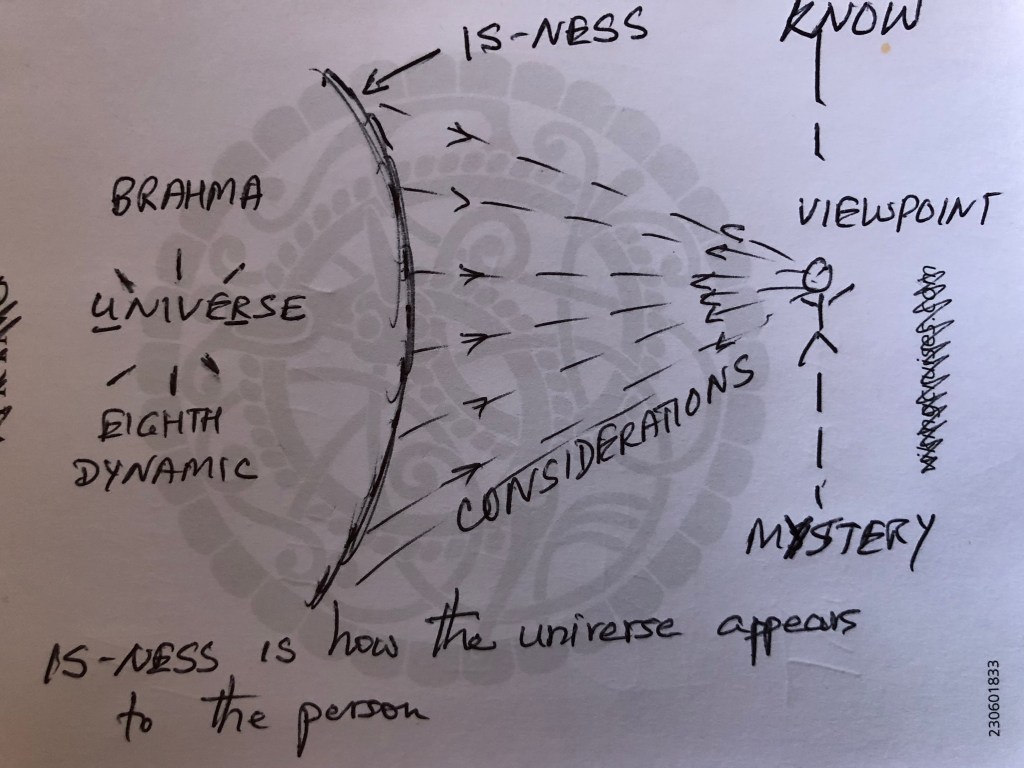
Is-ness is the reality (apparent universe) as perceived by a person. Is-ness is what the person is considering to be there from his viewpoint. The person’s viewpoint travels up and down the Know-to-Mystery scale, which may be sketched as follows.

As the person as-ises his considerations, his viewpoint moves up toward KNOW. As he alter-ises his considerations, his viewpoint moves downwards toward MYSTERY. Too much alter-is-ness leads to not-is-ness (unreality) and unconsciousness.

When two people are communicating, each has his own reality about what is there. As their viewpoints move up the scale toward KNOW their reality converges. As their viewpoints move down the scale, their reality diverges even when they may agree on the same misperceptions. As viewpoints diverge, they increasingly apply force on each other. To move back up the scale, a person should simply hold back the incoming force without applying new or more force, and then practice as-is-ness to nullify that force.

At the top of this scale the observer (VIEWPOINT) and the observed (UNIVERSE) merge into one. This results in a Universal Viewpoint observing itself. Hubbard defines it as STATIC. This is Buddhist NIRVANA.

.

BIBLE: MATTHEW (Chapter 2)

Reference: Religion

[NOTE: I present here my interpretation and understanding of some of the religious texts.  I apologize ahead of time if my presentation does not quite agree with the traditional interpretation. I welcome any discussion and consequent correction.]

.

BIBLE: MATTHEW (Chapter 2)

Verses 1 to 12 narrate the renown of Jesus right from his birth as the king of Jews. This summoned wise men from the East (by means of a new star) to worship him. It also alarmed King Herod of Judea.

Verses 13 to 18 narrate that Joseph, the father of Jesus, realized that Jesus was in danger. So, he, with his family, moved to Egypt. When King Herod heard of this escape, he ordered all boys in Bethlehem and its vicinity, who were two years old and under, to be killed.

Verses 19 to 21 narrate that when Joseph found out that King Herod had died, he returned to the district of Galilee, and settled in a town called Nazareth.         

A close up of a map

Description automatically generated
Judea and the district of Galilee

This account emphasizes magical events, stark portrayal of evil, and fulfilling of earlier prophecies. Believers may take this story to be factual, which in their mind, adds to the mystique and, therefore, divinity of Jesus. Here we are seeing a viewpoint that is operating in mystery. It has a tendency to equate mystery with divinity.

From Wikipedia:

“Most modern biographers of Herod, and probably a majority of biblical scholars, dismiss Matthew’s story as an invention. Contemporary non-biblical sources, including Herod’s friend and personal historian, Nicolas of Damascus, provide no corroboration for Matthew’s account of the massacre, and it is not mentioned in the Gospel of Luke. Classical historian Michael Grant states “[t]he tale is not history but myth or folk-lore”, while Peter Richardson notes that the story’s absence from the Gospel of Luke and the accounts of Josephus “work[s] against the account’s accuracy”. Richardson suggests that the event in Matthew’s gospel was inspired by Herod’s murder of his own sons.”

As an overview, the wisdom taught by Jesus is wonderful and it speaks for itself. The question arises, “Why must such mystique be attached to Jesus?”

In my opinion, it may have been difficult for the Church to convey the wisdom of Jesus to illiterate people. So, mystique was added to attract attention. This seems to be the case with all religions in general.

.