Monthly Archives: May 2021

DIANETICS: Emotion and the Dynamics

Reference: Hubbard 1950: Dianetics TMSMH

These are some comments on Book Two, Chapter 6, “Emotion and the Dynamics” from  DIANETICS: THE MODERN SCIENCE OF MENTAL HEALTH.

.

Comments on
Emotion and the Dynamics

KEY WORDS: Emotion, Suppressors

Emotion seems to be inextricably connected up with the actual force of life. When an individual’s dynamics are increasingly suppressed he descends into the emotions of hostility, anger, rage, fear, terror, and apathy. In this range of emotions he starts to become increasing irrational and reactive in his behavior.

The life force when suppressed produces various emotions.

Under normal circumstances, perceptions get continually assimilated in the mental matrix. The inherent impulse continually running through the mental matrix becomes the response as the perceptions are assimilated. It is similar to the electrical impulse that moves through the circuits of a computer naturally without effort, and forms a response. The response from mental matrix then directs the organism in real time. This function is natural and lightening fast. The situations are assessed and acted upon based on assimilated experience. There is imagination and prediction. The necessity level is brought up, as needed, to handle the situation. Adrenalin helps. So there is learning. It is all very rational and straightforward. The emotion associated with it is calm and serene. 

Emotion breaks down in terms of the endocrine system and the surging of life force to handle the situation.

But when there are engrams hooked up into the circuits there is dimming of awareness and precipitation of reactive behavior, since the traumatic perceptions are not assimilated in the mental matrix. Not having access to the engrams, the mental matrix is forced to make projections and come up with justifications for the irrational reactive behavior. There is attention and additional effort involved to figure out the reasons. Such justifications, obviously, are approximations in the absence of the actual truth. Therefore, they corrupt the experience and pose problems for the future, generating anxiety. 

The life force that is normally calm and serene becomes agitated and turbulent In the presence of engrams.

The incidents encountered by the organism, which generate engrams are called external suppressors. These suppressors then continue to influence the organism through dramatization of the trauma and the corruption of experience. These influences then become internal suppressors that reduce the person’s ability to handle external suppressors. Thus, a dwindling spiral ensues throughout one’s life. These suppressors push the person down in the emotions of hostility, anger, rage, fear, terror, until he becomes apathetic. 

The turbulence of life force ultimately ends up in the condition of apathy.

When a person dramatizes an engram he may express the emotion of different valences in that engram. These emotions are acute as they last only for the duration of the dramatization. But underlying such outbursts is the chronic emotion of the person, which depends on the accumulated internal suppressors influencing that person.

Emotion may then be seen as a personal condition resulting from the damming of the life force.

When this dammed up life force is released in any amount there is always relief followed by laughter. Thus, laughter is the relief of painful emotion. 

A person who is calm and serene with no internal suppressors is called a “clear” in Dianetics. 

A “clear” can handle external suppressors with greater ability. He can keep himself cleared of any residual influence of trauma that he encounters. Dianetic procedure may handle some internal suppressors through an auditor, but not all, as they do not train a person to handle himself.

In Dianetics, an auditor, in the long run, introduces more complications than it resolves in another person.

.

DIANETICS: Psycho-somatic Illness

Reference: Hubbard 1950: Dianetics TMSMH

These are some comments on Book Two, Chapter 5, “Psycho-somatic Illness” from  DIANETICS: THE MODERN SCIENCE OF MENTAL HEALTH.

.

Comments on
Psycho-somatic Illness

KEY WORDS: Psychosomatic illness, Sympathy engram

Psycho, of course, refers to mind and somatic refers to body; the term psycho-somatic means the mind making the body ill or illnesses which have been created physically within the body by derangement of the mind. 

Psycho-somatic illness are generated by the body-mind system. 

There are three stages of pathology: predisposition, by which is meant the factors which prepared the body for sickness, precipitation, by which is meant the factors which cause the sickness to manifest itself, and perpetuation, by which is meant the factors which cause the sickness to continue. A number of germ diseases are predisposed and perpetuated by engrams. Almost all accidents are to be traced to dramatization of engrams. Thousands and thousands of conditions result from engrams to disturb or derange the body. 

Engrams predispose the body for illness, precipitate accidents, and perpetuate the sickness.

The senses can be tuned up or down by hypnotic suggestion. Here we have simply the spoken word going into the mind and causing physical function to change. The verbal suggestions through hypnosis can even interrupt the blood flow. 

The body-mind system is very susceptible to the words in engrams. 

Mental tone makes body tone go down. Body tone, then being down, makes mental tone go down. A dwindling spiral ensues until stopped. Many drugs and treatments simply move the individual from one chronic engram into another. They don’t rid the person of his engrams.

There is no known treatment to rid a person of his engrams. 

Hubbard lists a whole lot of common ailments, such as, arthritis, blood pressure, bizarre pains, malformations, liver and kidney troubles, which, he claims, can be traced back to engrams. As the engram goes away, so goes the pain, so vanishes the arthritis. There is reason to believe that childhood illnesses are in themselves extremely mild and are complicated only by the restimulation of engrams. The germs may not be a serious problem in the absence of engrams.

Permanent solution lies in resolving the engram somehow.

Derangement falls sharply into two categories: mental (called aberration) and physical (called somatic). Both aberration and the somatic are present in every engram; but the engram can manifest itself chronically as either a somatic or as an aberration. When somatic is manifested, the person is in his own valence in the engram. When aberration is manifested, the person is in another valence.

Whether the derangement is mental (aberration) or physical (somatic) depends on how the engram is being dramatized.

Hubbard found that chronic psycho-somatic ills existed only when they had a sympathy engram behind them. A person is usually in his own valence when a sympathy engram is received. The psychosomatic illness is used to attract affinity (sympathy). Resistance to past therapies has resulted from these sympathy engrams.

.

The Unattached Viewpoint

Reference: Course on Subject Clearing

The “I” of The Bhagavad Gita is the Unattached viewpoint from which any and all motion can be viewed without distortion. This Unattached viewpoint is beyond any knowledge. It is only from this viewpoint that the cyclic nature of the universe can be fully comprehended. The Unattached viewpoint remains unaffected by any cycle.

An UNATTACHED viewpoint is a viewpoint that itself does not have any relative motion but has the potential to view all possible motion without any distortion.

Aristotle had a similar concept of the “unmoved mover” but the Unattached viewpoint is not moving anything. It is simply aware of all possible motion, which constitutes the universe. You can do so only from the reference point of absolute non-attachment (see Emptiness).

There is a scale of motion from STATIC (no motion) to KINETIC (different degrees of motion). Usually these two words describe two points relative to each other on the scale of motion.

A pendulum stops at either end of the swing for a fraction of a second. That condition is considered STATIC. The pendulum is then moving during the rest of the swing reaching maximum velocity half way through the swing. This condition is considered KINETIC. The total energy of the system is constant per the Law of Conservation of Energy. That energy is considered completely potential when the pendulum is STATIC, and completely kinetic at the middle of the swing when the velocity is at maximum. At other points during the swing, the energy is converting either from potential to kinetic or from kinetic to potential.

The STATIC state is not only completely devoid of relative motion but it also represents the totality of energy in potential form. We may consider this to be the state of the universe just before the “Big Bang.” From that point on the universe is increasingly becoming kinetic. This may be looked upon as the expanding universe. But, like the pendulum, the universe may reach a maximum state of expansion and then start to contract from that point. 

This is the cyclic universe of the Vedas. It goes from static to kinetic and back to static like a pendulum (see Universe: Static to Kinetic). But the Unattached viewpoint stands apart from the “static to kinetic” cycle of the universe, completely detached. Any attachment to the universe may make the viewpoint subject to the “static to kinetic” cycle to that degree.

The Unattached viewpoint is in a position to view the whole cycle of the universe from static to kinetic and then back to static. It is the most powerful viewpoint.

Also see:
Static & The Unattached Viewpoint
Omnipresence & Non-Attachment

.

THE BHAGAVAD GITA: Chapter 15

Reference: Course on The Bhagavad Gita
English Translation By Shri Purohit Swami

.

Chapter 15

श्रीभगवानुवाच
ऊर्ध्वमूलमधःशाखमश्वत्थंप्राहुरव्ययम्।
छन्दांसियस्यपर्णानियस्तंवेदसवेदवित्।।15.1।।

15.1 Lord Shri Krishna continued: This phenomenal creation, which is both ephemeral and eternal, is like a tree, but having its seed above in the Highest and its ramifications on this earth below. The scriptures are its leaves, and he who understands this, knows.

This verse reminds me of this universe starting from the lightest and flimsiest of radiation and gradually condensing into the universe of stars, suns and planets. The “seed” is something completely imperceptible from which has precipitated such an enormous universe. The scriptures (and now science) describe it to us, so we may understand it.

It is not just the energy that has condensed in infinitely different perceptible forms; it is the underlying simple impulse of that energy also that has condensed into infinitely complex animation and thought. The essence underlying this evolution of energy and its impulse is worth knowing.

अधश्चोर्ध्वंप्रसृतास्तस्यशाखागुणप्रवृद्धाविषयप्रवालाः।
अधश्चमूलान्यनुसन्ततानिकर्मानुबन्धीनिमनुष्यलोके।।15.2।।

15.2 Its branches shoot upwards and downwards, deriving their nourishment from the Qualities; its buds are the objects of sense; and its roots, which follow the Law causing man’s regeneration and degeneration, pierce downwards into the soil.

The universe surrounds us. It is rooted in the actions of man that bind him through the objects that he senses, motivated by the Qualities of purity, passion and ignorance.

Man is a complex energy form motivated by complex impulses woven in that form. It is a complete system in itself. This verse is looking at the man’s universe.

नरूपमस्येहतथोपलभ्यतेनान्तोनचादिर्नचसंप्रतिष्ठा।
अश्वत्थमेनंसुविरूढमूलमसङ्गशस्त्रेणदृढेनछित्त्वा।।15.3।।

15.3 In this world its true form is not known, neither its origin nor its end, and its strength is not understood, until the tree with its roots striking deep into the earth is hewn down by the sharp axe of non-attachment.

ततःपदंतत्परिमार्गितव्ययस्मिन्गताननिवर्तन्तिभूयः।
तमेवचाद्यंपुरुषंप्रपद्येयतःप्रवृत्तिःप्रसृतापुराणी।।15.4।।

15.4 Beyond lies the Path, from which, when found, there is no return. This is the Primal God from whence this ancient creation has sprung.

Without the Static viewpoint this world cannot be viewed for what it truly is. One needs to be free of all attachment to view the true form of this world, its origin and its end. Attachment is there because of ignorance. Beyond this ignorance and attachment lies the view and awareness, which when attained cannot be reversed.

निर्मानमोहाजितसङ्गदोषाअध्यात्मनित्याविनिवृत्तकामाः।
द्वन्द्वैर्विमुक्ताःसुखदुःखसंज्ञैर्गच्छन्त्यमूढाःपदमव्ययंतत्।।15.5।।

15.5 The wise attain Eternity when, freed from pride and delusion, they have conquered their love for the things of sense; when, renouncing desire and fixing their gaze on the Self, they have ceased to be tossed to and fro by the opposing sensations, like pleasure and pain.

नतद्भासयतेसूर्योनशशाङ्कोनपावकः।
यद्गत्वाननिवर्तन्तेतद्धामपरमंमम।।15.6।।

15.6 Neither sun, moon, nor fire shines there. Those who go thither never come back. For, O Arjuna, that is my Celestial Home!

How does one free oneself from ignorance and attachment, from pride and delusion? How does one conquer one’s love of the things of sense? How does one renounce desire without suppressing it? It all happens automatically when the static viewpoint is attained.

The focus should be on attaining the static viewpoint. Yoga helps. Subject clearing helps. Both are very basic and natural activities.

ममैवांशोजीवलोकेजीवभूतःसनातनः।
मनःषष्ठानीन्द्रियाणिप्रकृतिस्थानिकर्षति।।15.7।।

15.7 It is only a very small part of My Eternal Self, which is the life of the universe, drawing round itself the six senses, the mind the last, which have their source in Nature.

शरीरंयदवाप्नोतियच्चाप्युत्क्रामतीश्वरः।
गृहीत्वैतानिसंयातिवायुर्गन्धानिवाशयात्।।15.8।।

15.8 When the Supreme Lord enters a body or leaves it, He gathers these senses together and travels on with them, as the wind gathers perfume while passing through the flowers.

श्रोत्रंचक्षुःस्पर्शनंचरसनंघ्राणमेवच।
अधिष्ठायमनश्चायंविषयानुपसेवते।।15.9।।

15.9 He is the perception of the ear, the eye, the touch, the taste and the smell, yea and of the mind also; and the enjoyment the things which they perceive is also His.

There is a lot more to Nature than just the life of the universe. The life is limited to the six senses. There are the five physical senses, and the sixth sense is the mind. These six senses enter the body upon birth and leave the body upon death. These senses continue to exist between lives. This all can be observed from the Static viewpoint.

Today, we know through science that the body, upon death, disintegrates into atoms, molecules, and congregation of molecules that carry bits and pieces of programming captured from the senses. These elements come together into a new configuration of a body-mind system upon the birth of a new body.

उत्क्रामन्तंस्थितंवापिभुञ्जानंवागुणान्वितम्।
विमूढानानुपश्यन्तिपश्यन्तिज्ञानचक्षुषः।।15.10।।

15.10 The ignorant do not see that it is He Who is present in life and Who departs at death or even that it is He Who enjoys pleasure through the Qualities. Only the eye of wisdom sees.

यतन्तोयोगिनश्चैनंपश्यन्त्यात्मन्यवस्थितम्।
यतन्तोऽप्यकृतात्मानोनैनंपश्यन्त्यचेतसः।।15.11।।

15.11 The saints with great effort find Him within themselves; but not the unintelligent, who in spite of every effort cannot control their minds.

यदादित्यगतंतेजोजगद्भासयतेऽखिलम्।
यच्चन्द्रमसियच्चाग्नौतत्तेजोविद्धिमामकम्।।15.12।।

15.12 Remember that the Light which, proceeding from the sun, illumines the whole world, and the Light which is in the moon, and That which is in the fire also, all are born of Me.

It is the “Viewpoint” that is present in life and which departs at death. This “Viewpoint”, when attached to the world, is the effect of the three Qualities. But, when it is detached, it becomes static. All wisdom comes from this Viewpoint.

गामाविश्यचभूतानिधारयाम्यहमोजसा।
पुष्णामिचौषधीःसर्वाःसोमोभूत्वारसात्मकः।।15.13।।

15.13 I enter this world and animate all My creatures with My vitality; and by My cool moonbeams I nourish the plants.

अहंवैश्वानरोभूत्वाप्राणिनांदेहमाश्रितः।
प्राणापानसमायुक्तःपचाम्यन्नंचतुर्विधम्।।15.14।।

15.14 Becoming the fire of life, I pass into their bodies and, uniting with the vital streams of Prana and Apana, I digest the various kinds of food.

सर्वस्यचाहंहृदिसन्निविष्टोमत्तःस्मृतिर्ज्ञानमपोहनंच।
वेदैश्चसर्वैरहमेववेद्योवेदान्तकृद्वेदविदेवचाहम्।।15.15।।

15.15 I am enthroned in the hearts of all; memory, wisdom and discrimination owe their origins to Me. I am He Who is to be realised in the scriptures; I inspire their wisdom and I know their truth.

All animation of energy forms comes from the inherent impulse of energy. There is exchange of energy among various energy forms. This impulse travels through the energy forms, unites with other impulses, and there come about types of impulses. These impulses take the form of memory and wisdom. They are the very basis of discrimination.

So, a unique energy form shall have a unique system of impulses. The two will go hand in hand. As the energy form changes so would its system of impulse would change, and vice versa. A structure of energy forms (and their impulses) may exist from basic to increasingly elaborate.

द्वाविमौपुरुषौलोकेक्षरश्चाक्षरएवच।
क्षरःसर्वाणिभूतानिकूटस्थोऽक्षरउच्यते।।15.16।।

15.16 There are two aspects in Nature: the perishable and the imperishable. All life in this world belongs to the former, the unchanging element belongs to the latter.

उत्तमःपुरुषस्त्वन्यःपरमात्मेत्युदाहृतः।
योलोकत्रयमाविश्यबिभर्त्यव्ययईश्वरः।।15.17।।

15.17 But higher than all am I, the Supreme God, the Absolute Self, the Eternal Lord, Who pervades the worlds and upholds them all.

यस्मात्क्षरमतीतोऽहमक्षरादपिचोत्तमः।
अतोऽस्मिलोकेवेदेचप्रथितःपुरुषोत्तमः।।15.18।।

15.18 Beyond comparison of the Eternal with the non-eternal am I, Who am called by scriptures and sages the Supreme Personality, the Highest God.

Perishable means that the energy form rearranges itself. It doesn’t stay the same. All life in this world is like that. The unchanging element is the underlying energy that is rearranging itself. Beyond the energy forms and the energy is the Static viewpoint that pervades the world and upholds everything. This Static viewpoint is beyond the comparison of the eternal with non-eternal.

योमामेवमसम्मूढोजानातिपुरुषोत्तमम्।
ससर्वविद्भजतिमांसर्वभावेनभारत।।15.19।।

15.19 He who with unclouded vision sees Me as the Lord-God, knows all there is to be known, and always shall worship Me with his whole heart.

इतिगुह्यतमंशास्त्रमिदमुक्तंमयाऽनघ।
एतद्बुद्ध्वाबुद्धिमान्स्यात्कृतकृत्यश्चभारत।।15.20।।

15.20 Thus, O Sinless One, I have revealed to thee this most mystic knowledge. He who understands gains wisdom and attains the consummation of life.

The problem is to attain that unclouded vision. Hopefully, Subject Clearing may help one reach it.

.

Final Comment

This universe starts from the lightest and flimsiest of radiation and gradually condenses into galaxies, stars, suns and planets. The “seed” is something completely imperceptible. The essence underlying this evolution of energy and its impulse is worth knowing.

A person’s world is rooted in his actions that bind him through the objects that he senses, motivated by the Qualities of purity, passion and ignorance. He is a complex energy form motivated by complex impulses woven in that form. One needs to be free of all attachment to view the true form of this world, its origin and its end. Attachment is there because of ignorance. How does one free oneself from ignorance and attachment? How does one renounce desire without suppressing it? Yoga helps. Subject clearing helps. Both are very basic and natural activities.

A person’s world is limited to the six senses—the five physical senses and the mental sense. These six senses enter the body upon birth and leave  upon death. They continue through the body-mind systems that are born again and again. Underlying these senses is the viewpoint, which, when attached to the world, is the effect of the three Qualities; but, when detached, becomes static. All wisdom comes from this viewpoint.

Every person has a viewpoint, an energy form, and inherent impulses. There is exchange of energy and impulses among viewpoints. Thus come about memory, wisdom and discrimination. All viewpoints evolve toward the Static viewpoint. The Static viewpoint pervades the world and upholds everything. It is beyond eternal and non-eternal.

.

ARISTOTLE: Ethics and the Nature of Happiness

Reference: The Story of Philosophy

This paper presents Chapter II, Section 7 from the book THE STORY OF PHILOSOPHY by WILL DURANT. The contents are from the 1933 reprint of this book by TIME INCORPORATED by arrangement with Simon and Schuster, Inc.

The paragraphs of the original material (in black) are accompanied by brief comments (in color) based on the present understanding.  Feedback on these comments is appreciated.

The heading below is linked to the original materials.

.

VII. Ethics and the Nature of Happiness

And yet, as Aristotle developed, and young men crowded about him to be taught and formed, more and more his mind turned from the details of science to the larger and vaguer problems of conduct and character. It came to him more clearly that above all questions of the physical world there loomed the question of questions-what is the best life?- what is life’s supreme good?-what is virtue?-how shall we find happiness and fulfillment?

In eastern philosophy, the goal of human life has been the attainment of Static viewpoint, which is detached from all worldly phenomena, and can look at everything with equanimity.

He is realistically simple in his ethics. His scientific training keeps him from the preachment of superhuman ideals and empty counsels of perfection. “In Aristotle,” says Santayana, “the conception of human nature is perfectly sound; every ideal has a natural basis, and everything natural has an ideal development.” Aristotle begins by frankly recognizing that the aim of life is not goodness for its own sake, but happiness. “For we choose happiness for itself, and never with a view to anything further; whereas we choose honor, pleasure, intellect … because we believe that through them we shall be made happy.” But he realizes that to call happiness the supreme good is a mere truism; what is wanted is some clearer account of the nature of happiness, and the way to it. He hopes to find this way by asking wherein man differs from other beings; and by presuming that man’s happiness will lie in the full functioning of this specifically human quality. Now the peculiar excellence of man is his power of thought; it is by this that he surpasses and rules all other forms of life; and as the growth of this faculty has given him his supremacy, so, we may presume, its development will give him fulfillment and happiness. 

In my opinion, Aristotle correctly assumes that the development of the power of thought will give man fulfillment and happiness. 

The chief condition of happiness, then, barring certain physical pre-requisites, is the life of reason—the specific glory and power of man. Virtue, or rather excellence,* will depend on clear judgment, self-control, symmetry of desire, artistry of means; it is not the possession of the simple man, nor the gift of innocent intent, but the achievement of experience in the fully developed man. Yet there is a road to it, a guide to excellence, which may save many detours and delays: it is the middle way, the golden mean. The qualities of character can be arranged in triads, in each of which the first and last qualities will be extremes and vices, and the middle quality a virtue or an excellence. So between cowardice and rashness is courage; between stinginess and extravagance is liberality; between sloth and greed is ambition; between humility and pride is modesty; between secrecy and loquacity, honesty; between moroseness and buffoonery, good humor; between quarrelsomeness and flattery, friendship; between Hamlet’s indecisiveness and Quixote’s impulsiveness is self-control. “Right,” then, in ethics or conduct, is not different from “right” in mathematics or engineering; it means correct, fit, what works best to the best result.

*[The word excellence is probably the fittest translation of the Greek arete, usually mistranslated virtue. The reader will avoid misunderstanding Plato and Aristotle if, where translators write virtue, he will substitute excellence, ability, or capacity. The Greek arete is the Roman virtus; both imply a masculine sort of excellence (Ares, god of war; vir, a male). Classical antiquity conceived virtue in terms of man, just as medieval Christianity conceived it in terms of woman.]

It is true that virtue, or excellence, is the achievement of experience in the fully developed man. Such experience consists of assimilation of all perceptions such that no anomalies are left unresolved.

The golden mean, however, is not, like the mathematical mean, an exact average of two precisely calculable extremes; it fluctuates with the collateral circumstances of each situation, and discovers itself only to mature and flexible reason. Excellence is an art won by training and habituation: we do not act rightly because we have virtue or excellence, but we rather have these because we have acted rightly; “these virtues are formed in man by his doing the actions”; we are what we repeatedly do. Excellence, then, is not an act but a habit: “the good of man is a working of the soul in the way of excellence in a complete life; … for as it is not one swallow or one fine day that makes a spring, so it is not one day or a short time that makes a man blessed and happy.”

Excellence is learned from the experience that comes from resolving anomalies.

Youth is the age of extremes: “if the young commit a fault it is always on the side of excess and exaggeration.” The great difficulty of youth (and of many of youth’s elders) is to get out of one extreme without falling into its opposite. For one extreme easily passes into the other, whether through “over-correction” or elsewise: insincerity doth protest too much, and humility hovers on the precipice of conceit.* Those who are consciously at one extreme will give the name of virtue not to the mean but to the opposite extreme. Sometimes this is well; for if we are conscious of erring in one extreme “we should aim at the other, and so we may reach the middle position, … as men do in straightening bent timber.” . But unconscious extremists look upon the golden mean as the greatest vice; they “expel towards each other the man in the middle position; the brave man is called rash by the coward, and cowardly by the rash man, and in other cases accordingly”; so in modern politics the “liberal” is called “conservative” and ”radical” by the radical and the conservative.

*[“The vanity of Antisthenes” the Cynic, said Plato, “peeps out through the holes in his cloak.”] 

The golden mean is the best position. Unfortunately, the extreme viewpoint misconstrues the middle position as the other extreme.

It is obvious that this doctrine of the mean is the formulation of a characteristic attitude which appears in almost every system of Greek philosophy. Plato had had it in mind when he called virtue harmonious action; Socrates when he identified virtue with knowledge. The Seven Wise Men had established the tradition by engraving, on the temple of Apollo at Delphi, the motto meden agan,—nothing in excess. Perhaps, as Nietzsche claims all these were attempts of the Greeks to check their own violence and impulsiveness of character; more truly, they reflected the Greek feeling that passions are not of themselves vices, but the raw material of both vice and virtue, according as they function in excess and disproportion, or in measure and harmony.*

*[Cf. a sociological formulation of the same idea: “Values are never absolute, but only relative… A certain quality in human nature is deemed to be less abundant than it ought to be; therefore we place a value upon it, and … encourage and cultivate it. As a result of this valuation we call it a virtue; but if the same quality should become superabundant we should call it a vice and try to repress it.”—Carver, Essays in Social Justice.]

The golden mean lies in assuming that position which brings harmony, consistency and continuity to a situation.

But the golden mean, says our matter-of-fact philosopher, is not all of the secret of happiness. We must have, too, a fair degree of worldly goods: poverty makes one stingy and grasping; while possessions give one that freedom from care and greed which is the source of aristocratic ease and charm. The noblest of these external aids to happiness is friendship. Indeed, friendship is more necessary to the happy than to the unhappy; for happiness is multiplied by being shared. It is more important than justice: for “when men are friends, justice is unnecessary; but when men are just, friendship is still a boon.” “A friend is one soul in two bodies.” Yet friendship implies few friends rather than many; “he who has many friends has no friend”; and “to be a friend to many people in the way of perfect friendship is impossible.” Fine friendship requires duration rather than fitful intensity; and this implies stability of character; it is to altered character that we must attribute the dissolving kaleidoscope of friendship. And friendship requires equality; for gratitude gives it at best a slippery basis. “Benefactors are commonly held to have more friendship for the objects of their kindness than these for them. The account of the matter which satisfies most persons is that the one are debtors and the others creditors, … and that the debtors wish their creditors out of the way, while the creditors are anxious that their debtors should be preserved.” Aristotle rejects this interpretation; he prefers to believe that the greater tenderness of the benefactor is to be explained on the analogy of the artist’s affection for his work, or the mother’s for her child. We love that which we have made.

The golden mean lies in the balance, not just in thoughts and character, but also in acquiring the means of living satisfactorily.

And yet, though external goods and relationships are necessary to happiness, its essence remains within us, in rounded knowledge and clarity of soul. Surely sense pleasure is not the way: that road is a circle: as Socrates phrased the coarser Epicurean idea, we scratch that we may itch, and itch that we may scratch. Nor can a political career be the way; for therein we walk subject to the whims of the people; and nothing is so fickle as the crowd. No, happiness must be a pleasure of the mind; and we may trust it only when it comes from the pursuit or the capture of truth. “The operation of the intellect … aims at no end beyond itself, and finds in itself the pleasure which stimulates it to further operation; and since the attributes of self-sufficiency, unweariedness, and capacity for rest, … plainly belong to this occupation, in it must lie perfect happiness.” 

The essence of happiness remains within us, in rounded knowledge and clarity of soul; and, not in the pleasure of senses.

Aristotle’s ideal man, however, is no mere metaphysician. 

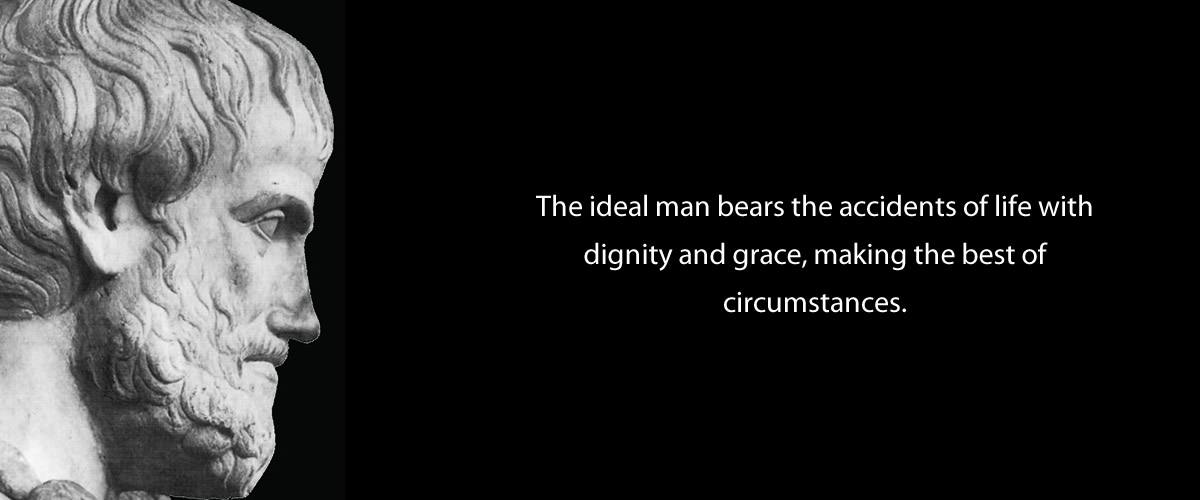
He does not expose himself needlessly to danger, since there are few things for which he cares sufficiently; but he is willing, in great crises, to give even his life,—knowing that under certain conditions it is not worth while to live. He is of a disposition to do men service, though he is ashamed to have a service done to him. To confer a kindness is a mark of superiority; to receive one is a mark of subordination… He does not take part in public displays… He is open in his dislikes and preferences; he talks and acts frankly, because of his contempt for men and things… He is never fired with admiration, since there is nothing great in his eyes. He cannot live in complaisance with others, except it be a friend; complaisance is the characteristic of a slave…. He never feels malice, and always forgets and passes over injuries… He is not fond of talking… It is no concern of his that he should be praised, or that others should be blamed. He does not speak evil of others, even of his enemies, unless it be to themselves. His carriage is sedate, his voice deep, his speech measured; he is not given to hurry, for he is concerned about only a few things; he is not prone to vehemence, for he thinks nothing very important. A shrill voice and hasty steps come to a man through care… He bears the accidents of life with dignity and grace, making the best of his circumstances, like a skillful general who marshals his limited forces with all the strategy of war… He is his own best friend, and takes delight in privacy whereas the man of no virtue or ability is his own worst enemy, and is afraid of solitude.

Such is the Superman of Aristotle. 

Aristotle’s ideal man is quite balanced and measured.

.