KG MATH 2: Numbers & Place Values

A number answers the question, “How many?” Numbers are used in counting to find out how many things there are. One counts by sequentially calling out for each item, one, two, three, four, five, and so on.

Counting starts from ONE and not from zero. Zero is not used in counting because zero stands for “nothing.” Zero is useful in marking the absence of a count. Therefore, zero is used in writing numbers where an absence of count is implied.

Numbers are written by combining symbols called digits, much like words are written by combining symbols called letters. We have twenty-six letters that combine to make thousands of different words. We have only ten digits that combine to make infinity of different numbers.

There are ten different digits – 0, 1, 2, 3, 4, 5, 6, 7, 8, and 9. The number FIVE is written with only one digit 5. The number FIFTEEN is written with two digits 1 and 5 as 15. All possible numbers can be written just with these ten digits.

The numbers are written in a compact form by using the trick of regrouping. We regroup ten pennies as one dime. Similarly, we regroup ten ONES as one TEN; ten TENS as one HUNDRED; ten HUNDREDS as one THOUSAND; and so on.

The number 15 represents “1 TEN and 5 UNITS.” The number 264 represents “2 HUNDREDS, 6 TENS, and 4 UNITS.” The values of UNIT, TEN, HUNDRED, THOUSAND, etc., are called place values, because they are applied to a digit depending on where it appears in a number. The best way to understand place values is by means of a counting board called Abacus, which is described in the document referenced below.

Ten is very important in our numbering system as can be seen in this discussion. It was chosen because we have ten fingers that were used for counting in the beginning. Here are some exercises in this subject for the kindergarten level.

LEVEL K2: NUMBERS & PLACE VALUES

“Numbers and Place Values” forms the foundation of the subject of ARITHMETIC. Arithmetic literally means, “Skill with numbers.” Arithmetic helps one find the answers to problems involving numbers

.
KG MATH 1: Orientation & Spatial Sense

Spatial sense is having the sense of direction, distance and location with respect to one’s environment. Orientation is getting adjusted to that environment.

To get oriented one needs to spot the relative locations of various things in one’s environment. To spot a location one only needs to know the direction it is in and its distance from one.

A direction is the line along which attention may be directed. There is infinity of directions radiating out from one’s location. The main directions are FRONT, BACK, ABOVE, BELOW, LEFT and RIGHT. The directions of LEFT and RIGHT are difficult for a child to recognize until he or she reaches Kindergarten.

A distance is the separation between two locations. There is infinity of different distances in any one direction. The distances may be identified roughly as NEAR or FAR.

A position of an object tells us how it is located in relation to other objects, such as, IN, OUT, ON, UNDER, MIDDLE, and NEXT TO. A child may learn these positions as part of learning the language, but may also be taught as part of mathematics.

Spatial locations combine into shape. A very common shape is rectangle that most doors and windows have. Other shapes are triangles, circles, etc. These shapes may be drawn on a plane surface. They are two dimensional because they have length and breadth, or width and height.

Most objects are three dimensional because they have a third dimension of thickness or depth. Examples of simple objects are cubes, spheres, cylinders, cones, etc.

Shapes and objects are symmetrical when one half is the mirror image of the other half. Most bodies are symmetrical. Objects may slide, flip or spin in space.

Our body is an object that exists in space. Therefore, orientation and spatial sense is an important subject for a child to become familiar with. Here are some exercises in this subject for the kindergarten level.

LEVEL K1: ORIENTATION & SPATIAL SENSE

“Orientation & Spatial Sense” forms the foundation of the subject of GEOMETRY. It introduces the elements of space and how these elements may relate to the student.

.

Is there Divinity?

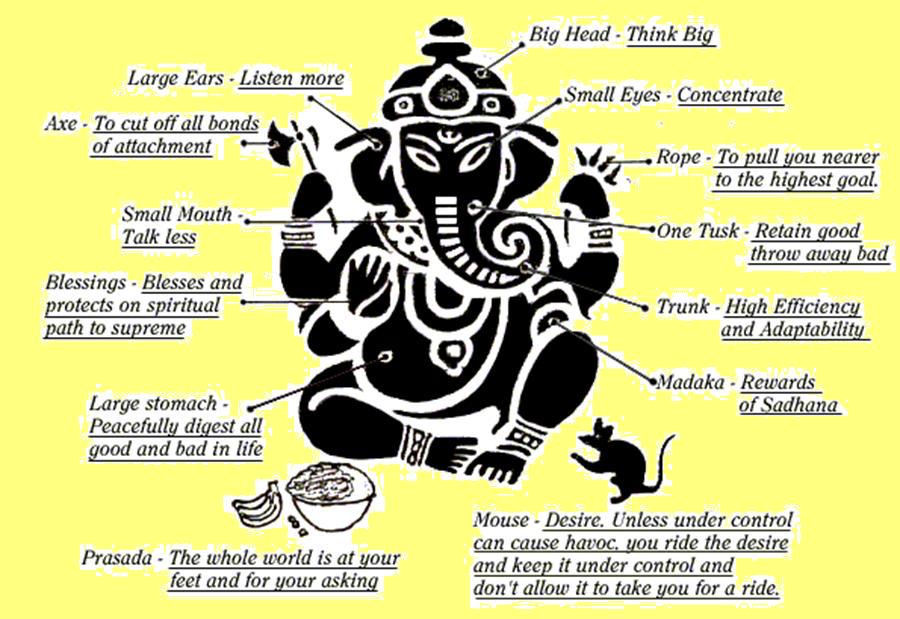
Ganesha

Reference: Religion

Socrates almost had his finger on it when he posed the question, “Can man be made self-determined and responsible for his own actions?”

Plato lost it when he recommended the use of religion (supernatural authority and fear) to control the wild beast nature latent in every person.

Aristotle came close to defining it, but the logic that brought him so close to an understanding of divinity, also prevented him from defining it precisely. Let us take a look at that one final step that he could not take.

Aristotle follows Socrates’ lead to examine such common terms as, justice, morality, virtue, etc., to uncover the unknowing assumptions made by people. He applies Plato’s Doctrine of Ideas to voluminous observations to define the concepts, laws, and principles that underlie all that we sense. He coins many new terms, such as, faculty, motive, energy, actuality, maxim, principle, etc., to communicate those concepts precisely. He formulates a scientific method so others may continue with this process.

Aristotle digs deep into observations, especially in the field of biology and natural sciences, and comes up with general frame of references (universals) from which to evaluate further observations. Thus he simplifies the management of voluminous observations by uncovering categories with logical connections.

He, then, digs deep into these categories to come up with a more fundamental frame of reference. He reduces all observations to (a) FORM (the shaping force), and (b) MATTER (the raw material being shaped).

To Aristotle, FORM is the inner necessity or impulse which exists in MATTER. MATTER is continually being formed into new, complex shapes by FORM that is inherent to it.

Aristotle considers MATTER to be without beginning. MATTER is worked into more complex and varied shapes by FORM. To him, God is “Prime Mover Unmoved.” God is the source of all motion. But, God has no motion within itself.

Aristotle never answers the question how MATTER arose in the first place. To him, this is like asking the question, “How God came to be in the first place?” And, that is as far as Aristotle goes. The inherent consideration here seems to be that ability, or potential, needs a “vessel” through which to express itself.

We find most viewpoints in the “Western thought” to be based on this frame of reference. It leads to the viewpoint that God must have a beingness in which to exist.

Can there be God without beingness? Can there be FORM without MATTER? Can there be Motion with no motion at its core? Can there be a Cause that is not itself caused?


DIVINITY

When we observe this universe, we cannot separate GOD from BEINGNESS, FORM from MATTER, MOTION from NO MOTION, and CAUSE from EFFECT.

These pairs, or dichotomies, appear simultaneously when a manifestation is perceived. Even the most fundamental ideas of MANIFESTATION and PERCEPTION seem to form a dichotomy. We all have struggled with the questions, “How does a manifestation appear?” “How is it perceived?” “Who or what creates?” “Who or what perceives?” The ultimate focus has been on “how,” “who” or “what.” It all boils down to the speculation that somebody or something must exist beyond all existence.

Essentially, the mind and its logic has hit a ceiling. Any attempt to pierce this ceiling runs into a fundamental  inconsistency, such as, “unmoved Mover” or ”uncaused Cause.”  This inconsistency seems to point to something that cannot even be conceived.

It would be beyond any mental conception. It would be beyond logic. It would be beyond any description. It would not be a form or cause. It would not even exist or be.

It would seem that

  1. A manifestation may occur without any prior consideration.
  2. A perception may occur without any prior consideration.

And in there, somewhere, may be Divinity, or may be not…

The Creation Hymn of Rig Veda

Neti, neti,”

.

An interview with Dalai Lama

This is a brief presentation of an interview where the Dalai Lama discusses how he would change his beliefs because of scientific data.

http://abcnews.go.com/GMA/video/dalai-lama-angry-13400561

In my view, Buddhism is very scientific to start with.

.

Pre-Kindergarten Math

Math, or maths, is short for mathematics. Etymologically, mathematics means ‘something learned.’ Actually, mathematics is a tool that teaches one to learn systematically.

For a child, mathematics really starts with the observation of space. A child looks around to get oriented to the space. This aspect of mathematics is called Geometry. Etymologically, geometry means ‘measuring earth.’ Here are some exercises in geometry for the pre-kindergarten level. (Note: It is a pdf file.)

The observation of things in space introduces one to the idea of ‘how many.’ A child may see single objects that are unique, or several objects of the same type. This aspect of mathematics is called Arithmetic. Etymologically, arithmetic means ‘number skill.’ Here are some exercises in arithmetic for the pre-kindergarten level.

The observation of things in space also introduces one to patterns and relationships among objects. For example, a child may see alternating objects or objects increasing in size. This aspect of mathematics is called Algebra. Etymologically, algebra means ‘reunion and equation.’ Here are some exercises in algebra for the pre-kindergarten level.

These exercises provide a basic familiarity to a young child on which subsequent mathematical concepts may be built.

.