The Dynamics

Hubble2

Reference: Postulate Mechanics

.

View of Dynamics from Scientology

The concept of DYNAMICS by Hubbard is a perfect human-centric view of life and existence. It is built on the idea of human individuality. Here is the definition from Hubbard’s Scientology.

There could be said to be eight urges (drives, impulses) in life. These we call dynamics. These are motives or motivations. We call them the eight dynamics.

The first dynamic —is the urge toward existence as one’s self. Here we have individuality expressed fully. This can be called the self dynamic.

The second dynamic—is the urge toward existence as a sexual or bisexual activity. This dynamic actually has two divisions. Second dynamic (a) is the sexual act itself and the second dynamic (b) is the family unit, including the rearing of children. This can be called the sex dynamic.

The third dynamic—is the urge toward existence in groups of individuals. Any group or part of an entire class could be considered to be a part of the third dynamic. The school, the society, the town, the nation are each part of the third dynamic, and each one is a third dynamic. This can be called the group dynamic.

The fourth dynamic—is the urge toward existence as mankind. Whereas the white race would be considered a third dynamic, all the races would be considered the fourth dynamic. This can be called the mankind dynamic.

The fifth dynamic—is the urge toward existence of the animal kingdom. This includes all living things whether vegetable or animal. The fish in the sea, the beasts of the field or of the forest, grass, trees, flowers, or anything directly and intimately motivated by life. This could be called the animal dynamic.

The sixth dynamic—is the urge toward existence as the physical universe. The physical universe is composed of matter, energy, space and time. In Scn we take the first letter of each of these words and coin a word, mest. This can be called the universe dynamic.

The seventh dynamic—is the urge toward existence as or of spirits. Anything spiritual, with or without identity, would come under the heading of the seventh dynamic. This can be called the spiritual dynamic.

The eighth dynamic—is the urge toward existence as infinity. This is also identified as the Supreme Being. It is carefully observed here that the science of Scn does not intrude into the dynamic of the Supreme Being. This is called the eighth dynamic because the symbol of infinity ∞ stood upright makes the numeral “8 .” This can be called the infinity or God dynamic.

Centered on the human individuality is the family, then human groups of increasing sizes, and then the whole mankind. These are the first four dynamics. At fifth dynamic we have life species other than mankind. It provides us with a human-centric view of life. At sixth and seventh dynamics we find a sharp division between matter and spirit. This again is a human-centric view that elevates spirit over matter. They are looked upon as separate existences that interact to produce life. At eighth dynamic we have the concept of Supreme Being. It is the concept of pure Cause that produces the universe. It projects itself outwards as spirit which impinges on inert matter to produce life. The human-centric view represents the eighth dynamic as a humanlike beingness (God).

.

View of Dynamics from Postulate Mechanics

Postulate Mechanics view has been developed through Subject Clearing. These definitions are consistent with the postulates that underlie this universe. The earliest postulates provide a clue to the eighth dynamic. As postulates evolve, we get the dynamics seven to one.

The Eighth Dynamic is the dynamic of the Unknowable as explained in the dichotomy Unknowable-Knowable. The Knowable then includes all other dynamics as the Universe. The Eighth Dynamic is the unknowable beyond the Universe.

The Seventh Dynamic is the dynamic of the Self that perceives the knowable Universe through Postulates. It is the awareness of the universe as one—the Oneness—which characterizes the Seventh Dynamic.

The Sixth Dynamic is the dynamic of Substance, which manifests as the Universe. The substance is categorized by its condensation from thought to energy to matter. It is the sensation of the substance that characterizes the Sixth Dynamic.

The Fifth Dynamic consists of Self identifying with Substance to generate the Beingness from unanimated minerals to animated plant and animal kingdoms. It is the continuing evolution of these beingness toward greater complexity and abilities that characterizes the Fifth Dynamic.

The Fourth Dynamic is the peak of evolution of the beingness, which is the human kind. It the emergence of self-awareness and intelligence that characterizes the Fourth Dynamic.

The Third Dynamic represents the subdivision of the human kind into different races, cultures and political groups. These groups continue to subdivide into societies and smaller groups. It is notion of group that characterizes the Third Dynamic.

The Second Dynamic represents the group of family that reproduces and nurtures new individuals to maintain the continuity and growth of the human kind. It is the notion of reproductive and nurturing activities that characterizes the Second Dynamic.

The First Dynamic represents the individual that is the unit of the human kind. It is aggregation of individuals that forms various groups and the human kind. Here we have the problem-solving abilities that accelerate the evolution of beingness. The rapid evolution is key characteristic of the individual.

.

Essays on Ground State

092: KNOWABLE AND UNKNOWABLE

130: THE PARADOX OF UNKNOWABLE

134: THE MATHEMATICS OF UNKNOWABLE

142: DEFINITION OF UNKNOWABLE

173: Research into Unknowable

174: WHAT IS UNKNOWABLE?

176: The Factors of Unknowable

197: Infinity and Unknowable

217: More on Unknowable

267: Absolutism and Philosophy

271: Gödel and Determinism


617: The Ground State of the Universe

634. Awareness and the Ground State

635. Aristotle and the Ground State

643. Ground State of Universe – History

.

The Human-Centric Fixation

Human8
Reference:  Motion and Space-Time

The scientific method searches for truth in the Universe by coming up with a hypothesis from empirical observations, testing the hypothesis by making predictions, and then verifying the predictions. This works to the degree one is objective.

It is much easier to be objective when studying physical objects. This is not so when studying mental objects because the mental processes one uses to study are very similar. This difficulty may be overcome by the practice of mindfulness (seeing things as they are). Mindfulness requires the following criterion.

POSTULATE: Truth is determined by consistency of definitions and data in the broadest context possible.

.

The scientific observations are reality-centric because rigorous consistency with physical reality is maintained through the use of experiments and mathematical models. Any assumption that cannot be verified by actual experiment is discarded.  Any inconsistency associated with a hypothesis must be resolved before it is accepted as a theory.

When it comes to maintaining rigorous consistency with mental reality, thought experiments become very necessary. But such thought experiments must be conducted for consistency in the broadest context possible.

Reality-centric observations are accepted only after rigorous verification.

.

It is the human-centric observations that made us believe that (1) Earth is the center of the universe; (2) the Sun revolves around the earth; and (3) the Earth is flat. These conclusions were proven wrong when science established greater consistency in celestial observations through the use of experiments and mathematics.

The human-centric observations are limited to human context. Assumptions are made to compensate for that limitation. When such assumptions are elevated to the level of beliefs it becomes very difficult to correct them. Even when the human-centric observations were shown to be inconsistent with celestial observations, science had to fight long and hard to get its conclusions accepted.

Human-centric observations suffer from belief in unverified assumptions.

.

Many believe that this Universe was created. When one conducts thought experiments in a broader context, one finds that the Universe could have transitioned from non-awareness into awareness. The Universe did not have to be created. The belief that this Universe is created has never been verified objectively. In fact, the ancient Vedas do not believe that this Universe was created. This raises doubt about this religious belief in creation.

It is a human-centric belief that this universe was created.

.

Furthermore, the religious belief goes on to say that this Universe was created by an eternal Being who has awareness and intelligence more sophisticated than those of humans. Scientific studies show that human awareness is only a recent development that has evolved from earlier forms of awareness. Ancient Vedas speak only in terms of elemental awareness at the beginning of the universe. It is highly unlikely that a highly sophisticated Being existed at the beginning of the universe.

It is a human-centric belief that this Universe started from highly developed awareness.

.

It is a religious belief that spirit and matter are separate, and that awareness can exist all by itself. Thought experiments show that awareness arises only when there is relative motion. Relative motion is a material characteristic. We find that awareness and relative motion cannot be separated from each other.  Separation between spirit and matter cannot be verified objectively. In fact, ancient Vedas speak of Brahma and existence to be one.

It is a human-centric belief that “spirit and matter” are separate.

.

It is commonly thought that an observer must be separate from what is being observed; that an observer cannot observe itself. But we find that the reality-centric observation is essentially reality observing itself. The observer is part of the reality. The observer does not have to be identified with a self. When one observes in as broad a context as possible then it becomes possible to recognize reality for what it is. From this viewpoint the observer is not separate from what is observed.

It is a human-centric belief that observer must be separate from the observed.

.

It is commonly assumed that “observer” is a being with humanlike awareness. This being is unique, permanent and separate from reality. However, thought experiments show awareness is also relative motion that forms the basis of all reality. Further studies show that human awareness has evolved from earlier awareness. There is no unique, permanent being that is separate from reality. “Beingness” is changing all the time like the rest of reality.

It is a human-centric belief that observer is unique, permanent and not part of reality.

.

The observer is not some fixed point from which reality is being observed. Observer is part of reality as is that, which is being observed. It is reality observing itself. It is the fixation on self that makes one believe that one is unique and separate from reality.

The human-centric belief is characterized by fixation on self.

.

Next: A View on Enlightenment

.

Einstein & New Thinking

Einstein

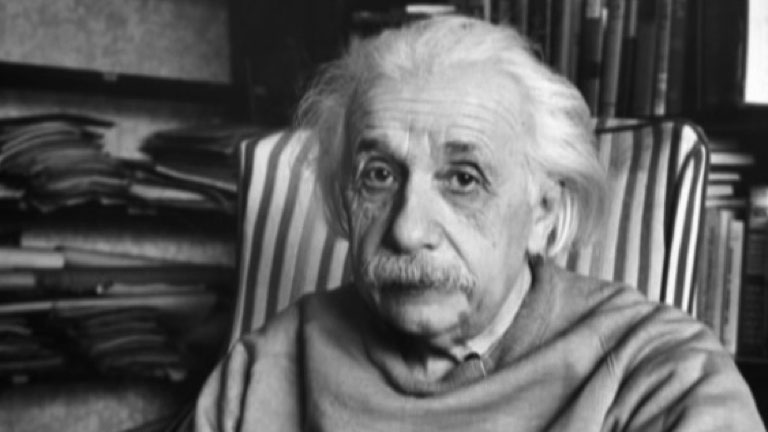
“A human being is part of the whole called by us Universe, a part limited in time and space.

“We experience ourselves, our thoughts and feelings, as something separate from the rest. A kind of optical delusion of consciousness…

“This delusion is a kind of prison for us, restricting us to our personal desires and to affection for a few persons nearest to us.

“Our task must be to free ourselves from this prison by widening our circle of compassion to embrace all living creatures and the whole of nature in its beauty…

“The true value of human beings is determined primarily by the measure and the sense in which they have obtained liberation from the self…

“We shall require a substantially new manner of thinking if humanity is to survive.”

(Albert Einstein, 1954)

.

Motion and Space-Time

Motion
Reference: Awareness and Motion

In its most fundamental form motion is perceived in physics as a varying field that has wavelike characteristics, such as, wavelength, period and frequency. We may postulate awareness as motion to vary with different wavelengths, periods and frequencies as is the case with light.

POSTULATE: Fundamentally awareness as motion has wavelike characteristics and appearance like that of light.

.

The wavelength provides a sense of extent. This extent is defined objectively by the dimension of space. Space is not empty at fundamental level. It is filled with awareness as motion.

Space is a measure of the extent of awareness as motion. Space is not empty.

.

The period provides a sense of duration. This duration is defined objectively by the dimension of time. Time is not arbitrary at the fundamental level. It is marked by awareness as motion.

Time is a measure of the duration of awareness as motion. Time is not arbitrary.

.

Space and time describe the motion present. The basic motion may be described as a harmonic of light (electromagnetic wave). If there is no motion there is no space and time.

Space-time describes the motion actually present. There is no space-time in absence of motion.

.

As frequency increases wavelength shortens and recurs at a higher rate. Space and time describing this motion appear as increasingly solid. Layers of this increasing condensation may be observed in an atom. The inner nucleus is much more condensed than the outer electron shell.

With increasing frequency, motion condenses and space-time appears more solid.

.

The science of wave mechanics explains how certain shells of atoms are formed and how the properties of elements are established per the Periodic Table. Different properties are the expression of different awareness of atoms.

The wave nature of motion establishes the property and awareness of different atoms.

.

The science of chemistry explains how electrons are shared among elements to form molecules and a variety of matter.  Here we are looking at more complex motion expressing increasingly sophisticated properties and awareness.

Molecules represent more complex motion expressing increasingly sophisticated awareness.

.

As molecules become larger, the electrons play additional role of forming circuits in outer shells that enable the macromolecules to store and pass information. Macromolecules then combine to form still larger combinations, such as, DNAs in cells that are capable of performing functions we identify with life.

Macromolecules provide still more sophisticated awareness that starts to approximate life.

.

Further combination of cells produces organisms. The evolution of organisms then peaks at humankind. It is the sophisticated motion at every stage in the structure of an organism that represents its awareness. The sophisticated awareness in humans has the capability of turning inward to observe itself.

This subjective awareness in humans cannot exist without the complex human structure.

.

Neither this human structure nor its sophisticated awareness existed at the beginning of the Universe. It is the human-centric bias, which projects such humanlike awareness to exist before the Universe.

It is human-centric bias that projects humanlike awareness to exist before the universe.

.

It was the human-centric viewpoint that maintained, “Earth is at the center of this universe, and the sun revolves around the earth.” The human-centric viewpoint seems to maintain, “Universe is created by a humanlike being called God.”

From a reality-centric viewpoint all reality is awareness. This has been so even before animated life and humans emerged in this universe. Everything in this universe is imbued with awareness.

Awareness is not limited to humans and animated life. Awareness forms the very fabric of this universe. 

.

Next: The Human-Centric Fixation

.