
The Scientific Frame of Reference

Reality1

Man looking out on the heavens. Woodcut from Universum by Camille Flammarion, published Paris, 1888. Monochrome version coloured by Hugo Heikenwaelder.

The “observer” of Einstein, whether it is a human or a physical instrument, is limited in its measurement by the velocity of light. Therefore, it cannot measure any velocity greater than the speed of light. The sense of space-time directly or through any instrument is similarly limited by the speed of light.

The Theory of Relativity basically acknowledges the physical perceptions to be limited by the speed of light.

However, mental perceptions are not limited by the speed of light. In order to define mental perception scientifically, let’s do the following thought experiment. Imagine being out there in the interstellar space without relying on physical perceptions. We ignore all light whether emitted from some source, or reflected by an object. This eliminates all external reference points. Now pay attention to your motion.

You could be standing still or you could be moving at the speed of light. But you will find that there is no mental perception of motion as long as it is uniform.  There is mental perception only when there is a change in motion accompanied by inertial resistance.

Mental perception seems to be related to inertial resistance.

Light that brings about physical perception of other objects is made up of changing electrical and magnetic fields. These changes are resisted by permittivity and permeability. This is a form of inertial resistance built into the very nature of light. We may refer to it as the inertia of light that is inherent. It determines the uniform motion of light.

In fact, this form of inertia is present wherever electromagnetic phenomenon is found, and that is pretty much in everything. Atoms and molecules consist of electromagnetic phenomenon and they make up all matter including the human body and brain. Thus inertia is built into the very fabric of the universe. Similar to mental perception, the physical perception also seems to based on inertia.

Physical perception seems to be related to inertia built into the fabric of the universe.

It seems that perception cannot be separated from inertia that is inherent to motion in all physical and mental phenomena. Every aspect of this universe is changing and giving rise to inertial forces at all times. This is a level of perception inherent to the universe.

This idea of perception goes far beyond what we think of as human perception and awareness. This perception is part of what is being observed. There is no separate viewpoint of the observer. The scientific method comes closest to this concept. Observation clarifies itself by looking more closely at inconsistencies.

Science is “observation” clarifying itself by looking at inconsistencies more closely.

The frame of reference of science is, therefore, the whole universe. In this frame of reference the perception is not limited by the speed of light. Science can perceive light creeping from star to star, while also perceiving the rotation of earth. Science can see the whole spectrum of motion in the universe at all times.

The Scientific frame of reference is the universe as a whole.

Once we fully understand this universal frame of reference, no other frame of reference is needed. In this frame of reference inertia determines the perception of motion and all other properties. The “uniform motion” of an object is determined by inherent inertial forces. These forces act to restore the uniform motion  whenever it is deviated from. The uniform motion of an object is not determined by the velocity of an external frame of reference.

The uniform motion of an object is determined by its inherent inertia.

All motion in this universe is continually changing. This makes the universe appear what it is. We may assume that the overall energy and momentum of the universe are conserved. This may mean that the universe, considered as a whole, is changeless. There is nothing beside the universe, so its overall properties are relative to itself only. We may assume the universe to have absolute motion of zero and infinite persistence.

The universe is inherently static and infinitely persistent.

Science may derive its sense of motion and time from the frame of reference of the universe as a whole.

.
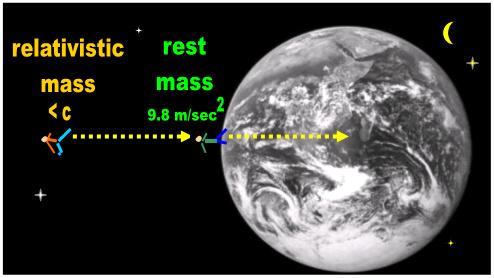
Rest Mass in the Scientific Frame

RelMass4
Reference: The Scientific Frame of Reference

All motion and persistence in the universe is relative; nothing is at absolute rest except, maybe, the universe taken as a whole. There is no such thing as mass completely at rest. All objects naturally move at a uniform rate under their own inertia. Any departure from their uniform motion causes restorative force due to inertia.

Uniform motion simply means “absence of acceleration.” It has nothing to do with the velocity of the object, which is relative anyway. It is the mass of an object that is moving uniformly under its own inertia, which may be defined as “rest mass.”

The “rest mass” is the mass of an object that is moving at uniform speed under its own inertia.

When the uniform motion of an object is disturbed by external force, a restorative force appears due to its inertia. This inertial force acts to eliminate acceleration and restore uniform motion. This restorative inertial force, very likely, is converted inertial mass.

Thus the inertial mass of an accelerating object is less than the “rest mass,” maybe by an imperceptible amount. When the acceleration stops, the original “rest mass” is restored.

Inertial mass converts into restorative force to oppose any change in uniform motion. Thus, the inertial mass of an object reduces with acceleration.

Once we understand the universal frame of reference of the Scientific Observer, no other frame of reference is needed to explain things. Changes in inertia in this frame of reference can explain all phenomena.

The Scientific Observer is simultaneously aware of the whole universe. This awareness is not limited by the speed of light. The Scientific Observer can observe light creeping among stars. He can see earth rotating. He can see motion at all different scales.

The Scientific Observer is aware that the velocity of light in space is limited by its inertia (permittivity and permeability). . The higher is the inertia, the lower is the uniform motion of any object under its own inertia. Maybe a mathematical relationship can be worked out between inertia and uniform motion.

In this frame of reference all inertia shall interact with all other inertia. Gravity shall be a natural outcome of this interaction. It may be possible from this universal frame of reference to derive all conclusions of the Theory of Relativity.

.

Space-Time in the Scientific Frame

image_1405_1e-Sagittarius-A
Reference: The Scientific Frame of Reference

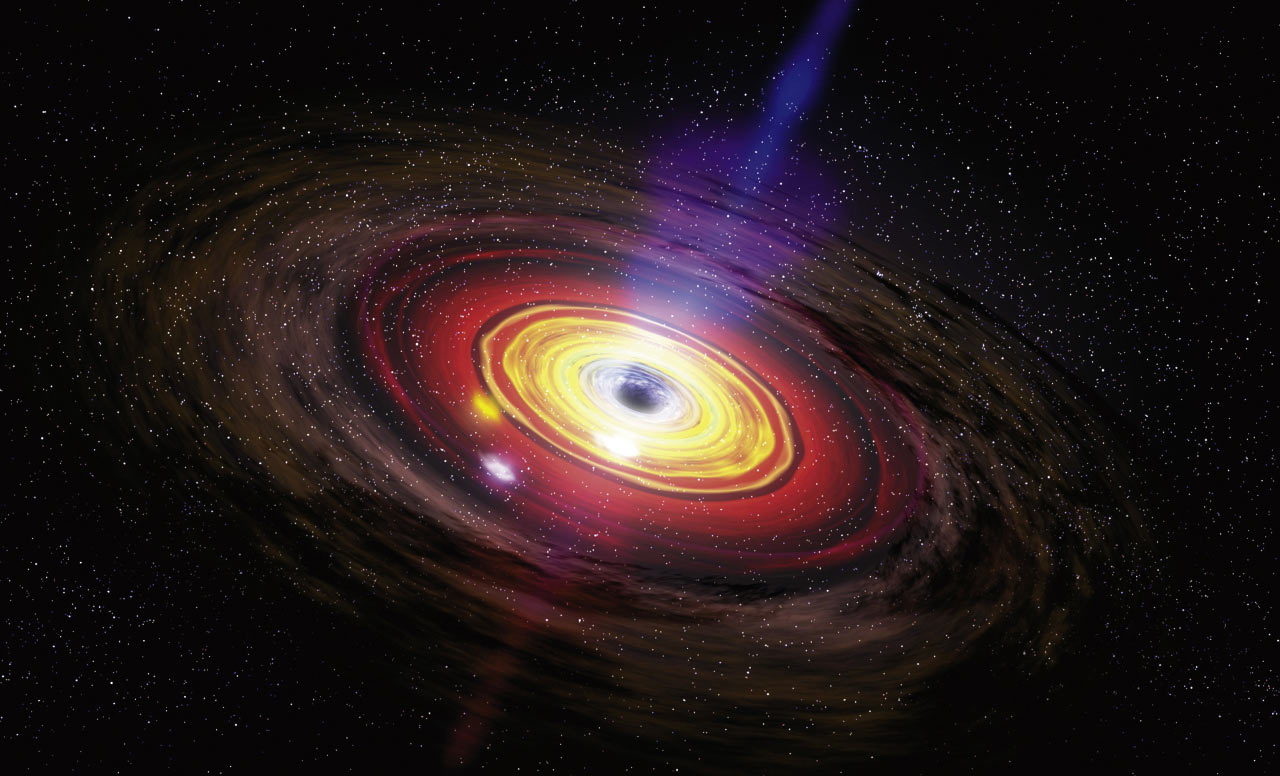
Space and time seems to vary in their characteristics with inertia of objects and particles. Therefore, we must consider space and time of objects and particles in terms of their inertia.

The primary forms of inertia are frequency (for a wave) and mass (for a particle).

In the wave-frequency form of inertia, inertial space is defined by the wavelength, and the inertial time is defined by the period of the wave.

As frequency decreases, the inertial space expands, and so does time. At the limiting frequency of zero, inertia also approaches zero. The space acts as the unlimited background of the Cosmos, against which finite extents of waves and particles could be viewed. The time also acts as the unlimited background against which the finite durations of waves and particles could be viewed.

The background of the Cosmos is characterized by unlimited extent of space and time. This background offers no inertia or resistance to change.

In the particle-mass form of inertia, the inertial space is defined by the shape, and the inertial time is defined by the duration, of the particle.

As mass increases, the inertial space contracts, and so does time. At the limiting value of infinite mass, inertia also becomes infinite. The space reduces to a point location against the background of the Cosmos. The time reduces to a completely durable state against a background that allows any change.

The content of the Cosmos is made up of waves and particles of varying extents, and durations. It offers inertia or resistance to change to various degrees.

.

The Scientific Observer

Reality1

Reference: What is Awareness, Scientifically?

In my opinion, the Theory of Relativity treats the “observer” as a human whose awareness is limited by the speed of light. The sense of time for this observer comes from watching the Sun move across the sky at a constant rate. From this sense he then perceives the rates of other changes in the universe.

The observer’s sense of rest comes from his motion relative to earth. That sense characterizes his frame of reference, which he then uses to estimate the rest mass of objects. In short, the concept of the frame of reference in the theory of relativity is tied to the characteristics of human awareness.

The Theory of Relativity is limited by a human-centric notion of awareness.

An observer is basically awareness. Awareness in reality is much broader than the limited notion of human awareness. In order to define awareness scientifically, let’s do the following thought experiment. Imagine being out there in the interstellar space, but with no stars or heavenly bodies around to provide any reference points. Pay attention to your motion.

You could be standing still or you could be moving at the speed of light. But you will find that there is no awareness of motion as long as it is uniform.  Awareness arises only when there is a change in motion that causes acceleration, and which immediately gives rise to inertial resistance.

Light that brings about awareness of other objects is made up of changing electrical and magnetic fields. Such changes are accompanied by inertial resistance as permittivity and permeability. Objects of awareness also consist of changing motion and accompanying inertia at atomic and molecular levels.

There are structures in the brain like visual cortex that are used to explain awareness. But the brain too is made up of neurons, electrical impulses, etc. that consists of changes in motion and inertial forces. So there is motion outside as well as inside the brain. Science is simply associating the motion inside the brain with awareness.

Thus awareness cannot be separated from inertial forces that are inherent to all phenomena. Human awareness is an instance of this. But, objectively, awareness, as inertial force, is present in all phenomena. It need not be defined in human terms.

Appearance of awareness of the characteristics of a phenomenon forms scientific observation. This is tied to the appearance of inertial forces. Every aspect of this universe is changing, and giving rise to inertial forces at all times. This is awareness, which is inherent to the universe. Both observer and observed are part of reality. There is no separate observer as such.

Science has been observing the universe from the viewpoint of the universe.

In this “frame of reference” the scientific observer is simultaneously aware of the whole universe. This awareness is not limited by the speed of light. The Scientific Observer can observe light creeping among stars. He can see earth rotating. He can see motion at all different scales.

Once we understand this universal “frame of reference” of the Scientific Observer, no other frame of reference is needed to explain things. In this frame of reference inherent uniform motion of an object is determined by its inertia. The uniform motion is restored whenever it is deviated from.

Though all aspects of the universe are continually changing, its overall energy and momentum are apparently constant. This condition “no change” means that the universe as a whole has infinite inertia and persistence. Since there is nothing beside the universe, the velocity of the universe may be assumed to be zero.

The scientific observer is inherently static and has infinite persistence like the universe.

The scientific observer derives its sense of motion and time from the frame of reference of the universe as a whole.

.
Abstract Thinking

mind5

Here is a description of an experiment in learning.

Today we had a student who came to the GED center for the first time. We started her on the self-learning pilot on MILESTONE A1: Numbers & Place Values.

Milestone A1 is written in very simple English. It consists of lots of pictures that explain the abstract concept of regrouping and the use of it to generate the numbering system. So it is very easy to understand. This is the most basic concept in math, so no other knowledge of math is required. Therefore, this pilot provides a measure of the learning ability of a student to grasp an abstract mathematical concept.

I started this student on the pilot. She seemed quite enthusiastic. She claimed that she had made it to the 12th grade but then failed the FCAT. So, I expected her to zip through Milestone A1.

Milestone A1 consists of 15 lessons. Usually I go over the first two lessons with the student to give an idea of how to proceed through rest of the milestone by oneself. I did the same with this student, then let her continue by herself, while keeping an eye on her.

She proceeded through the lessons fast. Then I found her stopped on lesson A1.7. She didn’t ask for help. She just sat there. So I went to help her. I checked her knowledge of lesson A1.5, because that is the key lesson on regrouping on which the understanding of all other lessons depend. She said that she understood it. But when I asked her to demonstrate regrouping on abacus, she couldn’t do it.

This is the common problem I am finding with school dropouts. They think that they know a concept but they really don’t. Asking them to demonstrate is a quick way to check their understanding. You cannot see what is going in their mind. But you can definitely see whether they can demonstrate a concept or not.

This student didn’t get the idea of regrouping on abacus despite the fact that the procedure of regrouping was clearly shown with pictures in Lesson A1.5. It took repeated demonstrations of regrouping on actual abacus for about 30 minutes before this student could get it. But this effort was worth it. After that, she was able to read and write numbers in millions and billions, and was quite happy about it.

.

You can improve your abstract thinking by learning to demonstrate abstract concepts using concrete elements. You may also use thought experiments to assure yourself of the consistency of the concept.

.