A person drops out of High School because he is faced with confusion in his schooling that seems to be increasing exponentially. He feels hopeless about learning. He can’t see any benefit from continuing in school. So he drops out.
What underlies that confusion are the holes in his understanding. There may be just a few holes in Kindergarten that, if not resolved, become significant by the end of the elementary school. Then, if they are still not addressed, they multiply and become substantial by the end of the middle school. Still not handled, these holes increase exponentially during the high school years until the student starts to drown in the resulting confusion.
The student’s attention is so fixed on the debilitating confusion that the underlying holes become invisible to him. He finds that the teachers and the after-school help are unable to help him with his confusion. All those lessons in the class he attends, just seem to add more to his confusion. He finds himself fighting a losing battle.
The student, and others trying to help him, focus on such holes “horizontally” at his grade level (see the graph above). But the solution does not lie in that direction. It lies in the direction of earlier grades. As you move down toward earlier education, the holes seem to merge into fewer holes. Thus, it becomes possible to trace all that confusion at the top to just a few holes at the bottom.
The cause of the massive confusion of a high school dropout is traceable to just a few holes in his early exposure to the subject.
.
The Difficulty
Will it be helpful if the student can make this logical connection between the confusion at the top to the holes at the bottom? Will he experience relief? That is the theory.
But, in general, the student is so overwhelmed by his present confusion that the holes from his early schooling are not visible to him. You cannot ask him to review the early parts of his schooling. This is unacceptable to him.
Yes, the cause of the confusion “at the top” can be traced to the holes “at the bottom,” but there is no way to trace it without the cooperation of the student. The path of confusion along which to trace the holes is locked inside the student. The student cannot access those holes on his own. One-on-one troubleshooting works but it takes time, and it is a hit and miss affair.
The student is so confused that he cannot trace the path from his confusions to the underlying holes in his earlier education.
.
The Possibility
All subjects start from some fundamental premise. From that premise a subject develops along logical lines. A good example is the subject of mathematics. Mathematics starts with counting, adding is “counting together,” subtraction is “reverse addition,” multiplication is “repeated addition,” division is “reverse multiplication,” and so it continues. When one talks about holes in understanding, one is really talking about missing grasp of a step in the logical structure of a subject.
A high school dropout cannot even describe what he needs help with, because he is pretty much confused about everything. When he needs help he cannot even put together his questions properly. He needs some firm context within which to formulate his questions. Maybe he can spot what he is missing if we present the outline of the subject to him in a logical sequence from its earliest premise.
The logical structure of a subject allows us to develop a context using which the student can discover the holes in his earlier education.
.
The Experiment
A series of lectures were designed to provide the student with a proper context so he could formulate his questions. The lectures, very simply, introduced the broad purpose and scope of mathematics. They described various parts of mathematics. Then within that context the common area of trouble was identified as fractions. The subject of fractions was then approached by defining the fractions broadly. Simple exercises were provided that focused on the logical structure of fractions.
This had an interesting effect on the students. They started to formulate questions about what was not clear to them. This was the start of a wonderful dialog that provided direction for subsequent lectures. The lectures followed the logical structure of mathematics while answering questions. From fractions, the lectures continued on division, factors, prime numbers, etc., and the interest of the students kept increasing and the questions kept coming.
As lectures continued on this journey of discovery the hopelessness of the students started to diminish. They were more interested. Actually, this increasing interest was the indicator that the lectures were tracing the confusion correctly. This led to the following solution.
The way to trace back the confusion is to generate a “Q &A” dialog that closely follows the logical structure of the subject.
.
The Proposal
The proposed solution is simple. Restructure the study materials at primary and middle school level such that they follow the logical structure of the subject. This was done for the subject of mathematics. Please see The Book of Mathematics.
So far these materials have been used in a private tutoring environment to handle student’s confusions at primary and middle school levels. The results have been fascinating. Not only the confusions of the students gets handled rapidly, they also become more interested in the subject of mathematics.
The approach used to develop these materials also led to the philosophy of Subject Clearing. One student who continued to be tutored through all four years of High School was also made familiar with the structured approach of subject clearing. Mathematics was his least favorite subject. He not only aced in Mathematics but in all other subjects as well. He truly developed confidence in his ability to learn.
.
The Solution
The solution, therefore, involves the following steps, which helps the student become a SELF-LEARNER.
(1) The development of study materials that are structured logically, and (2) Training the student in the use of Subject Clearing.
A self-learner is one who, on his own, can establish connection between his confusion and the relevant hole in his understanding. He can then proceed to fill that hole by searching for, and finding, the right material.
A self-learner knows how to clean up any confusion in real time so the holes don’t accumulate and become harder to handle later. His curiosity to learn, therefore, never diminishes, and he does not have to be pushed.
The effort of producing self-learners out of failing students may be organized into units called Self-Learning Clinics or SLCs. An SLC would be tasked with turning the “hopelessness about education” into an “eagerness to learn” within weeks.
More specifically,the purpose of a Self-Learning Clinic (SLC) is to help school drop-outs become effective self-learners.
The next step is to draw up a blueprint for the SLC in such a way that it becomes a reality with very little effort.
The above video provides an inspirational model for Self-Learning Clinics. This video consists of a beautiful talk given Pavi Mehta that provides a powerful business model based on the following three principles:
We can’t turn anyone away.
We can’t compromise on quality.
We must be self-reliant.
You may access the transcript of this talk at this link: Transcript.
.
Self-Learning Clinics
The idea of Self-Learning Clinics (SLCs) originated from the research outlined in The Future of Education.
An SLC is designed to help people use Subject Clearing. Subject Clearing helps a person resolve whatever contributed to their failure in certain subjects (including life), and sets them up to succeed in the subject they like.
The purpose of an SLC is to help school drop-outs become effective self-learners.SeeThe SLCPolicies.
An SLC supports people in their effort to apply subject clearing to themselves. Where possible, it shall participate in generating curricula, which is laid out in the sequence in which the fundamental concepts of a subject are developed logically. Here is an example of how fundamental may be presented simply and clearly: Numbers.
.
The Directives
The directives of SLCs are Dr. V’s unwritten directives as quoted from the above talk:
1. STAY ROOTED IN COMPASSION.
What he showed, he demonstrated that when skillfully channeled compassion can drive and dictate scale, efficiency, productivity, transparency, equality, inclusion. It can do all these things in such a way that each element reinforces the other and strengthens the whole. And it creates a finely tuned system which benefits everybody.
2. SERVE AND DESERVE.
When you make this your core. When the core of your energy and attention goes with serving unconditionally the boundaries of your perception shift and you start to see value and relevance in very unexpected places. You generate trust and goodwill. Your work fires a magnetic quality. It sustains and aligns resources to your mission in a way, which just money can’t do. CREATE MOVEMENT NOT DOMINANCE. Not all of us train our competitors. We should be part of something bigger to be generous to stand to benefit from that.
3. PRACTICE FOR PERFECT VISION.
This was something that Dr. V returned to over and over again. He knew that as there are external forms of blindness, so there are internal forms of blindness – anger, greed, jealousy. All these things clutter our vision and make it hard to see what is, and what the right next step is. So, he believed that the evolution of organizations hinges on the evolution of individuals within them. And clarity in thought and action comes from a discipline of mind and heart. And when you commit to sharpening your self-awareness and when you commit to working at the boundaries of your compassion then you tap into a higher wisdom which informs and transforms your work. You become a more perfect instrument for your highest quality.
The impossibility of the mathematical definition of dimensions. Why not mathematics sense dimensions? The entire conditionality of the representation of dimensions by powers. The possibility of representing all powers on a line. Kant and Lobachevsky. The difference between non-Euclidian geometry and metageometry, Where shall we find the explanation of the three-dimensionality of the world, if Kant’s ideas are true? Are not the conditions of the three-dimensionality of the world confined to our receptive apparatus, to our psyche?
.
Now that we have studied those “relations which our space itself bears within it” we shall return to the questions: But what in reality do the dimensions of space represent?—and why are there three of them?
The fact that it is impossible to define three-dimensionality mathematically must appear most strange.
Mathematics is the systematic treatment of magnitude, relationships between figures and forms, and relations between quantities expressed symbolically.
We are little conscious of this, and it seems to us a paradox, because we speak of the dimensions of space, but it remains a fact that mathematics does not sense the dimensions of space.
The question arises, how can such a fine instrument of analysis as mathematics not feel dimensions, if they represent some real properties of space.
Speaking of mathematics, it is necessary to recognize first of all, as a fundamental premise, that correspondent to each mathematical expression is always the relation of some realities.
If there is no such a thing, if it be not true—then there is no mathematics. This is its principal substance, its principal contents. To express the correlations of magnitudes, such is the problem of mathematics. But these correlations shall be between something. Instead of algebraical a, b and c it must be possible to substitute some reality. This is the ABC of all mathematics; a, b and c—these are credit bills, they can be good ones only if behind them there is a real something, and they can be counterfeited if behind them there is no reality whatever.
All mathematical terms must be defined precisely in real terms. A dimension represents the measure of a continuously varying characteristic of substance. Any characteristic that can be measured exists in a dimension. Length, width and height are different but interchangeable characteristics.
“Dimensions” play here a very strange role. If we designate them by the algebraic symbols a, b and c, they have the character of counterfeit credit bills. For this a, b and it is impossible to substitute any real magnitudes which are capable of expressing the correlations of dimensions.
Usually dimensions are represented by powers: the first, the second, the third; that is, if a line is called a, then a square, the sides of which are equal to this line, is called a2 , and a cube, the face of which is equal to this square, is called a3.
This among other things gave Hinton the foundation on which he constructed his theory of tesseracts, four-dimensional solids—a4. But this is “belles lettres” of the purest sort. First of all, because the representation of “dimensions” by powers is entirely conditional. It is possible to represent all powers on a line. For example, take the segment of a line equal to five millimeters; then a segment equal to twenty-five millimeters will be the square of it, i. e., a2; and a segment of one hundred and twenty-five millimeters will be the cube—a3.
How shall we understand that mathematics does not feel dimensions—that it is impossible to express mathematically the difference between dimensions?
It is possible to understand and explain it by one thing only namely, that this difference does not exist.
We really know that all three dimensions are in substance identical, that it is possible to regard each of the three dimensions either as following the sequence, the first, the second, the third, or the other way about. This alone proves that dimensions are not mathematical magnitudes. All the real properties of a thing can be expressed mathematically as quantities, i.e., numbers, showing the relation of these properties to other properties.
But in the matter of dimensions it is as though mathematics sees more than we do, or farther than we do, through some boundaries which arrest us but not it—and sees that no realities whatever correspond to our concepts of dimensions.
If the three dimensions really corresponded to three powers, then we would have the right to say that only these three powers refer to geometry, and that all the other higher powers, beginning with the fourth, lie beyond geometry.
But even this is denied us. The representation of dimensions by powers is perfectly arbitrary.
These powers are the measures of length, surface and volume, which are represented by different units. Representing them on the same line is arbitrary.
More accurately, geometry, from the standpoint of mathematics, is an artificial system for the solving of problems based on conditional data, deduced, probably, from the properties of our psyche.
The system of investigation of “higher space” Hinton calls metageometry, and with metageometry he connects the names of Lobachevsky, Gauss, and other investigators of non-Euclidian geometry.
We shall now consider in what relation the questions touched upon by us stand to the theories of these scientists.
Hinton deduces his ideas from Kant and Lobachevsky.
Others, on the contrary, place Kant’s ideas in opposition to those of Lobachevsky. Thus Roberto Bonola, in “Non-Euclidian Geometry,” declares that Lobachevsky’s conception of space is contrary to that of Kant. He says:
The Kantian doctrine considered space as a subjective intuition, a necessary presupposition of every experience. Lobachevsky’s doctrine was rather allied to sensualism and the current empiricism, and compelled geometry to take its place again among the experimental sciences.
Which of these views is true, and in what relation do Lobachevsky’s ideas stand to our problem? The correct answer to this question is: in no relation. Non-Euclidian geometry is not metageometry, and non-Euclidian geometry stands in the same relation to metageometry as Euclidian geometry itself.
The results of non-Euclidian geometry, which have submitted the fundamental axioms of Euclid to a revaluation, and which have found the most complete expression in the works of Bolyai, Gauss, and Lobachevsky, are embraced in the formula:
The axioms of a given geometry express the properties of a given space.
Thus geometry on the plane accepts all three Euclidian axioms, i.e.:
A straight line is the shortest distance between two points.
Any figure may be transferred into another position without changing its properties.
Parallel lines do not meet.
(This last axiom is formulated differently by Euclid.)
In geometry on a sphere, or on a concave surface the first two axioms alone are true, because the meridians which are separated at the equator meet at the poles.
Plane geometry is different from geometry on a curved surface.
In geometry on the surface of irregular curvature only the first axiom is true—the second, regarding the transference of figures, is impossible because the figure taken in one part of an irregular surface can change when transferred into another place. Also, the sum of the angles of a triangle can be either more or less than two right angles.
Therefore, axioms express the difference of properties of various kinds of surfaces.
A geometrical axiom is a law of a given surface.
But what is a surface?
Lobachevsky’s merit consists in that he found it necessary to revise the fundamental concepts of geometry. But he never went as far as to revalue these concepts from Kant’s standpoint. At the same time he is in no sense contradictory to Kant. A surface in the mind of Lobachevsky, as a geometrician, was only a means for the generalization of certain properties on which this or that geometrical system was constructed, or the generalization of the properties of certain given lines. About the reality or the unreality of a surface, he probably never thought.
Thus on the one hand, Bonola, who ascribed to Lobachevsky views opposite to Kant, and their nearness to “sensualism” and “current empiricism,” is quite wrong, while on the other hand, it is not impossible to conceive that Hinton entirely subjectively ascribes to Gauss and Lobachevsky their inauguration of a new era in philosophy.
Non-Euclidian geometry, including that of Lobachevsky, has no relation to metageometry whatever.
Lobachevsky does not go outside of the three-dimensional sphere.
Metageometry regards the three-dimensional sphere as a section of higher space. Among mathematicians, Riemann, who understood the relation of time to space, was nearest of all to this idea.
The point of three-dimensional space is a section of a metageometrical line. It is impossible to generalize on any surface whatever the lines considered in metageometry. Perhaps this last is the most important for the definition of the difference between geometries (Euclidian and non-Euclidian and metageometry). It is impossible to regard metageometrical lines as distances between points in our space, and it is impossible to represent them as forming any figures in our space.
The consideration of the possible properties of lines lying out of our space, the relation of these lines and their angles to the lines, angles, surfaces and solids of our geometry, forms the subject of metageometry.
The above is an explanation of metageometry. This can be visualized by looking at the relationship of a time-line with lines in space.
The investigators of non-Euclidian geometry could not bring themselves to reject the consideration of surfaces. There is something almost tragic in this. See what surfaces Beltrami invented in his investigations of non-Euclidian geometry—one of his surfaces resembles the surface of a ventilator, another, the surface of a funnel. But he could not decide to reject the surface, to cast it aside once and for all, to imagine that the line can be independent of the surface, i.e., a series of lines which are parallel or nearly parallel cannot be generalized on any surface, or even in three-dimensional space.
And because of this, both he and many other geometers, developing non-Euclidian geometry, could not transcend the three-dimensional world.
Mechanics recognizes the line in time, i.e., such a line as it is impossible by any means to imagine upon the surface, or as the distance between the two points of space. This line is taken into consideration in the calculations pertaining to machines. But geometry never touched this line, and dealt always with its sections only.
The first three dimensions are considered independent of each other, but they are not totally, because they are identical with each other and can be projected on each other. But this is not the case with the fourth dimension of time.
.
Now it is possible to return to the question: what is space? and to discover if the answer to this question has been found.
The answer would be the exact definition and explanation of the three-dimensionality of space as a property of the world.
But this is not the answer. The three-dimensionality of space as an objective phenomenon remains just as enigmatical and inconceivable as before. In relation to three-dimensionality it is necessary:
Either to accept it as a thing given, and to add this to the two data which we established in the beginning:
Or to recognize the fallacy of all objective methods of reasoning, and return to another method, outlined in the beginning of the book.
The question of objectivity and subjectivity disappears when we recognize that thought is also a substance that is sensed mentally. In other words, thought and consciousness are as much a part of the world as radiation and matter. Detached from the world is a uniform awareness that is not identified with anything in the world. Awareness is a dimension independent of the world, whereas, consciousness is not independent of the world.
Then, on the basis of the two fundamental data, the world and consciousness, it is necessary to establish whether three-dimensional space is a property of the world, or a property of our knowledge of the world.
Beginning with Kant, who affirms that space is a property of the receptivity of the world by our consciousness, I intentionally deviated far from this idea and regarded space as a property of the world.
Space is obviously the extent of substance, when it is treated in geometry as “space filled by matter”. We can also look at the empty space as “space filled by thought”, when we recognize thought also as a substance. This establishes space as a property of the world, and not a property of our senses. This contradicts Kant because Kant didn’t look at thought as a substance.
Along with Hinton, I postulated that our space itself bears within it the relations which permit us to establish its relations to higher space, and on the foundation of this postulate I built a whole series of analogies which somewhat clarified for us the problems of space and time and their mutual co-relations; but which, as was said, did not explain anything concerning the principal question of the causes of the three-dimensionality of space.
Three-dimensionality is how mathematics interprets space assumed to be filled by matter. It works for the material world.
The method of analogies is, generally speaking, a rather tormenting thing. With it, you walk in a vicious circle. It helps you to elucidate certain things, and the relations of certain things, but in substance it never gives a direct answer to anything. After many and long attempts to analyze complex problems by the aid of the method of analogies, you feel the uselessness of all your efforts; you feel that you are walking alongside of a wall. And then you begin to experience simply a hatred and aversion for analogies, and you find it necessary to search in the direct way which leads where you need to go.
The problem of higher dimensions has usually been analyzed by the method of analogies, and only very lately has science begun to elaborate that direct method, which will be shown later on.
What has been missing is the definition and dimension of substance. By definition, substance is anything substantial enough to be sensed. The dimension of substance is the continuity from matter to radiation to thought.
If we desire to go straight, without deviating, we shall keep strictly up to the fundamental propositions of Kant. But if we formulate Hinton’s above mentioned thought from the point of view of these propositions, it will be as follows: We bear within ourselves the conditions of our space, and therefore within ourselves we shall find the conditions which will permit us to establish correlations between our space and higher space.
In other words, we shall find the conditions of the three-dimensionality of the world in our psyche, in our receptive apparatus and shall find exactly there the conditions of the possibility of the higher dimensional world.
Boundaries of space essentially provide the extents of thought. We do not have to identify with that thought. It is out there just like matter is. We simply have to keep on discovering what more is there.
Propounding the problem in this way, we put ourselves upon the direct path, and we shall receive an answer to our question, what is space and its three-dimensionality?
How may we approach the solution of this problem?
Plainly, by studying our consciousness and its properties.
We shall free ourselves from any analogies, and shall enter upon the correct and direct path toward the solution of the fundamental question about the objectivity or subjectivity of space, if we shall decide to study the psychical forms by which we perceive the world, and to discover if there does not exist a correspondence between them and the three-dimensionality of the world—that is, if the three-dimensional extension of space, with its properties, does not result from properties of the psyche which are known to us.
The consciousness that we are identifying with is a part of this world; and so is the subconsciousness. We simply have to investigate it.
Methods of investigation of the problem of higher dimensions. The analogy between imaginary worlds of different dimensions. The one-dimensional world on a line. “Space” and “time” of a one-dimensional being. The two-dimensional world on a plane. “Space” and “time,” “ether,” “matter” and “motion” of a two-dimensional being. Reality and illusion on a plane. The impossibility of seeing an “angle.” An angle as motion. The incomprehensibility to a two-dimensional being of the functions of things in our world. Phenomena and noumena of a two-dimensional being. How could a plane being comprehend the third dimension?
.
A series of analogies and comparisons are used for the definition of that which can be, and that which cannot be, in the region of the higher dimension. Fechner, Hinton, and many others employ this method.
They imagine “worlds” of one, and of two dimensions, and out of the relations of lower-dimensional worlds to higher ones they deduce possible relations of our world to one of four dimensions; just as out of the relations of points to lines, of lines to surfaces, and of surfaces to solids we deduce the relations of our solids to four-dimensional ones.
Reality is made of dimensions. A dimension can always be represented by a scale that can be used for quantitative measures or qualitative assessments of some property.
Let us try to investigate everything that this method of analogy can yield.
Let us imagine a world of one dimension.
It will be a line. Upon this line let us imagine living beings. Upon this line, which represents the universe for them, they will be able to move forward and backward only, and these beings will be as the points, or segments of a line. Nothing will exist for them outside their line—and they will not be aware of the line upon which they are living and moving. For there will exist only two points, ahead and behind, or may be just one point ahead. Noticing the change in states of these points, the one-dimensional being will call these changes phenomena. If we suppose the line upon which the one-dimensional being lives to be passing through the different objects of our world, then of all these objects the one-dimensional being will perceive one point only; if different bodies intersect his line, the one-dimensional being will sense them only as the appearance, the more or less prolonged existence, and the disappearance of a point. This appearance, existence, and disappearance of a point will constitute a phenomenon. Phenomena, according to the character and properties of passing objects and the velocity and properties of their motions, for the one-dimensional being will be constant or variable, long or short-timed, periodical or unperiodical. But the one-dimensional being will be absolutely unable to understand or explain the constancy or variability, the duration or brevity, the periodicity or unperiodicity of the phenomena of his world, and will regard them simply as properties pertaining to them. The solids intersecting his line may be different, but for the one-dimensional being all phenomena will be absolutely identical—just the appearance or the disappearance of a point—and phenomena will differ only in duration and greater or less periodicity.
Here change and the dimension of time is being assumed to exist in the one-dimensional universe. A one-dimensional being will always be obstructed by another one-dimensional being and objects if he is not able to pass through them. This is a mathematical scenario and not a real one.
Such strange monotony and similarity of the diverse and heterogeneous phenomena of our world will be the characteristic peculiarity of the one-dimensional world.
Moreover, if we assume that the one-dimensional being possesses memory, it is clear that recalling all the points seen by him as phenomena, he will refer them to time. The point which was: this is the phenomenon already non-existent, and the point which may appear tomorrow: this is the phenomenon which does not exist yet. All of our space except one line will be in the category of time, i.e., something wherefrom phenomena come and into which they disappear. And the one-dimensional being will declare that the idea of time arises for him out of the observation of motion, that is to say, out of the appearance and disappearance of points. These will be considered as temporal phenomena, beginning at that moment when they become visible, and ending ceasing to exist—at that moment when they become invisible. The one-dimensional being will not be in a position to imagine that the phenomenon goes on existing somewhere, though invisibly to him; or he will imagine it as existing somewhere on his line, far ahead of him.
From our viewpoint, the one-dimensional being shall be struggling with many anomalies.
We can imagine this one-dimensional being more vividly. Let us take an atom, hovering in space, or simply a particle of dust, carried along by the air, and let us imagine that this atom or partide of dust possesses a consciousness, i.e., separates himself from the outside world, and is conscious only of that which lies in the line of his motion, and with which he himself comes in contact. He will then be a one-dimensional being in the full sense of the word. He can fly and move in all directions, but it will always seem to him that he is moving upon a single line; outside of this line will be for him only great Nothingness—the whole universe will appear to him as one line. He will feel none of the turns and angles of his line, for to feel an angle it is necessary to be conscious of that which lies to right or left, above or below. In all other respects such a being will be absolutely identical with the before-described imaginary being living upon the imaginary line. Everything that he comes in contact with, that is, everything that he is conscious of, will seem to him to be emerging from time, i.e., from nothing, and vanishing into time, i.e., into nothing. This nothing will be all our world. All our world except one line will be called time and will be counted as actually non-existent.
Everything that a one-dimensional being comes in contact with will seem to him to be simply appearing and disappearing. If things are appearing and disappearing in our universe, we may conclude that they are moving in a dimension we are not aware of.
.
Let us next consider the two-dimensional world, and the being living on a plane. The universe of this being will be one great plane. Let us imagine beings on this plane having the shape of points, lines, and flat geometrical figures. The objects and “solids” of that world will have the shape of flat geometrical figures too.
In what manner will a being living on such a plane universe cognize his world?
First of all we can affirm that he will not feel the plane upon which he lives. He will not do so because he will feel the objects, i.e., figures, which are on this plane. He will feel the lines which limit them, and for this reason he will not feel his plane, for in that case he would not be in a position to discern the lines. The lines will differ from the plane in that they produce sensations; therefore they exist. The plane does not produce sensations; therefore it does not exist. Moving on the plane, the two-dimensional being, feeling no sensations, will declare that nothing now exists. After having encountered some figure, having sensed its lines, he will say that something appeared. But gradually, by a process of reasoning, the two-dimensional being will come to the conclusion that the figures he encounters exist on something, or in something.
Here the author is making an assumption that empty space cannot be sensed, only matter in space can be sensed. But we can sense empty space. It is filled either with radiation or thought, or both.
Thereupon he may name such a plane (he will not know, indeed, that it is a plane) the “ether.” Accordingly he will declare that the “ether” fills all space, but differs in its qualities from “matter.” By “matter” he will mean lines. Having come to this conclusion the two-dimensional being will regard all processes as happening in his “ether,” i.e., in his space. He will not be in a position to imagine anything outside of this ether, that is, out of his plane. If anything, proceeding out of his plane, comes in contact with his consciousness, then he will either deny it, or regard it as something subjective, the creation of his own imagination, or else he will believe that it is proceeding right on the plane, in the ether, as are all other phenomena.
The “ether” may be a description for thought.
Sensing lines only, the plane being will not sense them as we do. First of all, he will see no angle. It is extremely easy for us to verify this by experiment. If we will hold before our eyes two matches, inclined one to the other in a horizontal plane, then we shall see one line. To see the angle we shall have to look from above. The two-dimensional being cannot look from above and therefore cannot see the angle. But measuring the distance between the lines of different “solids” of his world, the two-dimensional being will come continually in contact with the angle, and he will regard it as a strange property of the line, which is sometimes manifest and sometimes is not. That is, he will refer the angle to time, he will regard it as a temporary, evanescent phenomenon, a change in the state of a “solid,” or as motion. It is difficult for us to understand this. It is difficult to imagine how the angle can be regarded as motion. But it must be absolutely so, and cannot be otherwise. If we try to represent to ourselves how the plane being studies the square, then certainly we shall find that for the plane being the square will be a moving body. Let us imagine that the plane being is opposite one of the angles of the square. He does not see the angle—before him is a line, but a line possessing very curious properties. Approaching this line, the two-dimensional being observes that a strange thing is happening to the line. One point remains in the same position, and other points are withdrawing back from both sides. We repeat, that the two-dimensional being has no idea of an angle. Apparently the line remains the same as it was, yet something is happening to it, without a doubt. The plane being will say that the line is moving, but so rapidly as to be imperceptible to sight. If the plane being goes away from the angle and follows along a side of the square, then the side will become immobile. When he comes to the angle, he will notice the motion again. After going around the square several times, he will establish the fact of regular, periodical motions of the line. Quite probably in the mind of the plane being the square will assume the form of a body possessing the property of periodical motions, invisible to the eye, but producing definite physical effects (molecular motion)—or it will remain there as a perception of periodical moments of rest and motion in one complex line, and still more probably it will seem to be a rotating body.
Quite possibly the plane being will regard the angle as his own subjective perception, and will doubt whether any objective reality corresponds to this subjective perception. Nevertheless he will reflect that if there is action, yielding to measurement, so must there be the cause of it, consisting in the change of the state of the line, i.e., in motion.
The lines visible to the plane being he may call matter, and the angles—motion. That is, he may call the broken line with an angle, moving matter. And truly to him such a line by reason of its properties will be quite analogous to matter in motion.
When consciousness is limited to a fewer number of dimensions, its focus becomes narrow. It is unable to look at reality as a whole. So it looks at part of reality one moment at a time. This creates the illusion of motion.
If a cube were to rest upon the plane upon which the plane being lives, then this cube will not exist for the two-dimensional being, but only the square face of the cube in contact with the plane will exist for him—as a line, with periodical motions. Correspondingly, all other solids lying outside of his plane, in contact with it, or passing through it, will not exist for the plane being. The planes of contact or cross-sections of these bodies will alone be sensed. But if these planes or sections move or change, then the two-dimensional being will think, indeed, that the cause of the change or motion is in the bodies themselves, i.e., right there on his plane.
As has been said, the two-dimensional being will regard the straight lines only as immobile matter; irregular lines and curves will seem to him as moving. So far as really moving lines are concerned, that is, lines limiting the cross sections or planes of contact passing through, or moving along the plane, these will be for the two-dimensional being something inconceivable and incommensurable. It will be as though there were in them the presence of something independent, depending upon itself only, animated. This effect will proceed from two causes: He can measure the immobile angles and curves, the properties of which the two-dimensional being calls motion, for the reason that they are immobile; moving figures, on the contrary, he cannot measure, because the changes in them will be out of his control. These changes will depend upon the properties of the whole body and its motion, and of that whole body the two-dimensional being will know only one side or section. Not perceiving the existence of this body, and contemplating the motion pertaining to the sides and sections he probably will regard them as living beings. He will affirm that there is something in them which differentiates them from other bodies: vital energy, or even soul. That something will be regarded as inconceivable, and really will be inconceivable to the two-dimensional being, because to him it is the result of an incomprehensible motion of inconceivable solids.
If we imagine an immobile circle upon the plane, then for the two-dimensional being it will appear as a moving line with some very strange and to him inconceivable motions.
The two-dimensional being will never see that motion. Perhaps he will call such motion molecular motion, i.e., the movement of minutest invisible particles of “matter.”
Moreover, a circle rotating around an axis passing through its center for the two-dimensional being will differ in some inconceivable way from the immobile circle. Both will appear to be moving, but moving differently.
For the two-dimensional being a circle or a square, rotating around its center, on account of its double motion will be an inexplicable and incommensurable phenomenon, like a phenomenon of life for a modern physicist.
Therefore, for a two-dimensional being, a straight line will be immobile matter; a broken or a curved line—matter in motion; and a moving line—living matter.
The center of a circle or a square will be inaccessible to the plane being, just as the center of a sphere or of a cube made of solid matter is inaccessible to us—and for the two-dimensional being even the idea of a center will be incomprehensible, since he possesses no idea of a center.
Having no idea of phenomena proceeding outside of the plane that is, out of his “space”—the plane being will think of all phenomena as proceeding on his plane as has been stated. And all phenomena which he regards as proceeding on his plane, he will consider as being in causal interdependence one with another: that is, he will think that one phenomenon is the effect of another which has happened right there, and the cause of a third which will happen right on the same plane.
If a multi-colored cube passes through the plane, the plane being will perceive the entire cube and its motion as a change in the color of lines lying in the plane. Thus, if a blue line replaces a red one, then the plane being will regard the red line as a past event. He will not be in a position to realize the idea that the red line is still existing somewhere. He will say that the line is single, but that it becomes blue as a consequence of certain causes of a physical character. If the cube moves backward so that the red line appears again after the blue one, then for the two-dimensional being this will constitute a new phenomenon. He will say that the line became red again.
For the being living on a plane, everything above and below (if the plane be horizontal), and on the right or left (if the plane be vertical) will be existing in time, in the past and in the future that which in reality is located outside of the plane will be regarded as non-existent, either as that which is already past, i.e., as something which has disappeared, ceased to be, will never return, or as in the future, i.e., as not existent, not manifested, as a thing in potentiality.
For a two-dimensional being the reality shall be very different. The higher dimensions shall appear subjective. He will not have the whole picture. He will then succumb to speculations.
.
Let us imagine that a wheel with the spokes painted different colors is rotating through the plane upon which the plane-being lives. To such a being all the motion of the wheel will appear as a variation of the color of the line of intersection of the wheel and the plane. The plane being will call this variation of the color of the line a phenomenon, and observing these phenomena he will notice in them a certain succession. He will know that the black line is followed by the white one, the white by the blue, the blue by the red, and so on. If simultaneously with the appearance of the white line some other phenomenon occurs—say the ringing of a bell—the two-dimensional being will say that the white line is the cause of that ringing. The change of the color of the lines, in the opinion of the two-dimensional being, will depend on causes lying right in his plane. Any presupposition of the possibility of the existence of causes lying outside of the plane he will characterize as fantastic and entirely unscientific. It will seem so to him because he will never be in a position to represent the wheel to himself, i.e., the parts of the wheel on both sides of the plane. After a rough study of the color of the lines, and knowing the order of their sequence, the plane being, perceiving one of them, say the blue one, will think that the black and the white ones have already passed, i.e., disappeared, ceased to exist, gone into the past; and that those lines which have not yet appeared—the yellow, the green, and so on, and the new white and black ones still to come—do not yet exist, but lie in the future.
Therefore, though not conceiving the form of his universe, and regarding it as infinite in all directions, the plane being will nevertheless involuntarily think of the past as situated somewhere at one side of all, and of the future as somewhere at the other side of this totality. In such manner will the plane being conceive of the idea of time. We see that this idea arises because the two-dimensional being senses only two out of three dimensions of space; the third dimension he senses only after its effects become manifest upon the plane, and therefore he regards it as something different from the first two dimensions of space, calling it time.
What appears and disappears in awareness is assigned to the dimension of time, but it may belong to a dimension that is yet to be identified. Things appear and disappear because a limited consciousness is scanning the landscape of reality.
.
Now let us imagine that through the plane upon which the two-dimensional being lives, two wheels with multi-colored spokes are rotating and are rotating in opposite directions. The spokes of one wheel come from above and go below; the spokes of the other come from below and go above.
The plane being will never notice it.
He will never notice that where for one line (which he sees) there lies the past—for another line there lies the future. This thought will never even come into his head, because he will conceive of the past and the future very confusedly, regarding them as concepts, not as actual facts. But at the same time he will be firmly convinced that the past goes in one direction, and the future in another. Therefore it will seem to him a wild absurdity that on one side something past and something future can lie together, and on another side—and also beside these two—something future and something past. To the plane being the idea that some phenomena come whence others go, and vice versa, will seem equally absurd. He will tenaciously think that the future is that wherefrom everything comes, and the past is that whereto everything goes and wherefrom nothing returns. He will be totally unable to understand that events may arise from the past just as they do from the future.
Thus we see that the plane being will regard the changes of color of the lines lying on the plane very naively. The appearance of different spokes he will regard as the change of color of one and the same line, and the repeated appearance of the same colored spoke he will regard every time as a new appearance of a given color.
But nevertheless, having noticed periodicity in the change of the color of the lines upon the surface, having remembered the order of their appearance, and having learned to define the “time” of the appearance of certain spokes in relation to some other more constant phenomenon, the plane being will be in a position to foretell the change of the line from one color to another. Thereupon he will say that he has studied this phenomenon, that he can apply to it “the mathematical method”—can “calculate it.”
Past and future become part of our knowledge (assimilated sensations). Consciousness becomes limited when we don’t take knowledge into account.
.
If we ourselves enter the world of plane-beings, then its inhabitants will sense the lines limiting the sections of our bodies. These sections will be for them living beings; they will not know from whence they appear, why they alter, or whither they disappear in such a miraculous manner. So also, the sections of all our inanimate but moving objects will seem independent living beings.
If the consciousness of a plane being should suspect our existence, and should come into some sort of communion with our consciousness, then to him we would appear as higher, omniscient, possibly omnipotent, but above all incomprehensible beings of a quite inconceivable category.
We could see his world just as it is, and not as it seems to him. We could see the past and the future; could foretell, direct and even create events. We could know the very substance of things—could know what “matter” (the straight line) is, what “motion” (the broken line, the curve, the angle) is. We could see an angle, and we could see a center. All this would give us an enormous advantage over the two-dimensional being.
In all of the phenomena of the world of the two-dimensional being we could see considerably more than he sees—or could see quite other things than he.
And we could tell him very much that was new, amazing, and unexpected about the phenomena of his world—provided, indeed, that he could hear us and understand us.
First of all we could tell him that what he regards as phenomena—angles and curves, for instance—are properties of higher figures; that other “phenomena” of his world are not phenomena, but only “parts” or “sections” of phenomena; that what he calls “solids” are only sections of solids,—and many more things besides.
We should be able to tell him that on both sides of his plane (i.e., of his space or ether) lies infinite space (which the plane being calls time) ; and that in this space lie the causes of all his phenomena, and the phenomena themselves, the past as well as the future ones; moreover, we might add that “phenomena” themselves are not something happening and then ceasing to be, but combinations of properties of higher solids.
But we should experience considerable difficulty in explaining anything to the plane being; and it would be very difficult for him to understand us. First of all it would be difficult because he would not have the concepts corresponding to our concepts. He would lack necessary “words.”
For instance, “section”—this would be for him a quite new and inconceivable word; then ” angle”—again an inconceivable word; “center”—still more inconceivable; the third perpendicular —something incomprehensible, lying outside of his geometry.
The fallacy of his conception of time would be the most difficult thing for the plane being to understand. He could never understand that which has passed and that which is to be are existing simultaneously on the lines perpendicular to his plane. And he could never conceive the idea that the past is identical with the future, because phenomena come from both sides and go in both directions.
There is a lot of mystery when there is an unknown dimension. When the being becomes aware of this additional dimension, he displays much greater consciousness. But he would have to learn new concepts to have this awareness.
But the most difficult thing for the plane being would be to conceive the idea that “time” includes in itself two ideas: the idea of space, and the idea of motion upon this space.
We have shown that what the two-dimensional being living on the plane calls motion has for us quite a different aspect.
Motion occurs when the measurement on a dimension changes. Thus, motion can occur in the dimension of time itself. Change and time are two different concepts.
In his book “The Fourth Dimension,” under the heading “The First Chapter in the History of Four-space,” Hinton writes:
Parmenides, and the Asiatic thinkers with whom he is in close affinity, propound a theory of existence which is in close accord with a conception of a possible relation between a higher and lower dimensional space. . . It is one which in all ages has had a strong attraction for pure intellect, and is the natural mode of thought for those who refrain from projecting their own volition into nature under the guise of causality.
According to Parmenides of the school of Elea the all is one, unmoving and unchanging. The permanent amid the transient—that foothold for thought, that solid ground for feeling, on the discovery of which depends all our life—is no phantom; it is the image amidst deception of true being, the eternal, the unmoved, the one. Thus says Parmenides.
But how is it possible to explain the shifting scene, these mutations of things?
“Illusion,” answers Parmenides. Distinguishing between truth and error, he tells of the true doctrine of the one—the false opinion of a changing world. He is no less memorable for the manner of his advocacy than for the cause he advocates.
Can the mind conceive a more delightful intellectual picture than that of Parmenides pointing to the one, the true, the unchanging, and yet on the other hand ready to discuss all manner of false opinion ! . .
In support of the true opinion he proceeded by the negative way of showing the self-contradictions in the ideas of change and motion. . . To express his doctrine in the ponderous modern way we must make the statement that motion is phenomenal, not real.
Let us represent his doctrine.
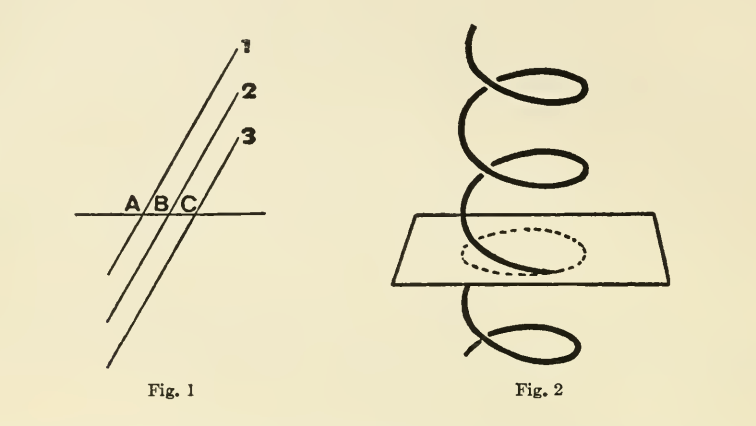
Imagine a sheet of still water into which a slanting stick is being lowered with a motion vertically downwards. Let 1, 2, 3, (Fig. 1), be three consecutive positions of the stick. A, B, C will be three connective positions of the meeting of the stick with the surface of the water. As the stick passes down, the meeting will move from A on to B and C.
Suppose now all the water to be removed except a film. At the meeting of the film and the stick there will be an interruption of the film. If we suppose the film to have a property, like that of a soap bubble, of closing up round any penetrating object, then as the stick goes vertically downwards the interruption in the film will move on. If we pass a spiral through the film the intersection will give a point moving in a circle (shown by the dotted lines in Fig. 2).
For the plane being such a point, moving in a circle in its plane, would probably constitute a cosmical phenomenon, something like the motion of a planet in its orbit.
Suppose now the spiral to be still and the film to move vertically upward, the whole spiral will be represented in the film in the consecutive positions of the point of intersection.
If instead of one spiral we take a complicated construction consisting of spirals, inclined, and straight lines, broken and curved lines, and if the film move vertically upwards we shall have an entire universe of moving points the movements of which will appear to the plane being as original.
The plane being will explain these movements as depending one upon another, and indeed he will never happen to think that these movements are fictitious and are dependent upon the spirals and other lines lying outside his space.
Oneness is a principle. It means if one part of the whole changes, then other parts of the whole also must change to maintain oneness. Oneness is constant as a principle. That doesn’t mean that changes cannot occur. Changes occur while maintaining the oneness of the whole. Therefore, change is not an illusion as Parmenides thought.
Returning to the plane being and his perception of the world, and analyzing his relations to the three-dimensional world, we see that for the two-dimensional or plane being it will be very difficult to understand all the complexity of the phenomena of our world, as it appears to us. He (the plane being) is accustomed to perceive the world as being too simple.
Taking into consideration the sections of figures instead of the figures themselves, the plane being will compare them in relation to their length and their greater or lesser curvature, i.e., their for him more or less rapid motion.
The differences between the objects of our world, as they exist for us he would not understand. The functions of the objects of our world would be completely mysterious to his mind—incomprehensible, “supernatural.”
Let us imagine that a coin, and a candle the diameter of which is equal to that of the coin, are on the plane upon which the twodimensional being lives. To the plane being they will seem two equal circles, i.e., two moving, and absolutely identical lines; he will never discover any difference between them. The functions of the coin and of the candle in our world—these are for him absolutely a terra incognita. If we try to imagine what an enormous evolution the plane being must pass through in order to understand the function of the coin and of the candle and the difference between these functions, we will understand the nature of the division between the plane world and the world of three dimensions, and the complete impossibility of even imagining, on the plane, anything at all like the three-dimensional world, with its manifoldness of function.
The properties of the phenomena of the plane world will be extremely monotonous; they will differ by the order of their appearance, their duration, and their periodicity. Solids, and the things of this world will be flat and uniform, like shadows, i.e., like the shadows of quite different solids, which seem to us uniform. Even if the plane being could come in contact with our consciousness, he would never be in a position to understand all the manifoldness and richness of the phenomena of our world and the variety of function of the things of that world.
Plane beings would not be in a position to master our most ordinary concepts.
It would be extremely difficult for them to understand that phenomena, identical for them, are in reality different; and on the other hand, that phenomena quite separate for them are in reality parts of one great phenomenon, and even of one object or one being.
A new basic dimension can bring a lot more complexity to the world.
This last will be one of the most difficult things for the plane being to understand. If we imagine our plane being to be inhabiting a horizontal plane, intersecting the top of a tree, and parallel to the surface of the earth, then for such a being each of the various sections of the branches will appear as a quite separate phenomenon or object. The idea of the tree and its branches will never occur to him.
Generally speaking, the understanding of the most fundamental and simple things of our world will be infinitely long and difficult to the plane being. He would have to entirely reconstruct his concepts of space and time. This would be the first step. Unless it is taken, nothing is accomplished. Until the plane being will imagine all our universe as existing in time, i.e., until he refers to time everything lying on both sides of his plane, he will never understand anything. In order to begin to understand “the third dimension” the inhabitant of the plane must conceive of his time concepts spatially, that is, translate his time into space.
Past, present and future is incorrectly associated with time. They are really a part of present knowledge.
To achieve even the spark of a true understanding of our world he will have to reconstruct completely all his ideas to revaluate all values, to revise all concepts, to dissever the uniting concepts, to unite those which are dissevered; and, what is most important, to create an infinite number of new ones.
If we put down the five fingers of one hand on the plane of the two-dimensional being they will be for him five separate phenomena.
Let us try to imagine what an enormous mental evolution he would have to undergo in order to understand that these five separate phenomena on his plane are the finger-tips of the hand of a large, active and intelligent being—man.
To make out, step by step, how the plane being would attain to an understanding of our world, lying in the region of the to him mysterious third dimension—i.e., partly in the past, partly in the future—would be interesting in the highest degree. First of all, in order to understand the world of three dimensions, he must cease to be two dimensional—he must become three dimensional himself or, in other words, he must feel an interest in the life of three-dimensional space. After having felt the interest of this life, he will by so doing transcend his plane, and will never be in a position thereafter to return to it. Entering more and more within the circle of ideas and concepts which were entirely incomprehensible to him before, he will have already become, not two-dimensional, but three-dimensional. But all along the plane being will have been essentially three-dimensional, that is, he will have had the third dimension, without his being conscious of it himself. To become three-dimensional he must be three-dimensional. Then as the end of ends he can address himself to the self-liberation from the illusion of the two-dimensionality of himself and the world, and to the apprehension of the three-dimensional world.
Adding the spatial third-dimension to two-dimensions makes a big difference; but it would not make such a big difference when adding color as a new dimension. So, the above complexity applies only when basic dimensions are considered. Normally, solving anomalies shall gradually build up the new dimension in our awareness.
Four-dimensional space. “Temporal body”—Linga Sharira. The form of a human body from birth to death. Incommensurability of three-dimensional and four-dimensional bodies. Newton’s fluents. The unreality of constant quantities in our world. The right and the left hands in three-dimensional and in four-dimensional space. Difference between three-dimensional and four-dimensional space. Not two different spaces but different methods of receptivity of one and the same world.
.
Four-dimensional space, if we try to imagine it to ourselves, will be the infinite repetition of our space, of our infinite three-dimensional sphere, as a line is the infinite repetition of a point.
If no changes are made then that infinite repetition shall appear simply as that 3D form enduring forever.
Many things that have been said before will become much clearer to us when we dwell on the fact that the fourth dimension must be sought for in time.
The fourth-dimension shall be the endurance of a form. But, when that form changes then the endurance of one form ends and the endurance of the next form start. And so it continues.
It will become clear what is meant by the fact that it is possible to regard a four-dimensional body as the tracing of the movement in space of a three-dimensional body in a direction not confined within that space. Now the direction not confined in three-dimensional space in which any three-dimensional body moves—this is the direction of time. Any three-dimensional body, existing, is at the same time moving in time and leaves as a tracing of its movement the temporal, or four-dimensional body. We never see nor feel this body, because of the limitations of our receptive apparatus, but we see the section of it only, which section we call the three-dimensional body. Therefore we are in error in thinking that the three-dimensional body is in itself something real. It is the projection of the four-dimensional body—its picture—the image of it on our plane.
The four-dimensional body is the infinite number of three-dimensional ones. That is, the four-dimensional body is the infinite number of moments of existence of the three-dimensional one—its states and positions. The three-dimensional body which we see appears as a single figure—one of a series of pictures on a cinematographic film as it were.
We see the 3D body enduring. If make a movie of it then that movie recording shall constitute a 4D body. Each frame of that recording shall contain a snapshot of the existence of the 3D body. It will represent a section of the 4D body.
Four-dimensional space—time—is really the distance between forms, states, and positions, of one and the same body (and different bodies, i.e., those seeming different to us). It separates those states, forms, and positions each from the other, and it binds them also into some to us incomprehensible whole. This incomprehensible whole can be formed in time out of one physical body—and out of different bodies.
The faster is the change in form, the shorter is the duration of each individual form.
It is easier for us to imagine the temporal whole as related to one physical body.
If we consider the physical body of a man, we will find in it besides its “matter” something, it is true, changing, but undoubtedly one and the same from birth until death.
This something is the Linga-Sharira of Hindu philosophy, i.e., the form on which our physical body is moulded. (H. P. Blavatsky “The Secret Doctrine.”) Eastern philosophy regards the physical body as something impermanent, which is in a condition of perpetual interchange with its surroundings. The particles come and go. After one second the body is already not absolutely the same as it was one second before. To-day it is in a considerable degree not that which it was yesterday. After seven years it is a quite different body. But despite all this, something always persists from birth to death, changing its aspect a little, but remaining the same. This is the Linga-Sharira.
The Linga Sharira may be translated as the Genetic Entity.
The Linga-Sharira is the form, the image, it changes, but remains the same. That image of a man which we are able to represent to ourselves is not the Linga-Sharira. But if we try to represent to ourselves mentally the image of a man from birth to death, with all the particularities and traits of childhood, manhood and senility, as though extended in time, then it will be the Linga-Sharira.
If a form changes, it means that, that particular form is changing. It is not being constant. But something else may remain relatively constant.
Form pertains to all things. We say that everything consists of matter and form. Under the category of “matter,” as already stated, the cause of a lengthy series of mixed sensations is predicated, but matter without form is not comprehensible to us; we cannot even think of matter without form. But we can think and imagine form without matter.
There is no form without substance. But there can be forms without matter whose substance is radiation or thought. Radiation and thought are categories of substance beside matter.
The thing, i.e., the union of form and matter, is never constant; it always changes in the course of time. This idea afforded Newton the possibility of building his theory of fluents and fluxions.
Newton came to the conclusion that constant quantities do not exist in Nature. Variables do exist flowing, fluents only. The velocities with which different fluents change were called by Newton fluxions.
From the standpoint of this theory all things known to us— men, plants, animals, planets—are fluents, and they differ by the magnitude of their fluxions. But the thing, changing continuously in time, sometimes very much, and quickly, as in the case of a living body for example, still remains one and the same. The body of a man in youth, the body of a man in senility—these are one and the same, though we know that in the old body there is not one atom left that was in the young one. The matter changes, but something remains one under all changes, this something is the Linga-Sharira. Newton’s theory is valid for the three-dimensional world existing in time. In this world there is nothing constant. All is variable because every consecutive moment the thing is already not that which it was before. We never see the Linga-Sharira, we see always its parts, and they appear to us variable. But if we observe more attentively we shall see that it is an illusion. Things of three dimensions are unreal and variable. They cannot be real because they do not exist in reality, just as the imaginary sections of a solid do not exist. Four-dimensional bodies alone are real.
The form made of substance. The shape of the form may change. The consistency of substance may also change. But the concept “form made of substance” continues as a constant. This constant may be viewed as a “thought object.” This is linga-sharira.
In one of the lectures contained in the book, “A Pluralistic Universe,” Prof. James calls attention to Prof. Bergson’s remark that science studies always the t of the universe only, i.e., not the universe in its entirety, but the moment, the “temporal section” of the universe.
.
The properties of four-dimensional space will become clearer to us if we compare in detail three-dimensional space with the surface, and discover the difference existing between them.
Hinton, in his book, “A New Era of Thought,” examines these differences very attentively. He represents to himself, on a plane, two equal rectangular triangles, cut out of paper, the right angles of which are placed in opposite directions. These triangles will be equal, but for some reason quite different. The right angle of one is directed to the right, that of the other to the left. If anyone wants to make them quite similar, it is possible to do so only with the help of three-dimensional space. That is, it is necessary to take one triangle, turn it over, and put it back on the plane. Then they will be two equal, and exactly similar triangles. But in order to effect this, it was necessary to take one triangle from the plane into three-dimensional space, and turn it over in that space. If the triangle is left on the plane, then it will never be possible to make it identical with the other, keeping the same relation of angles of the one to those of the other. If the triangle is merely rotated in the plane this similarity will never be established. In our world there are figures quite analogous to these two triangles.
We know certain shapes which are equal the one to the other, which are exactly similar, and yet which we cannot make fit into the same portion of space, either practically or by imagination.
If we look at our two hands we see this clearly, though the two hands represent a complex case of a symmetrical similarity. Now there is one way in which the right hand and the left hand may practically be brought into likeness. If we take the right hand glove and the left hand glove, they will not fit any more than the right hand will coincide with the left hand; but if we turn one glove inside out, then it will fit. Now suppose the same thing done with the solid hand as is done with the glove when it is turned inside out, we must suppose it, so to speak, pulled through itself. . . If such an operation were possible, the right hand would be turned into an exact model of the left hand.
But such an operation would be possible in the higher dimensional space only, just as the overturning of the triangle is possible only in a space relatively higher than the plane. Even granting the existence of four-dimensional space it is possible that the turning of the hand inside out and the pulling of it through itself is a practical impossibility on account of causes independent of geometrical conditions. But this does not diminish its value as an example. Things like the turning of the hand inside out are possible theoretically in four-dimensional space because in this space different, and even distant points of our space and time touch, or have the possibility of contact. All points of a sheet of paper lying on a table are separated one from another, but by taking the sheet from the table it is possible to fold it in such a way as to bring together any given points. If on one corner is written St. Petersburg, and on another Madras, nothing prevents the putting together of these corners. And if on the third corner is written the year 1812, and on the fourth 1912, these corners can touch each other too. If on one corner the year is written in red ink, and the ink has not yet dried, then the figures may imprint themselves on the other corner. And if afterwards the sheet is straightened out and laid on the table, it will be perfectly incomprehensible, to a man who has not followed the operation, how the figure from one corner could transfer itself to another corner. For such a man the possibility of the contact of remote points of the sheet will be incomprehensible, and it will remain incomprehensible so long as he thinks of the sheet in two-dimensional space only. The moment he imagines the sheet in three-dimensional space this possibility will become real and obvious to him.
In considering the relation of the fourth dimension to the three known to us, we must conclude that our geometry is obviously insufficient for the investigation of higher space.
As before stated, a four-dimensional body is as incommensurable with a three-dimensional one as a year is incommensurable with St. Petersburg.
It is quite clear why this is so. The four-dimensional body consists of an infinitely great number of three-dimensional ones; accordingly, there cannot be a common measure for them. The three-dimensional body, in comparison with the four-dimensional one is equivalent to the point in comparison with the line.
And just as the point is incommensurable with the line, so is the line incommensurable with the surface; as the surface is incommensurable with the solid body, so is the three-dimensional body incommensurable with the four-dimensional one.
It is clear also why the geometry of three dimensions is insufficient for the definition of the position of the region of the fourth dimension in relation to three-dimensional space.
Just as in the geometry of one dimension, that is, upon the line, it is impossible to define the position of the surface, the side of which constitutes the given line; just as in the geometry of two dimensions, i.e., upon the surface, it is impossible to define the position of the solid, the side of which constitutes the given surface, so in the geometry of three dimensions, in three-dimensional space, it is impossible to define a four-dimensional space. Briefly speaking, as planimetry is insufficient for the investigation of the problems of stereometry, so is stereometry insufficient for four-dimensional space.
As a conclusion from all of the above we may repeat that every point of our space is the section of a line in higher space, or as B. Riemann expressed it: the material atom is the entrance of the fourth dimension into three-dimensional space.
All we can say is that the 3D object of one moment is continuous with the 3D object of the next moment. In other words, the 4D object is continuous in the fourth-dimension.
.
For a nearer approach to the problem of higher dimensions and of higher space it is necessary first of all to understand the constitution and properties of the higher dimensional region in comparison with the region of three dimensions. Then only will appear the possibility of a more exact investigation of this region, and a classification of the laws governing it.
What is it that it is necessary to understand?
It seems to me that first of all it is necessary to understand that we are considering not two regions spatially different, and not two regions of which one (again spatially, “geometrically”) constitutes a part of the other, but two methods of receptivity of one and the same unique world of a space which is unique.
Furthermore it is necessary to understand that all objects known to us exist not only in those categories in which they are perceived by us, but in an infinite number of others in which we do not and cannot sense them. And we must learn first to think things in other categories, and then so far as we are able, to imagine them therein. Only after doing this can we possibly develop the faculty to apprehend them in higher space—and to sense “higher” space itself.
Or perhaps the first necessity is the direct perception of everything in the outside world which does not fit into the frame of three dimensions, which exists independently of the categories of time and space—everything that for this reason we are accustomed to consider as non-existent. If variability is an indication of the three-dimensional world, then let us search for the constant and thereby approach to an understanding of the four-dimensional world.
We have become accustomed to count as really existing only that which is measurable in terms of length, breadth and height, but as has been shown it is necessary to expand the limits of the really existing. Mensurability is too rough an indication of existence, because mensurability itself is too conditioned a conception. We may say that for any approach to the exact investigation of the higher dimensional region the certainty obtained by the immediate sensation is probably indispensable, that much that is immeasurable exists just as really as, and even more really than, much that is measurable.
The object is continuous in dimensions one, two, three and four. We can predict that the object will be continuous in higher dimensions. A dimension applies to an aspect of the object.
The fifth dimension can apply to the consistency (a degree of density, firmness, viscosity, etc.) of the substance. In an atom, there are shells in the nucleus, which then interface with the shells in the electronic region. This atom exists in an environment of a spectrum of radiation. We can say that the substance is continuous from the “solid mass” of the nucleus to the “liquid mass” of the electronic region to the “gaseous mass” of the radiation environment.
All properties of an object, such as color, may be assigned their own dimensions. The object shall be continuous in the dimension of each of these properties.
We may conclude that any change in the object will always be continuous.