Self-Learning Diagnostic #1

This exercise develops the fundamental thinking skill on which subsequent math skills are built. It fills an early hole in the understanding of math.

It is the first “Self-Learning” Diagnostic Test for students in middle school and above.

Can you compute these three addition problems on paper with pencil?

The purpose of this diagnostics is to assess the following:

  • Is the student’s attention well focused?
  • Is the student confident of his/her answer?
  • Is the student’s mental addition techniques up to par?

In this diagnostics, the student

  1. Adds the numbers from top to bottom to get the sum.
  2. Adds the numbers from bottom to top to verify the sum.
  3. Checks his answers against those provided on the right.
Diagnostic1

This exercise may be timed. If the student can do this exercise rapidly and accurately then his attention and self-learning potential are in good shape. No remedy is needed at this level.

If the student’s focus and confidence in math needs improvement then he should practice mental addition on a gradient as follows.

  1. Practice adding two single-digit numbers.
  2. Practice adding a single-digit number to a double-digit number.
  3. Practice adding two double-digit numbers

It all boils down to knowing the sum of two single-digit numbers. And, for that, there are limited numbers of combinations. The rest is attention and technique.

The techniques for mental addition help develop basic number sense. The student is then able to rapidly add two numbers, while also verifying the sum at the same time. This skill is then carried forward to the rest of the basic math operations. This builds up a confidence that is hard to shake.

The following document provides basic mental addition techniques and exercises. After learning these techniques, the student may develop his own techniques.

Mental Math Techniques for Addition

This diagnostic helps locate and fill one of the early holes in the understanding of math. Filling of such holes in a subject restores student’s eagerness to learn.

With eagerness comes the ability to self-learn.

.

Lorentz transformation

lorentz

Reference: Disturbance Theory

.

From Wikipedia,

“In physics, the Lorentz transformations are coordinate transformations between two coordinate frames that move at constant velocity relative to each other. The transformations are named after the Dutch physicist Hendrik Lorentz.

“Frames of reference can be divided into two groups: inertial (relative motion with constant velocity) and non-inertial (accelerating in curved paths, rotational motion with constant angular velocity, etc.). The term “Lorentz transformations” only refers to transformations between inertial frames, usually in the context of special relativity.”

“Historically, the transformations were the result of attempts by Lorentz and others to explain how the speed of light was observed to be independent of the reference frame.”

Thus, the earth provides one reference frame, and the Sun provides another. Since the earth is moving relative to the sun, one would expect the velocity of light to be slightly different in the two reference frames. However, this difference is practically undetectable from the experiments conducted so far. This resulted in the assumption that speed of light is independent of the reference frame.

Is the assumption that the speed of light is independent of the reference frame, correct?

This assumption will definitely be correct if the speed of light is infinite. But the measurements show that the speed of light is 3 x 10⁸ meters /second. It takes sunlight an average of 8 minutes and 20 seconds to travel from the Sun to the Earth. Why is the speed of light finite?

From the essay, The Inertial Frame and Space,

“The truth seems to be that matter cannot move freely through space.  Matter encounters resistance when pushed through space. This resistance is INERTIA.”

The speed of light is finite because its propagation through space is not without resistance. Light has a limiting speed because its acceleration is balanced by inertia.

The speed ‘c’ of light is the result of a balance of forces.

We know that the earth is always accelerating toward the sun; but it has hit a limiting speed because this acceleration is balanced by its inertia. This may be the case with the speed of all heavenly bodies.

A heavenly body has a limiting speed because its acceleration is balanced by its inertia.

It is the resistance between space and the moving object that limits the speed; therefore, we may use space as the common reference frame for both matter and energy.  This is the SRF (space reference frame) mentioned in The Inertial Frame and Space.

In SRF, the naturally balanced speeds of objects and radiation shall depend on their inertia. Light has a very high speed because its inertia is very small. The speed of the earth is likely to be very small because its inertia is very large. The speed of the sun shall be smaller still because its inertia is much larger than that of the earth.

This means that the speed of light shall be different relative to the earth and the sun.

The speed of light ‘c’ remains a universal constant in SRF. But it is not a constant in the reference frames of material origin.

The assumption that the speed of light is independent of the reference frame (of material origin) is theoretically incorrect.

This brings into question the usefulness of Lorenz transformations that are based on this assumption. This also brings into question those aspects of the Theory of Relativity that utilize Lorentz transformations.

Lorentz transformations have only a limited application.

There cannot be matter traveling at speeds that are significant fractions of the speed of light. Only sub-atomic particles with very small inertia can have speeds anywhere near the speed of light. But in that range more useful than velocities are frequencies, where the ratio of wavelength to period is ‘c’.

In Cosmology, Lorentz transformations may provide good approximations only for relative speeds that are very small compared to the speed of light. That happens to be the case in explaining the aberration of light.

In my opinion, the Theory of Relativity only resolves those difficult problems in physics, where the speeds are relatively very small compared to the speed of light. For larger relative speeds in the material realm, the speed of light cannot be held as a constant.

Lorentz transformations may provide good approximations only for relative speeds that are very small compared to the speed of light.

.


The Problem of Aether

Stellar_aberration_versus_the_dragged_aether
Reference: Disturbance Theory

.

James Bradley’s (1729) explanation for aberration of light became unacceptable in 1804 because light was established to be a wave. It was no longer looked upon as corpuscular, which was assumed earlier by Newton. So, the medium of light (aether) became an issue.

The aberration of light is an astronomical phenomenon which produces an apparent motion of celestial objects about their true positions, dependent on the velocity of the observer.

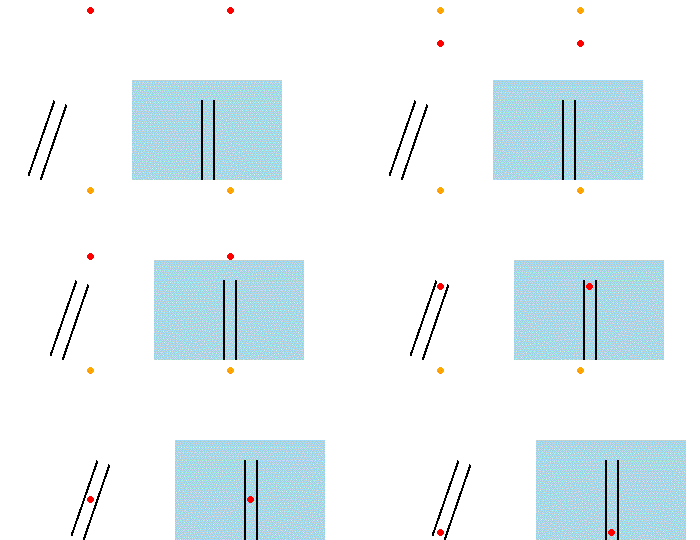
Pre-1800 Corpuscular theory of light – Light was considered to be made up of particles that had inertia and they traveled in straight lines. Aberration of light was explained very simply by James Bradley using this model for light. It was shown that the telescope had to be tilted to capture a vertically descending light particle because earth moved. This created the angle of aberration.

1804 Thomas Young – He proved the wave nature of light through the famous double-slit experiment. This revived investigation into the nature of the medium through which light moved. This medium was viewed as aether that filled all space. It was completely elastic as it could transmit light over infinite distances.

1810 François Arago – He expected the speed of light to be different as corpuscles of light were supposed to be affected differently by the gravity of different stars. But light from different stars produced the same refractive index, and, therefore, had the same velocity. This negated Newton’s corpuscular theory of light, and supported a uniform medium of aether.

1816 Augustin-Jean Fresnel – Since the speed of light was constant in aether, he expected it to have different values relative to earth as earth changed its directions. However, Arago’s results negated that. Therefore, Fresnel postulated that earth’s velocity did account for the aberration of light, but aether was partially dragged at the point of measurement to maintain a constant velocity of light. Fresnel calculated an aether drag coefficient based on the refractive index that seemed to explain the inconsistency.

1887 Michelson & Morley – Earth was expected to have a velocity relative to aether in order to explain the aberration of light. However, the velocity of light was found to be constant regardless of the direction in which earth moved. This created the same inconsistency as the Arago’s experiment, but on a much larger scale.  This could not be explained by Fresnel’s partial ether drag hypothesis.

1905 Albert Einstein – He explained the inconsistency by dropping the aether model and returning to the corpuscular theory of light. This generates questions about the very nature of light. Light cannot be a wave. It cannot be a particle with significant inertia either. The questions now become,

  1. If light is made up of particles that do not require a medium to travel, then how do these particles coordinate their motion?

  2. Matter has relative speeds. Light seems to adjust its speed to ‘c’ relative to any matter. So, how does light and matter coordinate their motion?

  3. Are light particles made up of electromagnetic fields? Do they exist within larger fields? If not, then what do we have?

The theory of relativity is too mathematical and does not seem to answer these questions

.

Aberration of light in SRF

Reference: Disturbance Theory

.

Problem: Celestial objects have apparent motion. (See https://en.wikipedia.org/wiki/Aberration_of_light )

What is true position of the celestial objects?
ra_and_dec_on_celestial_sphere

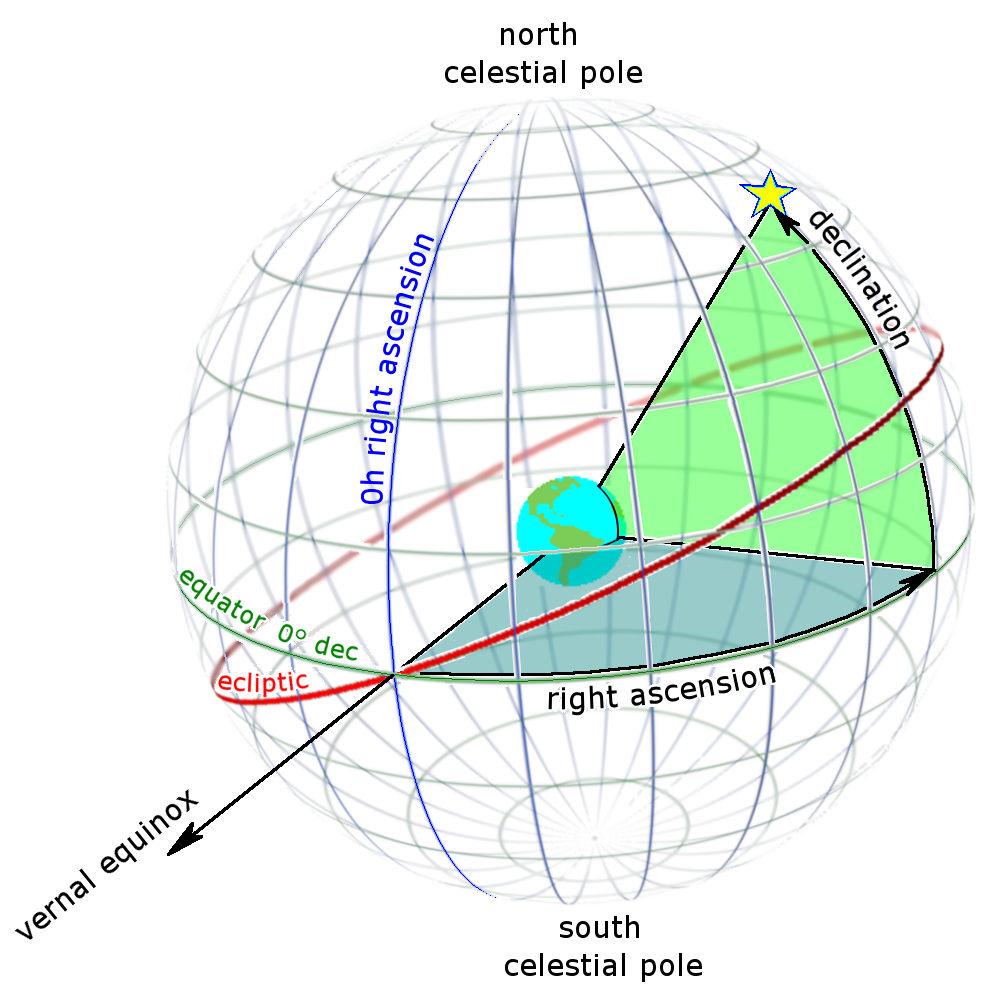
Mean Equator and Equinox of J2000.0: This coordinate system is oriented with its xy-plane parallel to the mean Earth equator at epoch J2000.0, and its z-axis pointing toward the mean north celestial pole of J2000.0. The x-axis points toward the mean equinox of J2000.0. This coordinate system is used for expressing the positions of stars in catalogs and planets in basic solar system ephemerides.

Right Ascension: Angular distance on the celestial sphere measured eastward along the celestial equator from the equinox to the hour circle passing through the celestial object.

Declination: Angular distance on the celestial sphere north or south of the celestial equator. It is measured along the hour circle passing through the celestial object.

Distance: The distance from the center of the Earth to the Solar System object, given in astronomical units (kilometers for the Moon). Distance is not calculated for stars.

Celestial Sphere: An imaginary sphere of arbitrarily large radius, concentric with Earth. All objects in the observer’s sky can be thought of as projected upon the inside surface of the celestial sphere, as if it were the underside of a dome or a hemispherical screen. The celestial sphere is a practical tool for spherical astronomy, allowing observers to plot positions of objects in the sky when their distances are unknown or unimportant.

Shouldn’t there be a motion?

The celestial sphere does not rotate with the earth. But it moves around the sun with earth. This may affect the observation of true position.

Annual aberration — a deflection caused by the velocity of the Earth’s motion around the Sun, relative to an inertial frame. This is independent of the distance of the star from the Earth.

Light-time correction is a displacement in the apparent position of a celestial object from its true position (or geometric position) caused by the object’s motion during the time it takes its light to reach an observer.

Is the aberration of light constant for all celestial objects?

It appears to be so for stars. For objects in the solar system their speeds become relevant.

Why is James Bradley’s (1729) explanation not adequate for the aberration of light?

Bradley conceived of an explanation in terms of a corpuscular theory of light in which light is made of particles that do not require a medium. His classical explanation appeals to the motion of the earth relative to a beam of light-particles moving at a finite velocity, and is developed in the Sun’s frame of reference. However, once the wave nature of light was better understood, a medium needed to be accounted for.

The aberration of light is an astronomical phenomenon which produces an apparent motion of celestial objects about their true positions, dependent on the velocity of the observer.

Let a star be at distance ‘d’ from earth. Light takes time = ‘d/c’ to reach earth from the star. If earth is moving at velocity ‘v’, then it has moved a distance ‘v.d/c’ during the time star light reaches earth. The ratio of these two distances is ‘v/c’. This is the angle of aberration.

In SRF, the only motion visible is acceleration. Uniform motion is indistinguishable from ‘rest’. Earth is always accelerating toward the sun, so this motion shall be visble in SRF. Earth’s velocity ‘v’ is the result of balanced acceleration.

Light’s velocity ‘c’ is also the result of balanced acceleration. It is a limiting velocity. Light has velocity ‘c’ because it cannot be accelerated anymore.

The motion visible in SRF is balanced acceleration. So, the explanation given above for angle of aberration based on ‘v’ and ‘c’ shall be valid in SRF.

In SRF, the motion of planets shall be perceived as if they are moving in a groove carved in space. Light is moving, similarly, in a groove carved in space.

Conclusion:

James Bradley’s (1729) explanation for aberration of light became unacceptable in 1804 because light was established to be a wave. It was no longer looked upon as corpuscular as was assumed earlier by Newton. So, the medium of light (aether) became an issue.

In SRF (space reference frame), the aether is the space itself. From SRF point of view, the change in view of light from corpuscular to wave would not have created an issue in 1804 with the earlier 1729 explanation for aberration of light.

.


The Faraday Atom

Loop ball

Reference: Disturbance Theory

.

The fundamental principles that Maxwell helped isolate are:

1.    A changing electric field produces a magnetic field of force

2.    A changing magnetic field produces an electric field of force

The next step is to generate a model based on these principles that we may visualize through Faraday’s lines of force.

When a current flows in a wire the magnetic lines of force loop around it. Similarly, when a magnet is moved through a wire loop, a current is generated in that loop. This gives us a basic structure as follows:

The electrical and magnetic lines of force may be visualized as two circular loops at right angles to each other, such that each loop passes through the center of the other loop.

If we model an atom based on Faraday’s lines of force, the entire atom shall consist of electrical and magnetic lines of forces coupled as above. There would be no sub-atomic particles. Such coupling can get quite complex as atoms grows in complexity.

Since the nucleus of an atom is positive, the electric lines of force in the atom would be mostly radial, and the magnetic lines of force would be mostly circumferential.

The atom is overall neutral. A neutral configuration shall consist of coupled electric and magnetic loops that are symmetrical. Symmetrical loops shall be circular. An asymmetric configuration shall consist of elongated loops resulting in charged or magnetized atom.

Under electrical induction, the electrical loop shall elongate producing positive and negative charge displacement. Under magnetic induction, the magnetic loop shall elongate producing North and South polarization.

When atoms are aligned in the plane of elongated electrical loops we shall have storage of electrical energy as in a capacitor. When atoms are aligned in the plane of elongated magnetic loops we shall have storage of magnetic energy as in a magnet.

It would be easy to distinguish between electric and magnetic lines of force.

When the opposite charges or poles exist in two separate objects situated close to each other, the elongated loop must pass through space from one to the other object. Here we have lines of forces that venture out in space but they always originate from and end in material atoms.  The displacement or polarization occurs in the atoms and not out in the space.

The “space medium” does not act like a dielectric as Maxwell assumed.

.

The electromagnetic phenomenon, such as light, may exist in space by itself as follows.

  1. The lines of forces are traveling through space as pulses.
  2. They exist as simple loops without atomic configuration.
  3. The electric and magnetic loops are symmetrical.

A free charged particle, such as a free electron shall be one end of the stretched loop of electric line of force. The other end of this loop may be attached to an atom (a positive ion) or simply extended into infinity.

The atom as a neutral particle is not really isolated. The lines of force extend from the atom into surrounding space to other atoms.

The atoms may appear discrete but they are never isolated unto themselves. They all connected as a continuum of lines of force.

Please note that this is only a working model of “Faraday atom”. The electrical and magnetic lines are always transforming into each other at a certain frequency.

All lines of forces are dynamic.

The nucleus of the atom is also made up of lines of force. These are extensions of the electromagnetic lines of force, but they have much higher frequency.

The nuclear lines of force have characteristics different from electromagnetic lines of force.

.