See: Electromagnetic Spectrum

Reference: Disturbance Theory
.
Newton’s First Law states, “Every body continues in its state of rest, or of uniform motion in a right line, unless it is compelled to change that state by forces impressed upon it.”
(a) A field is a disturbance that is spread out into emptiness. This disturbance is an energy that creates its own extension, duration, frequency and inertia.
(b) The extension/duration ratio is constant and so is the energy per cycle. These constants provide continuity as the frequency changes.
(c) There is resistance to changing the frequency, and that is inertia. Force is required to change the frequency. The force is then absorbed as increased frequency.
(d) Basic inertia appears as permeability and permittivity. This provides a window into the nature of field energy.
(e) Changes in inertia with increase in frequency may provide further knowledge about the nature of field energy.
(f) Changes in inertia with increasing frequency denote the formation of a structure of disturbance. We may call this structure “mass”.
(g) When we combine the equations, m = E/c2; E = hf; and c = 1/√(με),we get m = h (fμε). Thus, mass appears to be made up of high cycles of energy with permeability and permittivity.
(h) The structure of mass seems to start out like the formation of eddies in a flow (see quantum particles). Thus the primary characteristic of structure appears to be rotational.
(i) The rotational nature of structure reduces its linear motion, and tends to pin it down. We may see this as increased inertia. Thus inertia may be related to the natural speed of propagation of quantum particles.
(j) “No inertia and infinite speed” may then provide a workable reference point for the measurement of field as a substance.
.
Newton’s Second Law states, “The change of motion is proportional to the motive force impressed; and is made in the direction of the right line in which that force is impressed.”
(a) It seems that the external force impressed on a field increases its frequency, and thus becomes internalized as inertia. This is consistent with conservation of force of Faraday.
(b) The natural tendency for disturbance to spread seems to be balanced by inertia.
(c) Inertia is internal, but it seems to continue to act as “motive force impressed” in generating a negative acceleration.
.
Newton’s Third Law states, “To every action there is always opposed an equal reaction: or, the mutual actions of two bodies upon each other are always equal, and directed to contrary parts.”
(a) The inertia as a negative acceleration is equal and opposite to the positive acceleration of the disturbance.
.
Newton’s Laws apply to matter that has a certain level of inertia. They do not apply to field (light) that has a level of inertia, which is negligible compared to the inertia of matter.
At the level of matter, the structure of substance has become so complex that both wavelength and period have become infinitesimal, and any differences in them may be ignored. This gives the impression of absolute space and time.
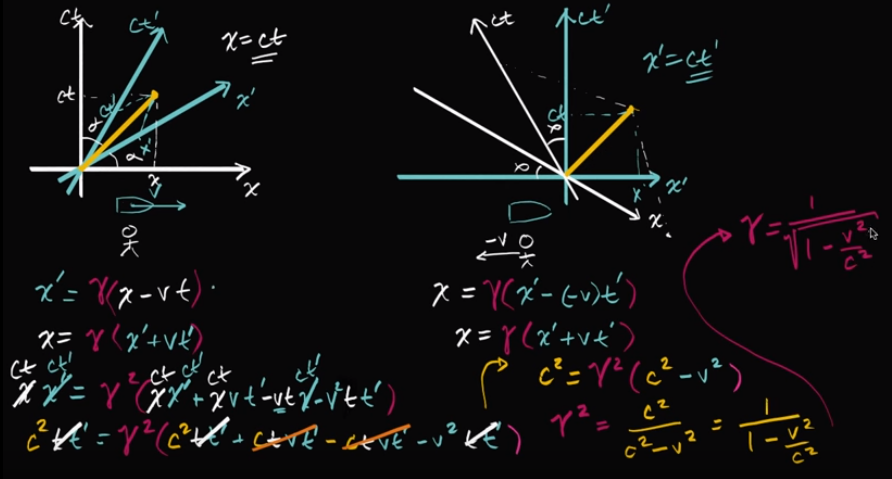
But at the level of field, the wavelength and period are not infinitesimal, and any differences in them are noticeable. This gives the impression of length contraction and time dilation.
Thus, the Newton’s Laws of motion are subject to inertia over the electromagnetic spectrum.
The vector addition supported by Newton’s Laws of motion applies to the inertia at the level of matter. The vector addition does not apply to velocities of matter and that of electromagnetic radiation because they are very far apart in their levels of inertia.
Where the levels of inertia are far apart by many orders of magnitude, the vector addition is replaced by relativistic addition.
Inertial frames considered in the theory of relativity all have the inertial property of matter. The relativistic addition works because the difference in inertia of the inertial frames may be assumed to be negligible when compared to the inertial gap with light.
.