The Spectrum of Substance (old-1)

Please see The Spectrum of Substance

Historically, Aristotle viewed things as made of matter (substance in general). To him, matter and thought were complementary principles.

Descartes conceived of matter as independent of thought. He postulated matter to be an abstract reality whose inherent property was limited to extension. He, thus, saw space as property of matter. But he separated matter from thought.

Newton developed Descartes’ notion of matter into the concept of material-substance that had intrinsic properties of extension, hardness, impenetrability, mobility, and inertia. This material-substance then existed within an absolute space. He thus separated matter from space. Newton was, however, troubled by the notion of gravity as “action at a distance.”

Einstein was fascinated by the phenomenon of light. He looked at the concept of light as an electromagnetic phenomenon as developed mathematically by Maxwell from the concept of electromagnetic field conceived by Faraday. Faraday saw field as a medium that carried force between material bodies. Einstein then conceived of space as a mathematical reality whose geometry (curvature) could explain the phenomenon of gravity. Einstein thus implied space and electromagnetic phenonomena to be kind of a ghostly mathematical substance.

Based on The Nature of Space, we may now consider space and the electromagnetic phenomena to be made up of actual (not mathematical) field-substance described by the electromagnetic spectrum as follows:

  1. Field-space
  2. Radio waves
  3. Microwave radiation
  4. Terahertz radiation
  5. Infrared radiation
  6. Visible radiation
  7. Ultraviolet radiation
  8. X-ray radiation
  9. Gamma radiation

This spectrum may be referenced from a theoretical Emptiness of zero-inertia.

.

The Field-Substance

We may forward the following hypothesis:

Space and matter are not separate and absolute as visualized by Newton. There is a spectrum of substance from space to matter in the form of electromagnetic field.

This field-substance is made of electromagnetic cycles. An electromagnetic cycle consists of dynamically interchanging electric and magnetic energies. This interchange is analogous to the dynamically interchanging kinetic and potential energies of a vibrating mass.

The electromagnetic cycles have characteristic frequencies. The field-substance has different properties associated with different frequencies. The electromagnetic spectrum describes the progression of these frequencies of the field-substance. This progression is broadly listed above.

The electromagnetic cycles spreading in three spatial dimensions forms the electromagnetic field. This field consists of the different characteristics found in the electromagnetic spectrum, which combine to produce turbulence, pulses and quantum particles.

This field is dynamic and seems to constitute the atoms. Within an atom the field seems to converge toward the center with increasing frequency. Ultimately, the field-substance seems to condense into mass at the center of the atom forming a nucleus.

It is within the atom that we find an interface between field and material substances.

.
Matter in Disturbance Theory

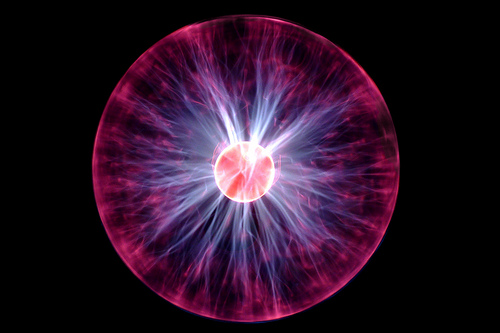
Electron
Reference: Disturbance Theory

.
The disturbance theory postulates that the continuum of substance from emptiness to matter is formed by field. The field is not invisible. It appears to us as “empty space”. A vacuum is not entirely empty even when there are no atoms and molecules of matter. There is still field in that vacuum because its extension is manifested as space.

Substance is made up of field and matter. Field is back and forth interchanges of electric and magnetic energy like the interchanges of kinetic and potential energy in a pendulum. Matter is the “condensed” form of field.

The field has a frequency structure. That frequency structure is maintained when a disturbance propagates through the field. Therefore, there is inertia at the level of the field also. There are disturbances in the field of numerous frequencies that may be plotted on a scale. Thus there is a broad spectrum of frequencies of which the known electromagnetic spectrum is a part This also provides us with a spectrum of inertia.

The field is continuous throughout; but a disturbance in it has frequency cycles that are quantized. In other words, the frequency cycles can be counted. Only complete frequency cycles participate in any interaction. Therefore, all interactions in the field are quantized. Emission and absorption of such cycles as a group during interactions produces the concept of quanta.

As frequency increases the structure of disturbance becomes denser. Within the field there is continuous gradient among disturbances of different frequencies. The frequency gradient comprises force, which is balanced by rotary motion in the field. Thus there are vortices in which frequency increases rapidly toward the center. This leads to increasingly denser structure of disturbance toward the center of a vortex. This gives us the particles of quantum mechanics.

When the frequency gradient is not balanced by the rotary motion, there is an imbalance of forces. This imbalance appears as “charge”. When the gradient is overcompensated by the rotary motion the charge appears as “negative”. When the gradient is undercompensated by the rotary motion, the charge appears as “positive”. An electron is such a vortex particle within the field that has negative charge at its surface. The condensing field within the electron appears as the beginning of mass.

Beyond a certain threshold, the frequency structure of disturbance collapses into solid mass. This occurs at the center of the vortex. A proton is a vortex particle of a much higher frequency. In a proton the frequency structure at the center has collapsed into solid mass. It also has an unbalanced frequency gradient at its surface that appears as positive charge. A neutron, on the other hand, is very similar to the proton in terms of mass, but its frequency gradient is matched by its rotary motion resulting in no charge.

The disturbance theory postulates that atoms are much larger and complex vortices in the electromagnetic field. The frequency gradients within an atom are mostly balanced by rotary motions and it is by and large neutral in terms of charge, except near its surface. This produces stable and discrete configurations that are neatly arranged as the periodic table.

An atomic configuration may range from negative to neutral to positive. An atom is a single vortex particle, but it is assumed to be made of electrons, protons and neutrons. This is because the mass of atomic configurations can be approximated as integer multiple of much heavier protons and neutrons; and because electrons, protons and neutrons are commonly observed during atomic interactions. But there are other quantum particles that have been observed during more energetic atomic level collisions. The Standard Model of particle physics has been derived from such observations.

The disturbance theory postulates that there are no discrete particles embedded within the atom, and that they are generated during atomic level interactions. Each and every quantum particle is a vortex in the field of different dimension. It either maintains a stable frequency structure or it decays back into the background field.

.

Matter in Historical Perspective (old)

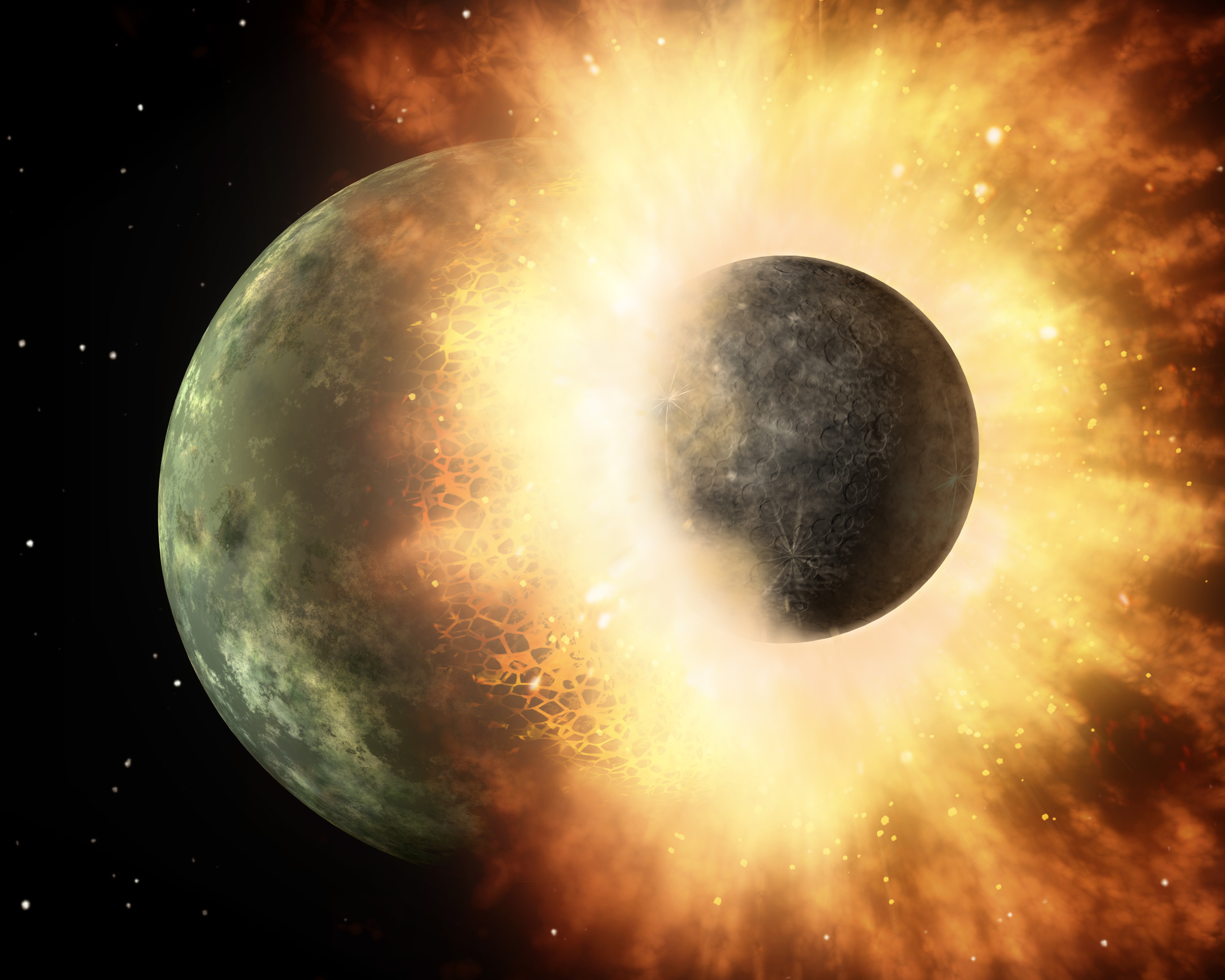
This artist's animation shows a celestial body about the size of our moon slamming at great speed into a body the size of Mercury.
Reference: Disturbance Theory

.

Historically, there has been confusion between matter and emptiness because it is difficult to conceive of emptiness. Matter is substance. Emptiness is absence of substance. It is impossible to visualize absence of something.

Aristotle viewed things as made of matter. To him, matter and thought were complementary principles.

Later Descartes argued that the inherent properties of bodies were limited to extension, and the so-called secondary qualities, like color, were only products of human perception. Thus, he conceived of matter as a thing in itself that was independent of thought. He arbitrarily postulated matter to be some abstract, mathematical substance that occupies space.

Newton developed Descartes’ notion of matter by attributing to it the intrinsic properties of extension, hardness, impenetrability, mobility, and inertia. To him, “secondary” qualities, such as color or taste, were those that were not amenable to mathematical description. Newton was, however, troubled by the notion of gravity as “action at a distance.”

Einstein then explained “action at a distance” by developing Faraday’s concept of field. He made a critical summary of the development of his ideas in a paper Relativity & Problem of Space near the end of his life.

Einstein’s paper explains the following among other things.

  • The electromagnetic field is a substance more basic than matter.
  • The concept of space is derived from the extensions of substance.

The Disturbance Theory develops these concepts further.

.

What is Substance? (old)

Substance1

Please see Course on Subject Clearing

Inertia characterizes the substance. If there is no inertia there is no substance, no interactions, and, therefore, no awareness. The interactions make us aware of substance. They form the basis of all our perceptions, feelings and experiences.

Matter is an aspect of substance that we are directly aware of. Matter has been contemplated upon since the beginning of human consciousness. It has long been thought to have been built out of discrete building blocks, the so-called particulate theory of matter.

Field is an aspect of substance that we are aware of only indirectly. We are aware of field when there are space, time and energy. Space is the manifestation of the extension of substance, time is the manifestation of changes in substance, and energy is the manifestation of the interactions of substance. When that substance is not matter, then it is field.

There are other aspects of substance – the most obvious being thought; but such aspects are not part of physics yet. The disturbance theory focuses on the matter and field aspects of substance but it may take up thought substance later. There is continuity, harmony and consistency among all different types of substances.

Matter and field interface with each other within the atom. The atom is mostly made up of a converging field that rapidly increases in frequency toward the center. At the center it ends up as matter. Matter consists of very high frequency that has condensed into mass. This interface between field and matter maintains continuity, harmony and consistency.

The above view of substance leads to some interesting conclusions. For example, a vacuum is not entirely empty even when there are no atoms and molecules of gaseous material. There is still field in that vacuum for space to be manifested. Furthermore, the idea that the fundamental constituents of atoms are point particles is a mathematical conjecture only. In reality, matter in atom uncondenses into field.

To summarize, matter directly forms the basis of all perception, feeling and experience. Field does so indirectly through space, time and energy. Matter and field, as substance, are the essential aspect of any interaction.

.

The Spectrum of Inertia

inertia5

Reference: Disturbance Theory

.

For a long time, in Physics, the basic substance was thought to be MATTER. Everything was matter. But this changed at the beginning of the 20th century. It was finally established that the electromagnetic phenomena consisted of a substance that was finer than matter. This substance was the electromagnetic field. The concept of substance suddenly expanded from matter to electromagnetic field consisting of a wide spectrum of frequencies.

The disturbance theory postulates that the actuality of substance is represented by inertia. Atomic matter is a substance of “high level” of inertia. Electromagnetic field is a substance of “low level” of inertia. Thus there is a spectrum of inertia. The lower part of this spectrum is occupied by the field. The upper part of this spectrum is occupied by matter. The field has its own spectrum that includes the electromagnetic spectrum. The matter also has a spectrum, that includes gases, liquids, solids, plasma, and the substances of neutron stars and black holes.

The zero on the spectrum of inertia is the theoretical point of zero inertia, which means complete “absence of substance”. We may label it as EMPTINESS. Emptiness is also be a point of non-actuality because actuality comes from the presence of substance. The disturbance theory postulates that actuality of substance appears in the form of a “disturbance”. It has a characteristic frequency. Thus, frequency is an indication of inertia. This is supported by the fact that frequency of radiation maintains itself until it is forced to change through some interaction.

Matter appears on this spectrum when the frequency has become so high that it collapses into mass. The appearance of nucleus within an atom is an example of this phenomenon. The Disturbance theory looks at atom as a whirlpool within the field where frequency is rapidly increasing toward the center. At the center, the frequency  becomes so high that it collapses into mass. Infinity of inertia indicates an extremely dense substance, such as that of the neutron star or black hole.

Space and time are characteristics of substances. They are not substances themselves.  Therefore, the presence of space and time indicates that there is some underlying substance. Thus matter has the characteristics of rigid space and enduring time.  On the other hand, field includes the whole electromagnetic spectrum and it behaves like the rough surface of a sea with its dynamically changing frequencies. The space of field is not rigid, and its time is fluctuating. The space that we see around us, has field underlying it. It is full of frequency gradients and force. This explains the presence of dark energy and dark matter in space. It is incorrect to think that space is something that matter occupies.

Thus, the spectrum of inertia ranges from theoretical zero frequency of EMPTINESS to “infinitely complex frequency” of extremely dense substance. This spectrum covers the range of all possible substances including so-called thought substance.

The spectrum of inertia is a brand new concept. It provides a structure to describe all possible substances. Its usefulness shall be ascertained with the unfolding of the disturbance theory.

.