The Field-Substance

The concept of field was conceived by Faraday. Faraday was an experimentalist and not a theorist. Based on extensive experimentation, Faraday boiled down the phenomena of electricity and magnetism to “lines of force” that originated from and terminated at material points. Faraday suggested that the lines of force acted as the medium for radiative phenomena, thus dispensing with the then popular idea of aether. This was the idea of the field. To Faraday, there was no “action at a distance.” The force between material bodies transmits through the field.

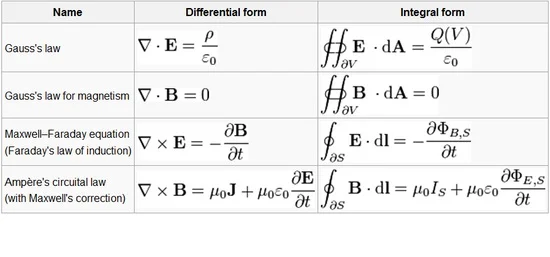
Maxwell supported the field idea. He also saw space not as something standalone but as a dimension of force. He saw Faraday’s approach to be compatible with the theory of potential from the mathematical discoveries of Laplace, Poisson, Green and Gauss. Thus he described the electromagnetic field-substance with the above four equations.

The Maxwell’s equations describe the dynamics within an electromagnetic cycle as follows:

The electrical lines of force flow in straight lines due to charge (misalignment) in the field. The magnetic lines of force rotate in circles around the electrical lines. The electrical flow slows as it converts into magnetic rotation. But then magnetic rotation converts back into electrical flow as it overshoots the point of equilibrium like in case of a pendulum. This electromagnetic cycle has a frequency.

Electromagnetic cycles of increasing frequency then form the spectrum of field-substance. An electromagnetic pulse propagates in field-space at a very high speed constrained only by its rate of formation. Maxwell showed this speed by the following relationship,

c = 1/√(μ0ε0)

Where

μ0 is permeability, which is a measure of how easily a magnetic field can pass through field-space.

ε0 is permittivity, which is the measure of resistance that is encountered when forming an electric field in field-space. 

This speed is determined to be 3 x 10⁸ m/s for light, which forms the visible part of the spectrum of field-substance.

Maxwell treated field-substance as something that spread out in three-dimensions as a continuous potential. In 1905, Einstein discovered that, at high frequencies, the field-substance acts as if it is made of particles (see Einstein’s 1905 Paper on Light Quanta). “Light quanta” were formed at higher frequencies. We know them today as “photons”. Einstein called this phenomenon quantization of light. Though deemed as particles, photons maintain continuity with each other through the background field.

Einstein’s discovery of “light quanta” points to the evolution of a continuous field into discrete particles at higher frequencies in the spectrum of field-substance.

Einstein’s discovery was the beginning of Quantum mechanics. It lead to the discovery of many more quantum particle. The phenomenon of quantization supports the hypothesis that field-substance provides the bridge between continuous space and discrete matter.

The atom is made up of very high frequency field-substance.

.

The Nature of Space

Reference: Essays on Substance

Einstein views space as an independent physical reality that remains after all substance (field and matter) is removed. I question this supposition.

According to Descartes space is identical with the three-dimensional extent of a material object, and so there is no such thing as empty space. We have been visualizing substance as rigid matter. This consideration changes with the discovery of electromagnetic field as a more basic substance. “Empty space” is then the observation of the extensions of invisible electromagnetic field. This field was not known to Descartes when, based on the consistency of philosophic ideas, he boldly asserted that there is no empty space. If he were here today, he would have been highly satisfied with the discovery of electromagnetic field.

The seemingly empty space that surrounds us then must be the extent of an invisible field at the lower end of the electromagnetic spectrum. This is so because as frequency approaches zero at the lower end of the spectrum, the wavelength approaches infinite proportions. This would be no different from the space we are accustomed to. The boundless three-dimensional extent around us is none other than an extremely low frequency field. Higher frequency fields and objects then have relative position and direction in this very low frequency field-space.

Space is a field of infinite dimensions that is approached at the lower end of the electromagnetic spectrum.

This field-space is not rigid like matter though we measure its extents as if by rigid material rods. We do this because our concept of space derives from the observation of extents of material objects.

Einstein’s space is purely mathematical whose properties are derived from material substances. We may get a more accurate concept of space by deriving its mathematical properties from those of low frequency field-space. Einstein’s thinking seem to have been moving in this direction because he notes,

The drawing of attention to the vacuum in a mercury barometer has certainly disarmed the last of the Cartesians. But it is not to be denied that, even at this primitive stage, something unsatisfactory clings to the concept of space, or to space thought of as an independent real thing.

When material substance is removed there still remains the invisible field-space, which we call “empty space”. But when the field-space is also removed, all we have left is true emptiness that is empty of all substance and its space. This condition of emptiness does not exist within this universe. It may be postulated to exist only beyond the universe and its space.

This argument brings consistency between physics and philosophy. We may say that emptiness is a theoretical concept of zero inertia, where inertia is a measure of the “content” of substance. On the other hand, space represents the “extent” of substance.

The electromagnetic spectrum may be looked upon as a gradual condensation of the field-space that ultimately forms the nucleus of an atom. Thus, there is a continuity of substance from space to mass through the electromagnetic field.

.

Space & Einstein

Obsolete: See A Logical Approach to Theoretical Physics

.

Einstein’s theory of relativity has been highly successful in resolving the problem of space at cosmological dimensions where the substance is matter, but it has failed at atomic dimensions, where the substance is field. For the rest of his life Einstein struggled to come up with a theory that applied to atomic dimensions.

.

Problem of Space

Einstein took an incisive look at the problem of space in his article Relativity & Problem of Space. This is a remarkable article written in 1952, just three years before his death. In this article Einstein seems to revise his earlier supposition about space that he made in his special theory of relativity. If Einstein had only lived longer, and followed up on his thoughts expressed in this article, he could have made further breakthroughs at a very fundamental level of physics.

.

Space in Special Theory of Relativity

In his special theory of relativity, Einstein takes the viewpoint that the physical universe is objective but its perceptions are subjective. Therefore, any understanding of the physical universe is subjective. Time is a conceptual ordering principle of the experiences of the individual. Objectivity of time is established only when more than one person reacts to an event, because that ensures that the event is taking place in the “real external world”. The success of Newton’s mechanics establishes the objectivity of space because it provides broad experience of space as a physical reality.

Einstein then concludes that space is an independent physical reality that remains after all matter and field are removed. Thus, Einstein disagrees with the philosophical view of Descartes that space is identical with extension, but extension is connected with bodies; thus there is no space without bodies and hence no empty space.

.

Space in General Theory of Relativity

Later in General Theory of Relativity, Einstein reverses his views on space by stating, “There is no such thing as an empty space, i.e. a space without field. Space-time does not claim existence on its own, but only as a structural quality of the field.”

This reversal came from Einstein’s recognition of field as a more basic substance. He arrived at this understanding through the general principle of relativity.

.

The General Principle of Relativity

Einstein states this principle as follows:

Natural laws must be covariant with respect to arbitrary continuous transformations of the co-ordinates.

The general principle of relativity deals with the nature of the universe, because the coordinates refer to space-time in which all phenomena take place. Accordingly the natural laws and continuous transformations of phenomena must go hand-in-hand.

A more general form of this principle is stated by Postulate #2 (see The Postulates),

The UNIVERSE is a single system that is intrinsically continuous, harmonious and consistent.

.

Further Research

In light of the postulate we shall examine Einstein’s general principle of relativity to see if it can help us understand the idea of space better.

.

Objectivity versus Subjectivity (old)

Objectivity

Reference: Disturbance Theory

.

I question Einstein’s concept of objectivity.

According to Einstein (Ref: “Relativity & Problem of Space”) the physical universe is OBJECTIVE and the mental considerations are SUBJECTIVE. Therefore, any understanding of the physical universe is subjective. Objectivity of time is established when more than one person reacts to the events taking place. Objectivity of space has alraedy been established by the success of Newtonian mechanics.

This is a black and white view of objectivity and subjectivity. Per Postulate #2 the universe is an integrated whole. Therefore, labels, such as, “space is physical and, therefore, objective,” or “time is mental and, therefore, subjective” are unnecessary. The physical and mental realities are attributes of the universe that are not independent of each other.

Therefore, objectivity and subjectivity may be visualized as forming the two ends of a continuous scale. A proper definition of objectivity may show that there are degrees of objectivity and subjectivity just like there are degrees of hot and cold.

Einstein believed in the consistency of observations to be the criterion of objectivity. Per postulate #2, the universe is inherently continuous, harmonious and consistent in all its aspects. Thus, consistency is inherent in the universe, and, therefore, the universe is naturally objective.

The universe is what it is. Its perceptions are what they are. The essential criterion of objectivity is continuity, harmony and consistency among what is observed.

Subjectivity is the degree to which one fails to observe the continuity, harmony and consistency of the universe.

This criterion of objectivity also establishes the basis of philosophy, mathematics and logic in the universe.

.

Continuity, Harmony and Consistency

Mutual Dependency

Reference: Mindfulness Approach

.

The Heart Sutra of Buddhism also states that there are no separate self-entities, such as, sense organs, sense objects, consciousness, ill-being, causes of ill-being, the path, insight and attainment. Everything in this universe is connected with everything else as an integrated system.

In other words, this universe is a continuum of infinite dimensions; and all things physical, metaphysical, mental and spiritual, etc., are continuous, harmonious and consistent with each other.

The UNIVERSE is intrinsically continuous, harmonious and consistent.

Thus any discontinuity, disharmony and inconsistency shall pose an anomaly underlying which would be found a more basic truth.

The criteria of continuity, harmony and consistency forms the basis of all logic.

.