Einstein 1938: Time, Distance, Relativity

Reference: Evolution of Physics

This paper presents Chapter III, section 7 from the book THE EVOLUTION OF PHYSICS by A. EINSTEIN and L. INFELD. The contents are from the original publication of this book by Simon and Schuster, New York (1942).

The paragraphs of the original material (in black) are accompanied by brief comments (in color) based on the present understanding.  Feedback on these comments is appreciated.

The heading below is linked to the original materials.

.

Time, Distance, Relativity

Our new assumptions are:

(1) The velocity of light in vacuo is the same in all CS moving uniformly, relative to each other.

(2) All laws of nature are the same in all CS moving uniformly, relative to each other.

The relativity theory begins with these two assumptions. From now on we shall not use the classical transformation because we know that it contradicts our assumptions.

These assumptions basically are: (1) In the field domain, the velocity is very large and almost constant for different inertias (frequencies). (2) In the material domain, the inertia (mass) is very large and almost constant for different velocities. These are two extreme relationship between velocity and inertia that are observed in reality.

It is essential here, as always in science, to rid ourselves of deep-rooted, often uncritically repeated, prejudices. Since we have seen that changes in (1) and (2) lead to contradiction with experiment, we must have the courage to state their validity clearly and to attack the one possibly weak point, the way in which positions and velocities are transformed from one CS to another. It is our intention to draw conclusions from (1) and (2), see where and how these assumptions contradict the classical transformation, and find the physical meaning of the results obtained.

These two assumptions modify the transformations of positions and velocities among inertial frames traveling at very high velocities. These transformations are different from Galilean transformations that are intuitive to us; but they provide more accurate results.

Once more, the example of the moving room with outside and inside observers will be used. Again a light signal is emitted from the centre of the room and again we ask the two men what they expect to observe, assuming only our two principles and forgetting what was previously said concerning the medium through which the light travels. We quote their answers:

The inside observer: The light signal travelling from the centre of the room will reach the walls simultaneously, since all the walls are equally distant from the light source and the velocity of light is the same in all directions.

The outside observer: In my system, the velocity of light is exactly the same as in that of the observer moving with the room. It does not matter to me whether or not the light source moves in my CS since its motion does not influence the velocity of light. What I see is a light signal travelling with a standard speed, the same in all directions. One of the walls is trying to escape from and the opposite wall to approach the light signal. Therefore, the escaping wall will be met by the signal a little later than the approaching one. Although the difference will be very slight if the velocity of the room is small compared with that of light, the light signal will nevertheless not meet these two opposite walls, which are perpendicular to the direction of the motion, quite simultaneously.

Comparing the predictions of our two observers, we find a most astonishing result which flatly contradicts the apparently well-founded concepts of classical physics. Two events, i.e., the two light beams reaching the two walls, are simultaneous for the observer on the inside, but not for the observer on the outside. In classical physics, we had one clock, one time flow, for all observers in all CS Time, and therefore such words as “simultaneously”, “sooner”, “later”, had an absolute meaning independent of any CS. Two events happening at the same time in one CS happened necessarily simultaneously in all other CS

Assumptions (1) and (2), i.e. the relativity theory, force us to give up this view. We have described two events happening at the same time in one CS, but at different times in another CS. Our task is to understand this consequence, to understand the meaning of the sentence: “Two events which are simultaneous in one CS, may not be simultaneous in another CS

The consequence of these two assumptions is that events that are simultaneous in one CS (coordinate system) may not be simultaneous in another. In other words, the clock does not tick at the same rate in the two coordinate systems traveling at different velocities.

What do we mean by “two simultaneous events in one CS“? Intuitively everyone seems to know the meaning of this sentence. But let us make up our minds to be cautious and try to give rigorous definitions, as we know how dangerous it is to over-estimate intuition. Let us first answer a simple question.

What is a clock?

The primitive subjective feeling of time flow enables us to order our impressions, to judge that one event takes place earlier, another later. But to show that the time interval between two events is 10 seconds, a clock is needed. By the use of a clock the time concept becomes objective. Any physical phenomenon may be used as a clock, provided it can be exactly repeated as many times as desired. Taking the interval between the beginning and the end of such an event as one unit of time, arbitrary time intervals may be measured by repetition of this physical process. All clocks, from the simple hour-glass to the most refined instruments, are based on this idea. With the hour-glass the unit of time is the interval the sand takes to flow from the upper to the lower glass. The same physical process can be repeated by inverting the glass.

At two distant points we have two perfect clocks, showing exactly the same time. This statement should be true regardless of the care with which we verify it. But what does it really mean? How can we make sure that distant clocks always show exactly the same time? One possible method would be to use television. It should be understood that television is used only as an example and is not essential to our argument. I could stand near one of the clocks and look at a televised picture of the other. I could then judge whether or not they showed the same time simultaneously. But this would not be a good proof. The televised picture is transmitted through electromagnetic waves and thus travels with the speed of light. Through television I see a picture which was sent some very short time before, whereas on the real clock I see what is taking place at the present moment. This difficulty can easily be avoided. I must take television pictures of the two clocks at a point equally distant from each of them and observe them from this centre point. Then, if the signals are sent out simultaneously, they will all reach me at the same instant. If two good clocks observed from the mid-point of the distance between them always show the same time, then they are well suited for designating the time of events at two distant points.

Any physical phenomenon may be used as a clock, provided it can be exactly repeated as many times as desired. Each repetition is one unit of time. If two good clocks observed from the mid-point of the distance between them always show the same time, then they are well suited for designating the time of events at two distant points.

In mechanics we used only one clock. But this was not very convenient, because we had to take all measurements in the vicinity of this one clock. Looking at the clock from a distance, for example by television, we have always to remember that what we see now really happened earlier, just as in viewing the setting sun we note the event eight minutes after it has taken place. We should have to make corrections, according to our distance from the clock, in all our time readings.

It is, therefore, inconvenient to have only one clock. Now, however, as we know how to judge whether two, or more, clocks show the same time simultaneously and run in the same way, we can very well imagine as many clocks as we like in a given CS. Each of them will help us to determine the time of the events happening in its immediate vicinity. The clocks are all at rest relative to the CS. They are “good” clocks and are synchronized, which means that they show the same time simultaneously.

There is nothing especially striking or strange about the arrangement of our clocks. We are now using many synchronized clocks instead of only one and can, therefore, easily judge whether or not two distant events are simultaneous in a given CS. They are if the synchronized clocks in their vicinity show the same time at the instant the events happen. To say that one of the distant events happens before the other has now a definite meaning. All this can be judged by the help of the synchronized clocks at rest in our CS.

This is in agreement with classical physics, and not one contradiction to the classical transformation has yet appeared.

For the definition of simultaneous events, the clocks are synchronized by the help of signals. It is essential in our arrangement that these signals travel with the velocity of light, the velocity which plays such a fundamental role in the theory of relativity.

Since we wish to deal with the important problem of two CS moving uniformly, relative to each other, we must consider two rods, each provided with clocks. The observer in each of the two CS moving relative to each other now has his own rod with his own set of clocks rigidly attached.

When discussing measurements in classical mechanics, we used one clock for all CS. Here we have many clocks in each CS. This difference is unimportant. One clock was sufficient, but nobody could object to the use of many, so long as they behave as decent synchronized clocks should.

An event needs its own clock to measure its time. The clocks are all at rest relative to the CS. This helps us judge whether or not two distant events are simultaneous in a given CS. The awareness of the time on the clock travels at the speed of light.

Now we are approaching the essential point showing where the classical transformation contradicts the theory of relativity. What happens when two sets of clocks are moving uniformly, relative to each other? The classical physicist would answer: Nothing; they still have the same rhythm, and we can use moving as well as resting clocks to indicate time. According to classical physics, two events simultaneous in one CS will also be simultaneous in any other CS.
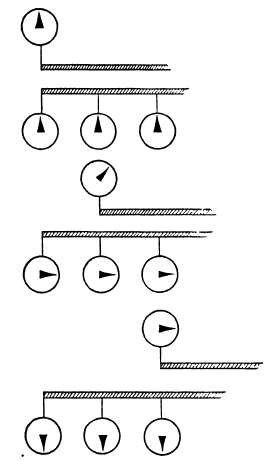
But this is not the only possible answer. We can equally well imagine a moving clock having a different rhythm from one at rest. Let us now discuss this possibility without deciding, for the moment, whether or not clocks really change their rhythm in motion. What is meant by the statement that a moving clock changes its rhythm? Let us assume, for the sake of simplicity, that we have only one clock in the upper CS and many in the lower. All the clocks have the same mechanism, and the lower ones are synchronized, that is, they show the same time simultaneously. We have drawn three subsequent positions of the two CS moving relative to each other. In the first drawing the positions of the hands of the upper and lower clocks are, by convention, the same because we arranged them so. All the clocks show the same time. In the second drawing, we see the relative positions of the two CS some time later. All the clocks in the lower CS show the same time, but the clock in the upper CS is out of rhythm. The rhythm is changed and the time differs because the clock is moving relative to the lower CS. In the third drawing we see the difference in the positions of the hands increased with time.

According to classical physics, two events simultaneous in one CS will also be simultaneous in any other CS. This simultaneity is lost when one CS is at rest and the other moves relative to it at a uniform velocity.

An observer at rest in the lower CS would find that a moving clock changes its rhythm. Certainly the same result could be found if the clock moved relative to an observer at rest in the upper CS; in this case there would have to be many clocks in the upper CS and only one in the lower. The laws of nature must be the same in both CS moving relative to each other.

In classical mechanics it was tacitly assumed that a moving clock does not change its rhythm. This seemed so obvious that it was hardly worth mentioning. But nothing should be too obvious; if we wish to be really careful, we should analyse the assumptions, so far taken for granted, in physics.

If clock time is changing, then “frequency” is changing; and that means inertia is changing. This is not accounted for in the laws of mechanics. This means the laws of nature are not what we think they are; but they must be the same for all inertial CS.

An assumption should not be regarded as unreasonable simply because it differs from that of classical physics. We can well imagine that a moving clock changes its rhythm, so long as the law of this change is the same for all inertial CS.

Yet another example. Take a yardstick; this means that a stick is a yard in length as long as it is at rest in a CS. Now it moves uniformly, sliding along the rod representing the CS. Will its length still appear to be one yard? We must know beforehand how to determine its length. As long as the stick was at rest, its ends coincided with markings one yard apart on the CS. From this we concluded: the length of the resting stick is one yard. How are we to measure this stick during motion? It could be done as follows. At a given moment two observers simultaneously take snapshots, one of the origin of the stick and the other of the end. Since the pictures are taken simultaneously, we can compare the marks on the CS rod with which the origin and the end of the moving stick coincide. In this way we determine its length. There must be two observers to take note of simultaneous events in different parts of the given CS. There is no reason to believe that the result of such measurements will be the same as in the case of a stick at rest. Since the photographs had to be taken simultaneously, which is, as we already know, a relative concept depending on the CS, it seems quite possible that the results of this measurement will be different in different CS moving relative to each other.

We can well imagine that not only does the moving clock change its rhythm, but also that a moving stick changes its length, so long as the laws of the changes are the same for all inertial CS.

We have only been discussing some new possibilities without giving any justification for assuming them.

We remember: the velocity of light is the same in all inertial CS. It is impossible to reconcile this fact with the classical transformation. The circle must be broken somewhere. Can it not be done just here? Can we not assume such changes in the rhythm of the moving clock and in the length of the moving rod that the constancy of the velocity of light will follow directly from these assumptions? Indeed we can! Here is the first instance in which the relativity theory and classical physics differ radically. Our argument can be reversed: if the velocity of light is the same in all CS, then moving rods must change their length, moving clocks must change their rhythm, and the laws governing these changes are rigorously determined.

There is nothing mysterious or unreasonable in all this. In classical physics it was always assumed that clocks in motion and at rest have the same rhythm, that rods in motion and at rest have the same length. If the velocity of light is the same in all CS, if the relativity theory is valid, then we must sacrifice this assumption. It is difficult to get rid of deep-rooted prejudices, but there is no other way. From the point of view of the relativity theory the old concepts seem arbitrary. Why believe, as we did some pages ago, in absolute time flowing in the same way for all observers in all CS? Why believe in unchangeable distance? Time is determined by clocks, space co-ordinates by rods, and the result of their determination may depend on the behaviour of these clocks and rods when in motion. There is no reason to believe that they will behave in the way we should like them to. Observation shows, indirectly, through the phenomena of electromagnetic field, that a moving clock changes its rhythm, a rod its length, whereas on the basis of mechanical phenomena we did not think this happened. We must accept the concept of relative time in every CS, because it is the best way out of our difficulties. Further scientific advance, developing from the theory of relativity, shows that this new aspect should not be regarded as a malum necessarium, for the merits of the theory are much too marked.

Observation shows, indirectly, through the phenomena of electromagnetic field, that a moving clock changes its rhythm, a rod its length, whereas on the basis of mechanical phenomena we did not think this happened.

The theory of relativity gets its validity because it calculates certain observational results better than the classical mechanics. But Einstein does not provide rigorous explanation using a theoretical model. NOTE: Postulates Mechanics now provides this theoretical model (see Final Comment).

So far we have tried to show what led to the fundamental assumptions of the relativity theory, and how the theory forced us to revise and to change the classical transformation by treating time and space in a new way. Our aim is to indicate the ideas forming the basis of a new physical and philosophical view. These ideas are simple; but in the form in which they have been formulated here, they are insufficient for arriving at not only qualitative, but also quantitative conclusions. We must again use our old method of explaining only the principal ideas and stating some of the others without proof.

Our aim is to indicate the ideas forming the basis of a new physical and philosophical view.

To make clear the difference between the view of the old physicist, whom we shall call O and who believes in the classical transformation, and that of the modern physicist, whom we shall call M and who knows the relativity theory, we shall imagine a dialogue between them.

O. I believe in the Galilean relativity principle in mechanics, because I know that the laws of mechanics are the same in two CS moving uniformly relative to each other, or in other words, that these laws are invariant with respect to the classical transformation.

M. But the relativity principle must apply to all events in our external world. Not only the laws of mechanics but all laws of nature must be the same in CS moving uniformly, relative to each other.

The theory of relativity is broadening the observations of laws of nature from matter to field.

O. But how can all laws of nature possibly be the same in CS moving relative to each other? The field equations, that is, Maxwell’s equations, are not invariant with respect to the classical transformation. This is clearly shown by the example of the velocity of light. According to the classical transformation, this velocity should not be the same in two CS moving relative to each other.

M. This merely shows that the classical transformation cannot be applied, that the connection between two CS must be different; that we may not connect co-ordinates and velocities as is done in these transformation laws. We have to substitute new laws and deduce them from the fundamental assumptions of the theory of relativity. Let us not bother about the mathematical expression for this new transformation law, and be satisfied that it is different from the classical. We shall call it briefly the Lorentz transformation. It can be shown that Maxwell’s equations, that is, the laws of field, are invariant with respect to the Lorentz transformation, just as the laws of mechanics are invariant with respect to the classical transformation. Remember how it was in classical physics. We had transformation laws for co-ordinates, transformation laws for velocities, but the laws of mechanics were the same for two CS moving uniformly, relative to each other. We had transformation laws for space, but not for time, because time was the same in all CS. Here, however, in the relativity theory, it is different. We have transformation laws different from the classical for space, time, and velocity. But again the laws of nature must be the same in all CS moving uniformly, relative to each other. The laws of nature must be invariant, not, as before, with respect to the classical transformation, but with respect to a new type of transformation, the so-called Lorentz transformation. In all inertial CS the same laws are valid and the transition from one CS to another is given by the Lorentz transformation.

Classical transformations cannot be applied to the field. In the case of field, Lorentz transformations replace the classical transformations; and the laws of field (Maxwell’s equations) replace the laws of mechanics.

O. I take your word for it, but it would interest me to know the difference between the classical and Lorentz transformations.

M. Your question is best answered in the following way. Quote some of the characteristic features of the classical transformation and I shall try to explain whether or not they are preserved in the Lorentz transformation, and if not, how they are changed.

O. If something happens at some point at some time in my CS, then the observer in another CS moving uniformly, relative to mine, assigns a different number to the position in which this event occurs, but of course the same time. We use the same clock in all our CS and it is immaterial whether or not the clock moves. Is this also true for you?

M. No, it is not. Every CS must be equipped with its own clocks at rest, since motion changes the rhythm. Two observers in two different CS will assign not only different numbers to the position, but also different numbers to the time at which this event happens.

Motion changes the rhythm of the clock. CS will assign different numbers not only to the position, but also to the time at which this event happens.

O. This means that the time is no longer an invariant. In the classical transformation it is always the same time in all CS. In the Lorentz transformation it changes and somehow behaves like the co-ordinate in the old transformation. I wonder how it is with distance? According to classical mechanics a rigid rod preserves its length in motion or at rest. Is this also true now?
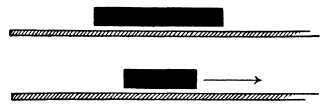
M. It is not. In fact, it follows from the Lorentz transformation that a moving stick contracts in the direction of the motion and the contraction increases if the speed increases. The faster a stick moves, the shorter it appears. But this occurs only in the direction of the motion. You see in my drawing a moving rod which shrinks to half its length, when it moves with a velocity approaching ca. [circa] 90 per cent of the velocity of light. There is no contraction, however, in the direction perpendicular to the motion, as I have tried to illustrate in my drawing.

O. This means that the rhythm of a moving clock and the length of a moving stick depend on the speed. But how?
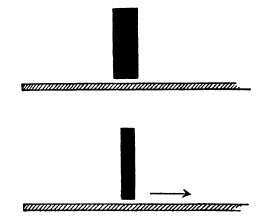
M. The changes become more distinct as the speed increases. It follows from the Lorentz transformation that a stick would shrink to nothing if its speed were to reach that of light. Similarly the rhythm of a moving clock is slowed down, compared to the clocks it passes along the rod, and would come to a stop if the clock were to move with the speed of light, that is, if the clock is a “good” one.

The rhythm of a moving clock and the length of a moving rod depend on the speed. NOTE: Einstein’s interpretation is examined more closely in the Final Comment.

O. This seems to contradict all our experience. We know that a car does not become shorter when in motion and we also know that the driver can always compare his “good” watch with those he passes on the way, finding that they agree fairly well, contrary to your statement.

M. This is certainly true. But these mechanical velocities are all very small compared to that of light, and it is, therefore, ridiculous to apply relativity to these phenomena. Every car driver can safely apply classical physics even if he increases his speed a hundred thousand times. We could only expect disagreement between experiment and the classical transformation with velocities approaching that of light. Only with very great velocities can the validity of the Lorentz transformation be tested.

A mass object cannot be pushed to great velocities without it losing inertia.

O. But there is yet another difficulty. According to mechanics I can imagine bodies with velocities even greater than that of light. A body moving with the velocity of light relative to a floating ship moves with a velocity greater than that of light relative to the shore. What will happen to the stick which shrank to nothing when its velocity was that of light? We can hardly expect a negative length if the velocity is greater than that of light.

M. There is really no reason for such sarcasm! From the point of view of the relativity theory a material body cannot have a velocity greater than that of light. The velocity of light forms the upper limit of velocities for all material bodies. If the speed of a body is equal to that of light relative to a ship, then it will also be equal to that of light relative to the shore. The simple mechanical law of adding and subtracting velocities is no longer valid or, more precisely, is only approximately valid for small velocities, but not for those near the velocity of light. The number expressing the velocity of light appears explicitly in the Lorentz transformation, and plays the role of a limiting case, like the infinite velocity in classical mechanics. This more general theory does not contradict the classical transformation and classical mechanics. On the contrary, we regain the old concepts as a limiting case when the velocities are small. From the point of view of the new theory it is clear in which cases classical physics is valid and wherein its limitations lie. It would be just as ridiculous to apply the theory of relativity to the motion of cars, ships, and trains as to use a calculating machine where a multiplication table would be sufficient.

As an object approaches the velocity of light, its mass must go to zero and not to infinity.

.

Final Comment

.

OT 1948: The Dynamics

Reference: DIANETICS: The Original Thesis

This paper presents Chapter 4 from the book DIANETICS: THE ORIGINAL THESIS by L. RON HUBBARD. The contents are from the original publication of this book by The Hubbard Dianetic Foundation, Inc. (1948).

The paragraphs of the original material (in black) are accompanied by brief comments (in color) based on the present understanding.  Feedback on these comments is appreciated.

The heading below is linked to the original materials.

.

The Dynamics

The basic dynamic, SURVIVE, increases in complexity as the complexity of the organism evolves. Energy may be considered to have taken many paths through eternity to arrive intact at the infinite goal. The “why” of the goal may lie above the finite line but below it, demarked by the word SURVIVE, definite manifestations are visible. Energy collects into various forms of matter which collect and aggregate in various materials and compounds. Life evolves from the simplest basic into complex forms since evolutionary change is in itself a method of survival.

Beyond immediate survival there is long-term evolution. This is the visible goal.

Conflict amongst species and individuals within the species is additionally a survival factor. Affinity of individuals for groups, races, and the whole of its species, and for other species, is additionally a survival factor, as strong as or stronger than conflict.

There are trials and errors, the resolution of which leads to evolution.

Drive is defined as the dynamic thrust through time toward the attainment of the goal. Survive is considered to be the lowest common denominator of all energy efforts and all forms. It can then be subdivided specifically into several drive lines as applicable to each form or species. The unaberrated self contains eight main drives which are held in common with man.

The dynamics are: One, self; Two, sex; Three, group; Four, mankind; Five, life; Six, the physical universe; Seven, thought; Eight, universal thought or infinity.

The dynamic is the drive toward evolution. It may be subdivided into drives of self, family (sex), group, mankind, life, physical universe, thought universe and universe as a whole.

An entire philosophy can be built around each one of these dynamics which will account for all the actions of an individual. Any one of these philosophies is so complete that it can be logically made to include the other seven. In other words, all purpose of an individual can be rationalized into the dynamic of self. A philosophy exists which attempts to rationalize everything into the sexual dynamic, and so on with all the dynamics. Observing that each one can stand as a logical unity, one finds it necessary to retire to the lowest common denominator of the basic dynamic which actually does explain the eight subdivisions. As each one of the subdivisions is capable of supporting the whole weight of a rational argument, it can readily be deduced that each is of nearly equal importance in the individual. The aberrated conditions of a society tend to vary the stress on these dynamics, making first one and then another the keynote of the society.

The primary consideration is the universal survival and evolution. Other survival considerations follow in the order of importance as: thought universe, physical universe, life, mankind, group, family (sex) and self.

In an unaberrated individual or society, the validity of all eight would be recognized.

The unaberrated individual may physiologically possess or environmentally stress one or more of these dynamics above the others. In terms of basic personality, the physiological-environmental-educational aspect of the individual is of varied strength in the eight dynamics.

A cleared individual shall be totally objective in his viewpoint. It takes the universal viewpoint to be objective.

Each one of the eight dynamics breaks further into purposes which are specific and complex. Purposes and other factors entangle these dynamics, and varying situations and the observational power of the individual may conflict one of these dynamics against another within the individual himself. This is a basic complex factor of unaberrated personality.

Dynamics help one to narrow down the situation so it can be resolved.

I. THE DYNAMIC OF SELF consists of the dynamic thrust to survive as an individual, to obtain pleasure as an individual, and to avoid pain. It covers the general field of food, clothing and shelter, personal ambition, and general individual purpose.

The Dynamic of Self is the most complex dynamic because the concerns of all other dynamics are concentrated here. The ultimate pleasure comes from resolving situations and engaging in activities that help survive and evolve.

II. THE DYNAMIC OF SEX embraces the procreation of progeny, the care of that progeny, and the securing for that progeny of better survival conditions and abilities in the future.

On Dynamic of Sex one interacts with the opposite sex for procreation, one then takes care of children and future. Therefore, it would include understanding of others and general education.

III. THE DYNAMIC OF GROUP embraces the various units of the species man, such as the association, the military company, the people in the surrounding countryside, the nation and the race. It is characterized by activity on the part of the individual to obtain and maintain the survival of the group of which he is a part.

On Dynamic of Group there is a whole gradient from smaller to larger groups. The cooperation within groups aids survival and further evolution. Therefore, the most important consideration here is one of cooperation.

IV. THE MANKIND DYNAMIC embraces the survival of the species.

The major concern on the Mankind Dynamic is that mankind must thrive and should not become extinct. This is achieved through the upper four dynamics.

Note: The first four dynamics belong to Dianetics. The upper four, introduced in late 1950, complete the full eight dynamics of Scientology.

V. THE DYNAMIC OF LIFE is the urge of the individual to survive for life and for life to survive for itself.

Life is an amazing step in evolution. Mankind survives in cooperation with other life. There is an ecosystem that one must become aware of.

VI. THE PHYSICAL UNIVERSE DYNAMIC is the drive of the individual to enhance the survival of all matter, energy, time and space.

The basis of life is the physical universe from which it has evolved, and which provides the ultimate sustenance. There is tremendous amount of knowledge here that one must be aware of.

VII. THE THOUGHT DYNAMIC concerns the urge of the individual to survive as thought.

Principles and knowledge develop as the existence evolves. These then become vital to one’s thinking to survive and evolve.

VIII. THE DYNAMIC OF UNIVERSAL THOUGHT is the urge of the individual to survive for the Creator.

Here is the comprehensive view of all existence. From this view evolve the other dynamics. The most important consideration here is that of objectivity.

While man is concerned with any one of the above dynamics, any one of them may become antipathetic to his own survival. This is rational conflict and is normally and commonly incidental to survival. It is non-aberrative in that it is rational within the educational limitation.

The conflicts may become easier to narrow down and resolve when approached with the knowledge of these dynamics.

The family as a unit is not a dynamic but a combination of dynamics. And in this and other societies it attains a position of interest which is not necessarily inherent in the individual or group.

Family is a combination of first and third dynamic where sixth and seventh dynamics enter as health and education.

Basically simple, complexity is introduced amongst the dynamics by individual and group irrationalities. The basic (unaberrated) individual has continual difficulty rationalizing the problems of importances and choices amongst these dynamics. When the basic individual becomes aberrated and is attendantly unable to reason freely on all problems, a selection of importances amongst these dynamics becomes nearly impossible and produces aberrated solutions which may resolve such an extreme as the destruction of the individual himself, by himself, under the mistaken solution that he may thus obey the primary command.

Note: All self-destructive effort is irrationality of a precise nature which will often be found by the auditor in his preclear (this term covers anyone who is not CLEAR; however, it is principally used to describe a person who, through auditing, is finding out more about himself and life) during auditing (the application of Dianetic procedures to a preclear by a trained Dianetic auditor) but which forms no part of the basic personality of that individual.

Irrationality may also be divided per these dynamics. Self-destruction, as part of sacrifice for a nobler cause, is not necessarily irrational.

.

Final Comments

KEY WORDS: Universe, Thought (impulse), Material (energy), Life (ecosystem), Mankind, Group (community, race, culture, nation), Family (sex, children), Individual (self).

The basic dynamic is not only SURVIVE but also EVOLVE. The universe cannot help but survive; so, it must evolve. This is the overall dynamic of the universe called the eighth dynamic. The universe, obviously, has an inherent impulse built in it. Therefore, we may say that the eighth dynamic subdivides into the inner impulse and the outer appearance as the seventh and sixth dynamics respectively.

As the universe evolves from gases to liquids to solids, to minerals, to animated life, to reacting organisms, to thinking mammals, and finally, to self-aware humans, we get life or the fifth dynamic. The humans are such a major step in evolution that they are called the mankind or fourth dynamic.

The human awareness has evolved under different geographic conditions and locations into different cultures, thinking patterns, abilities, etc. Thus we have subdivisions into many different groups, and each group is seen as a third dynamic. The keynote of a group is its common purpose and cooperation. Within the third dynamic we have the evolution of families to take better care of future generations. This is seen as the second dynamic. There is sexual activity within the context of second dynamic. The keynote here is taking responsibility for the future.

The second dynamic then provides an environment in which children develop their potential fully as individuals. The problem solving ability of an individual is the highest achievement of evolution. This is the first dynamic.

Hubbard describes the dynamics from the viewpoint of the individual, but it makes more sense to look at the dynamics from the viewpoint of the universe and its evolution as described above.

.

Einstein 1938: Ether and Motion

Reference: Evolution of Physics

This paper presents Chapter III, section 6 from the book THE EVOLUTION OF PHYSICS by A. EINSTEIN and L. INFELD. The contents are from the original publication of this book by Simon and Schuster, New York (1942).

The paragraphs of the original material (in black) are accompanied by brief comments (in color) based on the present understanding.  Feedback on these comments is appreciated.

The heading below is linked to the original materials.

.

Ether and Motion

The Galilean relativity principle is valid for mechanical phenomena. The same laws of mechanics apply to all inertial systems moving relative to each other. Is this principle also valid for non-mechanical phenomena, especially for those for which the field concepts proved so very important? All problems concentrated around this question immediately bring us to the starting-point of the relativity theory.

The Galilean relativity principle applies to a narrow range of velocities of matter. In this range, the velocities are small and inertia is very large (compared to light). Change in inertia corresponding to change in velocity is virtually undetectable. The laws of mechanics are based on this invariability of inertia (mass). All inertial frames exist in this narrow range of velocities of matter.

We remember that the velocity of light in vacuo, or in other words, in ether, is 186,000 miles per second and that light is an electromagnetic wave spreading through the ether. The electromagnetic field carries energy which, once emitted from its source, leads an independent existence. For the time being, we shall continue to believe that the ether is a medium through which electromagnetic waves, and thus also light waves, are propagated, even though we are fully aware of the many difficulties connected with its mechanical structure.

The principle of field applies to a broad spectrum of electromagnetic waves. In this spectrum, the inertia (represented by frequencies) is extremely small, but the velocity is very large. Change in velocity corresponding to change in inertia (frequency) is virtually undetectable. The electromagnetic field carries energy which, once emitted from its source, leads an independent existence.

We are sitting in a closed room so isolated from the external world that no air can enter or escape. If we sit still and talk we are, from the physical point of view, creating sound waves, which spread from their resting source with the velocity of sound in air. If there were no air or other material medium between the mouth and the ear, we could not detect a sound. Experiment has shown that the velocity of sound in air is the same in all directions, if there is no wind and the air is at rest in the chosen c.s.

Let us now imagine that our room moves uniformly through space. A man outside sees, through the glass walls of the moving room (or train if you prefer), everything which is going on inside. From the measurements of the inside observer he can deduce the velocity of sound relative to his c.s. connected with his surroundings, relative to which the room moves. Here again is the old, much discussed, problem of determining the velocity in one c.s. if it is already known in another.

The observer in the room claims: the velocity of sound is, for me, the same in all directions.

The outside observer claims: the velocity of sound, spreading in the moving room and determined in my c.s., is not the same in all directions. It is greater than the standard velocity of sound in the direction of the motion of the room and smaller in the opposite direction.

These conclusions are drawn from the classical transformation and can be confirmed by experiment. The room carries within it the material medium, the air through which sound waves are propagated, and the velocities of sound will, therefore, be different for the inside and outside observer.

We can draw some further conclusions from the theory of sound as a wave propagated through a material medium. One way, though by no means the simplest, of not hearing what someone is saying, is to run, with a velocity greater than that of sound, relative to the air surrounding the speaker. The sound waves produced will then never be able to reach our ears. On the other hand, if we missed an important word which will never be repeated, we must run with a speed greater than that of sound to reach the produced wave and to catch the word. There is nothing irrational in either of these examples except that in both cases we should have to run with a speed of about four hundred yards per second, and we can very well imagine that further technical development will make such speeds possible. A bullet fired from a gun actually moves with a speed greater than that of sound and a man placed on such a bullet would never hear the sound of the shot.

Sound lies in the narrow range of velocities of matter where inertia is very large. Because of high inertia, the wind is substantial. Sound is carried with the wind, so its velocity is higher in the direction of the wind.

All these examples are of a purely mechanical character and we can now formulate the important questions: could we repeat what has just been said of a sound wave, in the case of a light wave? Do the Galilean relativity principle and the classical transformation apply to optical and electrical phenomena as well as to mechanical? It would be risky to answer these questions by a simple “yes” or “no” without going more deeply into their meaning.

In the case of the sound wave in the room moving uniformly, relative to the outside observer, the following intermediate steps are very essential for our conclusion:

  1. The moving room carries the air in which the sound wave is propagated.
  2. The velocities observed in two c.s. moving uniformly, relative to each other, are connected by the classical transformation.

The corresponding problem for light must be formulated a little differently. The observers in the room are no longer talking, but are sending light signals, or light waves in every direction. Let us further assume that the sources emitting the light signals are permanently resting in the room. The light waves move through the ether just as the sound waves moved through the air.

Is the ether carried with the room as the air was? Since we have no mechanical picture of the ether, it is extremely difficult to answer this question. If the room is closed, the air inside is forced to move with it. There is obviously no sense in thinking of ether in this way, since all matter is immersed in it and it penetrates everywhere. No doors are closed to ether. The “moving room” now means only a moving c.s. to which the source of light is rigidly connected. It is, however, not beyond us to imagine that the room moving with its light source carries the ether along with it just as the sound source and air were carried along in the closed room. But we can equally well imagine the opposite: that the room travels through the ether as a ship through a perfectly smooth sea, not carrying any part of the medium along but moving through it. In our first picture, the room moving with its light source carries the ether. An analogy with a sound wave is possible and quite similar conclusions can be drawn. In the second, the room moving with its light source does not carry the ether. No analogy with a sound wave is possible and the conclusions drawn in the case of a sound wave do not hold for a light wave. These are the two limiting possibilities. We could imagine the still more complicated possibility that the ether is only partially carried by the room moving with its light source. But there is no reason to discuss the more complicated assumptions before finding out which of the two simpler limiting cases experiment favours.

We shall begin with our first picture and assume, for the present: the ether is carried along by the room moving with its rigidly connected light source. If we believe in the simple transformation principle for the velocities of sound waves, we can now apply our conclusions to light waves as well. There is no reason for doubting the simple mechanical transformation law which only states that the velocities have to be added in certain cases and subtracted in others. For the moment, therefore, we shall assume both the carrying of the ether by the room moving with its light source and the classical transformation.

If I turn on the light and its source is rigidly connected with my room, then the velocity of the light signal has the well-known experimental value 186,000 miles per second. But the outside observer will notice the motion of the room, and, therefore, that of the source—and, since the ether is carried along, his conclusion must be: the velocity of light in my outside c.s. is different in different directions. It is greater than the standard velocity of light in the direction of the motion of the room and smaller in the opposite direction. Our conclusion is: if ether is carried with the room moving with its light source and if the mechanical laws are valid, then the velocity of light must depend on the velocity of the light source. Light reaching our eyes from a moving light source would have a greater velocity if the motion is toward us and smaller if it is away from us.

If our speed were greater than that of light, we should be able to run away from a light signal. We could see occurrences from the past by reaching previously sent light waves. We should catch them in a reverse order to that in which they were sent, and the train of happenings on our earth would appear like a film shown backward, beginning with a happy ending. These conclusions all follow from the assumption that the moving c.s. carries along the ether and the mechanical transformation laws are valid. If this is so, the analogy between light and sound is perfect.

But there is no indication as to the truth of these conclusions. On the contrary, they are contradicted by all observations made with the intention of proving them. There is not the slightest doubt as to the clarity of this verdict, although it is obtained through rather indirect experiments in view of the great technical difficulties caused by the enormous value of the velocity of light. The velocity of light is always the same in all c.s. independent of whether or not the emitting source moves, or how it moves.

Light lies in the broad spectrum of electromagnetic waves where inertia is extremely small. The “wind” due to moving light source is not substantial at all, and the velocity is extremely large. Therefore, no change in velocity is detected.

We shall not go into detailed description of the many experiments from which this important conclusion can be drawn. We can, however, use some very simple arguments which, though they do not prove that the velocity of light is independent of the motion of the source, nevertheless make this fact convincing and understandable.

In our planetary system the earth and other planets move around the sun. We do not know of the existence of other planetary systems similar to ours. There are, however, very many double-star systems, consisting of two stars moving around a point, called their centre of gravity. Observation of the motion of these double stars reveals the validity of Newton’s gravitational law. Now suppose that the speed of light depends on the velocity of the emitting body. Then the message, that is, the light ray from the star, will travel more quickly or more slowly, according to the velocity of the star at the moment the ray is emitted. In this case the whole motion would be muddled and it would be impossible to confirm, in the case of distant double stars, the validity of the same gravitational law which rules over our planetary system.

Let us consider another experiment based upon a very simple idea. Imagine a wheel rotating very quickly. According to our assumption, the ether is carried by the motion and takes a part in it. A light wave passing near the wheel would have a different speed when the wheel is at rest than when it is in motion. The velocity of light in ether at rest should differ from that in ether which is being quickly dragged round by the motion of the wheel, just as the velocity of a sound wave varies on calm and windy days. But no such difference is detected! No matter from which angle we approach the subject, or what crucial experiment we may devise, the verdict is always against the assumption of the ether carried by motion. Thus, the result of our considerations, supported by more detailed and technical argument, is:

  1. The velocity of light does not depend on the motion of the emitting source.
  2. It must not be assumed that the moving body carries the surrounding ether along.

We must, therefore, give up the analogy between sound and light waves and turn to the second possibility: that all matter moves through the ether, which takes no part whatever in the motion. This means that we assume the existence of a sea of ether with all c.s. resting in it, or moving relative to it. Suppose we leave, for a while, the question as to whether experiment proved or disproved this theory. It will be better to become more familiar with the meaning of this new assumption and with the conclusions which can be drawn from it.

The analogy between sound and light in terms of wind and velocity does not exist. If there is any analogy, it is in terms of a balance between inertia and velocity.

There exists a c.s. resting relative to the ether-sea. In mechanics, not one of the many c.s. moving uniformly, relative to each other, could be distinguished. All such c.s. were equally “good” or “bad”. If we have two c.s. moving uniformly, relative to each other, it is meaningless, in mechanics, to ask which of them is in motion and which at rest. Only relative uniform motion can be observed. We cannot talk about absolute uniform motion because of the Galilean relativity principle. What is meant by the statement that absolute and not only relative uniform motion exists? Simply that there exists one c.s. in which some of the laws of nature are different from those in all others. Also that every observer can detect whether his c.s. is at rest or in motion by comparing the laws valid in it with those valid in the only one which has the absolute monopoly of serving as the standard c.s. Here is a different state of affairs from classical mechanics, where absolute uniform motion is quite meaningless because of Galileo’s law of inertia.

What conclusions can be drawn in the domain of field phenomena if motion through ether is assumed? This would mean that there exists one c.s. distinct from all others, at rest relative to the ether-sea. It is quite clear that some of the laws of nature must be different in this c.s., otherwise the phrase “motion through ether” would be meaningless. If the Galilean relativity principle is valid, then motion through ether makes no sense at all. It is impossible to reconcile these two ideas. If, however, there exists one special c.s. fixed by the ether, then to speak of “absolute motion” or “absolute rest” has a definite meaning.

We really have no choice. We tried to save the Galilean relativity principle by assuming that systems carry the ether along in their motion, but this led to a contradiction with experiment. The only way out is to abandon the Galilean relativity principle and try out the assumption that all bodies move through the calm ether-sea.

The laws of mechanics based on Galileo’s Relativity principle apply to a very small range of velocities for near constant inertia. Absolute velocities do not exist because the condition of absolute rest is not recognized in this range. But in the wider range, there can be absolute rest for a body of infinite inertia. An example would be a black hole at the center of the galaxy.

The next step is to consider some conclusions contradicting the Galilean relativity principle and supporting the view of motion through ether, and to put them to the test of an experiment. Such experiments are easy enough to imagine, but very difficult to perform. As we are concerned here only with ideas, we need not bother with technical difficulties.

Again we return to our moving room with two observers, one inside and one outside. The outside observer will represent the standard c.s., designated by the ether-sea. It is the distinguished c.s. in which the velocity of light always has the same standard value. All light sources, whether moving or at rest in the calm ether-sea, propagate light with the same velocity. The room and its observer move through the ether. Imagine that a light in the centre of the room is flashed on and off and, furthermore, that the walls of the room are transparent so that the observers, both inside and outside, can measure the velocity of the light. If we ask the two observers what results they expect to obtain, their answers would run something like this:

The outside observer: My c.s. is designated by the ether-sea. Light in my c.s. always has the standard value. I need not care whether or not the source of light or other bodies are moving, for they never carry my ether-sea with them. My c.s. is distinguished from all others and the velocity of light must have its standard value in this c.s., independent of the direction of the light beam or the motion of its source.

The inside observer: My room moves through the ether-sea. One of the walls runs away from the light and the other approaches it. If my room travelled, relative to the ether-sea, with the velocity of light, then the light emitted from the centre of the room would never reach the wall running away with the velocity of light. If the room travelled with a velocity smaller than that of light, then a wave sent from the centre of the room would reach one of the walls before the other. The wall moving toward the light wave would be reached before the one retreating from the light wave. Therefore, although the source of light is rigidly connected with my C.S., the velocity of light will not be the same in all directions. It will be smaller in the direction of the motion relative to the ether-sea as the wall runs away, and greater in the opposite direction as the wall moves toward the wave and tries to meet it sooner.

Thus, only in the one c.s. distinguished by the ether-sea should the velocity of light be equal in all directions. For other c.s. moving relatively to the ether-sea it should depend on the direction in which we are measuring.

The crucial experiment just considered enables us to test the theory of motion through the ether-sea. Nature, in fact, places at our disposal a system moving with a fairly high velocity: the earth in its yearly motion around the sun. If our assumption is correct, then the velocity of light in the direction of the motion of the earth should differ from the velocity of light in an opposite direction. The differences can be calculated and a suitable experimental test devised. In view of the small time-differences following from the theory, very ingenious experimental arrangements have to be thought out. This was done in the famous Michelson-Morley experiment. The result was a verdict of “death” to the theory of a calm ether-sea through which all matter moves. No dependence of the speed of light upon direction could be found. Not only the speed of light, but also other field phenomena would show a dependence on the direction in the moving c.s., if the theory of the ether-sea were assumed. Every experiment has given the same negative result as the Michelson-Morley one, and never revealed any dependence upon the direction of the motion of the earth.

The situation grows more and more serious. Two assumptions have been tried. The first, that moving bodies carry ether along. The fact that the velocity of light does not depend on the motion of the source contradicts this assumption. The second, that there exists one distinguished c.s. and that moving bodies do not carry the ether but travel through an ever calm ether-sea. If this is so, then the Galilean relativity principle is not valid and the speed of light cannot be the same in every c.s. Again we are in contradiction with experiment.

Michelson-Morley’s experiment simply demonstrated that the motion of Earth through space does not affect the speed of visible light. This result may be interpreted in different ways. But it consistent with almost zero inertia of light and aether. Light is a slightly condensed form of aether. Matter is an extremely condensed form of aether.

More artificial theories have been tried out, assuming that the real truth lies somewhere between these two limiting cases: that the ether is only partially carried by the moving bodies. But they all failed! Every attempt to explain the electromagnetic phenomena in moving c.s. with the help of the motion of the ether, motion through the ether, or both these motions, proved unsuccessful.

Thus arose one of the most dramatic situations in the history of science. All assumptions concerning ether led nowhere! The experimental verdict was always negative. Looking back over the development of physics we see that the ether, soon after its birth, became the enfant terrible of the family of physical substances. First, the construction of a simple mechanical picture of the ether proved to be impossible and was discarded. This caused, to a great extent, the breakdown of the mechanical point of view. Second, we had to give up hope that through the presence of the ether-sea one c.s. would be distinguished and lead to the recognition of absolute, and not only relative, motion. This would have been the only way, besides carrying the waves, in which ether could mark and justify its existence. All our attempts to make ether real failed. It revealed neither its mechanical construction nor absolute motion. Nothing remained of all the properties of the ether except that for which it was invented, i.e. its ability to transmit electromagnetic waves. Our attempts to discover the properties of the ether led to difficulties and contradictions. After such bad experiences, this is the moment to forget the ether completely and to try never to mention its name. We shall say: our space has the physical property of transmitting waves, and so omit the use of a word we have decided to avoid.

According to Einstein, aether is an invented concept. All we can say is that our space has the physical property of transmitting waves. Einstein then expresses the idea of space mathematically only.

The omission of a word from our vocabulary is, of course, no remedy. Our troubles are indeed much too profound to be solved in this way!

Let us now write down the facts which have been sufficiently confirmed by experiment without bothering any more about the “e——- r ” problem.

(1) The velocity of light in empty space always has its standard value, independent of the motion of the source or receiver of light.

(2) In two c.s. moving uniformly, relative to each other, all laws of nature are exactly identical and there is no way of distinguishing absolute uniform motion.

There are many experiments to confirm these two statements and not a single one to contradict either of them. The first statement expresses the constant character of the velocity of light, the second generalizes the Galilean relativity principle, formulated for mechanical phenomena, to all happenings in nature.

In mechanics, we have seen: If the velocity of a material point is so and so, relative to one c.s., then it will be different in another c.s. moving uniformly, relative to the first. This follows from the simple mechanical transformation principles. They are immediately given by our intuition (man moving relative to ship and shore) and apparently nothing can be wrong here! But this transformation law is in contradiction to the constant character of the velocity of light. Or, in other words, we add a third principle:

(3) Positions and velocities are transformed from one inertial system to another according to the classical transformation.

The contradiction is then evident. We cannot combine (1), (2), and (3).

The classical transformation seems too obvious and simple for any attempt to change it. We have already tried to change (1) and (2) and came to a disagreement with experiment. All theories concerning the motion of “e——- r” required an alteration of (1) and (2). This was no good. Once more we realize the serious character of our difficulties. A new clue is needed. It is supplied by accepting the fundamental assumptions (1) and (2), and, strange though it seems, giving up (3). The new clue starts from an analysis of the most fundamental and primitive concepts; we shall show how this analysis forces us to change our old views and removes all our difficulties.

Einstein’s assumptions may be criticized as follows: (1) Light is a substance of almost zero inertia; whereas, the source of light is considered to be a material object of extremely high inertia. The velocity of light is so high that variations in it due to changes in frequency cannot be detected in the framework of matter. (2) The idea of c.s. is limited to a narrow range of velocities for which inertia is so large that changes in it corresponding to changes in velocity cannot be detected. Based on inertia we can say that the velocity of light intuitively applies to “sunlight relative to the sun” and not to “sun relative to the sunlight.” (3) The laws of classical mechanics are a very small subset of the laws of nature under conditions as described above. The classical viewpoint does not consider the balance in nature between velocity and inertia.

Velocities can be differentiated as being greater or lesser on an absolute basis by comparing the inertia of the particles.

.

Final Comment

.

OT 1948: An Analogy of the Mind

Reference: DIANETICS: The Original Thesis

This paper presents Chapter 3 from the book DIANETICS: THE ORIGINAL THESIS by L. RON HUBBARD. The contents are from the original publication of this book by The Hubbard Dianetic Foundation, Inc. (1948).

The paragraphs of the original material (in black) are accompanied by brief comments (in color) based on the present understanding.  Feedback on these comments is appreciated.

The heading below is linked to the original materials.

.

An Analogy of the Mind

It is not the purpose of Dianetics to reconstruct the human mind. The purpose of Dianetics is to delete from the existing mind those physically painful experiences which have resulted in the aberration of the analytical mind, to resolve the physical manifestations of mental aberration, and to restore in its entirety the proper working function of a brain not otherwise physically deranged. Dianetics thus embraces the various aspects of psychosomatic conditions, including the glandular balance or imbalance of the organism, as influenced by painful physical experience. However, its purpose is not one of healing, and its address is not to such psychosomatic manifestations specifically, but rather to those aberrative experiences in which these conditions have their roots.

Dianetics assumes that physically painful experiences are the cause of all mental and psychosomatic aberrations.  

The initial adjustments of the individual are included in Child Dianetics and Educational Dianetics. Judicial Dianetics, Political Dianetics and Military Dianetics are elsewhere touched upon or allocated for study. Dianetics, as a family of sciences, proceeds however from the axioms cursorily touched upon in the last chapter and is uniformly governed by the principles of the behavior of the human mind.

When an individual is acting contrary to survival of himself, his group, progeny, race, mankind, or life he can be considered to be unintelligent, uninformed or aberrated. Every single instance of aberrated conduct threatening the general goal of the individual as outlined in the last chapter can be proven to have a source which will specifically be found to be a painful experience containing data not available to the analytical mind. Every single instance and facet of aberrated conduct has its exact causation in the physically painful error which has been introduced during a moment of absence of the analytical power.

The content of these physically painful experiences is not available to the analytical mind.

Dianetics consists of discovering the aberration in the individual, finding the physically painful experience which corresponds to it and placing the data therein contained at the disposal of the analytical mind. More as an effort to demonstrate how that is accomplished than as an actual outline of the character of the mind, the following analogy is offered.

First there is the physio-animal section of the brain, containing the motor controls, the sub-brains, and the physical nervous system in general, including the physical aspect of the analytical section of the brain. The control of all voluntary and involuntary muscles is contained in this section. It commands all body fluids, blood flow, respiration, glandular secretion, cellular construction, and the activity of various parts of the body. Experimentation has adequately demonstrated this. The physio-animal mind has specific methods of “thinking.” These are entirely reactive. Animal experimentation—rats, dogs, etc.—is experimentation on and with precisely this mind and little more. It is a fully conscious mind and should never be denoted by any term, which denies it “consciousness” since there is no period in the life of the organism from conception to death when this mind is not awake, observing, and recording perceptics. This is the mind of a dog, cat, or rat and is also the basic mind of a man so far as its operating characteristics are concerned. A man in the deepest possible somnambulistic sleep is still in possession of more mind and thinking and coordinating ability than a lower animal.

Hubbard’s model of the mind puts the physio-animal brain at the core. It controls all mechanical functions of the body through electro-chemical laws.

The term “consciousness” is no more than a designation of the awareness of now. The physio-animal mind never ceases to be aware of now and never ceases to record the successive instances of now which in their composite make up a time track connecting memory in an orderly chain. Cessation of life alone discontinues the recording of perceptions on this orderly track. Unconsciousness is a condition wherein the organism is discoordinated only in its analytical process and motor control direction. In the physio-animal section of the brain, a complete time track and a complete memory record of all perceptions for all moments of the organism’s existence is available.

Dianetics assumes that all electro-chemical-mechanical activity is recorded in an orderly chain, which is potentially available.

As life progresses, for instance, from a blade of grass, greater and greater complexities and degrees of self-determinism are possible. Energy in its various forms is the primary motivator in the lower orders, but as the complexity of the order is increased into the animal kingdom, the physio-animal brain attains more and more command of the entire organism until it itself begins to possess the second section of the mind.

All animals possess in some slight degree an analyzer. This, which we designate the analytical mind, is present even in lower orders, since it is only that section of the brain which possesses the self-deterministic coordinative command of the physio-animal brain and thus of the body. In a rat, for instance, it is no more than its “conscious” awareness of now applying to lessons of then without rationality but with instinct and painful experience. This is the analytical section of the mind in a lower animal but it is the reactive mind in a man whose analytical mind is so highly attuned and intricate that it can command entirely the physio-animal brain and thus the body.

In animals, the mind develops the capability of being programmed by experiences containing pain and pleasure.

Man not only possesses a superior physio-animal mind but possesses as well an analytical mind of such power and complexity that it has no real rival in any other species. The analytical mind of man cannot be studied by observing the reactions of animals under any situations. Not only is it more sensitive but it possesses factors and sensitivities not elsewhere found.

In Man the mind develops the capability to analyze all experiences rationally in much finer details and implement the solutions.

Continuing this analogy: Lying between the analytical mind and the physio-animal mind may be conceived the reactive mind. This is the coordinated responses of the physio-animal mind, the “analytical” mind of animals, and the first post of emergency command in man. All errors of a psychic or psychosomatic nature can be considered for the purposes of this analogy to lie in the reactive mind. The first human analytical mind took command of the body and physio-animal mind under strained and dangerous circumstances when man was still in violent contest with other species around him. It can be considered that the analytical mind received command with the single proviso that instantaneous emergency would be handled by the outdated but faster reactive mind.

Hubbard’s reactive mind comes about from the short-circuiting of the normal mind.

Any and all errors in thinking and action derive from the reactive mind as it is increased in strength and power by painful experience. It can be called a shadow mind, instantaneously reactive when any of its content is perceived in the environment of the individual, at which time it urgently bypasses the analytical mind and causes immediate reaction in the physio-animal mind and in the body. Additionally, the reactive mind is in continual presence when chronically restimulated by a constantly present restimulator—which is to say, an approximation of the reactive mind’s content or some part thereof continually perceived in the environment of the organism. The reactive mind is in action so long as it is activated by an exact or nearly exact approximation of its content. But given too continuous a restimulation, it can and does derange both the physio-animal mind and body below it and the analytical mind above it. It was created by deranging circumstances of a physical nature, hence it deranges.

According to Hubbard, this short-circuiting is caused by painful experiences. It can become dominant when activated continually.

The entire content of the reactive mind is records of physical pain with its accompanying perceptions during disconnection of the analyzer. All aberrated conduct and error on the part of an individual is occasioned by restimulation of his reactive mind.

None of these minds are “unconscious,” nor are they subconscious. The entire organism is always conscious but the temporary dispersion of the thought processes of the analytical mind brings about a condition whereby that mind, having been dispersed and considering itself the residence of the person, is unable to obtain and reach data perceived and received by the organism during the analytical mind’s condition of dispersion. That the analytical mind can be thrown, by pain or shock, out of circuit is a survival factor of its own: as sensitive “machinery” it must be protected by a fuse system.

Mind is always functioning. Analytical consciousness exists only when mental circuits are functioning normally as they should.

.

Final Comments

KEY WORDS: Analytical Mind, Aberration, Psychosomatic, Consciousness, Reactive Mind.

The mind is a structure of thoughts, which may be described as a matrix of data elements. A thought may appear in the mind as a concatenation of data elements. Ideally, all the data elements are well-assimilated in the matrix, such that no association is missing. All incoming perceptual data is continually broken down into fine data elements and assimilated. Assimilation removes all duplication of data and it indexes the data elements for efficient retrieval. Past experiences are easily recalled and any desired associations among data are easily retrieved making the thinking very quick. The state of mental matrix represents the consciousness of the individual.

Associations made in the mind immediately release electrical and chemical signals to activate the mechanical elements in the body. There is immediate feedback to the mind of the activity of the mechanical elements, which then releases further signals. Thus, any intended action is executed correctly with certainty.

Errors in the mind occur when the assimilation of data elements is not complete. As a consequence, proper associations are missing and the concatenation of data elements is short circuited. This results in thoughts that cause aberrations in thinking and pain in the body. This leads to the organism behaving erratically and abnormally.

This lack of assimilation appears to a person as unconsciousness, confusion and physically painful experience that may appear in dreams and nightmares. The unassimilated content of the mental matrix is not available to the consciousness of the individual. It is only the knowledge of what triggers these aberrations that may lead to the discovery of the unassimilated content and its re-assimilation into the overall matrix.

The functions of “physio-animal”, “analytical” and “reactive” minds, and memory as postulated by Hubbard can easily be derived from the mental matrix model described above. The whole matrix is always functioning, but the consciousness of the individual comes only from the assimilated portion of the matrix.

.

Einstein 1938: The Mechanical Scaffold

Reference: Evolution of Physics

This paper presents Chapter III, section 5 from the book THE EVOLUTION OF PHYSICS by A. EINSTEIN and L. INFELD. The contents are from the original publication of this book by Simon and Schuster, New York (1942).

The paragraphs of the original material (in black) are accompanied by brief comments (in color) based on the present understanding.  Feedback on these comments is appreciated.

The heading below is linked to the original materials.

.

The Mechanical Scaffold

On reaching this stage of our story, we must turn back to the beginning, to Galileo’s law of inertia. We quote once more:

Every body perseveres in its state of rest, or of uniform motion in a right line, unless it is compelled to change that state by forces impressed thereon.

Once the idea of inertia is understood, one wonders what more can be said about it. Although this problem has already been thoroughly discussed, it is by no means exhausted.

A factor that has been missing from the law of inertia is that the natural uniform motion of a body is not arbitrary. If inertia resists the uniform motion from being changed, then it will also try to restore the uniform motion after it is changed.

Imagine a serious scientist who believes that the law of inertia can be proved or disproved by actual experiments. He pushes small spheres along a horizontal table, trying to eliminate friction so far as possible. He notices that the motion becomes more uniform as the table and the spheres are made smoother. Just as he is about to proclaim the principle of inertia, someone suddenly plays a practical joke on him. Our physicist works in a room without windows and has no communication whatever with the outside world. The practical joker installs some mechanism which enables him to cause the entire room to rotate quickly on an axis passing through its centre. As soon as the rotation begins, the physicist has new and unexpected experiences. The sphere which has been moving uniformly tries to get as far away from the centre and as near to the walls of the room as possible. He himself feels a strange force pushing him against the wall. He experiences the same sensation as anyone in a train or car travelling fast round a curve, or even more, on a rotating merry-go-round. All his previous results go to pieces.

Our physicist would have to discard, with the law of inertia, all mechanical laws. The law of inertia was his starting-point; if this is changed, so are all his further conclusions. An observer destined to spend his whole life in the rotating room, and to perform all his experiments there, would have laws of mechanics differing from ours. If, on the other hand, he enters the room with a profound knowledge and a firm belief in the principles of physics, his explanation for the apparent breakdown of mechanics would be the assumption that the room rotates. By mechanical experiments he could even ascertain how it rotates.

Inertia is the centeredness of a body because of natural rotation of its substance at atomic level. The more centered the body is the lesser is its linear velocity. This is the proper understanding of the law of inertia. 

Why should we take so much interest in the observer in his rotating room? Simply because we, on our earth, are to a certain extent in the same position. Since the time of Copernicus we have known that the earth rotates on its axis and moves around the sun. Even this simple idea, so clear to everyone, was not left untouched by the advance of science. But let us leave this question for the time being and accept Copernicus’ point of view. If our rotating observer could not confirm the laws of mechanics, we, on our earth, should also be unable to do so. But the rotation of the earth is comparatively slow, so that the effect is not very distinct. Nevertheless, there are many experiments which show a small deviation from the mechanical laws, and their consistency can be regarded as proof of the rotation of the earth.

There are many experiments which show a small deviation from the mechanical laws, and their consistency can be regarded as proof of the rotation of the earth. That means, the heavens are being used as the absolutely still background for the mechanical laws.

Unfortunately we cannot place ourselves between the sun and the earth, to prove there the exact validity of the law of inertia and to get a view of the rotating earth. This can be done only in imagination. All our experiments must be performed on the earth on which we are compelled to live. The same fact is often expressed more scientifically: the earth is our co-ordinate system.

Our co-ordinate system happens to be the Earth, and the Earth’s rotation happens to be the implicit and unacknowledged part of it.

To show the meaning of these words more clearly, let us take a simple example. We can predict the position, at any time, of a stone thrown from a tower, and confirm our prediction by observation. If a measuring rod is placed beside the tower, we can foretell with what mark on the rod the falling body will coincide at any given moment. The tower and scale must, obviously, not be made of rubber or any other material which would undergo any change during the experiment. In fact, the unchangeable scale, rigidly connected with the earth, and a good clock are all we need, in principle, for the experiment. If we have these, we can ignore not only the architecture of the tower, but its very presence. The foregoing assumptions are all trivial and not usually specified in descriptions of such experiments. But this analysis shows how many hidden assumptions there are in every one of our statements. In our case, we assumed the existence of a rigid bar and an ideal clock, without which it would be impossible to check Galileo’s law for falling bodies. With this simple but fundamental physical apparatus, a rod and a clock, we can confirm this mechanical law with a certain degree of accuracy. Carefully performed, this experiment reveals discrepancies between theory and experiment due to the rotation of the earth or, in other words, to the fact that the laws of mechanics, as here formulated, are not strictly valid in a co-ordinate system rigidly connected with the earth.

Mechanical laws assume absolute rigidity of matter, space and time. This assumption is incorporated in Einstein’s measuring rod and clock. This reveals that the laws of mechanics are not strictly valid in a co-ordinate system rigidly connected with the rotating earth.

In all mechanical experiments, no matter of what type, we have to determine positions of material points at some definite time, just as in the above experiment with a falling body. But the position must always be described with respect to something, as in the previous case to the tower and the scale. We must have what we call some frame of reference, a mechanical scaffold, to be able to determine the positions of bodies. In describing the positions of objects and men in a city, the streets and avenues form the frame to which we refer. So far we have not bothered to describe the frame when quoting the laws of mechanics, because we happen to live on the earth and there is no difficulty in any particular case in fixing a frame of reference, rigidly connected with the earth. This frame, to which we refer all our observations, constructed of rigid unchangeable bodies, is called the co-ordinate system. Since this expression will be used very often, we shall simply write c.s.

The coordinate system (c.s.) is the frame of reference, constructed of rigid unchangeable bodies, that enables us to determine the positions of material points at some definite time. The laws of mechanics use the coordinate system provided by the fixed configuration of stars in the heavens.

All our physical statements thus far have lacked something. We took no notice of the fact that all observations must be made in a certain c.s. Instead of describing the structure of this c.s., we just ignored its existence. For example, when we wrote “a body moves uniformly. . .” we should really have written, “a body moves uniformly, relative to a chosen c.s. …” Our experience with the rotating room taught us that the results of mechanical experiments may depend on the c.s. chosen.

If two c.s. rotate with respect to each other, then the laws of mechanics cannot be valid in both. If the surface of the water in a swimming pool, forming one of the co-ordinate systems, is horizontal, then in the other the surface of the water in a similar swimming pool takes the curved form similar to anyone who stirs his coffee with a spoon.

When formulating the principal clues of mechanics we omitted one important point. We did not state for which c.s. they are valid. For this reason, the whole of classical mechanics hangs in mid-air since we do not know to which frame it refers. Let us, however, pass over this difficulty for the moment. We shall make the slightly incorrect assumption that in every c.s. rigidly connected with the earth the laws of classical mechanics are valid. This is done in order to fix the c.s. and to make our statements definite. Although our statement that the earth is a suitable frame of reference is not wholly correct, we shall accept it for the present.

The classical mechanics does not identify its coordinate system. We have kind of assumed that the laws of classical mechanics are valid in every c.s. rigidly connected with the earth.

We assume, therefore, the existence of one c.s. for which the laws of mechanics are valid. Is this the only one? Suppose we have a c.s. such as a train, a ship or an aeroplane moving relative to our earth. Will the laws of mechanics be valid for these new c.s.? We know definitely that they are not always valid, as for instance in the case of a train turning a curve, a ship tossed in a storm or an aeroplane in a tail spin. Let us begin with a simple example. A c.s. moves uniformly, relative to our “good” c.s., that is, one in which the laws of mechanics are valid. For instance, an ideal train or a ship sailing with delightful smoothness along a straight line and with a never-changing speed. We know from everyday experience that both systems will be “good”, that physical experiments performed in a uniformly moving train or ship will give exactly the same results as on the earth. But, if the train stops, or accelerates abruptly, or if the sea is rough, strange things happen. In the train, the trunks fall off the luggage racks; on the ship, tables and chairs are thrown about and the passengers become seasick. From the physical point of view this simply means that the laws of mechanics cannot be applied to these c.s., that they are “bad” c.s.

This result can be expressed by the so-called Galilean relativity principle: if the laws of mechanics are valid in one c.s., then they are valid in any other c.s. moving uniformly relative to the first.

A “good” c.s. is one in which the laws of mechanics are valid. The so-called Galilean relativity principle is, “If the laws of mechanics are valid in one c.s., then they are valid in any other c.s. moving uniformly relative to the first.”

If we have two c.s. moving non-uniformly, relative to each other, then the laws of mechanics cannot be valid in both. “Good” co-ordinate systems, that is, those for which the laws of mechanics are valid, we call inertial systems. The question as to whether an inertial system exists at all is still unsettled. But if there is one such system, then there is an infinite number of them. Every c.s. moving uniformly, relative to the initial one, is also an inertial c.s.

“Good” co-ordinate systems, that is, those for which the laws of mechanics are valid, we call INERTIAL SYSTEMS.

Let us consider the case of two c.s. starting from a known position and moving uniformly, one relative to the other, with a known velocity. One who prefers concrete pictures can safely think of a ship or a train moving relative to the earth. The laws of mechanics can be confirmed experimentally with the same degree of accuracy, on the earth or in a train or on a ship moving uniformly. But some difficulty arises if the observers of two systems begin to discuss observations of the same event from the point of view of their different c.s. Each would like to translate the other’s observations into his own language. Again a simple example: the same motion of a particle is observed from two c.s. the earth and a train moving uniformly. These are both inertial. Is it sufficient to know what is observed in one c.s. in order to find out what is observed in the other, if the relative velocities and positions of the two c.s. at some moment are known? It is most essential, for a description of events, to know how to pass from one c.s. to another, since both c.s. are equivalent and both equally suited for the description of events in nature. Indeed, it is quite enough to know the results obtained by an observer in one c.s. to know those obtained by an observer in the other.

It is quite enough to know the results obtained by an observer in one inertial system to know those obtained by an observer in another inertial system, provided their positions and relative velocities at some moment are known.

Let us consider the problem more abstractly, without ship or train. To simplify matters we shall investigate only motion along straight lines. We have, then, a rigid bar with a scale and a good clock. The rigid bar represents, in the simple case of rectilinear motion, a c.s. just as did the scale on the tower in Galileo’s experiment. It is always simpler and better to think of a c.s. as a rigid bar in the case of rectilinear motion and a rigid scaffold built of parallel and perpendicular rods in the case of arbitrary motion in space, disregarding towers, walls, streets, and the like. Suppose we have, in our simplest case, two c.s., that is, two rigid rods; we draw one above the other and call them respectively the “upper” and “lower” c.s. We assume that the two c.s. move with a definite velocity relative to each other, so that one slides along the other. It is safe to assume that both rods are of infinite length and have initial points but no end-points. One clock is sufficient for the two c.s., for the time flow is the same for both. When we begin our observation the starting-points of the two rods coincide. The position of a material point is characterized, at this moment, by the same number in both c.s. The material point coincides with a point on the scale on the rod, thus giving us a number determining the position of this material point. But, if the rods move uniformly, relative to each other, the numbers corresponding to the positions will be different after some time, say, one second. Consider a material point resting on the upper rod. The number determining its position on the upper c.s. does not change with time. But the corresponding number for the lower rod will change. Instead of “the number corresponding to a position of the point”, we shall say briefly, the coordinate of a point. Thus we see from our drawing that although the following sentence sounds intricate, it is nevertheless correct and expresses something very simple. The co-ordinate of a point in the lower c.s. is equal to its co-ordinate in the upper c.s. plus the co-ordinate of the origin of the upper c.s. relative to the lower c.s. The important thing is that we can always calculate the position of a particle in one c.s. if we know the position in the other. For this purpose we have to know the relative positions of the two co-ordinate systems in question at every moment. Although all this sounds learned, it is, really, very simple and hardly worth such detailed discussion, except that we shall find it useful later.

It is worth our while to notice the difference between determining the position of a point and the time of an event. Every observer has his own rod which forms his c.s., but there is only one clock for them all, Time is something “absolute” which flows in the same way for all observers in all c.s.

We assume that two rigid rods (c.s.) are moving with a definite velocity relative to each other, so that one slides along the other. One clock is sufficient for the two c.s., for the time flow is the same for both. We observe that The co-ordinate of a point in the lower c.s. is equal to its co-ordinate in the upper c.s. plus the co-ordinate of the origin of the upper c.s. relative to the lower c.s.

Now another example. A man strolls with a velocity of three miles per hour along the deck of a large ship. This is his velocity relative to the ship, or, in other words, relative to a c.s. rigidly connected with the ship. If the velocity of the ship is thirty miles per hour relative to the shore, and if the uniform velocities of man and ship both have the same direction, then the velocity of the stroller will be thirty-three miles per hour relative to an observer on the shore, or three miles per hour relative to the ship. We can formulate this fact more abstractly: the velocity of a moving material point, relative to the lower c.s., is equal to that relative to the upper c.s. plus or minus the velocity of the upper c.s. relative to the lower, depending upon whether the velocities have the same or opposite directions. We can, therefore, always transform not only positions, but also velocities from one c.s. to another if we know the relative velocities of the two c.s. The positions, or co-ordinates, and velocities are examples of quantities which are different in different c.s. bound together by certain, in this case very simple, transformation laws.

The positions, or co-ordinates, and velocities are examples of quantities which are different in different c.s. bound together by certain transformation laws.

There exist quantities, however, which are the same in both c.s. and for which no transformation laws are needed. Take as an example not one, but two fixed points on the upper rod and consider the distance between them. This distance is the difference in the co-ordinates of the two points. To find the positions of two points relative to different c.s., we have to use transformation laws. But in constructing the differences of two positions the contributions due to the different c.s. cancel each other and disappear, as is evident from the drawing. We have to add and subtract the distance between the origins of two c.s. The distance of two points is, therefore, invariant, that is, independent of the choice of the c.s.

The distance between two points is independent of the choice of the c.s.

The next example of a quantity independent of the c.s. is the change of velocity, a concept familiar to us from mechanics. Again, a material point moving along a straight line is observed from two c.s. Its change of velocity is, for the observer in each c.s., a difference between two velocities, and the contribution due to the uniform relative motion of the two c.s. disappears when the difference is calculated. Therefore, the change of velocity is an invariant, though only, of course, on condition that the relative motion of our two c.s. is uniform. Otherwise, the change of velocity would be different in each of the two c.s., the difference being brought in by the change of velocity of the relative motion of the two rods, representing our co-ordinate systems.

The change of velocity is also independent of the choice of the c.s., on condition that the relative motion of the two c.s. is uniform.

Now the last example! We have two material points, with forces acting between them which depend only on the distance. In the case of rectilinear motion, the distance, and therefore the force as well, is invariant. Newton’s law connecting the force with the change of velocity will, therefore, be valid in both c.s. Once again we reach a conclusion which is confirmed by everyday experience: if the laws of mechanics are valid in one c.s., then they are valid in all c.s. moving uniformly with respect to that one.

The forces acting between two material points, which depend only on the distance, are also independent of the choice of the c.s., on condition that the relative motion of the two c.s. is uniform.

Our example was, of course, a very simple one, that of rectilinear motion in which the c.s. can be represented by a rigid rod. But our conclusions are generally valid, and can be summarized as follows:

(1) We know of no rule for finding an inertial system. Given one, however, we can find an infinite number, since all c.s. moving uniformly, relative to each other, are inertial systems if one of them is.

(2) The time corresponding to an event is the same in all c.s. But the co-ordinates and velocities are different, and change according to the transformation laws.

(3) Although the co-ordinates and velocity change when passing from one c.s. to another, the force and change of velocity, and therefore the laws of mechanics are invariant with respect to the transformation laws.

The above are laws of transformation.

The laws of transformation formulated here for coordinates and velocities we shall call the transformation laws of classical mechanics, or more briefly, the classical transformation.

.

Final Comment

.