OT 1948: The Tone Scale

Reference: DIANETICS: The Original Thesis

This paper presents Chapter 7 from the book DIANETICS: THE ORIGINAL THESIS by L. RON HUBBARD. The contents are from the original publication of this book by The Hubbard Dianetic Foundation, Inc. (1948).

The paragraphs of the original material (in black) are accompanied by brief comments (in color) based on the present understanding.  Feedback on these comments is appreciated.

The heading below is linked to the original materials.

.

The Tone Scale

The tone scale denotes numerically, first the status of an engram in the reactive mind, next its erasure or reduction, and provides a measure for sanity in an individual.

The derivation of this scale is clinical and is based upon observation of engrams being worked. When an engram is located and developed, the extreme range it can follow begins with apathy, develops into anger (or the various facets of antagonism), proceeds into boredom, and arrives at last in cheerfulness or vanishes utterly.

The tone scale is essentially an assignation of numerical value by which individuals can be numerically classified. It is not arbitrary but will be found to approximate some actual governing law in nature.

Zero is equivalent to death. An individual with a zero tone would be dead.

Ranging upwards from zero to one then is that emotional bracket which may be denoted as apathy along its graduated scale from death to the beginnings of apathetic resentment.

From one to two is the range of antagonism, including suspicion, resentment, and anger.

Boredom and its equivalents, by which is denoted minor annoyance, begin at two and end at three.

From three to four are the emotions which range from carelessness to cheerfulness.

The term tone four denotes a person who has achieved rationality and cheerfulness.

Each engram residual in the reactive mind has its own independent tonal value. Serious engrams will be found in the apathy range. Dangerous engrams will be found in the anger range. Above two point five an engram could not be considered to have any great power to affect the analytical mind. Each engram in the reactive mind then can be said to possess a tone value. The composite sum of these engrams will give, if added, a numerical value to the reactive mind.

Engrams can be computed as they lie along the dynamics, and to each dynamic may be assigned a tone. The sum of the tones of the dynamics, divided by the number of the dynamics, will give a potential numerical value for an individual. This, of course, is variable depending on the existence of restimulators in his environment to reactivate the engrams.

The probable average of mankind at this writing may be in the vicinity of 3.0. Complete rationality depends upon exhaustion of the reactive mind and complete rationality is invariably the result of reaching tone four.

The initial diagnosis is done by the assignation of a general tone to denote the condition of an individual’s reactive mind. His methods of meeting life, his emotional reaction to the problems in his environment, can be evaluated by the use of the tone scale.

In auditing, as will be covered later, an engram normally can be expected to run from its initial value in the apathy or anger range to tone four. Very shortly after it reaches tone four it should vanish. If it vanishes without attaining the laughter of tone four it can be assumed that the individual’s basic engram has not been erased.

The tone scale has value in auditing and should be thoroughly understood.

.

Final Comments

KEY WORDS: Tone, Tone Scale, Tone Four.

A person’s tone generally changes in the following sequence as he improves:

0 to 1 ………. Range of Apathy
1 to 2 ………. Range of Antagonism
2 to 3
………. Range of Boredom
3 to 4 ………. Range of Cheerfulness

A dead person is assigned a tone level of 0. A person who has achieved rationality and cheerfulness is assigned the tone level of 4. In general, a person has a chronic tone level somewhere between 0 and 4. His actual tone fluctuates around this chronic tone level. The chronic tone level can be improved with mindfulness meditation. Dianetics auditing is a form of guided meditation.

When you are handling an engramic node in meditation or in auditing, your tone may reflect the tone of the painful experience but it will soon discharge with the real tone taking its place. The more the tones from the painful incidents are discharged, the greater is the improvement in the real tone. Progress may be measured by the improvement in the real tone.

.

Einstein 1938: The Time-Space Continuum

Reference: Evolution of Physics

This paper presents Chapter III, section 9 from the book THE EVOLUTION OF PHYSICS by A. EINSTEIN and L. INFELD. The contents are from the original publication of this book by Simon and Schuster, New York (1942).

The paragraphs of the original material (in black) are accompanied by brief comments (in color) based on the present understanding.  Feedback on these comments is appreciated.

The heading below is linked to the original materials.

.

The Time-Space Continuum

“The French revolution began in Paris on the 14th of July 1789.” In this sentence the place and time of an event are stated. Hearing this statement for the first time, one who does not know what “Paris” means could be taught: it is a city on our earth situated in long. 2° East and lat. 49° North. The two numbers would then characterize the place, and “14th of July 1789” the time, at which the event took place. In physics, much more than in history, the exact characterization of when and where an event takes place is very important, because these data form the basis for a quantitative description.

For the sake of simplicity, we considered previously only motion along a straight line. A rigid rod with an origin but no end-point was our CS Let us keep this restriction. Take different points on the rod; their positions can be characterized by one number only, by the co-ordinate of the point. To say the co-ordinate of a point is 7.586 feet means that its distance is 7.586 feet from the origin of the rod. If, on the contrary, someone gives me any number and a unit, I can always find a point on the rod corresponding to this number. We can state: a definite point on the rod corresponds to every number, and a definite number corresponds to every point. This fact is expressed by mathematicians in the following sentence: all points on the rod form a one-dimensional continuum. There exists a point arbitrarily near every point on the rod. We can connect two distant points on the rod by steps as small as we wish. Thus the arbitrary smallness of the steps connecting distant points is characteristic of the continuum.

All points on the rod form a one-dimensional continuum. The arbitrary smallness of the steps connecting distant points is characteristic of the continuum.

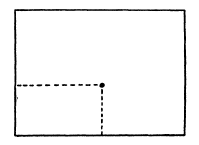
Now another example. We have a plane, or, if you prefer something more concrete, the surface of a rectangular table. The position of a point on this table can be characterized by two numbers and not, as before, by one. The two numbers are the distances from two perpendicular edges of the table. Not one number, but a pair of numbers corresponds to every point on the plane; a definite point corresponds to every pair of numbers. In other words: the plane is a two-dimensional continuum. There exist points arbitrarily near every point on the plane. Two distant points can be connected by a curve divided into steps as small as we wish. Thus the arbitrary smallness of the steps connecting two distant points, each of which can be represented by two numbers, is again characteristic of a two-dimensional continuum.

The plane is a two-dimensional continuum.

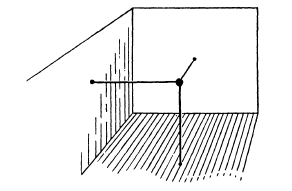
One more example. Imagine that you wish to regard your room as your CS This means that you want to describe all positions with respect to the rigid walls of the room. The position of the end-point of the lamp, if the lamp is at rest, can be described by three numbers: two of them determine the distance from two perpendicular walls, and the third that from the floor or ceiling. Three definite numbers correspond to every point of the space; a definite point in space corresponds to every three numbers. This is expressed by the sentence: Our space is a three-dimensional continuum. There exist points very near every point of the space. Again the arbitrary smallness of the steps connecting the distant points, each of them represented by three numbers, is characteristic of a three-dimensional continuum.

Our space is a three-dimensional continuum.

But all this is scarcely physics. To return to physics, the motion of material particles must be considered. To observe and predict events in nature we must consider not only the place but also the time of physical happenings. Let us again take a very simple example.

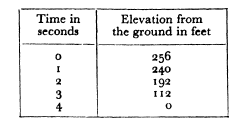
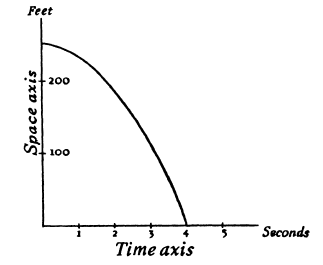
A small stone, which can be regarded as a particle, is dropped from a tower. Imagine the tower 256 feet high. Since Galileo’s time we have been able to predict the co-ordinate of the stone at any arbitrary instant after it was dropped. Here is a “timetable” describing the positions of the stone after 0, 1,2, 3, and 4 seconds. Five events are registered in our “timetable”, each represented by two numbers, the time and space coordinates of each event. The first event is the dropping of the stone from 256 feet above the ground at the zero second. The second event is the coincidence of the stone with our rigid rod (the tower) at 240 feet above the ground. This happens after the first second. The last event is the coincidence of the stone with the earth.

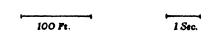
We could represent the knowledge gained from our “timetable” in a different way. We could represent the five pairs of numbers in the “timetable” as five points on a surface. Let us first establish a scale. One segment will correspond to a foot and another to a second. For example:

We then draw two perpendicular lines, calling the horizontal one, say, the time axis and the vertical one the space axis. We see immediately that our “timetable” can be represented by five points in our time-space plane.

The distances of the points from the space axis represent the time co-ordinates as registered in the first column of our “timetable”, and the distances from the time axis their space co-ordinates.

Exactly the same thing is expressed in two different ways: by the “timetable” and by the points on the plane. Each can be constructed from the other. The choice between these two representations is merely a matter of taste, for they are, in fact, equivalent.

Let us now go one step farther. Imagine a better “timetable” giving the positions not for every second, but for, say, every hundredth or thousandth of a second. We shall then have very many points on our time-space plane. Finally, if the position is given for every instant or, as the mathematicians say, if the space co-ordinate is given as a function of time, then our set of points becomes a continuous line. Our next drawing therefore represents not just a fragment as before, but a complete knowledge of the motion.

If the space co-ordinate is given as a function of time, then our set of points becomes a continuous line.

The motion along the rigid rod (the tower), the motion in a one-dimensional space, is here represented as a curve in a two-dimensional time-space continuum. To every point in our time-space continuum there corresponds a pair of numbers, one of which denotes the time, and the other the space, co-ordinate. Conversely: a definite point in our time-space plane corresponds to every pair of numbers characterizing an event. Two adjacent points represent two events, two happenings, at slightly different places and at slightly different instants.

The motion in a one-dimensional space is represented as a curve in a two-dimensional time-space continuum.

You could argue against our representation thus: there is little sense in representing a unit of time by a segment, in combining it mechanically with the space, forming the two-dimensional continuum from the two one-dimensional continua. But you would then have to protest just as strongly against all the graphs representing, for example, the change of temperature in New York City during last summer, or against those representing the changes in the cost of living during the last few years, since the very same method is used in each of these cases. In the temperature graphs the one-dimensional temperature continuum is combined with the one-dimensional time continuum into the two-dimensional temperature-time continuum.

Here we have formed a two-dimensional continuum from two one-dimensional continua.

Let us return to the particle dropped from a 256-foot tower. Our graphic picture of motion is a useful convention since it characterizes the position of the particle at an arbitrary instant. Knowing how the particle moves, we should like to picture its motion once more. We can do this in two different ways.

We remember the picture of the particle changing its position with time in the one-dimensional space. We picture the motion as a sequence of events in the one-dimensional space continuum. We do not mix time and space, using a dynamic picture in which positions change with time.

But we can picture the same motion in a different way. We can form a static picture, considering the curve in the two-dimensional time-space continuum. Now the motion is represented as something which is, which exists in the two-dimensional time-space continuum, and not as something which changes in the one-dimensional space continuum.

Both these pictures are exactly equivalent, and preferring one to the other is merely a matter of convention and taste.

Nothing that has been said here about the two pictures of the motion has anything whatever to do with the relativity theory. Both representations can be used with equal right, though classical physics favoured rather the dynamic picture describing motion as happenings in space and not as existing in time-space. But the relativity theory changes this view. It was distinctly in favour of the static picture and found in this representation of motion as something existing in time-space a more convenient and more objective picture of reality. We still have to answer the question: why are these two pictures, equivalent from the point of view of classical physics, not equivalent from the point of view of the relativity theory?

The answer will be understood if two CS moving uniformly, relative to each other, are again taken into account.

The relativity theory favors motion as existing in time-space, rather than the dynamic picture of motion as happenings in space.

According to classical physics, observers in two CS moving uniformly, relative to each other, will assign different space co-ordinates, but the same time coordinate, to a certain event. Thus in our example, the coincidence of the particle with the earth is characterized in our chosen CS by the time co-ordinate “4” and by the space co-ordinate “0”. According to classical mechanics, the stone will still reach the earth after four seconds for an observer moving uniformly, relative to the chosen CS But this observer will refer the distance to his CS and will, in general, connect different space co-ordinates with the event of collision, although the time co-ordinate will be the same for him and for all other observers moving uniformly, relative to each other. Classical physics knows only an “absolute” time flow for all observers. For every CS the two-dimensional continuum can be split into two one-dimensional continua: time and space. Because of the “absolute” character of time, the transition from the “static” to the “dynamic” picture of motion has an objective meaning in classical physics.

According to classical physics, observers in two CS moving uniformly, relative to each other, will assign different space co-ordinates, but the same time coordinate, to a certain event. For every CS the two-dimensional continuum can be split into two one-dimensional continua: time and space.

But we have already allowed ourselves to be convinced that the classical transformation must not be used in physics generally. From a practical point of view it is still good for small velocities, but not for settling fundamental physical questions.

According to the relativity theory the time of the collision of the stone with the earth will not be the same for all observers. The time co-ordinate and the space co-ordinate will be different in two CS, and the change in the time co-ordinate will be quite distinct if the relative velocity is close to that of light. The two-dimensional continuum cannot be split into two one-dimensional continua as in classical physics. We must not consider space and time separately in determining the time-space co-ordinates in another CS The splitting of the two-dimensional continuum into two one-dimensional ones seems, from the point of view of the relativity theory, to be an arbitrary procedure without objective meaning.

According to the relativity theory the time of the collision of the stone with the earth will not be the same for all observers. The two-dimensional continuum cannot be split into two one-dimensional continua as in classical physics.

It will be simple to generalize all that we have just said for the case of motion not restricted to a straight line. Indeed, not two, but four, numbers must be used to describe events in nature. Our physical space as conceived through objects and their motion has three dimensions, and positions are characterized by three numbers. The instant of an event is the fourth number. Four definite numbers correspond to every event; a definite event corresponds to any four numbers. Therefore: The world of events forms a four-dimensional continuum. There is nothing mysterious about this, and the last sentence is equally true for classical physics and the relativity theory. Again, a difference is revealed when two CS moving relatively to each other are considered. The room is moving, and the observers inside and outside determine the time-space co-ordinates of the same events. Again, the classical physicist splits the four-dimensional continua into the three-dimensional spaces and the one-dimensional time-continuum. The old physicist bothers only about space transformation, as time is absolute for him. He finds the splitting of the four-dimensional world-continua into space and time natural and convenient. But from the point of view of the relativity theory, time as well as space is changed by passing from one CS to another, and the Lorentz transformation considers the transformation properties of the four-dimensional time-space continuum of our four-dimensional world of events.

From the point of view of the relativity theory, time as well as space is changed by passing from one CS to another, and the Lorentz transformation considers the transformation properties of the four-dimensional time-space continuum of our four-dimensional world of events.

The world of events can be described dynamically by a picture changing in time and thrown on to the background of the three-dimensional space. But it can also be described by a static picture thrown on to the background of a four-dimensional time-space continuum. From the point of view of classical physics the two pictures, the dynamic and the static, are equivalent. But from the point of view of the relativity theory the static picture is the more convenient and the more objective.

Even in the relativity theory we can still use the dynamic picture if we prefer it. But we must remember that this division into time and space has no objective meaning since time is no longer “absolute”. We shall still use the “dynamic” and not the “static” language in the following pages, bearing in mind its limitations.

It is the integrated relationship between space and time that is unique in the theory of relativity.

.

Final Comment

It is not clear what is meant by a material object or an observer moving at the speed of light. The only thing that can move at the speed of light is a photon of light that has no mass. Massive objects cannot move at the speed of light because of their inertia. On the other hand, a massless object cannot be pushed to a higher velocity by any amount of external force because it would yield immediately.

The unique aspect of theory of relativity is the integrated relationship between space and time. This essentially is equivalent to the integrated relationship between velocity and inertia. The partial success of the theory of relativity comes from the fact that it indirectly establishes a linear relationship between inertia and velocity by extrapolating between very high and near constant inertia of matter and very high and near constant velocity of light. Awareness of observer has no part in it.

.

OT 1948: Aberrations

Reference: DIANETICS: The Original Thesis

This paper presents Chapter 6 from the book DIANETICS: THE ORIGINAL THESIS by L. RON HUBBARD. The contents are from the original publication of this book by The Hubbard Dianetic Foundation, Inc. (1948).

The paragraphs of the original material (in black) are accompanied by brief comments (in color) based on the present understanding.  Feedback on these comments is appreciated.

The heading below is linked to the original materials.

.

Aberrations

All aberrations of any kind are of precisely the same nature (as covered in the last chapter). It is the content of the engram which causes the aberration and forms its nature. Complexity amongst engramic contents may demonstrate a most complex aberration.

All aberrations are caused by the same mechanism of formation of the engramic node.

The various commands contained in the engrams, reactivating and modifying the basic dynamic command of the mind, produce abnormal characteristics in the behavior of the analytical mind, which are chronic or sporadic as the engrams occasioning them are restimulated. An entire concept of existence may be built from engramic content. Conflicts in the commands contained in engrams and conflicts between the basic drive and the engramic contents combine into behavior patterns.

The words contained in the painful experience act like hypnotic commands.

When the organism has become so impeded that it can no longer influence or command its environment, it can be considered to be insane in that environment. Change of environment may relieve the condition or, more certainly, the exhaustion of the content of the reactive mind will restore the ability of the analytical mind to solve the problems with which it is confronted.

Insanity comes about when the mental matrix is seriously compromised by these commands.

Whatever the engramic content of the reactive mind and its potential influence upon the behavior of the individual, it does not necessarily follow that the reactive mind need be chronically restimulated. However, when the reactive mind has been restimulated consistently, the analytical mind, called upon to solve the problems around and through antagonistic and incorrect data, may be unable to perform its task. In the absence of disease or injury, any mind not in a physiological amnesia state may be restored to normal function by the removal of the reactive mind. It should be noted however that this is modified by the fact that people who have received insulin shocks, prefrontal lobotomies, electric shocks and other treatments are regarded as equivocal and are temporarily classed with disease cases for lack of adequate observation in this stage of the experimental research.

Aberration may be reduced by minimizing the triggers in the environment. Aberration may be eliminated by assimilating the contents of the engramic node into the mental matrix.

People can be regarded as rational or irrational only insofar as they react in their customary environment. But any person in possession of a reactive mind is an unknown quantity until that reactive mind has been examined.

There are several factors contained in the engrams in the reactive mind which most certainly tend toward aberration. These include engramic commands which derange the time sense of the individual and thus apparently destroy his time track and engrams which contain restimulators of such timelessness and such perceptic content remain thereafter continually with the individual and seem to arrest him or regress him in time. Engrams containing commands which make the individual chronically unable to conceive differences are especially harmful since these tend to compare everything to engramic value and thus cause the individual to arrive at a chronic state of engramic thinking.

The space and time sense of the individual is affected by the engramic node.

The mind resolves problems related to survival, utilizing its ability to conceive similarities and observe differences.

Engrams which destroy or tend to hold in suspension the analytical mind’s ability to conceive associations most influence the apparent intelligence of the mind. But engrams which tend, by their command content, to destroy the mind’s ability to conceive differences may produce severe aberration.

The drive and intelligence of the individual is also affected by the engramic node.

EXAMPLE: “All men are alike,” received as powerful engramic content would tend to compare and associate every man with those men contained in the reactive mind as painful and dangerous.

An aberration may attain any form of complexion. As a rough analogy: a compulsion may be conceived to be an engramic command that the organism must do something; a repression is a command that the organism must not do something; a neurosis is an emotional state containing conflicts and emotional data inhibiting the abilities or welfare of the individual; and a psychosis is a conflict of commands which seriously reduce the individual’s ability to solve his problems in his environment to a point where he cannot adjust some vital phase of his environmental needs.

These aberrations may be classified as compulsions, repressions, neuroses, and psychoses, but the underlying mechanism is the same.

All this variety of manifestation of aberration is occasioned by the pain-enforced commands or contents of engrams.

Physical aberrations are occasioned by engrams when they are not the result of injury or disease; even then, the aspect may be improved by the exhaustion of the reactive mind of the sick individual. The engram cannot manifest itself as a mental aberration without also manifesting itself to some degree as somatic aberration. Removal of the somatic content of engrams which is also necessary to obtain any other relief, can and does occasion glandular readjustment, cellular inhibition and other physiological corrections.

Both mental and physical aberrations have the same source.

.

Final Comments

KEY WORDS: Hypnosis, Shock

Psychology is trying to classify aberrations; but if all aberrations are caused by the same mechanism, then we simply have to understand that mechanism and resolve it.

All aberrations are caused by the formation of engramic nodes that are the result of painful experiences. At the core of each experience is a “shock”. Handling starts with discovering this shock and bringing it fully into awareness.

Next would be bringing into awareness the whole painful experience, which caused the shock. This may be aided by observing the aberration, guessing the content of the painful experience and using it to jog the person’s recall of the actual experience.

The work is harder when very little awareness exists in the person. Here the existing environment could be activating the aberration to an intense degree. A change in environment may definitely help. A calm, natural and uplifting environment may bring a person to a condition where he can recall the shock and painful experience.

The engramic node may be fully discharged by getting more details about other similar experiences, and finding and discussing inconsistencies due to aberrations until they are resolved.

.

Einstein 1938: Relativity and Mechanics

Reference: Evolution of Physics

This paper presents Chapter III, section 8 from the book THE EVOLUTION OF PHYSICS by A. EINSTEIN and L. INFELD. The contents are from the original publication of this book by Simon and Schuster, New York (1942).

The paragraphs of the original material (in black) are accompanied by brief comments (in color) based on the present understanding.  Feedback on these comments is appreciated.

The heading below is linked to the original materials.

.

Relativity and Mechanics

The relativity theory arose from necessity, from serious and deep contradictions in the old theory from which there seemed no escape. The strength of the new theory lies in the consistency and simplicity with which it solves all these difficulties, using only a few very convincing assumptions.

Although the theory arose from the field problem, it has to embrace all physical laws. A difficulty seems to appear here. The field laws on the one hand and the mechanical laws on the other are of quite different kinds. The equations of electromagnetic field are invariant with respect to the Lorentz transformation and the mechanical equations are invariant with respect to the classical transformation. But the relativity theory claims that all laws of nature must be invariant with respect to the Lorentz and not to the classical transformation. The latter is only a special, limiting case of the Lorentz transformation when the relative velocities of two CS are very small. If this is so, classical mechanics must change in order to conform with the demand of invariance with respect to the Lorentz transformation. Or, in other words, classical mechanics cannot be valid if the velocities approach that of light. Only one transformation from one CS to another can exist, namely, the Lorentz transformation.

The classical transformation is only a special, limiting case of the Lorentz transformation when the relative velocities of two CS are very small. Classical mechanics cannot be valid if the velocities approach that of light.

It was simple to change classical mechanics in such a way that it contradicted neither the relativity theory nor the wealth of material obtained by observation and explained by classical mechanics. The old mechanics is valid for small velocities and forms the limiting case of the new one.

It would be interesting to consider some instance of a change in classical mechanics introduced by the relativity theory. This might, perhaps, lead us to some conclusions which could be proved or disproved by experiment.

Let us assume a body, having a definite mass, moving along a straight line, and acted upon by an external force in the direction of the motion. The force, as we know, is proportional to the change of velocity. Or, to be more explicit, it does not matter whether a given body increases its velocity in one second from 100 to 101 feet per second, or from 100 miles to 100 miles and one foot per second or from 180,000 miles to 180,000 miles and one foot per second. The force acting upon a particular body is always the same for the same change of velocity in the same time.

We can easily modify the laws of mechanics to be consistent with the laws of field for small velocities. But the assumption (that the force acting upon a particular body is always the same for the same change of velocity in the same time) is not true. Much greater force is required when acting upon an electron for the same change of velocity in the same time, because electron’s mass (inertia) is much smaller. That assumption is valid for matter only for which inertia is very high and constant.

Is this sentence true from the point of view of the relativity theory? By no means! This law is valid only for small velocities. What, according to the relativity theory, is the law for great velocities, approaching that of light? If the velocity is great, extremely strong forces are required to increase it. It is not at all the same thing to increase by one foot per second a velocity of about 100 feet per second or a velocity approaching that of light. The nearer a velocity is to that of light the more difficult it is to increase. When a velocity is equal to that of light it is impossible to increase it further. Thus, the changes brought about by the relativity theory are not surprising. The velocity of light is the upper limit for all velocities. No finite force, no matter how great, can cause an increase in speed beyond this limit. In place of the old mechanical law connecting force and change of velocity, a more complicated one appears. From our new point of view classical mechanics is simple because in nearly all observations we deal with velocities much smaller than that of light.

A body at rest has a definite mass, called the rest mass. We know from mechanics that every body resists a change in its motion; the greater the mass, the stronger the resistance, and the weaker the mass, the weaker the resistance. But in the relativity theory, we have something more. Not only does a body resist a change more strongly if the rest mass is greater, but also if its velocity is greater. Bodies with velocities approaching that of light would offer a very strong resistance to external forces. In classical mechanics the resistance of a given body was something unchangeable, characterized by its mass alone. In the relativity theory it depends on both rest mass and velocity. The resistance becomes infinitely great as the velocity approaches that of light.

Confusion starts with the concept of “Rest Mass.” This may be the mass of a particle at rest in its inertial frame, but it still has velocity on an absolute basis, if its inertia is not infinite. Therefore, the “rest mass” may differ from one inertial frame to another even when this difference is imperceptible for matter because its inertia is very high. The greater velocity means lesser inertia (farther from infinite value). The following statement of Einstein is incorrect, “Not only does a body resist a change more strongly if the rest mass is greater, but also if its velocity is greater.” Actually, the resistance (inertia) becomes infinitely small as the velocity approaches that of light.

The results just quoted enable us to put the theory to the test of experiment. Do projectiles with a velocity approaching that of light resist the action of an external force as predicted by the theory? Since the statements of the relativity theory have, in this respect, a quantitative character, we could confirm or disprove the theory if we could realize projectiles having a speed approaching that of light.

The inertia of a photon is extremely small, and its velocity is extremely high. It simply cannot be pushed to a higher velocity, no matter the amount of force applied. This shows that the idea of relativistic mass does not apply to the moving particle. It is a misinterpretation of what is really going on.

Indeed, we find in nature projectiles with such velocities. Atoms of radioactive matter, radium for instance, act as batteries which fire projectiles with enormous velocities. Without going into detail we can quote only one of the very important views of modern physics and chemistry. All matter in the universe is made up of elementary particles of only a few kinds. It is like seeing in one town buildings of different sizes, construction and architecture, but from shack to skyscraper only very few different kinds of bricks were used, the same in all the buildings. So all known elements of our material world from hydrogen the lightest, to uranium the heaviest are built of the same kinds of bricks, that is, the same kinds of elementary particles. The heaviest elements, the most complicated buildings, are unstable and they disintegrate or, as we say, are radioactive. Some of the bricks, that is, the elementary particles of which the radioactive atoms are constructed, are sometimes thrown out with a very great velocity, approaching that of light. An atom of an element, say radium, according to our present views, confirmed by numerous experiments, is a complicated structure, and radioactive disintegration is one of those phenomena in which the composition of atoms from still simpler bricks, the elementary particles, is revealed.

By very ingenious and intricate experiments we can find out how the particles resist the action of an external force. The experiments show that the resistance offered by these particles depends on the velocity, in the way foreseen by the theory of relativity. In many other cases, where the dependence of the resistance upon the velocity could be detected, there was complete agreement between theory and experiment. We see once more the essential features of creative work in science: prediction of certain facts by theory and their confirmation by experiment.

The Standard Model of Particle Physics lists 17 different elementary particles. A naturally disintegrating heavy nucleus ejects elementary particles at very high velocity. The velocity of an elementary particle is as great as its inertia is small. The experiments referred to by Einstein are simply being misinterpreted.

This result suggests a further important generalization. A body at rest has mass but no kinetic energy, that is, energy of motion. A moving body has both mass and kinetic energy. It resists change of velocity more strongly than the resting body. It seems as though the kinetic energy of the moving body increases its resistance. If two bodies have the same rest mass, the one with the greater kinetic energy resists the action of an external force more strongly.

It is difficult to change the inertia of an elementary particle, so it is difficult to change its intrinsic velocity also. The velocity may be influenced by forces, such as, electromagnetic, gravity and friction; but the intrinsic inertia may try to restore the intrinsic velocity. Einstein’s reference to kinetic energy in the context of mass brings into play the arbitrary velocity of the inertial frame.

Imagine a box containing balls, with the box as well as the balls at rest in our CS. To move it, to increase its velocity, some force is required. But will the same force increase the velocity by the same amount in the same time with the balls moving about quickly and in all directions inside the box, like the molecules of a gas, with an average speed approaching that of light? A greater force will now be necessary because of the increased kinetic energy of the balls, strengthening the resistance of the box. Energy, at any rate kinetic energy, resists motion in the same way as ponderable masses. Is this also true of all kinds of energy?

In case of light, the photons are moving at their natural extremely high velocities. It is not the same situation as the molecules of a gas. Changing the velocities of photons is more difficult because it means changing their inertia (frequency).

The theory of relativity deduces, from its fundamental assumption, a clear and convincing answer to this question, an answer again of a quantitative character: all energy resists change of motion; all energy behaves like matter; a piece of iron weighs more when red-hot than when cool; radiation travelling through space and emitted from the sun contains energy and therefore has mass; the sun and all radiating stars lose mass by emitting radiation. This conclusion, quite general in character, is an important achievement of the theory of relativity and fits all facts upon which it has been tested.

Before one can push a particle moving at high velocity, one needs to catch up with that particle first. Therefore, it is more difficult to further accelerate a moving particle. The difficulty comes from higher velocity and not from higher inertia (mass) as Einstein thinks. But, it is true that radiation has very small inertia (mass) and very high velocity. Inertia and velocity balance each other.

Classical physics introduced two substances: matter and energy. The first had weight, but the second was weightless. In classical physics we had two conservation laws: one for matter, the other for energy. We have already asked whether modern physics still holds this view of two substances and the two conservation laws. The answer is: “No”. According to the theory of relativity, there is no essential distinction between mass and energy. Energy has mass and mass represents energy. Instead of two conservation laws we have only one, that of mass-energy. This new view proved very successful and fruitful in the further development of physics.

We feel the presence of substance due to force moving through a distance. Force and motion can be separated in case of matter, but not in case of field. Therefore, from matter to radiation we are looking at the conservation of a force-motion combination. A combination of force and motion is represented mathematically as momentum, and also as energy.

How is it that this fact of energy having mass and mass representing energy remained for so long obscured? Is the weight of a piece of hot iron greater than that of a cold piece? The answer to this question is now “Yes”, but on p. 43 it was “No”. The pages between these two answers are certainly not sufficient to cover this contradiction.

The difficulty confronting us here is of the same kind as we have met before. The variation of mass predicted by the theory of relativity is immeasurably small and cannot be detected by direct weighing on even the most sensitive scales. The proof that energy is not weightless can be gained in many very conclusive, but indirect, ways.

The reason for this lack of immediate evidence is the very small rate of exchange between matter and energy. Compared to mass, energy is like a depreciated currency compared to one of high value. An example will make this clear. The quantity of heat able to convert thirty thousand tons of water into steam would weigh about one gram! Energy was regarded as weightless for so long simply because the mass which it represents is so small.

The differentiation here should be between mass (inertia, centeredness) and velocity (forward motion, spreading) rather than between mass and energy. Energy is a combination of mass and velocity.

The old energy-substance is the second victim of the theory of relativity. The first was the medium through which light waves were propagated.

The influence of the theory of relativity goes far beyond the problem from which it arose. It removes the difficulties and contradictions of the field theory; it formulates more general mechanical laws; it replaces two conservation laws by one; it changes our classical concept of absolute time. Its validity is not restricted to one domain of physics; it forms a general framework embracing all phenomena of nature.

Aether should be understood as the substance of lowest inertia on the spectrum of substance. The substance of highest inertia is matter (black hole). The law of conservation applies to a combination of inertia and velocity, which is momentum or energy.

.

Final Comment

.

OT 1948: The Basic Individual

Reference: DIANETICS: The Original Thesis

This paper presents Chapter 5 from the book DIANETICS: THE ORIGINAL THESIS by L. RON HUBBARD. The contents are from the original publication of this book by The Hubbard Dianetic Foundation, Inc. (1948).

The paragraphs of the original material (in black) are accompanied by brief comments (in color) based on the present understanding.  Feedback on these comments is appreciated.

The heading below is linked to the original materials.

.

The Basic Individual

For the purposes of this work the terms basic individual and Clear are nearly synonymous since they denote the unaberrated self in complete integration and in a state of highest possible rationality; a Clear is one who has become the basic individual through auditing.

The precise personality of the basic individual is of interest to the auditor. His complete characteristic is established by: 1. The strength of his basic DYNAMIC; 2. The relative strengths of his dynamics; 3. The sensitivity, which is to say the intelligence, of his analyzer; 4. The coordination of his motor controls; 5. His physiological and glandular condition; 6. His environment and education.

The experiences of each individual also create an individual composite and so may additionally designate individuality. There are as many distinct individuals on earth as there are men, women and children. That we can establish a common denominator of drive and basic function does not, cannot, and will not, alter the fact that individuals are amazingly varied one from the next.  

The basic individual is defined by a flawless mental matrix, and his “individuality” is defined by the contents of that matrix.

It will be found by experience and exhaustive research, as it has been clinically established, that the basic individual is invariably responsive in all the dynamics and is essentially “good.” There are varying degrees of courage but in the basic individual there is no pusillanimity. The virtues of the basic individual are innumerable. His intentional vices and destructive dramatizations are non-existent. He is in close alignment with that ideal which mankind recognizes as an ideal. This is a necessary part of an auditor’s working knowledge, since deviations from it denote the existence of aberration, and such departures are unnatural and enforced and are no part of the self-determinism of the individual.

The basic individual is essentially “good”.

Man is not a reactive animal. He is capable of self-determinism. He has will power. He ordinarily has high analytical ability. He is rational and he is happy and integrated only when he is his own basic personality.

The most desirable state in an individual is complete self-determinism. Such self-determinism may be altered and shaped to some degree by education and environment, but so long as the individual is not aberrated, he is in possession of self-determinism. So long as he is self-determined in his actions he adjusts himself successfully to the degree that his environment will permit such an adjustment. He will be more forceful, effective and happier in that environment than when aberrated.

The basic individual is completely self-determined.

That the basic personality is “good” does not mean that he cannot be a terribly effective enemy of those things rationally recognizable as destructive to himself and to his.

The basic individual is not a buried unknown or a different person, but an intensity of all that is best and most able in the person. The basic individual equals the same person minus his pain and dramatizations.

The drive strength of the person does not derive from his aberrations. The aberrations lessen the drive strength. Artistry, personal force, personality, all are residual in the basic personality. This is derived from clinical research and experimentation. The only reason an aberree occasionally holds hard to his aberrations is due to the fact that his engrams have a content which forbids their removal.

The flaws in the mental matrix lead to reactive behavior. No positive characteristics derive from that behavior.

The reactive mind consists of a collection of experiences received during an unanalytical moment which contain pain and actual or conceived antagonism to the survival of the individual. An engram is a perceptic entity which can be precisely defined. The aggregate of engrams compose the reactive mind.

The reactive mind refers to the flaws in the mental matrix, collectively.
Pain is the common denominator of the reactive mind. Pain forms the engramic character of the reactive mind that corrupts the logic circuits of the mental matrix.

A new sub-field entitled “Perceptics” has been originated here to define adequately engramic data. Perceptics contains as one of its facets the field of semantics. Precisely as the field of semantics is organized so is organized in perceptics each sensory perception.

“Perceptics” may be another way to refer to the data elements of the mental matrix.

The audio-syllabic communication system of man has its counterpart in various languages observable in lower animals. Words are sounds in syllabic form delivered with a definite timbre, pitch, and volume or sight recognition in each case. Words are a highly specialized form of audio-perceptics. The quality of the sound in uttering the word is nearly as important as the word itself. The written word belongs in part to visio-perceptics. Having but lately acquired his extensive vocabulary, the mind of man is least adjusted to words and their sense. The mind is better able to differentiate amongst qualities of utterance than amongst the meanings of words themselves.

Words are a highly specialized form of audio-perceptics.

Included in perceptics in the same fashion and on the same axioms as semantics are the other sensory perceptions—organic sensation, the tactile sense, the olfactory sense and the senses involved with sight and hearing. Each has its own grouping. And each carries its class of messages with highly complex meanings. Each one of these divisions of the senses is plotted in time according to the earliest or most forceful significances. Each class of messages is so filed as to lead the individual toward pleasure and away from pain. The classifications and study of this varied sensory file has been designated “Perceptics.”

Straightening out of the perceptics in the mental matrix is the essential part of clearing.

Engrams are received into the mind forming a reactive area during moments of lowered analytical awareness of the individual, and they contain physical pain and antagonism to survival. The engram is a packaged perceptic not available to the analytical mind but intimately connected to the physio-animal mind. Under normal conditions it reacts as a dramatization of itself when approximated by the organism’s perceptions of its content in the immediate environment during periods of weariness, illness, or hypnotic moments in the life of the individual.

When the circuit containing engramic data is activated, the contents of that engram are dramatized without much awareness.

When injury or illness supplants the analytical mind producing what is commonly known as “unconsciousness” and when physical pain and antagonism to the survival of the organism are present, an engram is received by the individual. Subsequently, during moments when the potential of the analytical mind is reduced by weariness, illness or similar circumstances, one or more of the perceptics contained in the engram may be observed by the individual in his environment, and without his perceiving that he has observed it (or the identity of it) the individual dramatizes the moment of receipt of the engram.

Any experience, such as, injury, illness, weariness, etc., that reduces awareness shall have relationship with the engramic nodes in the matrix.

An engram impedes one or more dynamics of the basic individual. Being antagonistic to his survival it can be considered analogically to consist of a reverse charge.

As an example, the analytical mind can be said to possess multiple scanners in layers. Ordinary or pleasurable memory can be considered to have, as an analogy only, a positive charge. The multiple scanners are able to sweep these areas and make available memory data to the analytical mind so that it can arrive by various mathematical means at a solution for its various problems.

The engram, as a specific memory package, can be considered to have a reverse charge which cannot be reached by the scanner of the analytical mind but which is directly connected to the motor controls and other physical functions and which can exert, at a depth not nearly as basic as the basic drive but nevertheless low, a hidden influence upon the analytical mind through another circuit. The analytical mind in awareness of now, nevertheless, is unable to discover, without assistance from an auditor, the existence of such an impediment since it was received during a moment of extremely low potential on the part of the analytical mind.

As a further analogy, and for demonstration only, an engram can be considered to be a bundle of perceptions of a precise nature. An engram is an entire dramatic sequence, implanted during unconsciousness, which possesses specific perceptic keys, any one of which, when unanalytically perceived by the individual in his environment, may in greater or lesser degrees set the engram into reaction.

An engramic node is activated when perceptics similar to its content appear in the environment.

Denied to the analytical mind at its reception, it is denied to the analytical mind in its exact character during its dramatization. Its content is literal and, on the physio-animal level, demands action. Man’s analytical ability and his vocabulary are imposed above both the physio-animal mind and the reactive mind, both on the evolutionary time track and in awareness. The charge contained in the engram is inexhaustible and remains reactive in full force whenever keyed into the circuit by restimulators.

An engramic node creates a short circuit in the mental matrix. Since the contents of this node are not assimilated into the mental matrix none of it reaches the awareness level.

Restimulators are those approximations in the environment of an individual of the content of an engram. Restimulators can exist in any of the various senses. The orderly filing of perceptics in the memory does not, apparently, include the content of engrams, these being filed separately under an “immediate danger” heading.

There are three kinds of thought: the first is engramic, or literal. It demands immediate action without examination by the analytical mind. A hand being withdrawn from a hot stove when burned is being governed by the reactive principle, but as the ensuing instant of unconsciousness caused by the shock is ordinarily slight, no real engram can be said to have formed.

The second type of thought is justified thought. Engramic thought is literal, without reason, irrational. Justified thought is the attempt of the analytical mind to explain the reactive, engramic reactions of the organism in the ordinary course of living. Every engram may cause some form of aberrated conduct on the part of the individual. Justified thought is the effort of the conscious mind to explain away that aberration without admitting, as it cannot do normally, that it has failed the organism.

Engramic behavior is not understandable even to the individual, so it gets justified.

The third and optimum type of thought is rational thought. This is the thought used by a “Clear.”

An engram is an apparent surcharge in the mental circuit with certain definite finite content. That charge is not reached or examined by the analytical mind but that charge is capable of acting as an independent command.

When the basic drive of the individual is boosted in potential by an observed necessity, the residual charge in an engram is insufficient to contest, at times, the raised purpose. The analytical mind can then be seen to function in entire command of the organism without serious modification by engramic command.

At other times, hostility in the environment and confusion of the analytical mind combine to reduce the dynamic potential to such a degree that the engramic command, in comparison to the basic drive, can be seen to be extremely powerful. It is at such times, in the presence of even faint restimulators, that the individual most demonstrates his aberrations.

EXAMPLE: Engram received at the age of three and one-half years. Adult preclear. As child in dental chair, against his will, under antagonistic conditions, given nitrous oxide and tricked by dentist. During painful portion of treatment the dentist says, “He is asleep. He can’t hear, feel or see anything. Stay there.”

The perceptics which can be restimulated in this are the quality, pitch and volume of the dentist’s voice; the sound of the dentist’s drill; the slap of the cable running the drill; street noises of a specific kind; the tactile of the mouth being forcibly held open; the smell of the mask; the sound of running water; the smell of nitrous oxide; and in short, several of each perceptic class, excluding only sight.

The effect of this experience, being a part of an engramic chain which contained two earlier experiences, was in some small degree to trance the individual and maintain some portion of him in a regressed state.

This engram is too brief and extraordinarily simple but it will serve as an example to the auditor. The timeless quality of the suggestions, the conceived antagonism, precursors on the engramic chain awakened and re-enforced, all these things confused the time sense of the individual and were otherwise reactive in later life.

For every engram there is a somatic as part of that engram. No aberration exists without its somatics unless it is a racial-educational aberration, in which instance it is compatible with its environment and so is not considered irrational.

Every aberration contains its exact command in some engram.

The numbers of engrams per individual are relatively few. The aberrated condition of the individual does not depend on the number of engrams but the severity of individual engrams.

The numbers of engrams per individual are relatively few.

An engram is severe in the exact ratio that it is conceived by the organism to have been a moment of threat to survival. The character of the threat and the perceptic content produce the aberration. A number of engrams with similar perceptics in an individual produce a complex aberration pattern which nevertheless has for its parts individual engrams.

An aberration is the manifestation of an engram and is serious only when it influences the competence of the individual in his environment.

Engrams are of two types depending upon the duration of restimulation. There are “floaters” and “chronics.” A floater has not been restimulated in the individual during the lifetime succeeding it. A chronic is an engram which has been more or less continuously restimulated so that it has become an apparent portion of the individual. A chronic begins to gather “locks.” A floater has not accumulated locks since it has never been restimulated.

A lock can be conceived to be joined to an engram in such a way that it can be reached by the multiple scanners of the analytical mind which cannot reach the engram. A lock is a painful mental experience. It is or is not regarded by the analytical mind as a source of difficulty or aberration. It is a period of mental anguish and is wholly dependent upon an engram for its pain value. When an engram is activated into a chronic, it accumulates numerous locks along the time track of the individual. The engram itself is not immediately locatable, except somatically, along the time track of the individual. Locks are of some diagnostic value but, as they exist as experiences more or less recallable by the analytical mind, they can be depended upon to vanish upon the removal of the engram from the reactive mind.

To locate the engramic node, one usually follows the somatic associated with it.

The running of a lock as a lock has some value but the exhaustion of locks from an aberrated individual is long and arduous and is seldom productive of any lasting result. Upon the location and exhaustion of the engram from the reactive mind, all of its locks vanish. An engram may exist unactivated as a floater for any number of years or for the entire duration of an individual’s life. At any future moment after the receipt of an engram, whether that time period consists of days or decades, the floater may reactivate at which time it becomes part of the command obeyed by the analytical mind in its efforts to rationalize. The removal of the individual from his restimulators, which is to say, the environment in which the engram was reactive, is in itself a form of therapy, since the engram may then return to its status as a floater.

Hubbard’s locks are simply extensions of the engramic node. You cannot get rid of the locks without discharging the engramic node.

EXAMPLE: Engram—At birth occurs the phrase, “No good,” uttered during a moment of headache and gasping on the part of a child.

Lock: At the age of seven while the child was ill with a minor malady, the mother in a fit of rage said that he was “no good.”

The removal of the engram also removes, ordinarily without further attention, the lock.

Note: Birth remained inactive in the above case as a floater until the moment of reduced analytical power at the age of seven when a birth phrase was repeated. It is worth remarking that the entire content of the birth engram is given simultaneously both to the child and to the mother, with only the difference of somatics. It is further worthy of note that the mother quite often perceives in the child a restimulator and uses against it the phrases which were said when the child gave the mother the greatest pain, namely, birth. The child is then victimized into various psychosomatic ills by the repetition of its birth engram restimulators, which may develop even more seriously into actual disease.

The brain controls the multiple and complex functions of the growth and condition of the organism. Containing organic sensation as one of its perceptics, the engram then, when reactivated, causes a somatic and additionally may deny body fluids, i.e. hormones and blood, to some portion of the anatomy, occasioning psychosomatic ills. The denial of fluid or adequate blood supply may result in a potentially infective area. The psychosomatic reduces the resistance of some portion of the body to actual disease.

Somatic and other sensory errors find their basis in unconscious antagonistic moments. A somatic may be adjusted by an address to a lock but the permanency of adjustment obtains only until such time as the engram is again reactivated, causing another lock.

All aberrations are occasioned by engrams.

An engram is severely painful or severely threatening to the survival of the organism and is an engram only if it cannot be reached by the awake analytical mind.

Hubbard says, “All aberrations are occasioned by engrams.” But the removal of aberrations mean not only the discharge of the painful incident that created the engramic node, but also the removal of all the distortions caused by the engramic node in the surrounding mental matrix.

A simple approximation of the action of an engram can be accomplished by an experiment in hypnotism whereby a positive suggestion which contains a posthypnotic signal is delivered to an amnesia-tranced person. The subject, having been commanded to forget the suggestion when awake, will then perform the act. This suggestion is then actually a light portion of the reactive mind. It is literally interpreted, unquestionably followed, since it is received during a period of unawareness of the analytical mind or some portion of it. The restimulator, which may be the act of the operator adjusting his tie, causes the subject to commit some act. The subject will then try to explain why he is doing what he is doing, no matter how illogical that action may be. The post-hypnotic suggestion is then recalled to the subject’s mind and he remembers it. The compulsion vanishes (unless it is laid upon an actual engram).

The obedience of the subject to the command has, as its source, engramic thought. The explanation by the subject for his own action is the analytical mind observing the organism, which it supposes is in its sole charge, and justifying itself. The release of the post-hypnotic suggestion into the analytical mind brings about rational thought.

The aberration is the manifestation of an engramic thought that has no proper logic underlying it. Therefore, one tries to justify it by long-winded explanations.

Engrams can be considered to be painfully inflicted, often timeless, post-hypnotic suggestions delivered antagonistically to the “unconscious” subject. The posthypnotic suggestion given the subject in the above example would not have any permanent effect on the subject even if it were not removed by the operator, because there was presumed to be no antagonism involved (unless, of course, it rested on a former engram).

The physio-animal mind of an organism never ceases recording on some level. The exact moment when recording begins in an organism has not at this date been accurately determined. It has been found to be very early, probably earlier than four months after conception and five months before birth. In the presence of pain, any moment prior to the age of two years may be considered to be unanalytical. Any painful experience received by the foetus contains its full perceptic package, including darkness.

Once an auditor has worked a prenatal engram and has seen its influence upon the engramic chain and the awake life of the adult, no question will remain in his mind concerning the actuality of the experience. That the foetus does record is attributable to a phenomenon of the extension of perceptions during moments of pain and the absence of the analytical mind.

Engramic node can be formed by a painful birth, or even earlier, during fetal stage, when there is some injury.

Laboratory experiment demonstrates that under hypnosis an individual’s sensory perception may be artificially extended.

The existence of pain in any large degree is sufficient to extend the hearing of the foetus so that it records, during the existence of pain and the presence of exterior sound, the entire and complete record of the experience. As a chronic engram is but precariously fixed on the mind, the syllables or voice timbres contained in the prenatal will reactivate the somatic and the emotional engramic content whenever the approximations of that engram appear in the child’s (or the adult’s) vicinity.

The understanding of language is not necessary to reactivate an engram since the recording of the brain is so precise that the utterance of the identical words in similar tones during later prenatal periods or during birth, or immediately after birth, can and may occasion the original prenatal or any of the prenatals to become reactive, producing locks, injuring the health of the infant or, for that matter, of the foetus.

The perceptics of the foetus are extended only during moments of pain. But a chain of prenatal engrams can occasion a condition wherein the hearing of the foetus is chronically extended, forming numerous locks before birth. These locks will vanish when the actual engrams are discovered and exhausted from the psyched.

A person follows an engramic thought literally as if it is a post-hypnotic suggestion. Such post-hypnotic suggestions can even affect one’s sensory perceptions.

Any painful unanalytical moment containing antagonism is not only a matter of record but a source of potential action in the human organism at any period during its lifetime, reserving, of course, the question of when the foetus first begins to record.

Birth is ordinarily a severely painful unconscious experience. It is ordinarily an engram of some magnitude. Anyone who has been born then possesses at least one engram. Any period of absence of analytical power during receipt of physical pain has some engramic potentiality.

Moments when the analytical power is present in some quantity, when physical pain is absent and only antagonism to the organism is present do not form engrams and are not responsible for the aberration of the individual.

Any confusion, doubt, or inconsistency in thinking observed by the individual must be followed up and resolved.

Sociological maladjustments; parental punishments of a minor sort, even when they include pain; libidos; childhood struggles and jealousies are not capable of aberrating the individual. These can influence the personality and environmental adjustment of the individual but so long as he is not pathologically incompetent, he can and will resolve these problems and remain without aberration.

The human mind is an enormously powerful organism and its analytical ability is great. It is not overlaid above naturally unsocial or evil desires, but is founded upon powerful and constructive basics which only powerful, painful and antagonistic experiences can impede. Engrams will be found to have been conceived by the individual as intensely antagonistic to the survival of the organism.

The discovery of the basic engram is the first problem of the auditor. It normally results in an engramic chain. The content of that chain will be found to be physically severe.

One simply pulls the string on somatic, confusion, concern, etc., and follows the trail. One resolves whatever possible while following the trail until everything is resolved with the discovery and eventual discharge of the engramic node.

An engram is physically painful, is conceived by the organism as an antagonistic threat to its survival, and is received during the absence of the analytical power of the mind. These factors may vary within the engram so that an engram may be of minimal pain, maximal antagonism and minimal absence of the analytical power.

NOTE: ONE HAS AS MUCH FUNCTIONING ANALYZER AS ONE HAS AWARENESS OF NOW.

The body is to some degree reliving the experience of the engram whenever the experience is restimulated. A chronic psychosomatic, such as a painful arm, indicates the chronic, continuous coexistence with NOW of the moment the arm was broken or hurt. Several engrams reactivated into a chronic state bring several moments of unconsciousness, pain, and antagonism into a coexistence with NOW. The engram is a bundle of perceptics which include, as the primary manifestation, organic sensation. The organic sensation is enforced on the members of the body to a greater or lesser degree whenever, and as long as, the engram is restimulated. There is only one psychosomatic command which is common to all engrams. Any engram contains this as part of the command it will enforce upon the body. As a stomach may be made to ache chronically (ulcers), to feel broken, the engram also enforces a command upon the organ of the analytical mind. That command is common to every engram. Engrams are valid only when they are received during a momentary dispersal or shocked, null condition of the analytical mind. Every engram contains and enforces the command on the analytical mind that it has been dispersed and is not operating. This is common to every engram. This is reduction of the intellect by engrams totally aside from specific engramic content. It explains at once insanity and also the remarkable mental facility of a cleared or released individual.

Engram short-circuits the rational operations of the mental matrix and replaces them by the dramatization of its contents.

.

Final Comments

KEY WORDS: Clear, Self-determinism, Engram, Perceptic, Dramatization, Restimulation, Charge, Justification.

The mind of the basic individual functions normally as described under the final comments to the chapter, An Analogy of the Mind. When a person’s mind is cleared of all flaws he becomes the basic individual.

The basic individual is characterized by a flawless mental matrix. His “individuality” is defined by the contents of that matrix. The finer are the data elements in his mental matrix, the more discriminative and intelligent he is. The easier he can access and freely associate the data from mental matrix, the greater is his drive. The basic individual is essentially “good” as his estimation of effort is appropriate for the situation. He is self-determined in that he is in control of his attention.

The drive and intelligence of an individual does not derive from his aberrations. The flaws in the mental matrix lead to irrational behavior only. Hubbard refers to such flaws, collectively, as the “reactive mind”. This is a misnomer because a reaction is not necessarily irrational. Technically, irrationality would consist of a breakdown in consistency and logic among data.

Extreme random motion is felt as pain. Random motion has neither consistency nor logic. This is the makeup of the physically painful experience. When such an experience enters the mind it cannot be broken down into fine data elements and assimilated into the mental matrix. The core of this experience appears as a “shock” to the mental matrix, which shuts its awareness down.

All the circuits associated with this “shock” then form an engramic node that contains all the data of the painful experience. This data is not available to the awareness of mental matrix because it is not assimilated with it. When computations are activated through this engramic node their effect appears as a literal dramatization of the recording. The engramic node enforces the logic of that one-time painful event to all computation passing through it. This corrupts the normal logic of all those mental circuits interrupted by the painful experience.

The engramic node becomes part of mental matrix, but the mental matrix is not aware of it. The illogic of the engramic node radiates out corrupting the logic of all other circuits downstream from it. The mental matrix is unable to figure out the source of this illogic and correct it, so it tries to justify it. Thus, a painful experience may corrupt the logic of a significant portion of the mind by lodging itself as an engramic node.

To locate the engramic node one may follow the initial “shock” of the painful experience and the somatic connected with it. Any consistency associated with that experience when followed may help diffuse the engramic node.

It is possible to handle engramic nodes with expert mindfulness meditation.

.