OT 1948: Primary Axioms

Reference: DIANETICS: The Original Thesis

This paper presents Chapter 2 from the book DIANETICS: THE ORIGINAL THESIS by L. RON HUBBARD. The contents are from the original publication of this book by The Hubbard Dianetic Foundation, Inc. (1948).

The paragraphs of the original material (in black) are accompanied by brief comments (in color) based on the present understanding.  Feedback on these comments is appreciated.

The heading below is linked to the original materials.

.

Primary Axioms

Dianetics is an heuristic science built upon axioms. Workability rather than Idealism has been consulted. The only claim made for these axioms is that by their use certain definite and predictable results can be obtained.

The principal achievement of Dianetics lies in its organization. Almost any of its parts can be found somewhere in history, even when they were independently evolved by the writer. There are no principal sources, and where a practice or a principle is borrowed from some past school the connection is usually accidental and does not admit any further use or validity of that school. Dianetics will work, and can only be worked, when regarded and used as a unity. When diluted by broader applications of older practices, it will no longer produce results. To avoid confusion and prevent semantic difficulties, new and simplified terminology has been used and is used only as defined herein.

Dianetics is actually a family of sciences. It is here addressed in the form of a science of thought applicable to psychosomatic ills and individual aberrations.

Dianetics is a science of thought designed to resolve psychosomatic ills and individual aberrations. It has been organized from past and current observations made objectively.

The field of thought may be divided into two areas which have been classified as the “knowable” and the “unknowable”. We are here concerned only with the “knowable”. In the “unknowable” we place that data which we do not need to know in order to solve the problem of improving or resolving aberrations of the human mind. By thus splitting the broad field of thought, we need not now concern ourselves with such indefinites as spiritualism, deism, telepathy, clairvoyance, or, for instance, the human soul.

Conceiving this split as a line drawn through the area, we can assign a dynamic principle of existence to all that data remaining in the “knowable” field.

After exhaustive research one word was selected as embracing the finite universe as a dynamic principle of existence. This word can be used as a guide or a measuring stick and by it can be evaluated much information. It is therefore our first and our controlling axiom.

The first axiom is.

SURVIVE!

We observe radiation condensing into matter; matter acquiring animation; animation developing into reaction; and reaction developing into rational thought. The dynamic principle of existence on an immediate basis is to SURVIVE, but on a longer basis it is to EVOLVE.

The first axiom is.
EVOLVE! SURVIVE BETTER.

This can be seen to be the lowest common denominator of the finite universe. It embraces all forms of energy. It further delineates the purpose of that energy so far as it is now viewable by us in the “knowable” field. The activity of the finite universe can easily be seen to obey this axiom as though it were a command. All works and energies can be considered to be motivated by it. The various kingdoms have this as their lowest common denominator, for animals, vegetables and minerals are all striving for survival. We do not know to what end we are surviving, and in our field of the “knowable” and in our choice of only the workable axioms, we do not know and have no immediate reason to ask why.

All forms of energy are then surviving to some unknown end, for some unknown purpose. We need only to know that they are surviving and that, as units or species, they must survive.

The basic substance is energy that gradually develops an organized structure. As this structure evolves we get minerals, vegetables, animals and humans. The organism evolves through trial and error with different activities to survive better.

By derivation from the first workable axiom, we come into possession of the second. In obedience to the command “survive”, life took on the form of a cell which, joining with other cells, formed a colony. The cell, by procreating, expanded the colony. The colony, by procreation, formed other colonies. Colonies of different types united and necessity, mutation and natural selection brought about specializing, which increased the complexity of the colonies until they became an aggregation. The problems of the colonial aggregation were those of food, protection and procreation. In various ways a colonial aggregation of cells became a standardized unity and any advanced colonial aggregation came into possession by necessity, mutation and natural selection of a central control system.

The purpose of the colonial aggregation was to survive. To do this it had to have food, means of defense, protection and means of procreation. The control center, which had developed, had as its primary command, Survive! Its prime purpose was the food, defense, protection and means of procreation.

Thus can be stated the second workable axiom:

THE PURPOSE OF THE MIND IS TO SOLVE PROBLEMS RELATING TO SURVIVAL.

The mind perceives the problems in the environment and solves them using trial and error towards the goal of surviving better, or evolving. The mind too evolves along with rest of the organism.

The second axiom is.
THE PURPOSE OF THE MIND IS TO SOLVE PROBLEMS RELATING TO THE ORGANISM’S EVOLUTION.

The ultimate success of the organism, its species or life would be, at its unimaginable extreme, immortality. The final failure in obedience to the law survive would be death. Between eternal survival and death lie innumerable gradations. In the middle ground of such a scale would be mere existence without hope of much success and without fear of failure. Below this point would lie, step by step, innumerable small errors, accidents, losses, each one of which would tend to abbreviate the chances of reaching the ultimate goal. Above this point would lie the small successes, appreciations, and triumphs which would tend to secure the desirable goal.

Immortality as a measure of ultimate success is inconsistent. Life and death occur normally in the course of evolution. A measure of ultimate success shall be successful evolution.

As an axiom, the mind can then be said to act in obedience to a central basic command, survive, and to direct or manage the organism in its efforts to accomplish the ultimate goal for the individual or species or life, and to avoid for the individual or species or life any part of the final failure, which leads to the stated axiom:

THE MIND DIRECTS THE ORGANISM, THE SPECIES, ITS SYMBIOTES OR LIFE IN THE EFFORT OF SURVIVAL.

The mind directs the activity of the organism to implement solutions for better survival. With the evolution of rational thought, these solutions have accelerated.

The next axiom shall be.
THE MIND DIRECTS THE ORGANISM, THE SPECIES, ITS SYMBIOTES OR LIFE TO IMPLEMENT SOLUTIONS FOR BETTER SURVIVAL.

A study of the field of evolution will indicate that survival has been, will be, and is the sole test of an organism, whether the organism is treated in the form of daily activity or the life of the species. No action of the organism will be found to lie without the field of survival, for the organism is acting within its environment upon information received or recorded, and error or failure does not alter the fact that its basic impulse was motivated by survival.

Another axiom may then be formulated as follows:

THE MIND AS THE CENTRAL DIRECTION SYSTEM OF THE BODY, POSES, PERCEIVES AND RESOLVES PROBLEMS OF SURVIVAL AND DIRECTS OR FAILS TO DIRECT THEIR EXECUTION

The mind is not always successful because it operates on trial and error. It is natural for the physical organism to go through the cycle of life and death for the specie to continue to evolve.

As there are many organisms in the same species, all attempting to accomplish the same end, and as there are many species, and as matter itself is attempting in one unit form or another to survive, there is necessarily conflict and contest amongst the individuals of the species, species, or units of matter. Species cannot survive without being interested primarily in the species. Natural selection and other causes have established this as a primary rule for survival: That the unit remains alive as long as possible as a unit and, by association and procreation, that the species remain alive as a species. Second grade interest is paid by the unit or the species to its symbiotes Third grade interest is paid to inanimate matter. As this is apparently the most workable solution, natural selection best preserves those species which follow this working rule. And the symbiotes of the successful species therefore have enhanced opportunity for survival.

Conflicts and contests are part of the equation. But an organism evolves better as it cooperates with other members of its species and the environment.

Man is the most successful organism currently in existence, at least on this planet. Man is currently winning in the perpetual cosmic election which possibly may select the thinker of the new THOUGHT.

Man is heir to the experience and construction of his own ancestors. As cellular conservatism is one of the factors of survival, his brain is basically the same brain which directed and resolved the problems of his animal forebears. By evolution and natural selection, this brain therefore has the primary priority in emergencies. Superimposed on this animal brain has been developed an enormously complex analyzer, which probably exists in his frontal lobe.

The evolution has successfully produced man, which is a very complex but efficient organism.

The command, survive, is variable in individuals and species to the extent that it may be strong or weak. Superior strength of the command in the individual or species is normally, but variably, a survival factor. The primary facet of personality is the basic strength of the DYNAMIC drive.

The DYNAMIC is variable from individual to individual and race to race. It is varied by physiology, environment, and experience. Its manifestation in the animal brain affects the tenacity of the individual to life or purpose, and it affects the activity of the analyzer. The first characteristic of the individual which should be considered is the basic strength of his DYNAMIC. By this an axiom can be formulated:

THE PERSISTENCY OF THE INDIVIDUAL IN LIFE IS DIRECTLY GOVERNED BY THE STRENGTH OF HIS BASIC DYNAMIC.

The analytical, human or, as it has elsewhere been called erroneously, the conscious mind, is variable from individual to individual and race to race in its ability to perceive and resolve problems. Another axiom can then be formulated:

INTELLIGENCE IS THE ABILITY OF AN INDIVIDUAL, GROUP, OR RACE TO RESOLVE PROBLEMS RELATING TO SURVIVAL.

People differ from each other in their inherent persistence and the ability to analyze.

It should be noted that there is a distinct difference between the DYNAMIC and the intelligence. High intelligence may not denote high DYNAMIC. High DYNAMIC may not denote high intelligence. Intelligence is mental sensitivity and analytical ability. DYNAMIC is the persistency of the individual in obedience to the command, survive!

It has been noted that there is a gradation in the scale of survival. Gains toward the ultimate goal are pleasurable. Failures toward the final defeat are sorrowful or painful. Pleasure is therefore the perception of well-being, or an advance toward the ultimate goal. Pain, therefore, is the perception of a reduction toward the final defeat. Both are necessary survival factors.

For the purpose of Dianetics, good and evil must be defined. Those things which may be classified as good by an individual are only those things which aid himself, his family, his group, his race, mankind or life in its dynamic obedience to the command, modified by the observations of the individual, his family, his group, his race, or life.

As evil may be classified those things which tend to limit the dynamic thrust of the individual, his family, his group, his race, or life in general in the dynamic drive, also limited by the observation, the observer and his ability to observe.

Good may be defined as constructive. Evil may be defined as destructive—definitions modified by viewpoint. The individual man is an organism attempting to survive in affinity or contest with other men, races, and the three kingdoms. His goal is survival for himself, his progeny, his group, his race, his symbiotes, life and the universe in general in contest with any efforts or entities which threaten or impede his efforts to attain the goal.

His happiness depends upon making, consolidating, or contemplating gains toward his goal.

There is pleasure and pain that comes from success or failure respectively. There is good and evil defined by situations that aid or hinder evolution. Happiness comes from evolving toward better states of existence.

It is a purpose of Dianetics to pass man across the abyss of irrational, solely reactive thought and enter him upon a new stage of constructive progression to the ultimate goal.

.

Final Comments

KEY WORDS: Survive (evolve), Mind, Immortality, Dynamic, Intelligence

A living entity is trying to SURVIVE, but the purpose of the universe is to EVOLVE through the living entities to better universal conditions.

We may call the structure of thoughts in a living entity to be its mind. The mind evolves by solving problems relating to survival through trial and error, and directs the organism according to its solutions. The mind is not always successful because it operates on trial and error.

Problems arise as every living entity is trying to survive. In doing so they may step on each other. But the solution lies in ultimate cooperation. This solution has evolved into a complex human body in which all organs function in cooperation with each other. The thought structures of all the organs in the body are also aligned with each other. Thus, an overall complex mind has evolved.

The characteristics of the overall mind may be summed up by its tenacity (DYNAMIC) and its ability to solve problems (INTELLIGENCE). Thoughts, such as, good and evil may be understood in terms of the usefulness of their solution. Happiness comes from evolving toward better states of existence.

.

OT 1948: Introduction

Reference: DIANETICS: The Original Thesis

This paper presents Chapter 1 from the book DIANETICS: THE ORIGINAL THESIS by L. RON HUBBARD. The contents are from the original publication of this book by The Hubbard Dianetic Foundation, Inc. (1948).

The paragraphs of the original material (in black) are accompanied by brief comments (in color) based on the present understanding.  Feedback on these comments is appreciated.

The heading below is linked to the original materials.

.

Introduction

In nineteen thirty-two an investigation was undertaken to determine the dynamic principle of existence in a workable form which might lead to the resolution of some of the problems of mankind. A long research in ancient and modern philosophy culminated, in nineteen thirty-eight, in the heuristically discovered primary law. A work was written at that time which embraced man and his activities. In the following years further research was undertaken in order to prove or disprove the axioms so established.

Certain experiences during the war made it necessary for the writer to resolve the work into applicable equations and an intensive program was begun in nineteen forty-five toward this end.

A year later many techniques had been discovered or evolved and a nebulous form of the present work was formulated. Financed chiefly by a lump sum disability compensation, that form of Dianetics was intensively applied to volunteer subjects, and the work gradually developed to its present form.

Dianetics has been under test by the writer, as here delineated, for the past three years. The last series of random volunteers, numbering twenty, were rehabilitated, twenty out of twenty, with an average number of work hours of 151.2 per subject. Dianetics offers the first anatomy of the human mind and techniques for handling the hitherto unknown reactive mind, which causes irrational and psychosomatic behavior. It has successfully removed any compulsions, repressions, neuroses and psychoses to which it has been applied.

L. R. H.
January, 1948

.

.

Final Comments

KEY WORDS: Human Condition, Dianetics, Investigate

When investigating a pervasive condition, one starts as broadly as possible, and establishes certain axioms. These axioms are then resolved into applicable equations and workable techniques. One then tests these techniques and refines them.

In this case that pervasive condition being investigated is the irrational behavior and psychosomatic condition originating from the mind.

.

Hubbard 1948: The Original Thesis

DIANETICS: The Original Thesis

BY L. RON HUBBARD
Published in 1948

.

CONTENTS

  1. INTRODUCTION
  2. PRIMARY AXIOMS
  3. AN ANALOGY OF THE MIND
  4. THE DYNAMICS
  5. THE BASIC INDIVIDUAL
  6. ABERRATIONS
  7. THE TONE SCALE
  8. THE CHARACTER OF ENGRAMS
  9. DRAMATIZATION
  10. THE AUDITOR’S CODE
  11. AUDITING
  12. DIAGNOSIS
  13. EXHAUSTION OF ENGRAMS
  14. ENGRAM CHAINS
  15. PRENATAL, BIRTH AND INFANT ENGRAMS
  16. THE “LAWS” OF RETURNING
  17. CASE HISTORIES
  18. GLOSSARY

.

Einstein 1938: Field and Ether

Reference: Evolution of Physics

This paper presents Chapter III, section 4 from the book THE EVOLUTION OF PHYSICS by A. EINSTEIN and L. INFELD. The contents are from the original publication of this book by Simon and Schuster, New York (1942).

The paragraphs of the original material (in black) are accompanied by brief comments (in color) based on the present understanding.  Feedback on these comments is appreciated.

The heading below is linked to the original materials.

.

Field and Ether

The electromagnetic wave is a transverse one and is propagated with the velocity of light in empty space. The fact that their velocities are the same suggests a close relationship between optical and electromagnetic phenomena.

The electromagnetic wave may appear as “transverse” as it propagates in its domain marked as “spherical surface.” Light may be described as an electromagnetic wave.

When we had to choose between the corpuscular and the wave theory, we decided in favour of the wave theory. The diffraction of light was the strongest argument influencing our decision. But we shall not contradict any of the explanations of the optical facts by also assuming that the light wave is an electromagnetic one. On the contrary, still other conclusions can be drawn. If this is really so, then there must exist some connection between the optical and electrical properties of matter that can be deduced from the theory. The fact that conclusions of this kind can really be drawn and that they stand the test of experiment is an essential argument in favour of the electromagnetic theory of light.

Diffraction of light is an optical property. But, if light is an electromagnetic wave, diffraction may also have an explanation as an electromagnetic property.

This great result is due to the field theory. Two apparently unrelated branches of science are covered by the same theory. The same Maxwell’s equations describe both electric induction and optical refraction. If it is our aim to describe everything that ever happened or may happen with the help of one theory, then the union of optics and electricity is, undoubtedly, a very great step forward. From the physical point of view, the only difference between an ordinary electromagnetic wave and a light wave is the wave-length: this is very small for light waves, detected by the human eye, and great for ordinary electromagnetic waves, detected by a radio receiver.

From the physical point of view, the only difference between an ordinary electromagnetic wave and a light wave is the wave-length: this is very small for light waves, detected by the human eye, and great for ordinary electromagnetic waves, detected by a radio receiver.

The old mechanical view attempted to reduce all events in nature to forces acting between material particles. Upon this mechanical view was based the first naive theory of the electric fluids. The field did not exist for the physicist of the early years of the nineteenth century. For him only substance and its changes were real. He tried to describe the action of two electric charges only by concepts referring directly to the two charges.

In the beginning, the field concept was no more than a means of facilitating the understanding of phenomena from the mechanical point of view. In the new field language it is the description of the field between the two charges, and not the charges themselves, which is essential for an understanding of their action. The recognition of the new concepts grew steadily, until substance was overshadowed by the field. It was realized that something of great importance had happened in physics. A new reality was created, a new concept for which there was no place in the mechanical description. Slowly and by a struggle the field concept established for itself a leading place in physics and has remained one of the basic physical concepts. The electromagnetic field is, for the modern physicist, as real as the chair on which he sits.

In the new field language it is the description of the field between the two charges, and not the charges themselves, which is essential for an understanding of their action.

But it would be unjust to consider that the new field view freed science from the errors of the old theory of electric fluids or that the new theory destroys the achievements of the old. The new theory shows the merits as well as the limitations of the old theory and allows us to regain our old concepts from a higher level. This is true not only for the theories of electric fluids and field, but for all changes in physical theories, however revolutionary they may seem. In our case, we still find, for example, the concept of the electric charge in Maxwell’s theory, though the charge is understood only as a source of the electric field. Coulomb’s law is still valid and is contained in Maxwell’s equations from which it can be deduced as one of the many consequences. We can still apply the old theory, whenever facts within the region of its validity are investigated. But we may as well apply the new theory, since all the known facts are contained in the realm of its validity.

The new theory shows the merits as well as the limitations of the old theory and allows us to regain our old concepts from a higher level. The concept of the electric charge is understood only as a source of the electric field in Maxwell’s theory.

To use a comparison, we could say that creating a new theory is not like destroying an old barn and erecting a skyscraper in its place. It is rather like climbing a mountain, gaining new and wider views, discovering unexpected connections between our starting-point and its rich environment. But the point from which we started out still exists and can be seen, although it appears smaller and forms a tiny part of our broad view gained by the mastery of the obstacles on our adventurous way up.

It was, indeed, a long time before the full content of Maxwell’s theory was recognized. The field was at first considered as something which might later be interpreted mechanically with the help of ether. By the time it was realized that this programme could not be carried out, the achievements of the field theory had already become too striking and important for it to be exchanged for a mechanical dogma. On the other hand, the problem of devising the mechanical model of ether seemed to become less and less interesting and the result, in view of the forced and artificial character of the assumptions, more and more discouraging.

Our only way out seems to be to take for granted the fact that space has the physical property of transmitting electromagnetic waves, and not to bother too much about the meaning of this statement. We may still use the word ether, but only to express some physical property of space. This word ether has changed its meaning many times in the development of science. At the moment it no longer stands for a medium built up of particles. Its story, by no means finished, is continued by the relativity theory.

A new theory provides new and wider view that helps discover unexpected connections. The old view of aether has been a medium built up of particles. Maxwell’s theory now provides a new view of aether as the physical property of transmitting electromagnetic waves in space.

.

Final Comment

In the model of an atom, the field may best describe the electronic region of very low mass and the radiation envelope of no mass. At the extreme outer boundary of the radiation envelope shall lie the layer of substance of the least  density. This layer may be referred to as aether. This aether would act as the background for spherical surfaces of all different densities. In other words, this aether will be able to contain all possible fields, and transmit electromagnetic waves of all energy densities.

.

Einstein 1938: The Reality of the Field

Reference: Evolution of Physics

This paper presents Chapter III, section 3 from the book THE EVOLUTION OF PHYSICS by A. EINSTEIN and L. INFELD. The contents are from the original publication of this book by Simon and Schuster, New York (1942).

The paragraphs of the original material (in black) are accompanied by brief comments (in color) based on the present understanding.  Feedback on these comments is appreciated.

The heading below is linked to the original materials.

.

The Reality of the Field

The quantitative, mathematical description of the laws of the field is summed up in what are called Maxwell’s equations. The facts mentioned so far led to the formulation of these equations, but their content is much richer than we have been able to indicate. Their simple form conceals a depth revealed only by careful study.

The formulation of these equations is the most important event in physics since Newton’s time, not only because of their wealth of content, but also because they form a pattern for a new type of law.

The characteristic features of Maxwell’s equations, appearing in all other equations of modern physics, are summarized in one sentence. Maxwell’s equations are laws representing the structure of the field.

Maxwell’s equations are laws representing the structure of the field.

Why do Maxwell’s equations differ in form and character from the equations of classical mechanics? What does it mean that these equations describe the structure of the field? How is it possible that, from the results of Oersted’s and Faraday’s experiments, we can form a new type of law, which proves so important for the further development of physics?

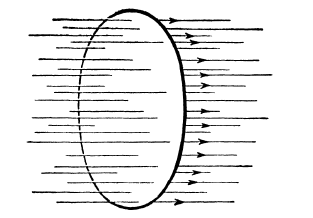
We have already seen, from Oersted’s experiment, how a magnetic field coils itself around a changing electric field. We have seen, from Faraday’s experiment, how an electric field coils itself around a changing magnetic field. To outline some of the characteristic features of Maxwell’s theory, let us, for the moment, focus all our attention on one of these experiments, say, on that of Faraday. We repeat the drawing in which an electric current is induced by a changing magnetic field. We already know that an induced current appears if the number of lines of force, passing the surface bounded by the wire, changes. Then the current will appear if the magnetic field changes or the circuit is deformed or moved: if the number of magnetic lines passing through the surface is changed, no matter how this change is caused. To take into account all these various possibilities, to discuss their particular influences, would necessarily lead to a very complicated theory. But can we not simplify our problem? Let us try to eliminate from our considerations everything which refers to the shape of the circuit, to its length, to the surface enclosed by the wire. Let us imagine that the circuit in our last drawing becomes smaller and smaller, shrinking gradually to a very small circuit enclosing a certain point in space. Then everything concerning shape and size is quite irrelevant. In this limiting process where the closed curve shrinks to a point, size and shape automatically vanish from our considerations and we obtain laws connecting changes of magnetic and electric field at an arbitrary point in space at an arbitrary instant.

Thus, this is one of the principal steps leading to Maxwell’s equations. It is again an idealized experiment performed in imagination by repeating Faraday’s experiment with a circuit shrinking to a point.

We should really call it half a step rather than a whole one. So far our attention has been focused on Faraday’s experiment. But the other pillar of the field theory, based on Oersted’s experiment, must be considered just as carefully and in a similar manner. In this experiment the magnetic lines of force coil themselves around the current. By shrinking the circular magnetic lines of force to a point, the second half-step is performed and the whole step yields a connection between the changes of the magnetic and electric fields at an arbitrary point in space and at an arbitrary instant.

The Maxwell equations are obtained by shrinking Oersted’s and Faraday’s circuits to an idealized point, such that everything concerning shape and size of the circuits become quite irrelevant.  We then obtain laws connecting the changes of the magnetic and electric fields at an arbitrary point in space and at an arbitrary instant.

But still another essential step is necessary. According to Faraday’s experiment, there must be a wire testing the existence of the electric field, just as there must be a magnetic pole, or needle, testing the existence of a magnetic field in Oersted’s experiment. But Maxwell’s new theoretical idea goes beyond these experimental facts. The electric and magnetic field or, in short, the electromagnetic field is, in Maxwell’s theory, something real. The electric field is produced by a changing magnetic field, quite independently, whether or not there is a wire to test its existence; a magnetic field is produced by a changing electric field, whether or not there is a magnetic pole to test its existence.

Maxwell’s theoretical ideas goes beyond the experimental fact that there must be a wire testing the existence of the electric field, just as there must be a magnetic pole, or needle, testing the existence of a magnetic field. The electromagnetic field is something quite independently real.

Thus two essential steps led to Maxwell’s equations. The first: in considering Oersted’s and Rowland’s experiments, the circular line of the magnetic field coiling itself around the current and the changing electric field had to be shrunk to a point; in considering Faraday’s experiment, the circular line of the electric field coiling itself around the changing magnetic field had to be shrunk to a point. The second step consists of the realization of the field as something real; the electromagnetic field once created exists, acts, and changes according to Maxwell’s laws.

Maxwell’s equations describe the structure of the electromagnetic field. All space is the scene of these laws and not, as for mechanical laws, only points in which matter or charges are present.

According to Maxwell, all space is the scene of these laws and not only the points in which matter or charges are present. Therefore, the duality of matter and void, as in the mechanical view, is eliminated.

We remember how it was in mechanics. By knowing the position and velocity of a particle at one single instant, by knowing the acting forces, the whole future path of the particle could be foreseen. In Maxwell’s theory, if we know the field at one instant only, we can deduce from the equations of the theory how the whole field will change in space and time. Maxwell’s equations enable us to follow the history of the field, just as the mechanical equations enabled us to follow the history of material particles.

Maxwell’s equations enable us to follow the history of the field, just as the mechanical equations enabled us to follow the history of material particles.

But there is still one essential difference between mechanical laws and Maxwell’s laws. A comparison of Newton’s gravitational laws and Maxwell’s field laws will emphasize some of the characteristic features expressed by these equations.

With the help of Newton’s laws we can deduce the motion of the earth from the force acting between the sun and the earth. The laws connect the motion of the earth with the action of the far-off sun. The earth and the sun, though so far apart, are both actors in the play of forces.

In Maxwell’s theory there are no material actors. The mathematical equations of this theory express the laws governing the electromagnetic field. They do not, as in Newton’s laws, connect two widely separated events; they do not connect the happenings here with the conditions there. The field here and now depends on the field in the immediate neighbourhood at a time just past. The equations allow us to predict what will happen a little farther in space and a little later in time, if we know what happens here and now. They allow us to increase our knowledge of the field by small steps. We can deduce what happens here from that which happened far away by the summation of these very small steps. In Newton’s theory, on the contrary, only big steps connecting distant events are permissible. The experiments of Oersted and Faraday can be regained from Maxwell’s theory, but only by the summation of small steps each of which is governed by Maxwell’s equations.

In Newton’s theory only big steps connecting distant events are permissible. In Maxwell’s theory, the field here and now depends on the field in the immediate neighborhood at a time just past. We can deduce what happens here from that which happened far away by the summation of these very small steps.

A more thorough mathematical study of Maxwell’s equations shows that new and really unexpected conclusions can be drawn and the whole theory submitted to a test on a much higher level, because the theoretical consequences are now of a quantitative character and are revealed by a whole chain of logical arguments.

Let us again imagine an idealized experiment. A small sphere with an electric charge is forced, by some external influence, to oscillate rapidly and in a rhythmical way, like a pendulum. With the knowledge we already have of the changes of the field, how shall we describe everything that is going on here, in the field language?

The oscillation of the charge produces a changing electric field. This is always accompanied by a changing magnetic field. If a wire forming a closed circuit is placed in the vicinity, then again the changing magnetic field will be accompanied by an electric current in the circuit. All this is merely a repetition of known facts, but the study of Maxwell’s equations gives a much deeper insight into the problem of the oscillating electric charge. By mathematical deduction from Maxwell’s equations we can detect the character of the field surrounding an oscillating charge, its structure near and far from the source and its change with time. The outcome of such deduction is the electromagnetic wave. Energy radiates from the oscillating charge travelling with a definite speed through space; but a transference of energy, the motion of a state, is characteristic of all wave phenomena.

The Maxwell’s equations provide the insight that energy radiates from the oscillating charge, traveling with a definite speed through space; but a transference of energy, the motion of a state, is characteristic of all wave phenomena.

Different types of waves have already been considered. There was the longitudinal wave caused by the pulsating sphere, where the changes of density were propagated through the medium. There was the jellylike medium in which the transverse wave spread. A deformation of the jelly, caused by the rotation of the sphere, moved through the medium. What kind of changes are now spreading in the case of an electromagnetic wave? Just the changes of an electromagnetic field! Every change of an electric field produces a magnetic field; every change of this magnetic field produces an electric field; every change of…, and so on. As field represents energy, all these changes spreading out in space, with a definite velocity, produce a wave. The electric and magnetic lines of force always lie, as deduced from the theory, on planes perpendicular to the direction of propagation. The wave produced is, therefore, transverse. The original features of the picture of the field we formed from Oersted’s and Faraday’s experiments are still preserved, but we now recognize that it has a deeper meaning.

Energy is diluted substance—force that is spread out in space. This is field, which is maintaining a balance between motion and inertia dynamically at every point. This balance gives it a certain density and velocity.

The electromagnetic wave spreads in empty space. This, again, is a consequence of the theory. If the oscillating charge suddenly ceases to move, then its field becomes electrostatic. But the series of waves created by the oscillation continues to spread. The waves lead an independent existence and the history of their changes can be followed just as that of any other material object.

There are electromagnetic waves of different densities (frequencies). Those densities are maintained. Therefore, we have many different densities spreading through the same region independent of each other. But they may mix in some manner without losing individual identities.

We understand that our picture of an electromagnetic wave, spreading with a certain velocity in space and changing in time, follows from Maxwell’s equations only because they describe the structure of the electromagnetic field at any point in space and for any instant.

There is another very important question. With what speed does the electromagnetic wave spread in empty space? The theory, with the support of some data from simple experiments having nothing to do with the actual propagation of waves, gives a clear answer: the velocity of an electromagnetic wave is equal to the velocity of light.

There are two distinct velocities: The velocity in material domain, and the velocity in radiation domain. The inertia of these two domains is very far apart, and so are their velocities. All the velocities in the radiation domain appear to be the same from the perspective of material domain. So, it is no surprise that the velocity of electromagnetic wave is same as the velocity of light.

Oersted’s and Faraday’s experiments formed the basis on which Maxwell’s laws were built. All our results so far have come from a careful study of these laws, expressed in the field language. The theoretical discovery of an electromagnetic wave spreading with the speed of light is one of the greatest achievements in the history of science.

Experiment has confirmed the prediction of theory. Fifty years ago, Hertz proved, for the first time, the existence of electromagnetic waves and confirmed experimentally that their velocity is equal to that of light. Nowadays, millions of people demonstrate that electromagnetic waves are sent and received. Their apparatus is far more complicated than that used by Hertz and detects the presence of waves thousands of miles from their sources instead of only a few yards.

The electromagnetic wave produced by an oscillating charge is of a different substantiality then that of the electromagnetic field existing among the nuclei of the atoms.

.

Final Comment

.