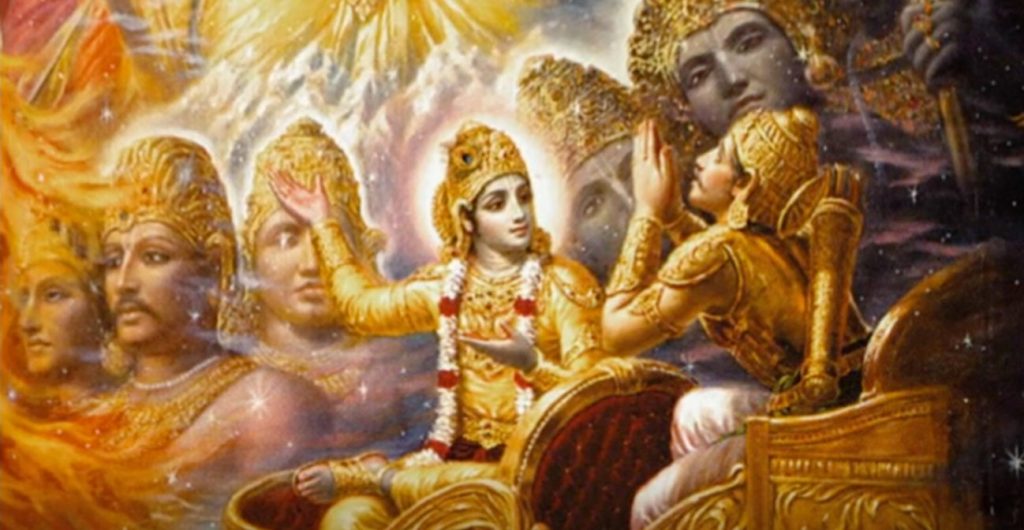
The Bhagavad Gita, often referred to as the Gita, is a 700-verse Hindu scripture that is part of the epic Mahabharata. The Gita is set in a narrative framework of a dialogue between Pandava prince Arjuna and his guide and charioteer Krishna.
A quick reference to translations of a verse of Gita from different sources may be obtained at
The purpose of this Glossary is to express ancient Vedic knowledge using modern scientific language. The “translation” may not be exactly right at first, but, hopefully, it shall improve as better input is received.
.
AGNI The Vedas start with homage to Agni. Agni implies energy in all its forms. It is animated by an innate impulse. Energy is the basic substance of the universe. Everything physical, spiritual, real, imaginary, postulated or considered, is made of energy.
BECOMING ONE To “become one” is to know something so intimately that there is no distance left. For example, when you are expert in riding a bicycle, you have become one with that bicycle. You push pedals and apply brakes without putting attention on them. But you are fully aware of those actions, and you can change them whenever you want. To “become one with God” is to know the universal laws so well that you operate according to them without having attention on them. When one says, “the seer and scenery has become one,” it implies knowingness. See KNOWINGNESS.
BEING A being is an energy form animated by an innate impulse.
BHAGAVĀN Bhagavān literally means “fortunate”, “blessed”, and hence “illustrious”, “divine”, “venerable”, “holy”, etc. Please see Etymology and meaning. “He who understands the creation and dissolution, the appearance and disappearance of beings, the wisdom and ignorance, should be called Bhagavān.” — Vishnu Purana, VI.5.78
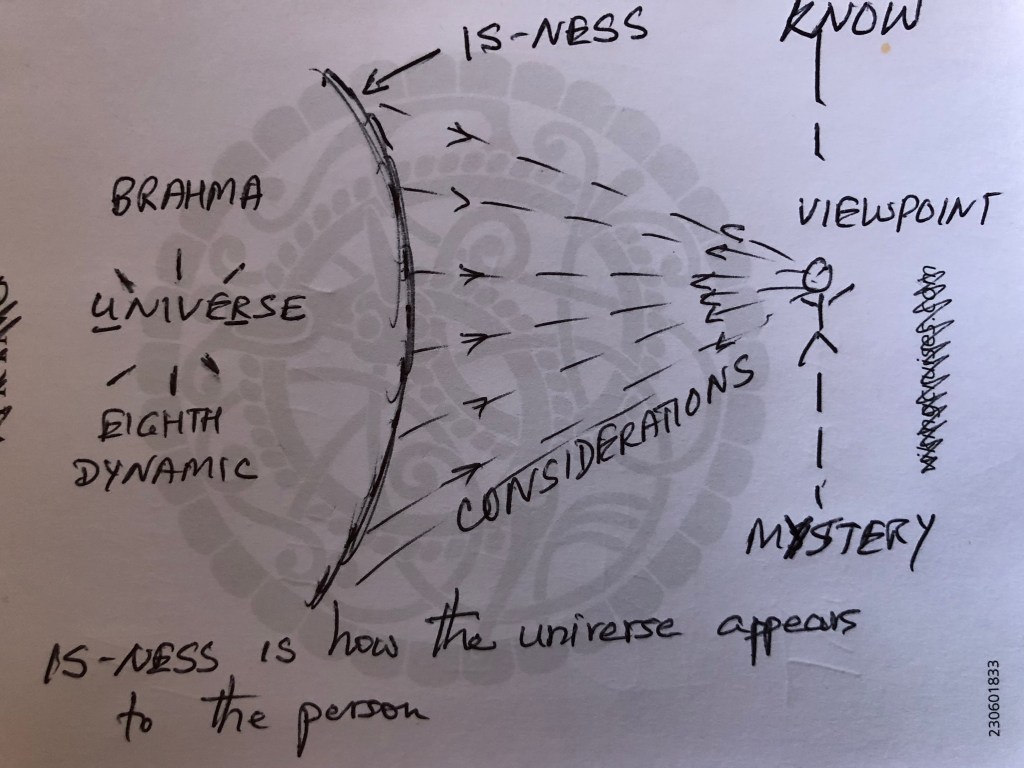
BRAHMA Brahma is the innate impulse manifested as energy in the form of the whole universe.
In modern language one would say that the highest metaphysical reality is the innate impulse, which is the characteristic of all energy. This impulse, on a universal scale, is understood as Brahma (the universal viewpoint). But, on the scale of an entity, it is understood as Atman (the individual viewpoint). There is quite a distance from Atman (or Paramatman) to Brahma in terms of broadness of the viewpoint.
CONSCIOUSNESS Consciousness is the level of awareness of the mind. The greater is the refinement of the data elements (and the relationships among them) from perception, the higher is the consciousness. Human consciousness is much higher than the consciousness in animals, because the data elements are much more refined with greater number of relationships among them. See MIND.
DHARMA Dharma means, literally, “the Law of Being.” It refers to the natural purpose of something. For example, the “Dharma” of the sun is to shine and give warmth.
ISHVARA (ईश्वर) The composite word, Ishvara literally means “owner of best, beautiful”, “ruler of choices, blessings, boons”, or “chief of suitor, lover”. As a concept, Ishvara in ancient and medieval Sanskrit texts, variously means God, Supreme Being, Supreme Soul, lord, king or ruler, rich or wealthy man, god of love, deity Vishnu… [in Vedas,] the contextual meaning, however as the ancient Indian grammarian Pāṇini explains, is neither god nor supreme being. Please see Etymology.
IS-NESS It is how the universe appears to a person
IMMORTALITY State of freedom from all samskaras (karmic impressions)
KALPA One day of Brahma equal to 1000 Yugas, equal to 4320 million years. See Hindu units of time.
KNOWINGNESS Knowingness is to know something so intimately that it has become part of you. For example, an expert has knowingness in his area of expertise. He knows his area so well that he can skillfully carry out the actions in that area without thinking. We associate absolute knowingness with God, but that is an ideal one holds. In reality, there is no absolute knowingness.
MAYA Maya consists of filters generated by karmic impressions that cloud one’s vision.
MIND The mind is the organ of mental sense. In a normal functioning mind, the perceptions are received through the senses of touch, sight, hearing, taste and smell. These perceptions break down into fine data elements, which are then arranged in a matrix type structure. Experience is stored as patterns of relationships among these data elements. The duplication of data elements is minimized. New perception is assimilated by arranging them in existing patterns with the correct time stamp and removing duplicate data elements. The existing patterns are modified and extended as necessary. Also see ASSIMILATION.
MINDFULNESS A presence, which is free of assumptions, bias and fixed ideas
REALITY Reality and unreality are the opposite ends of the scale of Is-ness, where is-ness is the sense of reality of the person. His is-ness on this scale improves as his viewpoint broadens.
SACRIFICE Sacrifice is surrendering one’s self-interests and devotedly working for the sake of the welfare of the world.
SAMĀDHI (समाधि) Samādhi means concentration of the thoughts, profound or abstract meditation, intense contemplation of any particular object (so as to identify the contemplator with the object meditated upon); this is the eighth and last stage of yoga; with Buddhists samādhi is the fourth and last stage of dhyāna or intense abstract meditation. The deep sleep like state of samadhi is the period of assimilation in which you completely reset your system. But you don’t live in that state. Samadhi leads you toward the universal viewpoint. Being “established in God” would means being established in the universal viewpoint.
SAMSKARAS Karmic impressions brought about by one’s actions and their consequences
SAT-CHIT-ANAND The bliss of pure thought energy
SURRENDER (in yoga) Surrendering is “not avoiding, not denying, not resisting, and not suppressing.” It is experiencing fully what is there. You free yourself from an unwanted condition only by becoming fully aware of it. Suppressing is not the same thing as surrendering. If a person is suppressing bad habits to become good, he has not surrendered yet. After you have surrendered, only your basic nature is left. The basic nature operates according to the universal laws
THOUGHT ENERGY Thought energy is the fundamental energy on which the spectrum of radiative energy and matter rest. The thought energy resides in the mind, which then transitions into physical energy of the body.
TRAUMA The traumas are like “tumors” in the data matrix of the mind. They are made up of painful perceptions that did not get assimilated. They have only a few connection with the data matrix. They get reactivated when perception comes through these few connections. These “traumas” have their own unhealthy patterns that are backed up by the force of mental pain. The continual reactivation of traumatic experiences then gradually infects and conditions the healthy parts of the mental matrix by forcefully imposing unhealthy patterns. These unhealthy patterns contain all the emotional baggage, phobias, fixed ideas, prejudices, biases, etc., that you encounter. The traumas are not easy to access because they are not assimilated into the mental matrix. Repairing infected circuits in the mental matrix may allow, ultimately, to uncover these traumas and blow them; at which point many deep rooted problems also resolve. See ASSIMILATION, MIND.
UNREALITY Unreality manifests itself in the form of inconsistencies, disharmonies and discontinuities. You resolve these things and the unreality disappears. It does not continue. Only the reality continues.
VIDHATA Vidhata means “inherent principles of existence.” Duality is a natural consequence of these principles. Any imbalance straightens out by itself.
YAJNA Yajna means selfless action done for the welfare of the world. For example, Jnana yajna is performed to spread jnana for larger benefit of community. The ritual of yajna is a symbol for such action. See SACRIFICE.
Chapter 36: Einstein’s Legacy – Albert Einstein (1879 – 1955)
“He also published an analysis indicating the equivalence of gravitational and inertial mass is not a mere accident of nature, but the basis of a profound physical principle that leads to a new theory of gravity.”
NOTE: Inertial mass is a mass parameter giving the inertial resistance to acceleration of the body when responding to all types of force. Gravitational mass is determined by the strength of the gravitational force experienced by the body when in the gravitational field g.
Comment:
To me, inertial mass balances the intrinsic motion. Light has very large but finite velocity because it has an “inertial mass” restraining infinite motion. As inertial mass increases the intrinsic velocity decreases. A body of infinite inertial mass may be postulated to be at absolute rest. Different inertial masses mean different intrinsic velocities. Thus, relative velocities may be understood in terms of differentials of inertial mass.
From this point of view, when a body is accelerating in a gravitational field, it means that the inertial mass of the body is somehow reduced by that gravitational field. Since this reduction is extremely small, the “gravitational mass” appears to be the same as the “inertial mass”.
Does the spider have an atman? There is some energy that is animating the spider. It is not as sophisticated as the energy which is animating the human body. But, in both cases, it is some kind of energy, which we may call atman. So, atman is not the same thing as some human identity, or any other identity.
The concept of atman is not the same as the idea of “soul” in Christianity or in other Semitic religions. All those ideas are based on the human identity one has been attached to while living. So he wants the same identity to continue after death as “soul”.
Two ideas are psychologically deep-rooted in man: self-protection and self-preservation. For self-protection man has created God, on whom he depends for his own protection, safety and security, just as a child depends on its parent. For self-preservation man has conceived the idea of an immortal Soul, which will live eternally. In his ignorance, weakness, fear, and desire, man needs these two things to console himself. Hence he clings to them deeply and fanatically.
The objective view of PARAMATMAN and ATMAN is very different from the subjective view of God and Soul as described above because the psychological factors of self-protection and self-preservation are not there.
Bhakti Yoga starts out with the subjective view of God and Soul. On the other hand, Jnana Yoga seeks to obtain the objective view of PARAMATMAN and ATMAN directly.
Chapter 21: Atoms and Electricity (Michael Faraday 1791 – 1867)
Newton’s abhorrence of action at a distance led Faraday to introduce the concept of a field of force in space, such as the one around a magnet. He viewed the field as tubes of force and explained the phenomenon of induction as follows: “Whenever tubes of force are cut by a conductor, current flows in the conductor; the faster the tubes are cut, the greater the electromotive force that is induced in the conductor.” Faraday began a series of experiments in electrochemistry and described electricity as the energy that loosens from matter and moves around carrying its chemical force. It is equivalent to the particles separated.
Chapter 22: Electromagnetic Theory (James Clerk Maxwell 1831 – 1879)
Maxwell pointed out that the interaction of charged bodies with the surrounding medium could not be disregarded. He assumed the existence of an electromagnetic field of force in space, which was composed of ethereal substance. This substance has a small but finite density. It has kinetic energy by motion, and potential energy by elasticity. The propagation of waves occurred because there was a continuous alternate transformation between these two forms of energy. Maxwell used experimental data of induction between electrical and magnetic fields. He had to overcome the idea of electric current being always associated with a conductor. He calls the changing electric field between two condenser plates a displacement current and states that it is measured by the rate at which the electric field is changing. With this innovation Maxwell was able to write down a set of equations for the electromagnetic field in which the electric field and the magnetic field enter in a symmetrical way. From these equations he derived a single wave equation that describes the way electromagnetic field is propagated. Maxwell’s theory explains how the atom absorbs and emits radiation.
Chapter 23: Cathode Rays – A “Fourth State of Matter” (William Crookes 1832 – 1919)
William Crookes studied the nature of electric current as it left a conductor into a vacuum, as “cathode rays.” It radiated out perpendicular to the surface of the cathode in straight line. It generated impact as demonstrated by rotation of leaves of a radiometer. This radiation is laminar as the “rays” do not cross each other. It produces sharp shadows. Focusing of these rays produces heating effects. The cathode rays are also deflected in the presence of a magnet, but this deflection decreases with increasing exhaustion of the tube.
Chapter 24: A Remarkable Regularity in the Hydrogen Spectrum (Johann Jacob Balmer 1825 – 1898)
Balmer produced a mathematical formula that correctly gave the wavelengths of the spectral lines of the hydrogen atom. Balmer’s discovery was generalized by the “Ritz combination principle” as follows: “For any atom there exist a characteristic sequence of numerical terms such that the frequency of any line in the spectrum of this atom can be expressed as the differences of other lines in the spectrum.” This remarkable sequence, which stemmed from the basic work of Balmer, was of great importance in leading finally to the Bohr model of the atom.
Chapter 25: The Luminiferous Ether Receives a Mortal Blow (Albert A. Michelson 1852 – 1931, Edward W. Morley 1838 – 1923)
The phenomenon of the aberration of starlight conflicted with the theory that light is a disturbance in the medium of ether. Fizeau’s experiment showed small increase in the speed of light in moving transparent bodies. This was cited as a confirmation of Fresnel’s concept of “ether drag” and as a proof for the existence of ether. Michelson-Morley’s experiment of 1887 demonstrated that if there be any relative motion between the earth and the luminiferous aether, it must be small; quite small enough entirely to refute Fresnel’s concept of “ether drag.” It raised the question about the real nature of light.
.
MAIN POINTS
There are electric and magnetic fields of force in space.
Electric field induces magnetic field and vice versa.
Electricity is energy that loosens from matter and moves around carrying its chemical force.
The electromagnetic field of force in space is a form of substance.
This substance has motion and elasticity, example of which is light.
Atoms emit and absorb electromagnetic radiation.
The electric current radiates out into vacuum as cathode rays.
The cathode rays have consistency and momentum.
The cathode rays travel in straight lines, and they are laminar in flow.
The regularity of atomic structure is visible in the atomic spectra.
Light is electromagnetic substance and not a disturbance in some ethereal medium.
THEORY Charge within the atom acts as the transitional phase between its nuclear mass and surrounding energy. It is responsible for the chemical force that locks atoms together. It can flow out into vacuum as cathode rays. Atoms extend out in space as electromagnetic vortex of energy and force that fills the space. The regularity of atomic structure is visible in atomic spectra that is produced when atoms absorb and emit electromagnetic radiation, such as light. Light is electromagnetic substance and not a disturbance in some ethereal medium.