This is fascinating…
And General Electric (G.E.) comes through again with breaking technology
>>> story here tonight, we’re about to hear one of the smartphone may change his profession and personal medical his story tonight from dr. nancy snyderman.
>> why do we have people being treated like cattle herds? that’s waste. and the billions of dollars that’s being wasted each year for screening and the wrong drugs and the wrong everything. it’s astounding, and we just can’t go on like this.
>> i’ll take that, thanks.
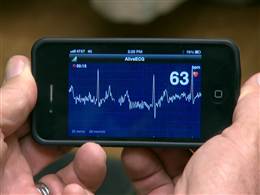
>> reporter: dr. eric topol has long been one of the world’s foremost cardiologists. he has now become the foremost expert in the exploding field of wireless medicine. and this explosion, he says, is about to make our health care better and cheaper. watch what he does with his cell phone.
>> we’ll just pop this is phone into it like that.
>> reporter: he shows how simply his modified iphone produces a cardiogram for a patient.
>> so you just put your fingers on it. there you go. and in a second — you know, in the first or second it stabilizes.
>> reporter: the device was approved by the fda in december and is now sold to physicians for $199. topol tells his patient he just saved a $100 technician’s fee.
>> so are we close to using this to say i’m going to diagnose you and prescribe four or five apps instead of four or five medications?
>> well, these days i’m actually prescribing a lot more apps than i am medications. you can take the phone and make it a lab on a chip. you can do blood tests, saliva tests, urine tests, all kinds of things. sweat tests through your phone. this is a powerful device.
>> and we’ll just have you hold that on there like that.
>> reporter: topol’s patient, ron thompson, is dealing with several significant heart issues.
>> you saw that on a phone. didn’t you just — weren’t you just amazed the first time you saw that?
>> absolutely. it’s like having an ecg machine hooked up to me and shaving my chest and sticking, you know, stick ’em on there and putting electrodes or whatever, but yeah, no, this is incredible.
>> reporter: topol also uses a portable ultrasound, a v-scan to image ron’s heart.
>> so get a window. there’s the aorta. you see —
>> i sure do.
>> reporter: the v-scan is made by ge, a parent company of nbc.
>> can you see that? see how strong that is coming together?
>> reporter: he does in the office what would normally be a separate test costing $800.
>> there’s 20 million, over 20 million echocardiograms done a year. so 20 million times $800, that’s a lot of money. probably 70, 80% we can get rid of just by having this as part of the physical exam.
>> i was surprised when you saw ron that the technology did not get in the way of the doctor/patient relationship.
>> actually i think it helps make the whole interaction much more intimate, because now i’m sharing the results in realtime. there’s so much technology now that we could — by using digital structure that exists today, that we could make the office visit an enjoyable thing. not only that, nancy, but it doesn’t have to be in person. there’s no reason why a lot of office visits, if not most, could be done remotely.
>> ron could take his ekg at home, send —
>> yes. we’d be looking at it together. or if i got him a wireless ultrasound and he just puts it right there and i say, okay, take a deep breath, i could be watching it in realtime. anything that we can do can be done remotely.
>> reporter: when topol came to scripps in san diego from cleveland, he started a new chapter in his life.
>> when you moved here in 2006, you had just left the cleveland clinic under not very happy circumstances.
>> right.
>> reporter: he had a rep contusion for brashness. he questioned the safety of the hugely profitable pain killer vioxx and eventually forced it off the market.
>> i resigned after having been there 14 years. it was a significant part of my career.
>> do you think, wow, i’ve done a really great job making health care better or do you think, damn, there’s so much yet to do?
>> i feel the damn, there’s so much to do problem. i feel that big-time.
>> do you ever think about how you’re going to die?
>> yeah, i do sometimes. you know, i watched my mother die at a very young age, in her early 50s, with leukemia. my father was an end-stage diabetic. he went blind at age 49.
>> reporter: topol uses dna testing and monitoring to guide his daily life. he refuses to use elevators and his day is spent walking from building to building. he incorporates an hour of exercise into virtually every day, no matter how busy. trying to live the life he thinks we’ll all be living in the near future.
>> how did you find out about that?
>> reporter: at lunch we pulled out what we were told is one of his weaknesses, tortilla chips.
>> will you partake?
>> oh, yeah, it’s hard to resist.
>> okay, come on. handful.
>> reporter: they are loaded with carbohydrates, which trigger glucose.
>> yeah, this is my guilty pleasure here.
>> reporter: so out comes his cell phone.
>> i can look at my glucose every minute. i don’t want to look at it every minute, but i can. so i can just turn it on, my glucose. fortunately i haven’t had enough chips yet. it’s 107.
>> how does it know that?
>> i have a sensor on.
>> where?
>> i have it on my abdomen, but i’ll show you what it looks like. it’s like that. touching the skin.
>> so that sends a wireless signal to this?
>> yes.
>> and if you were a diabetic and you had this, you could then send this message to your physician or to your computer.
>> oh, yeah.
>> and you could start to see triggers and trends and follow this?
>> sure, oh, yeah.
>> and there goes the lifestyle change?
>> you got it.
>> reporter: eric topol is a man who looks way over the horizon, and everywhere he looks, he sees a cell phone.
>> in the future, let’s assume i have heart disease, what could this tell me about impending trouble?
>> well, we’re working on a project that will take a nanosensor in the bloodstream that is smaller than a grain of sand and it will — it will pick up a signal when you have cells that are coming off, shed into the bloodstream, coming off from the artery lining, which is a precursor to a heart attack. and then you will get on your phone a special heart attack ring tone, which will warn you within the week or two weeks that you are very liable to have a heart attack. i know it sounds a little invasive putting this little tiny, smaller than a grain of sand in your blood, but what that will do of having your body under continuous surveillance, talking to your phone, that’s the future of medicine. so this is the heart rate.
>> reporter: this is his newest passion, the busy mobile wrist monitor. topol was involved in its development. everything a hospital intensive care unit now monitors, this does wirelessly.
>> so if my 90-year-old father is discharged from the hospital, it’s conceivable he could go home with something like this and a doctor could monitor him remotely?
>> absolutely.
>> reporter: his book lays out how the digital revolution will create better health care.
>> you write in your book that medicine is currently set up to be maximally imprecise.
>> medicine today is about as much wasteful as one can imagine. so let’s just take drugs in this country, prescription drugs. 350 billion a year, a third of which is total waste. we’re giving a drug that doesn’t work, in fact even worse now, we’re giving drugs that backfire with side effects. so that’s $100 billion plus just from the prescription medications. and what about mass screening? every woman should have a mammogram every year, colonoscopy, psas, it’s really medicine dumbed down. it’s treating everyone the same. that’s crazy. each of us are truly unique in every way.
>> what does the patient of tomorrow look like?
>> the patient of tomorrow is the biggest switch. people need to take ownership. they need to seize the moment and seize the data. the new medicine is plugged into you. it’s understanding you, which we’ve never really done before, and you drive it. you’ve got the data and you’ve got information that you never had before. wouldn’t you like that information? most people would. and wouldn’t you like to be helping to call the shots?
>> fascinating story. our thanks to doctors topol and snyderman for that.
.