Category Archives: Uncategorized

Gravitational attraction

objects-attracted-towards-the-earth

Reference: Disturbance Theory

.

This is the Disturbance theory view of gravitation.

  1. Relative velocity comes into picture only when there are other mass locations in space. There is no velocity in the absence of other mass locations. There is only acceleration in reference to oneself.

  2. When there is a mass location, there is collapse of high frequency disturbance at that location. An example of this is the nucleus of an atom.

  3. There exists undisturbed space (or space with low disturbance) between two mass locations.

  4. From a mass location to undisturbed space there is a sharp gradient of frequency.

  5. Such sharp gradients between mass locations must try to smooth themselves out  to maximize the entropy.

  6. This would appear as a tendency of the two mass locations to draw each other in.

  7. This would explain the gravitational attraction.

.

Note:

Math can explain the force of gravity due to sharp gradient of frequency as follows:

Momentum, p = E/c = hf/c, where f is frequency

Force, F = dp/dt = (h/c) df/dt, where df/dt is the gradient of frequency.

The concept of time needs to be further refined here.

.

Interesting Link:

Quora: Newton vs Einstein

Geometry should be understood as abstraction of material dimensions.

.

Obsolete: Disturbance Theory in Brief

See: BOOK: The Disturbance Theory

dl10b

Let’s start from the beginning. The theory of relativity started with the observation that Space and Time cannot be absolute and independent.

Einstein then postulated ‘c’ to provide a precise relationship between Space and Time. You may call it “speed of light” or a constant ratio between wavelength (space) and period (time). This leads to a combined entity “spacetime”.

The use of separate units for space (meter) and time (seconds) has generated confusion because space and time cannot be measured separately and absolutely when relatively is taken into account. We cannot use separate units for space and time. We must have a single unit for “spacetime”.

Since the ratio of wavelength to period is postulated to be the constant ‘c’, that single unit for spacetime has to be “frequency”.

This provides a relationship between spacetime and energy. This is the starting point of Disturbance Theory, which asserts that Spacetime and Energy cannot be absolute and independent.

The Disturbance Theory may simply be stated thus,

Space is an undisturbed field of (theoretical) zero frequency. This space is the elusive aether. Light propagates as a disturbance in this space. Time is bound by a constant wavelength to period ratio in this disturbance.

The Disturbance theory uses “frequency” as a measure of motion (energy) in spacetime. This leads to a spectrum that defines electromagnetic, electronic, and nuclear fields as characteristics generated by increasing frequency. In this definition we also have an atomic structure that is continuous with space.

Inertia is a property of frequency. Inertia increases with frequency. When very high frequency collapses as mass in the nucleus, inertia becomes the property of mass.

By equating space-time with energy-mass, Disturbance Theory hopes to bring about an interpretation that combines the theory of relativity with quantum mechanics into a unified theory.

.
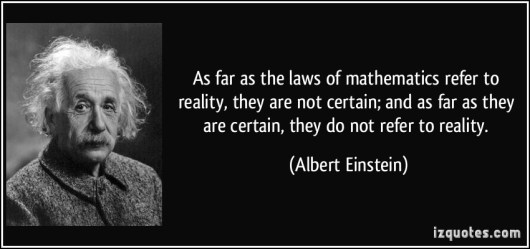
Mathematics and Reality

quote-as-far-as-the-laws-of-mathematics-refer-to-reality-they-are-not-certain-and-as-far-as-they-are-albert-einstein-226558

  1. Per Wikipedia [see Primitive Notion], a point is defined as a primitive notion. A primitive notion is not absolute. It must be logically consistent within the broad context of knowledge.

  2. This means that “point” is a starting concept of Euclidean geometry; but it is not absolute within the wider context of knowledge.

  3. Per Wikipedia [see Point (geometry)], “points do not have any length, area, volume, or any other dimensional attribute. A common interpretation is that the concept of a point is meant to capture the notion of a unique location in Euclidean space.”

  4. A location in real space may be infinitesimal, but it is not dimensionless. It is also continuous with the surrounding space. This notion is similar to that of an irrational number on a number line.

  5. Therefore, a Euclidean point may act only as an idealization of a location in real space. It may be used only as an approximation of a real location.

  6. A real location cannot act as a primitive notion like a Euclidean point because it is not dimensionless. Therefore, in reality, the notion of location shall depend on the notion of a continuous space.

  7. Per Wikipedia [see Space (mathematics)] Euclidean space is defined as a set that includes points as elements. Thus unlike Euclidean space, the real space is closer to being a primitive notion.

  8. The concepts of space and point in Euclidean geometry are reversed compared to what they are in reality.

  9. This may have some fundamental implications on the way General Relativity and Quantum Mechanics are currently being interpreted in physics.

  10. The Euclidean space is rigid as it is based on the idea of rigid dimensions of matter. But this idea of rigid space may not necessarily apply to the more basic substance of electromagnetic field.

  11. The Disturbance theory looks at space as a continuous “electromagnetic field of zero frequency” similar to the unperturbed surface of a lake.

  12. As the unperturbed surface of a lake is disturbed, there come about discrete ripples. Similarly, as the continuous space is disturbed the idea of discrete frequency comes about.

  13. For the electromagnetic disturbance to propagate through it, the real space must be flexible. This flexibility of space seems to reduce as frequency increases.

  14. The real space seems to be rigid only at very high frequencies. This is similar to the case when an object moves at the speed of sound through air and the frequency ahead of it becomes extremely high. This makes the medium of air appear rigid to the fast moving object.

  15. Therefore, it is only when the frequency of electromagnetic disturbance is very high that space approximates the rigid space as postulated in Euclidean geometry.

  16. Thus, space, in reality, is continuous and it acquires a discrete point location only where matter is present.

.

A New Look at Cosmology

1397399093612.cached

I have been looking at the electromagnetic field as vibrating space; electronic field as a rotating region within the electromagnetic field; and the nucleus as a collapsed region within the electronic field.

This is an atomic model provided by the Disturbance Theory. Now there seems to be a parallel to this model on a cosmic scale.

When we talk about dark energy, we might be looking at a vast electromagnetic field throughout the cosmic space.

When we talk about dark matter, we might be looking at rotating regions within this vast electromagnetic field of cosmic space.

And when we talk about black holes, we might be looking at collapsed regions within these vast rotating electronic  fields in cosmic space.

In short, it is quite possible that dark energy is vibrating space; dark matter is rotating space; and a black hole is collapsed space.

.

What is Space?

AXqM4

Reference: What Happened Before the Big Bang? The New Philosophy of Cosmology

First roundup

  • The concept of space lies at the foundation of physics.
  • Space may be referred to as modern ether.
  • Space is like undisturbed surface of a lake.
  • Time enters as disturbance of space.
  • The concept of spacetime applies to disturbed space.
  • Disturbed spacetime appears as energy.
  • Energy consists of a whole spectrum of frequencies.
  • At extremely high frequencies energy condenses into matter.
  • Space, time, energy and matter are not individually absolute and independent in themselves.

.

Second roundup

  • Disturbed space appears like disturbed surface of a lake.
  • Surface of a lake, when disturbed, breaks into “peaks” and “valleys”.
  • Space, when disturbed, breaks into “electric” and “magnetic” fields.
  • Disturbance propagates as electric and magnetic fields transforming back and forth.
  • This back and forth transformation of the two fields has a frequency.
  • Disturbed space is electromagnetic field vibrating at various frequencies.
  • A vibrating frequency has a “wavelength” and a “period”.
  • The “wavelength” and “period” occur in a constant ratio regardless of frequency.
  • This ratio expresses a constant relationship between space and time.
  • Both wavelength and period approach infinite values as frequency approaches zero.
  • Theoretically, space is “electromagnetic field” of zero frequency.

.

Third roundup

  • Undisturbed space has no motion.
  • When space is disturbed, there is motion.
  • Space and time are aspects of motion.
  • Space is represented by wavelength, and time is represented by period.
  • All motion occurs within space.
  • The motion appears as varying electrical and magnetic fields.
  • Space at zero frequency acts as reference point for all motion.

.

Fourth roundup

  • The fundamental reality of undisturbed space appears to be continuous.
  • When space is disturbed, discreteness enters in the form of frequency.
  • Quantum Mechanics deal with reality as discrete.
  • Integration using infinitesimals of space deals only with rigid space.
  • Sine and cosine functions deal with the flexibility of space.
  • Wave mechanics deals with reality as continuous.

.

Fifth roundup

  • Universe expanding does not mean that space is expanding.
  • It is more likely that the disturbance in space is expanding.
  • This expansion must be occurring at the “speed of light” in all directions.
  • “Volume” expansion of the universe would appear to be accelerating.
  • The universe need not contract at the end of its cycle.
  • This expansion of universe may simply peter out by disturbance petering out throughout.

.

Sixth roundup

  • Spacetime is generated from the resonance of some primeval field.
  • The primeval field may be viewed as some theoretical ground state.
  • This model visualizes multi-layered spacetime produced from disturbances of the primeval field described above.
  • Increasing disturbance generates increasing inertia (resistance to motion) in spacetime.
  • Inertia generates discreteness such as that of photon. At sufficiently high disturbance levels, inertia generates particles with mass.
  • At still higher disturbance levels, particles generated are of increased frequency and complexity, and of reduced velocity.
  • Thus come about atoms, molecules, compounds, materials, and the solidity and location of planets in the universe.
  • Higher frequency seems to equate with higher inertia and lower speed.

HIGH ENERGY GAMMA RAYS GO SLOWER THAN THE SPEED OF LIGHT?
.