Category Archives: Scientology

Scientology OT Levels

ReferenceGrassroots Scientology

There are eight OT Levels. These levels were researched and developed by Hubbard in the latter part of the sixties. These levels have been changed around a bit since their inception. I shall, therefore, be commenting on them in the order they were first issued. My focus shall be on what the OT Levels are all about and what techniques are used to handle it. 

The whole idea underlying the OT levels is to audit a person to bring him up to a point that he can be at cause knowingly and at will over thought, life, matter, energy, space and time, subjective and objective. When a person is fixated, he is not being cause knowingly and at will. Therefore,

The goal of the OT levels is:

TO FREE UP THE MIND FROM ALL ITS IDENTIFICATIONS (FIXATIONS). UNDERLYING THESE FIXATIONS ARE DEEP MISCONCEPTIONS.

.

OT Level I

The OT Level I comprises of closely observing bodies and tightly packed crowds, watching people and noticing various things about them, differentiating oneself from others, etc. The auditing technique is OBNOSIS (observing the obvious). A later version of OT Level I emphasizes on looking at upsets, problems etc., from the viewpoint of others.

Therefore, on OT level I, though not so specified, there is definitely an attempt to broaden the viewpoint of the person, so he is less fixated on himself.

Observing the obvious leads to a broadening of the viewpoint, and bringing misconceptions to light from broader to finer.

In Subject Clearing, you develop such a viewpoint by exercising the The 12 Aspects of Mindfulness.

Further reference: The Level of OT I

.

Clear and OT

On OT Level II one studies the Clearing Course Instruction booklet. At this time of development, the boundary between Clear and OT was blurred. A lot of work went into defining that boundary. It appears that,

A CLEAR is a person who has cleared all his engrams and related misjudgments but not the underlying identifications (misconceptions).

An OT is a person who is now focused on clearing up his identifications (misconceptions) on the OT levels. 

The Clearing Course techniques were very complex and required above average skills. Therefore, the Clearing Course was replaced when it was recognized that people could go Clear on Dianetics. However, the Clearing Course techniques were apparently retained in a simplified form on OT Level II. 

.

OT Level II

On OT Level II we are looking at the misconceptions starting from the earliest. The early misconceptions are very close to one’s beingness. The individual does not think they are misconceptions, instead he believes them to be his natural considerations. But he uses unnecessary force to achieve his goals. Such force is not necessary when the laws of nature are followed. The use of force means that the person is ignorant of the laws of nature.

The misconceptions affecting the beingness create very subtle charge (tension) that gradually condenses into complicated balls of confusion. Hubbard refers to this complexity of confusion as GPMs (Goals, Problem, Mass). He researched numerous permutations and combinations of basic concepts that could approximate these GPMs, and grouped them into a sequential list of items. Hubbard arranged these lists from the earliest to the latest as different GPMs. This forms the Whole Track Table.

Running the Whole Track Table is supposed to bring the misconceptions embedded in the psyche to light so they clear up. When considering the GPM items, one generally detects unreality, and goes over it again and again, until the misconception surfaces and is completely erased. 

This subtle charge of misconceptions at the level of beingness is very difficult to detect with an E-meter as it is subtler than the background static. This has made the OT Level II very complicated and long to run. The Subject Clearing approach based on The 12 Aspects of Mindfulness is much faster to run and more effective.

What makes most sense about OT Level II is the following lesson:

Look at a situation from all possible views until it resolves. Don’t get fixated on your personal viewpoint.

Further reference: The Level of OT II

.

OT Level III

An “OT technique” was finally introduced at OT Level III. The new datum introduced was that a person is not a single being, but a composite being made of BODY THETANS (BTs). These BTs are to be audited, so that they become clear and go away to pick up their own bodies.

So, the pre-OT audits these BTs one by one through the earliest engrams called “Incidents I and II” to the state of Clear. Some BTs require Grade Chart auditing before these incidents can be run. Other BTs may be stuck together into clusters and need to be unstuck before they can be audited.

Unfortunately, for a lot of people, OT Level III became not only too long but it turned into “endless auditing”. The subsequent OT levels were developed to handle this problem. The problem with OT Level III is that the body thetan is not understood as the finer identifications that corrupt the beingness.

But the underlying effort on this level is to get rid of the finer identifications (fixations) that have become part of the beingness, so that the beingness can expand to higher dynamics.

An example of this would be of getting rid of the first dynamic fixation on “eternal life”, to get back to expanding one’s goal to make this world a better place for everyone. 

The idea of expanding the beingness to all dynamics is same as broadening the viewpoint to KNOW on the Know-to-Mystery scale. This requires acquisition of broader knowledge. This knowledge is to be found in the societies and cultures around the world, and not on the whole track. This is very possible today through Internet using the Subject Clearing process. 

Further reference: The Level of OT III

.

OT Level IV

OT Level IV is about “freedom from uncertainty of self”. It follows OT Level III, which was about “freedom from overwhelm”. OT Level IV attempts to correct, rehabilitate, and stabilize earlier auditing levels, especially OT Levels II & III. Obviously, these earlier OT levels have been quite rough to run.

Hubbard’s theory is that the ultimate Clear state will be attained when the basic-basic engram on the whole track is erased from a person’s case. OT Level III takes the form of erasing “Incidents I & II” from each BT attached to the person. These incidents essentially involve thetans implanting each other heavily with all kinds of force. But underlying this theory is the implicit assumption that there existed an ideal CLEAR STATE before “Incidents I & II”. Was there such an ideal state at the start of the universe? Did thetans in an ideal clear state implant each other just for fun?

All we know is that this world, over millennia, has been undergoing evolution from minerals to plants to animals to humans. Before that there was raw energy condensing into galaxies, solar systems, planets and moons. This may be summarized as “order emerging out of chaos”. It seems that the farther you go back in time, the more chaos you will find.

There may not have been a CLEAR STATE at the beginning of the universe. We simply have to consolidate the evolution attained so far to evolve further.

We cannot endlessly keep going back on the track to find a Garden of Eden. The Fall of Man is the sum total of his doubts, perplexities and confusions on all dynamics. Once, a person has resolved his traumas, he simply need to resolve his confusions through continual acquisition of knowledge. Here Subject Clearing is the right procedure.

.

OT Level V

OT Level V is about “Freedom from fixated introversion into MEST”, but this level, like all earlier levels, is completely dependent on a MEST device called the e-meter. The dependency on a mechanical (conditioned) device for the freeing up of conditioned thought is definitely an anomaly. In Scientology, this has led to desperate attempts like RPF (Rehabilitation Project Force), where a person is forced to work with MEST to his physical limit under stringent conditions.

Scientology is trying to handle introversion into MEST while being totally fixated on the “accuracy” of a MEST device called e-meter.

The rehabilitation of a person depends on resolving all fixations in his viewpoint. The effort throughout Scientology has been to “exteriorize the thetan from his body”, or to “resolve the fixation on the body”. When we consider “Freedom from fixated introversion into MEST”, it includes resolving the fixation on the e-meter that does not have much utility beyond the handling of traumas. See E-Meter and OT Auditing.

The correct direction is the clearing up of doubts, perplexities and confusions through the use of study and Subject Clearing.

NOTE: The original OT Level V was replaced by NOTs (New Era Dianetics for OTs), but that did not handle the anomaly described above.

.

OT Level VI

The goal of original OT level VI was “Freedom from the inability to operate exterior.” It depended on going back to 1955 processes from the book CREATION OF HUMAN ABILITY. The mid-fifties were a period when Hubbard was at the height of his intuitive faculties. His outline of Scientology as presented in THE PHOENIX LECTURES is a masterpiece.

But Hubbard could not fully differentiate the handling of traumas in Dianetics from broad handling of knowledge in Scientology. He kept going back to his original theory in Dianetics, which had some success in early fifties. That theory was based on the idea of a BASIC-BASIC—which is best represented by the fall of Man from the Garden of Eden (See OT Level IV above).

But traumas in humankind are few and recent. Beyond the traumas are doubts, perplexities and confusions only. There is no ultimate trauma that caused all of man’s ills. Hubbard kept looking for this ultimate trauma but failed. See Handling the Charge.

Freedom from the inability to operate exterior depends only on freeing the viewpoint from all its fixations.

NOTE: The original OT Level VI was replaced by NOTs (New Era Dianetics for OTs) which was basically an attempt to clean up OT Level III.

.

OT Level VII

The goal of the original OT Levels VII and VIII was “Freedom from inability to be totally free,” and “Total cause as a being”.  The action at this level was later changed to going back to OT Level III type handling of BTs. This basically shows that OT levels went into a tailspin after OT Level III led to “endless auditing”.

It seems that solo auditing on OT levels turned into random auditing without any discipline, i. e. “self-auditing”. The cause of this is explained above as, (1) a flawed theory of “Fall of Man from the Garden of Eden,” and (2) total dependence on an unthinking device—E-meter.

The conclusion may be stated as,

There is no Garden of Eden to be restored. There are simply the gains from evolution to be consolidated.

Subject clearing is the current attempt to start rehabilitating the failure of OT levels.

.

OT Level VIII

On OT level VIII, Hubbard struggled with the question, “Why Thetans Mock Up?”

Well, Hubbard mocked up a theory that postulated that the universe started with an ideal scene from which a departure occurred. That departure was Hubbard’s basic-basic. Hubbard was unable to find his postulated basic-basic, and so his theory failed. There may not be such an ideal scene from which the universe started. The universe could simply be evolving toward an ideal scenepart of which is Man.

All we need to do is clean up the doubts, perplexities and confusions plaguing Man, while keeping the traumas resolved. That was the approach of Buddha.

Hubbard postulated that a fundamental separation between spiritual and physical characteristics existed. On this depended his concept of THETAN. But the spirit and body happen to be one integrated system. See The Definition of MEST. The spirit manifests itself as a VIEWPOINT and this viewpoint holds certain considerations. There is no thetan compulsively mocking up pictures. See Subject Clearing Beingness.

A person is an integrated “physio-spiritual” system in which the state of awareness is represented by the VIEWPOINT.

Hubbard defines “power” as “the ability to hold a position in space”; and, therefore, according to him, a thetan must hold his position in space to be powerful. But that actually translates as the viewpoint becoming fixed; and a fixed viewpoint cannot think its way through situations. We need the individual to clean up all fixations from his considerations.

A person improves as fixations in his viewpoint are resolved.

Resolving of situations, anomalies, and confusions does not necessarily mean going back to some previously attained ideal scene. It could also lead to a new ideal scene that never existed before. This is evolution. It requires out of the box creative thinking and not a dependence on some existing viewpoint. The viewpoint itself must evolve and not merely “hold a position”.

There is no “salvation” back to some previous state. There is only evolution to higher states.

Hubbard never allowed anyone else in his organization to think creatively. He held fixedly on to his THETA-MEST theory and never questioned it. Scientology is currently “holding its position” and degenerating into a set of beliefs.

Total dependence on recall in auditing means there is no creative thinking and no evolution.

This rounds up OT Level 8.

Further reference: The Level of OT VIII

.

Gains on OT Levels

The gains on OT levels have been fantastic at times, but not uniformly so. I am sure the clarity of OT levels will be isolated and presented over time. Here is a sincere expression of what is possible on OT levels:

Gains on OT Levels

.

Summary

The “OT technique” that Hubbard introduced at OT Level III was not clarified fully and, therefore, it failed. The few wins that one gets on OT Levels is through the resolution of cycles mishandled earlier on Hubbard’s previous techniques.

But Hubbard’s overall brilliance as a pioneer must be acknowledged without reservation. His research in Scientology has led to many new efforts to bring improvements in the field of mind and spirit.

Hubbard wanted to make an indelible impact in the field of both science and religion. I believe he has done so. It will be amply demonstrated as we go over all his research and consolidate the discoveries. For example, when we apply Hubbard’s discoveries in the field of Logic to his flawed THETA-MEST theory, it leads to great improvements in our understanding of this universe.

I thank Hubbard for his ample contributions to the field of Knowledge.

.

E-Meter and OT Auditing

Reference: Running Scientology Processes with Subject Clearing

The E-meter (Electropsychometer) used in Dianetics and Scientology auditing is described as follows.

“An electronic instrument for measuring mental state and change of state in individuals, as an aid to precision and speed in auditing… the meter tells you what the preclear’s mind is doing when the preclear is made to think of something. The meter registers before the preclear becomes conscious of the datum. It is therefore a pre-conscious meter.”

The preclear (person being audited) holds two cans that are connected to the E-meter. The meter reads when the mind of the preclear reacts to the auditing question. Obviously, this reaction is automatic, and not the result of any conscious thought.

So, the meter cannot tell you anything about what the preclear’s mind is doing beyond registering an automatic reaction.

E-meter is useful at the beginning, when one is starting to resolve one’s case. At this stage the reactions are pretty sharp. So it is useful in tracing down and resolving engrams. But engrams on a case are few. As those engrams are resolved and the awareness of a person increases, he gains confidence in recognizing his own automatic reactions faster, more accurately and in a more intimate fashion. This kind of knowingness is accompanied by recognition of outpoints.

Reaction of the e-meter may point only to some tension. This has limited usefulness since no definite conclusion can be drawn about the question being asked.

The meter itself does not discover any datum. It is the investigation triggered by the detection of the mental reaction that helps one discover the data in auditing.

For example, when you study you know intimately when something does not make sense. You can narrow down any misunderstanding from a chapter to a paragraph to a sentence to a word. You can do this precisely without the aid of an e-meter.

The intimate reaction in the mind is always accompanied by the person’s own knowingness. You never have to search for an answer when there is knowingness.

.

E-meter versus Knowingness

It seems that Hubbard never considered the possibility that the preclear could himself sense the mental reaction in auditing. This is because the people he started his research with were patients in hospitals who were quite sick. So, he did not have much cooperation from the research subjects. This research of Hubbard led to Dianetics, which explores the psychosomatic cause of disabilities. Here the E-meter is demonstrably a useful tool.

E-meter is a useful research tool in that it may help select an area for further inspection from a list of items. But this is useful only when that list is small and complete.

But later, when Hubbard’s research expanded into Scientology, he was no longer dealing with a few Dianetic engrams that existed below the level of awareness. He was dealing with a large quantity of fixations in people. The auditing approach allowed easier gradient for spotting things. The people on whom these auditing processes were applied were more willing and cooperative.

The fact is that by the time a person is through basic Scientology exercises such as TR0, and some auditing, his internal senses are trained enough to detect mental reactions. And after he has achieved the state of Clear, he can be expected to perceive mental reactions better than the E-meter.

Knowingness increases with auditing and it, ultimately, supersedes the practicality of the E-meter.

But Hubbard continued with the use of E-meter in Scientology.

.

Background Noise

There is always a background noise in the mind in the form of constant mental chatter. If you sit still for a moment and not think, you will soon become aware of this chatter that goes on continuously. This background noise also makes the meter needle move randomly at high sensitivity, which appears like “static on a radio”. In auditing, the auditor is reading the meter against this background noise.

One may read the meter usefully only when the meter reaction is distinct from the background noise.

But as the preclear moves up the Grade Chart, the meter reaction get smaller and becomes more difficult to differentiate from the background noise. Therefore, the reads to auditing questions are more often missed or taken up falsely. This leads to “overrun” in auditing and case difficulties, which now require “correction lists” to handle.

There is no evidence that Hubbard investigated this background noise.

.

Correction Lists

E-meter still is a handy device when auditing new people on the lower grades in Scientology. But as the person moves up the Grade Chart, the successes become fewer and far in between, and the use of “Correction Lists” proliferates. The very fact that one has to use correction lists in auditing points to errors. These errors become more frequent as one goes up the Grade Chart.

This situation of errors becoming more frequent led Hubbard to introduce complex administrative actions as part of the auditing procedure so one could trace the causes of errors and prevent them from occurring. But this did not handle the situation.

Correction lists become less accurate in spotting the cause as they became lengthy with lots of items.

Hubbard always blamed auditors for making errors, because from his viewpoint the auditing processes could not be faulted. However, in spite of the best efforts made to train auditors, the errors in auditing continued.

Hubbard never suspected that the problem was with the limited capability of the E-meter.

.

Self-Auditing

The principle of auditing is that one should take up only those items to which the mind reacts. The reaction and answer to auditing question follows almost immediately. Ask yourself for your favorite vacation spot, and the mind will immediately react followed by the knowledge of that favorite spot.

When you ask the preclear a question to which there is no reaction, the preclear does not have knowingness for the answer. But there may be an E-meter reaction due to background noise, and the preclear may think there is an answer not known to him. He then starts to randomly search for an answer in his mind, and when he doesn’t find the right answer anxiety sets in. This is called “self-auditing” in Scientology.

Self-auditing occurs in an auditing session in the form of a random search for an answer when the meter is not read correctly.

Hubbard had placed strict injunction against self-auditing because things can go dangerously awry when a person engages in it. But he could not stop it from happening in auditing sessions.

Unfortunately, Hubbard never suspected the inherent limitation of the E-meter.

.

The Discipline of Auditing

Hubbard considered Buddhism to be the ancestor of Scientology, and thought that he could improve upon it. The discipline taught by Buddha twenty-five centuries ago was mindfulness.

Mindfulness simply means, “Observe things as they are.” We find this concept appearing in Scientology as OBNOSIS (observing the obvious) or AS-IS-NESS. When this principle is applied in auditing, a “no reaction” should be observed as a “no-reaction” and no further action should be taken.

The questions to which the mind does not react should be strictly left alone. When in doubt it is safer to leave the question than to take it up.

Hubbard knew this principle, but he ignored the fact that the E-meter could react but not specifically to the question being asked. This is where the knowingness of the preclear becomes important. But Hubbard did not trust that knowingness. He wanted a mechanical procedure that was fool proof.

The knowingness is very important and it can be developed further by training on the 12 aspects of mindfulness:

With mindfulness, a person can easily differentiate the mental reaction from the background noise even when it cannot be so determined by the meter. The preclear will know when there is no reaction.

When the person feels that there is no-reaction to a question or an item, he must not take it up, even when it reacts on the E-meter.

This enables a person to become free of the liability of the E-meter and audit himself much faster up the OT Levels.

.

OT Levels

By the time the person reaches the OT Levels in Scientology, the auditing becomes so extensive that it may take years to complete a level. The person must note down all the meter reads and perform other administrative details in his solo auditing to be able to trace back any errors. This becomes a big distraction, but he is required to do it.

OT Level 1 attempts to broaden the viewpoint of a person by the use of OBNOSIS, so the use of E-meter is minimal. But on OT Level 2, the E-meter is used heavily to flatten the reads on an incredible number of significances generated by large permutations and combinations of basic concepts. It is a grinding process.

When a read is generated by some emotional reaction or a misunderstood word then simply grinding that read down makes no sense. This makes OT Level 2 a shot gun method to handle some valid reactions on significances. But most of the time one seems to be chasing questionable reads on a whole lot of significances.

E-meter errors are much more probable on OT Levels, and they go unhandled.

.

Conclusion

The use of E-meter is increasingly unnecessary as one moves up the Grade Chart of Scientology. By the time one reaches the OT Levels, E-meter becomes more of a liability than aid. The E-meter should be replaced by the discipline to develop knowingness (mindfulness) as described above.

When the person feels that there is no-reaction to a question or an item, he must not take it up, even when it reacts on the E-meter.

This conclusion is vital when it comes to the OT Levels.

.

OPERATING THETAN (in Scientology)

Please see The Definition of OPERATING THETAN.

Hubbard defines “Operating Thetan” as “an individual who could operate totally independently of his body whether he had one or didn’t have one. He’s now himself, he’s not dependent on the universe around him.”

I have no idea how a person can operate without a body, unless he has just withdrawn into some imaginary make-believe world. He still has a body, but it seems that he is NOT-IS-ING it (denying it completely).

All “OTs” I have met around Scientology organizations had bodies. But they seemed to believe that they could cause phenomena across the world just by thinking, so they didn’t have to go there with their bodies. This is fascinating. It sounds like magic. It can best be compared to the belief like “accepting Jesus equals eternal life”. It is all in the mind.

.

Exteriorization

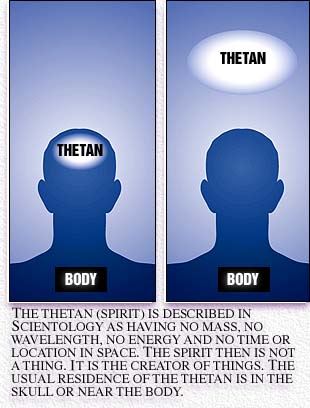
The idea of Operating Thetan (OT) probably started with Hubbard noticing the phenomenon of exteriorization. He described it as, the state of the thetan, the individual himself, being outside his body. When this is done, the person achieves a certainty that he is himself and not his body.

According to Hubbard, thetan does not have a location, but he can postulate a location for himself.  This is consistent with looking at thetan as an approximation of the viewpoint of the person. So, a person gets a viewpoint that he is outside the body. He has simply changed his viewpoint from being inside the body. The person himself does not have a location. He is simply considering a location.

The reason “exteriorization” is such a big deal is that it is quite a striking phenomenon. It often occurs in dreams. It may also occur when one is apparently unconscious, as in near-death experiences. Such an experience, at times, is so vivid that it takes your breath away.

When we look for an explanation, we find that the viewpoint of a normal person is quite fixated on himself as a body. The person gets the biggest surprise of his life, when suddenly that viewpoint is no longer fixated, but frees up. He didn’t know that his viewpoint was fixated on his body all this time. So, it is a remarkably exhilarating experience for him.

Hubbard is correct in saying that exteriorization is based on the consideration of the person, but then he also says, “the person achieves a certainty that he is himself and not his body.” This is a curve thrown by Hubbard. The fact is that the body is very much part of the identity of the person, and it expresses his individuality. Therefore, the correct interpretation of this phenomenon is, “the person achieves a certainty that his viewpoint is no longer limited to himself and his body.”

It seems that, over time, Hubbard did come to believe that a person can really be outside his body, and that it is not just his consideration, or viewpoint. He starts to make distinction between spirit and body as two distinctly separate things, and not an integrated whole.

.

Philosophical Underpinnings

Hubbard’s philosophy is based on the idea that thought is separate from the physical universe This idea was introduced by the Greeks.  It does not exist in Eastern philosophy. According to the VEDAS, physical and spiritual aspects exist in the same universe.

Therefore, the idea that spiritual and physical aspects of life represent two independent universes is an inconsistency. When you look at these two aspects to be integrated with each other, it becomes possible to find scientific explanations for psychic phenomena, such as, the feeling that somebody is looking at you from behind, or coincidences identified as telepathic communications.

The following conclusion appears to be more consistent.

The spiritual and physical aspects of life are integrated with each other. They are not separate and independent of each other as postulated by Greeks, the Western religions, and now, by Hubbard in Scientology.

.

THETAN (in Scientology)

Reference: Scientology Fundamentals

Please see The Definition of THETAN

Hubbard believes, literally, that a person is separate from his body, while “living” in that body. When the body dies, the person survives quite intact. Hubbard identifies a person with this concept of THETAN and considers the THETAN to be immortal. The idea of THETAN is similar to the idea of SOUL in Christianity, except that, after the death of the body, the THETAN “goes to the nearest hospital” and picks up a new body. Thus, the person is reincarnated or reborn almost instantly (in a matter of days or, sometimes, months).

But Hubbard’s idea of THETAN is also different from the concept of ATMAN in the VEDAS and Hinduism. A THETAN is the specific individuality of the person, whereas, ATMAN is pure energy without identity or individuality. Upon death, the individuality of the person disintegrates the same way as body does. The atoms and molecules of a disintegrated body combine with similar particles from other disintegrated bodies to form a new baby body. Similarly, the disintegrated individuality as ATMAN combines with similar ATMANs from other disintegrated individualities to form a new baby individuality.

Thus, reincarnation in Vedic religions mean something very different from what Hubbard assumes. According to the VEDAS, there is no such thing as an immortal THETAN (individuality).

Hubbard assumes that a person, as a THETAN, is separate from the BODY it associates with. Thus, he may literally EXTERIORIZE from his living body. Permanent exteriorization occurs only at death. But then he goes and attaches himself immediately to a new baby body (re-interiorizes).

Basically, according to Hubbard, a person, as an individual, as a THETAN, is not part of the physical universe. Here again we find a literal separation of the physical universe from a spiritual (THETA) universe, which was first thought up by the Greeks. According to Hubbard, “A thetan is a static that can consider, and can produce space, energy and objects.”

Recently, in NEW ERA SCIENTOLOGY, the “reincarnation of LRH” made the following “discovery”:

“THE QUALITY AND CHARACTER OF A THETAN CONSISTS OF A THETAN’S WHOLE TRACK EXPERIENCE.”

All this adds up to the following:

In reality, THETAN simply refers to a person’s VIEWPOINT. The VIEWPOINT depends on the person’s past experience. It is different from person to person. This VIEWPOINT can improve or decline by moving up and down on the KNOW-TO-MYSTERY scale. When the VIEWPOINT rises up to KNOW on this scale, it becomes universally broad in nature. This may be referred to as the UNIVERSAL VIEWPOINT. Hubbard’s idea of STATIC is actually this UNIVERSAL VIEWPOINT. Attainment of this UNIVERSAL VIEWPOINT is the NIRVANA of Buddhism.

You may obtain an understanding of the Know-to-Mystery scale from Scientology Processes (Part 3).

The above explanation cuts through all the mystery that somehow has gotten associated with Scientology. It aligns well with revised SCIENTOLOGY FACTORS.

.

STATIC (in Scientology)

The most fundamental concept in Scientology is STATIC. It is called STATIC because it has no motion. Hubbard defines STATIC as zero in terms of physical attributes. However, STATIC is not nothingness, because it has quality and ability. It simply has no quantitative factor. But STATIC can generate quantitative physical factors by considering them.

Here Hubbard is postulating quantity and quality to be literally separable. It is like literally separating software from hardware, or literally separating form from substance. I do not think that such separation can be observed in reality. Therefore, this is an inconsistency.

Hubbard’s postulate of STATIC is inherently inconsistent.

Such inconsistency does not exist in Buddha’s postulate of EMPTINESS, which is simply a theoretical reference point of “zero” for all phenomenon. The concept of EMPTINESS may be arrived at by following the process of “neti, neti” (neither this, nor that). Buddha does not call out EMPTINESS to be some actuality with ability. It is simply a theoretical reference point like “zero” in mathematics.

What Hubbard’s STATIC seems to be referring to is a viewpoint that has attained complete knowingness. I shall call it the UNIVERSAL VIEWPOINT. It is the broadest viewpoint that there is. It does not exclude anything from its consideration or examination.

When this viewpoint is attained by a human being, it is called NIRVANA. You do not have to be permanently separate from the body (like the way Hubbard postulates STATIC) to attain the UNIVERSAL VIEWPOINT obtained in NIRVANA. Buddha attained NIRVANA at the age of thirty-five, and he then lived to be eighty.

Hubbard’s STATIC could be an approximation of the UNIVERSAL VIEWPOINT obtained in NIRVANA.

Buddha thought like a scientist in the true sense, not restricting himself to the physical universe only. He considered the physical and spiritual aspects of life integrated into one universe.

.