Category Archives: Science

Is Reality fundamentally Discrete?

lights_620
Reference:  Speed of Light (Revision 1)

The whole idea of Quantum Mechanics keeps going back to Bohr atomic model, and to Bohr’s correspondence principle.

According to Bohr’s correspondence principle fundamental reality is discrete, but it seems continuous when one looks at the limiting case through Classical mechanics.

Einstein believed that fundamental reality is actually continuous. That was his primary disagreement with quantum mechanics.

Einstein did not disagree with the formulas of Quantum mechanics as far as they successfully led to real inventions. But he saw those mathematical formulas more than just the result of trial and error. Einstein felt that a real interpretation for the working formulas of quantum mechanics was missing. If those formulas could be explained in realistic terms, then fundamental progress in science could be made.

Maybe Einstein was right. When we apply the logic of Bohr’s correspondence principle to electromagnetic waves, we notice something interesting. The frequency of electromagnetic waves is discrete, but as it increases it becomes continuous in its limit.

As the frequency spectrum enters the gamma range, the electromagnetic field seems to converge upon itself (see the reference above). This produces electrons and the electronic field. As the frequency continues to increase within the gamma range the center of the electronic field seems to condense into a nucleus made up of “continuous mass”.

The discrete frequency is the property of a wave that is inherently continuous. So, underlying the discrete reality of frequency there is the continuous reality of wave.

Frequency is related to energy, and it is visible as “stationary orbits” of Bohr’s atomic model. But underlying that frequency there is the reality of wave. The electromagnetic wave is “disturbed space”.

Quantum mechanics focuses on the discrete energy states and avoids looking at the underlying reality of continuous space. That is why it sees reality as discrete.

But it seems that a bit of deeper digging will discover continuous space as a more fundamental reality.

If that can be done it will make Einstein very happy.

.

Wave Function Collapse (Part 3)

Bose_Einstein_condensate_620

Reference:

WAVE FUNCTION COLLAPSE (Part 1)

WAVE FUNCTION COLLAPSE (Part 2)

.

I asked the following question on Quora,

Can a phenomenon such as light be discrete in terms of energy but not in terms of space?

In other words, is photon discrete because of the way it interacts, but we erroneously assume it to be a particle in space?

The answer I got is that this question is a no-brainer and it has long been settled. But then, what is this mystery about wave-function collapse?

After a bit of Q&A I arrived at the following conclusion.

“Now it has started to make some sense. A measuring apparatus cannot measure position in space directly, because it interacts with the photon in terms of energy first. It will interact with an “energy particle” and through that interaction it will try to determine position in space. Of course the “energy particle” will collapse the position of the wave function.

“But that doesn’t mean that the position is collapsed in reality. The “space particle” does not exist. There is only a continuous wave in space, only we cannot measure it. Thank you. Now I understand what collapse of wave function means. It is an illusion.”

The imprint on photographic film also is an outcome of energy interactions, therefore it is impossible to observe the electron in the double slit experiment as it actually behaves in space–as a wave.

The problem is that we are trying to observe a spatial phenomenon indirectly through an energy phenomenon.

Quantum Mechanics is looking at space through the filter of energy.

.

Addition (12/31/18)

There is no position is space until there is a material particle. An energy particle does not exist because energy cannot be localized in space like matter. A measuring apparatus cannot observe a photon or an electron because, spatially, it is a wave. Electron is a wave more quantized (susbtantial) than the light (photon) wave. Please see

Einstein’s Light Quanta

.

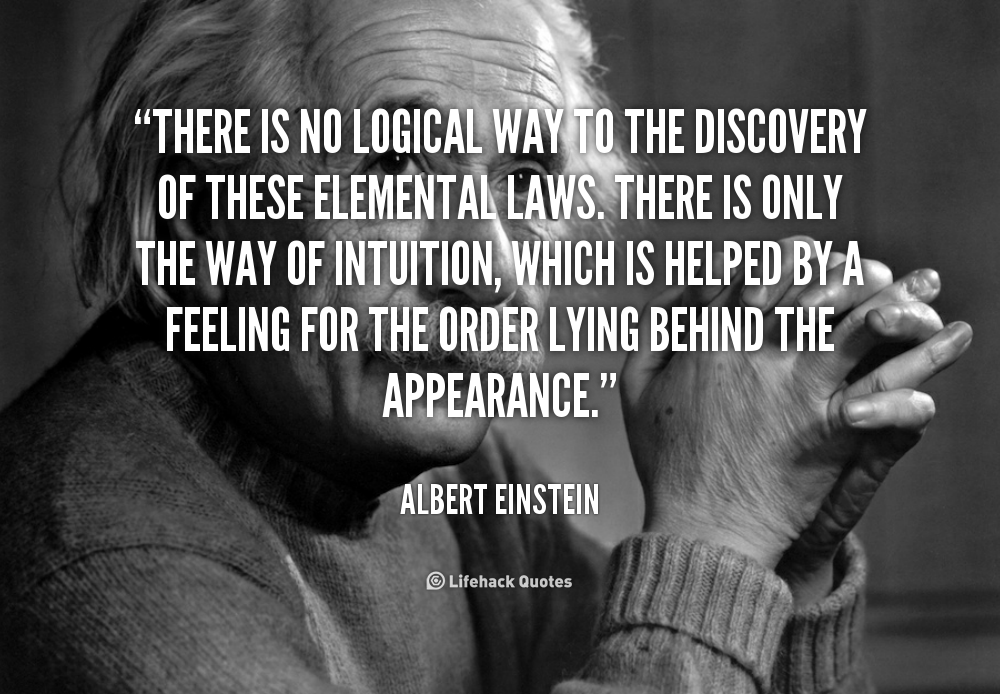
Logical Consistency

quote-Albert-Einstein-there-is-no-logical-way-to-the-41100_2

Reference: Subject: Logic

The essay on Viewpoint & Objectivity states:

“The logical consistency is determined within a personal context at first. As the context broadens toward universality, the logical consistency improves to become increasingly objective.”

To contemplate on logical consistency let’s start from point (11) from the essay referenced above.

  1. “The mental sense develops as it interprets order among these ideas and images through an intuitive sense of logical consistency.”

  2. This intuitive sense of logical consistency involves a sense of approach toward equilibrium.

  3. The system of ideas and images of a certain context acts like a closed system.

  4. In a closed thermal system, equilibrium is suggested by a uniform “temperature” throughout the system per the Zeroth law of thermodynamics.

  5. Similarly, within a certain context, equilibrium is suggested by a uniform sense of logic throughout the context.

  6. During the process of attaining equilibrium the internal energy of a closed thermal system is conserved per the First law of thermodynamics.

  7. Similarly, the total logical sense within a certain context is conserved during the process of attaining equilibrium.

  8. This approach of a closed system toward thermal equilibrium involves spontaneous maximization of entropy per the Second Law of Thermodynamics. Entropy is the ratio of internal thermal energy to temperature.

  9. Similarly, the approach toward equilibrium within a certain context involves spontaneous maximization of total logical sense while making the sense of logic uniform throughout the context.

  10. This defines what we refer to as the intuitive sense of logical consistency.

.

ADDITION (12/20/15)

This essay shows that the actual logic is limited by the context one uses and not because of lack of intuitive sense of logical consistency.

This means that the usual mental drawbacks in life arise from a context that is somehow narrow, binding and confusing.

The solution is to spot logical inconsistencies in the context one is using and look at them closely. This helps increase the context.

.

NOTES (Oct 27, 2022):

  1. The degree of continuity, consistency and harmony determines the logic of a system.
  2. The maximization of logic is constrained by the bounds of the context.
  3. Perfect logic is possible only within an infinite context.
  4. Intuition arises from broadening one’s context and viewpoint.
  5. To be perfectly logical one must broaden one’s viewpoint as much as possible.

.

Speed of Light

Animation from Wikipedia

Reference: Speed of Light Essays

Einstein’s book “Relativity – The Special and General Theory” starts out by looking at Euclidean geometry objectively.

Euclid sees that the concept of space is derived from material dimensions. Therefore, he assumes space to be perfectly rigid. This means that the distance and direction determined by two points in space are absolute. All  proofs in Euclidean geometry are built on this assumption.

Euclidean Geometry uses matter as its basis to understand space.

Einstein points out that nothing in reality is perfectly rigid. Therefore, space cannot be perfectly rigid, and distance and direction specified by two points in space cannot be absolute. Physics must modify geometrical concepts to make them logically consistent with physical reality. Therefore, Einstein’s theory of Relativity treats space as relative and not absolute.

Einstein uses matter more realistically as the basis to understand space. 

Einstein famously postulated that light does not need material medium to travel. This puts light in a very different class of its own called the wave-field. Einstein declared that “electromagnetic field” is a more basic form of substance than matter.

“Electromagnetic field” is very likely a more fundamental basis from which to understand space.

Let’s review the concept of electromagnetic field. Light is a form of electromagnetic wave. It propagates as a transverse wave, similar to the disturbance we see on the surface of a pond. It does not propagate like a longitudinal wave, an example of which is sound wave moving through air.  The difference is that a longitudinal wave moves through a medium, where a transverse wave travels at the interface of two media.

Since light is a transverse wave, it does not move through any medium; instead it forms at the interface of electrical and magnetic fields. These two fields continually transmute into each other like the peaks and valleys of the wave on the surface of pond. In doing so, the two fields drive the disturbance forward (see the animation from Wikipedia above). It so happens that the electrical and magnetic fields are part of light itself.

An electromagnetic wave is a disturbance propagating in space.

Light moves as a wave disturbance and not as a mass particle. The idea of light particle (photon) appears only in reference to energy interactions. The photon may not be discrete in space as assumed by many.

Light moves as a wave disturbance at the speed of 3 x 10⁸ meters/second according to units assigned on the basis of matter. That disturbance is not in some material medium but in space itself. The Disturbance Theory postulates space to be a primeval field of zero frequency that turns into electromagnetic field of finite frequency when disturbed. Space may be compared to the undisturbed surface of a pond.

Space is an undisturbed theoretical field of zero frequency.

The speed of electromagnetic disturbance (light) is constant and depends on the electromagnetic properties of space, as shown by Maxwell’s equations.

In the model proposed by the Disturbance Theory, space and time are experienced as disturbance of a theoretical field. There is no other way to measure space and time, except through the phenomenon of the disturbance. The cycles of electrical and magnetic fields determine Time. The spread of disturbance determines Distance.

Space and time appear in the units of “wavelength” and “period” of the disturbance respectively. The constant “c” describes the ratio of wavelength to period. Thus, space and time combine through “c” and the relative measure of disturbance is expressed through frequency.

The disturbance levels (DL) within the electromagnetic field are described as log base 2 of frequency.

Here are some notable disturbance levels (DL).

Space (Theoretical)                         DL 0 

Visible Light                                  ~ DL 49

Gamma Ray                                   > DL 64

Electron                                            DL 67

Neutron/Proton                                DL 78

DL > 78 is the region of matter. For matter, wavelength and period are infinitesimal and we can use the Euclidean concept of “dimensionless point” as a good approximation for location. This approximation for locations in field, however, does not hold that well. A “point location” in field has dimensions of finite wavelength-period. Thus mathematics takes a strange and complex form in Quantum Mechanics.

Locations in field cannot be approximated by Euclidean points.

Around DL of 67 the disturbance converges upon itself and electrons start to form within the electromagnetic field. The electron is a more complex electronic field within the basic electromagnetic field. The ratio “c” likely contributes to the properties of “spin” and electrical charge within the electronic field.

It is logical to postulate that as one moves from the periphery to the center of electronic field the disturbance levels increase and the disturbance condenses.

Around DL of 78 the disturbance condenses and a still more complex field starts to form at the center of the electronic field . This field may be identified as the nucleus of atom.

An atom is made up of nuclear and electronic fields within the electromagnetic field.

In a nuclear field the disturbance levels collapse and the disturbance appear as mass. The ratio “c” likely contributes to formation of gravity. Maybe mathematics will help us gain new insights into these relationships.

The speed of light is contained within the material objects. The material objects move relative to each other.

The speed of light “c” evidently has a nature very different from the speed of material objects.

The conjectures made above are logically consistent. They are worthy of further investigation.

.

Viewpoint & Objectivity

Objectivity-in-question

Reference: Subject: Logic

  1. Time is the ordering principle.

  2. We view time when we view order.

  3. We view order among parts through the view of whole.

  4. The order becomes more balanced as the context broadens.

  5. The viewpoint develops from personal to universal.

  6. A personal viewpoint is narrow when it is looking through personal bias, prejudice, fixed idea, assumption and blind faith. We may call it a “self-centric” viewpoint.

  7. A universal viewpoint is broad when it is inclusive of all things from which to view. We may call it a “scientific” viewpoint.

  8. Formation of viewpoint begins with physical sense experience.

  9. The physical sense experience consists of electrical impulses arriving at the brain through physical sense channels.

  10. The physical sense experience is interpreted into ideas and images by genetically programmed associations in DNA.

  11. The mental sense develops as it interprets order among these ideas and images through an intuitive sense of logical consistency.

  12. The overall context broadens as the physical and mental experience broadens.

  13. Logical inconsistencies present themselves as the overall context broadens.

  14. Objectivity develops as logical inconsistencies are resolved.

  15. And viewpoint develops from “self-centric” toward “scientific”.

The logical consistency is determined within a personal context at first. As the context broadens toward universality, the logical consistency improves to become increasingly objective.

Viewpoint is objective when it is logically consistent within a broad universal context.

.

NOTES (Oct 7, 2022):

  1. Only in the universal context can we see continuity, consistency and harmony of reality properly.
  2. Only through the context of spectrum of substance can we view space, time and energy properly.
  3. Space is the extent of substance that is shrinking per the spectrum.
  4. Time is the duration of substance that is increasing per the spectrum.
  5. Energy is the consistency of substance that is thickening per the spectrum.
  6. At a point on the spectrum, space provides ordering of spatial locations.
  7. At a point on the spectrum, time provides ordering of temporal events.
  8. At a point on the spectrum, energy provides constancy to space and time.
  9. A narrow viewpoint sees reality in a narrow context only.
  10. A narrow viewpoint does not provide a clear picture of reality

.