Category Archives: Science

Speed of Light, Correct Interpretation

Reference: Speed of Light Essays

The following was provided as an answer to this question of Quora.

If everything in the universe expands n times (say 10) then will the velocity of light in vacuum change?

.

Let’s look at the history of this idea called “velocity of light.” The idea of velocity comes from the concept of observer that is attached to an inertial frame of reference. Einstein used this concept in describing his special theory of relativity. But then there was this discovery of inertia-less field.

Earlier ideas of “temperature field” and “flow field” relayed material conditions at various coördinate points. Scientists assumed that the electromagnetic field relayed material conditions of an invisible substance called aether. Therefore, when light was established to be an electromagnetic phenomenon, it was postulated that light traveled as a disturbance in this invisible material substance known as aether.

Experimental evidence backed by theoretical calculations from Maxwell equations made Einstein conclude that there was no such thing as material aether, and that electromagnetic field itself was a fundamental substance more basic than matter. Compared to the inertia of matter, the electromagnetic field was practically inertia-less.

Apparently, the idea of an observer attached to an inertial frame of reference never got updated for electromagnetic phenomenon. The idea of velocity cannot be applied to an inertia-less frame of reference required for electromagnetic field.

The constant “c” used for the “velocity of light” is, however, a valid constant. It is still required per the principle of relativity. Only it has to be interpreted differently in an inertia-less frame of reference. The constant “c” is now to be interpreted as the “wavelength to period” ratio that does not change throughout the frequency spectrum.

So, the answer to the above question is that “c” as wavelength to period ratio for the electromagnetic disturbance does not change with expansion of the universe because “c” is based on spatial and not material characteristics.

.

The Nature of Spacetime

quantum_ill

NOTE: In the following essay the spacetime should be understood as EMPTINESS turning into “field” of disturbance. Time enters into the picture as endurance of disturbance (inertia). Force appears as the gradient of frequencies. It is electromagnetic attraction and repulsion in the electronic range where “swirling eddies” interact with each other. It is the gravitational attraction in the center as the curvature of the field.

  1. When we look at foundation of the universe it brings us to the concept of spacetime, because spacetime forms the background of matter, energy and motion.

  2. Spacetime, energy and matter cannot be defined independently of each other.

  3. Energy consists of a spectrum of frequencies. The upper end of this spectrum seems to have the limiting condition of matter. The lower end of this spectrum could very well have spacetime as its limiting condition.

  4. For our purposes we postulate spacetime to be a theoretical “electromagnetic field” of zero frequency. This would be analogous to the undisturbed surface of a pond.

  5. Time enters into space as disturbance. The disturbed space is the electromagnetic field. This is analogous to disturbed surface of a pond.

  6. When space is disturbed, the disturbance propagates as interchanging electrical and magnetic fields. This is analogous to interchanging peaks and valleys of a wave propagating on the surface of a pond.

  7. The electromagnetic disturbance is characterized by frequency. The constant “c” appears as constant “wavelength to period” ratio throughout the spectrum and not as “speed of light”.

  8. The electromagnetic disturbance propagates within the field as “influence”. This influence appears as force at higher frequencies

  9. At higher frequencies the disturbance converges and condenses into charge of electrons and mass of nucleus. Thus, spacetime underlies formation of atoms of matter.

  10. Spacetime has no material basis. It is the basis of all material.

  11. Spacetime is continuous. There is nothing else beside it. All frequencies (motion), charge (energy) and mass (matter) exist within spacetime.

  12. This makes spacetime the basic foundation for all existence. At “zero frequency” it forms the ultimate point of reference for all motion.

.

The Objective Observer

155d318f46b1b0e678b91e422777e7b3

Physics is the natural science that involves the study of matter and its motion through space and time, along with related concepts such as energy and force. More broadly, it is the general analysis of nature, conducted in order to understand how the universe behaves.

I don’t like to see the basic fundamentals of this universe defined as numbers, and no correspondence given with reality. It seems that science is looking at reality through the “filter” of mathematics, and all that it sees is certain relationships among numbers.

I find Einstein’s Theory of Relativity to be looking at space and time through the filter of matter. It is using coordinates designed to show the position and movement of matter particles, to somehow show motion of a disturbance in a field. Electromagnetic field is a more basic substance than matter with extra dimensions.

I find Quantum Mechanics confusing photon as a particle in space because it is looking at it through the “filter” of energy. Of course, photon is detected through energy interactions. At best it may be looked upon as lump of energy because it interacts that way. But to call it a particle in space is a misrepresentation in my view.

Instead of looking at space and time through the “filters” of energy, matter and mathematics, we should be using mathematics to look at space and time objectively and define energy and matter accordingly.

Here we can make good use of Bohr’s principle of correspondence: “The behavior of systems described by quantum theory reproduces classical physics in the limit of large quantum numbers.” In other words, energy and matter should be shown as limiting conditions of space.

Newtonian mechanics is limited to matter. Field is a more basic substance than matter (Reference: Relativity and Problem of Space). The mechanics that applies to field is much broader. It is the study of field that now holds clues to the understanding of the real nature of space and time.

Einstein’s relativity and Quantum mechanics are attempting to describe space and time from different viewpoints that fall short of having a universal context.

The scientific viewpoint is the logical viewpoint that uses the universe as its context. It is not limited by the “speed of light”. It can see light moving through the universe.

The objective observer is this scientific viewpoint that uses the universe as its context.

Fixed Ideas in Physics

maxresdefault

I asked the following question on Quora.

Isn’t comparing the speed of a mass particle to the speed of a mass-less photon like comparing apples to oranges?

The answers I got are unsatisfactory to me because they simply spout some fixed ideas.

To me position in space and time are the basic concepts to be clarified. Matter moves in space, but light does not move in space. Light moves in a field, and the field moves in space.

When Einstein said that there is no such thing as “material based aether” in which the electromagnetic disturbance was supposed to be propagating, he basically established electromagnetic field, as a more basic substance than matter.

Motion of matter may then be compared to motion of field. That would be apples to apples. Light is a disturbance within the field, so that would be oranges.

In an atom, the matter part is nucleus, and the field part is electronic shell. The electronic shell seems to provide a wider context in which the nucleus exists. It seems to me that material properties are a limiting condition of field properties per Bohr’s principle of correspondence.

Therefore, matter should be considered in the context of field, instead of the other way around.

The other confusion seems to be about definition of “particle”. Photon is described as a particle, but people forget that photon is a particle only in context of energy and not in context of space.

Detection of a photon requires energy interaction. Energy has been the basis of quantum since the time Planck postulated it to resolve the ultraviolet catastrophe of black body radiation. When we count quanta we are counting lumps (particles) of energy.

But the photon can still be a wave in space. That is pretty clear from the wavelike behavior of light where energy interactions are not involved. So where is this assumption of photon being a particle in space coming from?

To me the subject of quantum mechanics is looking at space through the “filter” of energy. On the same note, relativity is looking at space and time through the “filter” of matter.

This does not mean that quantum mechanics and relativity are not right. They are right in many of their conclusions. But they are hiding behind math and do not have correct explanations for space and time.

.


Einstein’s Relativity and Coordinate System

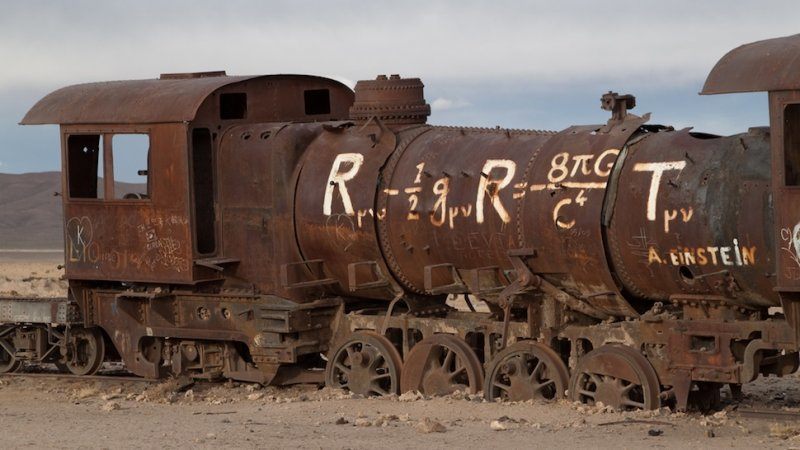
Uyuni Train Cemetery, Bolivia 18sth71nnihl8jpg

References:

Relativity – The Special and General Theory by Albert Einstein

Appendix V (added later to this book by Albert Einstein)


Einstein says in Appendix V: “Since the special theory of relativity revealed the physical equivalence of all inertial systems, it proved the untenability of the hypothesis of an aether at rest. It was therefore necessary to renounce the idea that the electromagnetic field is to be regarded as a state of a material carrier. The field thus becomes an irreducible element of physical description, irreducible in the same sense as the concept of matter in the theory of Newton.”

Einstein refers to field as “an irreducible element of physical description.” Field, therefore, is a substance, which is more basic than matter. The defining characteristic of field is frequency, where the defining characteristic of matter is mass.

.

Einstein says in Section V: “Even though classical mechanics does not supply us with a sufficiently broad basis for the theoretical presentation of all physical phenomena, still we must grant it a considerable measure of “truth,” since it supplies us with the actual motions of the heavenly bodies with a delicacy of detail little short of wonderful. The principle of relativity must therefore apply with great accuracy in the domain of mechanics. But that a principle of such broad generality should hold with such exactness in one domain of phenomena, and yet should be invalid for another, is a priori not very probable.”

Einstein is justifying his assumption that the principle of relativity, which is valid for uniform translation of mass, also applies to electrodynamic and optical phenomena that does not deal with mass. This is a big assumption that should be watched carefully.

.

Einstein says in Section VII, “There is hardly a simpler law in physics than that according to which light is propagated in empty space. Every child at school knows, or believes he knows, that this propagation takes place in straight lines with a velocity c = 300,000 km./sec. At all events we know with great exactness that this velocity is the same for all colours, because if this were not the case, the minimum of emission would not be observed simultaneously for different colours during the eclipse of a fixed star by its dark neighbour. By means of similar considerations based on observations of double stars, the Dutch astronomer De Sitter was also able to show that the velocity of propagation of light cannot depend on the velocity of motion of the body emitting the light. The assumption that this velocity of propagation is dependent on the direction ‘in space’ is in itself improbable.”

The observation by Dutch astronomer De Sitter gives us a clue that motion in field does not necessarily follow the laws of motion in the rigid coördinate system applied to matter. Therefore, we cannot use a coördinate system designed for matter as a coördinate system for motion in field. Field seems to have its own “coördinate system” that is different from the “coördinate system” for matter.

.

Einstein says in Section VII, “The velocity of propagation of a ray of light relative to the carriage thus comes out smaller than c. But this result comes into conflict with the principle of relativity set forth in Section V. For, like every other general law of nature, the law of the transmission of light in vacuo must, according to the principle of relativity, be the same for the railway carriage as reference-body as when the rails are the body of reference.”


Undoubtedly, the principle of relativity applies to the “coördinate system” for matter. We are used to looking at uniform translation with respect to matter. Relative velocities are additive from the viewpoint of matter whose position can be pinpointed by a center of mass.

But light is a disturbance traveling within a field that cannot be pinpointed by a center of mass. It is a frequency spread throughout the field. Comparing speed of a mass particle, to the speed of disturbance in a field, is like comparing apples to oranges. A correct comparison for speed of matter would be to the speed of the field itself.

According to Bohr’s principle of correspondence, the discrete frequency, as it increases, becomes, as a limit, the continuous mass of classical mechanics. The coördinate system for matter is too limited to include the phenomenon of light. For the principle of relativity, we need a coördinate system that would be applicable to both matter and field. Such a coördinate system shall be based on frequency and not mass.

We need to review Einstein’s Theory of Relativity in a coördinate system based on frequency and not on mass.

Einstein’s theory of relativity is looking at space and time through the filter of mass.

.