Category Archives: Science

Einstein, Space & Time

space-time

Reference: Subject: Logic

Einstein struggled with the concepts of Space and Time till the end of his life. He even dived into subjectivity, which is a dangerous thing for a scientist to do. In his 1952 essay “Relativity and the Problem of Space” Einstein says the following about Space:

The psychological origin of the idea of space, or of the necessity for it, is far from being so obvious as it may appear to be on the basis of our customary habit of thought. The old geometers deal with conceptual objects (straight line, point, surface), but not really with space as such, as was done later in analytical geometry. The idea of space, however, is suggested by certain primitive experiences. Suppose that a box has been constructed…

When a smaller box s is situated, relatively at rest, inside the hollow space of a larger box S, then the hollow space of s is a part of the hollow space of S, and the same “space”, which contains both of them, belongs to each of the boxes. When s is in motion with respect to S, however, the concept is less simple. One is then inclined to think that s encloses always the same space, but a variable part of the space S. It then becomes necessary to apportion to each box its particular space, not thought of as bounded, and to assume that these two spaces are in motion with respect to each other.

Before one has become aware of this complication, space appears as an unbounded medium or container in which material objects swim around. But it must now be remembered that there is an infinite number of spaces, which are in motion with respect to each other.

The concept of space as something existing objectively and independent of things belongs to pre-scientific thought, but not so the idea of the existence of an infinite number of spaces in motion relatively to each other.

By considering if space has bounds, Einstein is treating space as an object. Space is not an object. It is neither bounded nor unbounded. Space is abstraction of the bounds of matter.

Einstein is correct in saying that space does not exist independent of objects, but we can view space objectively despite Einstein’s opinion otherwise. Please see The Boundary of Space.

.

Einstein says the following about Time:

What do we mean by rendering objective the concept of time? Let us consider an example. A person A (“I”) has the experience “it is lightning”. At the same time the person A also experiences such a behaviour of the person B as brings the behaviour of B into relation with his own experience “it is lightning”. Thus it comes about that A associates with B the experience “it is lightning”. For the person A the idea arises that other persons also participate in the experience “it is lightning”. “It is lightning” is now no longer interpreted as an exclusively personal experience, but as an experience of other persons (or eventually only as a “potential experience”). In this way arises the interpretation that “it is lightning”, which originally entered into the consciousness as an “experience”, is now also interpreted as an (objective) “event”. It is just the sum total of all events that we mean when we speak of the “real external world”…

Now what is the position in this respect with the “events” which we have associated with the experiences? At first sight it seems obvious to assume that a temporal arrangement of events exists which agrees with the temporal arrangement of the experiences. In general, and unconsciously this was done, until sceptical doubts made themselves felt.  In order to arrive at the idea of an objective world, an additional constructive concept still is necessary: the event is localised not only in time, but also in space.

When Einstein “apportions each box its particular space and assumes that these spaces are in motion with respect to each other,” he is subjectively apportioning separate consciousness (viewpoint) to each box. Later, when talking about time, Einstein is attributing objectivity to agreement among separate viewpoints (points of consciousness). Agreement among viewpoints would be like a mixture of oil and water if those viewpoints are to keep their separate individuality.

Objectivity does not come from agreement among viewpoints. Objectivity comes from the context a viewpoint is using to view. The broader is the context the greater is the objectivity. For example, before Galileo appeared on the scene, people believed that Earth was the center of the universe; and therefore Sun revolved around the Earth. Since then Physics has helped broaden the context in which we can see that Sun is at the center of a planetary system. Sun appears to revolve around Earth because Earth rotates on an axis.

Objectivity is the characteristic of a viewpoint. The broader is the context of a viewpoint the more objective it is.

Thus we may express objective view of Space as follows.

Space is neither bound nor unbound. Space exists only as the boundary of this universe.

It seems that when there is no universe there would be no space either. The universe consists of matter as well as electromagnetic field. We tend to confuse this electromagnetic field with space.  Dark energy and matter seem to be aspects of electromagnetic field. The current research into Disturbance Theory attempts to resolve this confusion. (Reference: The Boundary of Space)

.

Time is the ordering principle of the universe. Objectivity of time comes from looking at the order of things in the broadest context possible.

We may provide an analogy in terms of looking through the window of a moving train. The narrower is the window the more chaotic seems to be the order of things viewed through it. When one climbs to the roof of the train’s cabin, one has a 360° view of the surroundings. The order of all things acquires a proper perspective. One now has a more objective view of time. It is only by referencing to the whole can one objectively evaluate the relationships among parts.

Thus we may express objective view of Time as follows.

Time is the ordering principle of the universe physically as well as conceptually and logically. 

It seems that one can arrive at the idea of an objective world only when one is looking from a broad universal context and not from a narrow personal context characterized by bias, prejudice, fixed idea, assumption and blind faith.

NOTES (Oct 7, 2022):

  1. It is only by referencing to the whole can one objectively evaluate the relationships among parts.
  2. Space and matter may be evaluated by referencing them to the spectrum of substance.
  3. Space forms the background while matter forms the foreground.
  4. The consistency of substance for matter is extremely high compared to that for space.
  5. The ratio of relative condensation of matter to space is extremely high. 
  6. This is also the ratio of relative condensation at a “point” for matter and space.
  7. This is also the ratio of relative duration of matter to space at a “material point.”
  8. This ratio is also known as the “speed of light.”

.
The Boundary of Space

348986-voyager-1-heliosphere

Reference: Subject: Logic

Here is a summary of some thoughts from Einstein’s essay “Relativity and the Problem of Space“.

  1. Newtonian physics treats space, time and matter to be independent of each other. This brings into question the physical reality of space. Newtonian physics does not offer answer to this question.

  2. The basic concept of space comes from the dimensions suggested by objects. Space is not considered by philosophers to have a physical reality of its own.

  3. We ascribe physical reality to those things that we can experience directly, and extend that reality through consistency of logical association among observations. The scientific thought evolves this way.

  4. Descartes is logical in arguing that space and bodies should be continuous; but the details of logical associations need to be worked out.

  5. Geometrical concepts, such as, straight line, point, surface, do not directly deal with space. Primitive experience of space comes from placing material objects in “empty space”; but it is difficult to think of unbounded space devoid of matter.

  6. The axiomatic structure of three-dimensional Euclidean geometry derives from the way bodies can be packed into space. There is an underlying assumption of bounded space, though it may not be so obvious.

Einstein had combined space and time by assuming a constant wavelength to period ratio (c) of electromagnetic disturbance, but he was still struggling with the problem of matter being looked upon as absolute. He knew that matter could somehow be combined with space.

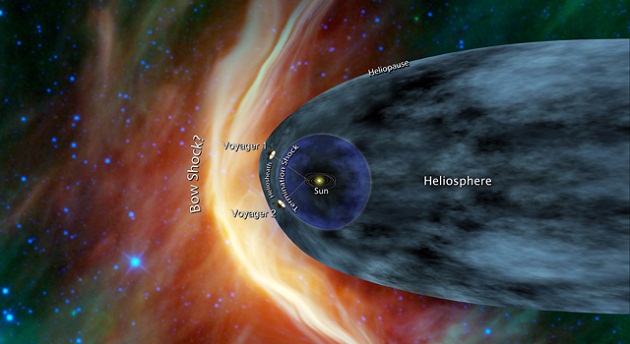
How does space relate to matter? What is happening at the boundary of space with matter? Is space extension of matter? Euclidean geometry assumes space to be bounded. How is space bounded? What is the relationship of space with its “bounds”? If space has bounds then what is bounding those bounds? This leads to an infinite regression. One may then ask, “Is space itself a bound?”

The Disturbance Theory defines space as the limiting condition of electromagnetic disturbance as its frequency goes to zero. This is an assumption of the same nature as Einstein’s assumption that speed of light is constant.

Thus space acts as the lower bound of electromagnetic disturbance.

At the upper bound of electromagnetic disturbance we have frequency increasing toward infinity. We calculate the disturbance level of gamma rays to be greater than 65. NOTE: The disturbance level is log2 of frequency associated with disturbance.

Calculations show that the disturbance level of electron is 66.7, and the disturbance level of proton and neutron is 77.6. It appears that the electromagnetic disturbance exists as a field in which high frequency regions (in gamma range) start to converge into electrons, which then further condense into protons and neutrons. This conjecture is logically consistent and it is worth investigating further.

Thus matter seems to act as the upper bound of electromagnetic disturbance.

The Disturbance Theory reverses how we view the problem of space. The problem is not what bounds space, but what is it that space bounds. What space is bounding is not matter but disturbance. And it is disturbance that converges and condenses as matter.

The interface between matter and space consists of electromagnetic disturbance.

So, space does not have existence independent of matter. Its existence depends on disturbance and its convergence and condensation into matter. This explains the continuity that Descartes was looking for.

.

NOTES (Oct 7, 2022):

  1. The “disturbance” of Disturbance theory is now recognized as the most general reference to SUBSTANCE. Substance is anything substantial enough to be sensed.
  2. The “frequency” of disturbance is now recognized as the consistency (thickness, solidity) of substance.
  3. Space is the limiting condition of substance as consistency goes to zero.
  4. Matter is the limiting condition of substance as consistency goes to infinity.
  5. From space to matter we have a spectrum of condensing substance.
  6. As the substance condenses its extent (space) shrinks and duration (time) increases.
  7. Lesser condensed substance forms the background of greater condensed substance.

.

THE FIELD

screen-shot-2011-12-23-at-11-25-57-pm

  1. Space may be regarded as a theoretical “field” of zero frequency. It is still just like the undisturbed surface of a pond.

  2. When space is disturbed it splits into electrical and magnetic components just like the disturbed surface of a pond splits into peaks and valleys.

  3. The electrical and magnetic aspects of space transmute back and forth at a certain frequency just like the peaks and valleys of the pond’s surface transmute back and forth at a certain frequency.

  4. An electromagnetic field is “disturbed space.” This field is very dynamic, and it carries electromagnetic disturbances of frequencies that constitute a spectrum.

  5. The electromagnetic disturbance is three-dimensional, and it is transmitted to other parts of space just like waves on the surface of pond are transmitted to other parts of the pond.

  6. Photons are elements of electromagnetic field. In space they are continuous like waves, but they behave like discrete energy particles during interactions among fields. The “size” of photon is determined by the frequency of disturbance at that location in the field.

  7. More complex forms of fields are generated when basic electromagnetic fields interact with each other. These complex fields also have their energy particles of higher and complex frequencies.

  8. Thus we have the Standard Model of Particle Physics.

  9. Matter is basically an electromagnetic field, in which are embedded atoms. An atom is a more complex electronic field, in which are embedded nuclei. The nuclei seem to be a still more complex nuclear field. Matter itself is embedded in the very low-frequency field of cosmos.

  10. A field consists of gradient of frequencies. The complex electronic field has gradients between nuclei embedded within it. Such gradients provide a rigid structure in solids that bind nuclei.

  11. In liquids this structure is less rigid with nuclei farther apart. These nuclei are able to move relative to each other maintaining a certain distance.

  12. In ideal gases, the nuclei are far enough not to be bound by the electronic structure of the field. They act as atoms with their own electronic fields. These atoms interact through “collisions” of their fields as they dart around.

  13. Heating is essentially an interaction of incident infra-red rays with electronic fields of matter. Such interaction tends to increase the average distance among nuclei by weakening the bonds

  14. The distance among nuclei is constrained by electronic bonds in solids and liquids, but much less so in vapor, and not at all in ideal gases.

  15. In unconstrained gases, such as, the atmosphere around earth, the distance among particles is determined by a wider gravitational field. The interaction among particles then appears as pressure.

  16. In externally constrained gases, we have higher pressures and we may have a pressure field.

.

New Laws of Physics

hqdefault

Could we create a universe with completely different laws of physics? It depends on the objectivity and logical consistency we may bring to the table.

(1) We must acknowledge what is there without any filters (bias, prejudice, fixed idea, assumption and blind faith). We may call such observations “objective”.

(2) We must postulate what is logically consistent with objective observations. We may call such theorizing “real”.

(3) Introduction of filters produces subjectivity.

(4) Introduction of logical inconsistency produces unreality.

(5) We are continually updating or refining the laws of physics based upon improved objectivity in observations.

(6) We are continually updating and refining the reality based upon improved logical consistency in theorizing.

(7) This may lead to completely different laws of physics that we are aware of at the moment. Galileo, Newton and Einstein have contributed this way in the past.

.

Particles in Space

space-particles

The property of a particle is that it is discrete. But a particle can be discrete in many ways. It can be discrete from the viewpoint of energy; or it can be discrete from the viewpoint of space. A particle of energy does not necessarily imply that it is also a particle of space. A particle of energy can very well be continuous spatially.

  1. The current idea of particles in Physics comes from quantum interaction that was first observed in black body radiation.

  2. Einstein then came up with the idea of a “light particle” or photon from the discreteness of energy interactions as observed in black body radiation. Thus, the idea of quantum was born as “a discrete chunk of energy”.

  3. But then, simultaneously, Einstein proposed his theory of special relativity that sees light as a continuous field of waves. Does this pose a contradiction?

  4. No contradiction arises if the light wave is continuous in space but appears discrete only when interacting with matter. This raises the question, “Does discreteness of energy interactions mean that there must also be a discreteness in space?”

  5. We seem to have an energy particle here. Do we then assume that such particles exist in space as discrete chunks? Can an energy particle remain continuous in space as a wave?

  6. According to Disturbance Theory, Space is like a field of zero frequency. It may be compared to undisturbed surface of a pond.

  7. When space is disturbed it splits into electrical and magnetic fields. These two fields seem to transmute back and forth at a frequency. This forms the disturbance.

  8. This disturbance is transmitted to other parts of space as three-dimensional waves. This is similar to the waves on the surface of a pond when it is disturbed.

  9. The wave-interference in the double-slit experiment is a spatial phenomenon and not an energy phenomenon. We are dealing here with a spatial wave and not with spatial particles.

  10. Quantum is a particle of energy and not a particle of space. It seems to be continuous spatially.

NOTE: We are talking about photon here. The case of electron is a little more complex but the same argument is applicable.