Category Archives: Science

The Problem of Relativity

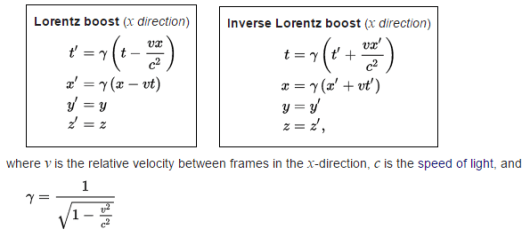
Lorentz Boost

Reference: Disturbance Theory

.

Einstein regarded space as a physical reality for the following reason. From Einstein’s essay, Relativity & Problem of Space [1]:

But in this [Newton’s] theory, acceleration can only denote “acceleration with respect to space”. Newton’s space must thus be thought of as “at rest”, or at least as “unaccelerated”, in order that one can consider the acceleration, which appears in the law of motion, as being a magnitude with any meaning.

In Newton’s theory, acceleration is a motion relative to the object itself and not to other objects in space. On a smoothly flying plane, we do not feel the velocity, but the moment there is acceleration we feel it instantly in our bones. The idea of acceleration is tied closely with the concept of inertia, which is the property of all substance.

Newton defined inertia in his book “Philosophiæ Naturalis Principia Mathematica”as follows:

The vis insita, or innate force of matter, is a power of resisting by which every body, as much as in it lies, endeavors to preserve its present state, whether it be of rest or of moving uniformly forward in a straight line.

In the cosmic background all bodies have some “uniform motion” or a drift velocity. This velocity shall be small for stars of very large inertial mass because the larger is the inertial mass the more force it takes to move it. On the same account, the drift velocity  for bodies of small inertial mass shall be large. Theoretically, a body with infinite inertia may have zero velocity; and a body with zero inertia may have infinite velocity. A finite drift velocity of a body shall mean that it has finite inertia. This shall apply to all substances whether matter or field.

.

Light

Though light has a very large speed in the cosmic background, it is not infinite. Michelson-Morley’s experiment determined this speed quite accurately, but it was unable to detect any inertia for light. However, the large but finite velocity of light means that it must have finite inertia. This inertia maybe infinitesimally small but it is not zero.

Light is made up of electromagnetic cycles. Each cycle consists of dynamic interchange between electrical and magnetic fields. But there is innate resistance to the formation of these fields. The inertia of light comes from such resistance to its cycles. Permittivity (ε0) is the measure of resistance that is encountered when forming an electric field in emptiness. Permeability (μ0) is a measure of how easily a magnetic field can pass through emptiness. Therefore, the resistance to the formation of an electromagnetic cycle is (μ0ε0). This may provide a measure of inertia for light.

The relationship between this inertia and the speed of light is,

c = 1/√(μ0ε0)

We may say that the speed of light is inversely proportional to the square root of its inertia.

.

The Lorentz Transformation

In physics, the Lorentz transformations are coordinate transformations between two coordinate frames that move at constant velocity relative to each other. Historically, the transformations were the result of attempts by the Dutch physicist Hendrik Lorentz and others to explain how the speed of light was observed to be independent of the reference frame.

The derivation of Lorentz transformation from purely mathematical considerations may be found at Reference from Khan Academy and Reference from Yale University.

The derivation of Lorentz transformation assumes the following.

Assumption #1: The speed of light is the same in all inertial systems.

Based on Michelson-Morley’s experiment, the speed of light of 3 x 10⁸ meters/second was not affected by the velocity of the earth, which is 3 x 10⁴ meters/second relative to the sun. The “v/c ratios” in this case is 1/10,000, which is of the same order of magnitude as most material bodies in the universe. Therefore, this assumption is good for a “v/c ratio” of 1/10,000 or less.

Assumption #2: The gamma “fudge” factor is the same for observers in different inertial systems.

In this cosmos, each body is drifting in space under a balance of inertial forces. These drift speeds are as different as their respective inertia. This may influence the gamma factor. But this difference may not be significant for a “v/c ratio” of 1/10,000 or less.

.

Special Theory of Relativity

The special theory visualizes inertial systems to be boundless inertial “spaces” that move rigidly relative to each other. These inertial systems are equivalent for the formulation of natural laws. In other words, the natural laws are invariant with respect to the transition from one inertial system to another.

The special theory further assumes that the speed of light is a natural law. It is, therefore, invariant with respect to the transition from one inertial system to another. This allows the Lorentz transformations to be used in the special theory. According to Einstein,

The whole content of the special theory of relativity is included in the postulate: The laws of Nature are invariant with respect to the Lorentz transformations. The important thing of this requirement lies in the fact that it limits the possible natural laws in a definite manner.

The Lorentz transformations have been successful in explaining the “aberration” of the fixed stars in consequence of the annual motion of the earth; and the “Doppler effect”, i.e. the influence of the relative motion of stars on the frequency of the light. This success depends on the “v/c” ratio being within the limits of assumption of the Lorentz transformation in these cases. In other words, the validity of Lorentz transformations depends on the inertia of light being negligible compared to the inertia of matter.

Thus, the special theory produces valid results as long as the inertia of light is negligible compared to the inertia of the system under consideration.

.

The Atomic Systems

The atomic systems have inertia comparable to the inertia of light. Therefore, when it comes to the application of special theory to systems of atomic dimensions, the inertia of light can no longer be considered negligible. So, the special theory of relativity does not produce valid results in such cases.

The success of the theory of relativity can be assured across the board only by reformulating it with a reference point of zero inertia instead of the velocity of light.

Such a reference point is provided by the concept of emptiness.

.

The Problem of “Empty Space”

Empty space

Reference: Disturbance Theory

.

Space

We measure the gap between objects by estimating the sum of extensions of material objects that will fill that gap. We suppose space to be rigid like matter. Mathematically, we think of unbounded space. But this “unbounded space” is a mental visualization of a rigid box of infinite dimensions. Thus the concept of space derives from the observation of extensions of substance.

We have been visualizing substance as rigid matter. This consideration changes with the discovery of electromagnetic field as a more basic substance. Empty space is then the observation of extensions of  invisible electromagnetic field. This field was not known to Descartes when, based on the consistency of philosophic ideas, he boldly asserted that there is no empty space. If he were here today, he would have been highly satisfied with this evolution of substance.

Einstein’s concept of space [3] has mathematically postulated properties that are borrowed from matter as substance. We may instead borrow properties from electromagnetic field as more basic substance to get accurate concept of space. However, this raises the question about the extensions of electromagnetic field. How is the electromagnetic field bounded?

Einstein notes,

The drawing of attention to the vacuum in a mercury barometer has certainly disarmed the last of the Cartesians. But it is not to be denied that, even at this primitive stage, something unsatisfactory clings to the concept of space, or to space thought of as an independent real thing.

A vacuum in a mercury barometer is not entirely empty. When there is no matter, there is electromagnetic field. However, this field is bounded by the glass of the barometer. What bounds the field when there is no matter? The answer to this question leads us to the concept of EMPTINESS. Objectivity lies in recognizing that beyond matter lies the field, and beyond field lies the emptiness of no substance.

“Empty space” is extension of the electromagnetic field, which is bounded by EMPTINESS of no substance.

.

Emptiness

True emptiness must be empty of “space” also. When we perceive space to be the extension of substance then there is no space in the absence of substance.  This argument brings consistency between physics and philosophy. However, there seems to be resistance to the idea of EMPTINESS in the scientific community. It is up to the scientific community now to critically reexamine the long held concept of space using the wisdom provided by philosophy.

EMPTINESS would be the absolute zero of substance; and this would mean, no frequency, no wavelength, no period, no inertia, no space, no time, and no energy. It is the ultimate reference point for substance and all its characteristics. Emptiness may be difficult to conceive because it implies no awareness as well.

EMPTINESS is the absence of substance and all its characteristics.

.

Summary

The universe of substance is bounded by emptiness of no substance.  The concept of emptiness lies in the domain of philosophy. But for physics, emptiness acts as a reference point from which the substance of the universe may be understood in its totality.

The above understanding leads to the following ideas.

“Empty space” is not really empty. There is electromagnetic field present.

There is no emptiness in an atom. The atom is filled with electromagnetic field and matter.

.


The Spectrum of Substance (old-1)

Please see The Spectrum of Substance

Historically, Aristotle viewed things as made of matter (substance in general). To him, matter and thought were complementary principles.

Descartes conceived of matter as independent of thought. He postulated matter to be an abstract reality whose inherent property was limited to extension. He, thus, saw space as property of matter. But he separated matter from thought.

Newton developed Descartes’ notion of matter into the concept of material-substance that had intrinsic properties of extension, hardness, impenetrability, mobility, and inertia. This material-substance then existed within an absolute space. He thus separated matter from space. Newton was, however, troubled by the notion of gravity as “action at a distance.”

Einstein was fascinated by the phenomenon of light. He looked at the concept of light as an electromagnetic phenomenon as developed mathematically by Maxwell from the concept of electromagnetic field conceived by Faraday. Faraday saw field as a medium that carried force between material bodies. Einstein then conceived of space as a mathematical reality whose geometry (curvature) could explain the phenomenon of gravity. Einstein thus implied space and electromagnetic phenonomena to be kind of a ghostly mathematical substance.

Based on The Nature of Space, we may now consider space and the electromagnetic phenomena to be made up of actual (not mathematical) field-substance described by the electromagnetic spectrum as follows:

  1. Field-space
  2. Radio waves
  3. Microwave radiation
  4. Terahertz radiation
  5. Infrared radiation
  6. Visible radiation
  7. Ultraviolet radiation
  8. X-ray radiation
  9. Gamma radiation

This spectrum may be referenced from a theoretical Emptiness of zero-inertia.

.

The Field-Substance

We may forward the following hypothesis:

Space and matter are not separate and absolute as visualized by Newton. There is a spectrum of substance from space to matter in the form of electromagnetic field.

This field-substance is made of electromagnetic cycles. An electromagnetic cycle consists of dynamically interchanging electric and magnetic energies. This interchange is analogous to the dynamically interchanging kinetic and potential energies of a vibrating mass.

The electromagnetic cycles have characteristic frequencies. The field-substance has different properties associated with different frequencies. The electromagnetic spectrum describes the progression of these frequencies of the field-substance. This progression is broadly listed above.

The electromagnetic cycles spreading in three spatial dimensions forms the electromagnetic field. This field consists of the different characteristics found in the electromagnetic spectrum, which combine to produce turbulence, pulses and quantum particles.

This field is dynamic and seems to constitute the atoms. Within an atom the field seems to converge toward the center with increasing frequency. Ultimately, the field-substance seems to condense into mass at the center of the atom forming a nucleus.

It is within the atom that we find an interface between field and material substances.

.

Matter in Disturbance Theory

Electron
Reference: Disturbance Theory

.
The disturbance theory postulates that the continuum of substance from emptiness to matter is formed by field. The field is not invisible. It appears to us as “empty space”. A vacuum is not entirely empty even when there are no atoms and molecules of matter. There is still field in that vacuum because its extension is manifested as space.

Substance is made up of field and matter. Field is back and forth interchanges of electric and magnetic energy like the interchanges of kinetic and potential energy in a pendulum. Matter is the “condensed” form of field.

The field has a frequency structure. That frequency structure is maintained when a disturbance propagates through the field. Therefore, there is inertia at the level of the field also. There are disturbances in the field of numerous frequencies that may be plotted on a scale. Thus there is a broad spectrum of frequencies of which the known electromagnetic spectrum is a part This also provides us with a spectrum of inertia.

The field is continuous throughout; but a disturbance in it has frequency cycles that are quantized. In other words, the frequency cycles can be counted. Only complete frequency cycles participate in any interaction. Therefore, all interactions in the field are quantized. Emission and absorption of such cycles as a group during interactions produces the concept of quanta.

As frequency increases the structure of disturbance becomes denser. Within the field there is continuous gradient among disturbances of different frequencies. The frequency gradient comprises force, which is balanced by rotary motion in the field. Thus there are vortices in which frequency increases rapidly toward the center. This leads to increasingly denser structure of disturbance toward the center of a vortex. This gives us the particles of quantum mechanics.

When the frequency gradient is not balanced by the rotary motion, there is an imbalance of forces. This imbalance appears as “charge”. When the gradient is overcompensated by the rotary motion the charge appears as “negative”. When the gradient is undercompensated by the rotary motion, the charge appears as “positive”. An electron is such a vortex particle within the field that has negative charge at its surface. The condensing field within the electron appears as the beginning of mass.

Beyond a certain threshold, the frequency structure of disturbance collapses into solid mass. This occurs at the center of the vortex. A proton is a vortex particle of a much higher frequency. In a proton the frequency structure at the center has collapsed into solid mass. It also has an unbalanced frequency gradient at its surface that appears as positive charge. A neutron, on the other hand, is very similar to the proton in terms of mass, but its frequency gradient is matched by its rotary motion resulting in no charge.

The disturbance theory postulates that atoms are much larger and complex vortices in the electromagnetic field. The frequency gradients within an atom are mostly balanced by rotary motions and it is by and large neutral in terms of charge, except near its surface. This produces stable and discrete configurations that are neatly arranged as the periodic table.

An atomic configuration may range from negative to neutral to positive. An atom is a single vortex particle, but it is assumed to be made of electrons, protons and neutrons. This is because the mass of atomic configurations can be approximated as integer multiple of much heavier protons and neutrons; and because electrons, protons and neutrons are commonly observed during atomic interactions. But there are other quantum particles that have been observed during more energetic atomic level collisions. The Standard Model of particle physics has been derived from such observations.

The disturbance theory postulates that there are no discrete particles embedded within the atom, and that they are generated during atomic level interactions. Each and every quantum particle is a vortex in the field of different dimension. It either maintains a stable frequency structure or it decays back into the background field.

.

Matter in Historical Perspective (old)

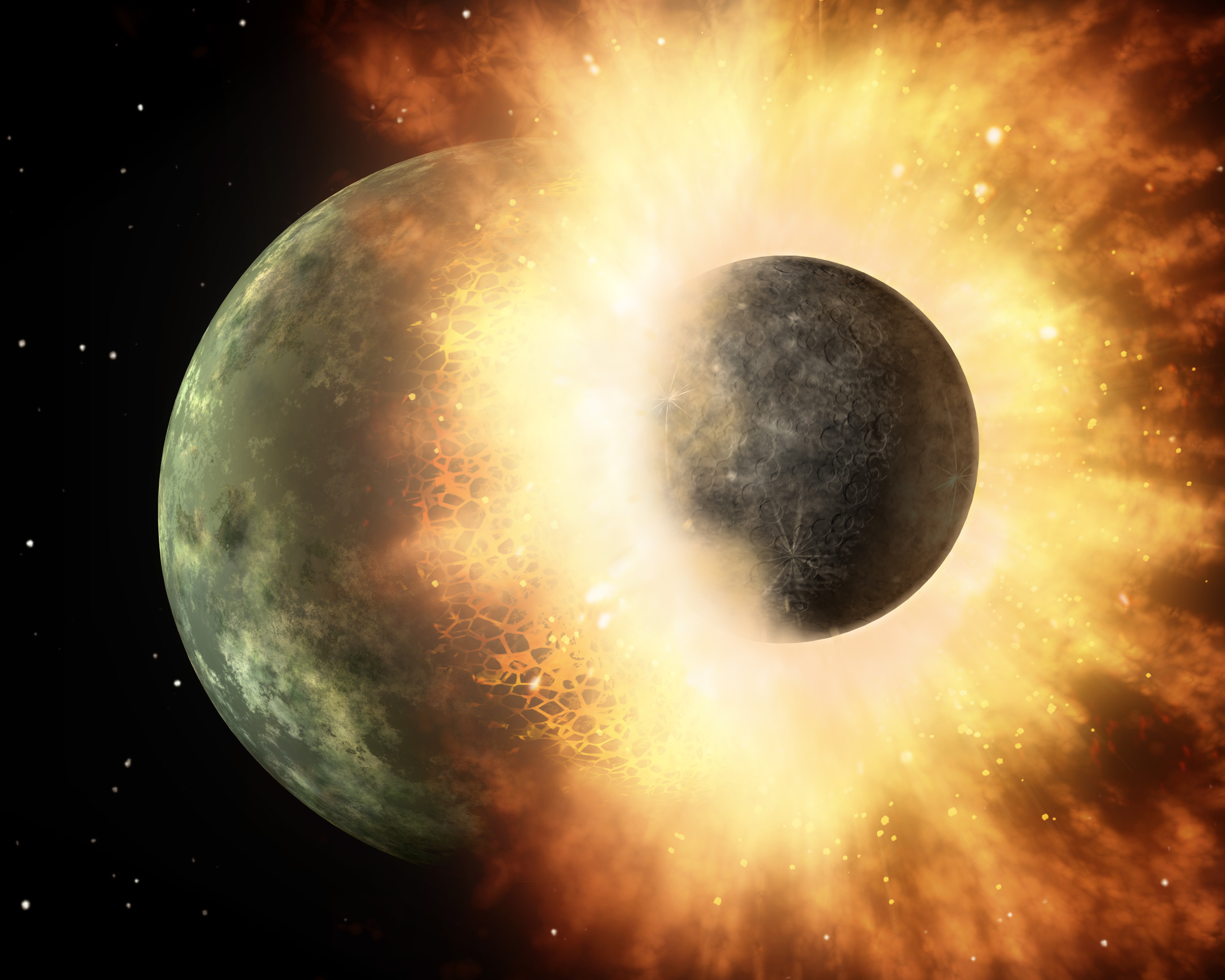
This artist's animation shows a celestial body about the size of our moon slamming at great speed into a body the size of Mercury.
Reference: Disturbance Theory

.

Historically, there has been confusion between matter and emptiness because it is difficult to conceive of emptiness. Matter is substance. Emptiness is absence of substance. It is impossible to visualize absence of something.

Aristotle viewed things as made of matter. To him, matter and thought were complementary principles.

Later Descartes argued that the inherent properties of bodies were limited to extension, and the so-called secondary qualities, like color, were only products of human perception. Thus, he conceived of matter as a thing in itself that was independent of thought. He arbitrarily postulated matter to be some abstract, mathematical substance that occupies space.

Newton developed Descartes’ notion of matter by attributing to it the intrinsic properties of extension, hardness, impenetrability, mobility, and inertia. To him, “secondary” qualities, such as color or taste, were those that were not amenable to mathematical description. Newton was, however, troubled by the notion of gravity as “action at a distance.”

Einstein then explained “action at a distance” by developing Faraday’s concept of field. He made a critical summary of the development of his ideas in a paper Relativity & Problem of Space near the end of his life.

Einstein’s paper explains the following among other things.

  • The electromagnetic field is a substance more basic than matter.
  • The concept of space is derived from the extensions of substance.

The Disturbance Theory develops these concepts further.

.