Category Archives: Buddhism

ZEN 1: Theory and Practice of Zazen

Zazen

Reference: Lectures on Zen

These are Yasutani-Roshi’s introductory lectures on Zen training from THE THREE PILLARS OF ZEN by Philip Kapleau.

There is little to comment here. A comment may simply empasize a point. The comments are in color.

.

Lecture 1—Theory and Practice of Zazen

What I am about to tell you is based upon the teachings of my revered teacher, Daiun1 Harada-roshi. Although he himself was of the Soto sect, he was unable to find a truly accomplished master in that sect and so went to train first at Shogen-ji and then Nanzen-ji, two Rinzai monasteries. At Nanzen-ji he eventually grasped the inmost secret of Zen under the guidance of Dokutan-roshi, an outstanding master.

1 A Zen name meaning “Great Cloud.” See “clouds and water” in section X. His other name is Sogaku.

There should be no secrets. There should simply be a systematic way to understand. The more systematic is the course, the less secretive it would appear.

While it is undeniably true that one must undergo Zen training himself in order to comprehend the truth of Zen, Harada-roshi felt that the modem mind is so much more aware that for beginners lectures of this type could be meaningful as a preliminary to practice. He combined the best of each sect and established a unique method of teaching Zen. Nowhere in Japan will you find Zen teaching set forth so thoroughly and succinctly, so well suited to the temper of the modem mind, as at his monastery. Having been his disciple for some twenty years, I was enabled, thanks to his grace, to open my Mind’s eye in some measure.

Lectures of this type that explain well can be very useful in starting a grass-root movement for general spiritual advancement.

Before commencing his lectures Harada-roshi would preface them with advice on listening. His first point was that everyone should listen with his eyes open and upon him—in other words, with his whole being—because an impression received only through the hearing is rather shallow, akin to listening to the radio. His second point was that each person should listen to these lectures as though they were being given to him alone, as ideally they should be. Human nature is such that if two people listen, each feels only half-responsible for understanding, and if ten people are listening each feels his responsibility to be but one-tenth. However, since there are so many of you and what I have to say is exactly the same for everybody, I have asked you to come as a group. You must nonetheless listen as though you were entirely alone and hold yourselves accountable for everything that is said.

This is very good advice on listening. Better comprehension comes from having consistency among the different physical perceptions.

This discourse is divided into eleven parts, which will be covered in some eight lecture sessions. The first involves the rationale of zazen and direct methods of practice; the next, special precautions; and the following lectures, the particular problems arising from zazen, to­gether with their solution.

In point of fact, a knowledge of the theory or principles of zazen is not a prerequisite to practice. One who trains under an accomplished teacher will inevitably grasp this theory by degrees as his practice ripens. Modem students, however, being intellectually more sophisticated than their predecessors in Zen, will not follow instructions unreservedly; they must first know the reasons behind them. Hence I feel obliged to deal with theoretical matters. The difficulty with theory, however, is that it is endless. Buddhist scriptures, Buddhist doctrine, and Buddhist philosophy are no more than intellectual formulations of zazen, and zazen itself is their practical demonstration. From this vast field I will now abstract what is most essential for your practice.

A course in zazen must explain any special terminology carefully at the outset, however, it must not delay the practice. Start practicing while studying the theory.

ZEN is an abbreviation of the Japanese word zenna, which is a transliteration of the Sanskrit dhyana (ch’an or ch’anna in Chinese), i.e., the process of concentration and absorption by which the mind is tranquilized and brought to one-pointedness.

ZAZEN is the principle discipline of Zen: To enter fully into every action with total attention and clear awareness. In the broad sense zazen embraces more than just correct sitting as in meditation. 

We start with the Buddha Shakyamuni.2 As I think you all know, he began with the path of asceticism, undergoing tortures and austerities which others before him had never attempted, including prolonged fasting. But he failed to attain enlightenment by these means and, half-dead from hunger and exhaustion, came to realize the futility of pursuing a course which could only terminate in death. So he drank the milk which was offered him, gradually regained his health, and resolved to steer a middle course between self-torture and self-indulgence. Thereafter he devoted himself exclusively to zazen for six years3 and eventually, on the morning of the eighth of December, at the very instant when he glanced at the planet Venus gleaming in the eastern sky, he attained perfect enlightenment. All this we believe as historical truth.

2 The traditional Japanese term is O-Shaka-sama. It is both respectful and intimate. The O and sama are honorifics, and rather than attempt an arbitrary translation of them, I have followed the usual English rendering of this title. (See “Buddha” in section X.)
3 Other accounts say six years elapsed from the time he left his home until his supreme enlightenment.

The middle-way of Buddha has to do with giving up the extremes of self-torture and self-indulgence, and following what comes naturally.

The words the Buddha uttered involuntarily at this time are recorded variously in the Buddhist scriptures. According to the Kegon sutra, at the moment of enlightenment he spontaneously cried out: “Wonder of wonders! Intrinsically all living beings are Buddhas, endowed with wisdom and virtue, but because men’s minds have become inverted through delusive thinking they fail to perceive this.” The first pronouncement of the Buddha upon his enlightenment seems to have been one of awe and astonishment. Yes, how truly marvelous that all human beings, whether clever or stupid, male or female, ugly or beautiful, are whole and complete just as they are. That is to say, the nature of every being is inherently without a flaw, perfect, no different from that of Amida or any other Buddha. This first declaration of Shakyamuni Buddha is also the ultimate conclusion of Buddhism. Yet man, restless and anxious, lives a half-crazed existence because his mind, heavily encrusted with delusion, is turned topsy-turvy. We need therefore to return to our original perfection, to see through the false image of ourselves as incomplete and sinful, and to wake up to our inherent purity and wholeness.

The word enlightened means bodhi or “awakened.” Enlightenment is the understanding of natural laws of our spiritual existence. These laws determine wisdom and virtue. They explain how our minds become inverted and deluded.

A human being, whether clever or stupid, male or female, ugly or beautiful, is capable of being awakened to the natural laws of spiritual existence. There is no other original perfection than this state of being awakened.

The most effective means by which to accomplish this is through zazen. Not only Shakyamuni Buddha himself but many of his disciples attained enlightenment through zazen. Moreover, during the 2,500 years since the Buddha’s death innumerable devotees in India, China, and Japan have, by grasping this selfsame key, resolved for themselves the most fundamental question, What are life and death? Even in this day there are many who have been able to cast off worry and anxiety and emancipate themselves through zazen.

Zazen is to enter fully into every action with total attention and clear awareness. This helps one resolve the questions about life and death and become free of anxiety on this subject.

Between a Nyorai (i.e., a supremely perfected Buddha) and us, who are ordinary, there is no difference as to substance. This “substance” can be likened to water. One of the salient characteristics of water is its conformability: when put into a round vessel it becomes round, when put into a square vessel it becomes square. We have this same adaptability, but as we live bound and fettered through ignorance of our true nature, we have forfeited this freedom. To pursue the metaphor, we can say that the mind of a Buddha is like water that is calm, deep, and crystal clear, and upon which the “moon of truth” reflects fully and perfectly. The mind of the ordinary man, on the other hand, is like murky water, constantly being churned by the gales of delusive thought and no longer able to reflect the moon of truth. The moon nonetheless shines steadily upon the waves, but as the waters are roiled we are unable to see its reflection. Thus we lead lives that are frustrating and meaningless.

The appropriate analogy is that of water in a pool. When the water is clear one can see the bottom in perfect detail, but when water is muddy one cannot even see the bottom. To clear the water one must stop stirring the water, and let the mud settle down of its own accord. Similarly, when mind is stirred up one cannot see through it clearly. One needs to stop stirring the mind, and let it settle down on its own accord. Any attemp to settle the mind will only stir it up.

The difference between Nyorai and us is that Nyorai has not only let the mind settle down but also cleared up the anomalies.

A turbulent mind is unable to perceive things as they are. 

How can we bring the moon of truth to illumine fully our life and personality? We need first to purify this water, to calm the surging waves by halting the winds of discursive thought. In other words, we must empty our minds of what the Kegon sutra calls the “conceptual thought of man.” Most people place a high value on abstract thought, but Buddhism has clearly demonstrated that discriminative thinking lies at the root of delusion. I once heard someone say: “Thought is the sickness of the human mind.” From the Buddhist point of view this is quite true. To be sure, abstract thinking is useful when wisely employed—which is to say, when its nature and limitations are properly understood—but so long as human beings remain slaves to their intellect, fettered and controlled by it, they can well be called sick.

Initially, any grounding is provided by our physical senses. The grounding becomes firm when the physical senses are consistent with each other.  From this come the laws that apply to all physical senses.

Such laws are abstract in nature. When there are many laws, they must be consistent with each other to be properly grounded. From this consistency come increasingly abstract laws.

Abstract thinking then must be consistent with its corresponding laws to be real and useful. If they are not then they only generate anomalies that must be resolved.

All thoughts, whether ennobling or debasing, are mutable and impermanent; they have a beginning and an end even as they are fleetingly with us, and this is as true of the thought of an era as of an individual. In Buddhism thought is referred to as “the stream of life-and-death.” It is important in this connection to distinguish the role of transitory thoughts from that of fixed concepts. Random ideas are relatively innocuous, but ideologies, beliefs, opinions, and points of view, not to mention the factual knowledge accumulated since birth (to which we attach ourselves), are the shadows which obscure the light of truth.

The nature of thought is to be mutable and impermanent and not fixed. By becoming fixed, thought obscures the light of truth.

So long as the winds of thought continue to disturb the water of our Self-nature, we cannot distinguish truth from untruth. It is imperative, therefore, that these winds be stilled. Once they abate, the waves subside, the muddiness clears, and we perceive directly that the moon of truth has never ceased shining. The moment of such realization is kensho, i.e., enlightenment, the apprehension of the true substance of our Self-nature. Unlike moral and philosophical concepts, which are variable, true Insight is imperishable. Now for the first time we can live with inner peace and dignity, free from perplexity and disquiet, and in harmony with our environment.

The laws underlying the spiritual nature are imperishable unlike the moral and philosophical concepts that are variable.

I have spoken to you briefly about these matters, but I hope I have succeeded in conveying to you the importance of zazen. Let us now talk about practice.

The practice of zazen now follows. 

The first step is to select a quiet room in which to sit. Lay out a fairly soft mat or pad some three feet square, and on top of this place a small circular cushion measuring about one foot in diameter to sit on, or use a square cushion folded in two. Preferably one should not wear trousers or socks, since these interfere with the crossing of the legs and the placing of the feet. For a number of reasons it is best to sit in the full-lotus posture. To sit full-lotus you place the foot of the right leg over the thigh of the left and the foot of the left leg over the thigh of the right. The main point of this particular method of sitting is that by establishing a wide, solid base, with the crossed legs and with both knees touching the mat, you achieve absolute stability. With the body thus immobile, thoughts are not stirred into activity by physical movements and the mind more easily becomes tranquil.

With the body immobile thoughts are not stirred into activity by physical movements and the mind more easily becomes tranquil.

If you have difficulty sitting in the full-lotus posture because of the pain, sit half-lotus, which is done by putting the foot of the left leg over the thigh of the right. For those of you who are not accustomed to sitting cross-legged, even this position may not be easy to maintain. You will probably find it difficult to keep the two knees resting on the mat and will have to push one or both of them down again and again until they remain there. In both the half- and the full-lotus posture the uppermost foot can be reversed when the legs become tired.

The posture should be comfortable and not painful.

For those who find both of these traditional zazen positions acutely uncomfortable, an alternative position is the traditional Japanese one of sitting on the heels and calves. This can be maintained for a longer time if a cushion is placed between the heels and the buttocks. One advantage of this posture is that the back can be kept erect easily. However, should all of these positions prove too painful, you may use a chair.4

4 See section IX for sketches of all these postures, including one widely used in the Southeast Asian Buddhist countries.

The important aspect of posture is keeping the back erect.

The next step is to rest the right hand in the lap, palm upward, and place the left hand, palm upward, on top of the right palm. Lightly touch the tips of the thumbs to each other so that a flattened circle is formed by the palms and thumbs. Now, the right side of the body is the active pole, the left the passive. Hence during practice we repress the active side by placing the left foot and left hand over the right members, as an aid in achieving the highest degree of tranquility. If you look at a figure of the Buddha, however, you will notice that the position of these members is just the reverse. The significance of this is that a Buddha, unlike the rest of us, is actively engaged in the task of saving.

The posture is an aid in achieving the highest degree of tranquility.

After you have crossed your legs, bend forward so as to thrust the buttocks out, then slowly bring the trunk to an erect posture. The head should be straight; if looked at from the side, your ears should be in line with your shoulders and the tip of your nose in line with your navel. The body from the waist up should be weightless, free from pressure or strain. Keep the eyes open and the mouth closed. The tip of the tongue should lightly touch the back of the upper teeth. If you close your eyes you will fall into a dull and dreamy state. The gaze should be lowered without focusing on anything in particular. Experience has shown that the mind is quietest, with the least fatigue or strain, when the eyes are in this lowered position.

In zazen, eyes are open without focusing on anything in particular, and in lowered position.

The spinal column must be erect at all times. This admonition is important. When the body slumps, not only is undue pressure placed on the internal organs, interfering with their free functioning, but the vertebrae by impinging upon nerves may cause strains of one kind or another. Since the body and mind are one, any impairment of the physiological functions inevitably involves the mind and thus diminishes its clarity and one-pointedness, which are essential for effective concentration. From a purely psychological point of view, a ramrod erectness is as undesirable as a slouching position, for the one springs from unconscious pride and the other from abjectness, and since both are grounded in ego they are equally a hindrance to enlightenment.

Be careful to hold the head erect; if it inclines forward or backward or sideward, remaining there for an appreciable length of time, a crick in the neck may result.

The posture should be well balanced so as not to cause strain on any body part.

When you have established a correct posture, take a deep breath, hold it momentarily, then exhale slowly and quietly. Repeat this two or three times, always breathing through the nose. After that breathe naturally. When you have accustomed yourself to this routine, one deep breath at the beginning will suffice. Now bend the body first to the right as far as it will go, then to the left, about seven or eight times, in large arcs to begin with, then smaller ones until the trunk naturally comes to rest at center.

Start the zazen session with a couple of deep breaths and settling down in the correct posture.

You are now ready to concentrate your mind.5 There are many good methods of concentration bequeathed to us by our predecessors in Zen. The easiest for beginners is counting incoming and outgoing breaths. The value of this particular exercise lies in the fact that all reasoning is excluded and the discriminative mind put at rest. Thus the waves of thought are stilled and a gradual one-pointedness of mind achieved. To start with, count both inhalations and exhalations. When you inhale, concentrate on “one”; when you exhale, on “two”; and so on, up to ten. Then you return to “one” and once more count up to ten, continuing as before. It is as simple as that.

5 For additional information on concentrating the mind, see pp. 128-29.

Start to concentrate your mind by counting incoming and outgoing breaths.

As I have previously pointed out, fleeting ideas which naturally fluctuate in the mind are not in themselves an impediment. This unfortunately is not commonly recognized. Even among Japanese who have been studying and practicing Zen for five years or more there are many who misunderstand Zen practice to be a stopping of consciousness. There is indeed a kind of zazen that aims at doing just this,6 but it is not the traditional zazen of Zen Buddhism. You must realize that no matter how intently you count your breaths you will still perceive what is in your line of vision, since your eyes are open, and you will hear the normal sounds about you, as your ears are not plugged. And since your brain likewise is not asleep, various thought-forms will dart about in your mind. Now, they will not hamper or diminish the effectiveness of zazen unless, evaluating them as “good,” you cling to them or, deciding they are “bad,” you try to check or eliminate them. You must not regard any perceptions or sensations as an obstruction to zazen, nor should you pursue any of them. I emphasize this. “Pursuit” simply means that in the act of seeing, your gaze lingers on objects; in the course of hearing, your attention dwells on sounds; and in the process of thinking, your mind adheres to ideas. If you allow yourself to be distracted in such ways, your concentration on the counting of your breaths will be impeded. To recapitulate: let random thoughts arise and vanish as they will, do not dally with them and do not try to expel them, but merely concentrate all your energy on counting the inhalations and exhalations of your breath.

6 See p. 45.

Fleeting ideas which naturally fluctuate in the mind are not in themselves an impediment. The impediment comes from clinging to thought-forms or trying to eliminate them.

In terminating a period of sitting do not arise abruptly, but begin by rocking from side to side, first in small swings, then in large ones, for about half a dozen times. You will observe that your movements in this exercise are the reverse of those you engage in when you begin zazen. Rise slowly and quietly walk around with the others in what is called kinhin, a walking form of zazen.

End the zazen session with movements that are the reverse of those you engage in when you begin zazen. 

Kinhin is performed by placing the right fist, with thumb inside, on the chest and covering it with the left palm while holding both elbows at right angles. Keep the arms in a straight line and the body erect, with the eyes resting upon a point about two yards in front of the feet. At the same time continue to count inhalations and exhalations as you walk slowly around the room. Begin walking with the left foot and walk in such a way that the foot sinks into the floor, first the heel and then the toes. Walk calmly and steadily, with poise and dignity. The walking must not be done absent-mindedly, and the mind must be taut as you concentrate on the counting. It is advisable to practice walking this way for at least five minutes after each sitting period of twenty to thirty minutes.

Walk for at least five minutes after each sitting period of twenty to thirty minutes.

You are to think of this walking as zazen in motion. Rinzai and Soto differ considerably in their way of doing kinhin. In the Rinzai method the walking is brisk and energetic, while in the traditional Soto it is slow and leisurely; in fact, upon each breath you step forward only six inches or so. My own teacher, Harada-roshi, advocated a gait somewhere between these two and that is the method we have been practicing here. Further, the Rinzai sect cups the left hand on top of the right, whereas in the orthodox Soto the right hand is placed on top. Harada-roshi felt that the Rinzai method of putting the left hand uppermost was more desirable and so he adopted it into his own teaching. Now, even though this walking relieves the stiffness in your legs, such exercise is to be regarded as a mere by-product and not the main object of kinhin. Hence those of you who are counting your breaths should continue during kinhin, and those of you who are working on a koan should carry on with it.

Walk naturally and comfortably. Walking is zazen in motion.

This ends the first lecture. Continue to count your breaths as I have instructed until you come before me again.

Zen and Zazen

Zen

Reference: Lectures on Zen

Definitions from THREE PILLARS OF ZEN By Philip Kapleau. There are some additions by Vinaire as indicated.

.

ZEN:

An abbreviation of the Japanese word zenna, which is a transliteration of the Sanskrit dhyana (ch’an or ch’anna in Chinese), i.e., the process of concentration and absorption by which the mind is tranquilized and brought to one-pointedness.

As a Mahayana Buddhist sect, Zen is a religion whose teachings and disciplines are directed toward Self-realization, that is to say, to the attainment of satori, which Shakyamuni Buddha himself experienced under the Bo tree after strenuous self-discipline. The Zen sect embraces the Soto, Rinzai, and Obaku sects.

.

ZAZEN (pronounced “zah-zen,” each syllable accented equally):

Zazen is the principle discipline of Zen. Zazen is not “meditation”. In the broad sense zazen embraces more than just correct sitting. To enter fully into every action with total attention and clear awareness is no less zazen.

The prescription for accomplishing this was given by the Buddha himself in an early sutra: “In what is seen there must be just the seen; in what is heard there must be just the heard; in what is sensed (as smell, taste or touch) there must be just what is sensed; in what is thought there must be just the thought.”

[Added by Vinaire]

The primary purpose of Zazen then is to “be there” with total attention, so that one may perceive what is there with total clarity. Here thinking becomes part of the perception because one can perceive solutions clearly.

In zazen, spiritual progress may be measured by how many delusive thoughts (prejudice, jealousy, fixed ideas, etc.) a person has been able to let go. This is a gradient process that may sometimes occur in huge steps. It is one of these huge steps that are looked upon as enlightenment.

.

SATORI:

The Japanese term for the experience of enlightenment, i.e., Self-realization, opening the Mind’s eye, awakening to one’s True-nature and hence of the nature of all existence. See also “kensho.”

.

KENSHO (lit., “seeing into one’s own nature”):

Semantically, kensho and satori have virtually the same meaning, and they are often used interchangeably. In describing the enlightenment of the Buddha and the Patriarchs, however, it is customary to use the word satori rather than kensho, the term satori implying a deeper experience.

.

KOAN (Ch., kung-an; pronounced in Japanese as two syllables, ko-an}:

Its original meaning in Chinese was a case which established a legal precedent. In Zen a koan is a formulation, in baffling language, pointing to ultimate Truth. Koans cannot be solved by recourse to logical reasoning but only by awakening a deeper level of the mind beyond the discursive intellect. Koans are constructed from the questions of disciples of old together with the responses of their masters, from portions of the masters’ sermons or discourses, from lines of the sutras, and from other teachings.

The word or phrase into which the koan resolves itself when grappled with as a spiritual exercise is called the wato (Ch., hua tou) . Thus “Has a dog the Buddha-nature?” together with Joshu’s answer “Mu!” constitutes the koan; “Mu!” itself is the wato.

Kōan zazen involves both motionless sitting, wherein the mind intensely seeks to penetrate the kōan, and mobile zazen, in which absorption in the kōan continues while one is at work, at play, or even asleep. Through intense self-inquiry–for example, questioning “What is Mu?”–the mind gradually becomes denuded of its delusive ideas, which in the beginning hamper its effort to become one with the kōan. As these abstract notions fall away, concentration on the kōan strengthens.

.

SHIKAN-TAZA:

Shikan-taza is a mode of zazen which involves neither a koan nor counting or following the breath. Shikan means “nothing but” or “just” while ta means “to hit” and za “to sit”. Hence Shikan-taza is a practice in which the mind is intensely involved in just sitting.

The very foundation of shikan-taza is an unshakable faith that sitting as the Buddha sat, with the mind void of all conceptions, of all beliefs and points of view, is the actualization or unfoldment of the inherently enlightened Bodhi-mind with which all are endowed. At the same time this sitting is entered into in the faith that it will one day culminate in the sudden and direct perception of the true nature of this Mind—in other words, enlightenment. Therefore to strive self-consciously for satori or any other gain from zazen is as unnecessary as it is undesirable.

Shikan-taza is a heightened state of concentrated awareness wherein one is neither tense nor hurried, and certainly never slack. It is the mind of somebody facing death. In the beginning tension is unavoidable, but with experience this tense zazen ripens into relaxed yet fully attentive sitting.

.

[Added by Vinaire]

ENLIGHTENMENT:

Enlightenment is the state in which a person is effortlessly “being there” with total attention. The clarity of his (or her) perception and thinking is perfect in the sense that he is able to observe the universe as it is, and realize the solutions to perplexities rapidly in their entirety.

.

The Doctrine of No-Soul: Anatta

Empty.Anatta

This is Chapter 6 of the Book: What the Buddha Taught by Walpola Rahula.

In color are the comments that have been added.

.

What in general is suggested by Soul, Self, Ego, or to use the Sanskrit expression Atman, is that in man there is a permanent, everlasting and absolute entity, which is the unchanging substance behind the changing phenomenal world.

According to some religions, each individual has such a separate soul which is created by God, and which, finally after death, lives eternally either in hell or heaven, its destiny depending on the judgment of its creator. According to others, it goes through many lives till it is completely purified and becomes finally united with God or Brahman, Universal Soul or Atman, from which it originally emanated. This soul or self in man is the thinker of thoughts, feeler of sensations, and receiver of rewards and punishments for all its actions good and bad.  Such a conception is called the idea of self.

There is a persistent belief that there is something unchanging that underlies this changing phenomenal world. For example, in a person who is alive, there is a “self” that is aware. It thinks the thought, feels the sensations, and it is the effect of its karma. After death, it separates from the body and maintains a distinct identity eternally. It may exist without a body; it may take birth into another body; or, it may merge into a universal entity. The belief in an eternal entity exists in some form in every religion. Is there such an eternally unchanging substance, such as soul or God?

Buddhism stands unique in the history of human thought in denying the existence of such a Soul, Self, or Atman.  According to the teaching of the Buddha, the idea of self is an imaginary, false belief which has no corresponding  reality,  and it produces harmful thoughts of ‘me’ and ‘mine’, selfish desire, craving, attachment, hatred, ill-will, conceit, pride, egoism, and other defilements, impurities and problems. It is the source of all the troubles in the world from personal conflicts to wars between nations. In short, to this false view can be traced all the evil in the world.

The human form may be seen as the body-mind-self. There is apparently a blueprint of human form that passes from one lifetime to the next through the DNA mechanism. Each lifetime may add certain impressions to the blueprint, but even the heaviest of these impressions ultimately get assimilated in four or five generations. The human blueprint may be the result of assimilation of impressions from more primitive blueprints. The human blueprint may ultimately evolve into some more efficient form. Any particular blueprint, therefore, has only relative endurance. None of its aspects have remained permanent. The only enduring aspect seems to be “evolution.” 

Two ideas are psychologically deep-rooted in man: self-protection and self-preservation.  For self-protection man has created God, on whom he depends for his own protection, safety and security, just as a child depends on its parent. For self-preservation man has conceived the idea of an immortal Soul or Atman, which will live eternally. In his ignorance, weakness, fear, and desire, man needs these two things to console himself. Hence he clings to them deeply and fanatically.

The Buddha’s teaching does not support this ignorance, weakness, fear, and desire, but aims at making  man enlightened by removing and destroying them, striking at their very root. According to Buddhism, our ideas of God and Soul are false and empty. Though highly developed as theories, they are all the same extremely subtle mental projections, garbed in an intricate metaphysical and philosophical phraseology. These ideas are so deep-rooted in man, and so near and dear to him, that he does not wish to hear, nor does he want to understand, any teaching against them.

God and soul are human ideas. They did not exist until humans evolved. The idea of “God” serves to protect man for he is weak. The idea of “Soul” serves to preserve man for he is afraid. These ideas are very deep-rooted in man. He uses them to justify everything from personal conflicts to wars between nations. But all ideas are approximations of reality. To think they are the reality is ignorance. Buddha’s enlightenment is the overcoming of such weakness, fear, and ignorance.

The Buddha knew this quite well. In fact, he said that his teaching was ‘against the current’ (patisotagami), against man’s selfish desires. Just four weeks after his Enlightenment, seated under a banyan tree, he thought to himself: ‘I have realized this Truth which is deep, difficult to see, difficult to understand… comprehensible only by the wise… Men who are overpowered by passions and surrounded by a mass of darkness cannot see this Truth, which is against the current, which is lofty, deep, subtle and hard to comprehend.

With these thoughts in his mind, the Buddha hesitated for a moment, whether it would not be in vain if he tried to explain to the world the Truth he had just realized. Then he compared the world to a lotus pond: In a lotus pond there are some lotuses still under water; there are others which have risen only up to the water level; there are still others which stand above water and are untouched by it. In the same way in this world, there are men at different levels of development. Some would understand the Truth.  So the Buddha decided to teach it.

Buddha knew that his teaching was ‘against the current’ (against man’s selfish desires); but he saw the possibility that some would understand the Truth. So he decided to teach it.

The doctrine of Anatta or No-Soul is the natural result of, or the corollary to, the analysis of the Five Aggregates and the teaching of Conditioned Genesis (Paticca-samuppada). We have seen earlier, in the discussion of the First Noble Truth (Dukkha), that what we call a being or an individual is composed of the Five Aggregates, and that when these are analysed and examined, there is nothing behind them which can be taken as ‘I’, Atman, or Self, or any unchanging abiding substance. That is the analytical  method.  The same result is arrived at through the doctrine of Conditioned Genesis which is the synthetical method, and according to this nothing in the world is absolute.  Everything is conditioned, relative, and interdependent. This is the Buddhist theory of relativity.

According to Buddha’s teaching, the individual is composed of the Five Aggregates: matter, sensations, perceptions, mental formations and consciousness. None of these constitute unchanging abiding substance. Furthermore, the whole existence is relative, interdependent and interconnected, and nothing is absolute or independent. According to this principle the individual self is relative also.

Before we go into the question of Anatta proper, it is useful to have a brief idea of the Conditioned Genesis.  The principle of this doctrine is given in a short formula of four lines:

When this is, that is (Imasmim sati idam hod);
This arising, that arises (Imassuppada idam uppajjati);
When this is not, that is not (Imasmim asati idam na boti);
This ceasing, that ceases (Imassa nirodha idam nirujjhati).

On this principle of conditionality, relativity and inter-dependence, the whole existence and continuity of life and its cessation are explained in a detailed formula which is called Paticca-samuppada ‘Conditioned Genesis’, consisting of twelve factors:

  1. Through ignorance are conditioned volitional actions or karma-formations (Avijjapaccaya samkhara).
  2. Through volitional actions is conditioned consciousness (Samkharapaccaja vinnanam).
  3. Through consciousness are conditioned mental and physical phenomena (Vinnanapaccaja namaruparti).
  4. Through mental and physical phenomena are conditioned the six faculties (i.e., five physical sense-organs and mind) (Namarupapaccayd salayatanam).
  5. Through the six faculties is conditioned (sensorial and mental) contact (Salayatanapaccaya phasso).
  6. Through (sensorial and mental) contact is conditioned sensation (Phassapaccaja vedana).
  7. Through sensation is conditioned desire, ‘thirst’ (Vedana-paccaja tanha).
  8. Through desire (‘thirst’) is conditioned clinging (Tanha-paccaja upadanam).
  9. Through clinging is conditioned the process of becoming (Upadatiapaccaya bhavo).
  10. Through the process of becoming is conditioned birth (Bhavapaccaya jati).
  11. Through birth are conditioned decay, death, lamentation, pain, etc. (Jatipaccaya jaramaranam…).

This is how life arises, exists and continues. If we take this formula in its reverse order we come to the cessation of the process:

Through the complete cessation of ignorance, volitional activities or karma formations cease; through the cessation of volitional activities, consciousness ceases; … through the cessation of birth, decay, death, sorrow, etc., cease.

The word GENESIS means “an origin, creation, or beginning.” According to Buddhism “genesis” is conditioned. Nothing happens by itself. A happening is always dependent on something else happening. This obviously contradicts the Biblical concept of “genesis,” and correctly so. The Biblical God is not defined except in terms of what it has created. It is a circular definition.

It should be clearly remembered that each of these factors is conditioned (paticcasamuppanna) as well as conditioning (paticcasamuppada). Therefore they are all relative, interdependent and interconnected, and nothing is absolute or independent; hence no first cause is accepted by Buddhism as we have seen earlier. Conditioned Genesis should be considered as a circle, and not as a chain.

Conditioned Genesis should be considered as a circle, and not as a chain. Therefore, first cause is not accepted in Buddhism.

The question of Free Will has occupied an important place in Western thought and philosophy. But according to Conditioned Genesis, this question does not and cannot arise in Buddhist philosophy. If the whole of existence is relative, conditioned and interdependent, how can Will alone be free? Will, like any other thought, is conditioned. So-called ‘freedom’ itself is conditioned and relative. Such a conditioned and relative ‘Free Will’ is not denied. There can be nothing absolutely free, physical or mental, as everything is interdependent and relative. If Free Will implies a will independent of conditions, independent of cause and effect, such a thing does not exist. How can a will, or anything for that matter, arise without conditions, away from cause and effect, when the whole of existence is conditioned and relative, and is within the law of cause and effect? Here again, the idea of Free Will is basically connected with the ideas of God, Soul, justice, reward and punishment. Not only is so-called free will not free, but even the very idea of Free Will is not free from conditions.

If Free Will implies a will independent of conditions, independent of cause and effect, such a thing does not exist.

According to the doctrine of Conditioned Genesis, as well as according to the analysis of being into Five Aggregates, the idea of an abiding, immortal substance in man or outside, whether it is called Atman, ‘I’, Soul, Self, or Ego, is considered only a false belief, a mental projection. This is Buddhist doctrine of Anatta, No-Soul or No-Self.

The idea of an abiding, immortal substance in man or outside, is considered only a false belief, a mental projection. 

In order to avoid a confusion it should be mentioned here that there are two kinds of truths: conventional truth (sammuti-sacca, Skt. Samvrti-satya) and ultimate truth (paramattha-sacca, Skt. paramartha-satya). When we use such expressions in our daily life as ‘I’, ‘you’, ‘being’, ‘individual’, etc., we do not lie because there is no self or being as such, but we speak a truth conforming to the convention of the world. But the ultimate truth is that there is no ‘I’ or ‘being’ in reality. As the Mahayana-sutralankara says: ‘A person (pudgala) should be mentioned as existing only in designation (prajnapit) (i.e., conventionally there is a being), but not in reality (or substance dravya)’.

According to Buddhism, the idea of self or being, is useful by convention only; but not in reality or substance.

‘The negation of an imperishable Atman is the common characteristic of all dogmatic systems of the Lesser as well as the Great Vehicle, and, there is, therefore, no reason to assume that Buddhist tradition which is in complete agreement on this point has deviated from the Buddha’s original teaching.’

It is therefore curious that recently there should have been a vain attempt by a few scholars to smuggle the idea of self into the teaching of the Buddha, quite contrary to the spirit of Buddhism. These scholars respect, admire, and venerate the Buddha and his teaching. They look up to Buddhism. But they cannot imagine that the Buddha, whom they consider the most clear and profound thinker, could have denied the existence of an Atman or self which they need so much. They unconsciously seek the support of the Buddha for this need for eternal existence–of course not in a petty individual self with small s, but in the big Self with a capital S.

It is better to say frankly that one believes in an Atman or self. Or one may even say that the Buddha was totally wrong in denying the existence of an Atman. But certainly it will not do for anyone to try to introduce into Buddhism an idea which the Buddha never accepted, as far as we can see from the extant original texts.

Religions which believe in God and Soul make no secret of these two ideas; on the contrary, they proclaim them, constantly and repeatedly, in the most eloquent terms. If the Buddha had accepted these two ideas, so important in all religions, he certainly would have declared them publicly, as he had spoken about other things, and would not have left them hidden to be discovered only 25 centuries after his death.

Religions which believe in God and Soul make no secret of these two ideas. Buddha never declared these two ideas publicly. He did not consider them to be real.

People become nervous at the idea that through the Buddha’s teaching of Anatta, the self they imagine they have is going to be destroyed. The Buddha was not unaware of this.

A bhikkhu once asked him: ‘Sir, is there a case where one is tormented when something permanent within oneself is not found?’

‘Yes, bhikkhu, there is,’ answered the Buddha.’ A man has the following view: “The universe is that Atman, I shall be that after death, permanent, abiding, ever-lasting, unchanging, and I shall exist as for eternity”. He hears the Tathagata or a disciple of his, preaching the doctrine aiming at the complete destruction of all speculative views… aiming at the extinction of “thirst”, aiming at detachment, cessation, Nirvana. Then that man thinks: “I will be annihilated, I will be destroyed, I will be no more.” So he mourns, worries himself, laments, weeps, beating his breast, and becomes bewildered. Thus, O bhikkhu, there is a case where one is tormented when something permanent within oneself is not found.’

Elsewhere the Buddha says: ‘O bhikkhus, this idea that I may not be, I may not have, is frightening to the uninstructed world-ling.’

Buddha was aware that people are frightened of the idea that nothing permanent within them will be found.

Those who want to find a ‘Self’ in Buddhism argue as follows: It is true that the Buddha analyses being into matter, sensation, perception, mental formations, and consciousness, and says that none of these things is self. But he does not say that there is no self at all in man or anywhere else, apart from these aggregates.

This position is untenable for two reasons:

One is that, according to the Buddha’s teaching, a being is composed only of these Five Aggregates, and nothing more. Nowhere has he said that there was anything more than these Five Aggregates in a being.

The second reason is that the Buddha denied categorically, in unequivocal terms, in more than one place, the existence of Atman, Soul, Self, or Ego within man or without, or anywhere else in the universe. Let us take some examples.

The effort to claim that Buddha never denied self, is the desire of that person for a permanent self.

In the Dhammapada there are three verses extremely important and essential in the Buddha’s teaching. They are nos. 5, 6 and 7 of Chapter 20 (or verses 277, 278, 279).

The first two verses say: ‘All conditioned things are impermanent'(Sabbe SAMKHARA anicca), and ‘All conditioned things are dukkha (Sabbe SAMKHARA dukkha).

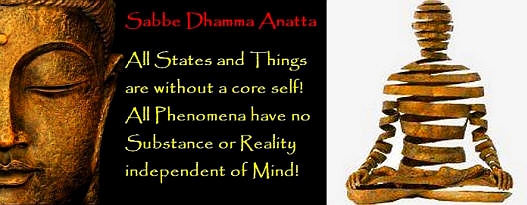
The third verse says: ‘All dhammas are without self’ (Sabbe DHAMMA anatta).

Here it should be carefully observed that in the first two verses the word samkhara ‘conditioned things’ is used. But in its place in the third verse the word dhamma is used. Why didn’t the third verse use the word samkhara ‘conditioned things’ as the previous two verses, and why did it use the term dhamma instead? Here lies the crux of the whole matter.

The term samkhara denotes the Five Aggregates, all conditioned, interdependent, relative thing and states, both physical and mental. If the third verse said : ‘All samkhara (conditioned things) are without self’, then one might think that, although conditioned things are without self, yet there may be a Self outside conditioned things, outside the Five Aggregates. It is in order to avoid misunderstanding that the term dhamma is used in the third verse.

The term dhamma is much wider than samkhara. There is no term in Buddhist terminology wider than dhamma. It includes not only the conditioned things and states, but also the non-conditioned, the Absolute, Nirvana. There is nothing in the universe or outside, good or bad, conditioned or non-conditioned, relative or absolute, which is not included in this term. Therefore, it is quite clear that, according to this statement: ‘ All dhammas are without Self’, there is no Self, no Atman, not only in the Five Aggregates, but nowhere else too outside them or apart from them.

This means, according to the Theravada teaching, that there is no self either in the individual (pudgala) or in dhammas. The Mahayana Buddhist philosophy maintains exactly the same position, without the slightest difference, on this point, putting emphasis on dharma-nairatmya as well as on pudgala-nairatmya.

Samkhara  are mental impressions that give rise to conditioned response. When these impressions are fully assimilated, then they gives rise to rational response or dhamma. There is nothing permanent here: neither self nor universe.

In the Alagaddupama-sutta of the Majjhima-nikaya, addressing his disciples, the Buddha said: ‘O bhikkhus, accept a soul-theory (Attavada) in the acceptance of which there would not arise grief, lamentation, suffering, distress and tribulation. But, do you see, O bhikkhus, such a soul-theory in the acceptance of which there would not arise grief, lamentation, suffering, distress and tribulation?’

‘Certainly not, Sir.’

‘Good, O bhikkhus. I, too, O bhikkhus, do not see a soul-theory, in the acceptance of which there would not arise grief, lamentation, suffering, distress and tribulation.

If there had been any soul-theory which the Buddha had accepted, he would certainly have explained it here, because he asked the bhikkhus to accept that soul-theory which did not produce suffering. But in the Buddha’s view, there is no such soul-theory, and any soul-theory, whatever it may be, however subtle and sublime, is false and imaginary, creating all kind of problems, producing in its train grief, lamentation, suffering, distress, tribulation and  trouble.

Continuing the discourse the Buddha said in the same sutta: ‘O bhikkhus, when neither self nor anything pertaining to self can truly and really be found, this speculative view: “The universe is that Atman (Soul); I shall be that after death, permanent, abiding, everlasting, unchanging, and I shall exist as such for eternity” – is it not wholly and completely foolish?’

Here the Buddha explicitly states that an Atman, or Soul, or Self, is nowhere to be found in reality, and it is foolish to believe that there is such a thing.

Death is the cessation of awareness and only impressions remain. But there is nothing permanent, abiding, everlasting, or unchanging about these impressions.

Those who seek a self in the Buddha’s teaching quote a few examples which they first translate wrongly, and then misinterpret. One of them is the well-known line Atta hi attano natho from the Dhammapada (XII , 4, or verse 160), which is translated as ‘Self is the lord of self’, and then interpreted to mean that the big Self is the lord of the small self.

First of all, this translation is incorrect. Atta here does not mean self in the sense of soul. In Pali the word atta is generally used as a reflexive or indefinite pronoun, except in a few cases where it specifically and philosophically refers to the soul-theory, as we have seen above. But in general usage, as in the chapter in the Dhammapada where this line occurs, and in many other places, it is used as a reflexive or indefinite pronoun meaning ‘myself’, ‘yourself’, ‘himself’, ‘one’, ‘oneself’, etc.

Next, the word natho does not mean ‘lord’, but ‘refuge’, ‘support’, ‘help’, ‘protection’. Therefore, Atta hi attano natho really means ‘One is one’s own refuge’ or ‘One is one’s own help’ or ‘support’. It has nothing to do with any metaphysical soul or self. It simply means that you have to rely on yourself, and not on others.

The phrase”Atta hi attano natho”means ‘One is one’s own refuge’. It has nothing to do with any metaphysical soul or self.

Another example of the attempt to introduce the idea of self into the Buddha’s teaching is in the well-known words Attadipa viharatha, attasarana anannasarana, which are taken out of context in the Mahaparinibbana-sutta. This phrase literally means: ‘Dwell making yourselves your island (support), making yourselves your refuge, and not anyone else as your refuge.’ Those who wish to see a self in Buddhism interpret the words attadipa and attasarana ‘taking self as a lamp’, ‘taking self as a refuge’.

We cannot understand the full meaning and significance of the advice of the Buddha to Ananda, unless we take into consideration the background and the context in which these words were spoken.

The Buddha was at the time staying at a village called Beluva. It was just three months before his death, Parinirvana. At this time he was eighty years old, and was suffering from a very serious illness, almost dying (maranantika). But he thought it was not proper for him to die without breaking it to his disciples who were near and dear to him. So with courage and determination he bore all his pains, got the better of his illness, and recovered. But his health was still poor.

After his recovery, he was seated one day in the shade outside his residence. Ananda, the most devoted attendant of the Buddha, went to his beloved Master, sat near him, and said: ‘Sir, I have looked after the health of the Blessed One, I have looked after him in his illness. But at the sight of the illness of the Blessed One the horizon became dim to me, and my faculties were no longer clear. Yet there was one little consolation: I thought that the Blessed One would not pass away until he had left instructions touching the Order of the Sangha.’

Then the Buddha, full of compassion and human feeling, gently spoke to his devoted and beloved attendant: ‘Ananda, what does the Order of the Sangha expect from me? I have taught the Dhamma (Truth) without making any distinction as exoteric and esoteric. With regard to the truth, the Tathagata has nothing like the closed fist of a teacher (acariya-mutthi). Surely, Ananda, if there is anyone who thinks that he will lead the Sangha, and that the Sangha should depend on him, let him set down his instructions. But the Tathagata has no such idea. Why should he then leave instructions concerning the Sangha? I am now old, Ananda, eighty years old. As a worn-out cart has to be kept going by repairs, so, it seems to me, the body of the Tathagata can only be kept going by repairs. Therefore, Ananda, dwell making yourselves your island (support), making yourselves, not anyone else, your refuge ; making the Dhamma your island (support), the Dhamma your refuge, nothing else your refuge.’

What the Buddha wanted to convey to Ananda is quite clear. The latter was sad and depressed. He thought that they would all be lonely, helpless, without a refuge, without a leader after their great Teacher’s death. So the Buddha gave him consolation, courage, and confidence, saying that they should depend on themselves, and on the Dhamma he taught, and not on anyone else, or on anything else. Here the question of a metaphysical Atman, or Self, is quite beside the point.

Buddha has laid down the path following which one could find one’s own answers. Buddha was willing to even have that path questioned. In spite of all help from others, one must ultimately find one’s own path. This doesn’t mean that there is a permanent self.

Further, the Buddha explained to Ananda how one could be one’s own island or refuge, how one could make the Dhamma one’s own island or refuge: through the cultivation of mindfulness or awareness of the body, sensations, mind and mind-objects (the four Satipatthanas). There is no talk at all here about an Atman or Self.

Another reference, oft-quoted, is used by those who try to find Atman in the Buddha’s teaching. The Buddha was once seated under a tree in a forest on the way to Uruvela from Benares. On that day, thirty friends all of them young princes, went out on a picnic with their young wives into the same forest. One of the princes who was unmarried brought a prostitute with him. While the others were amusing themselves, she purloined some objects of value and disappeared. In their search for her in the forest, they saw the Buddha seated under a tree and asked him whether he had seen a woman. He enquired what was the matter. When they explained, the Buddha asked them: ‘What do you think, young men? Which is better for you? To search after a woman, or to search after yourselves?’

Here again it is a simple and natural question, and there is no justification for introducing far-fetched ideas of a metaphysical Atman or Self into the business. They answered that it was better for them to search after themselves. The Buddha then asked them to sit down and explained the Dhamma to them. In the available account, in the original text of what he preached to them, not a word is mentioned about an Atman.

The subject of self-reliance is very different from the subject of Atman. The idea of self exists in conventional usage, but self does not exists as some absolute permanent reality.

Much has been written on the subject of the Buddha’s silence when a certain Parivrajaka (Wanderer) named Vacchagotta asked him whether there was an Atman or not. The story is as follows :

Vacchagotta comes to the Buddha and asks: ‘Venerable Gotama, is there an Atman?’
The Buddha is silent.
‘Then Venerable Gotama, is there no Atman?’
Again the Buddha is silent.
Vacchagotta gets up and goes away.

After the Parivrajaka had left, Ananda asks the Buddha why he did not answer Vacchagotta’s question. The Buddha explains his position:

‘Ananda, when asked by Vacchagotta the Wanderer: “Is there a self?”, if I had answered : “There is a self”, then, Ananda, that would be siding with those recluses and brahmanas who hold the eternalist theory (sassata-vada).

‘And, Ananda, when asked by the Wanderer; “Is there no self?” if I had answered: There is no self”, then that would be siding with those recluses and brahmanas who hold the annihilationist theory (ucchada-vada).

‘Again, Ananda, when asked by Vacchagotta: “Is there a self?”, if I had answered: “There is a self”, would that be in accordance with my knowledge that all dhammas are without self?’

‘Surely not, Sir,’

‘And again, Ananda, when asked by the Wanderer: “Is there no self?”, if I had answered: “There is no self”. Then that would have been a greater confusion to the already confused Vacchagotta. For he would have thought: Formerly indeed I had an Atman (self), but now I haven’t got one.’

It should now be quite clear why the Buddha was silent. But it will be still clearer if we take into consideration the whole background, and the way the Buddha treated questions and questioners – which is altogether ignored by those who discussed this problem.

The Buddha was not a computing machine giving answers to whatever questions were put to him by anyone at all, without any consideration. He was a practical teacher, full of compassion and wisdom. He did not answer questions to show his knowledge and intelligence, but to help the questioner on the way to realization. He always spoke to people bearing in mind their standard of development, their tendencies, their mental make-up, their character, their capacity to understand a particular question.

According to the Buddha, there are four ways of treating questions : (1) Some should be answered directly ; (2) others should be answered by way of analyzing them ; (3) yet others should be answered by counter-questions ; (4) and lastly, there are questions which should be put aside.

There may be several ways of putting aside a question. One is to say that a particular question is not answered or explained, as the Buddha had told this very same Vacchagotta on more than one occasion, when those famous questions whether the universe is eternal or not, etc., were put to him. In the same way he had replied to Malunkyaputta and others.

But he could not say the same thing with regard to the question whether there is an Atman (Self) or not, because he had always discussed and explained it. He could not say ‘there is self’, because it is contrary to his knowledge that ‘all dhammas are without self’. Then he did not want to say ‘there is no self’, because that would unnecessarily, without any purpose, have confused and disturbed poor Vacchagotta who was already confused on a similar question, as he had himself admitted earlier. He was not yet in a position to understand the idea of Anatta. Therefore, to put aside this question by silence was the wisest thing in this particular case.

Buddha’s responses were for the benefit of the questioner. If no answer could benefit the questioner he remained silent.

We must not forget too that the Buddha had known Vacchagotta quite well for a long time. This was not the first occasion on which this inquiring Wanderer had come to see him. The wise and compassionate Teacher gave much thought and showed great consideration for this confused seeker. There are many references in the Pali texts to this same Vacchagotta the Wanderer, his going round quite often to see the Buddha and his disciples and putting the same kind of question again and again, evidently very much worried, almost obsessed by these problems. The Buddha’s silence seems to have much more effect on Vacchagotta than any eloquent answer or discussion.

Some people take ‘self’ to mean what is generally known as ‘mind’ or ‘consciousness’. But the Buddha says that it is better for a man to take his physical body as self rather than mind, thought, or consciousness, because the former seems to be more solid than the latter, because mind, thought, or consciousness (citta, mano, vinnana) changes constantly day and night even faster than the body (kaya).

The body-mind system may be used as ‘self’; but it is not something permanent.

It is the vague feeling ‘I AM’ that creates the idea of self which has no corresponding reality, and to see this truth is to realize Nirvana, which is not very easy. In the Samjutta-nikaya there is an enlightening conversation on this point between a bhikkhu named Khemaka and a group of bhikkhus.

These bhikkhus ask Khemaka whether he sees in the Five Aggregates any self or anything pertaining to a self. Khemaka replies ‘No’. Then the bhikkhus say that, if so, he should be an Arahant free from all impurities. But Khemaka confesses that though he does not find in the Five Aggregates a self, or anything pertaining to a self, ‘I am not an Arahant free from all impurities. O friends, with regard to the Five Aggregates of Attachment, I have a feeling “I AM”, but I do not clearly see “This is I AM”.’

Then Khemaka explains that what he calls ‘I AM’ is neither matter, sensation, perception, mental formations, nor consciousness, nor anything without them. But he has the feeling ‘I AM’ with regard to the Five Aggregates, though he could not see clearly ‘This is I AM’.

He says it is like the smell of a flower: it is neither the smell of the petals, nor of the colour, nor of the pollen, but the smell of the flower.

Khemaka further explains that even a person who has attained the early stages of realization still retains this feeling ‘I AM’. But later on, when he progresses further, this feeling of ‘I AM’ altogether disappear, just as the chemical smell of a freshly washed cloth disappears after a time when it is kept in a box.

This discussion was so useful and enlightening to them that at the end of it, the text says, all of them, including Khemaka himself, became Arahants free from form all impurities, thus finally getting rid of ‘I AM’.

When the understanding of ‘I AM’ takes place all fixed attention on ‘I AM’ simply disappears.

According to the Buddha’s teaching, it is as wrong to hold the opinion ‘I have no self'(which is the annihilationist theory) as to hold the opinion ‘I have self’ (which is the eternalist theory), because both are fetters, both arising out of the false idea ‘I AM’. The correct position with regard to the question of Anatta is not to take hold of any opinions or views, but to try to see things objectively as they are without mental projections, to see that what we call ‘I’, or ‘being’, is only a combination of physical and mental aggregates, which are working together interdependently in flux of momentary change within the law of cause and effect, and that there is nothing permanent, everlasting, unchanging and eternal in the whole of existence.

What we call ‘I’, or ‘being’, is only a combination of physical and mental aggregates, which are working together interdependently in flux of momentary change within the law of cause and effect, and that there is nothing permanent, everlasting, unchanging and eternal in the whole of existence.

Here naturally a question arises: If there is no Atman or Self, who gets the results of karma (actions)? No one can answer this question better than the Buddha himself. When this question was raised by a bhikkhu the Buddha said: ‘I have taught you, O bhikkhus, to see conditionality everywhere in all things.’

The Buddha’s teaching on Anatta, No-Soul, or No-Self, should not be considered as negative or annihilistic. Like Nirvana, it is Truth, Reality; and Reality cannot be negative. It is the false belief in a non-existing imaginary self that is negative. The teaching on Anatta dispels the darkness of false beliefs, and produces the light of wisdom. It is not negative; as Asanga very aptly says: ‘There is the fact of No-selfness’ (nairatmyastita).

It simply boils down to freeing the fixed attention on the subject of ‘I’.

.

Kalama Sutta

The Buddha's Call For Free Inquiry: "The Kalama-Sutta" - Mindfulness Yoga

Reference: Course on Subject Clearing

Reference: Book: What the Buddha Taught by Walpola Rahula

The Buddha once visited a small town called Kesaputta in the kingdom of Kosala. The inhabitants of this town were known by the common name Kalama. When they heard that the Buddha was in their town, the Kalamas paid him a visit, and told him:

‘Sir, there are some recluses and brahmanas who visit Kesaputta.  They explain and illumine only their own doctrines, and despise, condemn and spurn others’ doctrines. Then come other recluses and brahmanas, and they, too, in their turn, explain and illumine only their own doctrines, and despise, condemn and spurn others’ doctrines. But, for us, Sir, we have always doubt and perplexity as to who among these venerable recluses and brahmanas spoke the truth, and who spoke falsehood.’

Then the Buddha gave them this advice, unique in the history of religions:

‘Yes, Kalamas, it is proper that you have doubt, that you have perplexity, for a doubt has arisen in a matter which is doubtful.  Now, look you Kalamas, do not be led by reports, or tradition, or hearsay. Be not led by the authority of religious texts, nor by mere logic or inference, nor by considering appearances, nor by the delight in speculative opinions, nor by seeming possibilities, nor by the idea: ‘this is our teacher’. But, O Kalamas, when, you know for yourselves that certain things are unwholesome (akusala), and wrong, and bad, then give them up… And when you know for yourselves that certain things are wholesome (kusala) and good, then accept them and follow them.’

The Buddha went even further. He told the bhikkhus that a disciple should examine even the Tathagata (Buddha) himself, so that he (the disciple) might be fully convinced of the true value of the teacher whom he followed.

According to the Buddha’s teaching, doubt (vicikiccha) is one of the five Hindrances (nivarana) to the clear understanding of Truth and to spiritual progress (or for that matter to any progress). Doubt, however, is not a ‘sin’, because there are no articles of faith in Buddhism. In fact there is no ‘sin’ in Buddhism, as sin is understood in some religions. The root of all evil is ignorance (avijja) and false views (micchā ditthi). It is an undeniable fact that as long as there is doubt, perplexity, wavering, no progress is possible. It is also equally undeniable that there must be doubt as long as one does not understand or see clearly. But in order to progress further it is absolutely necessary to get rid of doubt. To get rid of doubt one has to see clearly.

There is no point in saying that one should not doubt or one should believe. Just to say ‘I believe’ does not imply that you understand and see. When a student works on a mathematical problem, he comes to a stage beyond which he does not know how to proceed, and where he is in doubt and perplexity. As long as he has this doubt, he cannot proceed. If he wants to proceed, he must resolve this doubt. And there are ways of resolving that doubt. Just to say ‘I believe’, or ‘I do not doubt’ will certainly not solve the problem. To force oneself to believe and to accept a thing without understanding is political, and not spiritual or intellectual.

NOTE: This blog refers to ‘doubt’ as ‘inconsistency’ and more broadly, as ‘anomaly’. An anomaly is any violation of the integrity of reality, such as, discontinuity (missing data), inconsistency (contradictory data), or disharmony (arbitrary data).

.

ADDITION (June 5, 2023)

The Kalama sutta is often described as “the Buddha’s charter of free inquiry,” but while it certainly discourages blind belief it does not quite advocate the supremacy of personal opinion in the spiritual domain. One important criterion for sound judgement the Buddha proposed is the opinion of the wise, and to apply this criterion implies that one is prepared to recognize others as wiser than oneself and to accept their recommendations in the confidence they will lead to one’s long-range benefit.

But this is not quite satisfactory since Buddha also warned against the acceptance of authority. The question remains: How does one recognize what is wise?

Subject Clearing now answers this question with the criterion of ONENESS. Wisdom has the characteristic of oneness. In other words, wisdom is continuous, consistent and harmonious with reality. This is built into the definition of “anomaly.” (Please see the NOTE above.)

.

The Buddha

Reference: Book: What the Buddha Taught by Walpola Rahula

The Buddha, whose personal name was Siddhattha (Siddhartha in Sanskrit), and family name Gotama (Skt. Gautama), lived in North India in the 6th century B.C. His father, Suddhodana, was the ruler of the kingdom of the Sakyas (in modern Nepal). His mother was queen Maya. According to the custom of the time, he was married quite young, at the age of sixteen, to a beautiful and devoted young princess named Yasodhara. The young prince lived in his palace with every luxury at his command. But all of a sudden, confronted with the reality of life and the suffering of mankind, he decided to find the solution—the way out of this universal suffering. At the age of 29, soon after the birth of his only child, Rahula, he left his kingdom and became an ascetic in search of this solution.

For six years the ascetic Gotama wandered about the valley of the Ganges, meeting famous religious teachers, studying and following their systems and methods, and submitting himself to rigorous ascetic practices. They did not satisfy him. So he abandoned all traditional religions and their methods and went his own way. It was thus that one evening, seated under a tree (since then known as the Bodhi- or Bo-tree, ‘the Tree of Wisdom’), on the bank of the river Neranjara at Buddha-Gaya (near Gaya in modern Bihar), at the age of 35, Gotama attained Enlightenment, after which he was known as the Buddha, ‘The Enlightened One’.

After his Enlightenment, Gotama the Buddha delivered his first sermon to a group of five ascetics, his old colleagues, in the Deer Park at Isipatana (modern Sarnath) near Benares. From that day, for 45 years, he taught all classes of men and women—kings and peasants, Brahmins and outcasts, bankers and beggars, holy men and robbers—without making the slightest distinction between them. He recognized no differences of caste or social groupings, and the Way he preached was open to all men and women who were ready to understand and to follow it.

At the age of 80, the Buddha passed away at Kusinara (in modern Uttar Pradesh in India).

Today Buddhism is found in Ceylon, Burma, Thailand, Cambodia, Laos, Vietnam, Tibet, China, Japan, Mongolia, Korea, Formosa, in some parts of India, Pakistan and Nepal, and also in the Soviet Union. The Buddhist population of the world is over 500 million.

.