Category Archives: Philosophy

PLATO: The Context of Plato

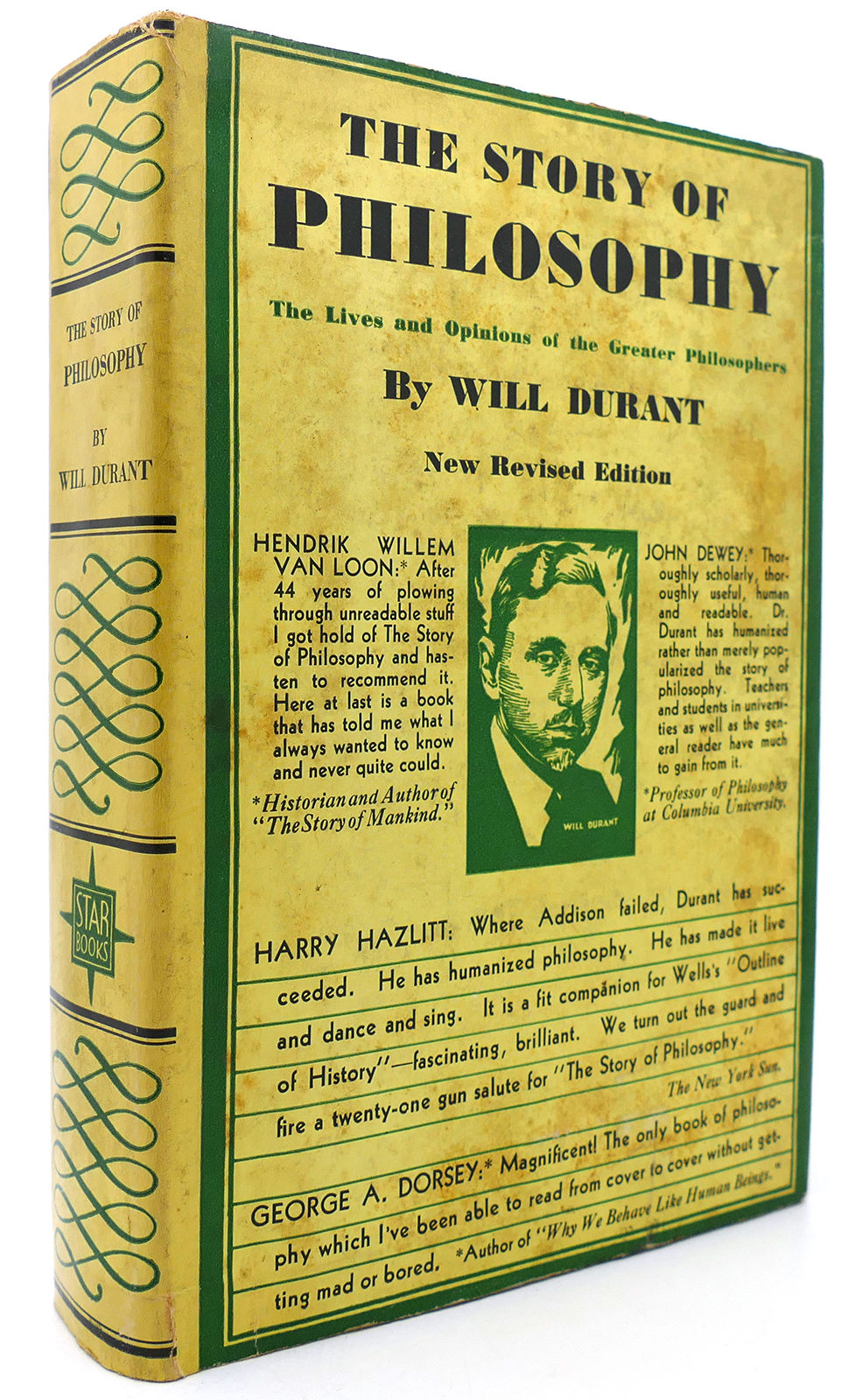
Reference: The Story of Philosophy 

Note: The original Text is provided below.
Previous / Next

.

Summary

.

Comments

.

Original Text

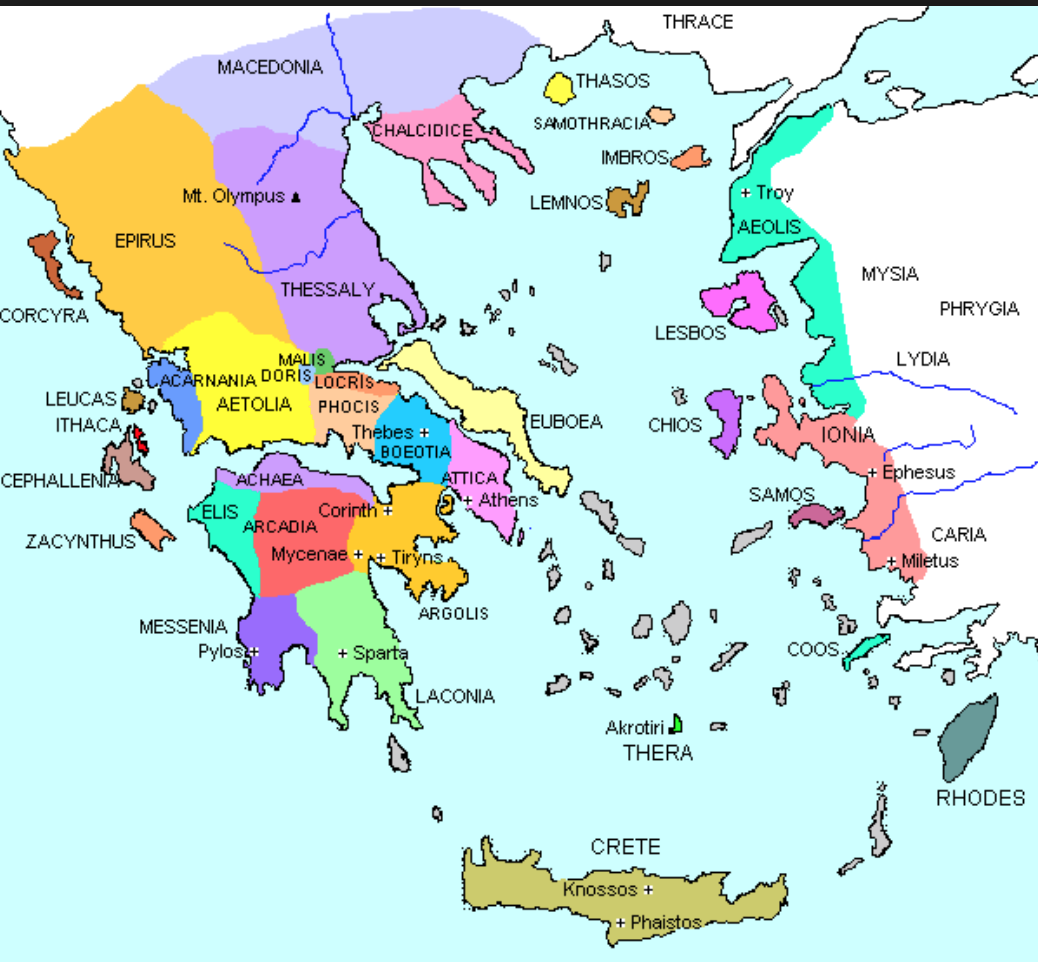
If you look at a map of Europe you will observe that Greece is a skeleton-like hand stretching its crooked fingers out into the Mediterranean Sea. South of it lies the great island of Crete, from which those grasping fingers captured, in the second millennium before Christ, the beginnings of civilization and culture. To the east, across the Aegean Sea, lies Asia Minor, quiet and apathetic now, but throbbing, in pre-Platonic days, with industry, commerce and speculation. To the west, across the Ionian, Italy stands, like a leaning tower in the sea, and Sicily and Spain, each in those days with thriving Greek colonies; and at the end, the “Pillars of Hercules” (which we caIl Gibraltar), that sombre portal through which not many an ancient mariner dared to pass. And on the north those still untamed and half-barbaric regions, then named Thessaly and Epirus and Macedonia, from which or through which the vigorous bands had come which fathered the geniuses of Homeric and Periclean Greece.

Look again at the map, and you see countless indentations of coast and elevations of land; everywhere gulfs and bays and the intrusive sea; and all the earth tumbled and tossed into mountains and hills. Greece was broken into isolated fragments by these natural barriers of sea and soil; travel and communication were far more difficult and dangerous then than now; every valley therefore developed its own self-sufficient economic life, its own sovereign government, its own institutions and dialect and religion and culture. In each case one or two cities, and around them, stretching up the mountain-slopes, an agricultural hinterland: such were the “city-states” of Euboea, and Locris, and Aetolia, and Phocis, and Boeotia, and Achaea, and Argolis, and Elis, and Arcadia, and Messenia, and Laconia—with its Sparta, and Attica—with its Athens.

Look at the map a last time, and observe the position of Athens: it is the farthest east of the larger cities of Greece. It was favorably placed to be the door through which the Greeks passed out to the busy cities of Asia Minor, and through which those elder cities sent their luxuries and their culture to adolescent Greece. It had an admirable port, Piraeus, where countless vessels might find a haven from the rough waters of the sea. And it had a great maritime fleet.

In 490-470 B.C. Sparta and Athens, forgetting their jealousies and joining their forces, fought off the effort of the Persians under Darius and Xerxes to turn Greece into a colony of an Asiatic empire. In this struggle of youthful Europe against the senile East, Sparta provided the army and Athens the navy. The war over, Sparta demobilized her troops, and suffered the economic disturbances natural to that process; while Athens turned her navy into a merchant fleet, and became one of the greatest trading cities of the ancient world. Sparta relapsed into agricultural seclusion and stagnation, while Athens became a busy mart and port, the meeting place of many races of men and of diverse cults and customs, whose contact and rivalry begot comparison, analysis and thought.

Traditions and dogmas rub one another down to a minimum in such centers of varied intercourse; where there are a thousand faiths we are apt to become skeptical of them all. Probably the traders were the first skeptics; they had seen too much to believe too much; and the general disposition of merchants to classify all men as either fools or knaves inclined them to question every creed. Gradually, too, they were developing science; mathematics grew with the increasing complexity of exchange, astronomy with the increasing audacity of navigation.

The growth of wealth brought the leisure and security which are the prerequisite of research and speculation; men now asked the stars not only for guidance on the seas but as well for an answer to the riddles of the universe; the first Greek philosophers were astronomers. “Proud of their achievements,” says Aristotle, “men pushed farther afield after the Persian wars; they took all knowledge for their province, and sought ever wider studies.” Men grew bold enough to attempt natural explanations of processes and events before attributed to supernatural agencies and powers; magic and ritual slowly gave way to science and control; and philosophy began.

At first this philosophy was physical; it looked out upon the material world and asked what was the final and irreducible constituent of things. The natural termination of this line of thought was the materialism of Democritus (460-360 B.C.) “in reality there is nothing but atoms and space.” This was one of the main streams of Greek speculation; it passed underground for a time in Plato’s day, but emerged in Epicurus (342-270), and became a torrent of eloquence in Lucretius (98-55 B.C.). But the most characteristic and fertile developments of Greek philosophy took form with the Sophists, traveling teachers of wisdom, who looked within upon their own thought and nature, rather than out upon the world of things. They were all clever men (Gorgias and Hippias, for example), and many of them were profound (Protagoras, Prodicus); there is hardly a problem or a solution in our current philosophy of mind and conduct which they did not realize and discuss. They asked questions about anything; they stood unafraid in the presence of religious or political taboos; and boldly subpoenaed every creed and institution to appear before the judgment-seat of reason. In politics they divided into two schools. One, like Rousseau, argued that nature is good, and civilization bad; that by nature all men are equal, becoming unequal only by class-made institutions: and that law is an invention of the strong to chain and rule the weak. Another school, like Nietzsche, claimed that nature is beyond good and evil; that by nature all men are unequal; that morality is an invention of the weak to limit and deter the strong; that power is the supreme virtue and the supreme desire of man; and that of all forms of government the wisest and most natural is aristocracy.

No doubt this attack on democracy reflected the rise of a wealthy minority at Athens which called itself the Oligarchical Party, and denounced democracy as an incompetent sham. In a sense there was not much democracy to denounce; for of the 400,000 inhabitants of Athens 250,000 were slaves, without political rights of any kind; and of the 150,000 freemen or citizens only a small number presented themselves at the Ecclesia, or general assembly, where the policies of the state were discussed and determined. Yet what democracy they had was as thorough as never since; the general assembly was the supreme power; and the highest official body, the Dikasteria, or supreme court, consisted of over a thousand members (to make bribery expensive), selected by alphabetical rote from the roll of all the citizens. No institution could have been more democratic, nor, said its opponents, more absurd. 

During the great generation-long Peloponnesian war (430-400 B. C.), in which the military power of Sparta fought and at last defeated the naval power of Athens, the Athenian oligarchic party, led by Critias, advocated the abandonment of democracy on the score of its inefficiency in war, and secretly lauded the aristocratic government of Sparta. Many of the oligarchic leaders were exiled; but when at last Athens surrendered, one cf the peace conditions imposed by Sparta was the recall of these exiled aristocrats. They had hardly returned when, with Critias at their head, they declared a rich man’s revolution against the “democratic” party that had ruled during the disastrous war. The revolution failed, and Critias was killed on the field of battle. 

Now Critias was a pupil of Socrates, and an uncle of Plato. 

.
Tertium Organum

Reference: Tertium Organum (1949)
Reference: Tertium Organum (1920)

The following is a commentary on the chapters of the book Tertium Organum by P D Ouspensky:

Tertium Organum, Introduction
Chapter 1: Knowledge
Chapter 2: Existence
Chapter 3: Space
Chapter 4: Time
Chapter 5: Change
Chapter 6: Reality
Chapter 7: Dimensions
Chapter 8: Consciousness
Chapter 9: Assimilation
Chapter 10: Motion

Chapter 11: Science
Chapter 12: Phenomena
Chapter 13: Life
Chapter 14: Sensation
Chapter 15: Love
Chapter 16: Man
Chapter 17: Oneness
Chapter 18: Intellect and Emotion
Chapter 19: New Knowledge
Chapter 20: Logic of Infinity
Chapter 21: Higher Logic
Chapter 22: Mysticism
Chapter 23: Cosmic Consciousness

.

KANT: A Note on Hegel

Reference: The Story of Philosophy

This paper presents Chapter VI, Immanuel Kant and German Idealism, Section 8 from the book THE STORY OF PHILOSOPHY by WILL DURANT. The contents are from the 1933 reprint of this book by TIME INCORPORATED by arrangement with Simon and Schuster, Inc.

The paragraphs of the original material (in black) are accompanied by brief comments (in color) based on the present understanding.  Feedback on these comments is appreciated.

The heading below is linked to the original materials.

.

A Note on Hegel

Not very long ago it was the custom for historians of philosophy to give to the immediate successors of Kant to Fichte, Schelling, and Hegel as much honor and space as to all his predecessors in modern thought from Bacon and Descartes to Voltaire and Hume. Our perspective today is a little different, and we enjoy perhaps too keenly the invective leveled by Schopenhauer at his successful rivals in the competition for professional posts. By reading Kant, said Schopenhauer, “the public was compelled to see that what is obscure is not always without significance.” Fichte and Schelling took advantage of this, and excogitated magnificent spider-webs of metaphysics. “But the height of audacity in serving up pure nonsense, in stringing together senseless and extravagant mazes of words, such as had previously been known only in madhouses, was finally reached in Hegel, and became the instrument of the most bare-faced general mystification that has ever taken place, with a result which will appear fabulous to posterity, and will remain as a monument to German stupidity.” [Caird, Hegel, in the Blackwood Philosophical Classics; pp. 5-8. The biographical account follows Caird throughout.] Is this fair?

Did Hegel really spew nonsense?

Georg Wilhelm Friedrich Hegel was born at Stuttgart in 1770. His father was a subordinate official in the department of finances of the state of Wurtemberg; and Hegel himself grew up with the patient and methodical habits of those civil servants whose modest efficiency has given Germany the best-governed cities in the world. The youth was a tireless student: he made full analyses of all the important books he read, and copied out long passages. True culture, he said, must begin with resolute self-effacement; as in the Pythagorean system of education, where the pupil, for the first five years, was required to keep his peace.

Hegel was very patient and methodical from his youth.

His studies of Greek literature gave him an enthusiasm for Attic culture which remained with him when almost all other enthusiasms had died away. “At the name of Greece,” he wrote, “the cultivated German finds himself at home. Europeans have their religion from a further source, from the East; . . . but what is here, what is present, science and art, all that makes life satisfying, and elevates and adorns it we derive, directly or indirectly, from Greece.” For a time he preferred the religion of the Greeks to Christianity; and he anticipated Strauss and Renan by writing a Life of Jesus in which Jesus was taken as the son of Mary and Joseph, and the miraculous element was ignored. Later he destroyed the book.

Hegel was fascinated by the Greek culture.

In politics too he showed a spirit of rebellion hardly to be suspected from his later sanctification of the status quo. While studying for the ministry at Tubingen, he and Schelling hotly defended the French Revolution, and went out early one morning to plant a Liberty Tree in the market-place. “The French nation, by the bath of its revolution,” he wrote, “has been freed from many institutions which the spirit of man has left behind like its baby shoes, and which therefore weighed upon it, as they still weigh upon others, like lifeless feathers.” It was in those hopeful days, “when to be young was very heaven,” that he flirted, like Fichte, with a kind of aristocratic socialism, and gave himself, with characteristic vigor, to the Romantic current in which all Europe was engulfed.

Hegel enthusiastically supported the French revolution in his youth.

He was graduated from Tubingen in 1793 with a certificate stating that he was a man of good parts and character, well up in theology and philology, but with no ability in philosophy. He was poor now, and had to earn his bread by tutoring in Berne and Frankfort. These were his chrysalis years: while Europe tore itself into nationalist pieces, Hegel gathered himself together and grew. Then (1799) his father died, and Hegel, falling heir to some $1500, considered himself a rich man, and gave up tutoring. He wrote to his friend Schelling for advice as to where to settle, and asked for a place where there would be simple food, abundant books, and “ein gutes Bier.” Schelling recommended Jena, which was a university town under the jurisdiction of the Duke of Weimar. At Jena Schiller was teaching history; Tieck, Novalis and the Schlegels were preaching romanticism; and Fichte and Schelling were propounding their philosophies. There Hegel arrived in 1801, and in 1803 became a teacher at the University.

When Hegel graduated his certificate stated that he had no ability in philosophy.

He was still there in 1806 when Napoleon’s victory over the Prussians threw the scholarly little city into confusion and terror. French soldiers invaded Hegel’s home, and he took to his heels like a philosopher, earning with him the manuscript of his first important book, The Phenomenology of Spirit. For a while he was so destitute that Goethe told Knebel to lend him a few dollars to tide him over. Hegel wrote almost bitterly to Knebel: “I have made my guiding-star the Biblical saying, the truth of which I have learned by experience, Seek ye first food and clothing, and the kingdom of heaven shall be added unto you.” For a while he edited a paper at Bamberg; then, in 1812, he became head of the gymnasium at Nurnburg. It was there, perhaps, that the stoic necessities of administrative work cooled the fires of romanticism in him, and made him, like Napoleon and Goethe, a classic vestige in a romantic age. And it was there that he wrote his Logic (1812-16), which captivated Germany by its unintelligibility, and won him the chair of philosophy at Heidelberg. At Heidelberg he wrote his immense Encyclopedia of the Philosophical Sciences (1817), on the strength of which he was promoted, in 1818, to the University of Berlin. From that time to the end of his life he ruled the philosophic world as indisputably as Goethe the world of literature, and Beethoven the realm of music. His birthday came on the day after Goethe’s; and proud Germany made a double holiday for them every year.

A Frenchman once asked Hegel to put his philosophy into one sentence; and he did not succeed so well as the monk who, asked to define Christianity while standing on one foot, said, simply, ‘Thou shalt love thy neighbor as thyself.” Hegel preferred to answer in ten volumes; and when they were written and published, and all the world was talking about them, he complained that “only one man understands me, and even he does not.” [Ruthless critics, as we might have expected, challenge the authenticity of this story.] Most of his writings, like Aristotle’s, consist of his lecture-notes; or, worse, of the notes taken by students who heard his lectures. Only the Logic and the Phenomenology are from his hand, and these are masterpieces of obscurity, darkened by abstractness and condensation of style, by a weirdly original terminology, and by an overcareful modification of every statement with a Gothic wealth of limiting clauses. Hegel described his work as “an attempt to teach philosophy to speak in German.” [Wallace: Prolegomena to tine Logic of Hegel, p. 16.] He succeeded.

Hegel described his work as “an attempt to teach philosophy to speak in German.”

The Logic is an analysis not of methods of reasoning, but of the concepts used in reasoning. These Hegel takes to be the categories named by Kant Being, Quality, Quantity, Relation, etc. It is the first business of philosophy to dissect these basic notions that are so bandied about in all our thinking. The most pervasive of them all is Relation; every idea is a group of relations; we can think of something only by relating it to something else, and perceiving its similarities and its differences. An idea without relations of any kind is empty; this is all that is meant by saying that “Pure Being and Nothing are the same”: Being absolutely devoid of relations or qualities does not exist, and has no meaning whatever. This proposition led to an endless progeny of witticisms which still breed; and it proved to be at once an obstacle and a lure to the study of Hegel’s thought.

Hegel’s Logic is an analysis not of methods of reasoning, but of the concepts used in reasoning. The most pervasive of them all is Relation; every idea is a group of relations; we can think of something only by relating it to something else, and perceiving its similarities and its differences. Being absolutely devoid of relations or qualities does not exist. This is hinting at the Principle of Oneness.

Of all relations, the most universal is that of contrast or opposition. Every condition of thought or of thingsevery idea and every situation in the worldleads irresistibly to its opposite, and then unites with it to form a higher or more complex whole. This “dialectical movement” runs through everything that Hegel wrote. It is an old thought, of course, foreshadowed by Empedocles, and embodied in the “golden mean” of Aristotle, who wrote that “the knowledge of opposites is one.” The truth (like an electron) is an organic unity of opposed parts. The truth of conservatism and radicalism is liberalisman open mind and a cautious hand, an open hand and a cautious mind; the formation of our opinions on large issues is a decreasing oscillation between extremes; and in all debatable questions veritas in medio stat. The movement of evolution is a continuous development of oppositions, and their merging and reconciliation. Schelling was rightthere is an underlying “identity of opposites”; and Fichte was right thesis, antithesis and synthesis constitute the Formula and secret of all development and all reality.

Of all relations, the most universal is that of contrast or opposition. Every condition of thought or of things leads irresistibly to its opposite, and then unites with it to form a higher or more complex whole. The movement of evolution is a continuous development of oppositions, and their merging and reconciliation. In other words, evolution comes from the resolution of anomalies. This is called the “dialectical movement”.

For not only do thoughts develop and evolve according to this “dialectical movement,” but things do equally; every condition of affairs contains a contradiction which evolution must resolve by a reconciling unity. So, no doubt, our present social system secretes a self-corroding contradiction: the stimulating individualism required in a period of economic adolescence and unexploited resources, arouses, in a later age, the aspiration for a cooperative commonwealth; and the future will see neither the present reality nor the visioned ideal, but a synthesis in which something of both will come together to beget a higher life. And that higher stage too will divide into a productive contradiction, and rise to still loftier levels of organization, complexity, and unity. The movement of thought, then, is the same as the movement of things; in each there is a dialectical progression from unity through diversity to diversity-in-unity. Thought and being follow the same law; and logic and metaphysics are one.

The movement of thought, then, is the same as the movement of things; in each there is a dialectical progression from unity through diversity to diversity-in-unity. Thought and being follow the same law; and logic and metaphysics are one. In other words, the thoughts as well as things get increasingly refined and evolved to loftier levels through this “dialectical movement.”

Mind is the indispensable organ for the perception of this dialectical process, and this unity in difference. The function of the mind, and the task of philosophy, is to discover the unity that lies potential in diversity; the task of ethics is to unify character and conduct; and the task of politics is to unify individuals into a state. The task of religion is to reach and feel that Absolute in which all opposites are resolved into unity, that great sum of being in which matter and mind, subject and object, good and evil, are one. God is the system of relationships in which all things move and have their being and their significance. In man the Absolute rises to self-consciousness, and becomes the Absolute Idea that is, thought realizing itself as part of the Absolute, transcending individual limitations and purposes, and catching, underneath the universal strife, the hidden harmony of all things. “Reason is the substance of the universe; . . . the design of the world is absolutely rational.” [Hegel: Philosophy of History, Bohn ed., pp. 9, 13.]

The function of the mind, and the task of philosophy, is to discover the unity that lies potential in diversity. The task of religion is to reach and feel that Absolute in which all opposites are resolved into unity. In other words, here we have the Principle of Oneness, according to which all thought and things are potentially continuous, consistent and harmonious.

Not that strife and evil are mere negative imaginings; they are real enough; but they are, in wisdom’s perspective, stages to fulfillment and the good. Struggle is the law of growth; character is built in the storm and stress of the world; and a man reaches his full height only through compulsions, responsibilities, and suffering. Even pain has its rationale; it is a sign of life and a stimulus to reconstruction. Passion also has a place in the reason of things: “nothing great in the world has been accomplished without passion”; [Hegel: Philosophy of History, Bohn ed., p. 26.] and even the egoistic ambitions of a Napoleon contribute unwittingly to the development of nations. Life is not made for happiness, but for achievement. “The history of the world is not the theatre of happiness; periods of happiness are blank pages in it, for they are periods of harmony”; [Hegel: Philosophy of History, Bohn ed., p. 28.] and this dull content is unworthy of a man. History is made only in those periods in which the contradictions of reality are being resolved by growth, as the hesitations and awkwardness of youth pass into the ease and order of maturity. History is a dialectical movement, almost a series of revolutions, in which people after people, and genius after genius, become the instrument of the Absolute. Great men are not so much begetters, as midwives, of the future; what they bring forth is mothered by the Zeitgeist, the Spirit of the Age. The genius merely places another stone on the pile, as others have done; “somehow his has the good fortune to come last, and when he places his stone the arch stands self-supported.” “Such individuals had no consciousness of the general Idea they were unfolding; . . . but they had an insight into the requirements of the time what was ripe for development. This was the very Truth for their age, for their world; the species next in order, so to speak, and which was already formed in the womb of time.” [Hegel: Philosophy of History, Bohn ed., p. 31.]

Strife and evil are, in wisdom’s perspective, stages to fulfillment and the good. History is made only in those periods in which the contradictions of reality are being resolved by growth. What great men bring forth is mothered by the Spirit of the Age.

Such a philosophy of history seems to lead to revolutionary conclusions. The dialectical process makes change the cardinal principle of life; no condition is permanent; in every stage of things there is a contradiction which only the “strife of opposites” can resolve. The deepest law of politics, therefore, is freedom an open avenue to change; history is the growth of freedom, and the state is, or should be, freedom organized. On the other hand, the doctrine that “the real is rational” has a conservative color: every condition, though destined to disappear, has the divine right that belongs to it as a necessary stage in evolution: in a sense it is brutally true that “whatever is, is right.” And as unity is the goal of development, order is the first requisite of liberty.

The dialectical process makes change the cardinal principle of life. And as unity is the goal of development, order is the first requisite of liberty.

If Hegel inclined, in his later years, to the conservative rather than to the radical implications of his philosophy, it was partly because the Spirit of the Age (to use his own historic phrase) was weary of too much change. After the Revolution of 1830 he wrote: “Finally, after forty years of war and immeasurable confusion, an old heart might rejoice to see an end of it all, and the beginning of a period of peaceful satisfaction.” [In Caird, p. 93.]  It was not quite in order that the philosopher of strife as the dialectic of growth should become the advocate of content; but at sixty a man has a right to ask for peace. Nevertheless, the contradictions in Hegel’s thought were too deep for peace; and in the next generation his followers split with dialectical fatality into the “Hegelian Right” and the “Hegelian Left.”  Weisse and the younger Fichte found, in the theory of the real as rational, a philosophical expression of the doctrine of Providence, and justification for a politics of absolute obedience. Feuerbach, Moleschott, Bauer and Marx returned to the scepticism and “higher criticism” of Hegel’s youth, and developed the philosophy of history into a theory of class struggles leading by Hegelian necessity to “socialism inevitable.” In place of the Absolute as determining history through the Zeitgeist, Marx offered mass movements and economic forces as the basic causes of every fundamental change, whether in the world of things or in the life of thought. Hegel, the imperial professor, had hatched the socialistic eggs.

Hegelian implication of the Principle of Oneness was not fully understood. Change must resolve some anomaly. Change for the sake of change is itself an anomaly. Arbitrary assumptions, such as those by Marxism, will always create new anomalies rather than resolve the existing ones.

The old philosopher denounced the radicals as dreamers, and carefully hid away his early essays. He allied himself with the Prussian Government, blessed it as the latest expression of the Absolute, and basked in the sun of its academic favors. His enemies called him “the official philosopher.” He began to think of the Hegelian system as part of the natural laws of the world; he forgot that his own dialectic condemned his thought to impermanence and decay. “Never did philosophy assume such a lofty tone, and never were its royal honors so fully recognized and secured, as in 1830” in Berlin. [Paulsen, Immanuel Kant, p. 385.]

Hagel was in a way correct in condemning change for change’s sake and cautious about what you want to change. Change must occur to bring about Oneness. But change need not be endless.

But Hegel aged rapidly in those happy years. He became as absentminded as a story-book genius; once he entered the lecture-room with only one shoe, having left the other, unnoticed, in the mud. When the cholera epidemic came to Berlin in 1831, his weakened body was one of the first to succumb to the contagion. After only a day’s illness he passed away suddenly and quietly in his sleep. Just as the space of a year had seen the birth of Napoleon, Beethoven and Hegel, so in the years from 1827 to 1832 Germany lost Goethe, Hegel, and Beethoven. It was the end of an epoch, the last fine effort of Germany’s greatest age.

.

Final Comments

.

The Book of Philosophy

Reference: The Story of Philosophy by Will Durant

The Story of Philosophy: the Lives and Opinions of the Greater Philosophers is a book by Will Durant that profiles several prominent Western philosophers and their ideas, beginning with Plato and on through Friedrich Nietzsche. Durant attempts to show the interconnection of their ideas and how one philosopher’s ideas informed the next. There are nine chapters each focused on one philosopher, and two more chapters each containing briefer profiles of three early 20th century philosophers.

CONTENTS

PREFACE, CONTENTS, and INTRODUCTION

CHAPTER ONE: Plato

  1. The Context of Plato
  2. Socrates
  3. The Preparation of Plato
  4. The Ethical Problem
  5. The Political Problem
  6. The Psychological Problem
  7. The Psychological Solution
  8. The Political Solution
  9. The Ethical Solution
  10. Criticism

CHAPTER TWO: Aristotle and Greek Science

  1. The Historical Background
  2. The Work of Aristotle
  3. The Foundation of Logic
  4. The Organization of Science
  5. Metaphysics and the Nature of God
  6. Psychology and the Nature of Art
  7. Ethics and the Nature of Happiness
  8. Politics
  9. Criticism
  10. Later Life and Death

CHAPTER THREE: Francis Bacon

  1. From Aristotle to the Renaissance 
  2. The Political Career of Francis Bacon 
  3. The Essays
  4. The Great Reconstruction
    1. The Advancement of Learning 
    2. The New Organon
    3. The Utopia of Science 
  5. Criticism
  6. Epilogue

CHAPTER FOUR: Spinoza

  1. Historical and Biographical
    1. The Odyssey of the Jews
    2. The Education of Spinoza
    3. Excommunication
    4. Retirement and Death
  2. The Treatise on Religion and the State
  3. The Improvement of the Intellect
  4. The Ethics
    1. Nature and God
    2. Matter and Mind
    3. Intelligence and Morals
    4. Religion and Immortality
  5. The Political Treatise
  6. The Influence of Spinoza

CHAPTER FIVE: Voltaire and the French Enlightenment

  1. Paris: Oedipe
  2. London: The Letters on the English
  3. Cirey: The Romances
  4. Potsdam and Frederick
  5. Les Délices: The Essay on Morals
  6. Ferney: Candide
  7. The Encyclopedia and the Philosophic Dictionary
  8. Écrasez l’lnfame
  9. Voltaire and Rousseau
  10. Dénouement

CHAPTER SIX: Immanuel Kant and German idealism

  1. Roads to Kant
  2. Kant Himself
  3. The Critique of Pure Reason
  4. The Critique: Transcendental Esthetic
  5. The Critique: Transcendental Analytic
  6. The Critique: Transcendental Dialectic
  7. The Critique of Practical Reason
  8. On Religion and Reason
  9. On Politics and Eternal Peace
  10. Criticism and Estimate
  11. A Note on Hegel

CHAPTER SEVEN: Schopenhauer

  1. The Age
  2. The Man
  3. The World as Idea
  4. The World as Will
    1. The Will to Live
    2. The Will to Reproduce
  5. The World as Evil
  6. The Wisdom of Life
    1. Philosophy
    2. Genius
    3. Art
    4. Religion
  7. The Wisdom of Death
  8. Criticism

CHAPTER EIGHT: Herbert Spencer

  1. Comte and Darwin
  2. The Development of Spencer
  3. First Principles
    1. The Unknowable
    2. Evolution
  4. Biology: The Evolution of Life 
  5. Psychology: The Evolution of Mind
  6. Sociology: The Evolution of Society
  7. Ethics: The Evolution of Morals
  8. Criticism
    1. First Principles
    2. Biology and Psychology 
    3. Sociology and Ethics
  9. Conclusion

CHAPTER NINE: Friedrich Nietzsche

  1. The Lineage of Nietzsche
  2. Youth
  3. Nietzsche and Wagner
  4. The Song of Zarathustra
  5. Hero-morality
  6. The Superman
  7. Decadence
  8. Aristocracy
  9. Criticism
  10. Finale

CHAPTER TEN: Contemporary European Philosophers

  1. Henri Bergson
    1. The Revolt against Materialism
    2. Mind and Brain
    3. Creative Evolution
    4. Criticism
  2. Benedetto Croce
    1. The Man
    2. The Philosophy of the Spirit
    3. What is Beauty?
    4. Criticism
  3. Bertrand Russell 
    1. The Logician
    2. The Reformer 
    3. Epilogue

CHAPTER ELEVEN: Contemporary American Philosophers

Introduction

  1. George Santayana
    1. Biographical
    2. Skepticism and Animal Faith
    3. Reason in Science
    4. Reason in Religion
    5. Reason in Society
    6. Comment
  2. William James
    1. Personal
    2. Pragmatism 
    3. Pluralism
    4. Comment
  3. John Dewey
    1. Education
    2. Instrumentalism
    3. Science and Politics

Conclusion

KANT: Criticism and Estimate

Reference: The Story of Philosophy

This paper presents Chapter VI, Immanuel Kant and German Idealism, Section 7 from the book THE STORY OF PHILOSOPHY by WILL DURANT. The contents are from the 1933 reprint of this book by TIME INCORPORATED by arrangement with Simon and Schuster, Inc.

The paragraphs of the original material (in black) are accompanied by brief comments (in color) based on the present understanding.  Feedback on these comments is appreciated.

The heading below is linked to the original materials.

.

Criticism and Estimate

And now how does this complex structure of logic, metaphysics, psychology, ethics, and politics stand today, after the philosophic storms of a century have beaten down upon it? It is pleasant to answer that much of the great edifice remains; and that the “critical philosophy” represents an event of permanent importance in the history of thought. But many details and outworks of the structure have been shaken.

First, then, is space a mere “form of sensibility,” having no objective reality independent of the perceiving mind? Yes and no. Yes: for space is an empty concept when not filled with perceived objects; “space” merely means that certain objects are, for the perceiving mind, at such and such a position, or distance, with reference to other perceived objects; and no external perception is possible except of objects in space; space then is assuredly a “necessary form of the external sense.” And no: for without doubt, such spatial facts as the annual elliptical circuit of sun by earth, though statable only by a mind, are independent of any perception whatever; the deep and dark blue ocean rolled on before Byron told it to, and after he had ceased to be. Not is space a “construct” of the mind through the coordination of spaceless sensations; we perceive space directly through our simultaneous perception of different objects and various points as when we see an insect moving across a still background. Likewise: time as a sense of before and after, or a measurement of motion, is of course subjective, and highly relative; but a tree will age, wither and decay whether or not the lapse of time is measured or perceived. The truth is that Kant was too anxious to prove the subjectivity of space, as a refuge from materialism; he feared the argument that if space is objective and universal, God must exist in space, and be therefore spatial and material. He might have been content with the critical idealism which shows that all reality is known to us primarily as our sensations and ideas. The old fox bit off more than he could chew. [The persistent vitality of Kant’s theory of knowledge appears in its complete acceptance by so matter-of-fact a scientist as the late Charles P. Steinmetz: “All our sense-perceptions are limited by, and attached to, the conceptions of time and space. Kant, the greatest and most critical of all philosophers, denies that time and space are the product of experience, but shows them to be categories—conceptions in which our minds clothe the sense perceptions. Modern physics has come to the same conclusion in the relativity theory, that absolute space and absolute time have no existence, hut time and space exist only as far as things or events fill them; that is, they are forms of perception.”—Address at the Unitarian Church, Schenectady, 1923.]

He might well have contented himself, too, with the relativity of scientific truth, without straining towards that mirage, the absolute. Recent studies like those of Pearson in England, Mach in Germany, and Henri Poincare in France, agree rather with Hume than with Kant: all science, even the most rigorous mathematics, is relative in its truth. Science itself is not worried about the matter; a high degree of probability contents it. Perhaps, after all, “necessary” knowledge is not necessary?

All science deals with the knowable (manifested) universe of substance. The substance is manifested as thought, energy and matter. In the background of the knowable universe is the Unknowable. As long as the Unknowable is there, science is not absolute.

The great achievement of Kant is to have shown, once for all, that the external world is known to us only as sensation; and that the mind is no mere helpless tabula rasa, the inactive victim of sensation, but a positive agent, selecting and reconstructing experience as experience arrives. We can make subtractions from this accomplishment without injuring its essential greatness. We may smile, with Schopenhauer, at the exact baker’s dozen of categories, so prettily boxed into triplets, and then stretched and contracted and interpreted deviously and ruthlessly to fit and surround all things. [Op. cit., vol. ii, p. 23.] And we may even question whether these categories, or interpretive forms of thought, are innate, existing before sensation and experience; perhaps so in the individual, as Spencer conceded, though acquired by the race; and then, again, probably acquired even by the individual: the categories may be grooves of thought, habits of perception and conception, gradually produced by sensations and perceptions automatically arranging themselves, first in disorderly ways, then, by a kind of natural selection of forms of arrangement, in orderly and adaptive and illuminating ways. It is memory that classifies and interprets sensations into perceptions, and perceptions into ideas; but memory is an accretion. That unity of the mind which Kant thinks native (the “transcendental unity of apperception”) is acquired and not by all; and can be lost as well as won in amnesia, or alternating personality, or insanity. Concepts are an achievement, not a gift.

It is true that the external world (Unknowable) first manifests as sensations. Sensations upon assimilation become perceptions. Such assimilation is guided by the inherent makeup of the mind, which may be described as a set of postulates. Reason applied to perceptions then generates further considerations, ideas, etc. Underlying this assimilation and reasoning is the active Principle of Oneness. Any violation of the Principle of Oneness generates anomalies.

Kant contributed much to this understanding. He describes the postulates referenced above as categories. The development of these categories is assisted by the Principle of Oneness. This Principle of Oneness fills in what was left out by Kant.

The nineteenth century dealt rather hardly with Kant’s ethics, his theory of an innate, a priori, absolute moral sense. The philosophy of evolution suggested irresistibly that the sense of duty is a social deposit in the individual, the content of conscience is acquired, though the vague disposition to social behavior is innate. The moral self, the social man, is no “special creation” coming mysteriously from the hand of God, but the late product of a leisurely evolution. Morals are not absolute; they are a code of conduct more or less haphazardly developed for group survival, and varying with the nature and circumstances of the group: a people hemmed in by enemies, for example, will consider as immoral that zestful and restless individualism which a nation youthful and secure in its wealth and isolation will condone as a necessary ingredient in the exploitation of natural resources and the formation of national character. No action is good in itself, as Kant supposes. [Practical Reason, p. 31.]

Kant’s theory of an innate and absolute moral sense has mostly been ignored. Instead the theory of evolution has been favored, according to which the sense of duty is mostly acquired through social conditions. No action is good in itself, as Kant supposes. This anomaly is resolved when one accepts the Principle of Oneness as the ultimate criterion.

His pietistic youth, and his hard life of endless duty and infrequent pleasure, gave him a moralistic bent; he came at last to advocate duty for duty’s sake, and so fell unwittingly into the arms of Prussian absolutism. [Cf. Prof. Dewey: German Philosophy and Politics.] There is something of a severe Scotch Calvinism in this opposition of duty to happiness; Kant continues Luther and the Stoic Reformation, as Voltaire continues Montaigne and the Epicurean Renaissance. He represented a stern reaction against the egoism and hedonism in which Helvetius and Holbach had formulated the life of their reckless era, very much as Luther had reacted against the luxury and laxity of Mediterranean Italy. But after a century of reaction against the absolutism of Kant’s ethics, we find ourselves again in a welter of urban sensualism and immorality, of ruthless individualism untempered with democratic conscience or aristocratic honor; and perhaps the day will soon come when a disintegrating civilization will welcome again the Kantian call to duty.

Kant’s sense of duty and moralistic bent may be contrasted against the free thinking and happy bent of Voltaire. Again, the apparent anomaly disappears as one accepts the Principle of Oneness as one’s ultimate criterion.

The marvel in Kant’s philosophy is his vigorous revival, in the second Critique, of those religious ideas of God, freedom, and immortality, which the first Critique had apparently destroyed. “In Kant’s works,” says Nietzsche’s critical friend, Paul Ree, “you feel as though you were at a country fair. You can buy from him anything you want freedom of the will and captivity of the will, idealism, and a refutation of idealism, atheism and the good Lord. Like a juggler out of an empty hat, Kant draws out of the concept of duty a God, immortality, and freedom, to the great surprise of his readers.” [In Untermann, Science and Revolution, Chicago, 1905; p. 81.] Schopenhauer too takes a fling at the derivation of immortality from the need of reward: “Kant’s virtue, which at first bore itself so bravely towards happiness, loses its independence later, and holds out its hand for a tip.” [In Paulsen, p. 317.] The great pessimist believes that Kant was really a sceptic who, having abandoned belief himself, hesitated to destroy the faith of the people, for fear of the consequences to public morals. “Kant discloses the groundlessness of speculative theology, and leaves popular theology untouched, nay even establishes it in a nobler form as a faith based upon moral feeling.” This was afterwards distorted by the philosophasters into rational apprehension and consciousness of God, etc. . . . ; while Kant, as he demolished old and revered errors, and knew the danger of doing so, rather wished through the moral theology merely to substitute a few weak temporary supports, so that the ruin might not fall upon him, but that he might have time to escape.” [The World as Will and Idea, vol. ii, p. 129.] So too Heine, in what is no doubt an intentional caricature, represents Kant, after having destroyed religion, going out for a walk with his servant Lampe, and suddenly perceiving that the old man’s eyes are filled with tears. “Then Immanuel Kant has compassion, and shows that he is not only a great philosopher, but also a good man; and half kindly, half ironically, he speaks: ‘Old Lampe must have a God or else he cannot be happy, says the practical reason; for my part, the practical reason may, then, guarantee the existence of God.’” [Quoted by Paulsen, p. 8.] If these interpretations were true we should have to call the second Critique a Transcendental Anesthetic.

Kant first destroys religion from the viewpoint of reason and then builds it back up from the viewpoint of faith. Thus, he appears self-contradictory. However, as we substitute faith by the Principle of Oneness, it starts to make sense.

But these adventurous reconstructions of the inner Kant need not be taken too seriously. The fervor of the essay on ”Religion within the Limits of Pure Reason” indicates a sincerity too intense to be questioned, and the attempt to change the base of religion from theology to morals, from creeds to conduct, could have come only from a profoundly religious mind. “It is indeed true,” he wrote to Moses Mendelssohn in 1766, “that I think many things with the clearest conviction, . . . which I never have the courage to say; but I will never say anything which I do not think.” [In Paulsen, p. 53.] Naturally, a long and obscure treatise like the great Critique lends itself to rival interpretations; one of the first reviews of the book, written by Reinhold a few years after it appeared, said as much as we can say today: “The Critique of Pure Reason has been proclaimed by the dogmatists as the attempt of a sceptic who undermines the certainty of all knowledge;—by the sceptics as a piece of arrogant presumption that undertakes to erect a new form of dogmatism upon the ruins of previous systems;—by the supernaturalists as a subtly plotted artifice to displace the historical foundations of religion, and to establish naturalism without polemic;—by the naturalists as a new prop for the dying philosophy of faith;—by the materialists as an idealistic contradiction of the reality of matter;—by the spiritualists as an unjustifiable limitation of all reality to the corporeal world, concealed under the name of the domain of experience.” [In Paulsen, p. 114,] In truth the glory of the book lay in its appreciation of all these points of view; and to an intelligence as keen as Kant’s own, it might well appear that he had really reconciled them all, and fused them into such a unity of complex truth as philosophy had not seen in all its history before.

As to his influence, the entire philosophic thought of the nineteenth century revolved about his speculations. After Kant, all Germany began to talk metaphysics: Schiller and Goethe studied him; Beethoven quoted with admiration his famous words about the two wonders of life “the starry heavens above, the moral law within”; and Fichte, Schelling, Hegel and Schopenhauer produced in rapid succession great systems of thought reared upon the idealism of the old Konigsberg sage. It was in these balmy days of German metaphysics that Jean Paul Richter wrote: “God has given to the French the land, to the English the sea, to the Germans the empire of the air.” Kant’s criticism of reason, and his exaltation of feeling, prepared for the voluntarism of Schopenhauer and Nietzsche, the intuitionism of Bergson, and the pragmatism of William James; his identification of the laws of thought with the laws of reality gave to Hegel a whole system of philosophy; and his unknowable “thing-in-itself” influenced Spencer more than Spencer knew. Much of the obscurity of Carlyle is traceable to his attempt to allegorize the already obscure thought of Goethe and Kant that diverse religions and philosophies are but the changing garments of one eternal truth. Caird and Green and Wallace and Watson and Bradley and many others in England owe their inspiration to the first Critique; and even the wildly innovating Nietzsche takes his epistemology from the “great Chinaman of Konigsberg” whose static ethics he so excitedly condemns. After a century of struggle between the idealism of Kant, variously reformed, and the materialism of the Enlightenment, variously redressed, the victory seems to lie with Kant. Even the great materialist Helvetius wrote, paradoxically: “Men, if I may dare say it, are the creators of matter.” [In Chamberlain, vol. i, p. 86.] Philosophy will never again be so naive as in her earlier and simpler days; she must always be different hereafter, and profounder, because Kant lived.

After Kant, all Germany began to talk metaphysics. After a century of struggle between the idealism of Kant, variously reformed, and the materialism of the Enlightenment, variously redressed, the victory seems to lie with Kant. Philosophy will never again be so naive as in her earlier and simpler days; she must always be different hereafter, and profounder, because Kant lived.

.

Final Comments

.