Category Archives: Mindfulness

Visualization

you-are-here

Previous: Guided Meditation
NextSubject Clearing

The mind solves the problem by visualizing it. Visualization helps us find the gaps in our understanding. The problem resolves when the visualization is complete without any gaps.

We visualize through free association. We then consciously visualize details that will fill any gaps. The key is consistency with reality. The details must be continuous and harmonious with rest of the visualization in order to fill the gap.

In this exercise we practice spatial visualization. We close our eyes and visualize the environment. Then we visualize ourselves in that environment. We do so from various angles and distances, little bit at a time until the whole visualization is continuous and consistent.

The basic idea is to learn to make the visualization continuous, harmonious and consistent with the actual reality.

.

MINDFULNESS APP 3: To learn to visualize with consistency.

1.    Settle down in mindfulness meditation.

In mindfulness meditation, become fully aware of your body and mind.

2.    Visualize the room you are sitting in.

Visualize the eight corners of the room on a gradient (little bit at a time). Do not put out too much effort. Let it happen slowly. Expand your visualization to include all space of the room.

3.    Visualize your body within that room.

Visualize your body from above, below, left, right, behind and front. Visualize it from different angles and distances. Do so until you can smoothly circle around the body.

4.    Expand your viewpoint beyond the body.

We are used to looking out from the frame of reference provided by the body. Expand this frame of reference to the whole room, then to the whole building, the city, the state, the country, and the whole earth, if possible. Do it slowly and at a pace that is comfortable.

5.    Visualize being at some pleasant locations.

Visualize yourself in locations that are pleasant. This could be your childhood home, or the first first school you went to. It could be a location where you felt safe, or some vacation spots.

6.    Visualize being at some unpleasant locations.

The visualization of unpleasant locations is a bit more difficult because there is resistance involved because of unpleasantness of the location. Use mindfulness technique to let the resistance discharge.

7.    Visualize being at some dangerous locations.

Once you have mastered being at unpleasant locations, visualize yourself in locations that are dangerous.  Remember that these are hypothetical visualizations.  The location can be as dangerous as the center of the sun. The whole idea is to be consistent with reality in such visualizations. These visualizations help one discharge irrational feelings, sensation and fears.

.

With this exercise a person becomes more objective, at least, in terms of visualization. It doesn’t mean that the person loses his feelings, sensations and emotions in real situations. In fact, he becomes more expressive of his real (rational) feelings and emotions.

.


The 3 Factors of Mindfulness

Path

Reference: Course on Human Nature

The Discipline of Mindfulness warns you against digging into the mind. It lets the mind unwind and settle down naturally. The following factors are fundamental to mindfulness.

1.    ATTENTION

Let attention be totally free. Fully discern where the attention goes naturally. This forms the ground of mindfulness.

2.    FREE ASSOCIATION

Let all associations occur freely in the mind. Fully discern the associations without influencing them.

3.    UNIVERSALITY

Let the viewpoint expand freely without fixation. Fully discern all observations in a universal context.

.

Subject Clearing (old-3)

Math

Please see The Book of Subject Clearing

Previous: Visualization
NextMindfulness Approach

When studying a subject one should be able to detect the hidden assumptions and subjectivity present in it. This is especially necessary when one is studying the fundamentals of a subject. Such subjectivity can be very pervasive. It may even enter the definitions of words provided in dictionaries.

Study of a subject must improve one’s objective perceptions in that area. It must be accompanied by full awareness of assumptions and subjectivity in the fundamentals of that subject.

The following procedure may help one detect and clear assumptions and subjectivity present in a subject being studied.

.

MINDFULNESS APP: To Engage in Subject Clearing

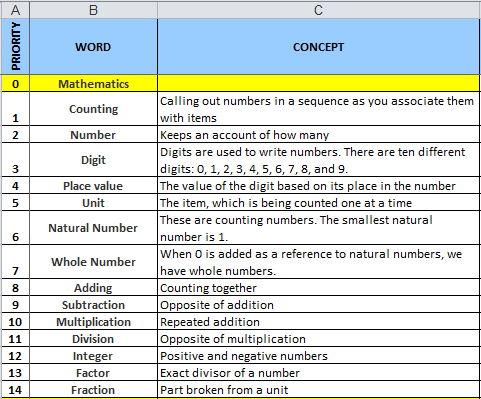
1.    Make a list of key words that describe the concepts in that subject.

Skim through the chapter that you are going to study, and make a list of key words that introduce new concepts in that chapter. Put that list on an Excel worksheet, so you can rearrange their order as necessary. You may add key words from previous chapters, or from other books, that you have studied. This list may grow as your studies get deeper into the subject.

2.    Write down the broad concept associated with the word.

In a dictionary you may find the broad concept listed under the ‘history’, ‘origin’, or ‘derivation’ of the word. This may appear either before, or after the definitions. For example, when you look up ARITHMETIC, you may find the underlying concept expressed as “skill with numbers.”

Look for broad concept only. Sometimes you may have to piece together the concept from the derivations given. Ignore most other details. Once you have grasped the broad concept note it down next to the word on your Excel worksheet.

3.    Locate the definition of the word that fits the context.

Scan through the definitions provided for that word, and locate the one that seems to be most appropriate in the current context. Note down this definition in your Excel worksheet.

It may help to visualize the definition through applications, such as, “Google Image” on the Internet. You may visualize more abstract concepts through personal experiences and through examples provided in dictionaries and books.

Of course, if there are words in the definition that you do not understand then you need to look them up in the same way. You may modify your notes on Excel worksheet as you gain more familiarity with the concept over time through application of mindfulness.

4.    Gradually build upon each concept for that subject.

Study the materials of the subject one paragraph at a time. Reduce a paragraph to its main thought before proceeding to the next paragraph. 

It is useful to have the study material in an editable document on a computer. Then you can note down your thoughts and comments under each paragraph. If the paragraph is difficult to reduce to its main thought then look for words in that paragraph that may not be clear in that context. If the difficulty with a paragraph still persists then note down the confusion at the bottom of the paragraph. It may get clarified by something you read later.

This may provide you with additional conceptual understanding. If so, then note it down next to the appropriate word on your Excel worksheet.

5.    Keep the purpose of study in mind.

Since additional information on a subject may easily be accessed through Internet these days, the purpose of study is not to memorize but to improve one’s critical thinking.

The true purpose of study is to resolve inconsistencies (things that do not make sense) as you come across them in a subject. This develops clarity of mind and the ability to think fast on your feet.

6.    Arrange the key words with their concepts in proper sequence.

The concepts in any subject are always connected to each other. There is a sequence in which they evolved. The key words on your Excel worksheet should be separated in a group that expresses fundamental concepts from the group of secondary concepts.

Arrange the fundamental concepts in the sequence they evolved. Then place the secondary concepts in the order that they were derived. Move the words expressing more fundamental concepts toward the top. Move the words expressing derived concepts toward the bottom.

This sequencing may not be totally linear. Connections may be more like that in a multidimensional matrix. The whole idea is to arrange these words so you can easily see the connection among various concepts.

You may create a “Priority column” in the worksheet with numbers assigned to each row in such a way that you can look at the key concepts in various arrangements.

7.    Note any inconsistencies among the concepts and clarify them.

As the study of the subject progresses and better understanding comes about, rearrange the list of key words to examine consistency among the various concepts. You are looking for things that appear inconsistent and do not make sense. There may be holes among these concepts that need to be filled.

Deeper research may be required to discover such holes and fill them. First review your materials to clarify any inconsistency. If it does not clarify easily then note it down on the worksheet and research through other materials in the library or on Internet.

8.    Clarify the fundamentals of the subject as a priority.

The fundamentals concepts of a subject must be consistent. Any inconsistency at the fundamental level must be handled as a priority. The consistency of the fundamentals determines the consistency of the whole subject.

If an observed inconsistency does not resolve upon proper research of the materials on that subject then test the fundamentals for possible assumptions. Arbitrary assumptions may reveal gaps in the subject itself.

There are likely to be many contributors to a subject. For example, many different cultures have contributed to the broad subject of religious knowledge. You may find similar concepts referred to by different words from different sources. Note down such words and study the differences among their concepts.

Develop your own understanding by seeking consistency among these concepts.

9.    Make the subject as complete as possible.

There are many examples in the subject of religion where gaps in knowledge are hidden under assumptions and dubious explanations. This may be the case with any subject where inconsistencies abound.

Underlying such assumptions and dubious explanations is subjectivity coming from a narrow viewpoint. As this viewpoint is recognized and expanded upon greater objectivity and consistency is achieved. The gaps in knowledge become obvious. Real progress becomes possible now.

Fill gaps in the subject with wider research. Make the subject as complete as possible through experimentation and direct experience.

.

Self-guided Meditation

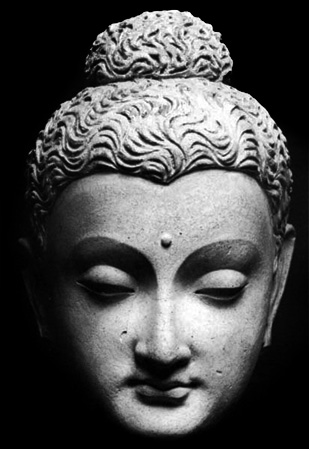
Buddha.Head

Previous: Mindfulness Meditation
Next: Guided Meditation

Once you have become comfortable with mindfulness meditation, you may advance to self-guided meditation.

The purpose of self-guided meditation is to resolve doubts and perplexities that commonly occur in one’s life. Meditate on the doubt or perplexity uppermost in your mind by bringing up all data related to it, and letting it associate freely as described in this exercise.

.

Mindfulness Meditation 2: Let the confusion resolve through free association.


  1. Bring up in meditation the doubt or perplexity uppermost in your mind. For example, it could be a doubt regarding marital relationship.


  2. Let yourself be grounded in your body through awareness of breathing; and in your mind through awareness of the order in the universe.


  3. Let the data regarding the doubt and perplexity associate freely as it comes up. Do not avoid, resist, or suppress any thoughts, emotions, feelings, sensations, etc. Let anything suppressed be released.


  4. Do not anxiously dig into the mind for answers, or act out impulsively. Let the mind unwind itself. This process goes deeper than any logic.


  5. Broaden the context as wide as possible. For example, when doubt relates to marital relationship then broaden the context to all marital relationships that you are aware of, such as, those of parents, friends, acquaintances, etc.


  6. Look at basic purpose of the key area of doubt and perplexity. For example, in the case of marital relationship you would look at the purpose of marriage not only in yours, but also in other cultures.


  7. Work out the ideal scene for that area. For example, in the case of marital relationship, look at the actions and condition, which make a marital relationship happy and successful in the broad context.


  8. Place the specific data of your situation in the broad context, and let free association sort it all out.


  9. Repeat the above steps using the 12 aspects of mindfulness until the doubt and perplexity resolve.


  10. Other doubts and perplexities may arise during this process. Apply the same steps as above to resolve them.


.

 Major revision on 7/29/16


The Self (old)

Previous: The Dynamics
Next: The Human Mind

Nobel Laureate in physics, Erwin Schrodinger, who introduced Wave Mechanics to the world, remarked in his book “My View of the World”:

“If we agree to leave aside, without further discussion, as altogether too naively puerile, the idea of a soul dwelling in the body as in a house, quitting it at death, and capable of existing without it, then I think that one of the principal problems, if not the principal problem, without whose solution there can be no final peace for the metaphysical urge, can be quite briefly characterized as follows.

“Consider these four questions, which cannot, as a whole, be satisfactorily answered with any combination of ‘yes’ and ‘no’, but rather lead one on in an endless circle.

(1) Does there exist a Self?
(2) Does there exist a world outside Self?
(3) Does this Self cease with bodily death?
(4) Does the world cease with my bodily death?”

.

The Self is generally viewed as the sense of ‘I’. I know myself through the feelings and sensations of my body. I am intimately associated with this body through which I perceive things around me. This body provides me with an identity and individuality. This body exists, and therefore, ‘I’ (Self ) exists.

I do not feel the sensations from other bodies, so I am uniquely associated with one body only. There is a world that exists outside the body. So the world must exist outside the Self.

My observation is that other people are gone when their body dies. I am so intimately connected with the physiology of the body that I must also disintegrate with the body at death.  So the Self ceases with bodily death.

The world obviously has continued after other people have died. So the world would not cease with my bodily death. But it is also true that as I cease to exist, the world would cease to exist for me.

The above is a self-centered view that leads to the conclusion that the world ceases for the self that has dissolved but it continues for the selves that continue. So, the Self and the world must consist of the same ‘empirical’ elements. We must reject a world existing outside ‘Self’, because that to which we give the name ‘world’ is only a complex within the Self.

Yet my own body is only a complex within the world-complex. It is inconsistent to think that what is known as ‘world’ would be completely eliminated by a destructive attack on one small part of itself—of which, furthermore, it contains millions of examples.

Please note that I have borrowed the argument above from Schrodinger. This brings up the question, “How is ‘Self’ related to the ‘world’?”

The obvious answer is that both ‘Self’ and the ‘world’ must be greater than the body. Some aspect of Self, therefore, must continue after bodily death.

The sensations and perceptions through the body cease after the bodily death. Therefore, the sense of identity and individuality must also cease with bodily death. But there is a universal sense we have when we assume the viewpoint represented by philosophy, science and mathematics. This is like the universe perceiving itself through itself. Such universal sense, though in a much more intimate way, must remain after bodily death.

A universal Self seems to emerge with bodily death. It is no longer intimate with a single body. It is intimate with the whole universe.

The universal self is the same across the board from person to person. The plurality of individuality relies on the sense of body. After bodily death there is no more individuality. The continued individuality projected through the idea of “soul” is just an idea arising from wishful thinking.

The Self seems to have two parts. One part is unique to the body because it feels the sensations of one body and not those of other bodies. It is individualistic as it thinks in terms of emotions and memories in the narrow context of body. The second part of the Self is not narrow at all but is universally broad and the same from person to person. It thinks in terms of universal principles. It forms the genesis of all our knowledge. If the first part thinks in narrow terms, such as, 3+5 = 5+3, the second part thinks in broad terms, such as, A+B = B+A, where A and B can be any two numbers. It is the individualistic part that dissolves at bodily death. The universal part remains.

Self may be viewed as a spectrum of consciousness that condenses into the plurality of individuality in one direction, and expands into the oneness of universality in the other direction.

Nirvana of Buddhism is the cultivation of that oneness of universal consciousness of Self.

.