Category Archives: Mindfulness

The Dynamics (old)

zen

Previous: A Basic Model of Universe
Next: The Self
Reference: The Quest for Certainty

We may start from the concept that there is always something to know; that there is no absolute knowledge. This ultimate concept may be looked upon as “Supreme Being” or Brahma. A version of it is considered to be the Eighth Dynamic by Hubbard of Scientology.

The “static” is the orientation point from which to view this vast universe. This reference point is theoretical but very essential. All properties of the universe must converge back to this point for orientation. Hubbard has a version of it as the Seventh Dynamic.

The universe is not only material but also spiritual. The material aspects are MEST (matter, energy, space and time), and the spiritual aspects are ICAD (identity, consciousness, awareness and desire). The material and spiritual aspects of the universe cannot be separated. Hubbard has a version of it as the Sixth Dynamic.

This universe evolves from the disturbance of the fabric of Space-awareness by the presence of Time-Desire. As a result, first there is Energy-consciousness, which then condenses into Matter-identity. Then there is progressive evolution of Matter-identity into minerals, plant life, and animal life. This evolution has now culminated in sentient humans. Hubbard refers to a version of the above as Fifth Dynamic.

When we focus on the highest form of evolution of this universe, we have Mankind as Fourth Dynamic. We can then look at the division of Mankind into Groups as the Third Dynamic. We may highlight the organization of the procreation activity among humans as the Second Dynamic. Finally, we may regard the individual person and his individuality as the First Dynamic.

Here we have a philosophy of evolution that is logically anchored in the Eighth Dynamic. The proper sequence of Dynamics occurs from Eighth to First. However, Hubbard reverses this sequence by making individuality as the center piece of his philosophy of Scientology. Thus, Hubbard’s philosophy of Scientology is backwards.

When we consider the Eighth Dynamic as the anchor, we notice that there is no limit to knowledge. Evolution has been bringing order to the surrounding disorder by trial and error. Now that evolution has culminated in sentient humans, it is obvious that the  trial and error mode is being replaced by a sentient approach for future evolution.

Science has done a great job in the investigation of the physical aspects of this universe. It has come up with many physical laws. However, science has lagged behind in the investigation of the metaphysical aspects of this universe. We must now come up with metaphysical laws that are as precise as the physical laws in order to evolve further.

Man as the most evolved organism must discover, understand and follow the basic laws of the universe to evolve further.

.
The Mind’s Resolution

tripping-through-bogomils-mind-otto-rapp

Previous: The Human Mind
Next: Mindfulness Approach

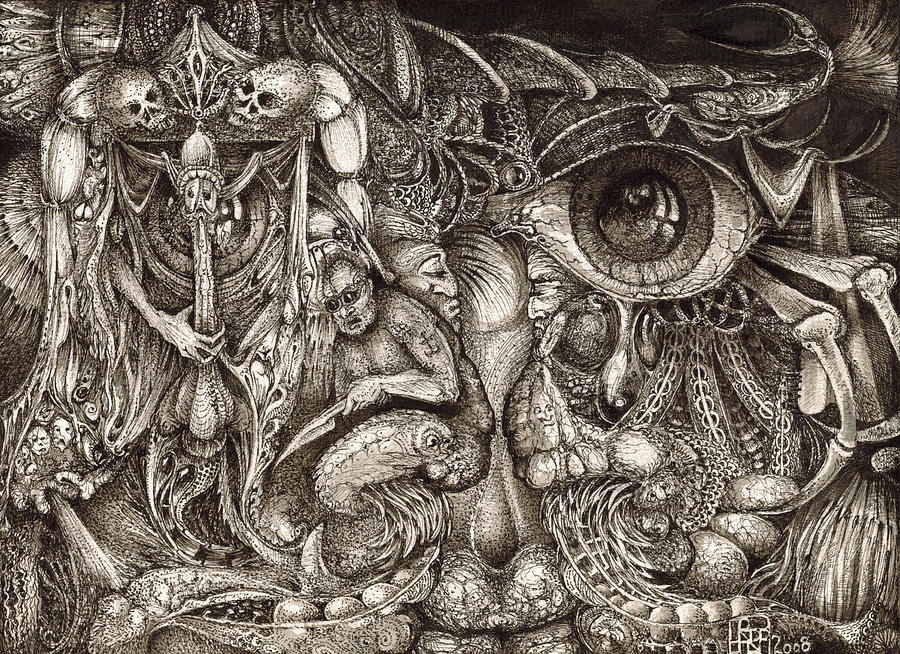
A mind is troubled when it is beset with doubts, perplexities and problems. Such troubles come from misalignment of data in the mind, which prevents the mind from resolving the troubles.  If that data could be aligned the troubles shall resolve.

The mind tries to resolve the misalignment of data by making postulates. A postulate is something taken as self-evident or assumed without proof as a basis for reasoning. A postulate is valid to the degree it helps align data. A valid postulate makes it possible to resolves doubts, perplexities and problems.

A postulate is something taken as self-evident or assumed without proof as a basis for reasoning. 

The common error occurs when the postulates align data only within a narrow context. Thus difficulties and problems are partially resolved in a narrow context only. From this comes about the idea of comfort zones. The narrow-minded postulates do not work beyond their comfort zones.

People become used to their narrow-minded postulates. These postulates become part of their mindset and beingness. They are happy as long as they are in their comfort zone. But when their circumstances change they find it difficult to adjust and they become unhappy. Most people are unhappy because nothing remains the same in this universe for long. It is common to be thrown out of comfort zone.

The mind becomes problematic when its postulates align data only within a narrow context.

In other words, all problems come from being narrow-minded. The solution, therefore, is to have postulates that help one align data in as broad a context as possible. One’s postulate must be flexible. When one becomes aware of a larger context, one should be able to update the postulates to align data in that larger context.

The solution is to develop postulates that help one align data in as broad a context as possible.

The mind becomes more problematic as its narrow-minded postulates become fixed. Resistance to change comes from fixed narrow-minded postulates.  The only way to overcome this resistance is to encourage willingness to examine the misalignments of data in a larger context.

Resistance to change comes from narrow-minded postulates that have become fixed.

Postulates that help align data in a universal context are considered objective. The laws pf physics fall in this category and so do the fundamental postulates of various philosophies. Postulates that help align data in a limited context only are considered subjective.

Postulates that can help align data in a universal context are objective. They can help resolve all doubts, perplexities and problems

Subjective postulates are usually limited to the context of “self” of a person. These subjective postulates act like filters that “color” the perceptions and evaluations of the person. Any problems that extend beyond the “self” of the person cannot be resolved by subjective postulates.

A person unwilling to change his subjective postulates ends up generating unusual solutions to resolve his problems. His life becomes increasingly complex, and he mostly runs around on wild goose chases.

Subjective postulates make one’s life very complex.

Free association helps one align data in a universal context. It helps one upgrade the postulates from subjective to objective. Sometimes misalignments in data come about from traumatic painful experiences. To resolve such misalignments free association needs to be carried out in a patient and disciplined manner. That discipline is provided by mindfulness.

Severe misalignments of data may be resolved through practice of free association under the discipline of mindfulness.

In cases where deeply painful data is difficult to access, a mindfulness guide may help the person through needed free associations. The mind is then able to inspect the postulates made under traumatic conditions and sort them out.

 .

Self-Determinism and the Law of Alignment

einstein-e1411233621142

Previous: Nirvana and Realization of God
Next: A Basic Model of Universe

FREE WILL is the doctrine that the conduct of human beings expresses personal choice and is not simply determined by physical or divine forces.

SELF-DETERMINATION is the power or ability to make a decision for oneself without influence from outside.

SELF-DETERMINISM is a theory that every present state or condition of the self is a result of previous states or conditions of the self.

When we start from the reference point of the ultimate static or absolute zero, the establishment of initial conditions is the only thing that may be considered free. What follows is determined by the initial conditions.

In case of Free Will the initial conditions are determined by the makeup of the self. The individual makeup of the “self” then determines how a self perceives and makes its choice. Free Will shall follow from the makeup of the self.

Self-determination applies to nations. Here initial conditions are determined by the Constitution of a nation. Self-determined action then proceeds from the constitution of the nation.

Free Will and Self-determination are parallel concepts. In the former case “self” is a person; whereas, in the latter case, “self” is a nation.

As we expand the idea of “self” to the whole universe, it becomes very interesting. The reference point of a universe shall be the ultimate static or absolute zero. Thus, a universe has no initial conditions; and nothing definite can be said about the initial form of the universe.

But we can say that any form of the universe shall act as initial condition from which the next form of universe is established. This is the same idea as the theory of Self-Determinism, but the “self” here is restricted to the universe.

Every present state or condition of the universe is a result of previous states or conditions of the universe.

This gives us a condition that must underlie all laws of the universe.

The common denominator of the laws of the universe is continuity, harmony and consistency.

It is this condition that may be called the Law of Alignment. This law brings order into disorder.

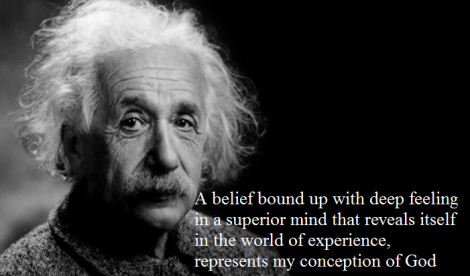
This law may said to be the primary characteristic of God.

.

Nirvana and Realization of God

Abbot_of_Watkungtaphao
Previous: Kalama Sutta
Next: Self-Determinism and Laws of Alignment

Nirvana in Buddhism is expressed as accessing that “still center” around which the self is built. We may refer to this still center as “The Unattached Viewpoint”.

The primary effort in Buddhism is to access the reality of this static condition directly and not just logically. Once this “static” is accessed, a person is forever oriented properly not only to his self, but also to the rest of the universe.

The ancient Vedas tried to approach the reality of this static through the practice of “neti-neti”. The Wikipedia states:

In Hinduism, and in particular Jnana Yoga and Advaita Vedanta, neti neti is a Sanskrit expression which means “not this, not this”, or “neither this, nor that” (neti is sandhi from na iti “not so”). It is found in the Upanishads and the Avadhuta Gita and constitutes an analytical meditation helping a person to understand the nature of Brahman by first understanding what is not Brahman. It corresponds to the western via negativa, a mystical approach that forms a part of the tradition of apophatic theology. One of the key elements of Jnana Yoga practice is often a “neti neti search.” The purpose of the exercise is to negate rationalizations and other distractions from the non-conceptual meditative awareness of reality.

Thus, this “static” may be viewed as the ultimate orientation point from which to sort out the confusion of self and the universe. This has been the characteristic feature of the eastern philosophy.

In the western philosophy, the orientation point is the concept of “God”, which has been defined as “the uncaused Cause” or “the unmoved Mover.” It has been assigned infinite characteristics. The Wikipedia states:

In monotheism, God is conceived of as the Supreme Being and principal object of faith. The concept of God as described by most theologians includes the attributes of omniscience (infinite knowledge), omnipotence (unlimited power), omnipresence (present everywhere), divine simplicity, and as having an eternal and necessary existence. Many theologians also describe God as being omnibenevolent (perfectly good), and all loving…
In theism, God is the creator and sustainer of the universe, while in deism, God is the creator, but not the sustainer, of the universe. In pantheism, God is the universe itself. In atheism, God is not believed to exist, while God is deemed unknown or unknowable within the context of agnosticism. God has also been conceived as being incorporeal (immaterial), a personal being, the source of all moral obligation, and the “greatest conceivable existent”. Many notable philosophers have developed arguments for and against the existence of God…

Thus, there are many different concepts of God, but the underlying concepts seem to be a point from which motion is created without limit. It is the concept of a Self that has infinite characteristics. It is the ultimate kinetic.

We seem to have a spread of characteristics from the “zero” of ultimate static to the “infinity” of ultimate kinetic.

We may represent this spread by a scale of motion and emotional characteristics. The static end represents Nirvana, whereas, the kinetic end represents God.

Nirvana and God seems to represent the opposite ends of a scale of physical and metaphysical characteristics.

The ultimate static of Nirvana represents an absolute zero not only for physical reality, but also for metaphysical and spiritual reality. It is zero qualities, zero capabilities and zero potential.

The ultimate kinetic of God represents the infinity not only for  metaphysical and spiritual reality, but also for physical reality. It is infinite qualities, infinite capabilities and infinite potential of this univrese.

Mathematically, “zero” is always viewed as the reference point on any scale. The zero of positive numbers is also the zero of negative numbers. Consistency lies in having the same zero for all numbers, whether positive, negative, rational or irrational.

Similarly, consistency lies in having the ultimate static of Nirvana as the reference point for all reality, whether physical, metaphysical, spiritual, abstract, real or imaginary. It is the point from which all values and characteristics are measured.

Infinity of God is simply an extreme value of all reality, whether physical, metaphysical, spiritual, abstract, real or imaginary. To understand infinity one requires the reference point of zero.

The understanding of God requires the orientation point of Nirvana.

.

The Human Mind

psychology

Previous: The Self
Next: The Mind’s Resolution

The human mind is the software that is programmed in the hardware of the brain. The mind has a capacity that is unrealized in most humans. The mind can easily operate on ten times the current capacity, or maybe more. But the upper limit of its capacity depends on the hardware of the brain. It is quite possible that this hardware may evolve toward greater capacity over time.

The mind may be described as a matrix of experiential data. The mind is self-determined in the sense that it always seeks continuity, harmony and consistency to align data as its equilibrium condition.

The human mind is a well-indexed matrix of experiential data that assimilates new experience by aligning it within the matrix.

The human mind senses, measures and experiences its contextual environment by resonating with it. In other words, the data of the experiential matrix replicates to match what is there. This is done through visualization. There is a gradient of resonance through which the mind becomes aware of similarities and differences of new data. This is the “observer” aspect of the mind.

The mind “observes” by resonating with what is there.

The human mind seeks equilibrium with new data by making it continuous, harmonious and consistent with its experiential data. It aligns and assimilates new data through free association. Thus, the mind is a self-adjusting data matrix. This is the “computer” aspect of the mind.

The mind “computes” by freely associating data into alignment.

When appropriate data is missing there come about gaps in alignment. The human mind makes projections to fill those gaps. The mind postulates data hoping it will bring the needed alignment. A postulate is something taken as self-evident or assumed without proof as a basis for reasoning. That postulate is most valuable, which brings about maximum alignment. A postulate is universally workable when it is aligned with the natural laws. The mind tests postulates by trial and error until it arrives at the right postulate. This is the “creative” aspect of the mind.

The mind “postulates” to resolve misalignment of data.

Memory is part of the creative function of the mind. Memories are not stored in their original form. Data is simply assimilated as experience once it is properly aligned. Past memories are dynamically constructed when recalled or used in free association of problem solving.

Memory is constructed ad hoc from experiential data matrix.

The ultimate criterion for resolution of doubts, perplexities and problems is the optimum alignment of data such that there are no remaining discontinuities, disharmonies and inconsistencies.

Doubts, perplexitites and problems are resolved by achieving alignment of data.

.