Category Archives: Meditation

The Law of Non-Interference

Please refer to The Discipline of Subject Clearing.

When contemplating deeply and meditating, one does not avoid, resist, suppress or deny any thoughts, emotions, and sensations. In short, one does not interfere with the activities of the mind.

Letting the mind unwind without interference or interruption keeps the mind safe during deep thinking, prayer and meditation. Here is a caution one must pay heed to.

Things may go dangerously awry when one anxiously digs into the mind for answers.

Note added March 29, 2022

Things may go dangerously awry when one anxiously digs into the mind for answers because one does not see the contents of the mind as they are. In short, he ceases to be mindful in perceiving the contents of his mind. Wrong interpretations then lead to wrong conclusions that can often destroy the reasoning ability of the mind.

The discipline for looking at the contents of the mind, which makes it safe, is provided at the following link along with the exercises.

The Discipline of Subject Clearing

.

Assumption and Inconsistencies

Please refer to Resolving Anomalies.

Suppose a person believes that all men have two ears. When he comes across a person with only one ear, he faces an inconsistency. His assumption then adversely influences his viewpoint and actions.

.

Assumption

Prejudice, bias, and beliefs are the result of inherent assumptions that people have. They think and act only in ways that agrees with their assumptions. Thus, assumptions act as constraints on their viewpoint. Their viewpoint is narrow.

From a narrow viewpoint, a person is unable to perceive the whole situation. Therefore, he misjudges and cannot resolve many situations in his life. He gets stuck with unwanted conditions.  He is not able to make progress.

An assumption narrows one’s viewpoint and leads to unwanted conditions.

.

Inconsistencies

When a person is running into problems with relationships, finances, or in living, he has a gut feeling that something is not right somewhere, but he can’t put his finger on it. Similar feelings had haunted him in school when he could not understand a subject, such as mathematics. He is faced with unwanted conditions that are filled with inconsistencies.

His doubts, confusions and perplexities corrupt his attention. It either becomes unfixed and sweeping at random or becomes too fixed without sweeping. This corrupted attention is a powerful indicator where he should be looking in meditation.

When he looks more closely at the area that is corrupting his attention he becomes aware of many inconsistencies. As he looks closer at the inconsistencies he finally discovers the underlying assumption that is causing him trouble.

Mindfulness exercises help one look at one’s unwanted conditions more closely and discover the underlying assumptions that he needs to get rid of.

.

Be There and Confront

Reference: Course on Subject Clearing

[NOTE: These are ancient ideas from the East, which were organized in the West by L. Ron Hubbard. I thank Hubbard for his ingenious contribution to knowledge.]

.

THE FUNDAMENTALS

In Subject Clearing you observe, contemplate and even meditate. The common ground of all these activities is to BE THERE AND CONFRONT.

It means focusing the thoughts on a subject from every point of view without flinching or avoiding.

It involves viewing something thoroughly. The idea is to understand all possible angles and relationships.

The end product of subject clearing is to perceive something for what it truly is.

.

LOOKING

Subject clearing is the process of looking, not thinking. Thinking is often used to avoid looking at things to such a degree that it degenerates into a never-ending “figure-figure.” In subject clearing one simply looks. If there is any thinking at all, it is to find out where to look.

The only thing that can be said about looking is that to look one must be willing to be there and face things without flinching or avoiding. If you cannot be there, then you cannot look and experience. Thus, whether one’s eyes are open or closed, one simply decides to be there and looks at the picture in front of one, whether real or imagined, without interfering with it.

Simply look without trying to figure things out.

.

BEING THERE

You do not have to assume a lotus position, as in meditation, to be there. Any posture is fine as long as you keep your body relaxed and spine straight. You may sit in a straight-backed chair if that is more comfortable. When sitting still in a chair for some time, you may keep feet flat on the floor, and hands in your lap. When contemplating or meditating, just be there without moving or doing anything.

Even when you close your eyes, simply observe what is there. At first, you may perceive only blackness. But soon you may become aware of light and darkness, various sounds and smells, the temperature in the room, the pull of gravity, the taste in your mouth, and scores of other such perceptions from the body. The mind may present pictures of current or past situations, thoughts, emotions and conclusions.

It is important to understand who is observing. The body’s eyes may be closed so you cannot be the body. You are observing the mind so you cannot be the mind. Who are you then? In subject clearing you simply are an observer (the awareness). And as you contemplate and meditate, you will discover many things about yourself and your perception of the world.

As you sit contemplating, all kind of things will come up, some flattering and some not so flattering. Do not get into any justification or “figure-figure.” Just be there and face them. Your sense of perception may heighten as a result.

Simply be there so you can look at what is there.

.

CONFRONTING

The essential part of being there is to face without flinching or avoiding. This is called confronting. As you contemplate, pictures may come up that remind you of something embarrassing or painful. The normal reaction would be to flinch and look away. But in subject clearing you must continue to be there and confront them, no matter how painful and embarrassing that may be. As you persevere, understanding will dawn, and the painful pictures will disappear.

As you sit in a comfortable posture, there may be a tendency to squirm, twitch, move or change position, when uncomfortable pictures come up. Just be there without moving or doing anything else, and the pain and discomfort will go away. You only have to make sure that your sitting posture is such that it can keep you comfortable for some time.

As you contemplate or meditate, certain physical reactions may occur, such as, stabs of pain, drowsiness, dullness of senses, twitches in muscles, and so on. Do not do anything. Do not resist or try to suppress such reactions. Just be there and confront. These physical reactions will disappear after some time.

There is a safety factor built into the mind. That is, the mind would never present something so embarrassing, discomforting, or painful that it is overwhelming. Just be there with whatever comes up.

It is important that you let the mind present things to you. If you find yourself getting involved in thoughts or doing something else mentally then simply realize this fact. Put your attention on breathing, or at the bottom of your spine, and do nothing else. This will get you back to just being there.

As you confront the material presented by the mind, new realizations will occur. Your ability to confront will come up, and as this happens, the mind finds it safe to present more material that you were not aware of before. And so, it continues.

Try ending each session of subject clearing at a point when some persisting reaction or thought has just gone away leaving you with a sense of relief. Do not end a session while you are in the middle of such a reaction. The end result of a subject clearing session is not necessarily more information, but it is a heightened awareness of your environment and an increased confidence in your being.

Simply face what is there without flinching or avoiding.

.

EXERCISE

Here are the exercises to practice the above.

  1. Mindfulness Meditation 
  2. TR0 with Mindfulness

.

SUMMARY

To be there and confront is an adventure. You embark on it to become more aware. It helps you discover the causes of conditions and gain control over them. And the results are beyond any expectations.

.

The Goal of Meditation

The original word for becoming enlightened is Bodhi, which means “awakened”. The words the Buddha uttered involuntarily at the moment of enlightenment were: 

“Wonder of wonders! Intrinsically all living beings are Buddhas, endowed with wisdom and virtue, but because men’s minds have become inverted through delusive thinking, they fail to perceive this.”

A human being, whether clever or stupid, male or female, ugly or beautiful, is capable of being awakened to the fact that he is naturally endowed with wisdom and virtue. There is no perfection other than this state of being awakened.

At the moment of enlightenment, the person is suddenly out of the trap of his deluded thinking that is preventing him from perceiving his true nature.

.

The Goal of Meditation

The goal of meditation is to become enlightened. When you start practicing meditation, it immediately reduces the turbulence in your mind so you can become more aware. With increased awareness you can start spotting your deluded thinking and make it disappear.

At first you may be in doubt about your true nature. But as you make progress through meditation there comes a point when you suddenly awake to your true nature. You now have a certainty that harbors no doubt. It is a unique moment that fills you completely with joy and happiness.

.

The Enlightened Individual

An enlightened individual is not absolutely free of flaws, but he is cleared of his deluded thinking. He has a mind in which perceptions continually divide into fine discriminative elements and get freely associated and assimilated into an orderly mental matrix providing rational solutions.

The cleared individual does not avoid, resist, suppress or deny any thoughts, emotions, and sensations when thinking; and so, he perceives things objectively with clarity. He is able to examine and overcome all prejudices, biases and fixations. He is keenly perceptive and knowledgeable and continues to explore new areas of knowledge.

The cleared individual is universal in his outlook. He rises above any idea of self or individuality. He is not subjective, self-centric, or human-centric. There are no conflicts within him. He would not hesitate to sacrifice himself if need be.

The cleared individual can look from the viewpoint of others as well as objectively from the viewpoint of all life and the environment. He continues to expand his understanding of the physical and spiritual aspects of the universe without resorting to superstitions.

The cleared individual is the first to realize his error and correct himself. Whenever he senses resistance or observes some oddity, he follows it up until it is cleared. If he suffers a painful experience, heavy loss, or confusion he is able to sort it out quietly in his mind.

The cleared individual is in good health and has no psychosomatic illnesses. He is purposeful in his demeanor, and graceful in his movements. He is strong and calm even in adversity. In no way is he trying to win or dominate, but he is passionately engaged in bringing order to his environment.

Above all, he is compassionate.

.

Posture in Meditation

In the Satipatthana Sutta Buddha instructs:

Herein, monks, a monk, having gone to the forest, to the foot of a tree or to an empty place, sits down with his legs crossed, keeps his body erect and his mindfulness alert.

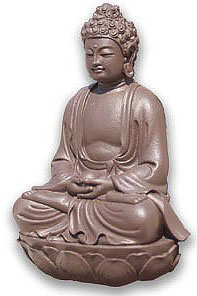
The ancient statues of Buddha show him sitting in this posture. An erect posture imparts the alertness of mindfulness.

In the Yoga Sutra, Patanjali describes this asana as a “steady and comfortable posture.” So, a meditative posture, besides being stable and erect must also be natural and comfortable so that it could be maintained for a long time without causing any stress or discomfort.

The condition of body in deep meditation is very similar to the condition in deep sleep. When sitting, the body may slump if not propped up properly. Crossing the legs and locking them in full-lotus position keeps the body erect even in deep meditation.

The purpose of the posture in meditation is to keep the body stably erect, even in deep meditation, in a natural and comfortable manner.

.

Niceties of Posture

In the ancient culture people were used to sitting with their legs crossed. This posture was natural and comfortable to them. So, this became the natural posture in meditation. Over time, however, other details got added that are not essential to meditation.

Zen Buddhism goes into incredible details about how to sit in meditation. It provides the size and shape of cushions to sit on, and the kinds of clothes that should be worn. It specifies how to place legs and knees on the mat, and hands and fingers in the lap. It dictates how ears should be lined up with the shoulders, and nose with the navel. It even directs the position of tip of the tongue, and the angle of the gaze. If you give importance to such niceties you can waste much time worrying about the correct posture during meditation.

Once the purpose of meditative posture is met, additional details prescribed for the posture are inessential.

.

Sitting in a Chair

In many cultures, especially in European culture, people are not used to sitting with their legs crossed. People find it easier to sit in a chair. They do not feel comfortable in the lotus posture after a while.

As long as body can be kept stably erect, there is no reason why a person cannot meditate sitting in a chair. One may use a straight-backed chair to keep the body erect. Additional cushions may be used to ensure the stability of the posture in deep meditation.

One may meditate sitting in a straight-backed chair as an alternative to the lotus position.

When meditating in a chair, it may help if the knees are parallel to the shoulders and feet are flat on the ground. The arms may rest in the lap. The hands, fingers and tongue may assume natural and relaxed positions. The eyes may be open, half open or closed according to natural tendency. The attention may focus or not focus on anything in particular. The gaze may become directed or peripheral. These variations may occur naturally during meditation.

.