
Please see Course on Subject Clearing
I shall start these postulates with what Buddha declared.
KHTK Postulate M-0: The Absolute Truth is that there is nothing absolute in the world, that everything is relative, conditioned and impermanent, and that there is no unchanging, everlasting, absolute substance like Self, Soul, or Ātman within or without.
DEFINITION: Absolute means, “Viewed independently; not comparative or relative; ultimate; intrinsic.”
This postulate may appear self-contradictory to some, but it essentially says, “There are no absolute certainties.” This is reflected in one of the most ancient hymns, The Creation Hymn of Rig Veda.
All certainties are relative. This statement does not degrade any certainty we have. It simply means that one can always come up with a better certainty.
That is how science makes progress. Einstein declared the speed of light to be a universal constant. This is a certainty for now, but there may possibly be a wider context in which the speed of light is a special case.
Similarly, in the field of spirituality, we cannot be absolutely certain that self or soul is permanent. The phenomenon that is described as self or soul must be open to further investigation.
There is no progress possible for a person who believes his certainties to be absolute.
Reference: The Quest for Certainty
.
KHTK Postulate M-1: Awareness is primordial disturbance.
Awareness is known to arise, change and disappear. It may be likened to a disturbance that arises, changes and disappears. We may assume some ground state, which when disturbed gives rise to awareness.
However, the ground state shall forever be unknowable and shall remain only theoretical because there is no awareness to go with it. Awareness arises only when this ground state is disturbed. Therefore, awareness is something relative and not absolute.
Reference: The Ultimate Reality
.
KHTK Postulate M-2: Consciousness (self-awareness) is primordial light.
Awareness is aware by its very nature. This self-awareness is called consciousness.
Since awareness seems to be disturbance, and science recognizes light (electromagnetic wave) as the most basic form of disturbance in nature, there is some justification in associating consciousness with light. It appears that this association of consciousness with light has been made on an intuitive basis since ancient times.
Consciousness may be regarded as something spiritual as opposed to physical. But spiritual and physical states are neither absolute nor independent. This is similar to the case with space and time which are found by the scientific investigation to be neither absolute nor independent.
For a long time space and time were regarded as absolute concepts in themselves. Newtonian mechanics built on that consideration is still very successful but in a limited scope on earth. Einstein’s Theory of Relativity, when considering a cosmic scale, finds space and time to be relative. Similarly, Abrahamic religions have long regarded spiritual and physical states to be absolute in themselves. This has been adequate for a limited understanding of human consciousness. But to understand consciousness on cosmic scale we need to consider spiritual and physical states to be relative. A spiritual state will have physical form, no matter how subtle. And a physical state will have some spiritual characteristics, no matter how subdued.
Thus, we may say with some confidence that self-awareness, or consciousness, has the basic form of light, which represents a disturbance of nearly infinite wave-length of practically zero frequency. Being timeless, its velocity is infinite. Since awareness is relative, consciousness is also relative.
This is a very raw level of consciousness. Soul, self, energy, matter, etc., come later.
Reference: Awareness and Light
.
KHTK Postulate M-3: Awareness, as a disturbance, is a back and forth conversion between perception and knowledge.
As disturbance occurs, there is perception. Perception then acquires meaning. This is knowledge. Knowledge then prompts perception, which then acquires meaning, and so on.
When I am looking at a tiled floor, I perceive a tiled floor because I know it is a tiled floor. It is almost like a tautology. It is a back and forth conversion of perception and knowledge of a tiled floor.
This is the form awareness as a disturbance – a back and forth conversion between perception and knowledge. This parallels light as a disturbance – a back and forth conversion between electric and magnetic fields.
.
KHTK Postulate M-4: Awareness expands and consciousness grows as the frequency of perception/knowledge interchange increases.
Knowledge gives meaning to incoming perception, whereas perception strengthens the knowledge with meaningful patterns. There is a finite frequency, wavelength and period to this interchange. As the frequency of this disturbance increases, more complex awareness comes about, and all that meaning molds consciousness.
The most fundamental level of consciousness (self-awareness) is the primordial light. As frequency increases, the light acquires new characteristics, and capabilities for new interactions. These characteristics express the inherent knowledge, and the interactions express the inherent perceptions.
The answers to questions like, “How this disturbance does come about?” or “How does its frequency increase?” shall have to wait. But we know that awareness seems to grow with intuition, and this intuition is somehow linked to the frequency of perception/knowledge interchange. That is why mindfulness is effective. Mindfulness is essentially seeing things as they are. As one perceives things continually without interfering with them, intuitions come about.
.
KHTK Postulate M-5: The range of frequencies of perception/knowledge interchange generates a spectrum of consciousness.
The increasing frequency of perception/knowledge interchange may be characterized by Disturbance levels. The basic level of disturbance may be defined as having a frequency of 1 (20). At this level the wavelength of the disturbance is practically infinite and the period is non-existent. The basic consciousness would appear as primordial light without characteristics. We may refer to this level as DL0 (Disturbance Level 0).
The subsequent disturbance levels, DL1, DL2, DL3, etc., may be defined in terms of doubling of frequency, such as, 2 (21), 4 (22), 8 (23), etc. Disturbance Level ‘n’ (DLn) will have a frequency of 2n. As disturbance levels increase, the wave-length of light shrinks to create the dimensions of space. The period is manifested to create the dimension of time. These dimensions become manifested with the formation of finite forms.
Please note that Consciousness consists of both spiritual and physical characteristics througout this spectrum.
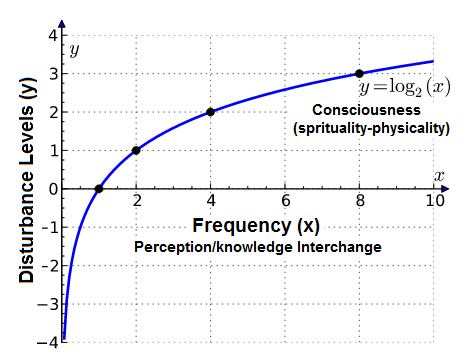
The graph above presents the disturbance levels as a function of frequency of perception/knowledge interchange. The frequencies are plotted along the x-axis, and the disturbance levels are plotted along the y-axis. It can be seen from this graph that negative disturbance levels may be postulated with the halving of frequency. The frequency never reaches the zero of the theoretical ground level.
The disturbance level of zero occurs at the frequency of 1. The disturbance is manifested as consciousness that has both spiritual and physical characteristics.
.
Next:
KHTK Postulates for Metaphysics – Part 2
KHTK Postulates for Physics
.