Category Archives: KHTK

Knowing How to Know

KHTK Postulates for Metaphysics – Part 4 (old)

ultimate-reality

Please see Course on Subject Clearing

KHTK Postulate M-16: Cause is the first part, and effect is the last part of association (in time) among forms.

We cut a tree; it falls. We strike a match; it lights up. Thus, we have a phenomenon that seems to be a direct consequence of another phenomenon. This makes us believe that all phenomena are caused. We, thus, assume that a form must be a consequence of another form. This belief leads to an infinite series of causes, where each cause has a form. To resolve the inconsistency of an infinite series of causes, we assume a First Cause that is not itself caused.

.

KHTK Postulate M-17: Forms precede cause and effect. There is no “First Cause.”

“First Cause” is a part of a series of assumptions as described above. The idea of cause has to do with the association and the type of relationship among forms. Cause is not some form itself. A cause is created only when an “association in time” is set up among existing forms. The forms themselves may simply appear or disappear depending on perception.

.

KHTK Postulate M-18: That which underlies forms cannot be a form. If God underlies forms then God cannot be a form.

God is associated with properties such as holiness, justice, sovereignty, omnipotence, omniscience, benevolence, omnipresence, and immortality. If these properties can be visualized then they are forms even when they are abstractions. None of these forms can be God. In fact any description of God would be a form. So, no description of God can be God.

.

KHTK Postulate M-19: What underlies forms is ultimately unknowable.

The processes of perceiving and knowing underlie the forms. Beyond these processes we may postulate primordial inertia-less field and activity-less energy. One may postulate something different. But it always ends up with postulates to make all forms consistent.

.

KHTK Postulate M-20: God is ultimately unknowable, though it may be speculated upon.

If God is viewed as the ultimate reality underlying all forms, then God is beyond all desires, activities and expectations because these are forms. Like the asymptote that never reaches its limiting value God cannot be known with absolute certainty, though we may speculate upon God.

.

KHTK Postulates for Metaphysics – Part 3 (old)

11

Please see Course on Subject Clearing

KHTK Postulate M-11: Knowledge is always relative and never absolute.

It seems that the speed of light is absolute as declared by the Theory of Relativity and verified by many experiments. But this has been verified only for the visible frequency and in a matter-centric frame of reference. This speed could be relative to the frequencies in the spectrum and to the frame of references provided by the disturbance levels.

Knowledge is an aspect of awareness. Since awareness is relative, knowledge is relative too. It is not possible to have an absolute reference point of knowledge. Any assumption of such reference point shall be arbitrary.

.

KHTK Postulate M-12: Reality is what is perceived and exists to be perceived.

KHTK Postulate M-13: Truth is the degree of consistency and coherency in the reality perceived.

.

KHTK Postulate M-14: A belief system is knowledge that interprets reality in some useful way.

.

KHTK Postulate M-15: Self is a belief system capable of dynamic projection. 

.

Next: 

KHTK Postulates for Metaphysics – Part 4

.

KHTK Postulates for Metaphysics – Part 2 (old)

Form2

Please see Course on Subject Clearing

KHTK Postulate M-6: Physics is the study of form. Metaphysics is the study of the underlying essence, or spirit.

Awareness consists of perception/knowledge interchange. It is conscious of itself as light.

The domain of Physics consists of the forms of perception starting with light. The ultimate in form is the body that serves as the vehicle for perception.

The domain of Metaphysics consists of the essence of knowledge starting with consciousness. The ultimate in essence (spirit) is the self that serves as the vehicle for knowledge.

.

KHTK Postulate M-7: Increase in disturbance levels make finite forms emerge out of primordial light.

Awareness comes about because of the desire to know. As this desire gets stronger the disturbance levels increase, and the perception/knowledge conversions occur at a greater frequency. The wave-length shrinks and becomes finite and periodic. Thus forms come about that have boundaries. There appears a sense of finite against an indescribable background.

As forms emerge from the primordial light, awareness acquires the distinction of who, what, where and when. This awareness is distributed among these forms. Thus, comes about knowledge of forms as beliefs.

All these forms and beliefs emerge from primordial light, so they are all connected and cross indexed in a consistent and coherent manner within the same consciousness.

.

KHTK Postulate M-8Dimensions then emerge to describe the finite characteristics of these forms.

Space and Time are the primary dimensions that emerge with the finite forms. They provide the characteristics of extension and duration, against a background that has neither of these characteristics. More complex characteristics, such as, density and temperature, come about as disturbance levels increase.

It is to be understood that the primordial background is indescribable. It has neither extension nor duration because there is neither space nor time at that level. It would be an error to visualize primordial light as having infinite extension.

Furthermore, the disturbance levels may be identified as a dimension that is basic to even space and time. We may describe it as the dimension of abstraction that becomes increasingly concrete with growing disturbance.

.

KHTK Postulate M-9: Basic level of knowledge consists of the direct perception of forms.

As disturbance levels increase, the primary forms interact with each other to generate more complex forms. Thus come about an infinite variety and diversity of forms. The forms of houses, trees, roads, business, people, etc., come together through extension in space to generate a complex city. Similarly, the forms of musical notes may come together through sequencing in time to generate a beautiful melody.

Essentially, knowledge is anything that is perceived. Direct perception provides the basic level of knowledge. More complex levels are generated through association among what is perceived, and projection from what is known.

.

KHTK Postulate M-10: As knowledge is associated and projected, direct perception condenses into experience, information, hypothesis, theory, principles, and axioms.

As knowledge is generated with increasing disturbance levels, it is cross-indexed through association and projection. Common elements are perceived and recognized as such. Thus organization and simplification of perception comes about in the form of experience, information, hypothesis, theory, principles, and axioms. Consistency and coherency is the key to the organization and simplification of overall knowledge.

There is overall self-awareness, but the individual forms are also self-aware. The self-awareness of individual forms add up to the self-awareness of more complex forms.

.

Next: 

KHTK Postulates for Metaphysics – Part 3

.

KHTK Postulates for Metaphysics – Part 1 (old)

alone-on-a-boat-fishing

Please see Course on Subject Clearing

I shall start these postulates with what Buddha declared.

KHTK Postulate M-0: The Absolute Truth is that there is nothing absolute in the world, that everything is relative, conditioned and impermanent, and that there is no unchanging, everlasting, absolute substance like Self, Soul, or Ātman within or without.

DEFINITION: Absolute means, “Viewed independently; not comparative or relative; ultimate; intrinsic.”

This postulate may appear self-contradictory to some, but it essentially says, “There are no absolute certainties.” This is reflected in one of the most ancient hymns, The Creation Hymn of Rig Veda.

All certainties are relative. This statement does not degrade any certainty we have. It simply means that one can always come up with a better certainty.

That is how science makes progress. Einstein declared the speed of light to be a universal constant. This is a certainty for now, but there may possibly be a wider context in which the speed of light is a special case.

Similarly, in the field of spirituality, we cannot be absolutely certain that self or soul is permanent. The phenomenon that is described as self or soul must be open to further investigation.

There is no progress possible for a person who believes his certainties to be absolute.

Reference: The Quest for Certainty

.

KHTK Postulate M-1: Awareness is primordial disturbance.

Awareness is known to arise, change and disappear. It may be likened to a disturbance that arises, changes and disappears. We may assume some ground state, which when disturbed gives rise to awareness.

However, the ground state shall forever be unknowable and shall remain only theoretical because there is no awareness to go with it. Awareness arises only when this ground state is disturbed. Therefore, awareness is something relative and not absolute.

Reference: The Ultimate Reality

.

KHTK Postulate M-2: Consciousness (self-awareness) is primordial light.

Awareness is aware by its very nature. This self-awareness is called consciousness.

Since awareness seems to be disturbance, and science recognizes light (electromagnetic wave) as the most basic form of disturbance in nature, there is some justification in associating consciousness with light. It appears that this association of consciousness with light has been made on an intuitive basis since ancient times.

Consciousness may be regarded as something spiritual as opposed to physical. But spiritual and physical states are neither absolute nor independent. This is similar to the case with space and time which are found by the scientific investigation to be neither absolute nor independent.

For a long time space and time were regarded as absolute concepts in themselves. Newtonian mechanics built on that consideration is still very successful but in a limited scope on earth. Einstein’s Theory of Relativity, when considering a cosmic scale, finds space and time to be relative. Similarly, Abrahamic religions have long regarded spiritual and physical states to be absolute in themselves. This has been adequate for a limited understanding of human consciousness. But to understand consciousness on cosmic scale we need to consider spiritual and physical states to be relative. A spiritual state will have physical form, no matter how subtle. And a physical state will have some spiritual characteristics, no matter how subdued.

Thus, we may say with some confidence that self-awareness, or consciousness, has the basic form of light, which represents a disturbance of nearly infinite wave-length of practically zero frequency. Being timeless, its velocity is infinite. Since awareness is relative, consciousness is also relative.

This is a very raw level of consciousness. Soul, self, energy, matter, etc., come later.

Reference: Awareness and Light

.

KHTK Postulate M-3: Awareness, as a disturbance, is a back and forth conversion between perception and knowledge.

As disturbance occurs, there is perception. Perception then acquires meaning. This is knowledge. Knowledge then prompts perception, which then acquires meaning, and so on.

When I am looking at a tiled floor, I perceive a tiled floor because I know it is a tiled floor. It is almost like a tautology. It is a back and forth conversion of perception and knowledge of a tiled floor.

This is the form awareness as a disturbance – a back and forth conversion between perception and knowledge. This parallels light as a disturbance – a back and forth conversion between electric and magnetic fields.

.

KHTK Postulate M-4: Awareness expands and consciousness grows as the frequency of perception/knowledge interchange increases.

Knowledge gives meaning to incoming perception, whereas perception strengthens the knowledge with meaningful patterns. There is a finite frequency, wavelength and period to this interchange. As the frequency of this disturbance increases, more complex awareness comes about, and all that meaning molds consciousness.

The most fundamental level of consciousness (self-awareness) is the primordial light. As frequency increases, the light acquires new characteristics, and capabilities for new interactions. These characteristics express the inherent knowledge, and the interactions express the inherent perceptions.

The answers to questions like, “How this disturbance does come about?” or “How does its frequency increase?” shall have to wait. But we know that awareness seems to grow with intuition, and this intuition is somehow linked to the frequency of perception/knowledge interchange. That is why mindfulness is effective. Mindfulness is essentially seeing things as they are. As one perceives things continually without interfering with them, intuitions come about.

.

KHTK Postulate M-5: The range of frequencies of perception/knowledge interchange generates a spectrum of consciousness.

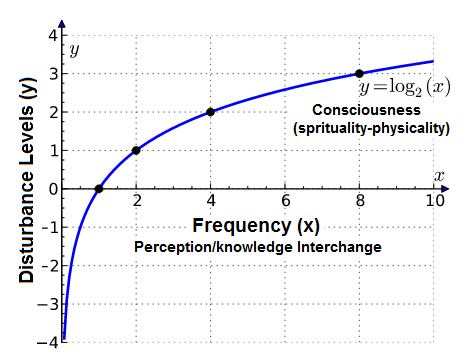
The increasing frequency of perception/knowledge interchange may be characterized by Disturbance levels. The basic level of disturbance may be defined as having a frequency of 1 (20). At this level the wavelength of the disturbance is practically infinite and the period is non-existent. The basic consciousness would appear as primordial light without characteristics. We may refer to this level as DL0 (Disturbance Level 0).

The subsequent disturbance levels, DL1, DL2, DL3, etc., may be defined in terms of doubling of frequency, such as, 2 (21), 4 (22), 8 (23), etc. Disturbance Level ‘n’ (DLn) will have a frequency of 2n. As disturbance levels increase, the wave-length of light shrinks to create the dimensions of space. The period is manifested to create the dimension of time. These dimensions become manifested with the formation of finite forms.

Please note that Consciousness consists of both spiritual and physical characteristics througout this spectrum.

Disturbance Levels

The graph above presents the disturbance levels as a function of frequency of perception/knowledge interchange. The frequencies are plotted along the x-axis, and the disturbance levels are plotted along the y-axis. It can be seen from this graph that negative disturbance levels may be postulated with the halving of frequency. The frequency never reaches the zero of the theoretical ground level.

The disturbance level of zero occurs at the frequency of 1. The disturbance is manifested as consciousness that has both spiritual and physical characteristics.

.

Next: 

KHTK Postulates for Metaphysics – Part 2

KHTK Postulates for Physics

.

KHTK Postulates (old)

einsteintagore1

When Einstein Met Tagore

Please see Course on Subject Clearing

KHTK Postulate #0: There are no absolute certainties.

DEFINITION: Absolute means, “Viewed independently; not comparative or relative; ultimate; intrinsic.”

All certainties are relative. This statement does not degrade any certainty we have. It simply means that one can always come up with a better certainty. That is how science makes progress.

Einstein declared the speed of light to be a universal constant. This is a certainty for now, but I believe that there is possibly a wider context in which the speed of light may simply be a special case.

There is no progress possible for a person who believes his certainties to be absolute.

.

KHTK Postulate #1: All motion is relative.

With nothing else to compare to one cannot tell if one is at rest or if one is moving at the speed of light. When there are two objects in relative motion there is still no way to tell which object is at rest and which object is moving.

There is no frame of reference that may be considered absolute. Einstein makes “speed of light” as the absolute frame of reference, from which he then derives rest of his theory. I believe that this frame of reference needs to be examined more closely.

.

KHTK Postulate #2: Awareness arises with motion.

All awareness must consist of motion. For example, all objects perceived consist of motion at atomic level. Similarly, there is no inherent awareness, or consciousness, that does not consist of motion within itself.

Awareness is an interesting subject yet to be fully investigated.

.

KHTK Postulate #3: Physical motion is composed of physical space and time.

Motion consists of changing states that must occur relative to each other. This postulates separation, which is the characteristic of space. Space consists of dimensions, such as, length, width and depth. Relative occurrence is the characteristic of time.

The radical idea here is that space and time are components of motion. This is different from the traditional idea that motion takes place in space and time, which is how it appears.

.

KHTK Postulate #4: Awareness is composed of mental space and time.

Awareness consists of relative assessment of perceptions. Mental space provides dimensions, such as, good – evil, survival – non-survival, constructive – destructive, etc., in the form of scales. Mental time provides sequencial associations and consistency.

.

KHTK Postulate #5: Physical Space consists of distances and directions.

A point may be referenced from another point by means of a distance and a direction. In a three-dimensional frame of reference the distance may have component dimensions of length, width and height. Relationship among these dimensions represents the direction.

Distance and direction form the space component of motion.

.

KHTK Postulate #6: Mental Space consists of evaluations and tones.

A datum may be compared to another datum resulting in an evaluation and a tone or feeling. Evaluations are based on gradient scales, such as, good – evil, survival – non-survival, constructive – destructive, etc. Tone is set by the relationship of the positions on these scales.

Evaluation and tone form the mental space component of awareness.

.

KHTK Postulate #7: Physical time consists of repetitive occurrence.

A moving object disappears at one location and appears at another location repetitively. Repetitive appearance and disappearance form the time component of motion.

.

KHTK Postulate #8: Mental time consists of controllable sequences.

Mental time consists of sequences that may be accessed at a slow or faster pace, and which, to some degree, may be controlled. Access to such sequences form the mental time component of awareness.

.

KHTK Postulate #9: Motion may be represented by a wave.

When we use wave to represent motion, the wave-length shall represent the space aspect of motion, and the period shall represent the time aspect of motion.

In addition, the frequency shall represent the inertial aspect of motion. The larger is the frequency, the greater shall be the inertia (resistance to change from the status quo) contained in that motion.

.

KHTK Postulate #10: The frequency of a wave is a measure of its inertia.

Per E = hʋ, the momentum of a photon is proportional to its frequency. Taking it one step further it may be said that the frequency of a wave is a measure of its inertia. As the frequency of wave increases, the inertia of the wave increases. This increased inertia first appears in the discreteness of wave packets or photons.

The higher is the frequency of electromagnetic radiation, the straighter will be its path through a gravity field. A massive celestial body may bend the electromagnetic radiation variously by its frequency components. This may be easy to verify. [Note 1/13/16 – This may just be the opposite. The higher inertia will bend the radiation more.]

.

KHTK Postulate #11: The location of an object in this universe is only as certain as its inertia.

The stars and planets in this universe are massive and can be located with precision. However, the electrons in an atom have very little mass or inertia. They can be located in highly probabilistic terms only. Thus, it appears that the higher is the inertia of an object, the greater is the certainty with which it may be located as a discrete entity.

Inertia is resistance to motion. Increasing inertia may collapse an electromagnetic wave upon itself making it appear like a discrete particle with a form. It may also be looked upon as condensation of motion or space-time.

.

NOTE: This is a developing post. It shall be continually added to.

.