Category Archives: KHTK

Knowing How to Know

Universe and Awareness

Laniakea

Reference: The Creation Hymn of Rig Veda

Of all the dichotomies in this Universe, the most interesting dichotomy is “awareness – non-awareness.”

“Non-awareness” is like a curtain. We do not know what is behind that curtain. We only know what is in front of it. When something emerges from that curtain we become aware of it. Until then we may only speculate about what is behind that curtain.

POSTULATE: The Universe begins as it emerges from behind the “curtain” of non-awareness.

.

Like any dichotomy, “awareness – non-awareness” may represent a single continuum, and the two ends extend to infinity in either direction. The “curtain” described above is a transition point on this continuum, and not a point of creation.

We cannot tell whether the universe was ever created or if it has always been there.

.

The state of the Universe behind the “curtain” can only be speculated. If there is a Divine Principle that stands above the Universe, it would lie behind the “curtain,” and would only represent a speculation.

Any Divine Principle that stands above the Universe may be relegated to speculation.

.

Since the Universe begins when it transitions from non-awareness into awareness, the common denominator of the entire Universe may be established as AWARENESS. Awareness is, however, only half of the dichotomy. The Vedic process of “Neti, Neti” (not this, not that) essentially asserts that the basis of this universe lies beyond awareness.

The Universe is made up of AWARENESS, the basis of which lies in non-awareness.

.

The idea, “God created this world” arbitrarily divides the awareness of Universe into “God” and “world.” God cannot be excluded from the awareness of Universe.

The Universal awareness shall include awareness attributed to gods or God.

.

The universe begins with awareness. It has evolved entirely out of awareness. It may end by transitioning back into non-awareness. The universe has to be aware of itself because it is all that there is.

The Universe is aware of itself.

.

Next: Awareness and Motion

A Model of Mind

self

Reference: A Model of Self

The Universe begins as it emerges from non-awareness into awareness. It may appear at first as a vast field of awareness having the form of light. The physical universe evolves within this universal field of awareness. The perception of the physical universe agrees from person to person. This is like personal minds sharing this field of awareness, or universal mind.

The personal minds seem to exist within a vast field of awareness, or universal mind.

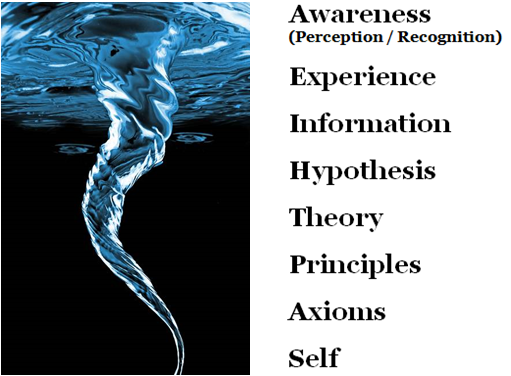
The personal mind seems to be produced by the condensation of awareness at locations within this vast field. This condensation is postulated to comprise of various stages as shown in the whirlpool model above.

The mind begins with awareness. Awareness consists of perception and recognition. According to Wikipedia, the process of perception involves the following steps:

  1. Body’s sensory organs are incited by means of light, sound or another physical process.
  2. These sensory organs transform the input energy into neural activity.
  3. These neural signals are transmitted to the brain.
  4. The brain organizes and interprets the signals.
  5. This creates awareness or understanding of the environment.

But the various elements of this process are themselves perceived in a way. Therefore, it is not quite definitive how we perceive and recognize things

We perceive only what awareness tells us through the mind.

.

As soon as perceptions are recognized, they become experience. Over time experience condenses as information. Experience and information seems to be stored in a very efficiently organized matrix constructed out of definitions and logics. It seems to have the form of an electromagnetic field supported by macromolecules and neurons in the body.

A matrix constructed out of definitions and logics seems to form the core of the mind.

From information the mind generates hypotheses. Certain hypotheses get confirmed as theories and can be relied upon for prediction. Hypotheses and theories help associate data in the mind.

Hypotheses and theories seem to aid the computation that occurs within the mind.

This leads to the generation of wider principles, which provide directions to thinking. Principles are followed by axioms, which are taken for granted to be true when one thinks.

Principles and axioms seem to provide the basis on which the mind operates.

Finally, there is self that represents the uniqueness of the mind. This is the final form of condensed awareness at a location in the field of awareness of the universal mind.

The uniqueness of the mind appears as Self.

.

The objectivity of awareness is determined by the basic field of awareness of the universal mind. Thus, the uncompressed awareness at the point of perception is the most objective in nature. When this perception is condensed as experience and information from some unique perspective of the mind it becomes subjective.

The awareness consistent with the universal field of awareness is the most objective in nature.

The awareness becomes more subjective as it is condensed through various stages of the mind in its unique way. The end product of that condensation is self, which is regarded as a unique individuality.

The most subjective form of awareness is the unique individuality of the self.

The reality is made of the objective awareness at the level of the universal mind. The subjective awareness of self then appears to be as real as it is consistent and coherent with the universal mind.

.

The minds are thus constructed out of condensations of awareness at various locations within the universal mind. The uniqueness of condensation is the self that is recognized by its individuality.

Mind relates the condensation from simple universal awareness to the complex self.

The simple and vast universal mind has the form of light. The unique and complex self has the form of the human body. Spirit and matter occur together as essence and form at every point of condensation.

Matter provides form to spirit, and spirit provides essence to matter.

.

As a summary of this model.

(1) Mind is a multi-dimensional matrix of definitions and logic.

(2) Self is the most condensed expression of the mind.

Also please refer to A Model of Self.

.

A Model of Self

Amsterdam 2008

BRAHMA (Vedas) – A postulated ground state that is beyond definition  or awareness.

GOD (Christianity) – A postulated Supreme Self to explain the appearance of existence

STATIC (Scientology) – A postulated Unmoved Mover that stands separate from the Universe.

GROUND STATE – The ground state has no awareness and no definition. The definition comes with awareness.

AWARENESS – Awareness is postulated to be the disturbance of ground state. It provides a definition. Awareness, as a disturbance, oscillates between perceiving and recognizing.

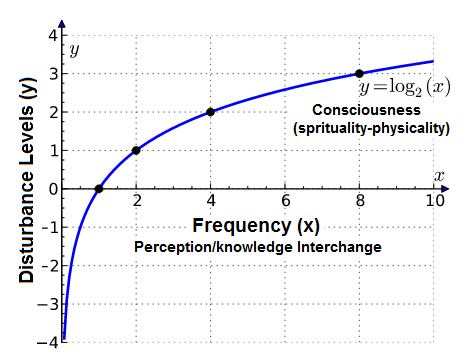
CONSCIOUSNESS – This is the awareness of the formed definition and properties. The physical form of consciousness is light. It has a frequency, wave-length and period. Consciousness is the divine principle that is fundamental to all existence.

SELF – Self is the definition or properties that arise. As frequency of consciousness increases, more and more definition comes about. The structures known as mind and ego are aspects of self at high frequencies. See A Model of Mind.

.

This seems to be a broad model of self.

  1. A self is a node in a very large matrix of selves in which communication flows.
  2. Each self is a compressed matrix of “definitions” (defined datums) among which logic flows.
  3. A communication particle arrives at the self and activates the flow of logic inside it.
  4. The logic flows through the complex matrix of definitions inside the self.
  5. These definitions are cross-indexed in a fantastically efficient way.
  6. This cross-indexing generates the framework of logic.
  7. The flow of logic consists of the sequences in which these relationships are activated.
  8. A score is kept in terms of the summation of the vectors of activated relationships.
  9. The final resultant vector is shaped into a communication particle.
  10. This communication particle is spitted out by the self.

We can probably make an animation out of the above model. This is a reality-centric model. There are an incredibly large numbers of variables here. How and in what sequence they could be activated provides an incredibly large number of choices for logic to flow. Here may lie the secret of “I”, “will” and “intention.”

This model may develop further.

Guide in KHTK

Affinity

In KHTK, a guide is one who helps another apply KHTK exercises. He may be a partner or a friend who is also interested in doing KHTK exercises. The two may do the exercises together encouraging and guiding each other.

All that is required of a guide is

  • Apply mindfulness at all times
  • Be familiar with KHTK exercises
  • Have compassion for all

The first thing that a guide helps another with is the application of mindfulness. He encourages the other person to think for himself, or herself, and practice mindfulness exercises per The 12 Aspects of Mindfulness

.

The guide recommends the correct KHTK exercise for the other person to work on, giving his reason. He provides factual information with no inconsistencies.

The person needn’t give to the guide any personal details of what he looked at during the exercise. The guide does not analyze a person’s data and give advice.

If the guide is told something he makes sure that he understands it. He responds only in terms of sorting out difficulties with the application of the 12 aspects of mindfulness.

The guide encourages the person to come up with creative ways to look at the area of interest more closely.

If the person’s attention is fixed or dispersed, the guide helps restore it to optimum with proper KHTK exercises.

Almost all exercises in KHTK may be applied by oneself. The guide simply encourages and aids as needed.

The guide does not challenge what the other person is doing. He simply helps the person understand the exercise.

The guide also aids in the development of the subject of KHTK based on his, or her, actual experience.

The guide offers his services as possible for him, and without fee. The compensation, if any, for the services may only be determined by the person helped.

The Nature of Form

Disturbance Levels

Reference: The Nature of Consciousness

NOTE: This graph plots the levels of any disturbance as a function of frequency. The disturbance levels are defined in terms of the doubling of frequency. The basic disturbance DL0 has a frequency of 1 (20). The subsequent disturbance levels (DL1, DL2, DL3 … DLn.) have frequencies of 21 (2), 22 (4), 23 (8) … 2n. It can be seen from this graph that negative disturbance levels may be postulated to exist with the halving of frequency. The frequency never reaches the zero of ground state. As long as some frequency is present, awareness is also present in some form.

Theoretically, awareness arises when ground state is disturbed. Awareness has a certain frequency, which gives it the form of “light”. And, thus, there is consciousness..

Awareness has a certain frequency, which gives it the form of “light”. 

The undisturbed ground state has no characteristics, definition or form. It is simply undefined. When disturbance is present, there is a frequency that has the characteristics of wave-length and period. These characteristics provide definition in terms of extent and duration. Thus there is form, which appears as finite against the background of ground state.

Any characteristic, definition, or form is finite relative to ground state. However, it may be considered to have a large range extending from “negative infinity” to “positive infinity.”

The form is defined by extent and duration against the background of undefined ground state.


The extent and duration of form are defined by the dimensions of space and time respectively. Since the basic form is defined against the background of ground state, space and time are also defined against that background. Thus space and time are differentiated from spacelessness and timelessness of ground state.

Extent and duration of form are defined by the dimensions of space and time.


This separation of form (from ground state) introduces the idea of a space-time boundary of awareness, which can still be conceived as infinite. This leads to the visualization of a spherical boundary on which any linear progression would appear to have neither beginning nor end. A spherical boundary also meets the requirements of symmetry in the absence of defining conditions.

This universe of awareness has a space-time boundary that is spherical.


As the disturbance levels increase, the frequency increases, the wave-length shrinks, and the period shortens. This provides denser forms. It is as if the disturbance folds over itself to provide the denser appearance. Thus there is a dimension of increasing density.

An atom could be visualized as a homogenous structure with the most condensed nuclear layer at the core and the least condensed electronic layer on the outside. This provides a picture of an atom with  layers of increasing density who spacing is tightly determined by the the frequency, wave-length, and period of the disturbance, Sub-atomic particles are likely to be generated when this structure of the atom is impacted.

With increasing frequency, denser layers of form emerge within the lighter layers.


As disturbance levels increase, the various layers of form interact with each other to generate complex forms. Thus come about an infinite variety and diversity of forms. The forms of houses, trees, roads, business, people, etc., come together through placement in space to generate a complex city. Similarly, the forms of musical notes may come together through sequencing in time to generate a beautiful melody.

The layers of form interact with each other to generate complex forms.

.

Next: Beingness, Viewpoint and Reality

.